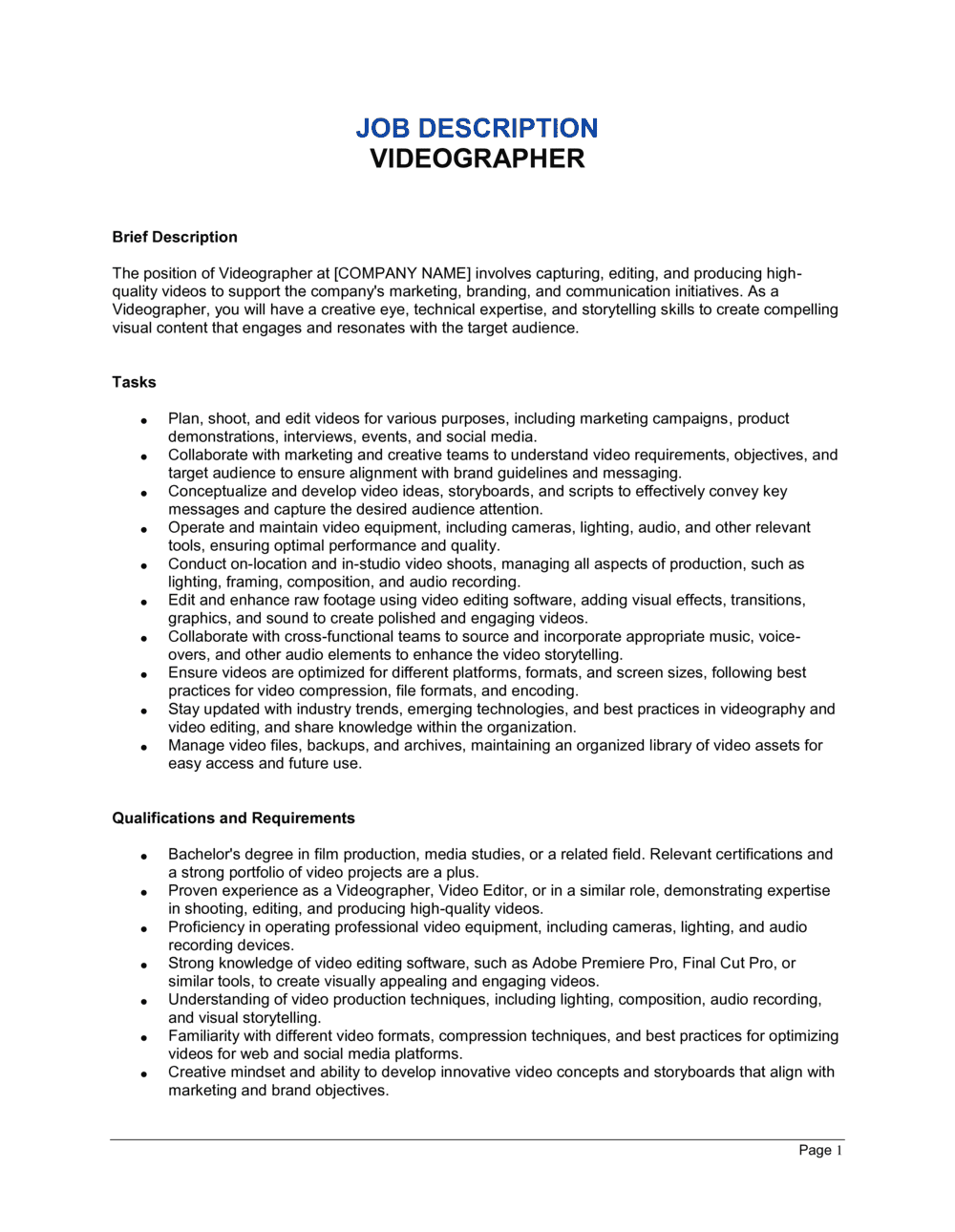
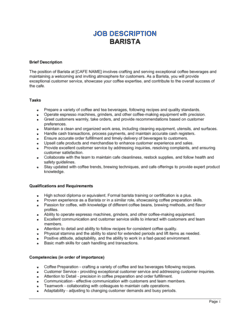
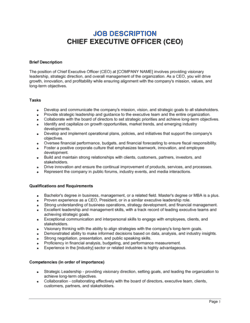
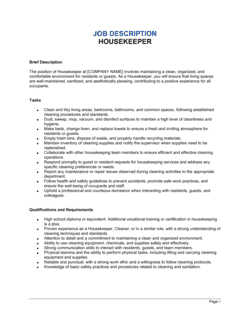
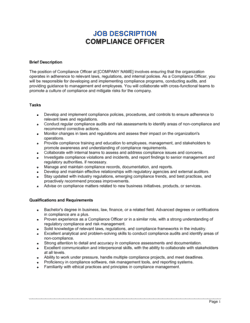
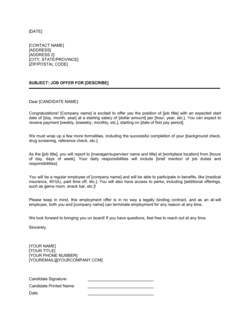
Videographer Job Description Template

Free Word download β€’ Edit online β€’ Save & share with Drive β€’ Export to PDF

2 pagesβ€’25–30 min to fillβ€’Difficulty: Standardβ€’Signature requiredβ€’Legal review recommended
Learn more ↓
FreeVideographer Job Description Template

At a glance

What it is
A Videographer Job Description is a formal document that defines the role, responsibilities, required equipment, deliverable standards, compensation, and IP ownership terms for a videographer position β€” whether full-time, part-time, or freelance. This free Word download can be edited online and exported as PDF, giving you a legally grounded, ready-to-post job description that also serves as a binding reference for performance expectations and intellectual property assignment.
When you need it
Use it when hiring a staff videographer, onboarding a freelance video professional for recurring work, or replacing an informal arrangement with documented, enforceable terms. It is particularly important before any project where footage ownership, client confidentiality, or equipment liability could become disputed.
What's inside
Role overview and reporting structure, core duties and production responsibilities, required skills and equipment, deliverable specifications and turnaround timelines, compensation and benefits, intellectual property assignment, confidentiality obligations, and termination conditions.

What is a Videographer Job Description?

A Videographer Job Description is a formal document that defines the scope, responsibilities, technical requirements, deliverable standards, and legal terms β€” including intellectual property assignment and confidentiality obligations β€” for a videographer role, whether full-time, part-time, or freelance. Unlike a casual posting, a properly drafted videographer job description creates a binding reference point that governs IP ownership over raw footage, restricts unauthorized publication of client content, and sets enforceable expectations for deliverable formats and turnaround times from the moment the engagement begins.

Why You Need This Document

Without a written, signed job description or accompanying agreement, footage ownership defaults to whoever created it β€” not necessarily the company that paid for the shoot. Raw footage disputes, social media leaks of unreleased client content, and disagreements over deliverable formats are the three most common and costly problems in video production engagements, and all three are preventable with a single document executed before filming starts. A clear videographer job description also protects the videographer: kill fee terms, equipment responsibility allocations, and expense reimbursement policies eliminate the ambiguity that strains working relationships on fast-moving productions. This template gives you a legally grounded, production-ready foundation that covers every critical term β€” so both parties spend their time making content, not resolving disputes.

Which variant fits your situation?

If your situation is…Use this template
Hiring a full-time salaried videographer as a permanent employeeVideographer Job Description (Staff)
Engaging a freelance videographer for a single project or eventFreelance Videographer Contract
Hiring a video editor rather than an on-location shooterVideo Editor Job Description
Bringing on a content creator covering both video and photoPhotographer / Videographer Job Description
Engaging a director of photography for high-production projectsDirector of Photography Job Description
Posting for a social media video specialist with platform focusSocial Media Video Producer Job Description
Hiring a broadcast or news videographer for a media organizationBroadcast Videographer Job Description

Common mistakes to avoid

❌ Misclassifying a freelancer as an employee β€” or vice versa

Why it matters: Classifying a regular freelance videographer as an independent contractor when they work exclusively for you and follow your direction can trigger back payroll taxes, benefit liabilities, and fines from the IRS, CRA, or HMRC.

Fix: Apply the applicable classification test before drafting. If the videographer works set hours on your equipment under your direct supervision, employment status is likely correct regardless of what the contract says.

❌ Omitting raw footage from the IP assignment

Why it matters: Courts have ruled that a work-for-hire clause covering 'finished videos' does not automatically transfer ownership of unedited raw footage β€” leaving the videographer with leverage to demand payment for files you believe you already own.

Fix: Explicitly name raw footage, project files, proxy files, and audio recordings in the IP assignment clause alongside the finished deliverables.

❌ No kill fee clause for cancelled shoots

Why it matters: Without a kill fee, a last-minute cancellation leaves the videographer uncompensated for prep work and blocked calendar dates, straining the relationship and exposing the company to a quantum meruit claim.

Fix: Include a tiered kill fee β€” for example, 25% of the shoot day rate for cancellations 72 to 48 hours out, and 50% for cancellations under 48 hours.

❌ Allowing personal social media posting of unreleased footage by default

Why it matters: A videographer who posts behind-the-scenes footage before a product launch can breach client NDAs, damage brand positioning, and expose the company to third-party claims from the client.

Fix: Add an explicit social media restriction clause prohibiting the videographer from posting any footage β€” raw or edited β€” without written approval and a defined embargo period.

❌ Vague deliverable specifications

Why it matters: Describing deliverables as 'edited video files' without specifying format, resolution, colour space, or audio mix standard routinely results in unusable files that require costly re-editing.

Fix: List every deliverable with codec, resolution, frame rate, aspect ratio, and audio specification. A table format in the contract appendix works well for complex projects.

❌ Signing after the first shoot has already taken place

Why it matters: IP assignment and confidentiality clauses signed after work has begun may be unenforceable in common-law jurisdictions for lack of fresh consideration β€” meaning footage shot before signing may not legally belong to the employer.

Fix: Always execute the job description and any accompanying contract before the videographer sets foot on set. Use e-signature tools to timestamp execution instantly.

The 10 key clauses, explained

Role title and reporting structure

In plain language: Names the position, clarifies whether it is full-time, part-time, or freelance, and identifies who the videographer reports to.

Sample language
The Videographer reports to the [TITLE β€” e.g., Director of Marketing] and is engaged as a [full-time / part-time / freelance] [employee / contractor] of [COMPANY NAME], effective [START DATE].

Common mistake: Omitting whether the role is an employment or contractor engagement. The distinction determines tax withholding, benefit eligibility, and IP ownership defaults β€” misclassification triggers penalties.

Core duties and production responsibilities

In plain language: Lists the specific filming, editing, and production tasks the videographer is expected to perform on a regular basis.

Sample language
Duties include: filming [event / commercial / social / documentary] content; operating [CAMERA MAKE/MODEL] and associated equipment; editing footage in [SOFTWARE]; delivering final files in [FORMAT] within [X] business days of shoot completion.

Common mistake: Using a generic 'other duties as assigned' catch-all without listing the primary responsibilities β€” leaving both parties uncertain about what is in and out of scope.

Required skills, qualifications, and experience

In plain language: States the minimum technical skills, software proficiency, portfolio requirements, and years of experience needed for the role.

Sample language
Candidates must demonstrate: [X]+ years of professional video production experience; proficiency in [Adobe Premiere Pro / DaVinci Resolve / Final Cut Pro]; a portfolio of at least [X] completed projects available for review; [additional certifications if required].

Common mistake: Setting experience thresholds so high that the posting fails to attract qualified applicants, or so vague that you cannot objectively screen candidates during hiring.

Equipment requirements and provision

In plain language: Specifies which equipment the videographer must own and bring, and which the employer will provide, along with responsibility for maintenance and loss.

Sample language
The Videographer shall provide: [camera body, lenses, audio recorder]. [COMPANY NAME] shall provide: [lighting kit, tripod, storage drives]. The Videographer is responsible for the safe operation and maintenance of all personally owned equipment.

Common mistake: Failing to specify who owns rental costs for additional equipment. Ambiguity here routinely results in unexpected expense disputes on larger productions.

Deliverables, formats, and turnaround timelines

In plain language: Defines exactly what finished files must be delivered, in which formats and resolutions, and by what deadline after each shoot.

Sample language
Deliverables: one (1) primary edited video in [4K H.264 / 1080p ProRes], one (1) vertical cut for social media (9:16, max [60] seconds), and all raw footage on [COMPANY-PROVIDED drive]. Final delivery due within [5] business days of shoot.

Common mistake: Specifying deliverables by vague terms like 'edited video' without format, resolution, codec, or aspect ratio β€” leading to disputes when the client expects broadcast-ready files and receives a compressed social cut.

Intellectual property assignment and raw footage ownership

In plain language: Assigns ownership of all footage, edited content, and project files to the employer, including raw footage, and prevents the videographer from using or sharing the material without written permission.

Sample language
All footage, edited content, and project assets created in connection with this engagement are works made for hire and are the sole property of [COMPANY NAME]. The Videographer assigns all rights, title, and interest in the work product to [COMPANY NAME] and shall not publish, license, or retain copies without prior written consent.

Common mistake: Forgetting to include raw footage in the IP assignment. Courts have found that edited deliverables are owned by the employer while unedited raw footage remains with the videographer when the contract is silent.

Confidentiality and non-disclosure

In plain language: Prohibits the videographer from sharing, posting, or discussing client identities, project details, unreleased footage, or proprietary information acquired during the engagement.

Sample language
The Videographer shall not disclose, publish, or use any Confidential Information β€” including client identities, unreleased footage, scripts, or strategic plans β€” during or after the term of this engagement without [COMPANY NAME]'s prior written consent.

Common mistake: Omitting an explicit restriction on posting behind-the-scenes content to personal social media. Videographers frequently assume they may share set footage unless explicitly prohibited.

Compensation, payment schedule, and expenses

In plain language: States the salary or day rate, payment frequency, overtime policy, and which production expenses β€” travel, accommodation, parking β€” will be reimbursed and how.

Sample language
Compensation: [$X per year / $X per shoot day], payable [bi-weekly / net-14 after invoice]. Pre-approved travel and accommodation expenses reimbursed within [30] days of submission with receipts. Overtime at [1.5Γ—] applies to days exceeding [10] hours.

Common mistake: Not specifying what constitutes a 'shoot day' (hours included) or the overtime threshold β€” creating disputes when multi-location shoots extend past standard hours.

Termination, notice, and kill fee

In plain language: Sets the notice period for ending the engagement from either side, specifies grounds for immediate termination for cause, and states the kill fee owed if a project is cancelled after preparation has begun.

Sample language
Either party may terminate this agreement with [X] business days' written notice. Immediate termination for cause applies upon breach of the IP or confidentiality clauses. If [COMPANY NAME] cancels a confirmed shoot with less than [48] hours' notice, a kill fee of [$X / X% of the shoot day rate] is payable.

Common mistake: No kill fee provision at all β€” leaving the videographer uncompensated for pre-production work, blocked calendar dates, and declined bookings when the client cancels last-minute.

Governing law and dispute resolution

In plain language: Specifies which jurisdiction's law governs the agreement and how disputes will be handled β€” arbitration, mediation, or court proceedings.

Sample language
This Agreement is governed by the laws of [STATE / PROVINCE / COUNTRY]. Any dispute arising under this Agreement shall first be submitted to mediation administered by [ORGANIZATION] in [CITY] before either party may pursue litigation or arbitration.

Common mistake: Selecting a governing law based on the employer's headquarters when the videographer works remotely in a different jurisdiction β€” some states and countries apply local law regardless of the contractual choice.

How to fill it out

  1. 1

    Define the engagement type before filling any other field

    Determine whether this is a full-time employment role, a part-time position, or a freelance contractor engagement. The answer changes IP ownership defaults, tax obligations, and benefit entitlements throughout the document.

    πŸ’‘ When in doubt about employee vs. contractor classification, consult the IRS 20-factor test (US) or the equivalent CRA or HMRC guidance before issuing the job description.

  2. 2

    Write a specific role overview and reporting line

    Name the exact job title, the department, and the direct supervisor's title. State the primary purpose of the role in one or two sentences so candidates understand what success looks like.

    πŸ’‘ Listing the reporting title β€” not the person's name β€” prevents the document from requiring an update every time there is a personnel change above the role.

  3. 3

    List core duties with production-specific detail

    Write out the primary filming, editing, and delivery responsibilities. Specify the types of content (events, commercials, social media, training videos), the software platform, and the expected output cadence (e.g., four shoots per month).

    πŸ’‘ Limit the duties list to the top eight to ten responsibilities. A list of twenty signals a role that needs to be split into two positions.

  4. 4

    Complete the equipment and deliverables clauses

    List exactly which equipment the videographer must supply versus what the company provides. Then specify every deliverable format, resolution, codec, and turnaround time so there is no ambiguity at project close.

    πŸ’‘ Use specific codec names (H.264, ProRes 422, HEVC) rather than 'high quality' β€” technical specs eliminate the most common post-delivery disputes.

  5. 5

    Fill in the IP assignment and confidentiality sections

    Confirm that all footage, including raw files, is assigned to the company. Add any social media restrictions β€” e.g., prohibiting the videographer from posting set content before the client's public launch date.

    πŸ’‘ If the videographer's portfolio use of the work matters to them, negotiate a limited portfolio licence clause now rather than leaving it unaddressed and litigated later.

  6. 6

    Set compensation, overtime, and expense reimbursement terms

    Enter the salary or day rate, payment schedule, and overtime trigger. List the expense categories pre-approved for reimbursement and the submission deadline with receipts.

    πŸ’‘ Capping per-diem travel expenses (e.g., hotel up to $150/night) prevents open-ended reimbursement claims on multi-day location shoots.

  7. 7

    Define termination, kill fee, and notice terms

    Set the notice period for both parties, the kill fee amount or formula, and the specific causes that allow immediate termination without notice.

    πŸ’‘ A kill fee of 50% of the shoot day rate for cancellations within 48 hours is a common industry standard β€” research your local market before setting a different figure.

  8. 8

    Sign before the first shoot or start date

    Both parties must execute the document before any work begins. Signatures after filming has started can invalidate IP assignment and confidentiality clauses in common-law jurisdictions.

    πŸ’‘ Use a timestamped e-signature tool so the execution date is automatically recorded and cannot be disputed.

Frequently asked questions

What is a videographer job description?

A videographer job description is a formal document that defines the responsibilities, required skills, equipment expectations, deliverable standards, compensation terms, and legal obligations β€” including IP assignment and confidentiality β€” for a videographer role. It functions as both a hiring document and a binding reference for performance and IP expectations once the role is filled.

What should a videographer job description include?

At minimum: role title and reporting line, engagement type (employee or contractor), core filming and editing duties, required equipment and software skills, deliverable formats and turnaround timelines, compensation and expense policy, intellectual property assignment covering raw and edited footage, confidentiality obligations, and termination and kill fee terms. Missing the IP and deliverable sections creates the most common disputes in video production engagements.

Does a videographer job description need to be signed?

For a full-time employment role, the job description is typically incorporated into or attached to a signed employment contract. For a freelance videographer, the signed job description or accompanying service agreement is the primary enforceable document. In both cases, signatures should be obtained before the first shoot to protect IP ownership and confidentiality obligations.

Who owns the video footage β€” the videographer or the company?

Ownership depends on the contract. In the US and Canada, work created by an employee within the scope of their employment is typically owned by the employer under the work-for-hire doctrine. For independent contractors, ownership defaults to the creator unless the contract explicitly assigns it to the employer. Always include a broad IP assignment clause covering raw footage, edited files, and project assets to eliminate ambiguity.

What is a kill fee and should I include one?

A kill fee is a pre-agreed payment owed to a videographer when a confirmed shoot is cancelled after preparation has begun. Including one protects both parties: the videographer is compensated for blocked time, and the company has a predictable, capped liability. A common structure is 25–50% of the shoot day rate for cancellations within 48 hours.

Can a videographer post behind-the-scenes footage to social media?

Unless the contract explicitly permits it, the videographer generally should not post footage of an engagement before the client or employer approves and publishes it. An explicit social media restriction clause β€” prohibiting posting without written consent and specifying an embargo period β€” is the clearest way to protect against accidental disclosure of unreleased products, events, or client identities.

What software skills should a videographer job description require?

The most common requirements are Adobe Premiere Pro, DaVinci Resolve, or Final Cut Pro for editing; Adobe After Effects or Motion for motion graphics; and Audition or Logic Pro for audio mixing. The correct choice depends on your existing post-production pipeline. Specify the exact software and version where compatibility matters to prevent workflow disruptions.

What is the difference between a videographer job description and a videographer contract?

A job description defines the role, duties, and qualifications β€” it is the public-facing or internal document used to recruit and onboard. A contract is the legally binding agreement that governs the terms of the engagement, including payment, IP, and termination. For staff roles, the job description is typically attached to an employment contract. For freelance engagements, a separate service agreement or the signed job description itself serves as the contract.

Do I need a lawyer to create a videographer job description?

For straightforward domestic staff roles or recurring freelance arrangements, a well-drafted template is typically sufficient. Consider legal review when the videographer will handle highly sensitive client footage, when the engagement involves cross-border IP rights, or when the role includes access to proprietary product or brand materials ahead of public launch. A brief legal review typically costs $200–$500 and is worthwhile for any senior or high-exposure production role.

How this compares to alternatives

vs Independent Contractor Agreement

An independent contractor agreement governs the legal and financial terms of a freelance engagement β€” payment, liability, IP, and termination β€” without describing the role in detail. A videographer job description defines the duties, deliverables, and qualifications of the role itself. For freelance videographers, both documents are typically used together: the job description defines the scope; the contractor agreement provides the legal framework.

vs Employment Contract

An employment contract governs the full working relationship for a staff hire β€” compensation, benefits, non-compete, and termination. A videographer job description focuses on role-specific scope, technical requirements, and deliverable standards. For full-time hires, the job description is typically attached as a schedule to the employment contract rather than used as a standalone document.

vs Photographer Job Description

A photographer job description covers still-image capture, editing in Lightroom or Photoshop, and image deliverable specifications. A videographer job description addresses motion capture, non-linear video editing, audio production, and multi-format export requirements. The two roles often overlap in content-team hiring, but the technical equipment, software, and deliverable standards are distinct enough to warrant separate documents.

vs Video Production Agreement

A video production agreement governs a single project engagement β€” defining the scope, timeline, budget, and IP terms for one specific production. A videographer job description governs an ongoing role, whether staff or recurring freelance, with repeatable duties and standing deliverable standards. Use a production agreement for one-off projects and a job description for any arrangement involving regular, repeated work.

Industry-specific considerations

Marketing and advertising

Brand safety and pre-launch embargo clauses are critical; deliverables typically include multiple social media cuts alongside the hero video.

Event production

Kill fee and short-notice cancellation terms are essential given the frequency of last-minute venue or schedule changes in live event work.

Media and broadcasting

Union agreements (IATSE, BECTU) may override contractual terms; broadcast-standard deliverable specs β€” frame rate, audio loudness β€” must be explicitly stated.

Education and e-learning

Accessibility requirements (closed captions, audio description tracks) should be included in deliverable specifications; long-term archival formats are standard.

Real estate

Fast turnaround timelines (24–48 hours) and drone footage licensing compliance (FAA Part 107 in the US) are commonly required terms.

Healthcare

HIPAA-compliant footage handling, patient consent documentation requirements, and restrictions on footage depicting identifiable patients must be addressed explicitly.

Jurisdictional notes

United States

Work-for-hire doctrine under the Copyright Act automatically assigns IP to the employer for employee-created content, but applies to independent contractors only for specific enumerated categories β€” video is not always included. Drone footage requires FAA Part 107 certification; include this as a qualification requirement for any role involving aerial videography. Non-compete enforceability varies sharply by state β€” California bans most post-employment restrictions.

Canada

Copyright in Canada vests in the employer for works created by employees in the course of their employment under Section 13(3) of the Copyright Act, but the same default does not apply to independent contractors β€” explicit assignment language is required. Quebec's Act Respecting the Professional Status of Artists may confer additional protections on freelance videographers working in Quebec. Provincial employment standards set minimum notice and severance floors that override contractual terms.

United Kingdom

Under the Copyright, Designs and Patents Act 1988, copyright in works created by an employee in the course of employment belongs to the employer; freelance videographers retain copyright unless it is explicitly assigned by contract. IR35 rules require employers to assess whether a freelancer engaged through a personal service company should be treated as a deemed employee for tax purposes. The right to be identified as the author (moral right) must be expressly waived in the contract if the employer does not wish the videographer credited.

European Union

IP ownership rules for employment relationships vary by member state β€” France, Germany, and Spain each have distinct author's rights frameworks that may give creators residual moral rights even after assignment. GDPR applies when footage captures identifiable individuals; the job description should reference the company's data processing policy and require the videographer to follow consent and retention procedures. Freelance videographers in several EU countries benefit from statutory protections as dependent contractors that cannot be contracted away.

Template vs lawyer β€” what fits your deal?

PathBest forCostTime
Use the templateStandard staff or recurring freelance videographer roles with straightforward IP and deliverable termsFree20–30 minutes
Template + legal reviewSenior or specialized roles involving sensitive client footage, cross-border IP, or union jurisdiction overlap$200–$5001–3 days
Custom draftedHigh-exposure broadcast, agency, or healthcare roles where IP disputes, talent regulations, or data privacy laws create material risk$800–$2,500+1–2 weeks

Glossary

Work for Hire
A legal doctrine under which creative work produced by an employee or contracted party within the scope of their engagement is owned by the employer from creation, not the creator.
Deliverable
A specific, agreed output β€” such as a color-graded 4K video file in H.264 format β€” that the videographer must produce by a defined deadline.
Raw Footage
Unedited video files captured on location, prior to color correction, sound mixing, or editing β€” often the subject of IP and retention disputes.
Post-Production
All editing, color grading, audio mixing, motion graphics, and export work performed after filming is complete.
B-Roll
Supplementary footage filmed alongside the primary subject β€” cutaways, environment shots, and contextual visuals used to support the main narrative.
Turnaround Time
The contractually agreed period between the completion of filming and the delivery of final edited files to the client or employer.
Non-Disclosure Agreement (NDA)
A legally binding confidentiality obligation preventing the videographer from sharing, publishing, or using footage, client information, or project details without authorization.
Equipment Rider
A supplementary clause or attachment specifying which camera bodies, lenses, stabilizers, audio gear, and lighting equipment the videographer is required to own or provide.
Kill Fee
A pre-agreed payment made to a freelancer when a project is cancelled after work has begun, compensating for time allocated and opportunities foregone.
Usage Rights
The specific ways an employer or client is permitted to use completed video content β€” by platform, geography, duration, or medium β€” distinct from full copyright ownership.
EXIF / Metadata
Embedded technical data in video files recording camera settings, location, date, and codec information β€” relevant for asset management and authenticity verification.
Indemnification
A contractual obligation for one party to compensate the other for losses or legal claims arising from a specified act β€” such as the videographer's use of unlicensed music in a deliverable.

Part of your Business Operating System

This document is one of 3,000+ business & legal templates included in Business in a Box.

  • Fill-in-the-blanks β€” ready in minutes
  • 100% customizable Word document
  • Compatible with all office suites
  • Export to PDF and share electronically

Create your document in 3 simple steps.

From template to signed document β€” all inside one Business Operating System.
1
Download or open template

Access over 3,000+ business and legal templates for any business task, project or initiative.

2
Edit and fill in the blanks with AI

Customize your ready-made business document template and save it in the cloud.

3
Save, Share, Send, Sign

Share your files and folders with your team. Create a space of seamless collaboration.

Save time, save money, and create top-quality documents.

β˜…β˜…β˜…β˜…β˜…

"Fantastic value! I'm not sure how I'd do without it. It's worth its weight in gold and paid back for itself many times."

Managing Director Β· Mall Farm
Robert Whalley
Managing Director, Mall Farm Proprietary Limited
β˜…β˜…β˜…β˜…β˜…

"I have been using Business in a Box for years. It has been the most useful source of templates I have encountered. I recommend it to anyone."

Business Owner Β· 4+ years
Dr Michael John Freestone
Business Owner
β˜…β˜…β˜…β˜…β˜…

"It has been a life saver so many times I have lost count. Business in a Box has saved me so much time and as you know, time is money."

Owner Β· Upstate Web
David G. Moore Jr.
Owner, Upstate Web

Run your business with a system β€” not scattered tools

Stop downloading documents. Start operating with clarity. Business in a Box gives you the Business Operating System used by over 250,000 companies worldwide to structure, run, and grow their business.

Start freeΒ Β·Β No credit card required