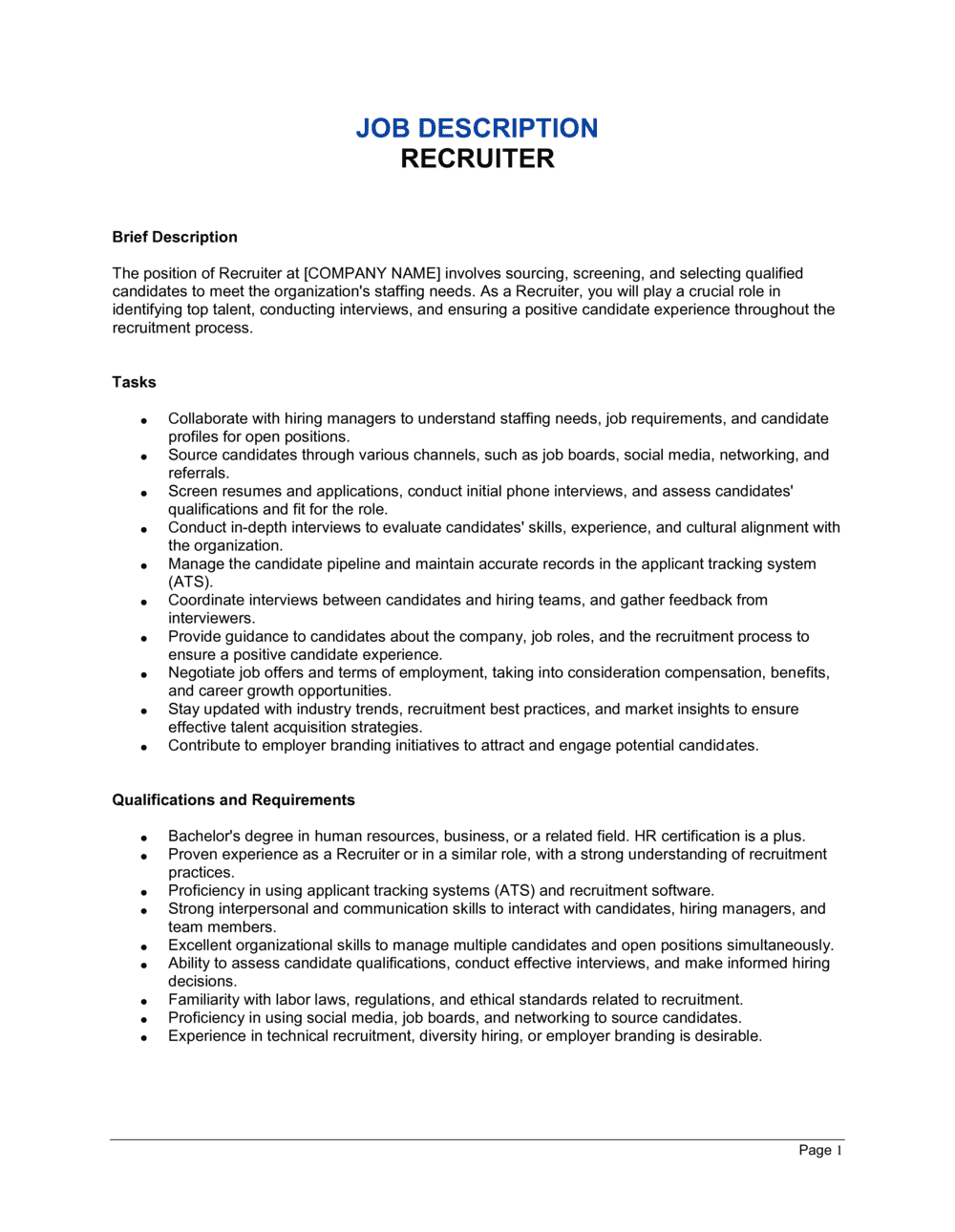
Recruiter Job Description Template

Free Word download β€’ Edit online β€’ Save & share with Drive β€’ Export to PDF

2 pagesβ€’20–30 min to fillβ€’Difficulty: Standardβ€’Signature requiredβ€’Legal review recommended
Learn more ↓
FreeRecruiter Job Description Template

At a glance

What it is
A Recruiter Job Description is a formal document that defines the duties, qualifications, reporting structure, compensation, and legal obligations associated with a recruiter or talent acquisition role. This free Word download gives you a structured, compliance-ready starting point you can edit online and export as PDF β€” ready to post on job boards or attach to an employment offer.
When you need it
Use it when hiring an in-house recruiter, talent acquisition specialist, or sourcing coordinator β€” or when formalizing the scope of an existing recruiting role ahead of a performance review or compensation adjustment.
What's inside
Role title and department, reporting structure, core responsibilities, required and preferred qualifications, compensation range, employment type, equal opportunity language, and a signature block for acknowledgment by both employer and employee.

What is a Recruiter Job Description?

A Recruiter Job Description is a formal document that defines the duties, qualifications, reporting structure, compensation, performance expectations, and legal obligations associated with a recruiter or talent acquisition role. Unlike a casual job posting, a properly drafted recruiter job description functions as both an external hiring tool and an internally signed document β€” incorporated into the offer letter or employment contract to create an enforceable record of agreed role scope, data-handling responsibilities, and measurable KPIs from day one.

Why You Need This Document

Without a signed recruiter job description, four problems compound quickly. Performance management becomes subjective β€” without documented KPIs like time-to-fill and offer acceptance rate, disciplinary action for underperformance lacks factual grounding and exposes the employer to wrongful-dismissal claims. Data liability goes unaddressed β€” recruiters handle significant volumes of candidate personal data subject to GDPR, CCPA, and PIPEDA; without a contractual data-handling clause, there is no internal accountability framework when a breach occurs. Compensation disputes arise in pay-transparency jurisdictions when a salary range was never documented at the posting stage. And equal opportunity exposure materializes when outdated EEO language omits protected categories now covered by current law. A complete, signed job description closes all four gaps before the recruiter's first day β€” and this template gives you a compliance-ready starting point you can adapt and sign in under 30 minutes.

Which variant fits your situation?

If your situation is…Use this template
Hiring a senior talent acquisition partner managing strategic rolesSenior Recruiter Job Description
Engaging a recruiter on a contract or freelance basisIndependent Contractor Agreement
Defining a specialized technical or IT recruiting roleTechnical Recruiter Job Description
Hiring an executive search or headhunter roleExecutive Recruiter Job Description
Onboarding a campus or university recruiting specialistCampus Recruiter Job Description
Adding a sourcing-only role focused on pipeline buildingSourcing Specialist Job Description
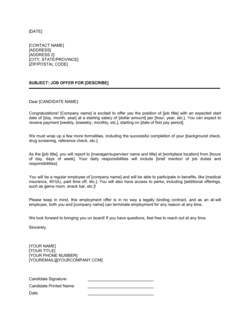
Formalizing the full employment relationship after the job description is acceptedEmployment Contract

Common mistakes to avoid

❌ Publishing a single salary figure in a pay-transparency jurisdiction

Why it matters: Colorado, California, New York, and Washington require salary ranges on external postings. A single figure exposes the employer to regulatory complaints and fines of up to $10,000 per violation in some states.

Fix: Replace any single-figure salary with a documented range and verify the range is current against market data before each new posting cycle.

❌ Using mandatory degree requirements for a skills-based role

Why it matters: Requiring a four-year degree when the role is genuinely performable without one may constitute disparate-impact discrimination under Title VII and equivalent laws β€” narrowing the applicant pool and creating legal exposure.

Fix: Replace 'Bachelor's degree required' with 'Bachelor's degree or equivalent professional experience' for all recruiting roles where a credential is not a true legal prerequisite.

❌ Omitting KPIs from the job description

Why it matters: Without documented performance standards, termination-for-cause decisions for underperforming recruiters lack a factual foundation, increasing wrongful-dismissal claims and making progressive discipline harder to defend.

Fix: Add at least three measurable KPIs β€” time-to-fill, offer acceptance rate, requisition load β€” with specific numeric targets agreed to at the time of hire.

❌ No confidentiality or data-handling clause

Why it matters: Recruiters process candidate names, addresses, compensation history, and background check results β€” all personal data subject to GDPR, CCPA, or PIPEDA. Without contractual data obligations, a breach has no internal accountability hook.

Fix: Add an explicit clause obligating the recruiter to handle candidate data only for lawful recruitment purposes and referencing the applicable data protection law for the work location.

❌ Never obtaining a signed acknowledgment

Why it matters: An unsigned job description is a posting, not a binding document. Employees can dispute whether specific duties, KPIs, or confidentiality obligations were ever communicated, undermining performance management and termination decisions.

Fix: Require both employer and employee signature before the start date and store the executed copy in the personnel file.

❌ Blending required and preferred qualifications into one list

Why it matters: Recruiters and hiring managers then screen out qualified candidates for lacking preferred-only items, inadvertently narrowing the pipeline and potentially introducing disparate-impact risk.

Fix: Create two distinct labeled sections β€” 'Required Qualifications' and 'Preferred Qualifications' β€” and apply required criteria as a hard screen only.

The 10 key clauses, explained

Role Title, Department, and Reporting Structure

In plain language: States the official job title, the department the role sits within, and the name or title of the direct manager β€” establishing the organizational context for the position.

Sample language
Position: [JOB TITLE] | Department: [DEPARTMENT NAME] | Reports to: [MANAGER TITLE] | Location: [CITY, STATE / REMOTE / HYBRID]

Common mistake: Using an informal working title that differs from the payroll title β€” this creates discrepancies in employment records and can complicate unemployment claims or compliance audits.

Employment Type and Schedule

In plain language: Specifies whether the role is full-time or part-time, permanent or fixed-term, on-site, remote, or hybrid, and the standard working hours expected.

Sample language
This is a [FULL-TIME / PART-TIME], [PERMANENT / FIXED-TERM] position. Standard hours are [X] per week, [ON-SITE / REMOTE / HYBRID β€” CITY, STATE]. Occasional travel of up to [X]% may be required.

Common mistake: Omitting the employment type entirely. Without this, a recruiter hired as a contractor may argue they were a permanent employee, triggering benefits and severance obligations.

Core Duties and Responsibilities

In plain language: Lists the recruiter's primary tasks β€” sourcing, screening, interviewing, offer management, and ATS maintenance β€” and preserves the employer's right to adjust duties reasonably over time.

Sample language
The Recruiter shall: (a) manage full-cycle recruitment for [X] open requisitions at any time; (b) source candidates through [JOB BOARDS / LINKEDIN / REFERRALS]; (c) conduct phone screens and coordinate [X]-stage interviews; (d) extend verbal and written offers within [X] business days of final approval; (e) maintain accurate records in [ATS NAME].

Common mistake: Over-specifying duties so narrowly that any change in requisition volume or sourcing channel requires a formal job description amendment and re-signature.

Required Qualifications

In plain language: Lists the non-negotiable minimum education, experience, certifications, and skills a candidate must have to be considered β€” forming a legally defensible screening baseline.

Sample language
Required: [X] years of full-cycle recruiting experience; proficiency in [ATS NAME]; demonstrated experience sourcing candidates for [FUNCTION / INDUSTRY]; [DEGREE OR EQUIVALENT EXPERIENCE].

Common mistake: Including degree requirements that are not genuinely necessary for the role. A four-year degree requirement for a primarily skills-based recruiting role may constitute disparate-impact discrimination under EEOC guidelines.

Preferred Qualifications

In plain language: Lists desirable but non-mandatory skills and experience that distinguish stronger candidates from minimally qualified ones.

Sample language
Preferred: experience recruiting for [INDUSTRY / FUNCTION]; familiarity with Boolean sourcing; [CERTIFICATION β€” e.g., PHR, SHRM-CP]; bilingual in [LANGUAGE].

Common mistake: Blending required and preferred qualifications into a single list. Recruiters and hiring managers then screen out qualified candidates who lack preferred-only items, narrowing the pool unnecessarily.

Compensation, Benefits, and Incentive Structure

In plain language: States the base salary range, pay frequency, any performance bonus or placement fee structure, and a reference to the company's standard benefits program.

Sample language
Base salary: $[MIN]–$[MAX] per year, paid [bi-weekly / semi-monthly]. Performance bonus: up to [X]% of base, based on [METRIC β€” e.g., time-to-fill targets, offer acceptance rate]. Benefits: per Company's standard program as in effect from time to time.

Common mistake: Publishing a single salary figure rather than a range in jurisdictions that require pay transparency, such as Colorado, New York, California, and Washington β€” exposing the employer to regulatory fines.

Performance Expectations and KPIs

In plain language: Defines the measurable standards against which the recruiter will be evaluated β€” typically time-to-fill, offer acceptance rate, requisition load, and quality-of-hire score.

Sample language
Performance will be evaluated against the following metrics: (a) average time-to-fill of [X] business days; (b) offer acceptance rate of at least [X]%; (c) active requisition load of [X]–[X] open roles; (d) quality-of-hire score (manager satisfaction rating) of [X]/5 within [X] months of hire.

Common mistake: Omitting KPIs entirely. Without measurable standards, performance management and termination-for-cause decisions lack documentation, increasing wrongful-dismissal exposure.

Confidentiality and Data Handling

In plain language: Obligates the recruiter to protect candidate personal data, salary information, and hiring strategy from unauthorized disclosure β€” and references applicable data protection law.

Sample language
Recruiter shall keep all candidate personal data, compensation information, and hiring strategies strictly confidential. Data shall be processed only for lawful recruitment purposes in compliance with [applicable law β€” e.g., GDPR / CCPA / PIPEDA].

Common mistake: No data-handling clause at all. Recruiters handle significant volumes of personal data β€” names, addresses, salaries, background checks β€” and without this clause, a data breach has no contractual hook for internal accountability.

Equal Opportunity and Non-Discrimination Statement

In plain language: Affirms that the role will be filled without discrimination on the basis of any protected characteristic and that the recruiter is expected to apply the same standard in all hiring activities they manage.

Sample language
[COMPANY NAME] is an equal opportunity employer. All qualified applicants will receive consideration without regard to race, color, religion, sex, national origin, disability, age, or any other characteristic protected by applicable law. The Recruiter is expected to uphold these standards in all recruitment activities.

Common mistake: Using outdated protected-class language that omits categories now covered in the applicable jurisdiction β€” for example, failing to include sexual orientation or gender identity, which are protected under Title VII in the US since 2020.

Acknowledgment and Signature Block

In plain language: Documents that both the employer and the employee have reviewed, understood, and agreed to the job description β€” creating a signed record for the personnel file.

Sample language
By signing below, Employee acknowledges receipt and review of this Job Description and agrees that it accurately describes the role. Employer: [NAME / TITLE / DATE]. Employee: [NAME / DATE].

Common mistake: Treating the job description as a posting-only document and never obtaining a signature. Without a signed copy, the employee can later dispute whether specific duties or KPIs were ever communicated.

How to fill it out

  1. 1

    Enter the role title, department, and reporting line

    Use the official payroll job title β€” not a colloquial working title. Confirm the department name matches your org chart and state the direct manager's title rather than their personal name to avoid amendment obligations when managers change.

    πŸ’‘ If the role is posted externally, confirm the title aligns with market benchmarks on LinkedIn or Indeed so the posting attracts the right candidate volume.

  2. 2

    Define employment type, schedule, and location

    Specify full-time or part-time, permanent or fixed-term, and on-site, remote, or hybrid. State the standard weekly hours and any travel expectation as a percentage of time.

    πŸ’‘ For hybrid roles, specify the minimum in-office days per week β€” vague hybrid language generates candidate questions and post-hire disputes.

  3. 3

    List core duties in order of time allocation

    Rank duties from most to least time-consuming. Lead with full-cycle recruiting responsibilities, then add sourcing, reporting, and administrative tasks. Include a catch-all clause preserving the employer's right to assign additional reasonable duties.

    πŸ’‘ Limit the duties list to 8–10 bullet points. Longer lists signal a role that has accumulated tasks beyond one person's capacity and will cause turnover.

  4. 4

    Separate required from preferred qualifications

    Required qualifications must be genuinely necessary to perform the role β€” education, years of experience, ATS proficiency. Preferred qualifications are differentiators. Keep them in separate labeled sections to avoid inadvertent screening of qualified candidates.

    πŸ’‘ Audit every required qualification against EEOC disparate-impact guidelines before publishing. Replace degree requirements with 'degree or equivalent experience' unless a degree is a true legal prerequisite.

  5. 5

    Complete the compensation and benefits block

    Enter the salary range β€” not a single figure β€” and the pay frequency. Include bonus eligibility with the metric it is tied to. Reference benefits by category only (health, dental, PTO) without locking in specific plan details.

    πŸ’‘ Check your jurisdiction's pay transparency requirements before posting. Colorado, California, New York, and Washington mandate salary ranges on external job postings.

  6. 6

    Define KPIs and performance expectations

    Populate the KPI block with at least three measurable metrics: average time-to-fill, offer acceptance rate, and active requisition load. Tie each metric to a specific numeric target and a review cadence (90-day, 6-month, annual).

    πŸ’‘ Align KPIs with your current ATS reporting capabilities β€” if you cannot measure it automatically, it creates administrative burden and inconsistent enforcement.

  7. 7

    Add confidentiality and data-handling language

    Reference the applicable data protection law for your jurisdiction β€” GDPR for EU employees, CCPA for California, PIPEDA for Canada. State that candidate personal data may only be used for lawful recruitment purposes and must be deleted or anonymized per company retention policy.

    πŸ’‘ If your company has a standalone data protection or privacy policy, reference it by name here rather than restating its full terms.

  8. 8

    Obtain signatures before the start date

    Route the completed document to the hiring manager for countersignature, then to the incoming employee before day one. File the signed copy in the employee's personnel file and provide the employee with a copy.

    πŸ’‘ Use Business in a Box eSign to timestamp execution and create an auditable record β€” especially important in jurisdictions that require written evidence of agreed employment terms.

Frequently asked questions

What is a recruiter job description?

A recruiter job description is a formal document that defines the duties, qualifications, reporting structure, compensation, and performance expectations of a recruiter or talent acquisition role. It functions as both an external hiring tool β€” posted on job boards to attract candidates β€” and an internal legal document acknowledged by the employee at hire. A signed job description creates an enforceable record of agreed role scope for use in performance management and compliance audits.

What should a recruiter job description include?

At minimum: role title and department, reporting structure, employment type and schedule, core duties listed in order of priority, required and preferred qualifications in separate sections, salary range, performance KPIs, confidentiality and data-handling obligations, an equal opportunity statement, and a signature block. Missing any of these creates gaps in the employer's ability to manage performance or defend hiring decisions.

Is a recruiter job description a legally binding document?

A job description becomes a legally significant document when signed by both the employer and employee. In most jurisdictions, it is not a standalone employment contract, but it is incorporated by reference into the offer letter or employment agreement β€” making its terms enforceable. Courts and employment tribunals regularly rely on signed job descriptions as evidence of agreed duties and performance expectations in wrongful dismissal cases.

Do I need to include a salary range in a recruiter job description?

In several US states β€” including Colorado, California, New York, and Washington β€” salary ranges are legally required on external job postings. Even where not legally mandated, publishing a range reduces time-to-hire by filtering candidates outside the band early and signals pay equity compliance. Always verify current requirements in your posting jurisdiction before publishing.

What KPIs should appear in a recruiter job description?

The three most universally applicable KPIs are time-to-fill (target in business days), offer acceptance rate (target percentage), and active requisition load (number of concurrent open roles). Depending on the role, quality-of-hire score, candidate pipeline conversion rate, or diversity sourcing metrics may also be appropriate. Each KPI should carry a specific numeric target so performance reviews have an objective baseline.

Can I use the same job description for a contract recruiter and an employee?

No. An employee job description and an independent contractor agreement serve different legal purposes. Using an employee-style job description for a contractor strengthens the argument that the worker is actually an employee β€” triggering tax withholding, benefits, and overtime obligations under the IRS common-law test, Canada's CRA guidelines, and IR35 rules in the UK. Use a separate Independent Contractor Agreement for freelance or contract recruiters.

What equal opportunity language must a recruiter job description include?

In the US, the description must affirm that employment decisions are made without regard to race, color, religion, sex, national origin, age, disability, and β€” since the Supreme Court's 2020 Bostock decision β€” sexual orientation and gender identity. In Canada, protected grounds under federal and provincial human rights legislation must be covered. In the UK and EU, the applicable list follows the Equality Act 2010 and EU non-discrimination directives respectively. Outdated boilerplate that omits current protected categories creates compliance exposure.

How often should a recruiter job description be updated?

Review the job description annually or whenever the role's scope changes materially β€” new ATS, change in requisition volume, shift to remote work, or a new reporting line. Each material update should be re-signed by the employee with the revision date noted. A job description that has not been updated in more than two years is likely out of sync with the actual role and may not reflect current legal requirements.

What is the difference between a recruiter job description and an offer letter?

A job description defines the role's duties, qualifications, and performance expectations β€” it is a document about the position. An offer letter confirms the specific compensation, start date, and employment conditions offered to a named individual β€” it is a document about the person filling that position. Both documents should be consistent and cross-reference each other; the job description is typically attached as a schedule to the offer letter or employment agreement.

How this compares to alternatives

vs Employment Contract

An employment contract governs the entire working relationship β€” compensation, IP, non-compete, termination, and severance. A job description defines role scope, duties, and performance expectations. The job description is typically incorporated into or attached to the employment contract. Both are required for a complete onboarding package; neither substitutes for the other.

vs Offer Letter

An offer letter is issued to a specific candidate to confirm compensation, start date, and employment type β€” it is a document about the individual. A job description defines the role itself and applies to whoever fills it. The offer letter references the job description and typically attaches it as a schedule. Using only an offer letter without a job description leaves duties, KPIs, and data obligations undocumented.

vs Independent Contractor Agreement

An independent contractor agreement governs a self-employed recruiter engaged for specific projects or on a fee basis β€” no employment entitlements, no tax withholding, no KPI obligations tied to employment law. An employee job description signals a control and integration level consistent with employment. Using a job description format for a contractor worker increases misclassification risk under IRS, CRA, and IR35 tests.

vs Employee Handbook

An employee handbook sets company-wide policies β€” conduct, leave, benefits, and workplace rules β€” applicable to all staff. A job description is role-specific and defines the duties and expectations for one position. Both documents work together: the handbook governs general employment conduct; the job description governs role-specific performance. Neither replaces the other.

Industry-specific considerations

Technology / SaaS

Technical recruiter variant emphasizes Boolean sourcing, GitHub pipeline tools, and high-volume engineering hiring metrics with rapid requisition turnover.

Healthcare

Credentialing verification requirements, HIPAA data-handling obligations for candidate health records, and licensure confirmation as a prerequisite screening step.

Staffing and Recruitment Agencies

Placement fee structures, client relationship management duties, and commission-based incentive language specific to agency billing models.

Financial Services

Background screening requirements under FINRA or FCA rules, regulatory disclosure obligations during the candidate vetting process, and handling of compensation data subject to enhanced confidentiality.

Retail / Hospitality

High-volume, hourly-role recruiting focus with seasonal demand spikes, rapid time-to-fill KPIs, and multi-location coordination across store or property networks.

Manufacturing

Safety certification and trades-qualification screening, shift-schedule alignment, and union-agreement interaction when recruiting into represented roles.

Jurisdictional notes

United States

Colorado, California, New York, and Washington require salary ranges on external job postings; violations carry fines up to $10,000 per posting in some states. EEOC guidelines require that all listed qualifications be job-related and consistent with business necessity to avoid disparate-impact claims. The Bostock v. Clayton County decision (2020) extended Title VII protections to sexual orientation and gender identity β€” ensure the EEO statement reflects current law. At-will language should appear in the job description or accompanying offer letter in all US states except Montana.

Canada

Several provinces β€” including British Columbia and Prince Edward Island β€” require pay transparency disclosures on job postings, with more provinces moving in this direction. Federal and provincial human rights codes prohibit discrimination on an extensive list of grounds; the job description's EEO language must align with the applicable provincial code. PIPEDA and provincial privacy laws (Quebec's Law 25 in particular) impose strict obligations on the handling of candidate personal data collected during recruitment. Quebec employers must provide job descriptions in French for provincially regulated positions.

United Kingdom

The Equality Act 2010 prohibits job descriptions that include requirements capable of indirectly discriminating against protected groups; generic degree requirements are increasingly scrutinized. From April 2026, employers with 250 or more employees must publish gender pay gap data β€” job descriptions that reflect accurate banding support compliant reporting. IR35 rules apply when engaging a recruiter through a personal service company; an employee-style job description strengthens the inside-IR35 argument. Data handling obligations under UK GDPR apply to all candidate personal data collected during the recruiting process.

European Union

The EU Pay Transparency Directive (2023/970) requires member states to implement salary disclosure obligations for job postings by June 2026; early-adopting countries including Germany and the Netherlands already have requirements in effect. GDPR imposes a legal basis requirement for processing candidate personal data β€” typically legitimate interest or consent β€” and candidates have the right to erasure once hiring is complete. The EU Transparent and Predictable Working Conditions Directive requires that workers receive written information about their role within seven days of hire, making a signed job description a compliance tool rather than just a best practice. Non-discrimination directives cover race, religion, disability, age, sexual orientation, and gender across all member states.

Template vs lawyer β€” what fits your deal?

PathBest forCostTime
Use the templateSmall businesses and HR teams hiring a standard in-house recruiter in a single jurisdictionFree20–30 minutes
Template + legal reviewEmployers in pay-transparency states, cross-border hires, or roles with sensitive data access$200–$500 for an employment lawyer or HR compliance consultant1–3 days
Custom draftedExecutive talent acquisition roles with equity, agency placements with complex fee structures, or heavily regulated industries$800–$2,500+1–2 weeks

Glossary

Job Description
A formal document listing the duties, qualifications, reporting structure, and terms associated with a specific role β€” used for hiring, performance management, and legal compliance.
Talent Acquisition
The strategic function of identifying, attracting, and hiring candidates to fill open positions, distinct from administrative HR tasks.
ATS (Applicant Tracking System)
Software used to post jobs, collect applications, track candidate progress, and manage recruiter workflows β€” commonly referenced as a required competency in recruiter job descriptions.
EEOC (Equal Employment Opportunity Commission)
The US federal agency that enforces laws prohibiting employment discrimination; job descriptions must not contain language that unlawfully screens out protected classes.
Bona Fide Occupational Qualification (BFOQ)
A characteristic that is genuinely necessary to perform a job and can therefore be listed as a requirement without constituting illegal discrimination.
Exempt vs. Non-Exempt
US FLSA classification determining overtime eligibility; most full-time corporate recruiters are classified as exempt salaried employees under the administrative or professional exemption.
At-Will Employment
Employment that either party may end at any time for any lawful reason β€” the default relationship in most US states, which the job description should not inadvertently override.
KPI (Key Performance Indicator)
A measurable metric used to evaluate recruiter performance β€” commonly time-to-fill, offer acceptance rate, and quality-of-hire score.
Sourcing
The proactive practice of identifying and engaging passive candidates who have not applied β€” a core recruiter duty that distinguishes talent acquisition from reactive posting.
Offer Letter
A separate document issued after the job description is accepted, confirming the specific compensation, start date, and employment terms offered to the selected candidate.
Scope of Role
The defined boundaries of a position's responsibilities β€” clarified in the job description to prevent role creep and support performance reviews and compensation decisions.

Part of your Business Operating System

This document is one of 3,000+ business & legal templates included in Business in a Box.

  • Fill-in-the-blanks β€” ready in minutes
  • 100% customizable Word document
  • Compatible with all office suites
  • Export to PDF and share electronically

Create your document in 3 simple steps.

From template to signed document β€” all inside one Business Operating System.
1
Download or open template

Access over 3,000+ business and legal templates for any business task, project or initiative.

2
Edit and fill in the blanks with AI

Customize your ready-made business document template and save it in the cloud.

3
Save, Share, Send, Sign

Share your files and folders with your team. Create a space of seamless collaboration.

Save time, save money, and create top-quality documents.

β˜…β˜…β˜…β˜…β˜…

"Fantastic value! I'm not sure how I'd do without it. It's worth its weight in gold and paid back for itself many times."

Managing Director Β· Mall Farm
Robert Whalley
Managing Director, Mall Farm Proprietary Limited
β˜…β˜…β˜…β˜…β˜…

"I have been using Business in a Box for years. It has been the most useful source of templates I have encountered. I recommend it to anyone."

Business Owner Β· 4+ years
Dr Michael John Freestone
Business Owner
β˜…β˜…β˜…β˜…β˜…

"It has been a life saver so many times I have lost count. Business in a Box has saved me so much time and as you know, time is money."

Owner Β· Upstate Web
David G. Moore Jr.
Owner, Upstate Web

Run your business with a system β€” not scattered tools

Stop downloading documents. Start operating with clarity. Business in a Box gives you the Business Operating System used by over 250,000 companies worldwide to structure, run, and grow their business.

Start freeΒ Β·Β No credit card required