Business Analyst Job Description Template

Free Word download β€’ Edit online β€’ Save & share with Drive β€’ Export to PDF

2 pagesβ€’20–30 min to fillβ€’Difficulty: Standardβ€’Signature requiredβ€’Legal review recommended
Learn more ↓
FreeBusiness Analyst Job Description Template

At a glance

What it is
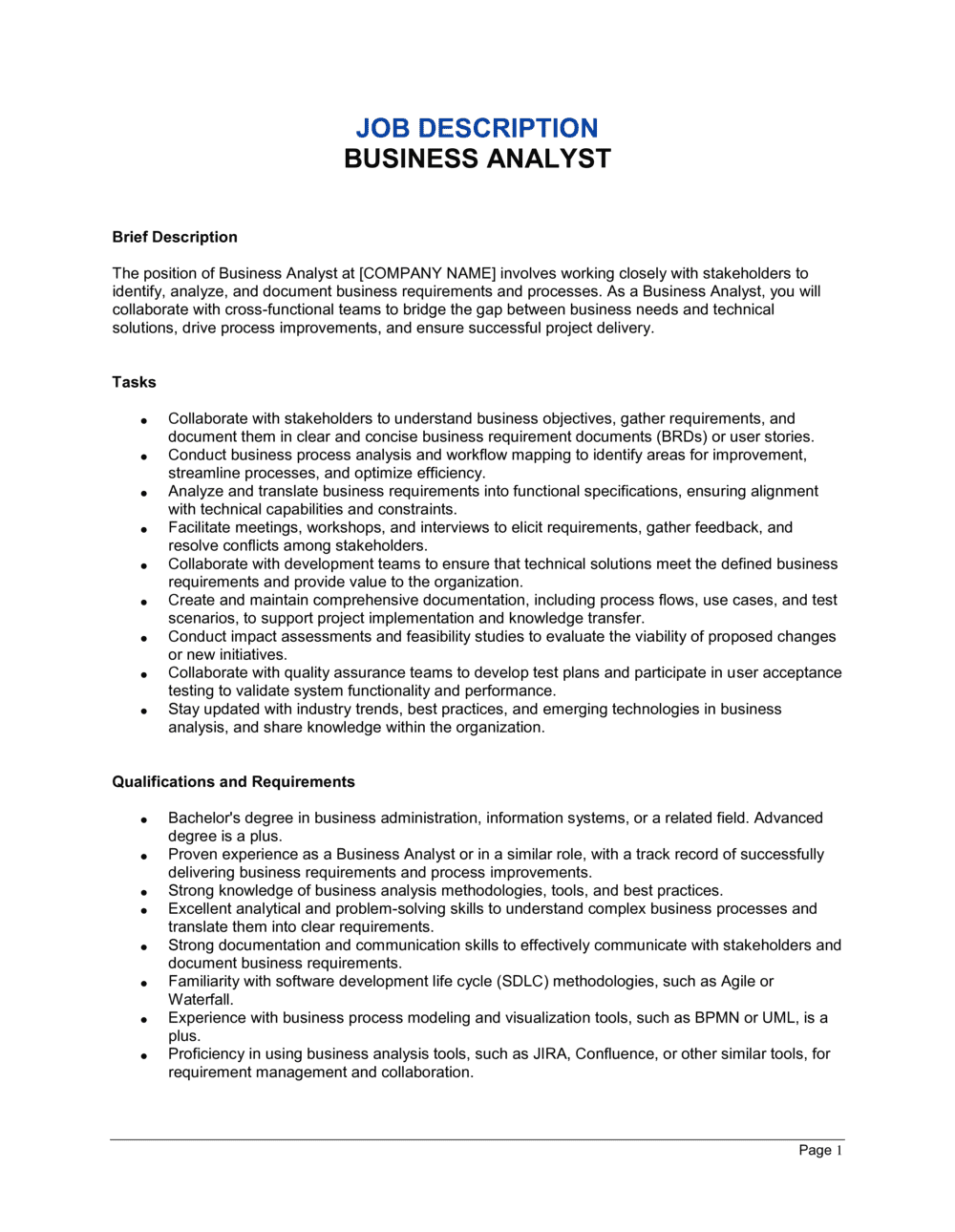
A Business Analyst Job Description is a formal employment document that defines the scope, responsibilities, qualifications, reporting structure, and terms of engagement for a business analyst role. This free Word download gives you an editable, professionally structured template you can customize for internal hiring, external job postings, or as the foundational exhibit attached to an employment contract.
When you need it
Use it when creating a new business analyst position, backfilling an existing role, or standardizing how the role is defined across departments or hiring managers. It is also required whenever an employment contract references a Schedule of Duties.
What's inside
Role summary and position title, reporting structure, core duties and deliverables, required and preferred qualifications, technical and soft skill requirements, compensation band, working conditions, and equal opportunity statement.

What is a Business Analyst Job Description?

A Business Analyst Job Description is a formal employment document that defines the scope of responsibilities, required qualifications, reporting structure, compensation range, and working conditions for a business analyst position. It functions both as a recruitment instrument β€” attracting and screening candidates β€” and as a legal reference document when attached to an employment contract as a Schedule of Duties. Unlike a casual role summary or a job posting headline, a properly structured job description is specific enough to anchor performance evaluations, compensation benchmarking, and, where relevant, the IP assignment and non-compete clauses in the accompanying employment agreement.

Why You Need This Document

Without a documented job description, hiring a business analyst creates four compounding risks. First, without defined duties, performance management becomes a credibility contest rather than a contract interpretation β€” a termination for underperformance is far harder to defend when there is no written record of what the role required. Second, in pay-transparency jurisdictions including California, New York, and Colorado, publishing a job posting without a salary range now draws regulatory penalties. Third, when an employment contract's IP assignment or non-compete clause references the "scope of the employee's role," a vague or missing job description weakens those restrictions precisely when you most need them enforceable. Fourth, undocumented working conditions β€” remote work arrangements, travel expectations, on-site requirements β€” become the basis for constructive dismissal claims if you later need to change them. This template gives you a signed, structured baseline that closes all four gaps in the time it takes to run a single interview.

Which variant fits your situation?

If your situation is…Use this template
Hiring a mid-level BA handling requirements gathering and process mappingBusiness Analyst Job Description
Hiring a senior BA managing stakeholder relationships and leading projectsSenior Business Analyst Job Description
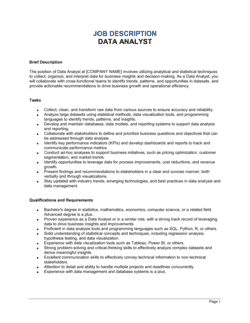
Hiring a BA focused exclusively on data pipelines and analyticsData Analyst Job Description
Hiring a BA embedded in an agile software development teamIT Business Analyst Job Description
Engaging a BA on a fixed-term project basis rather than as a permanent hireIndependent Contractor Agreement
Documenting the full employment terms once a candidate accepts the roleEmployment Contract
Posting the role publicly with a standard external job advertisement formatJob Posting Template

Common mistakes to avoid

❌ Conflating required and preferred qualifications

Why it matters: Candidates self-select out of roles they are qualified for, and recruiters filter out strong applicants. The pipeline narrows unnecessarily and time-to-fill increases.

Fix: Use two clearly separated sections with distinct labels. Only list something as required if you would genuinely reject an otherwise strong candidate who lacks it.

❌ Omitting the salary range in pay-transparency jurisdictions

Why it matters: Colorado, California, New York, and Washington state now require salary ranges in job postings β€” non-compliance triggers regulatory scrutiny and reputational risk with candidates.

Fix: Confirm pay transparency requirements for every jurisdiction where the posting is visible, not just where the company is headquartered, and add the approved salary band before publishing.

❌ Using vague duty descriptions that can't support performance management

Why it matters: A performance improvement plan or termination for poor performance is far harder to defend when the duties section says 'assist with various projects as needed' rather than specific, measurable deliverables.

Fix: Write each duty as a specific, observable action with a named output β€” 'Produce weekly KPI dashboard in Tableau for the finance leadership team' rather than 'support reporting needs.'

❌ Treating the job description as a recruiting artifact rather than a legal document

Why it matters: When a job description is attached to an employment contract as a Schedule of Duties, vague or unsigned exhibits weaken the enforceability of IP assignment, non-compete, and non-solicitation clauses that reference the scope of work.

Fix: Have both the hiring manager and employee sign the job description before day one, and ensure language is specific enough to anchor the employment contract's restrictive covenants.

❌ Not updating the job description when the role evolves significantly

Why it matters: An outdated job description creates mismatches between what the employee was hired to do and what they are actually doing β€” undermining performance reviews, compensation benchmarking, and promotion decisions.

Fix: Review and update job descriptions annually or whenever the role changes materially. Document each revision with a date and have the employee acknowledge the updated version.

❌ Setting overly broad geographic non-compete or confidentiality scope in the duties reference

Why it matters: When a job description's scope of work is used to anchor restrictive covenants, overly broad definitions of the role's access to confidential information can make the covenants unenforceable in several jurisdictions.

Fix: Define the role's access to confidential information specifically β€” naming the systems, data sets, or customer segments β€” rather than claiming blanket access to 'all company information.'

The 10 key clauses, explained

Position title and department

In plain language: States the official job title, the department the role sits within, and the employment classification (full-time, part-time, or contract).

Sample language
Position Title: Business Analyst | Department: [DEPARTMENT NAME] | Employment Type: Full-Time, Exempt | Location: [CITY, STATE / REMOTE]

Common mistake: Using an informal working title instead of the title that will appear on the employment contract and payroll records β€” mismatches between documents create confusion during onboarding and performance reviews.

Role summary

In plain language: A 3–5 sentence overview of the role's purpose, the problems it solves, and how it fits within the organization's broader goals.

Sample language
The Business Analyst will work across [DEPARTMENT] and technology teams to identify process inefficiencies, document requirements, and support the delivery of [SPECIFIC INITIATIVES]. Reporting to the [MANAGER TITLE], this role bridges business stakeholders and technical teams to ensure solutions align with organizational objectives.

Common mistake: Writing a role summary that reads like a marketing tagline rather than a functional description β€” vague language like 'drive synergies' tells candidates and hiring managers nothing concrete about what the role actually does.

Reporting structure

In plain language: Identifies the direct manager and any dotted-line relationships, clarifying the chain of authority and collaboration expectations.

Sample language
Reports directly to: [MANAGER TITLE]. Collaborates regularly with: [STAKEHOLDER TITLES]. No direct reports in this role [OR: Manages [X] junior analysts].

Common mistake: Omitting dotted-line or matrix reporting relationships β€” in matrixed organizations, an undocumented secondary reporting line creates authority disputes and performance review gaps.

Core duties and responsibilities

In plain language: An itemized list of the primary tasks the employee is expected to perform on a recurring basis, written with enough specificity to support performance evaluation.

Sample language
Elicit, document, and validate business and functional requirements through stakeholder interviews, workshops, and process observation; produce BRDs, use cases, and user stories for [SYSTEM / PROJECT]; conduct gap analyses between current-state and future-state processes; monitor and report on [KPIs] on a [weekly / monthly] basis.

Common mistake: Listing 15 or more bullet points without grouping or prioritizing β€” a candidate cannot tell what the role actually focuses on, and a manager cannot use the list for performance evaluation.

Required qualifications

In plain language: Minimum education, certifications, years of experience, and domain knowledge the candidate must have to be considered for the role.

Sample language
Bachelor's degree in Business Administration, Computer Science, or a related field; minimum [X] years of business analysis experience; proficiency in [TOOLS: e.g., JIRA, Confluence, SQL, Visio]; experience with [METHODOLOGY: e.g., Agile/Scrum, Waterfall].

Common mistake: Setting years-of-experience thresholds that screen out qualified candidates β€” requiring '5 years of experience' for a role that genuinely needs 2 years creates unnecessary recruiting friction and may raise adverse impact concerns under equal employment law.

Preferred qualifications

In plain language: Nice-to-have skills, certifications, or domain experience that would make a candidate more competitive but are not mandatory for the role.

Sample language
CBAP or CCBA certification from IIBA; experience in [INDUSTRY: e.g., financial services, healthcare]; familiarity with [SPECIFIC TOOL / PLATFORM]; prior experience in a regulated environment.

Common mistake: Blurring required and preferred qualifications into a single undifferentiated list β€” candidates cannot assess their fit, and recruiters cannot filter applicants consistently.

Compensation and benefits

In plain language: States the salary band or hourly rate, bonus eligibility, and a reference to the company's standard benefits package.

Sample language
Annual salary range: $[MIN] – $[MAX], commensurate with experience. Eligible for annual discretionary bonus of up to [X]% of base salary. Comprehensive benefits including [HEALTH / DENTAL / VISION / 401(k)] as described in the Company's current benefits program.

Common mistake: Omitting the salary range entirely in jurisdictions that now legally require pay transparency β€” Colorado, California, New York, and Washington state mandate salary ranges in job postings; non-compliance draws regulatory penalties.

Working conditions and location

In plain language: Describes the physical or remote work environment, travel requirements, standard working hours, and any physical demands of the role.

Sample language
This position is [on-site at LOCATION / hybrid: [X] days on-site per week / fully remote]. Standard working hours are [X:XX AM – X:XX PM, TIME ZONE]. Travel required: [None / up to X% annually for client or site visits].

Common mistake: Leaving working conditions vague at the time of hire and then mandating return-to-office later β€” without a documented baseline, changes to work location can trigger constructive dismissal claims in Canada and the UK.

Equal opportunity statement

In plain language: Affirms the employer's commitment to non-discriminatory hiring under applicable federal, state, or provincial law.

Sample language
[COMPANY NAME] is an equal opportunity employer. We do not discriminate on the basis of race, color, religion, sex, national origin, age, disability, veteran status, sexual orientation, gender identity, or any other characteristic protected by applicable law.

Common mistake: Using a boilerplate EEO statement that doesn't include all protected classes required by the applicable jurisdiction β€” state and provincial laws often extend beyond federal minimums, and an outdated statement can create compliance exposure.

Acknowledgment and signature block

In plain language: Provides a signature line for the hiring manager and, where used as a Schedule of Duties attached to an employment contract, for the employee β€” confirming they have reviewed and understood the role.

Sample language
I acknowledge that I have reviewed this Job Description and understand the duties and requirements of the [JOB TITLE] position. | Employee: [NAME] __________ Date: __________ | Hiring Manager: [NAME] __________ Date: __________

Common mistake: Treating the job description as an informal document that doesn't require a signature β€” when attached to an employment contract as a Schedule of Duties, an unsigned exhibit weakens the enforceability of IP assignment and non-compete clauses that reference the role scope.

How to fill it out

  1. 1

    Define the position title and classification

    Enter the official job title exactly as it will appear on the employment contract and payroll system. Select the correct FLSA classification (exempt or non-exempt in the US) and specify full-time, part-time, or contract status.

    πŸ’‘ Confirm the title with HR and finance before posting β€” retroactively changing a job title after an offer is accepted can create confusion about compensation benchmarks.

  2. 2

    Write the role summary from the business need outward

    Start with the specific business problem this role solves, not with a generic description of what a business analyst is. Name the key stakeholders, systems, or initiatives the role will support.

    πŸ’‘ A role summary that names a specific project or system (e.g., 'supporting the ERP migration' or 'owning the pricing analytics function') attracts more relevant applicants than a generic overview.

  3. 3

    Document the reporting structure explicitly

    Name the direct manager by title (not personal name, which changes with turnover), list all significant cross-functional relationships, and note if the role has any direct reports or matrix responsibilities.

    πŸ’‘ In matrixed organizations, map the dotted-line reporting relationship to the functional lead in addition to the direct manager β€” this prevents confusion during performance cycles.

  4. 4

    List core duties in order of time allocation

    Group the primary duties into three to five clusters β€” for example, requirements gathering, process analysis, stakeholder communication, and reporting. List each cluster's specific tasks and order them by the percentage of the role's time they represent.

    πŸ’‘ Limit the duties section to 8–12 bullet points. More than that signals the role is either two jobs or poorly scoped.

  5. 5

    Separate required from preferred qualifications

    Required qualifications are non-negotiable minimum thresholds. Preferred qualifications are differentiators. Use two clearly labeled sections. Avoid inflating required experience levels beyond what the work actually demands.

    πŸ’‘ Audit your required qualifications list against your last three successful hires in similar roles β€” if most hires met only 70% of the 'required' list, the list needs recalibration.

  6. 6

    Enter the compensation range and benefits reference

    Enter the approved salary band, bonus eligibility percentage, and a reference to the company's standard benefits program. Include the currency for any role that could attract candidates internationally.

    πŸ’‘ Check pay transparency laws for every state or country where the posting will be visible β€” not just where the role is based. Some jurisdictions require disclosure even for remote postings visible to residents.

  7. 7

    Specify working conditions and location clearly

    State whether the role is fully on-site, hybrid, or fully remote. If hybrid, specify the required number of on-site days. Note travel expectations in percentage or trips per year.

    πŸ’‘ Document the baseline working arrangement at the time of hire β€” this becomes the reference point if working conditions change later and an employee claims constructive dismissal.

  8. 8

    Obtain signatures before the start date

    Have both the hiring manager and the employee sign the job description before or on day one β€” especially if it is attached as a Schedule of Duties to the employment contract.

    πŸ’‘ Store the signed job description in the employee's personnel file and in your HR system. An unsigned Schedule of Duties attached to a signed contract creates enforceability gaps for IP and non-compete clauses.

Frequently asked questions

What is a business analyst job description?

A business analyst job description is a formal document that defines the responsibilities, qualifications, reporting structure, and working conditions of a business analyst role. It serves as both a recruitment tool and a legal reference document when attached to an employment contract as a Schedule of Duties. A well-written job description also provides the baseline for performance reviews, compensation benchmarking, and role-change documentation.

What are the main responsibilities of a business analyst?

Core business analyst responsibilities typically include eliciting and documenting business requirements through stakeholder interviews and workshops, analyzing current-state processes and identifying gaps, producing business requirements documents (BRDs), user stories, and process maps, tracking project progress against defined KPIs, and serving as the communication bridge between business stakeholders and technical teams. The specific balance of these responsibilities varies significantly by industry, seniority level, and whether the role is embedded in an agile or waterfall environment.

What qualifications should a business analyst job description require?

Standard required qualifications include a bachelor's degree in business, computer science, or a related field, 2–5 years of relevant BA experience (depending on seniority), proficiency in requirements documentation tools such as JIRA or Confluence, and experience with at least one delivery methodology (Agile or Waterfall). Preferred qualifications often include CBAP or CCBA certification from the IIBA, domain expertise in the employer's industry, and familiarity with specific platforms like Salesforce, SAP, or SQL. Avoid requiring certifications as mandatory unless the role genuinely needs them β€” it narrows the candidate pool without improving hire quality.

Does a job description need to be signed?

A standalone job description used only for recruitment does not typically require a signature. However, when a job description is attached to an employment contract as a Schedule of Duties β€” which is common practice for roles with IP assignment or non-compete obligations β€” both the hiring manager and the employee should sign it before the start date. An unsigned exhibit weakens the enforceability of any contract clause that references the scope of the role.

Should a job description include a salary range?

In an increasing number of jurisdictions, yes β€” legally. Colorado, California, New York, and Washington state require salary ranges in job postings, including remote roles visible to residents of those states. Even where not legally required, including a salary range reduces time-to-fill by aligning candidate expectations early and avoids late-stage offer rejections. Always confirm the applicable pay transparency requirements before publishing any posting.

What is the difference between a job description and an employment contract?

A job description defines what the role entails β€” duties, qualifications, and working conditions. An employment contract is the binding legal agreement that governs the employment relationship β€” covering compensation, IP assignment, confidentiality, non-compete, termination, and severance. The two documents work together: the employment contract typically incorporates the job description by reference as a Schedule of Duties. A job description alone creates no enforceable employment obligation.

How often should a business analyst job description be updated?

Review the job description annually at minimum, and update it immediately whenever the role changes materially β€” for example, if the BA takes on direct reports, moves from waterfall to agile delivery, or gains access to a new category of confidential data. Each update should be dated, stored in the employee's personnel file, and acknowledged in writing by the employee. An outdated job description undermines performance reviews and compensation benchmarking.

Can a business analyst job description be used for contractor engagements?

With modifications, yes β€” but the document must be carefully adapted. A contractor engagement should remove references to benefits, employment classification, and at-will or notice-period termination terms. The scope-of-work section from the job description can inform the Independent Contractor Agreement's Statement of Work. Avoid language that implies an employment relationship (set hours, direct supervision, exclusive availability) as this can contribute to worker misclassification findings in the US, Canada, and the UK.

What tools and skills should a business analyst job description mention?

Technical skills commonly listed include proficiency in requirements management tools (JIRA, Confluence, Azure DevOps), process modeling (Visio, Lucidchart, BPMN notation), data analysis (SQL, Excel, Tableau, Power BI), and familiarity with ERP or CRM platforms relevant to the business. Soft skills worth specifying include structured communication with non-technical stakeholders, facilitation of workshops and requirements sessions, and the ability to translate ambiguous business needs into precise technical specifications. Tailor the list to the tools actually used in your environment rather than listing every possible BA tool.

How this compares to alternatives

vs Employment Contract

An employment contract is the binding legal agreement governing the entire employment relationship β€” compensation, IP, non-compete, termination, and severance. A job description defines the scope of the role and is typically attached to the contract as a Schedule of Duties. The contract creates the enforceable obligation; the job description defines what the employee is obligated to do. Both documents are needed for a complete hire.

vs Independent Contractor Agreement

An independent contractor agreement engages a self-employed individual for defined project work with no employment entitlements. A job description is appropriate for employees; contractor engagements use a Statement of Work instead of a job description. Using a job description format for a contractor engagement can contribute to worker misclassification findings, which trigger back taxes and benefit liability.

vs Job Offer Letter

A job offer letter confirms the role, compensation, and start date to secure a candidate's acceptance β€” it is a summary document, not a comprehensive legal instrument. A job description provides the detailed scope of duties that the offer letter references. The offer letter initiates the hire; the job description and employment contract govern it.

vs Employee Handbook

An employee handbook covers company-wide policies, conduct standards, and procedures that apply to all employees. A job description is role-specific and defines duties, qualifications, and working conditions for one position. Handbooks and job descriptions serve different purposes and neither substitutes for the other β€” both should be provided to new hires on or before their first day.

Industry-specific considerations

Financial Services

BA roles in financial services emphasize regulatory compliance requirements (Basel III, AML, SOX), risk data lineage documentation, and close collaboration with compliance and audit functions.

Healthcare / MedTech

Healthcare BAs must document HIPAA data-handling obligations in the job description and typically require domain experience with HL7, FHIR, or EHR platforms such as Epic or Cerner.

Technology / SaaS

SaaS BA roles are heavily agile-oriented, with duties centered on sprint-level user story writing, backlog grooming, and product roadmap support alongside engineering and product teams.

Government and Public Sector

Government BA job descriptions must align with civil service classification frameworks, include security clearance requirements where applicable, and reference procurement and policy compliance obligations.

Jurisdictional notes

United States

Pay transparency laws in Colorado (EPEWA), California (SB 1162), New York, and Washington state require salary ranges in job postings β€” including remote roles visible to residents of those states. The FLSA requires correct exempt/non-exempt classification; misclassifying a BA as exempt when they earn below the salary threshold ($684/week as of 2024) creates overtime liability. Several states restrict questions about salary history in job postings.

Canada

Canadian provinces increasingly require pay transparency β€” British Columbia's Pay Transparency Act (2023) and Ontario's Bill 149 (2024) mandate salary ranges in job postings. Job descriptions attached to employment contracts must be consistent with the contract's duties clause; material changes to documented duties can support a constructive dismissal claim. Quebec employers must publish postings in French under the Charter of the French Language.

United Kingdom

UK employers must provide a written statement of employment particulars β€” which incorporates the job description's scope β€” on or before day one under the Employment Rights Act 1996. Significant changes to documented duties without employee consent can constitute a breach of contract. Gender pay gap reporting obligations apply to employers with 250 or more employees and require salary band transparency in some reporting frameworks.

European Union

The EU Pay Transparency Directive (2023/970) requires member states to implement salary disclosure obligations for job postings by June 2026. GDPR applies to any personal data collected during the recruitment process β€” job postings should not request unnecessary personal information. Works council consultation may be required before publishing new role definitions in Germany, France, and the Netherlands.

Template vs lawyer β€” what fits your deal?

PathBest forCostTime
Use the templateHR managers and hiring managers creating standard domestic BA roles in a single jurisdictionFree30–60 minutes
Template + legal reviewRoles in pay-transparency jurisdictions, roles with significant IP or non-compete exposure, or cross-border postings$150–$400 for an employment lawyer or HR consultant review1–2 days
Custom draftedSenior or executive BA roles with equity, regulated industries (healthcare, financial services), or multi-jurisdiction hiring programs$500–$2,000+3–7 days

Glossary

Job Description
A formal document that defines the duties, qualifications, and conditions of a specific role β€” used internally for performance management and externally for recruitment.
Business Analyst (BA)
A professional who identifies business needs, analyzes processes and data, and translates findings into actionable requirements for stakeholders and development teams.
Requirements Gathering
The structured process of collecting, documenting, and validating what a project or system must achieve, typically through stakeholder interviews, workshops, and surveys.
Stakeholder
Any individual or group with an interest in or influence over a project's outcome β€” including executives, end users, customers, and technology teams.
BPMN (Business Process Model and Notation)
A standardized graphical notation for mapping business processes, widely used by business analysts to document current-state and future-state workflows.
User Story
A short, informal description of a feature or requirement written from the perspective of the end user β€” typically formatted as 'As a [user], I want [goal] so that [reason].'
Gap Analysis
A structured comparison of current-state performance or capability against a desired future state, used to identify what changes are needed.
KPI (Key Performance Indicator)
A measurable value that indicates how effectively an individual, team, or organization is achieving a specific business objective.
Exempt vs. Non-Exempt
A US FLSA classification determining overtime eligibility β€” exempt employees (typically salaried professionals earning above a threshold) are not entitled to overtime pay.
IIBA (International Institute of Business Analysis)
The professional association for business analysts that administers the CBAP and CCBA certifications and publishes the BABOK Guide, the field's primary body of knowledge.
CBAP (Certified Business Analysis Professional)
The senior-level certification issued by IIBA, requiring 7,500 hours of BA work experience and a passing score on a proctored exam.
RACI Matrix
A responsibility assignment chart that maps tasks to roles as Responsible, Accountable, Consulted, or Informed β€” commonly used by BAs to define project governance.

Part of your Business Operating System

This document is one of 3,000+ business & legal templates included in Business in a Box.

  • Fill-in-the-blanks β€” ready in minutes
  • 100% customizable Word document
  • Compatible with all office suites
  • Export to PDF and share electronically

Create your document in 3 simple steps.

From template to signed document β€” all inside one Business Operating System.
1
Download or open template

Access over 3,000+ business and legal templates for any business task, project or initiative.

2
Edit and fill in the blanks with AI

Customize your ready-made business document template and save it in the cloud.

3
Save, Share, Send, Sign

Share your files and folders with your team. Create a space of seamless collaboration.

Save time, save money, and create top-quality documents.

β˜…β˜…β˜…β˜…β˜…

"Fantastic value! I'm not sure how I'd do without it. It's worth its weight in gold and paid back for itself many times."

Managing Director Β· Mall Farm
Robert Whalley
Managing Director, Mall Farm Proprietary Limited
β˜…β˜…β˜…β˜…β˜…

"I have been using Business in a Box for years. It has been the most useful source of templates I have encountered. I recommend it to anyone."

Business Owner Β· 4+ years
Dr Michael John Freestone
Business Owner
β˜…β˜…β˜…β˜…β˜…

"It has been a life saver so many times I have lost count. Business in a Box has saved me so much time and as you know, time is money."

Owner Β· Upstate Web
David G. Moore Jr.
Owner, Upstate Web

Run your business with a system β€” not scattered tools

Stop downloading documents. Start operating with clarity. Business in a Box gives you the Business Operating System used by over 250,000 companies worldwide to structure, run, and grow their business.

Start freeΒ Β·Β No credit card required