Food Preparation Worker Job Description Template

Free Word download • Edit online • Save & share with Drive • Export to PDF

2 pages20–30 min to fillDifficulty: StandardSignature requiredLegal review recommended
Learn more ↓
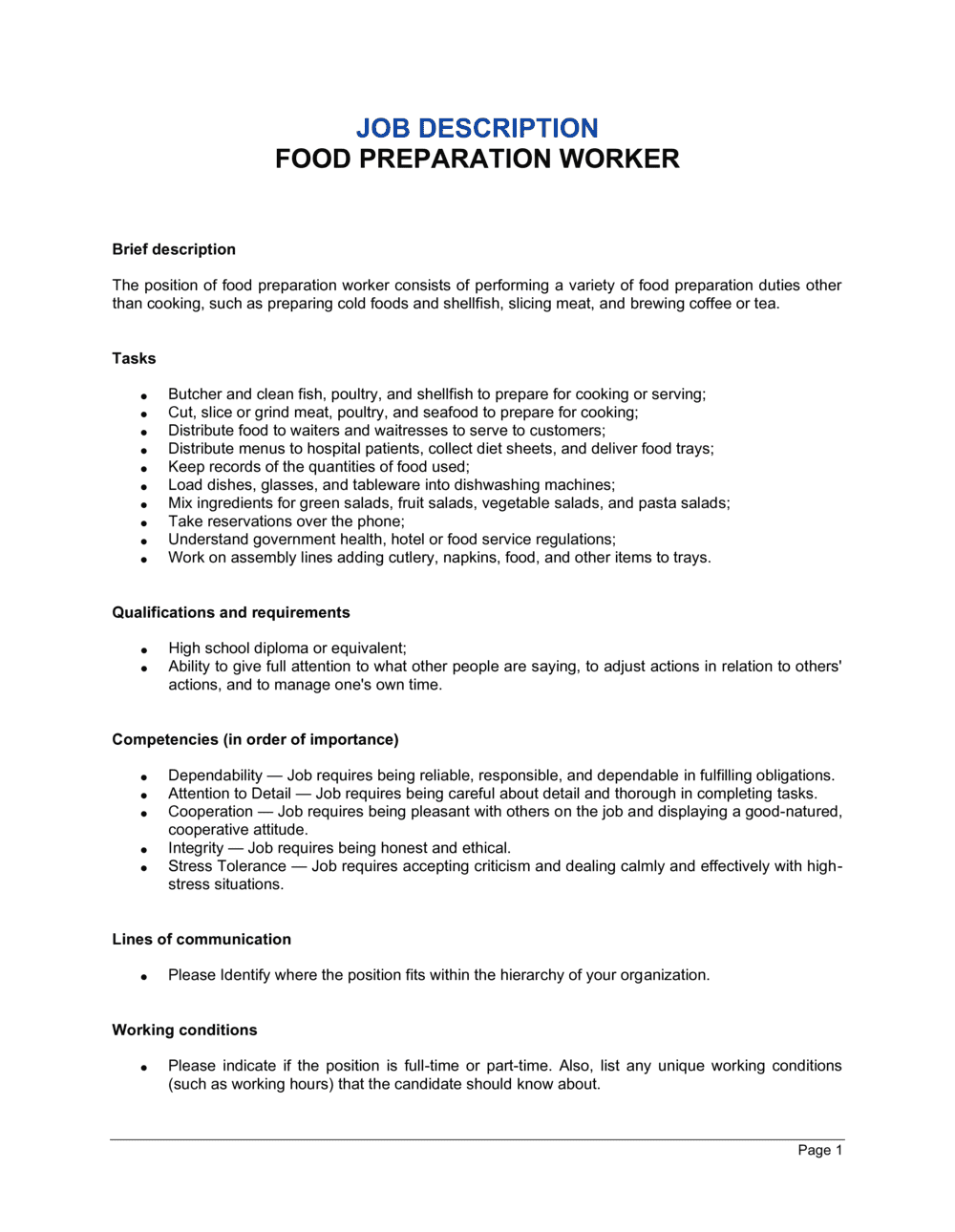
FreeFood Preparation Worker Job Description Template

At a glance

What it is
A Food Preparation Worker Job Description is a binding employment document that defines the responsibilities, qualifications, working conditions, and performance expectations for kitchen and food service prep roles. This free Word download gives operators, HR managers, and restaurant owners a structured, legally defensible starting point they can edit online and export as PDF for offer letters, employee files, and labor compliance records.
When you need it
Use it when hiring, rehiring, or reclassifying a food prep worker — whether for a restaurant, institutional kitchen, catering company, or food manufacturing facility. It is also required when documenting roles for workers' compensation classification, union negotiations, or regulatory inspections.
What's inside
Role title and reporting structure, detailed duties and tasks, required qualifications and certifications (including food handler licenses), physical requirements, working hours and schedule, compensation range, safety and sanitation obligations, and signature acknowledgment block.

What is a Food Preparation Worker Job Description?

A Food Preparation Worker Job Description is a binding employment document that formally defines the duties, qualifications, physical requirements, schedule, wage classification, and food safety obligations for a prep kitchen role. It functions as the authoritative written record of what the position requires — used at onboarding, referenced in performance reviews, and produced during health authority inspections, workers' compensation audits, and employment disputes. Unlike a casual job posting, a signed job description creates a documented acknowledgment that the employee received and understood the role requirements before beginning work, which is essential for defensible discipline and termination decisions in the food service industry.

Why You Need This Document

Food preparation is one of the most heavily regulated and litigation-prone employment categories in the service economy. Without a signed, specific job description, an employer cannot demonstrate that a worker was informed of sanitation obligations before a health code violation, establish the essential physical functions needed to evaluate an ADA accommodation request, or document the non-exempt classification that justifies overtime payments — leaving the business exposed to wage-theft claims, wrongful dismissal actions, and regulatory penalties simultaneously. Health departments frequently request employee documentation during inspections, and a missing or vague job description signals systemic compliance gaps that invite broader scrutiny. This template gives food service operators, HR managers, and catering directors a legally defensible starting point in under 30 minutes — covering every element from task-level duties and food handler certification deadlines to physical demands and signature acknowledgment — so that every new prep hire is onboarded on a documented, enforceable basis.

Which variant fits your situation?

If your situation is…Use this template
Hiring a head prep cook with supervisory responsibilitiesPrep Cook Job Description
Staffing a full-service restaurant kitchen from front to backRestaurant Cook Job Description
Hiring kitchen staff for a catering or events operationCatering Staff Job Description
Onboarding a dishwasher or kitchen porter alongside prep staffDishwasher Job Description
Documenting a food service role in a school or institutional settingSchool Food Service Worker Job Description
Hiring an hourly food worker under a union collective agreementUnionized Food Service Worker Job Description
Classifying a food manufacturing line worker for payroll and OSHA purposesFood Manufacturing Worker Job Description

Common mistakes to avoid

❌ Omitting the FLSA or wage classification

Why it matters: Food prep workers are almost always non-exempt under the FLSA and provincial equivalents. Failing to document overtime eligibility creates wage-theft liability if workers are ever required to stay beyond 40 hours without premium pay.

Fix: Add an explicit non-exempt classification line and state the overtime threshold (40 hours per week in the US; lower in some provinces) and multiplier before the employee signs.

❌ No acknowledgment disclaimer separating the description from a contract

Why it matters: A signed job description without a disclaimer can be interpreted as an implied employment contract, complicating at-will termination in jurisdictions that recognize implied-contract exceptions.

Fix: Include a one-sentence disclaimer in the signature block: 'This document does not constitute a contract of employment and may be amended with reasonable notice.'

❌ Listing vague essential duties instead of specific tasks

Why it matters: When a termination or performance dispute arises, a job description that says 'assists with food preparation' provides no documented standard to defend against a wrongful dismissal claim.

Fix: Replace every vague duty with a specific, measurable task (e.g., 'slices and portions proteins per recipe card spec within ±5% of target weight') that a supervisor can observe and evaluate.

❌ Referencing sanitation SOPs that do not exist or are outdated

Why it matters: Health department inspectors and plaintiffs' attorneys both request the documents cross-referenced in job descriptions. A reference to a missing or superseded SOP signals systemic compliance failure.

Fix: Before finalizing the job description, verify that every referenced SOP is current, version-numbered, and accessible to the employee in both print and digital form.

❌ Not specifying the food handler certification deadline and who pays

Why it matters: Ambiguity about when certification is required and who covers the cost produces both compliance risk (worker never gets certified) and termination disputes (worker claims they were not told).

Fix: State the exact deadline (e.g., 'within 30 days of hire') and confirm in writing whether the employer reimburses the certification fee or deducts it from wages in accordance with applicable law.

❌ Skipping the physical requirements section entirely

Why it matters: Without a documented physical demands statement, the employer cannot establish that a worker who cannot lift 40 lbs is unable to perform the essential functions of the role — a critical element in both ADA accommodation decisions and workers' compensation disputes.

Fix: Conduct a physical demands analysis for the specific prep station and record lifting limits, standing duration, temperature exposure, and required PPE before the description is finalized.

The 9 key clauses, explained

Position identification and reporting structure

In plain language: States the official job title, department, location, employment classification (full-time, part-time, or seasonal), and the supervisor the worker reports to.

Sample language
Position Title: Food Preparation Worker | Department: Kitchen / Food Service | Reports To: [HEAD COOK / KITCHEN MANAGER NAME OR TITLE] | Classification: [FULL-TIME / PART-TIME / SEASONAL] | Location: [FACILITY NAME AND ADDRESS]

Common mistake: Using a generic title like 'kitchen staff' instead of the specific classification. Misclassified titles complicate workers' compensation rating codes and make performance management harder to document.

Position summary

In plain language: A 3–5 sentence overview of the role's purpose, the type of operation it supports, and its place within the kitchen team hierarchy.

Sample language
The Food Preparation Worker is responsible for preparing ingredients and maintaining a clean, organized prep kitchen in support of [FACILITY TYPE] service operations. Working under the direction of [SUPERVISOR TITLE], this role ensures all food is prepared to specification, stored safely, and presented on time for [MEAL SERVICE / PRODUCTION SCHEDULE].

Common mistake: Writing the position summary as a marketing pitch rather than a functional description. It should orient a new hire, not recruit them — the job posting handles that.

Essential duties and responsibilities

In plain language: Lists the core tasks the worker must perform — washing, cutting, measuring, portioning, labeling, storing, and cleaning — in enough detail to support performance evaluations and ADA accommodation decisions.

Sample language
Essential duties include: (a) washing, peeling, and cutting vegetables and proteins to recipe specification; (b) measuring and portioning ingredients per standardized recipes; (c) labeling and dating all prepared items per FIFO protocols; (d) maintaining prep area cleanliness in compliance with [HEALTH DEPARTMENT / HACCP] standards; (e) operating prep equipment including slicers, mixers, and food processors safely.

Common mistake: Listing only vague duties like 'assists with food preparation.' Vague language prevents the employer from disciplining or terminating for failure to perform specific tasks because the expectation was never documented.

Qualifications and certifications

In plain language: States the minimum education, prior experience, and mandatory certifications — including food handler or food safety manager credentials — required before the first day.

Sample language
Minimum qualifications: (a) High school diploma or equivalent preferred; (b) [X] months of experience in a commercial kitchen preferred but not required; (c) current [STATE / PROVINCE] Food Handler Certificate required within [30] days of hire; (d) ServSafe or equivalent food safety certification preferred.

Common mistake: Requiring credentials the worker is expected to obtain after hire without specifying the deadline and who pays. Leave this ambiguous and you create a termination dispute when the worker doesn't complete the certification.

Physical requirements and working conditions

In plain language: Documents the physical demands of the role — lifting limits, standing duration, temperature exposure, noise levels, and required personal protective equipment — to support ADA compliance and workers' compensation classification.

Sample language
This position requires: (a) standing for up to [8] consecutive hours; (b) lifting and carrying items up to [50] lbs; (c) working in environments with temperatures ranging from [35°F / 2°C] (walk-in cooler) to [110°F / 43°C] (cooking line); (d) frequent bending, reaching, and repetitive hand motions. Required PPE: non-slip footwear, cut-resistant gloves when operating slicing equipment.

Common mistake: Omitting the temperature range and lifting limit. Without them, workers' compensation claims and ADA accommodation requests lack a documented baseline, exposing the employer to larger liability.

Schedule, hours, and compensation

In plain language: States the expected weekly hours, shift structure, overtime eligibility, and pay range or hourly rate — including any premium pay for evenings, weekends, or holidays.

Sample language
This position is classified as [non-exempt / exempt] under applicable wage and hour law. Standard schedule: [X] hours per week, [DAYS AND SHIFTS]. Hourly rate: $[X.XX]–$[X.XX] per hour depending on experience. Overtime is paid at 1.5× the regular rate for hours exceeding [40] per week in accordance with applicable law.

Common mistake: Listing only a job title and omitting the FLSA or provincial wage classification. Food prep workers are almost universally non-exempt — failing to document this invites wage-theft claims if overtime is unpaid.

Food safety, sanitation, and hygiene obligations

In plain language: Sets out the worker's specific responsibilities for personal hygiene, surface sanitation, equipment cleaning, and reporting illness or injury — and cross-references the employer's food safety plan.

Sample language
Employee must: (a) follow all personal hygiene protocols including handwashing at intervals specified in the Sanitation SOP; (b) report any illness, open wound, or communicable condition to [SUPERVISOR TITLE] before beginning work; (c) complete all assigned cleaning tasks per the Daily Sanitation Checklist; (d) comply with [LOCAL HEALTH DEPARTMENT / FDA Food Code / CFIA / FSA] requirements at all times.

Common mistake: Cross-referencing a sanitation SOP that hasn't been written yet. If the referenced document doesn't exist, the clause is unenforceable and creates a paper trail that the health department can use against you.

Performance standards and evaluation criteria

In plain language: Defines measurable benchmarks the worker is expected to meet — accuracy, speed, waste reduction, sanitation scores — and states the frequency of formal performance reviews.

Sample language
Performance will be evaluated [quarterly / annually] against the following standards: (a) ingredient prep accuracy rate of [X]% or better as measured by supervisor inspection; (b) zero critical violations on internal sanitation audits; (c) completion of daily prep checklist by [TIME] for each scheduled shift; (d) adherence to portion control guidelines within [±X]% of specification.

Common mistake: Setting no measurable standards and relying on subjective supervisor discretion. When a termination is challenged, a job description with no performance benchmarks provides no defense.

Acknowledgment and signature block

In plain language: Confirms that the employee has read, understood, and received a copy of the job description, and that the employer may update it with reasonable notice.

Sample language
By signing below, Employee acknowledges receipt and review of this Job Description, understands the duties and requirements outlined herein, and agrees to perform the essential functions of the position. Employee acknowledges that this Job Description does not constitute a contract of employment and may be revised by [EMPLOYER NAME] with [X days'] written notice. | Employee Signature: _______________ Date: ________ | Supervisor Signature: _______________ Date: ________

Common mistake: No disclaimer that the document is not a contract of employment. Without it, a signed job description can be cited as an implied promise of continued employment, undermining at-will status.

How to fill it out

  1. 1

    Enter the position title and reporting structure

    Fill in the official job title, the department or kitchen section, the facility address, and the exact title of the supervising role. Use the payroll system title — not a colloquial name — to ensure consistency across HR records.

    💡 Cross-check the job title against your workers' compensation classification codes before finalizing — kitchen prep roles have specific class codes that affect your premium rate.

  2. 2

    Write the position summary in plain language

    Describe the role's purpose in three to five sentences: what the worker does, for what type of operation, and how it fits within the kitchen team. Avoid using the word 'responsible' more than once.

    💡 Read the summary aloud — if it could describe any food service job, it is too vague. Add the meal service type (breakfast, full-service lunch, batch production) to anchor it.

  3. 3

    List essential duties with task-level specificity

    Itemize every core task the worker is expected to perform — cutting, portioning, labeling, storing, cleaning. Use action verbs (wash, slice, measure, rotate) and reference the applicable SOP or recipe standard where one exists.

    💡 Separate 'essential functions' from 'other duties as assigned' — this distinction is legally significant under the ADA when evaluating accommodation requests.

  4. 4

    Specify qualifications and certification deadlines

    State the minimum education, experience, and mandatory certifications. For any certification required after hire (e.g., Food Handler Card), state the deadline and confirm in writing who covers the cost.

    💡 In most US states and Canadian provinces, food handler certification must be obtained within 30 days of hire — check your local health authority's current requirement before finalizing.

  5. 5

    Document physical requirements and working conditions

    Enter the maximum lifting weight, standing duration, temperature range, and any required PPE. Be conservative with estimates — understating physical demands creates ADA and workers' compensation exposure.

    💡 If you are unsure of the exact lifting limit, time a current employee performing the role and note the heaviest item they routinely lift. Document that observation in your HR file.

  6. 6

    Set the schedule, wage rate, and overtime classification

    Specify scheduled hours, shift times, and hourly rate range. Confirm the FLSA or provincial classification (non-exempt for virtually all food prep workers) and state the overtime threshold and multiplier.

    💡 Even in tip-pooling operations, food prep workers who are part of a valid tip pool must still receive at least the full applicable minimum wage — confirm this before entering the rate range.

  7. 7

    Add the food safety and sanitation obligations

    Reference your current Sanitation SOP by name and version number, list the personal hygiene requirements, and include the illness-reporting requirement. Confirm the referenced SOP is up to date before attaching it.

    💡 Pair this clause with a signed receipt confirming the employee received the SOP — health inspectors routinely ask for both during audits.

  8. 8

    Obtain signatures before the first shift

    Both the employee and a supervisor must sign and date before work begins. Give the employee a copy and retain the original in their personnel file alongside the onboarding checklist.

    💡 Use Business in a Box eSign to timestamp execution digitally and store the signed document in BIB Drive for instant retrieval during inspections or legal proceedings.

Frequently asked questions

What does a food preparation worker do?

A food preparation worker performs the foundational kitchen tasks that enable cooks and chefs to deliver completed dishes on time: washing and peeling produce, cutting and portioning proteins and vegetables, measuring ingredients per recipe specification, labeling and rotating stored items using FIFO protocols, and maintaining the cleanliness of prep surfaces and equipment. The role is distinct from a cook in that it typically does not involve operating hot cooking equipment such as stoves or fryers.

What certifications should be listed in a food prep worker job description?

At minimum, the description should reference the jurisdiction's food handler certificate requirement — typically a state or provincial card proving completion of a food safety basics course. Operations subject to more rigorous oversight (hospitals, schools, large-volume catering) may require a ServSafe Food Handler credential or equivalent. List both the certification name and the deadline by which it must be obtained, and confirm whether the employer reimburses the cost.

Does a food prep worker job description need to include physical requirements?

Yes, and this is one of the most legally significant sections. Under the ADA in the US and analogous disability legislation in Canada, the UK, and the EU, an employer must document the essential physical functions of a role in order to evaluate reasonable accommodation requests fairly. A physical demands section stating lifting limits, standing duration, and temperature exposure also establishes the baseline for workers' compensation classification and premium rates.

What is the difference between a food prep worker job description and an employment contract?

A job description defines what the role requires — duties, qualifications, physical demands, and schedule. An employment contract governs the legal relationship — compensation, benefits, IP, confidentiality, termination notice, and severance. Job descriptions are referenced in employment contracts but do not replace them. For food service workers, using both documents protects the employer against wage disputes, wrongful dismissal claims, and health authority penalties.

How often should a food prep worker job description be updated?

Review the description whenever the role's duties, equipment, certifications, or physical demands change materially — typically at least once per year and whenever a health authority issues new food safety requirements. In unionized operations, any change to the job description may require bargaining unit consultation before the amendment takes effect. Have employees sign an acknowledgment of each updated version and retain the prior version on file.

Can a food prep worker job description be used for multiple locations?

A single template can cover multiple locations if the duties, qualifications, and physical requirements are genuinely consistent across sites. However, wage rates, certification requirements, and applicable health codes vary by state, province, and municipality — these fields must reflect the specific location. Multi-unit operators typically maintain a master template with location-specific addenda rather than separate documents for each site.

Does a food prep worker need to sign their job description?

Yes. A signed job description creates a documented record that the employee received, read, and understood the role requirements before starting work. Without a signature, the employer cannot prove the worker was made aware of duties, certification obligations, or sanitation requirements — making disciplinary action and termination for performance failures significantly harder to defend. Obtain signatures before the first shift and retain the original in the personnel file.

What wage laws apply to food preparation workers?

Food preparation workers are almost universally classified as non-exempt under the US Fair Labor Standards Act, meaning they are entitled to federal minimum wage (currently $7.25/hour, though most states set higher floors) and overtime at 1.5× their regular rate for hours over 40 per week. In Canada, provincial employment standards set minimum wages ranging from approximately CAD $15 to $17.40/hour depending on the province. In the UK, the National Living Wage and National Minimum Wage apply based on the worker's age. Tip-pool arrangements must comply with jurisdiction-specific rules and do not reduce the base wage obligation.

How this compares to alternatives

vs Employment Contract

An employment contract governs the full legal relationship — compensation, benefits, IP, confidentiality, termination, and severance. A job description defines what the role requires day to day. The two documents complement each other: the employment contract references the job description but does not replace it. Food service operators need both to protect against wage disputes, wrongful dismissal claims, and regulatory penalties.

vs Offer Letter

An offer letter summarizes the role and compensation to secure a candidate's acceptance — it is not a comprehensive record of duties or compliance obligations. A job description is the operative document that defines performance expectations and physical requirements for ongoing employment, health authority inspections, and ADA accommodation decisions. Using an offer letter alone leaves significant operational and legal gaps.

vs Restaurant Cook Job Description

A cook job description covers roles that operate hot cooking equipment — stoves, fryers, and ovens — and typically requires culinary training or a formal apprenticeship. A food preparation worker description covers pre-cooking tasks only and has a lower qualification threshold, distinct physical demands, and different workers' compensation classification codes. Using the wrong template misclassifies the role and creates premium and payroll errors.

vs Employee Handbook

An employee handbook sets company-wide policies — conduct, attendance, benefits, and disciplinary procedures — applicable to all staff. A job description is role-specific and defines the particular duties, qualifications, and performance standards for a single position. Both documents should be signed at onboarding: the handbook governs conduct; the job description governs performance. Neither replaces the other.

Industry-specific considerations

Restaurants and food service

High turnover and varied shift structures make a signed, specific job description critical for consistent onboarding and defensible terminations in a sector with frequent labor disputes.

Healthcare and institutional dining

Hospital and long-term care kitchens require enhanced food safety language, allergen-handling protocols, and compliance with dietary department accreditation standards not found in standard commercial kitchen descriptions.

Education and school food service

Public school food service positions are often covered by civil service or collective bargaining rules, requiring classification-specific language and union-consultation procedures before any description change.

Manufacturing and food processing

Food manufacturing prep roles require OSHA-specific physical demands documentation, GMP (Good Manufacturing Practice) compliance language, and workers' compensation class codes distinct from restaurant kitchen positions.

Jurisdictional notes

United States

Food prep workers are non-exempt under the FLSA in virtually all cases, entitling them to federal minimum wage and 1.5× overtime after 40 hours per week. State minimum wages frequently exceed the federal floor — California ($16/hour as of 2024), New York, and Washington set among the highest. Food handler certification requirements vary by state and county; some jurisdictions require certification within 30 days of hire, others require it before the first shift. The ADA requires that physical demands be documented with sufficient specificity to evaluate reasonable accommodation requests.

Canada

Each province sets its own minimum wage and employment standards — Ontario, British Columbia, and Alberta have distinct rules on overtime thresholds (ranging from 40 to 44 hours per week depending on province) and termination notice. Food handler certification is regulated provincially; most provinces require a food handler certificate before food handling begins. Quebec job descriptions provided to French-speaking employees must be in French under the Charter of the French Language. Union coverage in institutional dining is common and may require that description changes be bargained.

United Kingdom

Food preparation workers are entitled to the National Living Wage (age 23+) or National Minimum Wage, both updated annually each April. The Food Safety Act 1990 and Food Hygiene Regulations 2006 require documented food safety training for all food handlers — the job description should reference this obligation explicitly. Employers must provide a written statement of employment particulars, including duties and pay, on or before the first day of work. Disability-related adjustments are governed by the Equality Act 2010, making a physical demands statement important for compliance.

European Union

EU Regulation (EC) No 852/2004 requires that all food handlers receive adequate food hygiene training proportionate to their role — this must be referenced in the job description and documented in employee files. The EU Transparent and Predictable Working Conditions Directive requires written terms of employment within 7 days of the start date, including a description of duties and working conditions. Member state minimum wages and working-time rules vary significantly; Germany, France, and the Netherlands impose among the strictest requirements. GDPR applies to personnel records, including signed job descriptions containing personal data.

Template vs lawyer — what fits your deal?

PathBest forCostTime
Use the templateIndependent restaurant owners, small food service operators, and catering companies hiring standard prep kitchen roles in a single jurisdictionFree20–30 minutes
Template + legal reviewMulti-location operators, unionized kitchens, healthcare or school food service, or employers in jurisdictions with complex wage and certification requirements$150–$400 for an employment lawyer or HR consultant review1–3 days
Custom draftedLarge food manufacturers, hospital systems with accreditation requirements, or operations subject to EEOC pattern-or-practice audits$500–$1,500+3–7 days

Glossary

Job Description
A written document outlining a position's duties, qualifications, reporting structure, and working conditions — used in hiring, performance management, and legal compliance.
Food Handler Certificate
A jurisdiction-issued credential confirming that a worker has completed training in safe food handling, temperature control, and cross-contamination prevention.
HACCP
Hazard Analysis and Critical Control Points — a systematic food safety framework identifying physical, chemical, and biological hazards at each stage of food preparation.
Mise en Place
A culinary term meaning 'everything in its place' — the practice of measuring, cutting, and arranging all ingredients before cooking begins, which is a core prep worker responsibility.
FIFO (First In, First Out)
An inventory rotation method requiring that older stock is used before newer stock, reducing spoilage and food safety risk.
Sanitation Standards
Regulatory and employer-set requirements for cleaning frequency, chemical concentrations, surface contact times, and personal hygiene that prep workers must follow.
At-Will Employment
An employment arrangement, common in most US states, where either the employer or employee may end the relationship at any time for any lawful reason without advance notice.
Essential Functions
The core duties a position must perform — a legally significant term under the ADA and similar disability laws that determines reasonable accommodation obligations.
Physical Demands Statement
A section of a job description cataloguing lifting requirements, standing duration, temperature exposure, and other physical conditions — used in workers' compensation and ADA compliance.
Probationary Period
A defined initial employment window — typically 30 to 90 days — during which performance is evaluated under reduced termination formalities.
Collective Bargaining Agreement (CBA)
A negotiated contract between an employer and a union that sets wages, hours, and working conditions for covered employees, which may supersede individual job descriptions.

Part of your Business Operating System

This document is one of 3,000+ business & legal templates included in Business in a Box.

  • Fill-in-the-blanks — ready in minutes
  • 100% customizable Word document
  • Compatible with all office suites
  • Export to PDF and share electronically

Create your document in 3 simple steps.

From template to signed document — all inside one Business Operating System.
1
Download or open template

Access over 3,000+ business and legal templates for any business task, project or initiative.

2
Edit and fill in the blanks with AI

Customize your ready-made business document template and save it in the cloud.

3
Save, Share, Send, Sign

Share your files and folders with your team. Create a space of seamless collaboration.

Save time, save money, and create top-quality documents.

★★★★★

"Fantastic value! I'm not sure how I'd do without it. It's worth its weight in gold and paid back for itself many times."

Managing Director · Mall Farm
Robert Whalley
Managing Director, Mall Farm Proprietary Limited
★★★★★

"I have been using Business in a Box for years. It has been the most useful source of templates I have encountered. I recommend it to anyone."

Business Owner · 4+ years
Dr Michael John Freestone
Business Owner
★★★★★

"It has been a life saver so many times I have lost count. Business in a Box has saved me so much time and as you know, time is money."

Owner · Upstate Web
David G. Moore Jr.
Owner, Upstate Web

Run your business with a system — not scattered tools

Stop downloading documents. Start operating with clarity. Business in a Box gives you the Business Operating System used by over 250,000 companies worldwide to structure, run, and grow their business.

Free Forever Plan · No credit card required