Server Job Description Template

Free Word download β€’ Edit online β€’ Save & share with Drive β€’ Export to PDF

2 pagesβ€’20–30 min to fillβ€’Difficulty: Standardβ€’Signature requiredβ€’Legal review recommended
Learn more ↓
FreeServer Job Description Template

At a glance

What it is
A Server Job Description is a formal written document that defines the duties, qualifications, compensation, conduct standards, and reporting structure for a food and beverage server role. This free Word download gives hospitality employers a structured, legally grounded starting point they can edit online and export as PDF β€” suitable for full-service restaurants, hotel dining rooms, catering operations, and event venues.
When you need it
Use it when posting a server position, onboarding a new hire, or formalizing existing role expectations after a period of informal arrangements. It is especially important when the position involves tip income, alcohol service, or variable scheduling, where written documentation of duties and compensation terms reduces wage and classification disputes.
What's inside
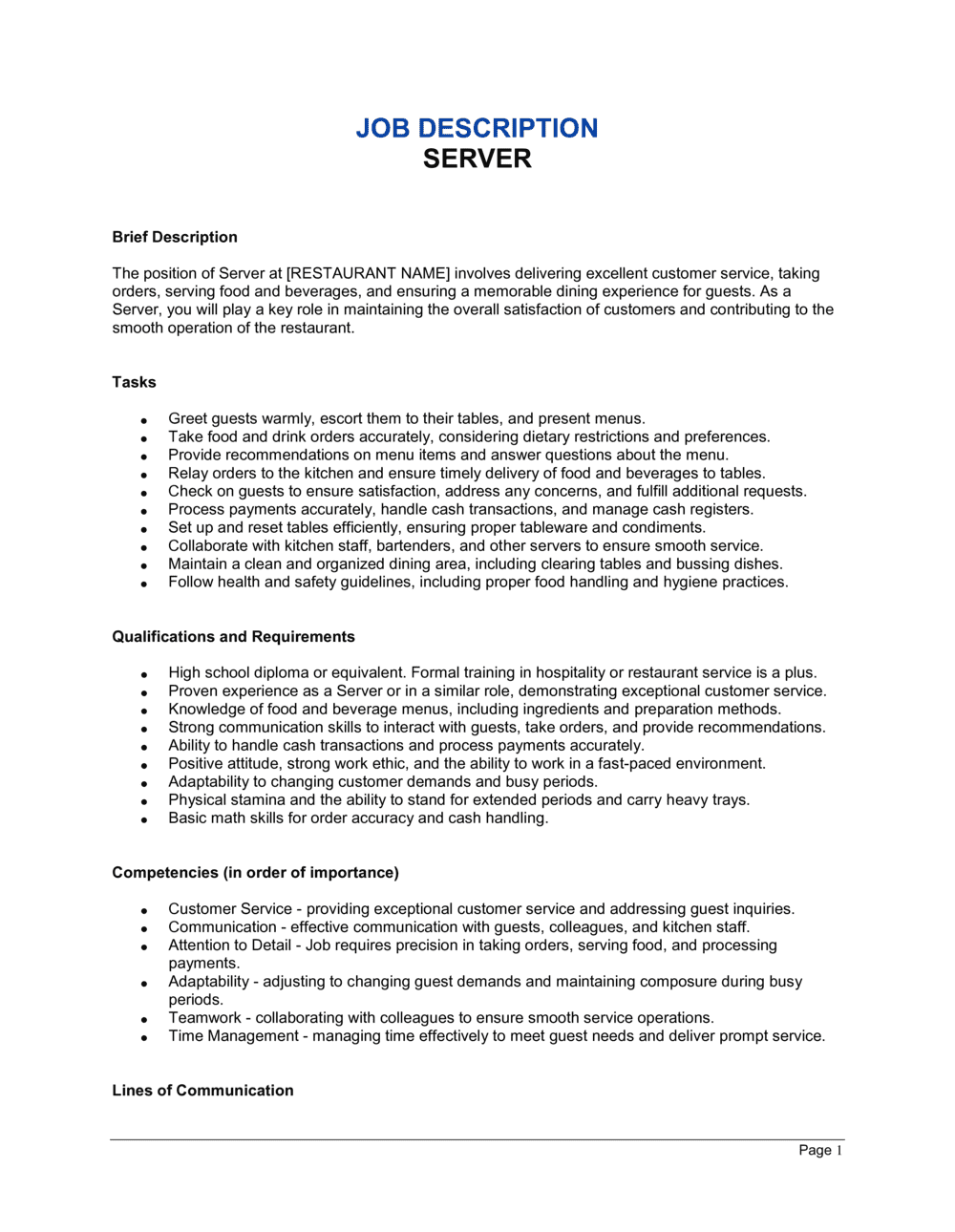
Position title and reporting structure, summary of role purpose, itemized duties and responsibilities, required and preferred qualifications, compensation and tip-handling policies, scheduling and availability requirements, conduct and appearance standards, and an employee acknowledgment signature block.

What is a Server Job Description?

A Server Job Description is a formal written document that defines the duties, qualifications, compensation terms, scheduling requirements, and conduct standards for a food and beverage server position in a restaurant, hotel, catering operation, or event venue. It functions as both a recruiting instrument and a legal record β€” communicating role expectations to candidates before hire and documenting what the employee agreed to perform before their first shift. When signed by both the employee and a manager, it establishes the written notice required by the FLSA for tip credit eligibility, supports performance management and progressive discipline, and provides documentary evidence in wage disputes, workers' compensation claims, and dram shop liability cases.

Why You Need This Document

Operating without a written server job description exposes hospitality businesses to four categories of concrete legal risk. First, applying a tip credit without written pre-hire notice voids the credit under the FLSA β€” courts have ordered employers to pay the full minimum wage retroactively for the entire employment period, plus back taxes and penalties. Second, without documented duties, employers cannot demonstrate that a terminated server failed to meet specific performance standards, which weakens unemployment insurance disputes and wrongful termination defenses. Third, undocumented physical requirements make ADA accommodation requests harder to evaluate and workers' compensation claims harder to defend when injuries arise from tasks the employer cannot prove were part of the role. Fourth, the absence of a signed conduct and alcohol service standard creates dram shop liability exposure when servers over-serve guests. A properly drafted, signed server job description closes all four gaps β€” and this template gives you a compliant, editable starting point in under 30 minutes.

Which variant fits your situation?

If your situation is…Use this template
Hiring a full-service restaurant server in a tipped roleServer Job Description (Tipped Employee)
Hiring a banquet or event server for one-time or seasonal workBanquet Server Job Description
Hiring a bartender with service dutiesBartender Job Description
Hiring a host or hostess to support server workflowHost/Hostess Job Description
Hiring a food runner or busser supporting serversFood Runner Job Description
Documenting the full terms of employment beyond duties aloneEmployment Contract (At-Will)
Onboarding a server as an independent contractor for catering eventsIndependent Contractor Agreement

Common mistakes to avoid

❌ Failing to provide written tip credit notice

Why it matters: Under the FLSA, employers must notify employees in writing of the tip credit amount, the applicable minimum wage, and that tips belong to the employee before applying the credit. Courts have disallowed tip credits retroactively and ordered employers to pay the full minimum wage for the entire employment period.

Fix: Include tip credit disclosures directly in the job description and have the employee sign before the first tipped shift. Retain the signed copy for a minimum of three years to satisfy FLSA recordkeeping requirements.

❌ Using 'duties as assigned' as the primary task description

Why it matters: Without specific enumerated duties, employers cannot document clear performance standards, which undermines progressive discipline, termination for cause, and unemployment insurance disputes.

Fix: List at least eight specific, observable duties that a manager can evaluate objectively. Reserve 'and other duties as reasonably assigned' as a supplementary catch-all at the end of the list.

❌ Setting a blanket minimum age requirement without checking local alcohol service law

Why it matters: Requiring all servers to be 21 in a jurisdiction where 18-year-olds may legally serve alcohol with supervision may constitute age discrimination against protected applicants aged 18–20.

Fix: Research the minimum service age in the specific state or province where the establishment operates and use that age as the documented requirement, noting the statutory basis.

❌ Omitting physical requirements to attract more applicants

Why it matters: Undisclosed physical demands make ADA accommodation requests harder to evaluate and weaken workers' compensation defense when injuries arise from tasks the employer cannot prove were part of the documented role.

Fix: Document realistic weight limits, standing duration, and environmental conditions based on the actual working environment. Include the standard ADA reasonable accommodation language to signal good-faith compliance.

❌ Signing the job description after the employee's first shift

Why it matters: In jurisdictions that recognize implied contract claims, a job description signed after employment has begun may create a stronger implied contractual argument than one signed before. Tip credit notice signed post-hire is also legally ineffective.

Fix: Execute all job description and tip credit notices before the employee's first shift. Use a dated acknowledgment block and file the signed original immediately.

❌ Including contract language that conflicts with at-will status

Why it matters: Phrases like 'this document governs your employment' or 'employment will continue as long as performance standards are met' have been used by plaintiffs to argue an implied employment contract β€” limiting the employer's ability to terminate without cause.

Fix: Include the standard at-will disclaimer in the acknowledgment block: 'This job description does not constitute a contract of employment and does not alter the at-will nature of the employment relationship.'

The 9 key clauses, explained

Position title and reporting structure

In plain language: Names the role exactly as it will appear on payroll and identifies who the server reports to β€” typically a floor manager, head server, or food and beverage director.

Sample language
Position Title: Server | Department: Food & Beverage | Reports To: [FLOOR MANAGER / RESTAURANT MANAGER NAME OR TITLE] | Location: [ESTABLISHMENT NAME AND ADDRESS]

Common mistake: Using a generic title like 'Staff' instead of a specific role title. Mismatched titles between the job description and payroll records create classification ambiguity in wage disputes and workers' compensation claims.

Role summary

In plain language: A 2–4 sentence statement of the position's core purpose β€” what value the server delivers to guests and the operation β€” without listing individual tasks.

Sample language
The Server is responsible for delivering an exceptional dining experience to guests of [ESTABLISHMENT NAME] by providing attentive, knowledgeable, and professional food and beverage service in accordance with the establishment's service standards and applicable health and safety regulations.

Common mistake: Starting the role summary with a list of tasks rather than a purpose statement. Reviewers β€” and courts assessing role classification β€” rely on the summary to understand the job's fundamental character.

Core duties and responsibilities

In plain language: An itemized list of the server's day-to-day tasks β€” greeting guests, taking orders, upselling, delivering food and beverages, processing payments, and completing side work.

Sample language
Duties include, but are not limited to: (a) greeting and seating guests promptly; (b) presenting menus and answering questions regarding menu items, ingredients, and allergens; (c) accurately entering orders into the POS system; (d) delivering food and beverages within [X] minutes of order placement; (e) processing guest payments accurately; (f) completing assigned side work before and after each shift.

Common mistake: Writing 'duties as assigned' as the only task description. This provides no defensible basis for performance management or progressive discipline when a server fails to perform specific expected functions.

Required and preferred qualifications

In plain language: States the minimum education, experience, certifications, and physical requirements a candidate must meet, plus any preferred qualifications that would strengthen an application.

Sample language
Required: minimum age [18 / 19 / 21] years (per [STATE/PROVINCE] alcohol service laws); [X] months of prior food service experience; valid food handler's permit; ServSafe or [STATE] alcohol server certification. Preferred: [X] years fine dining experience; fluency in [LANGUAGE]; familiarity with [POS SYSTEM NAME].

Common mistake: Setting age requirements without linking them to the applicable alcohol service law. A blanket 'must be 21' requirement in a state where 18-year-olds may serve alcohol with supervision can expose the employer to age discrimination claims.

Compensation, tip credit, and tip pooling

In plain language: States the direct cash wage, identifies whether the employer applies a tip credit, describes any tip-pooling arrangement, and confirms that total earnings will meet or exceed the applicable minimum wage.

Sample language
Base wage: $[X.XX] per hour. The Company applies a tip credit of $[X.XX] per hour pursuant to the FLSA and [STATE] law, resulting in a direct cash wage of $[X.XX] per hour. Total tips plus direct wage are guaranteed to meet or exceed the applicable minimum wage of $[X.XX] per hour. Servers participate in the establishment's tip pool, contributing [X]% of [gross / net] sales per shift, distributed as follows: [DISTRIBUTION SCHEDULE].

Common mistake: Applying a tip credit without notifying the employee in writing of the tip credit amount, the applicable minimum wage, and that all tips belong to the employee. Failure to provide written notice voids the tip credit under FLSA and requires the employer to pay the full minimum wage.

Scheduling and availability requirements

In plain language: Describes the expected shift structure β€” days, hours, and frequency β€” and states minimum availability requirements, including evenings, weekends, and holidays.

Sample language
This position requires availability for [X] shifts per week, including [Friday / Saturday] evenings and at least [X] of the following holidays: [LIST]. Standard shift length is [X] hours. Schedule changes require [X] hours' advance notice. Employees must clock in using [TIME SYSTEM] at the start of each shift.

Common mistake: Omitting holiday availability requirements and then attempting to discipline or terminate servers who refuse holiday shifts β€” courts look for documentation of the requirement at the time of hire.

Conduct, appearance, and service standards

In plain language: Sets expectations for professional behavior, uniform compliance, personal hygiene, guest interaction tone, and adherence to health and safety codes during service.

Sample language
Servers must maintain the following standards at all times: (a) wear the designated uniform β€” [DESCRIBE UNIFORM] β€” clean and in good repair; (b) comply with all applicable food safety and allergen-handling protocols; (c) adhere to the establishment's responsible alcohol service policy and refuse service in accordance with [STATE/PROVINCE] dram shop regulations; (d) treat all guests and colleagues with professionalism and respect.

Common mistake: Describing uniform requirements verbally but not including them in the written job description. Uniform deduction disputes β€” where employers attempt to charge servers for uniform costs β€” require written pre-disclosure to be lawful under FLSA.

Physical requirements and working conditions

In plain language: Documents the physical demands of the role β€” standing, carrying, lifting β€” and the working environment (heat, noise, uneven surfaces) for compliance with ADA documentation obligations and workers' compensation records.

Sample language
This role requires the ability to: stand and walk for up to [8] hours per shift; carry trays weighing up to [25] lbs; work in a kitchen-adjacent environment with exposure to heat, noise levels up to [X] dB, and slippery surfaces. Reasonable accommodations will be provided in accordance with applicable law.

Common mistake: Omitting physical requirements entirely to avoid deterring applicants. If a server sustains a workplace injury and the employer cannot demonstrate the physical demands were disclosed and accepted, workers' compensation and ADA accommodation claims become significantly harder to defend.

Acknowledgment and signature block

In plain language: A closing clause in which the employee confirms they received, read, and understood the job description, and that it does not constitute a contract of employment unless combined with a signed employment agreement.

Sample language
By signing below, Employee confirms they have received and read this Job Description, understand its contents, and agree to perform the duties described as a condition of employment. This document does not constitute a contract of employment and does not alter the at-will nature of the employment relationship unless a separate written employment agreement provides otherwise. Employee Signature: _______________ Date: _______________ Manager Signature: _______________ Date: _______________

Common mistake: Including language that implies the job description is a contract β€” such as 'this document governs your employment' β€” without a signed employment agreement. This creates an implied contract claim in jurisdictions that recognize them, limiting the employer's ability to modify duties or terminate at will.

How to fill it out

  1. 1

    Enter the establishment details and reporting line

    Add your business's legal name, address, and the specific manager title or name the server will report to. Use the same title that appears on your org chart and payroll records.

    πŸ’‘ If your restaurant operates as a legal entity separate from a parent company, use the entity name β€” not the brand name β€” to ensure consistency with employment tax filings.

  2. 2

    Customize the core duties list for your service model

    Review the default duties list and add, remove, or reorder items to reflect your specific service style β€” fine dining tableside service differs materially from casual counter-assist models. Include any technology-specific duties such as operating a particular POS system.

    πŸ’‘ Keep the duties list to 8–12 items. Lists longer than 15 items are rarely read in full by candidates and are harder to use as performance-management benchmarks.

  3. 3

    Set legally compliant age and certification requirements

    Look up the minimum age for alcohol service in the jurisdiction where the establishment operates and enter the correct age. Add any state- or province-mandated food handler or alcohol server certification requirements.

    πŸ’‘ In states like California and Texas, specific alcohol server training programs are recognized by name in regulations β€” listing the correct program avoids compliance gaps.

  4. 4

    Complete the compensation and tip credit block

    Enter the direct cash wage, the tip credit amount (if applicable), and the resulting total. If you operate a tip pool, describe the contribution percentage and distribution schedule. Confirm the numbers against the current federal, state, and local minimum wage floor.

    πŸ’‘ Check both the state minimum wage and the local minimum wage β€” many cities (Seattle, New York City, Chicago) have floors that exceed the state rate. Use the higher figure.

  5. 5

    State scheduling and availability requirements explicitly

    Specify the minimum number of shifts per week, required days (particularly weekends and holidays), and the shift length. If your operation requires split shifts or late-night availability, include those expectations here.

    πŸ’‘ Be accurate rather than aspirational β€” overstating availability requirements that you never enforce weakens your position if you later need to discipline or terminate for schedule non-compliance.

  6. 6

    Add uniform, conduct, and alcohol service standards

    Describe the uniform in enough detail that the employee knows exactly what to purchase or maintain. Include a specific reference to your responsible alcohol service policy and the dram shop law of the applicable jurisdiction.

    πŸ’‘ If you deduct uniform costs from wages, include the disclosure here and ensure it is separately documented to satisfy FLSA deduction notice requirements.

  7. 7

    Document physical requirements accurately

    Enter realistic weight limits and shift duration figures based on your actual service environment. Include environmental conditions β€” heat near open kitchens, noise levels during peak service β€” and add the ADA accommodation language.

    πŸ’‘ Consult your workers' compensation insurer when setting physical requirement language β€” insurers often have standard language that aligns with claims defense requirements.

  8. 8

    Obtain signatures before the first shift

    Have the employee sign the acknowledgment block before their first day of work β€” not after training is complete. File the signed copy in the employee's personnel record and provide a copy to the employee.

    πŸ’‘ In several US states and Canadian provinces, failing to provide the employee with their own copy of signed employment documents is itself a labor standards violation β€” always give one copy to the employee at signing.

Frequently asked questions

What is a server job description?

A server job description is a written document that defines the duties, qualifications, compensation terms, scheduling requirements, and conduct standards for a food and beverage server position. It serves as both a recruiting tool and a legal record β€” documenting what the employer expects the employee to perform and what the employee was told before accepting the role. When signed by both parties, it supports wage compliance, performance management, and termination documentation.

Is a server job description legally binding?

A job description is generally not a contract of employment on its own, but it carries legal weight in several important contexts. Tip credit disclosures included in the job description are legally required and must be signed before the first tipped shift. Physical requirements and alcohol service expectations documented in the job description are used in workers' compensation, ADA accommodation, and dram shop liability cases. Including a clear at-will disclaimer prevents the document from being construed as an implied employment contract.

Does a server job description need to include tip credit information?

Yes, if the employer applies a tip credit under the FLSA or applicable state law. The FLSA requires employers to notify tipped employees in writing β€” before the first tipped shift β€” of the direct cash wage, the tip credit amount, the applicable minimum wage, and that the employee retains all tips except in a lawful tip pool. Failing to provide this notice voids the tip credit and requires the employer to pay the full minimum wage retroactively.

What qualifications should be required for a server position?

Minimum qualifications typically include the minimum age required by the applicable alcohol service law (which varies by jurisdiction), a valid food handler's permit, and any state- or province-mandated alcohol server certification (such as ServSafe Alcohol or TIPS). Prior food service experience, POS system proficiency, and specific language skills are commonly listed as preferred qualifications. Requirements should be tied to the actual demands of the role to avoid inadvertent discrimination claims.

Can I use a server job description as a substitute for an employment contract?

No. A job description describes the role and its requirements; it does not establish enforceable IP assignment, non-compete, confidentiality, or detailed termination and severance terms. For servers in roles with access to proprietary recipes, customer data, or management-level information, a separate employment agreement is recommended. The job description should explicitly state that it does not constitute a contract of employment.

What tip pooling rules apply to servers?

Under the FLSA as amended in 2018, employers who do not take a tip credit may include back-of-house employees (cooks, dishwashers) in a tip pool. Employers who take a tip credit may only pool tips among employees who customarily and regularly receive tips β€” managers and supervisors are always excluded. State law may impose stricter rules; California, for example, prohibits employer-mandated tip pooling arrangements that include non-tipped employees regardless of tip credit usage.

Do servers need to be classified as employees rather than independent contractors?

In virtually all restaurant and food service contexts, servers are employees β€” not independent contractors β€” under FLSA economic reality and IRS common-law tests. The employer controls the work schedule, sets service standards, provides the workspace and equipment, and sets the pricing. Misclassifying servers as contractors to avoid payroll taxes and minimum wage obligations carries significant back-tax, penalty, and class-action risk.

What physical requirements should a server job description include?

A well-drafted server job description documents standing and walking duration (typically 6–8 hours per shift), tray-carrying weight limits (commonly 20–30 lbs), exposure to kitchen heat and noise, and the requirement to navigate crowded or uneven service areas. These disclosures support ADA interactive-process documentation when accommodation requests arise and strengthen workers' compensation defense when injuries occur from disclosed physical demands.

How often should a server job description be updated?

Review and update the job description whenever the role materially changes β€” new POS system, revised tip pool structure, updated minimum wage rates, or changes to state alcohol service certification requirements. At minimum, conduct an annual review aligned to your local minimum wage adjustment schedule. Have existing employees sign an updated acknowledgment when compensation-related terms change, particularly tip credit notices, which must accurately reflect current wage rates.

How this compares to alternatives

vs Employment Contract (At-Will)

An employment contract is the governing legal agreement covering compensation, IP, confidentiality, non-compete, and termination terms in binding detail. A server job description defines the role's duties and qualifications β€” it is a component of the hiring package, not a substitute for the contract. Employers should use both: the job description to communicate role expectations, the employment contract to establish enforceable legal obligations.

vs Offer Letter

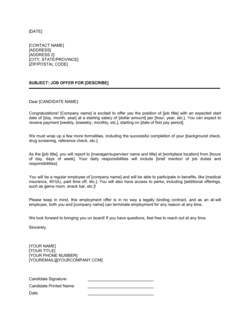
An offer letter confirms the role, start date, and compensation to secure the candidate's acceptance. A job description details the specific duties, qualifications, conduct standards, and physical requirements of the role. The offer letter triggers acceptance; the job description documents what the employee agreed to perform. Both should be signed before the first day of work.

vs Independent Contractor Agreement

An independent contractor agreement is used when engaging a self-employed individual for project-based work with no employment entitlements. In virtually all food service contexts, servers are employees β€” not contractors. Misclassifying a server as a contractor to avoid minimum wage, overtime, and payroll tax obligations carries significant legal and financial risk under FLSA and IRS standards.

vs Employee Handbook

An employee handbook sets company-wide policies β€” conduct standards, leave policies, anti-harassment procedures, and disciplinary processes β€” that apply to all staff. A server job description is role-specific, covering the duties, qualifications, and compensation terms unique to the server position. The handbook and job description work together: the description defines the role; the handbook governs the workplace.

Industry-specific considerations

Full-service restaurants

Tableside ordering, upselling protocols, and allergen knowledge are core enumerated duties; tip credit and tip pool disclosures are mandatory given tipped wage structures.

Hotel food and beverage

Servers may rotate across multiple outlets β€” restaurant, bar, room service, and banquet β€” requiring the job description to enumerate outlet-specific duties or reference separate outlet addenda.

Catering and event services

Seasonal and event-based scheduling requirements dominate; the availability clause must explicitly address variable hours and short-notice event calls to support schedule enforcement.

Healthcare and corporate dining

Dietary restriction compliance, HIPAA-adjacent confidentiality for patient-facing roles, and strict allergen-handling documentation elevate the qualifications and conduct sections beyond standard restaurant requirements.

Jurisdictional notes

United States

The FLSA permits a federal tip credit reducing the direct cash wage to $2.13/hr provided total tips bring earnings to at least $7.25/hr, but many states β€” including California, Minnesota, and Alaska β€” prohibit the tip credit entirely and require full minimum wage. Tip pooling rules were revised in 2018 to permit back-of-house inclusion when no tip credit is taken. Seven states have their own tip pool restrictions that go beyond federal law. Side work exceeding 20% of total work time may not be compensated at the tipped rate.

Canada

Canada has no federal equivalent to the FLSA tip credit; minimum wage for servers equals the general minimum wage in most provinces. Ontario abolished the lower liquor server minimum wage in 2019, requiring the general minimum wage for all servers. British Columbia and Quebec have their own minimum wage schedules updated annually. Tip allocation and tip pooling are governed by provincial employment standards β€” Ontario's Employment Standards Act, for example, prohibits employers from taking any portion of tips.

United Kingdom

The Employment (Allocation of Tips) Act 2023, in force from October 2024, requires employers to pass 100% of tips to workers and prohibits deducting tips to subsidize wages. Employers must maintain a written tip allocation policy and provide workers with access to it. The National Living Wage applies to servers aged 21 and over; the National Minimum Wage applies to younger workers on a tiered scale. Zero-hours contracts are common in hospitality but must accurately reflect actual working patterns under the Workers (Predictable Terms and Conditions) Act 2023.

European Union

EU member states set their own minimum wage floors and tip regulations β€” there is no EU-wide tip credit mechanism. The EU Transparent and Predictable Working Conditions Directive (2019/1152) requires employers to provide written particulars of employment on or before day one, including working hours, remuneration, and any probationary period. France requires a service charge breakdown on guest bills; Germany prohibits employers from treating tips as part of the taxable wage base for minimum wage calculations. Variable-schedule hospitality roles must comply with each member state's on-call and predictive scheduling rules.

Template vs lawyer β€” what fits your deal?

PathBest forCostTime
Use the templateRestaurants and small hospitality businesses hiring standard tipped servers in a single US state or Canadian provinceFree20–30 minutes
Template + legal reviewMulti-location operators, establishments applying tip pooling to back-of-house staff, or employers in jurisdictions with complex local wage laws (NYC, California, Ontario)$200–$500 for a labor attorney or HR consultant review1–2 days
Custom draftedHotel chains, large catering operations with complex shift structures, unionized workplaces, or employers with prior wage-and-hour litigation exposure$800–$2,500+1–2 weeks

Glossary

Tipped Employee
An employee who regularly receives more than $30 per month in tips, allowing employers in the US to pay a reduced direct cash wage under the FLSA tip credit provision.
Tip Credit
A legal mechanism permitting an employer to count a portion of an employee's tips toward meeting the federal or state minimum wage obligation.
Tip Pooling
An arrangement where servers contribute a percentage of their tips to a shared pool distributed among eligible staff β€” subject to strict federal and state rules on which employees may participate.
FLSA (Fair Labor Standards Act)
The US federal law that sets minimum wage, overtime pay, recordkeeping, and child labor standards β€” including specific provisions governing tipped employees.
At-Will Employment
Employment that either party may end at any time, for any lawful reason, without advance notice β€” the default standard in most US states.
Side Work
Non-tipped tasks servers perform during a shift β€” such as rolling silverware, stocking condiments, or cleaning stations β€” which must not exceed the FLSA's 20% rule relative to tipped work time.
Responsible Alcohol Service
Training and practices β€” such as checking ID and refusing service to visibly intoxicated guests β€” that reduce employer liability under dram shop laws.
Dram Shop Liability
Legal liability imposed on an establishment that serves alcohol to a visibly intoxicated person who subsequently causes injury or property damage to a third party.
POS System (Point of Sale)
The software and hardware servers use to enter orders, split bills, process payments, and track table activity β€” proficiency is a standard qualification requirement.
Availability Requirements
The employer's stated expectations for when an employee must be available to work β€” including evenings, weekends, and holidays β€” which must be documented to support scheduling disputes.
Acknowledgment Clause
A signature block at the end of a job description in which the employee confirms they have read, understood, and received a copy of the document.

Part of your Business Operating System

This document is one of 3,000+ business & legal templates included in Business in a Box.

  • Fill-in-the-blanks β€” ready in minutes
  • 100% customizable Word document
  • Compatible with all office suites
  • Export to PDF and share electronically

Create your document in 3 simple steps.

From template to signed document β€” all inside one Business Operating System.
1
Download or open template

Access over 3,000+ business and legal templates for any business task, project or initiative.

2
Edit and fill in the blanks with AI

Customize your ready-made business document template and save it in the cloud.

3
Save, Share, Send, Sign

Share your files and folders with your team. Create a space of seamless collaboration.

Save time, save money, and create top-quality documents.

β˜…β˜…β˜…β˜…β˜…

"Fantastic value! I'm not sure how I'd do without it. It's worth its weight in gold and paid back for itself many times."

Managing Director Β· Mall Farm
Robert Whalley
Managing Director, Mall Farm Proprietary Limited
β˜…β˜…β˜…β˜…β˜…

"I have been using Business in a Box for years. It has been the most useful source of templates I have encountered. I recommend it to anyone."

Business Owner Β· 4+ years
Dr Michael John Freestone
Business Owner
β˜…β˜…β˜…β˜…β˜…

"It has been a life saver so many times I have lost count. Business in a Box has saved me so much time and as you know, time is money."

Owner Β· Upstate Web
David G. Moore Jr.
Owner, Upstate Web

Run your business with a system β€” not scattered tools

Stop downloading documents. Start operating with clarity. Business in a Box gives you the Business Operating System used by over 250,000 companies worldwide to structure, run, and grow their business.

Start freeΒ Β·Β No credit card required