Paralegal Job Description Template

Free Word download β€’ Edit online β€’ Save & share with Drive β€’ Export to PDF

2 pagesβ€’20–30 min to fillβ€’Difficulty: Standardβ€’Signature requiredβ€’Legal review recommended
Learn more ↓
FreeParalegal Job Description Template

At a glance

What it is
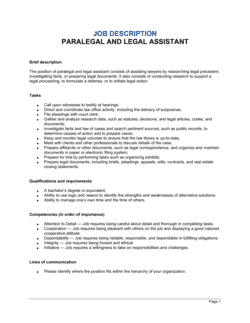
A Paralegal Job Description is a formal document that defines the scope of a paralegal role within a law firm or corporate legal department β€” covering duties, required qualifications, reporting structure, compensation range, and working conditions. This free Word download gives you a complete, editable starting point you can tailor to your practice area and export as PDF for posting or internal HR records.
When you need it
Use it when hiring a new paralegal, backfilling an existing role, or formalizing a position that has grown organically without written parameters. It is also required documentation in most HR compliance and equal-employment audit processes.
What's inside
Position title and reporting line, summary of purpose, detailed duties and responsibilities, required and preferred qualifications, compensation and benefits, working conditions, and an acknowledgment signature block. The template covers both law-firm and in-house corporate settings with bracketed placeholders throughout.

What is a Paralegal Job Description?

A Paralegal Job Description is a formal employment document that defines the full scope of a paralegal role within a law firm, corporate legal department, government agency, or nonprofit organization. It specifies the position title and practice area, summarizes the role's purpose, itemizes duties and responsibilities, sets required and preferred qualifications, states the compensation range and FLSA classification, describes working conditions, and includes a supervision clause that explicitly prohibits unauthorized practice of law. Unlike a casual posting or a verbal briefing, a properly structured paralegal job description functions as the foundational HR record against which performance is measured, pay equity is defended, and bar compliance is documented.

Why You Need This Document

Operating without a written paralegal job description creates four concrete problems simultaneously. First, without a documented supervision clause, the employing attorney has no written standard to point to if a paralegal oversteps into unauthorized practice of law β€” a bar discipline risk that can result in suspension or disbarment. Second, misclassifying a paralegal as FLSA-exempt without documented analysis of the learned-professional exemption exposes the firm to back-pay liability and penalty multipliers under the Department of Labor's enforcement program. Third, in pay-transparency jurisdictions β€” including California, Colorado, and New York β€” posting a role without a salary range is a direct compliance violation. Fourth, without a signed acknowledgment on file, enforcing performance standards tied to specific duties becomes a credibility contest in any employment dispute. This template closes all four gaps in under 30 minutes, giving you a defensible, signed record from day one.

Which variant fits your situation?

If your situation is…Use this template
Hiring a paralegal for a litigation-focused law firmLitigation Paralegal Job Description
Recruiting a paralegal for a corporate transactional practiceCorporate Paralegal Job Description
Posting a paralegal role within an in-house legal departmentIn-House Paralegal Job Description
Hiring a legal assistant rather than a credentialed paralegalLegal Assistant Job Description
Describing a senior or supervising paralegal with managerial dutiesSenior Paralegal Job Description
Engaging a paralegal on a contract or temporary basisContract Paralegal Agreement
Creating a full employment agreement to accompany the job descriptionEmployment Contract

Common mistakes to avoid

❌ Omitting the UPL supervision clause

Why it matters: Without explicit UPL language in the job description, there is no documented standard against which to discipline a paralegal who provides independent legal advice β€” and the supervising attorney faces bar liability for inadequate oversight.

Fix: Include a dedicated clause stating that all paralegal work is performed under attorney supervision and that the paralegal is prohibited from providing legal advice, appearing in court, or setting fees independently.

❌ Misclassifying the role as FLSA-exempt

Why it matters: Most paralegals are non-exempt under the FLSA because their primary duty does not require advanced knowledge in a field of science or learning customarily acquired by a prolonged course of specialized intellectual instruction β€” meaning overtime is owed.

Fix: Classify paralegal roles as non-exempt unless outside employment counsel has confirmed the specific duties meet the learned professional exemption test, and document that analysis in the HR file.

❌ Using a pay range that is below current market rates without disclosing it

Why it matters: In pay-transparency jurisdictions, failure to post a salary range is a compliance violation. Even where not required, posting a below-market range wastes candidate time and damages employer reputation.

Fix: Check NALA's annual paralegal salary survey and BLS Occupational Employment Statistics for your metro area and practice type, then post a range that is competitive within 10% of the median.

❌ Conflating paralegal and legal assistant duties

Why it matters: Paralegals perform substantive legal work β€” research, document drafting, case management β€” while legal assistants typically handle administrative support. Mixing the two creates mismatched expectations, pay disputes, and high turnover.

Fix: Review the ABA's definition of paralegal services and the NALA Model Standards before writing the duties section. If the role is primarily administrative, title and price it as a legal assistant.

❌ Not updating the job description before each new hire

Why it matters: A job description written three years ago for a different paralegal may no longer reflect current software, billing targets, or practice area focus β€” and creates misaligned expectations from day one.

Fix: Treat the job description as a living document. Review it before each hire cycle, update duties and tools, and have the current supervising attorney sign off on the revision.

❌ Omitting remote and hybrid work parameters

Why it matters: Candidates now treat work-location flexibility as a primary filter. A job description silent on this point drives high offer-rejection rates after interviews and misaligns expectations about court appearance obligations.

Fix: Explicitly state in-office days per week, whether remote work is permanent or trial-based, and any non-negotiable in-person requirements such as court appearances, client meetings, or trial preparation sessions.

The 10 key clauses, explained

Position Title and Reporting Line

In plain language: States the exact job title, the department or practice group, and the attorney or supervisor the paralegal reports to directly.

Sample language
Position Title: Paralegal β€” [PRACTICE GROUP, e.g., Corporate / Litigation / Real Estate]. Reports To: [SUPERVISING ATTORNEY NAME / TITLE], [DEPARTMENT]. Location: [OFFICE ADDRESS / REMOTE / HYBRID].

Common mistake: Using a generic title like 'Paralegal I' without specifying the practice area β€” candidates cannot self-screen for fit and the posting attracts unqualified applicants from unrelated legal fields.

Position Summary

In plain language: A 3–5 sentence overview of the role's core purpose, the type of work performed, the level of supervision, and the organizational context.

Sample language
The Paralegal will support [NUMBER] attorneys in the [PRACTICE GROUP] department by conducting legal research, preparing and filing court documents, managing case files, and coordinating client communications under direct attorney supervision. This is a [full-time / part-time] non-exempt position.

Common mistake: Writing a summary so broad it applies to any legal role β€” phrases like 'support the legal team' without specifying practice area or supervision level add no signal for qualified candidates.

Duties and Responsibilities

In plain language: An itemized list of the core tasks the paralegal is expected to perform, organized by function and weighted toward the most time-intensive activities.

Sample language
Draft, proofread, and finalize correspondence, pleadings, and contracts. Conduct legal research using [WESTLAW / LEXISNEXIS]. Manage docket and calendar deadlines for [NUMBER] active matters. Prepare document productions and privilege logs in response to discovery requests. Coordinate with clients, courts, and opposing counsel as directed by supervising attorneys.

Common mistake: Listing duties without indicating the relative time allocation β€” paralegals who discover that 70% of the role is administrative filing after accepting an offer typically leave within six months.

Required Qualifications

In plain language: The minimum education, experience, certifications, and technical skills a candidate must have to be considered for the role.

Sample language
Associate's or Bachelor's degree in Paralegal Studies or a related field, or equivalent combination of education and experience. Minimum [X] years of paralegal experience in [PRACTICE AREA]. Proficiency in [MICROSOFT OFFICE / CLIO / WESTLAW]. [CP / ACP certification preferred / required].

Common mistake: Setting experience requirements so high they screen out qualified candidates β€” requiring five or more years for a role with primarily administrative duties creates adverse-impact exposure and shrinks the applicant pool unnecessarily.

Preferred Qualifications

In plain language: Additional credentials, experience, or skills that differentiate stronger candidates but are not absolute requirements for the role.

Sample language
NALA Certified Paralegal (CP) or NFPA PACE designation. Experience with e-discovery platforms (Relativity, Concordance). Bilingual in [LANGUAGE]. Prior experience in [SPECIFIC INDUSTRY, e.g., healthcare, financial services].

Common mistake: Conflating required and preferred qualifications in a single list β€” candidates treat any listed requirement as a hard filter and self-screen out, reducing applications for roles where flexibility is actually available.

Supervision and Unauthorized Practice of Law Acknowledgment

In plain language: Clarifies that all paralegal work is performed under attorney supervision and explicitly prohibits the paralegal from providing independent legal advice, representing clients, or setting fees.

Sample language
All work performed by the Paralegal is subject to review and supervision by a licensed attorney. The Paralegal shall not provide legal advice to clients, appear in court on behalf of clients, or perform any function that constitutes the unauthorized practice of law under applicable state / provincial bar rules.

Common mistake: Omitting the UPL acknowledgment entirely β€” without it, the job description provides no documented basis for disciplining or terminating a paralegal who oversteps their role, and the supervising attorney faces bar exposure.

Compensation and Benefits

In plain language: States the salary range or hourly rate, pay frequency, FLSA classification, and a reference to the applicable benefits program.

Sample language
Hourly Rate: $[MIN]–$[MAX] per hour, commensurate with experience. FLSA Classification: Non-Exempt. Benefits: Medical, dental, vision, [X] days PTO, [401(k) / RRSP] with [X]% employer match. Overtime eligible for hours exceeding 40 per week.

Common mistake: Omitting the FLSA classification β€” misclassifying a paralegal as exempt from overtime is one of the most common wage-and-hour violations in law firm employment and triggers back-pay liability.

Working Conditions and Physical Requirements

In plain language: Describes the work environment, schedule expectations, remote or hybrid arrangements, travel requirements, and any physical demands of the role.

Sample language
This position operates in a professional office environment with standard business hours of [HOURS] and occasional overtime during trial preparation or deal closings. [Remote / Hybrid work available: X days per week.] Occasional travel to court, client offices, or [CITY] may be required.

Common mistake: Ignoring hybrid or remote work parameters entirely β€” candidates now treat work-location terms as a primary filter, and omitting them results in high offer-rejection rates after interviews.

Equal Opportunity and Accommodation Statement

In plain language: A standard EEO statement affirming the employer's commitment to non-discriminatory hiring and offering to provide reasonable accommodations to applicants with disabilities.

Sample language
[FIRM / COMPANY NAME] is an equal opportunity employer. We do not discriminate on the basis of race, color, religion, sex, national origin, age, disability, veteran status, or any other protected class. Applicants requiring accommodation in the application process may contact [HR CONTACT] at [EMAIL / PHONE].

Common mistake: Using a boilerplate EEO statement that has not been updated for recent protected-class additions β€” several US states and Canadian provinces have expanded protected categories in the last five years.

Acknowledgment and Signature Block

In plain language: A section where the hiring manager and, upon hire, the employee sign to confirm receipt, review, and understanding of the job description.

Sample language
I have read and understand the responsibilities, requirements, and expectations described in this job description. Employee Signature: _______________ Date: ______. Hiring Manager Signature: _______________ Date: ______.

Common mistake: Treating the job description as a one-time posting document rather than a signed HR record β€” without a signed acknowledgment on file, enforcing performance standards tied to documented duties becomes legally difficult.

How to fill it out

  1. 1

    Define the position title and practice area

    Enter the exact job title and the practice group or department. Specify whether the role is in a law firm, corporate legal department, government agency, or nonprofit. This single line determines which candidates self-select in.

    πŸ’‘ Titles like 'Paralegal β€” Real Estate' or 'Paralegal β€” Commercial Litigation' outperform generic 'Paralegal' postings in both application volume and candidate quality.

  2. 2

    Write the position summary

    Describe the role's core purpose in three to five sentences: what the paralegal does, for whom, in what practice area, and under what level of supervision. State whether it is full-time or part-time and note the FLSA classification.

    πŸ’‘ Lead with the most distinctive aspect of the role β€” if 40% of the work involves e-discovery, say so in the summary rather than burying it in the duties list.

  3. 3

    List duties in order of time intensity

    Itemize the primary duties from most to least time-consuming. Aim for eight to twelve bullet points. Use action verbs: draft, review, coordinate, manage, prepare, conduct, file.

    πŸ’‘ Validate the list against a one-week task log from your current or most recent paralegal in that role β€” job descriptions built from actual time data have significantly lower turnover.

  4. 4

    Set required and preferred qualifications separately

    List only non-negotiable minimums under 'Required' β€” education, years of experience, and tools the candidate must use from day one. Move everything else to 'Preferred.' Mixing the two lists reduces applications from qualified candidates who meet all the hard requirements.

    πŸ’‘ For most paralegal roles, a two-year degree plus two years of practice-area experience is a defensible minimum. Requiring a four-year degree can trigger adverse-impact scrutiny if the degree is not genuinely necessary.

  5. 5

    Include the UPL supervision clause

    Add the unauthorized practice of law acknowledgment verbatim or adapted from the template. Specify the name or title of the supervising attorney and confirm that all client-facing communication flows through that attorney.

    πŸ’‘ Your state or provincial bar association may have specific guidance on UPL language for paralegal employment documents β€” check the ABA or LSBC guidance before finalizing.

  6. 6

    Enter compensation range and FLSA classification

    Research market rates for paralegals in your metro area and practice area using NALA's salary survey or Bureau of Labor Statistics data. Enter a salary or hourly range and explicitly label the role as exempt or non-exempt.

    πŸ’‘ Several US states β€” California, Colorado, New York, Washington β€” and Canadian provinces require pay ranges to be disclosed in job postings. Check local pay-transparency laws before publishing.

  7. 7

    Add EEO statement and accommodation language

    Insert your organization's current equal opportunity employer statement and confirm it covers all protected categories required by applicable federal, state or provincial, and local law.

    πŸ’‘ If you have not reviewed your EEO language in more than two years, have HR or outside counsel confirm it is current β€” several states have added protections for cannabis use, salary history, and caregiver status since 2022.

  8. 8

    Obtain signatures before the first day of employment

    Have the hiring manager sign the finalized job description before posting it, and have the hired paralegal sign an acknowledgment copy on or before their first day. File both copies in the employee's personnel record.

    πŸ’‘ Attach the signed job description to the employment contract so both documents reference each other β€” this eliminates disputes about the scope of duties during performance reviews or disciplinary proceedings.

Frequently asked questions

What should a paralegal job description include?

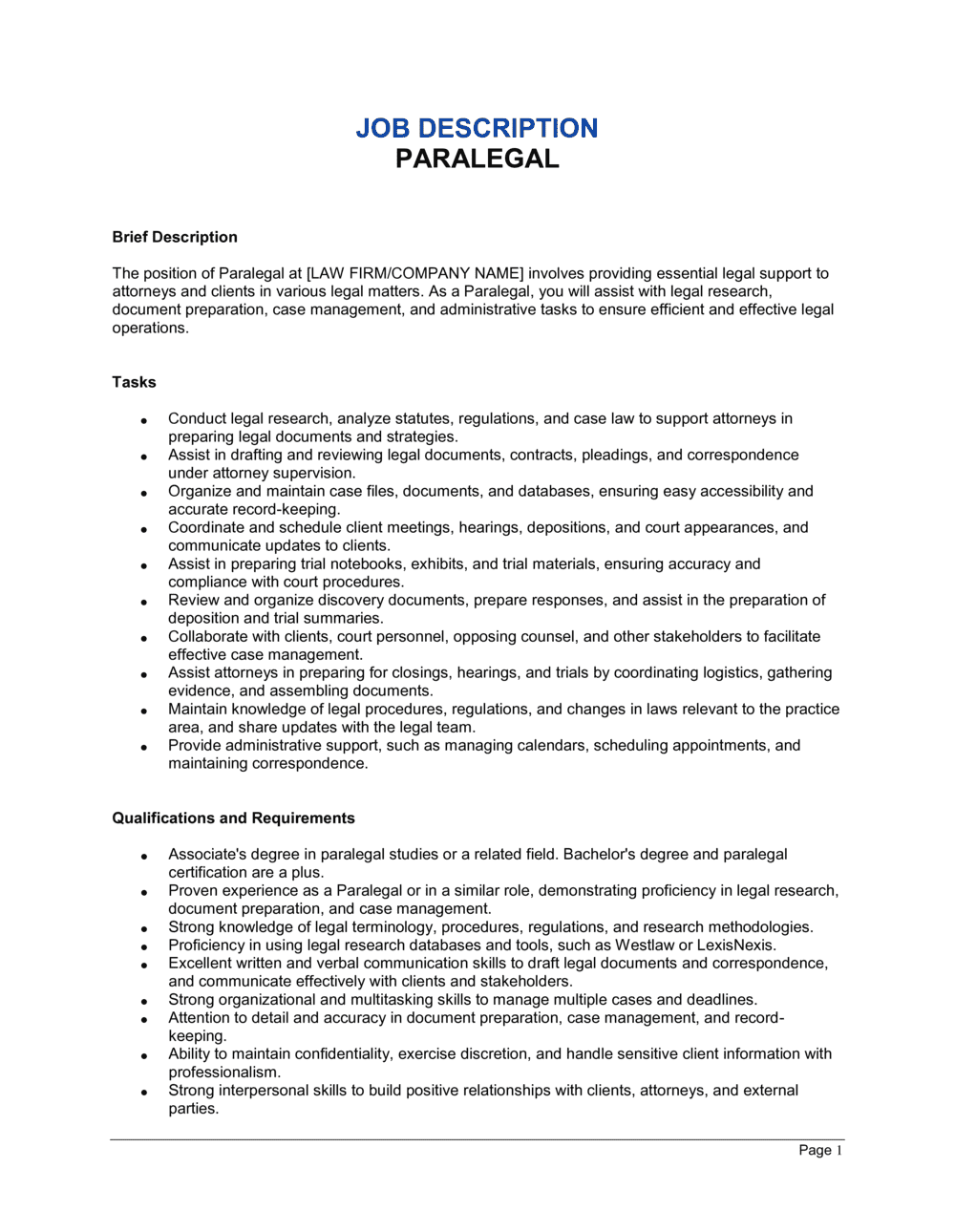
A complete paralegal job description includes the position title and practice area, a summary of the role's purpose, an itemized list of duties and responsibilities, required and preferred qualifications, FLSA classification and compensation range, working conditions, a supervision and unauthorized practice of law clause, an EEO statement, and a signature acknowledgment block. Missing any of these creates compliance exposure or misaligned candidate expectations.

Are paralegals exempt or non-exempt under the FLSA?

Most paralegals are classified as non-exempt under the Fair Labor Standards Act and are therefore entitled to overtime pay at 1.5Γ— their regular rate for hours worked over 40 in a week. The learned professional exemption that covers attorneys does not typically extend to paralegals unless the role requires advanced knowledge acquired through a prolonged course of specialized intellectual instruction β€” a high bar that most paralegal positions do not meet. Misclassifying a paralegal as exempt is one of the most common wage-and-hour violations in law firm employment.

Do I need to include a salary range in a paralegal job posting?

In Colorado, California, New York, Washington, and several other US states, pay transparency laws require employers to disclose a salary or hourly range in job postings. Even where not legally required, posting a range reduces time-to-fill and improves offer acceptance rates. NALA publishes an annual paralegal compensation survey that provides median rates by practice area and metro market.

What qualifications should I require for a paralegal role?

The baseline for most roles is an associate's or bachelor's degree in paralegal studies or a related field, plus two or more years of experience in the relevant practice area. NALA's Certified Paralegal (CP) or NFPA's PACE credential is strongly preferred for roles with significant drafting or client-facing responsibilities. Requiring a four-year degree when the duties do not genuinely require that level of education can trigger adverse-impact scrutiny under Title VII.

Why does a paralegal job description need a UPL clause?

The unauthorized practice of law clause documents that all paralegal work is performed under attorney supervision and that the paralegal may not provide independent legal advice, set fees, or represent clients in court. Without this clause, there is no written standard against which to discipline or terminate a paralegal who oversteps β€” and the supervising attorney faces disciplinary exposure from the state or provincial bar for inadequate oversight.

Can a paralegal job description serve as an employment contract?

No. A job description defines the scope, duties, and qualifications of a role but does not constitute a binding employment agreement. You need a separate employment contract to establish legally enforceable obligations around compensation, IP assignment, confidentiality, non-compete restrictions, and termination terms. The job description should be attached to β€” and referenced in β€” the employment contract so both documents are read together.

How often should a paralegal job description be updated?

Review and update the job description before each new hire, after any significant change in the paralegal's duties or the practice area's technology stack, and at least annually for roles with billable-hour targets. A job description more than two years old is likely to reference outdated software, incorrect compensation ranges, and duties that no longer reflect how the role actually functions.

What are the jurisdictional differences in paralegal regulations?

The United States has no uniform federal licensing requirement for paralegals β€” regulation is handled by state bar associations through ethics rules governing attorney supervision. Canada has provincial paralegal licensing in Ontario under the Law Society of Ontario; other provinces treat paralegals similarly to the US model. In the UK, paralegals are not regulated as a profession but may be regulated as legal practitioners in some contexts. EU member states vary widely β€” some have formal paralegal credentials while others do not recognize the title at all.

How this compares to alternatives

vs Legal Assistant Job Description

A legal assistant job description covers primarily administrative and clerical support roles β€” scheduling, filing, correspondence, and reception β€” that do not involve substantive legal work. A paralegal job description defines a role with drafting, research, and case management responsibilities that must be performed under attorney supervision. Conflating the two creates pay classification errors, misaligned candidate expectations, and bar ethics exposure.

vs Employment Contract

A job description defines the scope, duties, and qualifications of a role; it does not create legally enforceable compensation, IP, confidentiality, or termination obligations. An employment contract is the binding governing document that does. The two documents work together β€” the job description should be attached to and referenced in the employment contract, not used as a substitute for it.

vs Independent Contractor Agreement

An independent contractor agreement engages a self-employed paralegal for project-based or part-time work with no employment entitlements β€” no benefits, no tax withholding, no overtime. A paralegal job description is used when hiring an employee. Misclassifying a paralegal who works regular hours under attorney supervision as an independent contractor triggers IRS, state tax, and benefits liability.

vs Job Offer Letter

A job offer letter confirms the role, compensation, and start date to secure candidate acceptance β€” it is not a comprehensive governing document. A paralegal job description provides the detailed duty and qualification framework that the offer letter references. Relying on an offer letter alone leaves no documented performance standard, no UPL acknowledgment, and no signed record of what the paralegal agreed to do.

Industry-specific considerations

Law Firms

Practice-area specialization is critical β€” litigation, real estate, corporate, and family law paralegals have almost no task overlap, requiring separate job descriptions for each.

Corporate Legal Departments

In-house paralegals typically handle contract management, compliance tracking, and regulatory filings, with billing-rate concerns replaced by cost-center headcount approvals.

Government and Public Sector

Government paralegal roles require civil service classification compliance, union-agreement interaction, and security clearance conditions that must be stated explicitly in the job description.

Healthcare and Life Sciences

Healthcare paralegals support HIPAA compliance, FDA regulatory submissions, and healthcare contract reviews β€” requiring industry-specific experience references that generic templates omit.

Jurisdictional notes

United States

No federal license is required to work as a paralegal in the US β€” regulation is through state bar ethics rules governing attorney supervision. Most paralegals are non-exempt under the FLSA and must receive overtime. Several states, including California, Colorado, New York, and Washington, require salary ranges to be disclosed in job postings. California AB 2832 and similar state laws have expanded protected categories beyond federal Title VII.

Canada

Ontario is the only province with formal paralegal licensing under the Law Society of Ontario β€” licensed paralegals in Ontario may appear in small claims court and before certain tribunals independently. In all other provinces, paralegals operate under the same attorney-supervision model as the US. Quebec job descriptions must be provided in French for provincially regulated employers. Pay equity legislation in Ontario and federally regulated workplaces affects how paralegal roles are classified and compensated.

United Kingdom

Paralegals in the UK are not a regulated profession under the Legal Services Act 2007, though some may be regulated as legal practitioners in specific contexts. Employers must provide a written statement of employment particulars on or before the first day of work. The National Living Wage and Working Time Regulations cap weekly hours at 48 unless the worker opts out in writing. UK job descriptions should include IR35 considerations if the role may be structured through a personal service company.

European Union

The paralegal title and role vary significantly across EU member states β€” some countries have formal credentials while others do not recognize the title. The EU Transparent and Predictable Working Conditions Directive requires written employment terms within seven days of hire. GDPR applies to any personal data of applicants or employees processed during the hiring process, requiring a lawful basis and privacy notice. Works councils in Germany, France, and the Netherlands may need to be consulted before implementing a new job description.

Template vs lawyer β€” what fits your deal?

PathBest forCostTime
Use the templateLaw firms and legal departments hiring paralegals for standard roles in a single US state or Canadian provinceFree20–30 minutes
Template + legal reviewMulti-state employers, roles with restrictive covenants, or practices in heavily regulated industries such as healthcare or financial services$200–$500 (employment counsel review)1–3 days
Custom draftedLarge law firms standardizing paralegal classifications across multiple offices and jurisdictions, or practices facing past wage-and-hour exposure$500–$2,000+1–2 weeks

Glossary

Paralegal
A trained legal professional who performs substantive legal work under the supervision of a licensed attorney but is not licensed to practice law independently.
Unauthorized Practice of Law (UPL)
The act of providing legal services or advice in a manner reserved for licensed attorneys β€” a risk that paralegal job descriptions must explicitly guard against by defining supervision requirements.
FLSA Exemption
A classification under the US Fair Labor Standards Act determining whether a role is exempt from overtime pay requirements β€” most paralegals are non-exempt and entitled to 1.5Γ— pay for hours over 40 per week.
ABA Guidelines
The American Bar Association's model guidelines for the utilization of paralegal services, which establish ethical standards for paralegal supervision and task delegation.
NALA Certification
The Certified Paralegal (CP) credential awarded by the National Association of Legal Assistants, a widely recognized benchmark for paralegal competency in the United States.
Billable Hour
A unit of time β€” typically six minutes or a tenth of an hour β€” that a paralegal charges to a client matter; paralegal billing rates are typically 40–60% of the supervising attorney's rate.
Docket Management
The process of tracking deadlines, hearing dates, filing requirements, and case milestones across multiple active matters to ensure nothing is missed.
Legal Research
The process of identifying and retrieving applicable statutes, case law, regulations, and secondary sources to support attorney analysis or case strategy.
E-Discovery
The identification, collection, and production of electronically stored information (ESI) in litigation β€” a specialized paralegal function requiring familiarity with platforms such as Relativity or Concordance.
Supervising Attorney
The licensed attorney legally responsible for overseeing a paralegal's work product and ensuring it meets professional responsibility standards.

Part of your Business Operating System

This document is one of 3,000+ business & legal templates included in Business in a Box.

  • Fill-in-the-blanks β€” ready in minutes
  • 100% customizable Word document
  • Compatible with all office suites
  • Export to PDF and share electronically

Create your document in 3 simple steps.

From template to signed document β€” all inside one Business Operating System.
1
Download or open template

Access over 3,000+ business and legal templates for any business task, project or initiative.

2
Edit and fill in the blanks with AI

Customize your ready-made business document template and save it in the cloud.

3
Save, Share, Send, Sign

Share your files and folders with your team. Create a space of seamless collaboration.

Save time, save money, and create top-quality documents.

β˜…β˜…β˜…β˜…β˜…

"Fantastic value! I'm not sure how I'd do without it. It's worth its weight in gold and paid back for itself many times."

Managing Director Β· Mall Farm
Robert Whalley
Managing Director, Mall Farm Proprietary Limited
β˜…β˜…β˜…β˜…β˜…

"I have been using Business in a Box for years. It has been the most useful source of templates I have encountered. I recommend it to anyone."

Business Owner Β· 4+ years
Dr Michael John Freestone
Business Owner
β˜…β˜…β˜…β˜…β˜…

"It has been a life saver so many times I have lost count. Business in a Box has saved me so much time and as you know, time is money."

Owner Β· Upstate Web
David G. Moore Jr.
Owner, Upstate Web

Run your business with a system β€” not scattered tools

Stop downloading documents. Start operating with clarity. Business in a Box gives you the Business Operating System used by over 250,000 companies worldwide to structure, run, and grow their business.

Free Forever PlanΒ Β·Β No credit card required