Underwriter Job Description Template

Free Word download • Edit online • Save & share with Drive • Export to PDF

2 pages20–30 min to fillDifficulty: StandardSignature requiredLegal review recommended
Learn more ↓
FreeUnderwriter Job Description Template

At a glance

What it is
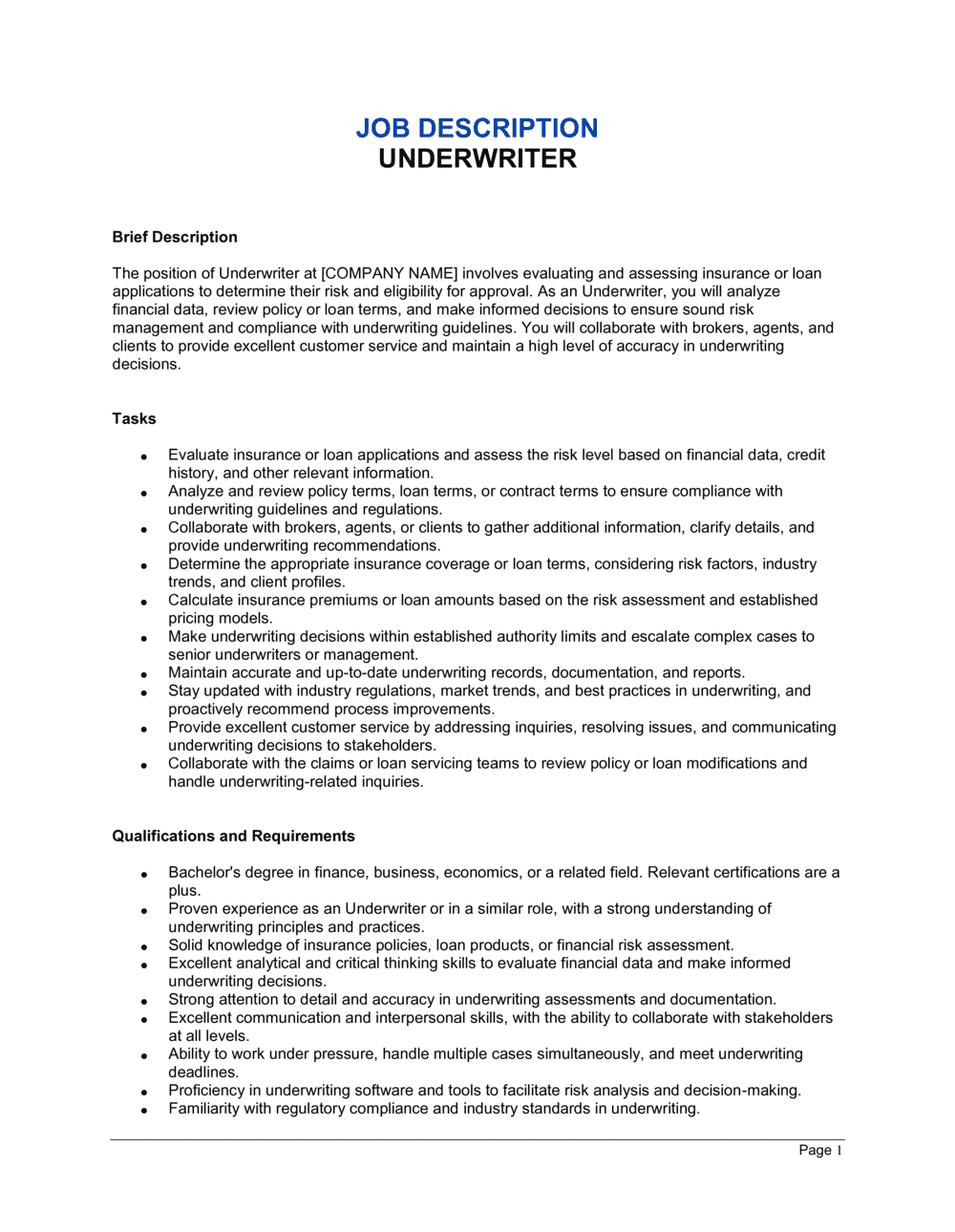
An Underwriter Job Description is a formal employment document that defines the duties, qualifications, licensing requirements, reporting structure, and compensation parameters for an underwriting role. This free Word download lets you edit and customize the position description, add your organization's specifics, and export as PDF for job postings, offer letters, or internal HR records — all in one structured document.
When you need it
Use it when hiring a new underwriter, backfilling a vacant underwriting position, or formalizing the scope of an existing role for compliance, performance management, or compensation benchmarking purposes.
What's inside
Position title and department, reporting structure, core underwriting duties, risk assessment responsibilities, licensing and certification requirements, required and preferred qualifications, compensation range, and equal opportunity and compliance language.

What is an Underwriter Job Description?

An Underwriter Job Description is a formal employment document that defines the scope, duties, qualifications, licensing requirements, and delegated authority for an underwriting position — whether in insurance, mortgage lending, commercial banking, or investment banking. It functions as the authoritative reference for recruiting, onboarding, performance management, and regulatory compliance throughout the employee's tenure. Unlike a generic job posting, a well-drafted underwriter job description specifies binding authority limits, required professional licenses by jurisdiction, risk assessment responsibilities, and the measurable performance standards by which the role is evaluated.

Why You Need This Document

Without a formal underwriter job description, hiring conversations stall on scope disagreements, candidates self-screen based on inaccurate assumptions, and newly hired underwriters operate without a documented authority threshold — creating unauthorized commitments or excessive escalations that slow production. In regulated industries, the absence of a written role definition can complicate state insurance department examinations, FINRA audits, or FCA reviews that require documented evidence of how underwriting authority is assigned and controlled. A precise job description also protects against disparate impact claims during hiring by ensuring every qualification has a documented business necessity. This template gives you a structured, jurisdiction-aware starting point that covers licensing, authority limits, pay transparency requirements, and EEO compliance — reducing the time to a defensible, recruiter-ready document from days to under an hour.

Which variant fits your situation?

If your situation is…Use this template
Hiring a property and casualty insurance underwriterInsurance Underwriter Job Description
Filling a residential mortgage underwriting roleMortgage Underwriter Job Description
Recruiting a securities or equity underwriter at an investment bankSecurities Underwriter Job Description
Onboarding a commercial loan underwriter at a bank or credit unionCommercial Loan Underwriter Job Description
Defining a senior or lead underwriter with supervisory dutiesSenior Underwriter Job Description
Describing a reinsurance underwriter role at a specialty firmReinsurance Underwriter Job Description
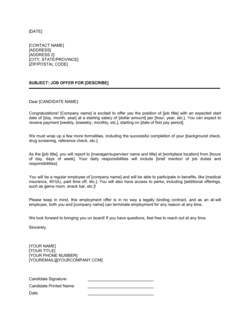
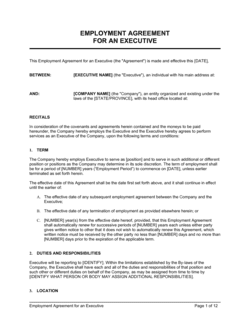
Creating a full employment agreement after the job description is acceptedEmployment Agreement (At-Will Employee)

Common mistakes to avoid

❌ Omitting binding authority limits

Why it matters: Without a stated authority threshold, underwriters make inconsistent escalation decisions — resulting in unauthorized commitments or excessive approval bottlenecks that slow production.

Fix: State the specific dollar or coverage limit in the duties section and align it to your internal underwriting guidelines before publishing the description.

❌ Listing designations as 'required' when they are truly preferred

Why it matters: Requiring a CPCU, CFA, or similar designation eliminates a large pool of experienced candidates who are actively pursuing the credential — with no demonstrable performance benefit.

Fix: Move all designations that are not genuinely mandatory to the 'Preferred Qualifications' section and note that candidates in progress toward the designation are encouraged to apply.

❌ Skipping salary range disclosure in pay-transparency jurisdictions

Why it matters: Colorado, New York, Washington, and California require salary range disclosure in job postings. Non-compliance triggers state agency complaints, fines, and reputational damage in talent markets.

Fix: Identify every jurisdiction where the role will be posted or could be worked remotely, check current pay transparency statutes, and include a compliant salary range before publishing.

❌ Blending required and preferred qualifications into one list

Why it matters: Candidates cannot tell which requirements are eliminatory — overqualified candidates self-screen out, and underqualified candidates flood the pipeline, wasting recruiter time.

Fix: Use two clearly labeled sections — 'Required Qualifications' and 'Preferred Qualifications' — and review each item with the hiring manager to confirm its classification.

❌ Using a generic EEO statement without jurisdictional tailoring

Why it matters: Federal EEO language omits protected categories added by state and provincial laws — exposing the employer to discrimination claims and regulatory findings in operating jurisdictions.

Fix: Build a master EEO statement that includes the superset of protected categories across all jurisdictions where you recruit, and review it annually as new legislation takes effect.

❌ Writing the position summary about the company rather than the role

Why it matters: Candidates skim the summary to determine relevance in under 30 seconds. A company overview forces them to read further to find role-specific information — increasing drop-off rates on job boards.

Fix: Lead the summary with the role's primary function, the type of risk or portfolio managed, and the key outcome expected. Save company background for the end of the posting or a separate 'About Us' section.

The 9 key clauses, explained

Position title, department, and reporting structure

In plain language: Names the specific underwriting role, identifies the business unit it sits in, and states the direct reporting line.

Sample language
Position: [UNDERWRITER TITLE] | Department: [UNDERWRITING / RISK / MORTGAGE] | Reports to: [MANAGER TITLE], [DEPARTMENT NAME] | Location: [CITY, STATE] or Remote

Common mistake: Using a generic title like 'Underwriter' without specifying the line of business — this attracts candidates from incompatible specialties (e.g., property underwriters applying for securities roles) and complicates HRIS classification.

Position summary

In plain language: A 3–5 sentence overview of the role's core function, the types of risk evaluated, and the business outcome the underwriter is expected to drive.

Sample language
[COMPANY NAME] seeks an experienced [UNDERWRITER TYPE] to evaluate [RISK TYPE] applications, make approval decisions within delegated authority of up to $[LIMIT], and maintain a book of [X] accounts. The successful candidate will balance risk quality with production targets in a [INDUSTRY] environment.

Common mistake: Writing a summary that describes the company instead of the role. Candidates skim summaries to decide whether to read further — lead with what the underwriter will actually do, not your company's founding story.

Core duties and responsibilities

In plain language: An itemized list of the primary tasks the underwriter will perform daily, from application review through approval, declination, or referral.

Sample language
Analyze [LOAN / POLICY / SECURITIES] applications for completeness and accuracy; assess financial statements, credit reports, and [COLLATERAL / ACTUARIAL] data; issue approvals, declinations, or counteroffers within delegated authority of $[AMOUNT]; document decisions in [SYSTEM NAME]; and maintain a loss ratio / portfolio quality target of [METRIC].

Common mistake: Listing 15 or more duties without grouping them by function. An overloaded duties section obscures the role's true priority and makes performance management harder.

Risk assessment and decision authority

In plain language: Defines the types of risk the underwriter evaluates, the decision criteria applied, and the financial or coverage limits within which they can act independently.

Sample language
Underwriter has binding authority to approve transactions up to $[DOLLAR LIMIT] per occurrence. Transactions exceeding $[LIMIT] or falling outside standard guidelines require referral to [SENIOR UNDERWRITER / COMMITTEE]. All exception decisions must be documented with written justification in [SYSTEM].

Common mistake: Omitting the binding authority limit from the job description. Without a stated limit, new hires and managers disagree on escalation thresholds — leading to unauthorized commitments or excessive bottlenecks.

Licensing and regulatory requirements

In plain language: States any required or preferred professional licenses, certifications, and regulatory registrations that the candidate must hold or obtain within a specified timeframe.

Sample language
Required: [STATE] Property & Casualty Insurance License / FINRA Series 79 / NMLS Mortgage Loan Originator License. Preferred: [CPCU / AU / CFA / CMB Designation]. Licenses must be maintained in good standing. [COMPANY NAME] will sponsor eligible license applications within [X] days of hire.

Common mistake: Listing a desired designation (e.g., CPCU or CFA) as 'required' when the hiring manager would accept candidates currently pursuing it. This unnecessarily shrinks the qualified applicant pool.

Required qualifications and experience

In plain language: Specifies minimum education, years of relevant experience, technical skills, and domain knowledge the candidate must demonstrate to be considered.

Sample language
Bachelor's degree in [FINANCE / BUSINESS / ACTUARIAL SCIENCE] or equivalent; minimum [X] years of [LINE OF BUSINESS] underwriting experience; proficiency in [SYSTEM NAME]; demonstrated knowledge of [REGULATORY FRAMEWORK / UNDERWRITING GUIDELINES].

Common mistake: Setting experience thresholds that inadvertently screen out protected classes under EEOC guidelines — for example, requiring '10+ years of experience' for a role a 7-year professional could perform. Apply a business necessity test to every requirement.

Preferred qualifications

In plain language: Lists skills, credentials, or experience that would make a candidate stronger but are not disqualifying if absent.

Sample language
Preferred: [DESIGNATION] designation; experience with [SPECIFIC PORTFOLIO TYPE]; bilingual in [LANGUAGE]; familiarity with [REGULATORY BODY] examination process; prior experience managing a book exceeding $[AMOUNT] in premium or loan volume.

Common mistake: Blending required and preferred qualifications into a single list. Candidates cannot distinguish what is mandatory, which leads to underqualified applications and missed referrals from qualified candidates who self-screened out.

Compensation, benefits, and employment type

In plain language: States the salary range, bonus or incentive structure, benefits eligibility, employment classification (exempt/non-exempt), and schedule.

Sample language
Base salary: $[MIN] – $[MAX] annually, commensurate with experience. Annual bonus: up to [X]% of base based on portfolio performance and individual objectives. Benefits: [HEALTH / DENTAL / VISION / 401(K)]. Employment type: Full-time, Exempt. Schedule: [HOURS / REMOTE POLICY].

Common mistake: Omitting the salary range entirely in jurisdictions (Colorado, New York, California, Illinois) where pay transparency laws require disclosure in job postings — exposing the employer to regulatory penalties and reputational risk.

Equal opportunity and compliance statement

In plain language: A legally required declaration that the employer does not discriminate on the basis of protected characteristics and, where applicable, invites accommodation requests.

Sample language
[COMPANY NAME] is an equal opportunity employer. All qualified applicants will receive consideration for employment without regard to race, color, religion, sex, national origin, disability, age, veteran status, or any other characteristic protected by applicable law. Applicants requiring accommodation should contact [HR CONTACT / EMAIL].

Common mistake: Using a boilerplate EEO statement that does not include all protected categories required in the employer's operating jurisdictions. State and provincial laws often add protections beyond federal minimums — e.g., sexual orientation and gender identity in Canada and many US states.

How to fill it out

  1. 1

    Confirm the specific underwriting line of business

    Identify whether the role covers insurance (P&C, life, health, specialty), mortgage, commercial lending, or securities underwriting. The line of business determines licensing requirements, system references, and performance metrics.

    💡 If the role spans multiple lines, create separate sections for each — blending responsibilities from unrelated lines produces a confusing job description that attracts unqualified candidates.

  2. 2

    Define the reporting structure and team context

    Enter the direct manager's title, the department name, and whether the underwriter will work independently or as part of a team with shared accounts. For senior roles, note if the position has supervisory responsibilities.

    💡 Naming the reporting title (not the person) keeps the document accurate through management changes and avoids the need to re-issue the description with every personnel update.

  3. 3

    Draft the core duties list with a production or quality metric

    List the primary responsibilities in order of time allocation. For each major duty, attach a measurable standard — e.g., 'review and decision a minimum of [X] applications per week' or 'maintain a loss ratio below [X]%.'

    💡 Limit the duties list to 8–10 items. If you find yourself listing more, group related tasks under a single heading and move granular details to a separate performance plan.

  4. 4

    Set the binding authority limit and escalation threshold

    Enter the dollar amount or coverage limit the underwriter can approve without escalation, and the threshold at which decisions require senior review or committee approval. Align this with your organization's credit or underwriting policy.

    💡 Coordinate with legal or compliance before publishing binding authority limits in a publicly posted job description — some firms treat delegated authority levels as confidential.

  5. 5

    List required licenses with jurisdiction-specific detail

    Identify every license or NMLS registration required for the role in each state or province where the underwriter will operate. Specify whether the company will sponsor new applications and the expected timeframe.

    💡 Check your state's Department of Insurance or NMLS licensing lookup before publishing — license names and requirements vary materially by state, and errors expose the employer to non-compliance findings.

  6. 6

    Separate required from preferred qualifications

    Place hard minimum requirements (degree, years of experience, specific license) in a clearly labeled 'Required Qualifications' block. Move nice-to-haves to a separate 'Preferred Qualifications' block. Apply a business necessity test to each required item.

    💡 Run the required qualifications list past your EEO officer or HR counsel before posting — experience-year requirements above what the role actually demands can constitute disparate impact under EEOC guidance.

  7. 7

    Insert the salary range and check pay transparency requirements

    Enter the base salary range and bonus structure. Confirm whether the posting jurisdiction requires salary range disclosure — Colorado, New York, Washington, California, and Illinois all have active pay transparency laws.

    💡 Post the broadest range you can credibly offer rather than a narrow band. Artificially narrow ranges reduce applicant volume and create offer negotiation problems when strong candidates fall outside the stated range.

  8. 8

    Review the EEO statement for jurisdictional completeness

    Confirm the equal opportunity statement covers all protected categories required in every jurisdiction where you are hiring. Add state or provincial categories — such as sexual orientation, gender identity, or source of income — as applicable.

    💡 If you operate across multiple states or provinces, maintain a master EEO statement that includes the superset of all applicable protected categories rather than the federal minimum alone.

Frequently asked questions

What is an underwriter job description?

An underwriter job description is a formal document that defines the duties, qualifications, licensing requirements, decision authority, and compensation parameters for an underwriting role. It serves as the authoritative record of what the position entails for recruitment, onboarding, performance management, and compliance purposes. A well-drafted description reduces hiring mismatches and establishes the scope of the underwriter's delegated authority from day one.

What does an underwriter do?

An underwriter evaluates applications for insurance policies, mortgage loans, commercial credit, or securities offerings to determine whether and on what terms the risk is acceptable. They analyze financial statements, credit reports, actuarial data, or property appraisals, then approve, decline, or modify the application within their delegated authority. The core output is a documented risk decision that balances portfolio quality against production targets.

What qualifications should an underwriter job description require?

At minimum: a bachelor's degree in finance, business, or a related field; a specified number of years of experience in the relevant line of business; required licenses (state P&C license, NMLS registration, or FINRA Series 79, depending on the role); and proficiency in the firm's underwriting or loan origination system. Designations such as CPCU, AU, or CMB are typically listed as preferred rather than required unless the role specifically demands them.

Does an underwriter job description need to include a salary range?

In several US states — including Colorado, New York, Washington, and California — and in some Canadian provinces, employers are legally required to include a salary range in job postings. Even where not legally mandated, including a range is increasingly expected by candidates and reduces time spent on mismatched offers. Review the pay transparency laws in every jurisdiction where the role will be posted or worked before publishing.

What licenses are typically required for an underwriting role?

License requirements vary by line of business. Insurance underwriters typically need a state-issued Property and Casualty or Life and Health license in every state where they bind coverage. Mortgage underwriters may need an NMLS Mortgage Loan Originator license depending on their exact function and employer type. Securities underwriters at investment banks typically require a FINRA Series 79 (Investment Banking Representative) license. The job description should specify required licenses by jurisdiction.

What is binding authority and why does it belong in a job description?

Binding authority is the delegated limit up to which an underwriter can approve risk or commit the employer without senior sign-off. Including it in the job description sets expectations before hire, aligns the role with internal underwriting policy, and provides the performance framework for escalation training. Omitting it consistently leads to unauthorized commitments or excessive referrals to management that slow production.

How does an underwriter job description differ from an employment contract?

A job description defines the role's scope, duties, and qualifications — it is typically incorporated by reference into an employment contract but does not on its own create binding contractual obligations regarding compensation, termination, or IP. An employment contract governs the legal relationship, including non-compete, confidentiality, severance, and governing law. For regulated underwriting roles, both documents should be executed before the employee's first day.

Should an underwriter job description reference specific underwriting systems?

Yes, where the system is a genuine job requirement. If the underwriter must use a specific platform — such as Guidewire, Encompass, Salesforce Financial Services Cloud, or a proprietary loan origination system — list it in the required or preferred qualifications. This reduces onboarding time and signals to experienced candidates that proficiency will be tested. Avoid listing systems that are interchangeable or where training is provided regardless of prior experience.

What EEO language must an underwriter job description include?

At minimum, the federal EEO statement covering race, color, religion, sex, national origin, disability, age, and veteran status. Many states and all Canadian provinces add protected categories such as sexual orientation, gender identity, marital status, and source of income. The safest approach is to use a master EEO statement that covers the superset of all applicable categories across your recruiting jurisdictions and review it annually as legislation changes.

How this compares to alternatives

vs Employment Agreement (At-Will Employee)

A job description defines the role's scope, duties, and qualifications for recruiting and onboarding purposes. An employment agreement creates the binding legal relationship covering compensation, IP assignment, confidentiality, non-compete, and termination. Job descriptions are typically incorporated by reference into the employment agreement. You need both — the description to attract and qualify candidates, the agreement to govern the relationship once hired.

vs Job Offer Letter

A job offer letter confirms compensation, start date, and employment conditions to secure a candidate's acceptance. It references the job description but does not restate duties in full. The job description is the source document for what the role requires; the offer letter is the transactional document that initiates the hire. Issue both in sequence — description first, offer letter after the candidate clears the final round.

vs Performance Review Template

A job description establishes what the underwriter is expected to do; a performance review evaluates how well they did it against measurable standards. The binding authority limits, production targets, and portfolio quality metrics in the job description should flow directly into the performance review criteria. Without a clear job description, performance reviews become subjective and legally difficult to defend.

vs Independent Contractor Agreement

Underwriting is one of the roles most scrutinized under employee-vs.-contractor classification tests, because licensed underwriters typically work set hours, use employer systems, and operate under binding authority delegated by the employer — all factors that weigh toward employee status. Using a contractor agreement for a role that functions like an employee creates IRS, state labor, and insurance regulatory liability. Use the job description paired with an employment agreement for genuine underwriting hires.

Industry-specific considerations

Insurance

P&C, life, health, and specialty lines underwriters require state-specific licensing, actuarial data fluency, and loss ratio performance targets unique to each line of business.

Mortgage and Real Estate Finance

Residential and commercial mortgage underwriters evaluate DTI, LTV, and credit scores against agency or proprietary guidelines, with NMLS licensing requirements varying by state and employer type.

Investment Banking and Securities

Securities underwriters support IPOs, debt offerings, and private placements, requiring FINRA Series 79 registration and deep knowledge of SEC disclosure requirements and deal structuring.

Commercial Banking and Credit Unions

Commercial loan underwriters assess business financials, cash flow, and collateral against internal credit policy, with authority limits and escalation thresholds driven by loan size and risk grade.

Jurisdictional notes

United States

Insurance underwriters require a state-issued license in every state where they bind coverage — licenses are not federally portable and must be obtained separately in each operating state. Mortgage underwriters may require an NMLS MLO license depending on their employer type and specific function. Pay transparency laws in Colorado, New York, Washington, California, and Illinois require salary range disclosure in job postings. EEO statements must cover federal protected categories at minimum, with many states adding sexual orientation, gender identity, and other protections.

Canada

Insurance underwriters in Canada must meet provincial licensing requirements administered by bodies such as RIBO in Ontario or the Insurance Council of BC — there is no single national license. Quebec requires French-language job postings for provincially regulated employers. Pay equity legislation in Ontario, Quebec, and federally regulated sectors may affect compensation structure disclosures. Canadian human rights legislation prohibits discrimination on grounds including sexual orientation and gender identity, which must be reflected in the EEO statement.

United Kingdom

Underwriters in FCA-regulated firms may require FCA Authorization as an Approved Person or as a Senior Manager under the Senior Managers and Certification Regime (SM&CR). The job description must reflect the specific Controlled Function or Certified Function the role performs. The Equality Act 2010 governs protected characteristics and must inform the EEO statement. Gender pay gap reporting obligations apply to employers with 250 or more employees, which may affect how compensation information is presented in the job description.

European Union

Insurance underwriters in EU member states must meet requirements under the Insurance Distribution Directive (IDD), which mandates professional knowledge and continuing education standards that vary by member state. The EU Pay Transparency Directive (effective 2026) will require employers to disclose salary ranges in job advertisements across all member states. GDPR governs the collection of candidate personal data during the recruitment process — the job posting should not request information beyond what is necessary for the underwriting role assessment.

Template vs lawyer — what fits your deal?

PathBest forCostTime
Use the templateStandard underwriting hires in a single jurisdiction where licensing requirements are well understood internallyFree30–60 minutes
Template + legal reviewMulti-state hiring, roles with material binding authority limits, or organizations subject to state insurance department oversight$300–$600 (HR counsel review)1–3 days
Custom draftedSenior or chief underwriting officer roles with equity, complex non-compete requirements, or cross-border hiring in regulated markets$1,000–$3,500+1–2 weeks

Glossary

Underwriting
The process of evaluating the risk associated with a loan, insurance policy, or securities offering to determine whether and on what terms to accept it.
Risk Assessment
A structured evaluation of applicant financials, credit history, property data, or actuarial tables to quantify the likelihood and cost of a potential loss.
Loss Ratio
Insurance claims paid divided by premiums earned — a core metric underwriters use to evaluate the profitability of a book of business.
Debt-to-Income Ratio (DTI)
A borrower's total monthly debt payments divided by gross monthly income, used by mortgage underwriters to assess repayment capacity.
FINRA Series 79
A Financial Industry Regulatory Authority license required for investment banking professionals, including those involved in securities underwriting transactions.
Combined Ratio
Loss ratio plus expense ratio — a figure below 100% indicates an insurance company is generating underwriting profit.
Actuarial Data
Statistical data on historical loss frequencies and severities used by underwriters to price risk and set policy terms.
Binding Authority
The delegated power granted to an underwriter to accept risk and issue coverage up to a defined limit without requiring senior approval.
Reinsurance
Insurance purchased by an insurer from another insurer to limit exposure on large or catastrophic risks — underwriters must understand reinsurance treaty terms when pricing policies.
Loan-to-Value Ratio (LTV)
The ratio of a loan amount to the appraised value of the collateral property — a primary metric in mortgage underwriting decisions.
Exception Underwriting
A decision to approve a risk or loan that falls outside standard guidelines, requiring documented justification and often senior approval.

Part of your Business Operating System

This document is one of 3,000+ business & legal templates included in Business in a Box.

  • Fill-in-the-blanks — ready in minutes
  • 100% customizable Word document
  • Compatible with all office suites
  • Export to PDF and share electronically

Create your document in 3 simple steps.

From template to signed document — all inside one Business Operating System.
1
Download or open template

Access over 3,000+ business and legal templates for any business task, project or initiative.

2
Edit and fill in the blanks with AI

Customize your ready-made business document template and save it in the cloud.

3
Save, Share, Send, Sign

Share your files and folders with your team. Create a space of seamless collaboration.

Save time, save money, and create top-quality documents.

★★★★★

"Fantastic value! I'm not sure how I'd do without it. It's worth its weight in gold and paid back for itself many times."

Managing Director · Mall Farm
Robert Whalley
Managing Director, Mall Farm Proprietary Limited
★★★★★

"I have been using Business in a Box for years. It has been the most useful source of templates I have encountered. I recommend it to anyone."

Business Owner · 4+ years
Dr Michael John Freestone
Business Owner
★★★★★

"It has been a life saver so many times I have lost count. Business in a Box has saved me so much time and as you know, time is money."

Owner · Upstate Web
David G. Moore Jr.
Owner, Upstate Web

Run your business with a system — not scattered tools

Stop downloading documents. Start operating with clarity. Business in a Box gives you the Business Operating System used by over 250,000 companies worldwide to structure, run, and grow their business.

Start free · No credit card required