I Value Your Business and Regret Losing it Template

Free Word download β€’ Edit online β€’ Save & share with Drive β€’ Export to PDF

1 pageβ€’20–30 min to fillβ€’Difficulty: Standardβ€’Signature requiredβ€’Legal review recommended
Learn more ↓
FreeI Value Your Business and Regret Losing it Template

At a glance

What it is
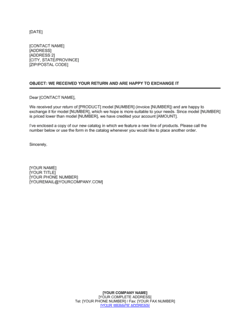
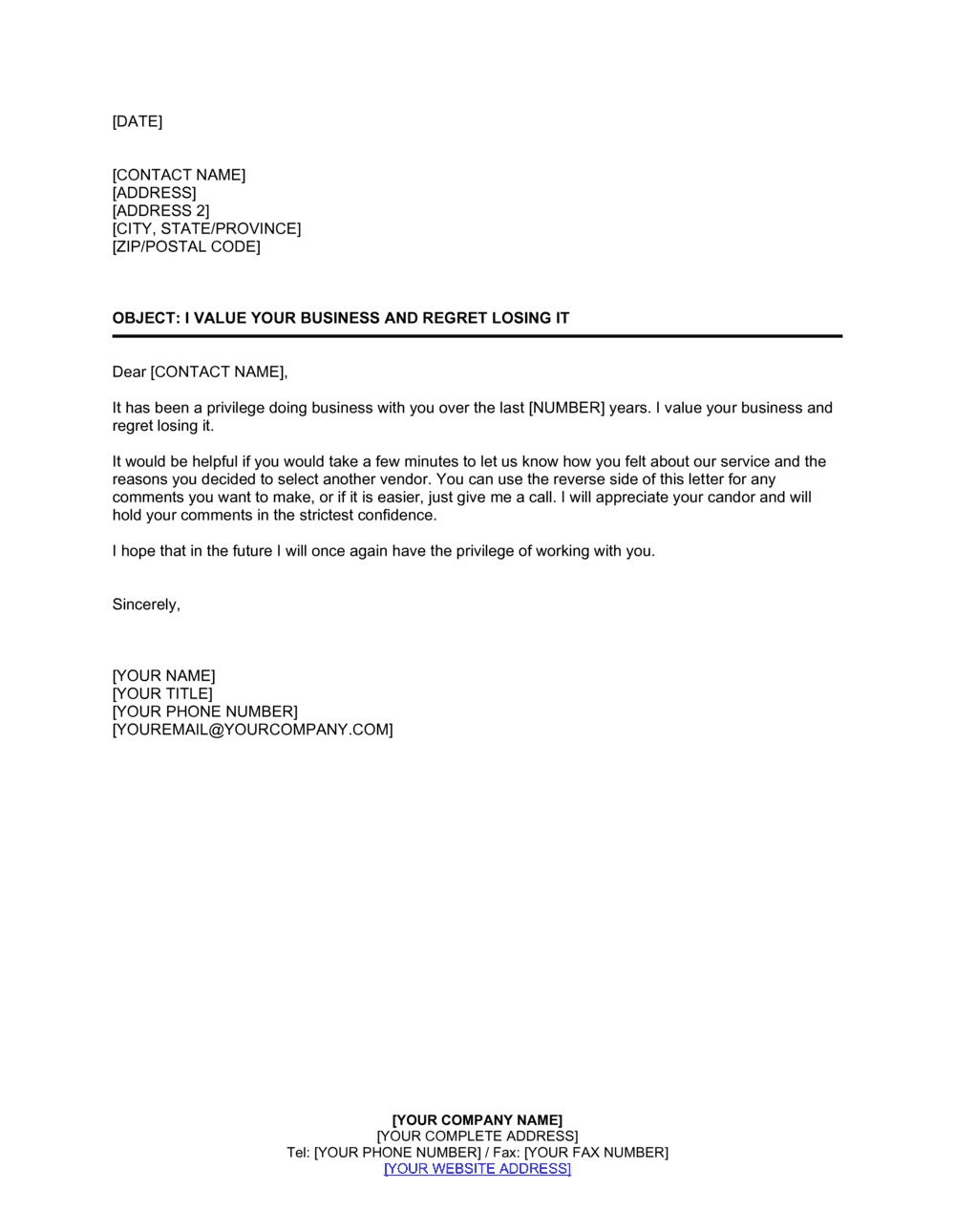
"I Value Your Business And Regret Losing It" is a formal written communication from a business to a departing or dissatisfied client, acknowledging the loss of the relationship, expressing genuine regret, and proposing specific remedies or goodwill gestures to encourage the client to return. This free Word download gives you a structured, professional starting point you can edit online and export as PDF to send by post, email, or courier.
When you need it
Use it when a valued client has cancelled a contract, reduced their account, or disengaged following a service failure, billing dispute, or competitive loss β€” and you want to make a documented, good-faith effort to recover the relationship before it is permanently lost.
What's inside
A formal acknowledgment of the client's decision to leave, a sincere expression of regret, identification of the specific issue or failure that led to the loss, a concrete remedial offer or goodwill gesture, a commitment to improved service terms, and an invitation to re-engage with a named point of contact and response deadline.

What is an "I Value Your Business And Regret Losing It" Letter?

An "I Value Your Business And Regret Losing It" letter is a formal written communication sent by a business to a client who has cancelled their contract, disengaged from services, or otherwise ended the commercial relationship. It combines a sincere, direct apology for the specific failure that prompted the departure with a concrete remedial offer β€” a credit, discount, revised service terms, or dedicated account support β€” and an explicit invitation to re-engage within a defined timeframe. Unlike a generic customer service email, a properly structured win-back letter acknowledges the root cause of the departure by name, accepts responsibility without qualification, and proposes measurable commitments that address the underlying problem rather than simply expressing regret.

Why You Need This Document

The cost of losing a client is rarely just the lost revenue from that account. Studies across industries consistently show that acquiring a new client costs five to seven times more than retaining an existing one β€” and a departed client who receives no formal response is statistically more likely to share the negative experience publicly than one who receives a genuine, well-constructed win-back communication. Without a documented letter, the company has no record of a good-faith recovery attempt, which matters if the client later escalates the matter to a regulator, posts a damaging review, or initiates a claim. A signed, dated letter with a specific remedial offer also creates the foundation for a revised service agreement if the client agrees to return, converting an emotional re-engagement into an enforceable commercial commitment. This template gives you the structure to move quickly, professionally, and with the right level of formality β€” without starting from a blank page at the moment when speed and tone both matter most.

Which variant fits your situation?

If your situation is…Use this template
Client left due to a specific billing error or overchargeCredit Note
Client cancelled a service contract and you want to offer revised termsService Agreement Amendment Letter
Client departed after a product defect or quality failureCustomer Apology and Remedy Letter
Long-term client reduced spend and you want to renegotiate a lower-tier agreementContract Amendment
Client is threatening legal action over the service failureSettlement Agreement
Corporate client left and you need to confirm termination of the service contractContract Termination Letter
Reaching out proactively before a client at risk churnsClient Relationship Renewal Letter

Common mistakes to avoid

❌ Conditional or qualified apologies

Why it matters: Phrases like 'if our service did not meet your expectations' or 'to the extent you were inconvenienced' signal defensiveness and are the single most commonly cited reason clients do not respond to win-back letters.

Fix: Use a direct, unqualified apology: 'We apologize for [SPECIFIC FAILURE]. We accept full responsibility.' Remove all hedging language before sending.

❌ No specific remedial offer

Why it matters: A letter that expresses regret without a concrete incentive gives the client no commercial reason to return β€” emotional appeal alone rarely overcomes a competitive switch.

Fix: State a specific, quantified offer β€” credit amount, discount percentage, or free service period β€” and make it proportionate to the account value and the severity of the failure.

❌ Sending without a named senior signatory

Why it matters: A win-back letter signed by a junior representative or a generic customer service team signals that the departure is not taken seriously at a leadership level.

Fix: Route the letter through a director, VP, or business owner for signature. The seniority of the signatory is itself a signal of how much the relationship is valued.

❌ No response deadline on the offer

Why it matters: Open-ended offers are deprioritized indefinitely. Without a closing date, clients who are genuinely considering returning have no prompt to act, and the letter is archived without a decision.

Fix: Set a specific deadline β€” 14 business days is standard β€” and state clearly what happens when it passes. A deadline forces a decision and often doubles response rates.

❌ Using the without-prejudice qualifier on a purely goodwill letter

Why it matters: Marking a routine win-back letter 'without prejudice' when no dispute or legal claim exists can signal to the client that the company fears litigation, undermining the goodwill intent of the communication.

Fix: Only apply the without-prejudice qualifier when a formal complaint, legal threat, or billing dispute is active. Have legal counsel confirm whether it is appropriate before adding it.

❌ Failing to document the root cause in the letter

Why it matters: A letter that acknowledges the departure but never names what went wrong reads as a form communication and gives the client no confidence that the underlying problem has been fixed.

Fix: Include one clear sentence identifying the specific issue that caused the departure, followed by a brief explanation of what has been changed or corrected internally.

The 9 key clauses, explained

Opening acknowledgment of departure

In plain language: States plainly that the sender is aware the client has ended or reduced the relationship, names the account or contract in question, and confirms the effective date of the client's decision.

Sample language
We write to acknowledge your decision to discontinue your engagement with [COMPANY NAME], effective [DATE], in respect of [CONTRACT / ACCOUNT REFERENCE]. We deeply regret this outcome and appreciate the opportunity to address it directly.

Common mistake: Using vague language like 'we noticed some changes to your account' instead of directly naming the departure β€” clients read this as evasive and it undermines the sincerity of the letter.

Expression of regret and appreciation

In plain language: Expresses genuine regret at losing the client's business, acknowledges the history of the relationship, and quantifies its significance without being sycophantic.

Sample language
Over the [X]-year relationship, [COMPANY NAME] has valued your account as one of our most significant partnerships. The loss of your business is not taken lightly, and we sincerely regret that we fell short of the standard you β€” and we β€” expect.

Common mistake: Writing generic appreciation statements that could apply to any client. Referencing the specific tenure, value, or shared milestones of the relationship is far more effective and credible.

Identification of the root cause

In plain language: Acknowledges the specific issue, complaint, or failure that led to the client's departure β€” without making admissions of liability β€” and demonstrates that the sender has investigated and understands what went wrong.

Sample language
We understand that your decision was prompted by [SPECIFIC ISSUE β€” e.g., the delay in delivery during [MONTH], the billing discrepancy on Invoice [NUMBER], or the response-time failures in Q[X]]. We have conducted an internal review and identified [ROOT CAUSE SUMMARY].

Common mistake: Acknowledging the departure without naming the cause. A letter that expresses regret but does not identify the problem reads as a form letter and signals that nothing will actually change.

Apology and accountability statement

In plain language: Issues a direct apology for the specific failure, accepts responsibility on behalf of the company, and avoids deflecting blame to third parties or external circumstances.

Sample language
We apologize unreservedly for [SPECIFIC FAILURE]. This fell below the standards we set for ourselves and the commitments we made to you under our agreement. We accept full responsibility for [SPECIFIC IMPACT ON CLIENT].

Common mistake: Qualifying the apology with 'if you were affected' or 'to the extent this caused inconvenience.' Conditional apologies signal defensiveness and are routinely cited as reasons clients do not return.

Remedial offer or goodwill gesture

In plain language: Sets out the specific, concrete remedy being offered β€” credit, discount, free service period, revised SLA, dedicated account contact β€” and states its monetary value or duration clearly.

Sample language
As a direct remedy, we are offering [CREDIT OF $X / [X]% discount on services for [Y] months / [SPECIFIC REMEDIAL ACTION]] with no conditions attached beyond your agreement to re-engage on the terms set out below.

Common mistake: Making a vague offer like 'we will work harder to meet your needs' with no quantified commitment. Clients who have already left require a specific, tangible incentive β€” not a promise of effort.

Commitment to improved service terms

In plain language: Documents specific, measurable changes to the service relationship β€” revised SLA metrics, dedicated account management, escalation procedures β€” that address the root cause of the departure.

Sample language
Should you choose to return, we commit to the following service improvements: [SPECIFIC METRIC, e.g., a dedicated account manager, [COMPANY NAME], contactable at [EMAIL/PHONE]]; response times of no more than [X] business hours; and monthly service reviews for the first [X] months of re-engagement.

Common mistake: Promising improvements without naming a responsible individual. Commitments to 'the team' or 'our support function' are not accountable β€” clients need a named person they can escalate to.

Without-prejudice qualifier (where applicable)

In plain language: Flags the letter as written on a without-prejudice basis where there is any risk of legal proceedings, ensuring that the apology and remedial offer cannot be used as admissions of liability in litigation.

Sample language
This letter is written on a without-prejudice basis and is intended solely to explore the possibility of restoring our commercial relationship. Nothing in this letter constitutes an admission of liability in respect of any claim.

Common mistake: Including a without-prejudice header on a purely goodwill letter where no legal claim exists. This can unintentionally signal to the client that the company fears litigation, when the intent is simply to express regret.

Call to action and response deadline

In plain language: Specifies what the client is being asked to do next β€” call a named contact, sign and return an enclosed agreement, or attend a meeting β€” and sets a clear deadline by which the offer remains open.

Sample language
We invite you to respond to this letter by [DATE], either by contacting [NAME] directly at [PHONE / EMAIL] or by signing and returning the enclosed Re-engagement Confirmation. This offer remains open until [DATE], after which we will assume your decision to discontinue the relationship is final.

Common mistake: No deadline on the offer. Open-ended win-back letters are deprioritized indefinitely β€” a specific closing date creates urgency and produces a decision, even if that decision is not to return.

Authorised signatory and company details

In plain language: Closes the letter with the name, title, and contact details of the most senior person authorised to make the offer β€” typically a director, VP, or the business owner β€” and ensures the letter is signed before sending.

Sample language
Yours sincerely, [FULL NAME] | [TITLE] | [COMPANY NAME] | [ADDRESS] | [PHONE] | [EMAIL] | Date: [DATE]

Common mistake: Sending the letter unsigned, or signed by a junior account representative rather than a senior decision-maker. Clients evaluate the seriousness of a win-back effort by who signed the letter.

How to fill it out

  1. 1

    Identify the client and the specific departure event

    Enter the client's full legal name, account reference number, and the effective date of their cancellation or departure. Confirm these details against your CRM or contract records before drafting.

    πŸ’‘ Pull the client's full purchase history and contract terms before writing β€” referencing the tenure and value of the relationship in specific terms is far more persuasive than generic praise.

  2. 2

    Investigate and document the root cause

    Before writing a single word of apology, identify precisely what went wrong. Review complaint logs, support tickets, billing records, and any correspondence that preceded the departure. Write one clear sentence summarizing the root cause.

    πŸ’‘ If the client gave a reason for leaving, use their exact words to describe the issue β€” this signals you actually listened rather than guessed.

  3. 3

    Draft the acknowledgment and apology clauses

    Complete the opening acknowledgment with the client name, contract reference, and departure date. Write the apology clause using direct, unqualified language β€” name the failure specifically and accept responsibility.

    πŸ’‘ Read the apology clause aloud before finalizing. If it sounds like a press statement, rewrite it. It should sound like something a senior leader would say in a room with the client.

  4. 4

    Define the remedial offer with specific numbers

    Enter the exact value of the goodwill gesture or remedy β€” a credit amount, discount percentage, free service months, or revised SLA metrics. Ensure the offer is proportionate to the client's account value and the severity of the failure.

    πŸ’‘ A remedial offer below 10% of the annual contract value is routinely dismissed as tokenistic. Calibrate the offer to the client lifetime value, not the cost of the incident.

  5. 5

    Name a specific point of contact for re-engagement

    Enter the full name, direct phone number, and email address of the person who will manage the client's return. This should be a senior individual β€” not a general support queue.

    πŸ’‘ If the client's departure was driven by poor communication, assign a different contact person than the one who managed the account previously.

  6. 6

    Set a specific response deadline

    Enter a response deadline β€” typically 10–21 business days from the send date. State clearly what happens if the deadline passes (the offer lapses, or the company accepts the departure as final).

    πŸ’‘ A 14-day window is the industry standard for win-back letters. Shorter feels pressured; longer loses urgency.

  7. 7

    Apply the without-prejudice qualifier if a dispute is active

    If the client departure is linked to a formal complaint, threatened claim, or billing dispute, add the without-prejudice header to the letter before the opening salutation. If no legal risk exists, omit it.

    πŸ’‘ Ask your legal advisor whether the without-prejudice qualifier applies before adding it β€” using it incorrectly can create confusion about the letter's legal status.

  8. 8

    Have a senior signatory review and sign before sending

    Route the completed letter to the most senior appropriate signatory β€” ideally a director, VP, or the business owner β€” for review and wet or digital signature before sending by tracked post or secure email.

    πŸ’‘ Send the letter by both email and tracked post to create a documented delivery record, which is essential if the offer is later referenced in a dispute or legal proceeding.

Frequently asked questions

What is a 'I Value Your Business And Regret Losing It' letter?

It is a formal written communication sent by a business to a client who has cancelled, churned, or significantly reduced their engagement. The letter acknowledges the departure, issues a direct apology for any failures that contributed to it, offers a specific remedy or goodwill gesture, and invites the client to re-engage under improved terms. It serves both as a genuine retention tool and as a documented record of the company's good-faith effort to resolve the issue.

Should the letter be marked 'without prejudice'?

Only if an active dispute, complaint, or threatened legal claim is connected to the client's departure. The without-prejudice qualifier protects the contents of the letter from being used as evidence in litigation. If the letter is purely a goodwill communication with no legal risk attached, omit the qualifier β€” it can inadvertently signal that the company expects a legal challenge.

Who should sign the win-back letter?

The most senior person with authority to deliver on the promises made in the letter β€” typically a director, VP of Customer Success, or the business owner. The seniority of the signatory is itself a signal of how seriously the company takes the departure. Letters signed by junior account representatives are significantly less effective at prompting a response.

How long should I give the client to respond?

Fourteen business days is the standard response window for win-back letters in most industries. Shorter windows β€” under seven days β€” feel pressured and can trigger a negative reaction. Longer windows β€” beyond 21 days β€” lose urgency and are routinely ignored. Always state the specific calendar date by which the offer lapses, not just a number of days.

What remedial offer is appropriate to include?

The offer should be proportionate to the client's annual account value and the severity of the failure. A common benchmark is 10–25% of the annual contract value in the form of a credit, discount, or free service period. A credit or discount below 10% is often perceived as tokenistic. Above 25%, the offer may signal that the company accepts significant fault β€” which can complicate matters if the issue is also the subject of a formal complaint.

Can this letter be used in conjunction with a new contract?

Yes. The win-back letter is most effective when paired with an enclosed revised service agreement or re-engagement confirmation that the client can sign and return. This converts the letter from an expression of intent into a binding commitment by both sides. The new agreement should incorporate the specific service improvements promised in the letter.

What happens if the client does not respond by the deadline?

The letter should state clearly that a non-response by the deadline will be treated as a final decision to discontinue the relationship. This allows the business to close the account cleanly in its records and avoid leaving the win-back offer open indefinitely. In practice, following up with a brief phone call from the signatory one to two days before the deadline significantly improves response rates.

Is this type of letter suitable for consumer clients as well as business clients?

Yes, though the tone and content should be calibrated to the audience. For B2B clients, focus on commercial terms, SLA commitments, and account value. For consumer clients, emphasize personal apology, simplicity of the remedial offer, and ease of re-engagement. Consumer-facing versions should also be reviewed for compliance with applicable consumer protection regulations, which in some jurisdictions restrict the types of offers that can be made to resolve a complaint.

How this compares to alternatives

vs Contract Termination Letter

A contract termination letter formally ends a commercial relationship and documents the effective date, notice obligations, and post-termination responsibilities. A win-back letter is sent in response to the client's decision to terminate β€” its purpose is to reverse or delay that decision by offering remedies, not to confirm it. The two documents are functional opposites in the client lifecycle.

vs Customer Complaint Response Letter

A customer complaint response letter addresses a specific grievance and proposes a remedy while the client relationship is still active. A win-back letter is sent after the relationship has already ended or is in the process of ending β€” the stakes are higher, the offer must be more substantial, and the tone must acknowledge a more serious failure of trust. Use the complaint response letter first; escalate to the win-back letter if the complaint is not resolved.

vs Settlement Agreement

A settlement agreement is a binding legal document that resolves a formal dispute between parties in exchange for mutual releases of claims. A win-back letter is a pre-litigation commercial communication aimed at restoring a business relationship without legal proceedings. If the client's departure is accompanied by a formal claim or legal threat, a settlement agreement β€” not a win-back letter β€” is the appropriate instrument.

vs Credit Note

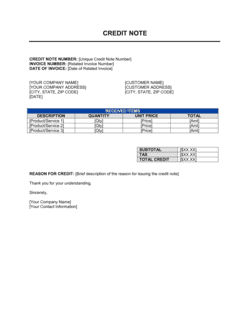
A credit note is an accounting document that reduces or cancels a specific invoice. A win-back letter is a relationship document that may reference or enclose a credit note as part of its remedial offer, but its purpose extends beyond a single billing correction to address the entire relationship. Where the departure is caused solely by a billing error, a credit note with a brief apology may be sufficient β€” the full win-back letter is warranted when the relationship itself is at risk.

Industry-specific considerations

Professional Services

Law firms, accountants, and consultancies use this letter when a long-standing retainer client leaves following a billing dispute or service quality complaint, often pairing it with a revised fee agreement.

SaaS / Technology

SaaS companies send this letter after a high-value account churns due to platform downtime, missed SLAs, or product gaps β€” typically including a free subscription credit and a named customer success manager as the recovery offer.

Retail / E-commerce

Retailers and online stores deploy win-back letters to lapsed high-spend customers after a fulfillment failure or return dispute, typically enclosing a discount code with a specific expiry date.

Financial Services

Banks, wealth managers, and insurance brokers use formally structured versions of this letter when clients transfer accounts or cancel policies, ensuring the without-prejudice qualifier is applied given the regulated environment.

Jurisdictional notes

United States

In the US, win-back letters containing specific financial offers can constitute binding contracts once accepted by the recipient under general contract principles. Apply the without-prejudice qualifier carefully β€” its protection is not universally recognized across all US states in the same way it is in common-law jurisdictions. In consumer-facing contexts, certain states (notably California) impose strict requirements on the handling of consumer complaints and the types of remedies that can be offered.

Canada

Canadian courts generally recognize the without-prejudice privilege for settlement communications, but the privilege must be properly invoked to be protected. In Quebec, the letter must be issued in French for provincially regulated businesses under the Charter of the French Language. Consumer protection legislation in provinces such as Ontario and British Columbia may impose additional obligations when offering remedies to consumer clients.

United Kingdom

The without-prejudice rule is well-established in English law and protects genuine settlement communications from being used as admissions in litigation. Win-back letters that include financial offers to resolve a dispute should be marked accordingly. For regulated financial services businesses, the FCA's complaint-handling rules (DISP) impose specific timelines and documentation requirements that interact with any win-back or remedial communication sent to a complainant.

European Union

GDPR obligations are relevant when win-back letters are sent as part of an automated marketing or re-engagement campaign β€” explicit consent or a legitimate interest basis is required for processing the client's personal data for outreach purposes. Consumer-facing win-back letters in EU member states must comply with applicable consumer rights directives, which may require that the remedial offer be clearly explained and not conditional on waiving statutory rights.

Template vs lawyer β€” what fits your deal?

PathBest forCostTime
Use the templateSmall businesses and account teams sending goodwill win-back letters where no formal dispute or legal risk is presentFree30–60 minutes
Template + legal reviewMid-market accounts where the departure involves a billing dispute, SLA breach claim, or formal complaint alongside the relationship loss$150–$400 for a legal or senior advisor review1–2 business days
Custom draftedHigh-value enterprise clients, regulated industries (financial services, healthcare), or situations where litigation is a realistic possibility$500–$2,000+3–7 business days

Glossary

Goodwill Gesture
A voluntary, non-legally-obligated offer β€” such as a discount, credit, or free service period β€” made to repair a damaged business relationship.
Churn
The rate at which customers stop doing business with a company over a given period, typically expressed as a monthly or annual percentage.
Win-Back Campaign
A structured set of communications or offers designed to re-engage customers who have lapsed or cancelled.
Service Level Agreement (SLA)
A contractual commitment defining the minimum performance standards β€” uptime, response time, delivery speed β€” a vendor must meet.
Consideration
Something of value exchanged between parties that makes a promise legally enforceable; in a win-back letter, the remedial offer constitutes consideration for the client's return.
Without Prejudice
A legal qualifier indicating that statements made in a communication cannot be used as admissions of liability in subsequent legal proceedings.
Acknowledgment of Receipt
A signed confirmation by the recipient that they have received and read the letter β€” important for establishing the start of any response deadline.
Escalation Clause
A provision in the letter specifying that the matter will be referred to a senior executive or alternative resolution process if the initial offer is not accepted within a stated period.
Client Lifetime Value (CLV)
The total gross profit a business expects to generate from a single client over the entire relationship β€” used to justify the cost of retention efforts.
Root Cause
The underlying reason a client left, as distinct from the surface-level complaint β€” identifying it correctly is essential to making a credible remedial offer.
Re-engagement Offer
A specific, time-limited commercial incentive β€” discounted rate, bonus service, or extended term β€” offered to a departed client as an inducement to return.

Part of your Business Operating System

This document is one of 3,000+ business & legal templates included in Business in a Box.

  • Fill-in-the-blanks β€” ready in minutes
  • 100% customizable Word document
  • Compatible with all office suites
  • Export to PDF and share electronically

Create your document in 3 simple steps.

From template to signed document β€” all inside one Business Operating System.
1
Download or open template

Access over 3,000+ business and legal templates for any business task, project or initiative.

2
Edit and fill in the blanks with AI

Customize your ready-made business document template and save it in the cloud.

3
Save, Share, Send, Sign

Share your files and folders with your team. Create a space of seamless collaboration.

Save time, save money, and create top-quality documents.

β˜…β˜…β˜…β˜…β˜…

"Fantastic value! I'm not sure how I'd do without it. It's worth its weight in gold and paid back for itself many times."

Managing Director Β· Mall Farm
Robert Whalley
Managing Director, Mall Farm Proprietary Limited
β˜…β˜…β˜…β˜…β˜…

"I have been using Business in a Box for years. It has been the most useful source of templates I have encountered. I recommend it to anyone."

Business Owner Β· 4+ years
Dr Michael John Freestone
Business Owner
β˜…β˜…β˜…β˜…β˜…

"It has been a life saver so many times I have lost count. Business in a Box has saved me so much time and as you know, time is money."

Owner Β· Upstate Web
David G. Moore Jr.
Owner, Upstate Web

Run your business with a system β€” not scattered tools

Stop downloading documents. Start operating with clarity. Business in a Box gives you the Business Operating System used by over 250,000 companies worldwide to structure, run, and grow their business.

Start freeΒ Β·Β No credit card required