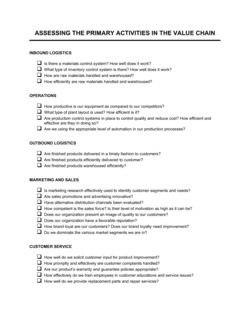
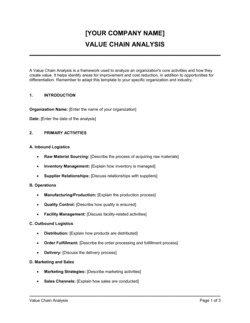
Assessing the Support Activities in the Value Chain Template

Free Word download • Edit online • Save & share with Drive • Export to PDF

1 page20–30 min to fillDifficulty: StandardSignature requiredLegal review recommended
Learn more ↓
FreeAssessing the Support Activities in the Value Chain Template

At a glance

What it is
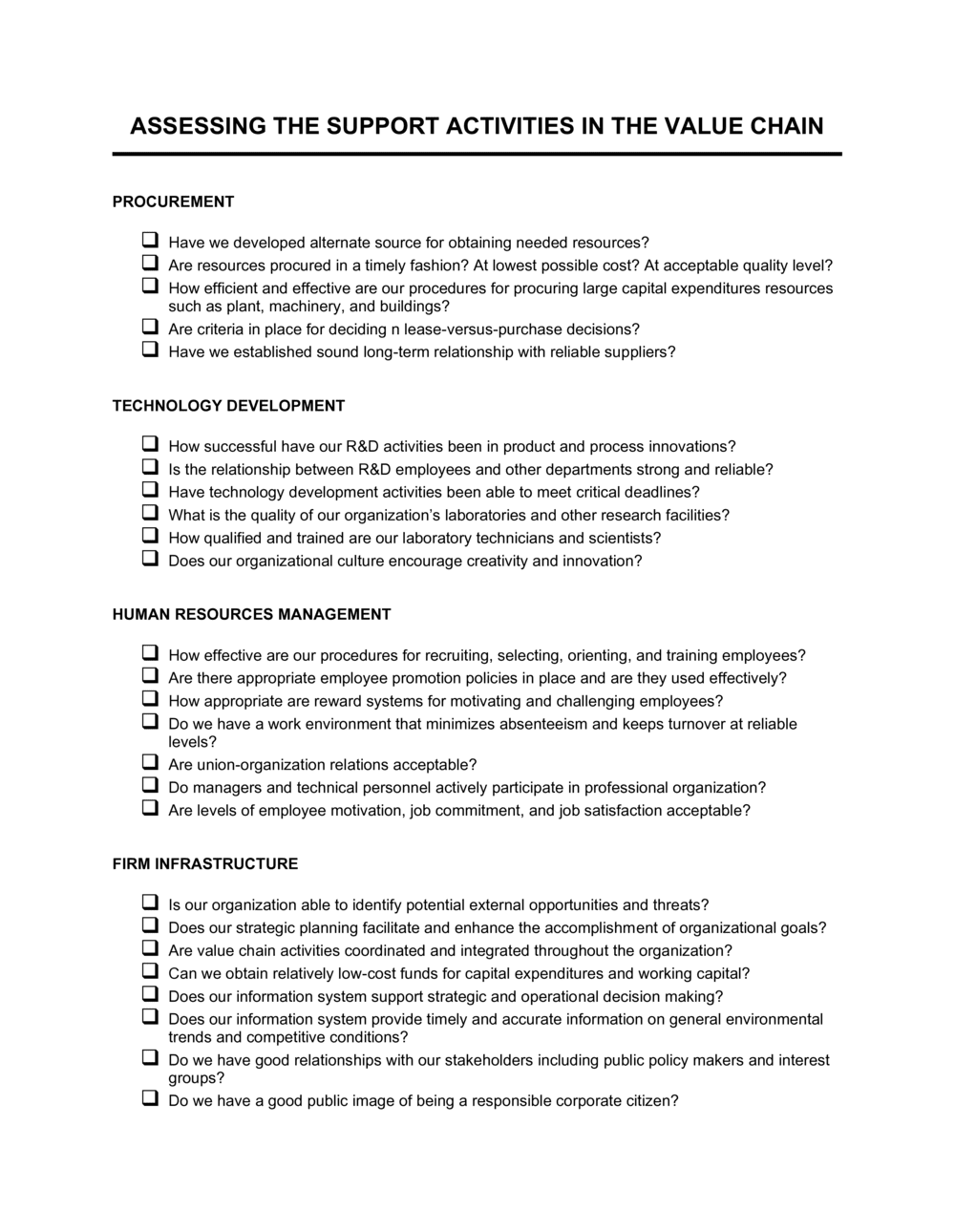
An Assessing The Support Activities In The Value Chain document is a structured analytical and governance template that formally evaluates the four support activities in Porter's Value Chain framework — firm infrastructure, human resource management, technology development, and procurement — against defined performance criteria. This free Word download gives organizations a ready-to-edit assessment instrument they can customize, execute with authorized signatories, and archive as a binding strategic record.
When you need it
Use it when conducting a formal strategic review, preparing for a merger or acquisition due diligence process, benchmarking operational capabilities against competitors, or fulfilling board-mandated governance assessments of internal support functions.
What's inside
The template covers scope and objectives, firm infrastructure evaluation, HRM capability scoring, technology development assessment, procurement analysis, gap identification, strategic recommendations, and sign-off clauses with defined accountabilities. Together these sections produce a defensible, auditable record of where support activities create or erode competitive advantage.

What is an Assessing The Support Activities In The Value Chain Document?

An Assessing The Support Activities In The Value Chain document is a structured analytical and governance instrument that applies Porter's Value Chain framework to formally evaluate the four support activities — firm infrastructure, human resource management, technology development, and procurement — against defined strategic and operational criteria. It captures capability scores, identifies measurable gaps between current and required performance levels, documents strategic recommendations with assigned owners and timelines, and records formal attestations from authorized signatories. Unlike a casual internal memo or a slide-deck summary, this template produces a binding, auditable record that organizations can use for board governance, M&A due diligence, lender reporting, and strategic planning accountability.

Why You Need This Document

Without a formally executed support activities assessment, strategic capability gaps remain invisible until they become crises — a procurement function overconcentrated in a single supplier, an HRM process too weak to retain the talent a new strategy requires, or a technology development function that is spending on maintenance rather than innovation. The cost of the gap is borne later, in failed strategy execution, transaction due diligence surprises, or board challenges to management representations. A completed and signed assessment forces the organization to convert anecdotal impressions into scored, evidence-based findings with named owners and deadlines, creating the accountability loop that most strategic reviews lack. For organizations preparing for a transaction or a board-level governance filing, it also provides the formal attestation structure that external counsel and counterparties require — something an internal PowerPoint cannot supply.

Which variant fits your situation?

If your situation is…Use this template
Assessing the full value chain including primary and support activitiesComplete Value Chain Analysis
Evaluating only primary activities such as inbound logistics and operationsAssessing Primary Activities In The Value Chain
Conducting a high-level strategic position reviewSWOT Analysis
Benchmarking against competitors on capability dimensionsCompetitive Analysis Template
Reviewing HRM policies and workforce capabilities specificallyHR Audit Checklist
Assessing technology investments and digital maturityIT Strategic Plan
Supporting a full strategic planning cycle with leadershipStrategic Planning Template

Common mistakes to avoid

❌ Assessing all four support activities at the same shallow depth

Why it matters: A uniform but superficial treatment of all four activities produces findings too generic to act on and fails to surface the specific gaps that actually constrain competitive position.

Fix: Spend proportionally more time on the activities most critical to the organization's strategy — a technology company should assess technology development at greater depth than its procurement function.

❌ Using inconsistent scoring criteria across activities

Why it matters: When each activity is scored using different benchmarks or methodologies, cross-function prioritization becomes impossible and the aggregate score is meaningless to leadership and boards.

Fix: Define the 1–5 maturity scale with behavioral anchors before beginning any scoring, and use the same calibration session for all four activities.

❌ Omitting the representations and sign-off clauses

Why it matters: Without formal attestation, the document is an internal opinion rather than a binding governance record — it cannot be used in M&A diligence, board reporting, or regulatory submissions without risk of challenge.

Fix: Always complete both clauses before distributing the final document, and ensure signatories have the authority to bind the organization for the stated purpose.

❌ Writing recommendations without named owners or deadlines

Why it matters: Unassigned recommendations have a near-zero implementation rate — they are revisited at the next review cycle with the same gaps still open, eroding confidence in the assessment process itself.

Fix: Every recommendation must name a specific role or individual as owner, set a completion date, and estimate the resource requirement, even if approximate.

❌ Treating procurement assessment as purely a cost-reduction exercise

Why it matters: Focusing only on unit cost savings ignores supplier concentration risk, contract coverage gaps, and supply chain resilience — weaknesses that become catastrophic during supply disruptions.

Fix: Include supplier concentration metrics, contract coverage percentage, and a risk rating for the top five suppliers in every procurement assessment.

❌ Circulating draft findings before the document is executed

Why it matters: Draft findings without sign-off create competing versions, allow recipients to act on unverified conclusions, and expose the organization to liability if the final assessment differs materially from the draft.

Fix: Establish a firm rule that no findings leave the assessment team until the final document is signed and dated by all authorized signatories.

The 10 key clauses, explained

Scope and Objectives

In plain language: Defines the boundaries of the assessment — which entity, business unit, or time period is being evaluated — and states the purpose (strategic review, M&A diligence, board reporting, etc.).

Sample language
This assessment covers the support activities of [ENTITY NAME] ('Company') for the period ending [DATE]. The objective is to evaluate firm infrastructure, HRM, technology development, and procurement relative to [STRATEGIC OBJECTIVE / BENCHMARK].

Common mistake: Defining scope so broadly that every function is in scope but no function is assessed in depth — resulting in a superficial document that fails to surface actionable gaps.

Firm Infrastructure Evaluation

In plain language: Assesses the quality of governance structures, financial management, legal compliance systems, and planning processes that support all other activities.

Sample language
The Company's firm infrastructure is assessed across the following dimensions: (a) governance and board oversight, (b) financial reporting and controls, (c) legal and regulatory compliance, and (d) strategic planning processes. Current maturity level: [1–5 SCALE]. Key findings: [FINDINGS].

Common mistake: Treating infrastructure as a pass/fail checklist rather than a maturity continuum — missing the graduated weaknesses that cumulatively erode competitive position.

Human Resource Management Assessment

In plain language: Evaluates the organization's ability to attract, develop, retain, and deploy talent across all functions, and identifies gaps relative to strategic requirements.

Sample language
HRM capabilities are assessed against five criteria: (a) talent acquisition effectiveness, (b) onboarding and development programs, (c) performance management rigor, (d) compensation benchmarking, and (e) retention rates. Current attrition rate: [X]%. Gap identified: [DESCRIPTION].

Common mistake: Limiting HRM assessment to headcount and turnover metrics while ignoring capability quality — an organization can have low turnover and still lack the skills its strategy requires.

Technology Development Assessment

In plain language: Examines the firm's capacity to innovate, automate processes, protect intellectual property, and leverage technology to create or sustain differentiation.

Sample language
Technology development capabilities are evaluated across: (a) R&D investment as a percentage of revenue ([X]%), (b) technology roadmap alignment with strategy, (c) IP portfolio status ([NUMBER] patents / [STATUS]), and (d) digital process automation maturity.

Common mistake: Conflating IT infrastructure (hardware, networks) with technology development — the clause should focus on innovation and IP creation, not systems maintenance.

Procurement Analysis

In plain language: Reviews how the organization sources inputs, manages supplier relationships, controls purchasing costs, and ensures supply chain resilience.

Sample language
Procurement practices are assessed on: (a) supplier concentration (top-3 suppliers account for [X]% of spend), (b) contract coverage ([X]% of spend under written agreements), (c) cost reduction initiatives, and (d) supplier qualification and risk management processes.

Common mistake: Assessing procurement only on unit cost savings while ignoring supplier concentration risk — a procurement function that saves 8% on cost but relies on a single supplier for 70% of critical inputs is strategically fragile.

Gap Identification and Scoring

In plain language: Summarizes the delta between current capability levels and required levels for each support activity, using a consistent scoring methodology.

Sample language
Each support activity is scored on a [1–5] maturity scale. Current aggregate score: [X/20]. Priority gaps identified: (1) [ACTIVITY] — current [X], required [Y]; (2) [ACTIVITY] — current [X], required [Y]. Gap closure timeline: [TIMEFRAME].

Common mistake: Using different scoring criteria for each activity, making cross-function comparisons meaningless and preventing prioritization of investment across the support function portfolio.

Strategic Recommendations

In plain language: Documents the specific actions, owners, timelines, and resource requirements needed to close identified capability gaps.

Sample language
To address the gaps identified in Section [X], the Company shall implement the following initiatives: (1) [RECOMMENDATION], owned by [TITLE], by [DATE], estimated cost $[X]; (2) [RECOMMENDATION], owned by [TITLE], by [DATE], estimated cost $[X].

Common mistake: Writing recommendations without assigning a named owner and a specific completion date — recommendations without accountability are aspirations, not commitments.

Representations and Warranties

In plain language: States that the information provided in the assessment is accurate and complete to the best of the signatories' knowledge, and that no material facts have been omitted.

Sample language
Each signatory represents and warrants that the information provided in this assessment is, to the best of their knowledge, accurate, complete, and not misleading as of the date of execution. No material facts relating to the assessed activities have been knowingly omitted.

Common mistake: Omitting the representations clause entirely — without it, the document is an opinion piece rather than a binding attestation, undermining its use as a governance or due diligence record.

Confidentiality and Use Restrictions

In plain language: Limits the circulation of the assessment to named recipients and prohibits external disclosure without authorization, given the commercially sensitive nature of the findings.

Sample language
This assessment is confidential and intended solely for [AUTHORIZED RECIPIENTS]. It may not be reproduced, disclosed, or distributed to any third party without the prior written consent of [COMPANY NAME]. Unauthorized disclosure may constitute a breach of [APPLICABLE AGREEMENT / POLICY].

Common mistake: Using a generic 'confidential' header without specifying authorized recipients or consequences of unauthorized disclosure — courts have declined to enforce confidentiality obligations that are not specific enough to be actionable.

Sign-Off and Authorization

In plain language: Records the names, titles, and signatures of the individuals authorizing the assessment findings and recommendations as the official position of the organization.

Sample language
The undersigned authorize this assessment as an accurate representation of the Company's support activity capabilities as of [DATE]. [NAME], [TITLE] _____________ Date: _____ | [NAME], [TITLE] _____________ Date: _____

Common mistake: Obtaining only one signature when board governance or M&A diligence requires dual authorization — a single signatory may lack the authority to bind the organization, making the document challengeable.

How to fill it out

  1. 1

    Define the scope and assessment objective

    Enter the legal entity name, the business unit being assessed, the assessment period, and the stated purpose (strategic review, M&A diligence, board reporting). Narrow scope produces deeper, more actionable findings.

    💡 If the assessment is for M&A due diligence, align the objective language with the transaction scope to avoid post-signing disputes about what was assessed.

  2. 2

    Gather baseline data for each support activity

    Collect measurable inputs before opening the template: org charts and turnover rates for HRM, R&D spend and IP register for technology, supplier spend concentration for procurement, and governance documents for infrastructure.

    💡 Request data at least two weeks before the assessment session — last-minute data gathering consistently produces the vague estimates that undermine scoring credibility.

  3. 3

    Score each support activity on the maturity scale

    Apply the 1–5 maturity scale consistently across all four activities. Use the same evaluator or calibration session for all four to prevent scoring drift between assessors.

    💡 Anchor score levels to observable behaviors — '3 = process exists and is documented but not consistently followed' is more reliable than '3 = average'.

  4. 4

    Identify and prioritize capability gaps

    For each activity scoring below the required level, document the gap in specific, measurable terms. Rank gaps by strategic impact — not by ease of closure — to ensure the most critical deficiencies are addressed first.

    💡 A gap that affects multiple primary activities (e.g., weak procurement affecting operations and outbound logistics) should be weighted higher than one confined to a single function.

  5. 5

    Draft strategic recommendations with owners and timelines

    Write at least one recommendation per identified gap. Assign a named role or individual as owner, set a specific completion date, and estimate the resource requirement. Vague recommendations without owners are not actionable.

    💡 Limit recommendations to the top five gaps — a list of twelve recommendations with no prioritization signals that the assessors did not make hard choices.

  6. 6

    Complete the representations and confidentiality clauses

    Fill in the authorized recipients list in the confidentiality clause and review the representations language to confirm it accurately reflects the evidence base for the assessment.

    💡 If the assessment relies on management-provided data rather than independently verified information, note that limitation explicitly in the representations clause to avoid overstatement.

  7. 7

    Obtain dual sign-off before distribution

    Secure signatures from both the primary assessor and an authorizing executive before distributing the document. Record the date of execution on the sign-off page.

    💡 For M&A or board use, execute the document before distributing findings — circulating draft findings without sign-off creates version-control and liability risks.

  8. 8

    Archive the executed document and schedule a follow-up review

    Store the signed assessment in a secure document management system with restricted access. Set a calendar reminder for a 6–12 month follow-up to track gap closure progress.

    💡 Linking the archived assessment to the strategic recommendations tracker closes the loop between identification and execution, which is the step most organizations skip.

Frequently asked questions

What are support activities in the value chain?

Support activities in Porter's Value Chain are the four firm-wide functions that enable and enhance primary activities — firm infrastructure, human resource management, technology development, and procurement. Unlike primary activities (inbound logistics, operations, outbound logistics, marketing, and service), support activities cut across the entire organization rather than sitting in a single operational sequence. They create competitive advantage by improving the efficiency and effectiveness of primary activities.

Why is it important to formally assess value chain support activities?

A formal assessment converts an abstract strategic framework into a documented, scored, and actionable record of where the organization's support functions create or erode competitive advantage. Without a structured assessment, strategy teams rely on anecdotal impressions of capability rather than evidence. Formal assessments are also required for M&A due diligence, board governance reporting, and lender covenant compliance in many mid-market transactions.

How does a value chain support activities assessment differ from a SWOT analysis?

A SWOT analysis identifies broad organizational strengths, weaknesses, opportunities, and threats at a high level. A value chain support activities assessment drills into the specific operational and governance functions that drive or limit competitive position, producing capability scores, gap measurements, and assigned recommendations. The SWOT is a diagnostic frame; the value chain assessment is a detailed operational audit with binding accountability.

Who should sign the assessment?

The assessment should be signed by the primary assessor (typically a strategy director, COO, or external consultant) and an authorizing executive with organizational authority over the assessed scope — most commonly the CEO or CFO. For board-level governance purposes, dual signatures are standard. In M&A contexts, the signing authority is typically defined in the due diligence protocol agreed between the transaction parties.

Can this template be used for M&A due diligence?

Yes, and it is particularly well suited for that purpose. The representations and warranties clause and the sign-off section give the document the formal attestation structure that acquirers and their counsel require. When used in M&A, align the scope clause with the transaction perimeter, ensure the authorized recipients clause covers the acquirer's advisors under NDA, and confirm the assessment date falls within the diligence period agreed in the letter of intent.

How often should a value chain support activities assessment be updated?

For strategic planning purposes, annually — aligned to the fiscal year review cycle. For organizations in a period of rapid change (post-acquisition integration, digital transformation, or significant headcount growth), a semi-annual cadence is more appropriate. The assessment should also be refreshed whenever a material change in strategy, ownership, or regulatory environment could alter the relevance of prior findings.

What scoring method should we use for the maturity scale?

A 1–5 maturity scale with defined behavioral anchors is the most widely used and defensible approach. Level 1 indicates an absent or ad-hoc process; Level 3 indicates a documented and consistently followed process; Level 5 indicates a continuously optimized process benchmarked against external best practices. Using the same anchors across all four support activities is critical — inconsistent anchoring is the most common reason cross-function scores cannot be compared.

What is the difference between this document and a full value chain analysis?

A full value chain analysis covers all nine activities in Porter's model — five primary and four support. This template focuses exclusively on the four support activities, making it appropriate when the strategic question is specifically about how well the organization's enabling functions support competitive advantage rather than a comprehensive operational audit. For a complete picture, pair this assessment with a primary activities analysis covering inbound and outbound logistics, operations, marketing and sales, and service.

How this compares to alternatives

vs SWOT Analysis

A SWOT analysis provides a broad strategic snapshot of organizational strengths, weaknesses, opportunities, and threats without drilling into specific operational functions. The value chain support activities assessment produces capability scores, evidence-based gap measurements, and assigned recommendations for four specific functions. Use the SWOT for executive alignment and the value chain assessment for operational accountability.

vs Strategic Planning Template

A strategic plan sets organizational direction, goals, and resource allocation for a 3–5 year horizon. The value chain support activities assessment diagnoses the current capability baseline that the strategic plan must build from. The assessment informs the plan — use it first to understand where support functions are strongest and weakest before committing to strategic objectives that depend on those capabilities.

vs HR Audit Checklist

An HR audit checklist evaluates HR policies, compliance, and process adherence within the human resources function alone. The value chain support activities assessment covers HRM as one of four support activities within an integrated strategic framework, contextualizing HR capability relative to infrastructure, technology, and procurement. Use the HR audit for compliance and process depth; use this assessment for strategic positioning.

vs Competitive Analysis Template

A competitive analysis maps external rivals — their products, pricing, channels, and market share. The value chain support activities assessment is inward-facing, evaluating the internal functions that enable or constrain the organization's ability to compete. Both are necessary: the competitive analysis defines the target; the value chain assessment reveals whether the organization has the internal capabilities to reach it.

Industry-specific considerations

Professional Services

HRM and firm infrastructure dominate competitive advantage; the assessment focuses heavily on talent acquisition quality, knowledge management systems, and governance structures that enable consistent client delivery.

Manufacturing

Procurement and technology development are the most strategically critical support activities; supplier concentration risk and process automation maturity drive the largest gaps in this sector.

Technology / SaaS

Technology development assessment covers R&D spend ratios, IP portfolio health, and engineering capability depth — the support activity most directly linked to product differentiation and market position.

Healthcare

Firm infrastructure assessment must address regulatory compliance frameworks (HIPAA, FDA, CE), credentialing governance, and quality management systems that underpin every primary activity in the care delivery chain.

Jurisdictional notes

United States

In the US, value chain assessments used in M&A contexts become part of the transaction record and can be referenced in representations and warranties insurance underwriting. State-specific employment law affects HRM assessments — California, New York, and Illinois impose additional obligations on workforce capability disclosures. Trade secret protections under the Defend Trade Secrets Act (DTSA) should be considered when the technology development assessment references proprietary processes or IP.

Canada

Canadian securities regulations (OSC, AMF) may require formal capability assessments as part of public company disclosure obligations. HRM sections must account for provincial employment standards, which vary significantly between Ontario, Quebec, and British Columbia. French-language requirements apply to documents used by Quebec-regulated entities — assessments shared in Quebec should be available in French. PIPEDA and provincial privacy legislation govern how employee data referenced in the HRM section is collected and retained.

United Kingdom

UK Corporate Governance Code requirements for FTSE-listed companies may mandate formal assessments of support functions as part of internal control reporting. The UK GDPR and Data Protection Act 2018 affect how employee data in HRM assessments is handled and retained. Post-Brexit, procurement assessments for organizations operating across both UK and EU markets must address the diverging procurement regulatory frameworks. Assessments used in UK M&A transactions become subject to the Takeover Panel rules if either party is a publicly listed company.

European Union

The EU Corporate Sustainability Reporting Directive (CSRD) increasingly requires formal assessment of workforce and procurement practices as part of non-financial reporting obligations for qualifying companies. GDPR compliance must be addressed in both the HRM and technology development sections — any assessment referencing employee personal data or data processing capabilities must include appropriate legal bases. Member state variations are significant: German co-determination law (Mitbestimmung) affects HRM assessments, and French strategic sector procurement rules impose additional requirements on procurement analysis for certain industries.

Template vs lawyer — what fits your deal?

PathBest forCostTime
Use the templateInternal strategic reviews, annual planning cycles, and management team capability audits with no external audienceFree4–8 hours per assessment cycle
Template + legal reviewBoard-level governance submissions, lender covenant reporting, or assessments shared with external advisors under NDA$300–$800 for a legal or strategy advisor review3–5 business days
Custom draftedM&A due diligence with binding representations, multi-jurisdiction regulatory submissions, or assessments with material contractual consequences$1,500–$5,000+ depending on transaction complexity1–3 weeks

Glossary

Value Chain
A sequential set of activities a firm performs to deliver a product or service, classified by Michael Porter into primary activities and support activities.
Support Activities
The four firm-wide functions in Porter's Value Chain — firm infrastructure, human resource management, technology development, and procurement — that enable and enhance primary activities.
Firm Infrastructure
The organizational systems, governance structures, finance, legal, and planning functions that underpin all other activities in the value chain.
Human Resource Management
All activities related to recruiting, hiring, training, developing, compensating, and retaining employees across the organization.
Technology Development
The processes, systems, and know-how involved in product development, process improvement, automation, and intellectual property creation.
Procurement
The processes a firm uses to acquire inputs — raw materials, equipment, services, and supplies — used across all primary and support activities.
Competitive Advantage
A position of sustained superiority over rivals achieved by performing value chain activities more efficiently or distinctively than competitors.
Value Chain Analysis
A systematic examination of each activity in the value chain to identify where value is added and where cost or differentiation advantages can be built or improved.
Capability Gap
The measurable difference between the current performance level of a support activity and the level required to achieve a stated strategic objective.
Due Diligence
A formal investigation and assessment of a business's operations, financials, and capabilities, typically conducted in anticipation of a transaction or investment.
Porter's Framework
Michael Porter's analytical model, introduced in Competitive Advantage (1985), that decomposes a firm's activities into a value chain to identify sources of competitive advantage.

Part of your Business Operating System

This document is one of 3,000+ business & legal templates included in Business in a Box.

  • Fill-in-the-blanks — ready in minutes
  • 100% customizable Word document
  • Compatible with all office suites
  • Export to PDF and share electronically

Create your document in 3 simple steps.

From template to signed document — all inside one Business Operating System.
1
Download or open template

Access over 3,000+ business and legal templates for any business task, project or initiative.

2
Edit and fill in the blanks with AI

Customize your ready-made business document template and save it in the cloud.

3
Save, Share, Send, Sign

Share your files and folders with your team. Create a space of seamless collaboration.

Save time, save money, and create top-quality documents.

★★★★★

"Fantastic value! I'm not sure how I'd do without it. It's worth its weight in gold and paid back for itself many times."

Managing Director · Mall Farm
Robert Whalley
Managing Director, Mall Farm Proprietary Limited
★★★★★

"I have been using Business in a Box for years. It has been the most useful source of templates I have encountered. I recommend it to anyone."

Business Owner · 4+ years
Dr Michael John Freestone
Business Owner
★★★★★

"It has been a life saver so many times I have lost count. Business in a Box has saved me so much time and as you know, time is money."

Owner · Upstate Web
David G. Moore Jr.
Owner, Upstate Web

Run your business with a system — not scattered tools

Stop downloading documents. Start operating with clarity. Business in a Box gives you the Business Operating System used by over 250,000 companies worldwide to structure, run, and grow their business.

Start free · No credit card required