- Value Chain
- The full sequence of activities a firm performs to design, produce, market, deliver, and support its products or services, as originally defined by Michael Porter in 1985.
- Primary Activities
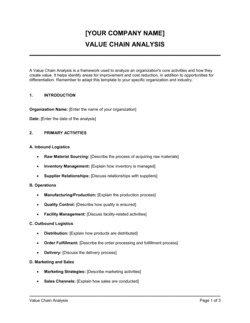
- The five direct value-creating activities in Porter's model: inbound logistics, operations, outbound logistics, marketing and sales, and service.
- Inbound Logistics
- All activities involved in receiving, storing, and distributing inputs — raw materials, components, or data — needed for production.
- Operations
- The transformation processes that convert inputs into the final product or service delivered to customers.
- Outbound Logistics
- Activities associated with collecting, storing, and physically or digitally distributing the finished product to buyers.
- Competitive Advantage
- A position of sustained superiority over rivals achieved either by delivering equivalent value at lower cost or delivering superior value at a comparable cost.
- Value Driver
- A specific activity, capability, or resource within the value chain that meaningfully increases the perceived value of the output to the customer.
- Cost Driver
- A factor — scale, learning, capacity utilization, linkages, or policy choices — that determines the cost level of a given value chain activity.
- Support Activities
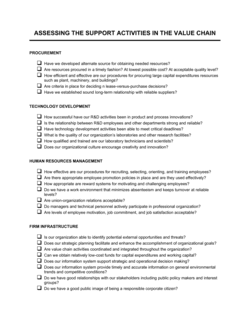
- Indirect activities in Porter's model — firm infrastructure, human resource management, technology development, and procurement — that enable the primary activities.
- Margin
- The difference between the total value created by the value chain and the total cost of performing all activities; the measure of whether the chain is generating profit.
- Linkages
- Interdependencies between value chain activities where the performance or cost of one activity affects another — managing them well is a source of competitive advantage.