Understanding Value Chain Analysis Template

Free download β€’ Use as a template β€’ Print or share

6 pagesβ€’25–35 min to useβ€’Difficulty: Complex
Learn more ↓
FreeUnderstanding Value Chain Analysis Template

At a glance

What it is
A Value Chain Analysis is a structured operational document that maps every activity your business performs β€” from inbound logistics to after-sales service β€” and evaluates each one for cost efficiency and contribution to competitive advantage. This free Word download gives you a ready-to-edit framework based on Porter's value chain model, which you can complete online and export as PDF to share with leadership, consultants, or investors.
When you need it
Use it when diagnosing why margins are eroding, preparing for a strategic planning cycle, evaluating a new market entry, or benchmarking operations against competitors. It is also a standard deliverable in MBA strategy courses and management consulting engagements.
What's inside
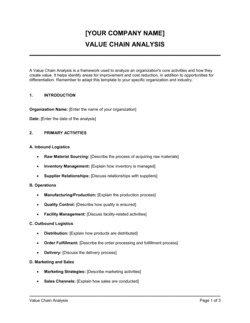
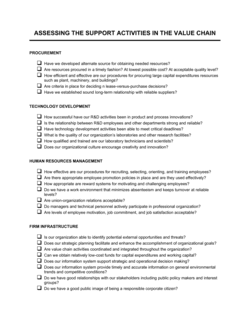
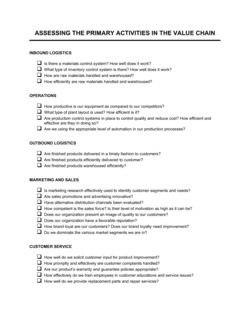
The template covers the five primary activities (inbound logistics, operations, outbound logistics, marketing and sales, and service) plus four support activities (firm infrastructure, human resource management, technology development, and procurement), each with a cost and value assessment section and a competitive advantage summary.

What is a Value Chain Analysis?

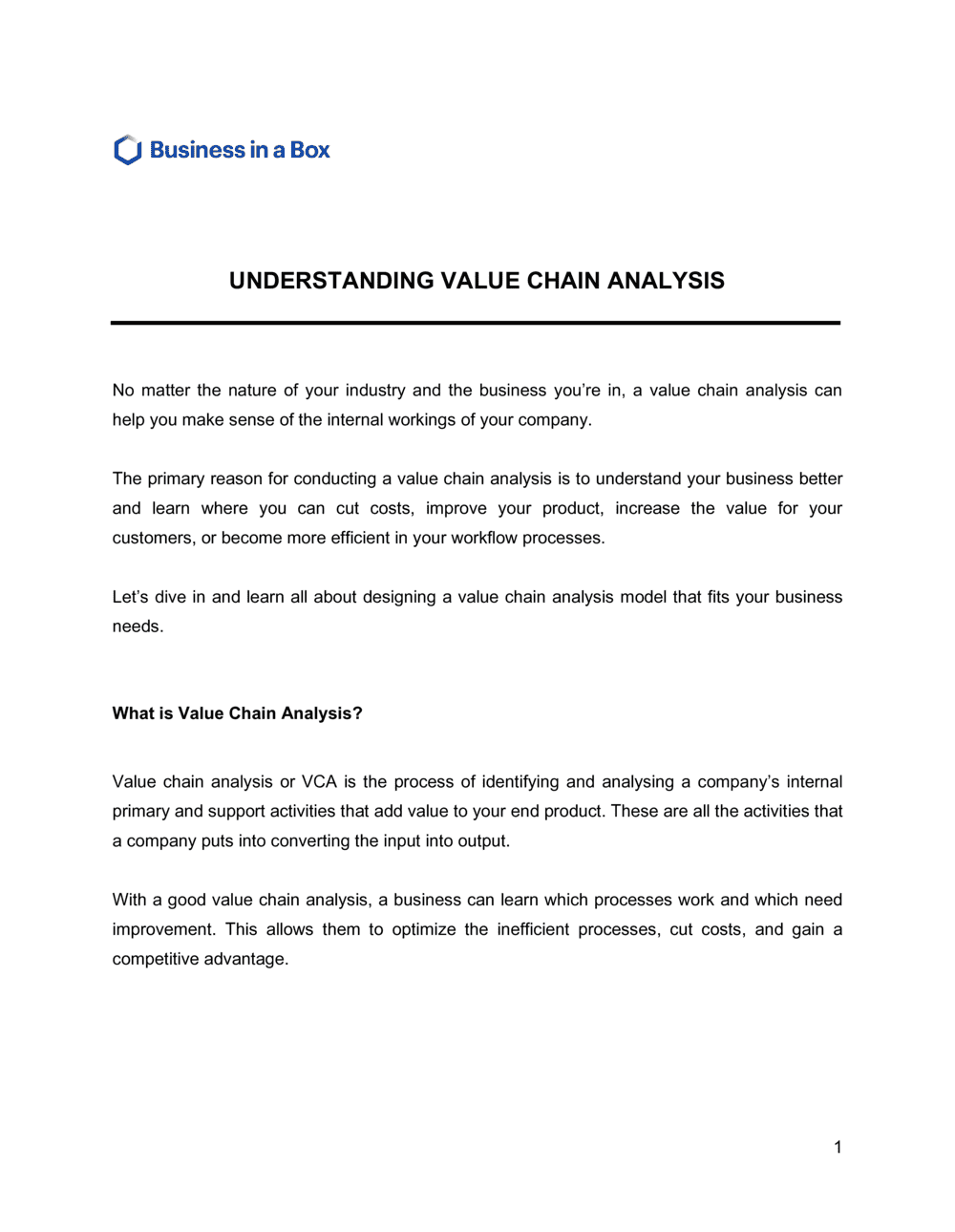
A Value Chain Analysis is a strategic diagnostic document that systematically maps every activity a business performs β€” from receiving raw materials to supporting customers after a sale β€” and evaluates each one for its cost efficiency and contribution to competitive advantage. Originally formalized by Michael Porter in his 1985 book Competitive Advantage, the framework organizes activities into five primary categories (inbound logistics, operations, outbound logistics, marketing and sales, and service) and four support categories (firm infrastructure, human resource management, technology development, and procurement). By assessing each activity individually and tracing the linkages between them, an organization can pinpoint exactly where it generates superior value for customers, where it incurs unnecessary cost, and which activities should be invested in, restructured, or outsourced.

Why You Need This Document

Without a value chain analysis, margin erosion and competitive gaps tend to be treated as vague organizational problems rather than specific operational failures β€” and vague problems do not get fixed. Companies that skip this diagnostic commonly invest in the wrong activities: upgrading marketing spend when the real problem is a defect rate in operations, or hiring sales staff when poor outbound logistics is causing customer churn. A completed value chain analysis gives leadership a fact-based map of where the business actually creates and destroys value, making capital allocation, outsourcing decisions, and competitive positioning discussions concrete rather than speculative. This template gives you the structure to complete that analysis in days rather than weeks, with a ready-to-present format for boards, investors, and management teams.

Which variant fits your situation?

If your situation is…Use this template
Broad competitive positioning across the full businessValue Chain Analysis (Full)
Rapid internal strategic alignment before a planning sessionSWOT Analysis
Assessing the external competitive environment onlyPorter's Five Forces Analysis
Mapping processes to eliminate waste in a manufacturing contextOperations Plan
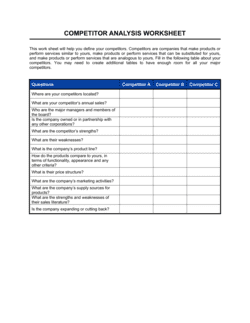
Benchmarking activities against a specific competitorCompetitive Analysis Template
Translating value chain findings into a strategic roadmapStrategic Planning Template
Evaluating whether to outsource a specific activityMake-or-Buy Analysis

Common mistakes to avoid

❌ Scoping the analysis at the entire company level

Why it matters: A whole-company value chain produces findings so broad they cannot be prioritized or acted on β€” every department looks like a mix of strengths and weaknesses without clear direction.

Fix: Restrict the scope to a single product line, business unit, or geographic market. Complete that analysis thoroughly, then replicate the approach for adjacent units.

❌ No quantified metrics for any activity

Why it matters: A purely qualitative assessment produces a document that reads as opinion rather than analysis β€” leadership cannot make investment or cost-reduction decisions without data.

Fix: Require at least one quantified metric per activity before writing the assessment. Use industry benchmarks from IBISWorld, trade associations, or competitor public filings when internal data is unavailable.

❌ Classifying every activity as a strength or neutral

Why it matters: A value chain with no weaknesses is either a monopoly or an incomplete analysis. Omitting genuine disadvantages causes the strategic recommendations to miss the most important improvement opportunities.

Fix: Use a structured scoring rubric and require the analyst to identify at least two activities that rate as disadvantages. If none emerge, revisit the competitor benchmarks β€” the bar may be set too low.

❌ Skipping the linkage analysis between activities

Why it matters: Optimizing each activity in isolation misses the interdependencies where margin actually leaks β€” a procurement policy that saves 3% on inputs but creates a 7% defect rate in operations destroys value.

Fix: After scoring each activity individually, map the three to five most significant upstream-downstream relationships and assess whether optimizing one activity creates problems elsewhere in the chain.

❌ Action plan items with no named owner or deadline

Why it matters: Strategy documents without accountability consistently go unimplemented. Research on organizational behavior consistently shows that unowned recommendations have an execution rate below 20%.

Fix: Every recommendation must have a named owner (by title), a completion deadline, and a measurable expected outcome. Review progress at the next leadership meeting after the analysis is presented.

❌ Writing the executive summary before completing the activity assessments

Why it matters: A summary written in advance shapes the analysis toward confirming a predetermined conclusion rather than discovering actual insights β€” a form of confirmation bias baked into the process.

Fix: Lock the executive summary as the final step. Write it by pulling directly from the completed competitive advantage summary and action plan sections.

The 10 key sections, explained

Executive Summary

Company and Scope Overview

Inbound Logistics Assessment

Operations Assessment

Outbound Logistics Assessment

Marketing and Sales Assessment

Service Assessment

Support Activities Assessment

Competitive Advantage Summary

Strategic Recommendations and Action Plan

How to fill it out

  1. 1

    Define scope and the strategic question

    Decide whether the analysis covers a single product line, business unit, or the whole company. Write the specific strategic question the analysis must answer β€” for example, 'Where are we losing margin to competitors in manufacturing and distribution?'

    πŸ’‘ A narrower scope produces more actionable findings. Analyze one business unit thoroughly rather than the whole company superficially.

  2. 2

    Gather cost and performance data for each activity

    Collect cost-per-activity data from your finance system, operational KPIs from department heads, and benchmarking data from industry reports or competitor filings. You need at least one quantified metric per activity.

    πŸ’‘ If internal cost data is not broken down by activity, ask finance to allocate total costs across the nine activity buckets using a time-and-motion estimate β€” it does not need to be perfect to be useful.

  3. 3

    Assess each primary activity for cost and differentiation

    For each of the five primary activities, score it as a cost advantage, differentiation advantage, parity, or disadvantage relative to your two or three closest competitors. Support each score with at least one data point.

    πŸ’‘ Use a simple 2Γ—2 grid β€” cost performance (below/above industry average) versus differentiation (higher/lower perceived value) β€” to make the scoring consistent across activities.

  4. 4

    Assess each support activity

    Evaluate HR, technology, procurement, and firm infrastructure using the same scoring framework. For each, identify one specific linkage to a primary activity where the support function either amplifies or constrains performance.

    πŸ’‘ Technology development is frequently underscored by non-tech companies β€” ask IT and operations to jointly assess which systems are enabling or bottlenecking primary activities.

  5. 5

    Map linkages between activities

    Identify the three to five most significant interdependencies β€” for example, poor procurement practices increasing inbound logistics defect rates, or slow outbound logistics undermining a premium service positioning.

    πŸ’‘ Linkages are often where the biggest margin improvements hide. An activity that looks efficient in isolation may be creating cost or quality problems downstream.

  6. 6

    Build the competitive advantage summary

    Consolidate activity scores into a single summary table: list each activity, your rating, your primary competitor's inferred rating, and the resulting advantage, parity, or gap.

    πŸ’‘ Be honest about disadvantages β€” a summary that shows only strengths will not generate useful strategic action and will lose credibility with an experienced reader.

  7. 7

    Write prioritized recommendations with owners and deadlines

    Convert each identified gap into a specific action item. Assign a named owner (by title), a completion date, a budget estimate if capital is required, and the expected outcome in quantified terms.

    πŸ’‘ Limit the action plan to five to seven items. A list of fifteen recommendations is a wish list; five focused priorities with owners get executed.

  8. 8

    Write the executive summary last

    Pull the top two or three findings and the top three recommendations into a one-page executive summary. This is the section your audience will read first and may read exclusively.

    πŸ’‘ If the executive summary requires more than one page, the analysis findings are not yet sharp enough β€” sharpen the language before expanding the summary.

Frequently asked questions

What is a value chain analysis?

A value chain analysis is a strategic framework β€” originally developed by Michael Porter in 1985 β€” that maps every activity a firm performs into a sequence of primary and support activities, then evaluates each for its cost and contribution to customer value. The goal is to identify which activities generate competitive advantage and which create unnecessary cost or reduce differentiation. It is widely used in strategic planning, consulting engagements, and MBA strategy courses.

What are the primary activities in a value chain?

Porter's model identifies five primary activities: inbound logistics (receiving and storing inputs), operations (converting inputs into outputs), outbound logistics (distributing finished products to customers), marketing and sales (attracting and converting buyers), and service (after-sales support, warranty, and customer success). Each contributes directly to the product or service the customer ultimately receives and pays for.

What are support activities in a value chain analysis?

Support activities are the four enabling functions that underpin all primary activities: firm infrastructure (finance, legal, management), human resource management (hiring, training, compensation), technology development (R&D, IT systems, process innovation), and procurement (purchasing of inputs, vendor management). They do not directly produce the product but determine how efficiently and effectively primary activities are performed.

How is a value chain analysis different from a SWOT analysis?

A SWOT analysis identifies strengths, weaknesses, opportunities, and threats at a broad organizational level without specifying which activities drive them. A value chain analysis drills into the specific operational activities that create or destroy competitive advantage and produces actionable findings at the activity level. In practice, value chain findings often populate the strengths and weaknesses quadrants of a SWOT with evidence-based, quantified inputs.

When should a business conduct a value chain analysis?

The four most common triggers are: margin erosion with an unclear source, a strategic planning cycle requiring a baseline competitive assessment, evaluation of a new market or product line entry, and a benchmarking exercise before or after a merger or acquisition. It is also standard practice before significant capital investment decisions β€” when you need to confirm which activities are worth scaling.

How long does a value chain analysis take to complete?

A focused single-business-unit analysis typically takes 2–4 weeks for an experienced analyst β€” one week of data gathering, one week of activity scoring and linkage mapping, and one week of recommendation development and report writing. A whole-company analysis across multiple business units can run 6–12 weeks. Using a structured template reduces the structural and formatting work by roughly 50%, concentrating effort on the data collection and judgment calls that require original thinking.

Can a small business benefit from a value chain analysis?

Yes β€” and the analysis is often faster and more actionable for a small business because fewer activities are involved and the analyst typically has direct access to operational data and decision-makers. Small business owners most commonly use it to decide which activities to outsource as they scale, to identify where competitors are undercutting their pricing, and to prioritize where to invest limited capital for maximum margin impact.

What data do I need to complete a value chain analysis?

At minimum: a cost breakdown by activity or department (from your P&L or cost accounting system), operational KPIs for each primary activity (utilization rates, defect rates, fulfillment times, CAC, NPS), and competitor benchmarks for at least two rivals. Industry benchmark data is available from IBISWorld, trade associations, and public competitor filings. If internal cost data is not broken down by activity, a time-and-motion estimate from department heads is a workable starting point.

What should the output of a value chain analysis include?

A complete output includes an activity-by-activity cost and differentiation assessment, a competitive advantage summary table rating each activity relative to primary competitors, a linkage map identifying the most significant interdependencies between activities, and a prioritized action plan with named owners, deadlines, and quantified expected outcomes. An executive summary of one page or less should appear at the front of the document for leadership audiences.

How this compares to alternatives

vs SWOT Analysis

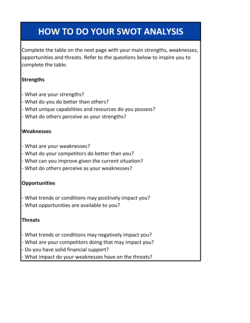
A SWOT analysis identifies organizational strengths, weaknesses, opportunities, and threats at a high level without specifying which activities drive them. A value chain analysis produces the activity-level evidence that should populate the strengths and weaknesses quadrants of a SWOT. Use the value chain first to gather the evidence, then summarize it in the SWOT for executive communication.

vs Competitive Analysis

A competitive analysis evaluates rivals' products, pricing, positioning, and market share from an external-market perspective. A value chain analysis evaluates your own internal activities and compares them to competitors at the operational level. They are complementary β€” competitive analysis tells you what competitors offer; value chain analysis explains why you can or cannot match it.

vs Strategic Planning Template

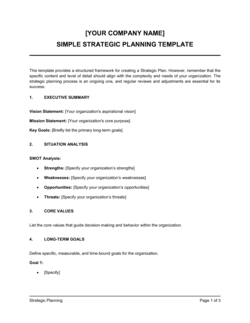
A strategic plan defines goals, initiatives, KPIs, and resource allocation for the next 3–5 years. A value chain analysis is a diagnostic input to that plan β€” it identifies which activities to invest in, fix, or outsource before goals are set. Complete the value chain analysis first to ensure the strategic plan is built on an accurate baseline of operational capability.

vs Operations Plan

An operations plan defines how day-to-day business processes will be executed β€” staffing, systems, facilities, and workflows. A value chain analysis evaluates whether those processes generate competitive advantage or create unnecessary cost. The value chain analysis diagnoses the current state; the operations plan prescribes how to run the business going forward.

Industry-specific considerations

Manufacturing

Operations and inbound logistics dominate the value chain β€” analysis typically focuses on throughput rates, defect percentages, supplier lead times, and make-or-buy decisions for sub-components.

Retail / E-commerce

Outbound logistics and marketing are the primary differentiators β€” analysis maps fulfillment speed, last-mile cost per order, customer acquisition cost by channel, and return-rate drivers.

SaaS / Technology

Technology development and marketing dominate β€” analysis evaluates R&D spend as a percentage of revenue, CAC payback period, net revenue retention, and support-ticket resolution time as service proxies.

Professional Services

Human resource management and service delivery are the core value drivers β€” analysis centers on billable utilization rates, staff attrition, client retention, and the linkage between talent development and project quality.

Template vs pro β€” what fits your needs?

PathBest forCostTime
Use the templateSmall business owners, students, and internal strategy teams conducting a first-pass competitive diagnosticFree2–4 weeks
Template + professional reviewMid-market companies using the analysis to support a capital investment decision or market entry evaluation$500–$2,000 for a strategy advisor or business analyst review session3–5 weeks
Custom draftedEnterprises requiring a multi-business-unit analysis, M&A due diligence, or a deliverable for a board or institutional investor$5,000–$25,000+ for a management consulting engagement4–12 weeks

Glossary

Value Chain
The full sequence of activities a firm performs to design, produce, market, deliver, and support its product or service.
Primary Activities
The five core operational activities in Porter's model that directly create and deliver a product: inbound logistics, operations, outbound logistics, marketing and sales, and service.
Support Activities
The four enabling activities β€” firm infrastructure, human resource management, technology development, and procurement β€” that underpin all primary activities.
Margin
In value chain terms, the difference between the total value created for the customer and the total cost of performing all activities.
Competitive Advantage
A structural benefit β€” lower cost or differentiated output β€” that one firm achieves in a specific activity relative to rivals.
Cost Driver
Any factor that causes the cost of an activity to increase or decrease β€” such as scale, capacity utilization, location, or learning curve effects.
Differentiation Driver
Any factor that causes a firm's output to be perceived as more valuable than competitors' β€” such as quality, speed, reliability, or unique features.
Linkage
An interdependency between two value chain activities where the cost or performance of one affects the other β€” optimizing linkages is a key source of competitive advantage.
Outsourcing
Delegating a value chain activity to an external supplier, typically when that activity is not a source of competitive advantage and can be performed more cheaply externally.
Value System
The broader network of value chains β€” suppliers, the firm, distributors, and buyers β€” that together create and deliver the final product to the end customer.

Part of your Business Operating System

This document is one of 3,000+ business & legal templates included in Business in a Box.

  • Fill-in-the-blanks β€” ready in minutes
  • 100% customizable Word document
  • Compatible with all office suites
  • Export to PDF and share electronically

Create your document in 3 simple steps.

From template to signed document β€” all inside one Business Operating System.
1
Download or open template

Access over 3,000+ business and legal templates for any business task, project or initiative.

2
Edit and fill in the blanks with AI

Customize your ready-made business document template and save it in the cloud.

3
Save, Share, Send, Sign

Share your files and folders with your team. Create a space of seamless collaboration.

Save time, save money, and create top-quality documents.

β˜…β˜…β˜…β˜…β˜…

"Fantastic value! I'm not sure how I'd do without it. It's worth its weight in gold and paid back for itself many times."

Managing Director Β· Mall Farm
Robert Whalley
Managing Director, Mall Farm Proprietary Limited
β˜…β˜…β˜…β˜…β˜…

"I have been using Business in a Box for years. It has been the most useful source of templates I have encountered. I recommend it to anyone."

Business Owner Β· 4+ years
Dr Michael John Freestone
Business Owner
β˜…β˜…β˜…β˜…β˜…

"It has been a life saver so many times I have lost count. Business in a Box has saved me so much time and as you know, time is money."

Owner Β· Upstate Web
David G. Moore Jr.
Owner, Upstate Web

Run your business with a system β€” not scattered tools

Stop downloading documents. Start operating with clarity. Business in a Box gives you the Business Operating System used by over 250,000 companies worldwide to structure, run, and grow their business.

Start freeΒ Β·Β No credit card required