Thank You for Product, Impressed, Declined Template

Free Word download β€’ Edit online β€’ Save & share with Drive β€’ Export to PDF

1 pageβ€’20–30 min to fillβ€’Difficulty: Standardβ€’Signature requiredβ€’Legal review recommended
Learn more ↓
FreeThank You for Product, Impressed, Declined Template

At a glance

What it is
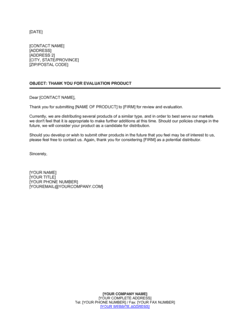
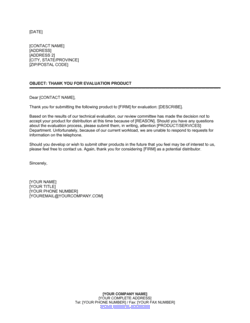
A Thank You For Product Impressed Declined letter is a formal written communication a business sends to a vendor or supplier to acknowledge receipt and review of a submitted product, express genuine appreciation for the presentation, and officially decline to proceed β€” without creating any implied obligation to purchase or negotiate further. This free Word download gives you a professionally structured, editable template you can customize and export as PDF in minutes.
When you need it
Use it whenever your procurement, purchasing, or product team has evaluated a vendor's product submission and decided not to move forward, but wants to preserve the business relationship and avoid any implied acceptance of terms. It is especially important when a supplier has invested significant time in a formal product demonstration or proposal.
What's inside
The letter covers a formal acknowledgment of the product received, a genuine appreciation statement, a clear and unambiguous declination notice, a brief non-committal reason for the decision, a relationship preservation statement, and a signature block with authorized representative details.

What is a Thank You For Product Impressed Declined Letter?

A Thank You For Product Impressed Declined letter is a formal written communication a business sends to a vendor or supplier after evaluating a submitted product β€” acknowledging genuine appreciation for the quality of the product or the professionalism of the presentation, and officially declining to proceed with a purchase. Unlike a simple rejection notice, this document is designed to close the evaluation on a positive, relationship-preserving note while including legally important language that prevents any implied purchase obligation, promise of future business, or misinterpretation of the appreciation language as a letter of intent. It is used across procurement, purchasing, and product-evaluation functions in businesses of every size.

Why You Need This Document

Failing to issue a formal written declination after a product evaluation creates concrete legal and operational risk. Without a signed letter on file, a vendor may legitimately claim the evaluation is still open β€” generating unwanted follow-up, renegotiation attempts, or in extreme cases, a claim of implied acceptance or promissory estoppel based on positive verbal feedback. If proprietary samples or confidential specifications were shared during the review and no written record addresses their return or handling, your company may face IP misappropriation exposure. In regulated industries such as healthcare and financial services, undocumented procurement decisions create audit gaps. This template closes all of those risks in a single, 15-minute document β€” preserving the vendor relationship, creating a timestamped declination record, and ensuring your team never leaves an evaluated product in legal limbo.

Which variant fits your situation?

If your situation is…Use this template
Declining a product after a formal RFP or tender processRejection of Proposal Letter
Declining a service offering rather than a physical productThank You For Service Proposal Declined Letter
Declining a vendor after initial contact with no formal product reviewVendor Rejection Letter
Terminating an existing supplier relationship entirelySupplier Termination Letter
Acknowledging a product and requesting a follow-up at a later dateDefer Vendor Decision Letter
Declining a product but inviting a revised proposal at a different price pointCounter Proposal Letter
Formally declining after a product trial or pilot periodPost-Trial Product Declination Letter

Common mistakes to avoid

❌ Using ambiguous future-intent language

Why it matters: Phrases like 'we'll revisit this next quarter' or 'we're not ready yet' can be read as a conditional promise to purchase, giving the vendor grounds to follow up with a claim of implied agreement or promissory estoppel.

Fix: Either make the declination final and unconditional, or add a specific, date-bound resubmission invitation clause that makes the conditions for future consideration explicit.

❌ Providing overly specific declination reasons

Why it matters: Citing a competitor's lower price, a specific product defect, or a named internal stakeholder's objection exposes confidential procurement data and can invite renegotiation, legal challenges, or reputational damage.

Fix: Limit the reason to one sentence referencing internal priorities, budget timing, or strategic fit β€” language that is honest, professional, and does not reveal actionable procurement intelligence.

❌ Omitting the no-obligation clause

Why it matters: Without explicit language disclaiming any contractual commitment, a vendor's counsel may argue that a series of positive written communications β€” combined with the appreciation language in the letter β€” constitutes a letter of intent or creates reliance.

Fix: Include a dedicated no-obligation paragraph confirming that nothing in the letter creates a purchase commitment, negotiation obligation, or implied agreement of any kind.

❌ Failing to address return or destruction of proprietary materials

Why it matters: If the vendor shared trade secrets, proprietary formulas, or confidential product specifications during the review and the letter ignores them, the company may face IP misappropriation claims if those details later appear in a competing product or internal specification.

Fix: Add a materials-handling clause stating specifically how samples and confidential documentation will be returned or destroyed, with a timeframe of no more than 30 business days.

❌ Having an unauthorized or too-junior staff member sign

Why it matters: A declination letter signed by someone without actual authority to make procurement decisions can be challenged as not representing the company's official position β€” leaving the formal evaluation result in legal ambiguity.

Fix: Ensure the signatory holds a title with documented procurement authority β€” at minimum a manager-level title, and VP or C-suite for vendor relationships above a defined spend threshold.

❌ Sending the letter without proofreading vendor and product names

Why it matters: Misspelling a vendor's company name or referencing the wrong product in a formal declination letter signals carelessness and, in some cases, creates ambiguity about which vendor or which product the declination covers.

Fix: Cross-reference the vendor's name and product title against the original submission or proposal before signing and sending. A 60-second check prevents a relationship-damaging error.

The 9 key clauses, explained

Date, parties, and reference line

In plain language: Opens the letter with the date sent, the recipient's full name and company, and a subject line referencing the specific product or demonstration reviewed.

Sample language
[DATE] | [VENDOR CONTACT NAME] | [VENDOR COMPANY NAME] | [ADDRESS] | Re: Thank You and Decision Regarding [PRODUCT NAME / SUBMISSION DATE]

Common mistake: Omitting the specific product name or submission date in the reference line β€” without it, vendors with multiple outstanding proposals cannot match the letter to the correct submission, creating confusion and follow-up calls.

Acknowledgment of product received

In plain language: Confirms that the company received, reviewed, and gave genuine consideration to the vendor's product β€” establishing a factual record of the evaluation.

Sample language
Thank you for presenting [PRODUCT NAME] to [COMPANY NAME] on [DATE]. We appreciate the time and effort your team invested in the demonstration and have given your submission careful consideration.

Common mistake: Using vague language like 'we looked at your materials' instead of confirming a formal review took place β€” this can imply the product was not seriously considered and damage the vendor relationship unnecessarily.

Expression of genuine appreciation

In plain language: Acknowledges the quality of the product or the professionalism of the presentation in specific, honest terms without overpromising or implying a future purchase.

Sample language
We were genuinely impressed by the quality of [PRODUCT NAME] and the thoroughness of your presentation. Your team demonstrated a clear understanding of [RELEVANT FEATURE / MARKET NEED].

Common mistake: Making this section sound formulaic or insincere with generic phrases like 'very impressive product' β€” vendors notice, and it undermines the relationship-preservation purpose of the letter.

Clear and unambiguous declination statement

In plain language: States plainly that the company will not be proceeding with a purchase or further negotiation at this time β€” the most legally important clause in the letter.

Sample language
After careful review, we have decided not to move forward with the purchase of [PRODUCT NAME] at this time. This decision is final and does not create any obligation for future consideration.

Common mistake: Softening the declination with phrases like 'we're not ready yet' or 'maybe in the future' β€” this creates an implied promise of reconsideration and can generate unwanted follow-up or, in rare cases, a claim of implied agreement.

Brief, non-committal reason for the decision

In plain language: Provides a short, honest explanation for the declination that does not expose the company to dispute or imply that a different product configuration would be accepted.

Sample language
Our decision reflects our current internal priorities and budget allocation rather than any deficiency in your product or organization.

Common mistake: Giving overly specific reasons β€” such as 'your price was $X higher than a competitor' β€” which can invite renegotiation, expose confidential procurement information, or prompt legal challenges.

Confidentiality and return of materials

In plain language: Addresses whether samples, proprietary specifications, or demonstration materials will be returned or destroyed, and confirms that confidential product information will not be shared.

Sample language
Any materials, samples, or proprietary information provided during the review process will be [returned / destroyed] within [X] business days. We confirm that confidential product details shared during the evaluation will not be disclosed to third parties.

Common mistake: Ignoring this clause entirely when physical samples or trade-secret-level specifications were shared β€” omitting it creates exposure if the vendor later claims their IP was misused.

No obligation or future commitment language

In plain language: Explicitly confirms that this letter does not create any contractual obligation, implied agreement, or promise of future business between the parties.

Sample language
Nothing in this letter should be construed as a commitment, agreement, or obligation on the part of [COMPANY NAME] to purchase, negotiate, or enter into any future arrangement with [VENDOR COMPANY NAME].

Common mistake: Omitting this clause entirely β€” without it, a vendor's legal team may argue that a series of positive communications constitutes a letter of intent or creates promissory estoppel exposure.

Relationship preservation statement

In plain language: Closes the substantive content with a professional statement that keeps the business relationship intact for potential future engagement, without making any legally enforceable promise.

Sample language
We value the relationship we have developed with your organization and hope to have the opportunity to consider your products in future procurement cycles. We wish [VENDOR COMPANY NAME] continued success.

Common mistake: Writing 'we will definitely consider you next year' instead of 'we hope to consider you in future cycles' β€” the former can be construed as a conditional promise with timeline implications.

Authorized signature block

In plain language: Closes the letter with the name, title, and signature of the authorized company representative β€” establishing accountability and confirming the letter is an official company communication.

Sample language
Sincerely, [AUTHORIZED REPRESENTATIVE NAME] | [TITLE] | [COMPANY NAME] | [DIRECT EMAIL] | [PHONE NUMBER]

Common mistake: Having a junior staff member sign a declination letter for a high-value vendor submission β€” this signals the vendor was not taken seriously and can damage the professional relationship or trigger an escalation request.

How to fill it out

  1. 1

    Enter the date and vendor's full contact details

    Fill in today's date, the vendor contact's full name and title, and the vendor company's registered name and mailing address at the top of the letter.

    πŸ’‘ Use the vendor's legal entity name β€” not a brand or trade name β€” to ensure the letter reaches the correct accounts receivable or legal contact if the vendor escalates.

  2. 2

    Complete the reference line with the specific product name

    Enter the exact name of the product submitted and the date it was demonstrated or received. This creates an unambiguous record linking the letter to the specific evaluation.

    πŸ’‘ If the vendor submitted multiple products, create a separate letter for each β€” a single letter covering multiple products creates confusion about which decisions apply to which submission.

  3. 3

    Personalize the acknowledgment and appreciation section

    Replace the placeholder language with one or two specific observations about the product or presentation β€” a particular feature, the quality of the demonstration, or the vendor's domain expertise.

    πŸ’‘ One specific, honest compliment carries more relationship-preservation value than three generic ones. Reference something the vendor actually said or showed during the review.

  4. 4

    Write the declination statement clearly and finally

    Confirm the decision not to proceed in plain, direct language. Avoid conditionals like 'at this stage' or 'for now' unless you genuinely intend to invite resubmission at a defined future date.

    πŸ’‘ If there is any possibility you want to revisit the product in six months, add a specific resubmission invitation clause rather than leaving the door ambiguously open.

  5. 5

    Add a brief, non-specific reason for the decision

    Include one sentence explaining the decision in terms of internal priorities, budget cycles, or strategic fit β€” without referencing competitors, specific price points, or product deficiencies that could be disputed.

    πŸ’‘ Phrases like 'our current budget cycle' or 'our existing supplier commitments' are safe and honest without revealing confidential procurement information.

  6. 6

    Address confidentiality and return of materials

    If the vendor provided physical samples, proprietary specifications, or trade-secret-level documentation, state clearly how those materials will be handled β€” returned, destroyed, or retained under a confidentiality obligation.

    πŸ’‘ If you already have an NDA in place with this vendor, reference it by date in this clause rather than restating confidentiality obligations at length.

  7. 7

    Have an authorized representative sign the letter

    Route the completed letter to the appropriate signing authority β€” typically the procurement manager, operations director, or a C-suite executive for high-value vendor relationships β€” before sending.

    πŸ’‘ Match the seniority of the signatory to the value of the vendor relationship. A $500K annual supplier warrants a VP or C-suite signature even on a declination.

Frequently asked questions

What is a Thank You For Product Impressed Declined letter?

It is a formal business letter a company sends to a vendor after reviewing a product submission, acknowledging genuine appreciation for the quality of the product or presentation, and officially declining to proceed with a purchase. It closes the evaluation professionally, protects the company from implied purchase obligations, and preserves the vendor relationship for future opportunities.

Why should a product declination letter be in writing?

A verbal declination leaves no record of when the decision was communicated, what was said, or whether the vendor received notice. A written letter creates a timestamped, signed record that the evaluation is complete and the company has declined β€” protecting against vendor claims of implied acceptance, ongoing negotiation, or unresolved purchase intent. In disputes, courts and arbitrators give significant weight to written, signed communications over verbal accounts.

Should I give specific reasons for declining the product?

Generally, no. Specific reasons β€” such as a competitor's lower price, a named product defect, or an internal stakeholder's objection β€” expose confidential procurement data, invite renegotiation, and can create grounds for a legal challenge if the vendor believes the reason was discriminatory or pretextual. A single sentence referencing internal priorities, budget timing, or strategic fit is professionally sufficient and legally safer.

Can this letter be used to decline an unsolicited product submission?

Yes. For unsolicited submissions, add a non-solicitation acknowledgment clause confirming that the company did not request the product and therefore has no obligation arising from the submission. This is particularly important in industries where vendors routinely send unsolicited samples or proprietary specifications and may later claim the company benefited from confidential product information.

What should happen to product samples or proprietary materials after sending this letter?

The letter should specify whether materials will be returned to the vendor or destroyed within a defined timeframe β€” typically 10 to 30 business days. If an NDA was in place during the evaluation, reference it in the letter rather than restating confidentiality terms. Retaining vendor samples or specifications without a clear handling policy creates IP and confidentiality exposure, particularly in regulated industries.

Who should sign a product declination letter?

The signatory should be an authorized representative with documented procurement authority β€” typically a procurement manager, operations director, or VP of Supply Chain. For high-value vendor relationships or strategic product categories, a C-suite signature is appropriate. A junior staff member's signature on a significant declination can signal the evaluation was not taken seriously and may prompt the vendor to request escalation.

Is this letter appropriate for declining a product after a trial or pilot?

The core structure works for post-trial declinations, but the acknowledgment section should reference the trial period specifically and confirm that the evaluation included operational testing β€” not just a demonstration. If the vendor provided the product on consignment or under a pilot agreement, the letter should also confirm the trial period has ended and any return or payment obligations under the pilot agreement have been satisfied.

Can I use this letter template for international vendors?

Yes, with adjustments. For vendors in the EU, ensure the confidentiality clause aligns with GDPR requirements if any personal data was exchanged during the evaluation. For vendors in Canada or the UK, the no-obligation language should be reviewed to confirm it meets local contract law standards. For high-value international vendor relationships, consider a brief legal review before sending to confirm the letter is appropriate for the vendor's home jurisdiction.

How this compares to alternatives

vs Rejection of Proposal Letter

A Rejection of Proposal Letter declines a formal submitted proposal β€” typically in response to an RFP or tender β€” and focuses on the proposal's failure to meet stated evaluation criteria. A Thank You For Product Impressed Declined letter is used after an informal or direct product demonstration, emphasizes genuine appreciation for the product's quality, and is more relationship-oriented. Use the proposal rejection for competitive bid processes and this letter for one-on-one product evaluations.

vs Vendor Termination Letter

A Vendor Termination Letter ends an existing supplier relationship and typically references contract terms, notice periods, and outstanding obligations. A product declination letter is used when no purchase or supply relationship was ever established β€” the vendor is being declined at the evaluation stage, not terminated mid-contract. Confusing the two can inadvertently imply a supplier relationship existed when it did not.

vs Counter Proposal Letter

A Counter Proposal Letter declines the vendor's current terms but invites renegotiation at different pricing, specifications, or conditions. A product declination letter is appropriate when the decision is final and no renegotiation is desired. Use a counter proposal when the product is genuinely of interest but the terms are not acceptable, and this template when the decision is closed.

vs Letter of Intent

A Letter of Intent signals a company's preliminary intention to proceed with a vendor relationship or purchase, typically outlining key terms subject to final agreement. It is the functional opposite of a product declination letter. The two documents should never be confused β€” sending a letter of intent when a declination was intended can create binding preliminary obligations in some jurisdictions.

Industry-specific considerations

Retail and consumer goods

Buyers routinely evaluate hundreds of product submissions per season and need a standardized, relationship-preserving declination letter to manage vendor volume without creating implied purchase commitments across a large supplier base.

Manufacturing and supply chain

Procurement teams evaluating component suppliers or raw material vendors need declination letters that address return of proprietary samples, handling of technical specifications, and protection against IP misappropriation claims.

Healthcare and medical devices

Hospital procurement and group purchasing organizations face strict conflict-of-interest rules requiring documented, formal declination records for every product evaluated β€” including those that impressed reviewers but did not meet formulary or regulatory criteria.

Technology and SaaS

Technology buyers evaluating software integrations, hardware components, or third-party platforms need declination letters that address confidentiality of any API documentation, security specifications, or proprietary architecture shared during the evaluation.

Jurisdictional notes

United States

Under US common law, a series of positive written communications followed by conduct consistent with intent to purchase can support a promissory estoppel or implied contract claim. The no-obligation clause in this template is designed to negate that risk. State-level UCC Article 2 governs sales of goods β€” a letter that inadvertently describes agreed pricing and quantity terms could be read as a contract formation document in some states, so avoid specific price or quantity references.

Canada

Canadian common law (outside Quebec) recognizes implied contracts and promissory estoppel on similar grounds to US law, making the no-obligation clause equally important. In Quebec, the Civil Code governs commercial obligations, and pre-contractual negotiations can give rise to good-faith dealing obligations β€” a clearly worded declination letter reduces the risk of a vendor claiming bad-faith termination of negotiations. Bilingual correspondence (English and French) is advisable for Quebec-based vendors.

United Kingdom

Under English contract law, a clear written declination with no-obligation language effectively prevents any argument of offer acceptance or implied agreement. If proprietary samples were shared under a confidentiality agreement, UK courts will enforce NDA terms regardless of whether this letter references them β€” but explicit reference in the letter creates a cleaner record. The Misrepresentation Act 1967 is not triggered by an appreciation statement in a declination letter, but avoid any language that could be read as a factual representation about the product's fitness.

European Union

GDPR applies if any personal data about the vendor's representatives was collected during the evaluation process β€” for example, business cards, contact details, or recorded presentations. The letter should be consistent with your data retention policy for vendor evaluation records. Several EU member states (notably Germany and France) impose pre-contractual good-faith obligations under national civil codes, meaning a protracted evaluation with positive feedback followed by a sudden declination could theoretically support a culpa in contrahendo claim β€” keep the tone professional and the timeline of the evaluation factually accurate.

Template vs lawyer β€” what fits your deal?

PathBest forCostTime
Use the templateStandard product declinations with no existing NDA, no proprietary materials exchanged, and no prior purchase history with the vendorFree10–15 minutes per letter
Template + legal reviewDeclinations where proprietary samples or trade-secret specifications were shared, or where the vendor relationship has a complex prior history$100–$300 for a brief legal review1–2 business days
Custom draftedHigh-value vendor declinations in regulated industries, cross-border supplier relationships, or situations where IP ownership or confidentiality obligations are in dispute$500–$1,5003–5 business days

Glossary

Declination Notice
A formal written statement communicating that a receiving party has chosen not to accept, purchase, or proceed with an offered product or service.
No Obligation Language
Phrasing in a business letter that explicitly confirms the recipient has not entered into any contractual commitment by reviewing or acknowledging the product.
Vendor Relationship Management
The ongoing practice of maintaining professional, documented communication with suppliers to preserve future business opportunities and avoid disputes.
Implied Contract
An unintended contractual obligation that can arise from conduct or ambiguous written communication, even without a formal signed agreement.
Authorized Representative
A person within an organization who has legal authority to sign correspondence or contracts on behalf of the company.
Procurement Cycle
The end-to-end process by which a business identifies needs, solicits vendors, evaluates products or services, and makes a purchase decision.
Non-Solicitation Acknowledgment
A clause confirming that the recipient did not solicit the product submission and therefore has no obligation arising from unsolicited materials.
Business Relationship Preservation Clause
Language in a declination letter that keeps communication cordial and signals openness to future engagement without creating any legal promise to do so.
Product Submission
A formal presentation, sample, demonstration, or proposal in which a vendor offers a product for a buyer's consideration and potential purchase.
Confidentiality Acknowledgment
A statement confirming whether any information shared during the product review will be kept confidential or returned to the submitting party.

Part of your Business Operating System

This document is one of 3,000+ business & legal templates included in Business in a Box.

  • Fill-in-the-blanks β€” ready in minutes
  • 100% customizable Word document
  • Compatible with all office suites
  • Export to PDF and share electronically

Create your document in 3 simple steps.

From template to signed document β€” all inside one Business Operating System.
1
Download or open template

Access over 3,000+ business and legal templates for any business task, project or initiative.

2
Edit and fill in the blanks with AI

Customize your ready-made business document template and save it in the cloud.

3
Save, Share, Send, Sign

Share your files and folders with your team. Create a space of seamless collaboration.

Save time, save money, and create top-quality documents.

β˜…β˜…β˜…β˜…β˜…

"Fantastic value! I'm not sure how I'd do without it. It's worth its weight in gold and paid back for itself many times."

Managing Director Β· Mall Farm
Robert Whalley
Managing Director, Mall Farm Proprietary Limited
β˜…β˜…β˜…β˜…β˜…

"I have been using Business in a Box for years. It has been the most useful source of templates I have encountered. I recommend it to anyone."

Business Owner Β· 4+ years
Dr Michael John Freestone
Business Owner
β˜…β˜…β˜…β˜…β˜…

"It has been a life saver so many times I have lost count. Business in a Box has saved me so much time and as you know, time is money."

Owner Β· Upstate Web
David G. Moore Jr.
Owner, Upstate Web

Run your business with a system β€” not scattered tools

Stop downloading documents. Start operating with clarity. Business in a Box gives you the Business Operating System used by over 250,000 companies worldwide to structure, run, and grow their business.

Start freeΒ Β·Β No credit card required