Thank You for Tour Template

Free Word download β€’ Edit online β€’ Save & share with Drive β€’ Export to PDF

1 pageβ€’20–30 min to fillβ€’Difficulty: Standardβ€’Signature requiredβ€’Legal review recommended
Learn more ↓
FreeThank You for Tour Template

At a glance

What it is
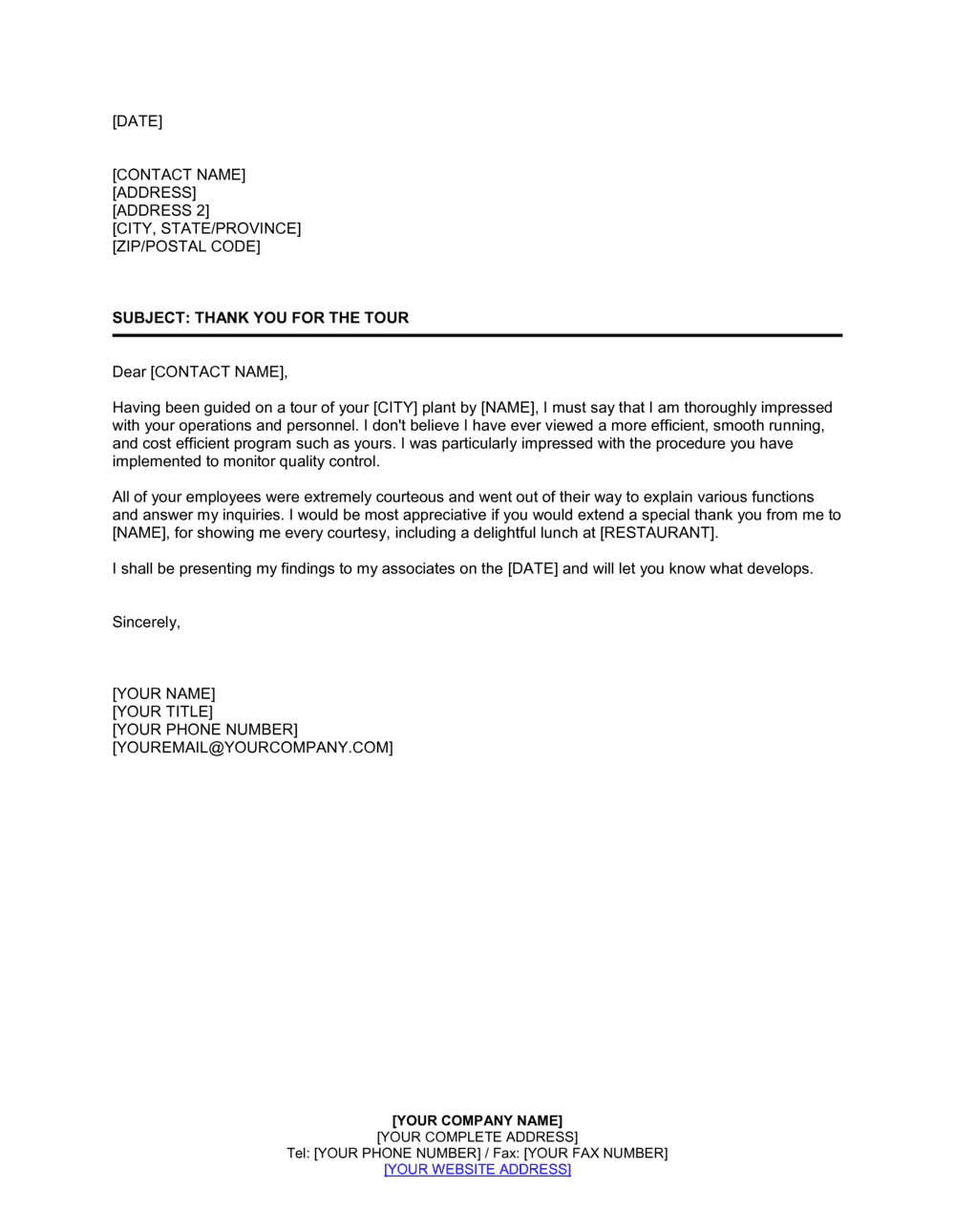
A Thank You For Tour letter is a formal written communication sent by a property manager, real estate agent, or venue operator to a prospective tenant, buyer, or client following an in-person or virtual tour. This free Word download lets you customize the key details, reinforce the value of the property or venue, and move the recipient toward a decision β€” all in a professionally formatted document you can export as PDF and send the same day.
When you need it
Send it within 24–48 hours of any property showing, apartment walkthrough, commercial space tour, or venue visit where a formal follow-up is needed to maintain momentum and document the interaction. It is especially important when the tour leads into a negotiation or application process where a written record of communications is valuable.
What's inside
The letter includes an opening acknowledgment of the tour, a summary of the key property or venue details discussed, a restatement of pricing and availability, next steps and a clear call to action, contact information for follow-up questions, and a professional closing with authorized signature.

What is a Thank You For Tour Letter?

A Thank You For Tour letter is a formal written follow-up sent by a property manager, real estate agent, or venue operator to a prospective tenant, buyer, or client after an in-person or virtual property tour. It acknowledges the visit by name and date, recaps the specific features and pricing discussed, and presents a clear, time-bound call to action β€” such as submitting a rental application, signing a letter of intent, or scheduling a second visit. Beyond its sales function, the letter creates a documented written record of the post-tour communication and the terms represented, which is valuable if questions or disputes arise later in the leasing or purchase process.

Why You Need This Document

Failing to send a professional, personalized follow-up after a property tour is one of the most common and costly errors in property management and real estate sales. Prospects touring multiple properties in the same week make decisions quickly, and a well-crafted letter sent within 24 hours can be the single factor that keeps your property on the shortlist. Without it, you have no written record of the pricing, availability, and next steps you communicated verbally during the tour β€” leaving you exposed if a prospect later claims they were promised different terms. A clearly structured follow-up letter with a rate-validity deadline creates measurable decision pressure that passive verbal follow-ups cannot replicate. This template gives you a legally sound, professionally formatted starting point that you can personalize and send the same day as the tour, ensuring you capture serious applicants before they sign elsewhere.

Which variant fits your situation?

If your situation is…Use this template
Following up after a residential apartment or home showingThank You For Tour β€” Residential
Following up after a commercial office or retail space tourThank You For Tour β€” Commercial
Following up after a venue or event space walkthroughThank You For Tour β€” Venue
Sending a formal written offer after a tourLease Proposal Letter
Confirming a property showing appointment in advanceProperty Showing Confirmation Letter
Declining a prospective tenant following a tourTenant Rejection Letter
Inviting a prospect back for a second tour or follow-up visitProperty Showing Invitation Letter

Common mistakes to avoid

❌ Sending a generic, non-personalized letter

Why it matters: A prospect touring multiple properties will not remember your property from a letter that reads like a mass mailing. Generic letters are deleted without reply.

Fix: Reference the specific unit toured, the date, and at least one detail from the conversation during the visit to establish that the letter was written for this recipient.
❌ Omitting a rate validity deadline

Why it matters: Without a deadline, the letter creates no decision pressure and the prospect continues shopping indefinitely while your unit sits vacant.

Fix: Include a specific date β€” typically 5 to 10 business days β€” by which the quoted rate and availability are guaranteed, then follow up by phone one day before it lapses.

❌ Quoting a price that differs from the formal application or listing

Why it matters: A discrepancy between the follow-up letter and the formal application creates a fair housing complaint risk and may be used by the prospect to demand the lower price.

Fix: Cross-reference the letter's pricing against the active listing and the application form before sending. Any promotions or incentives must be identical across all written materials.

❌ Sending the letter from a generic inbox with no named contact

Why it matters: Replies to a generic inbox β€” leasing@, info@, or contact@ β€” are often delayed or lost, and prospects who cannot reach a person quickly move to a competing property.

Fix: Use the direct email address of the leasing agent who conducted the tour, and include their direct phone number as the primary point of contact in the letter.

❌ Describing a holding deposit as non-refundable without legal review

Why it matters: Non-refundable pre-lease deposits are restricted or prohibited in several US states and Canadian provinces. Calling a deposit non-refundable in writing exposes the landlord to regulatory complaints and restitution claims.

Fix: Default to 'fully refundable if application is not approved' language and consult local tenancy law β€” or your legal counsel β€” before characterizing any pre-lease deposit as non-refundable.

❌ No terms and conditions reservation clause

Why it matters: A letter that quotes a price, states availability, and includes a call to action can be interpreted as a binding offer in common-law jurisdictions if the prospect communicates acceptance in writing.

Fix: Always include a clause stating that the letter is not a binding commitment and that any occupancy or sale is contingent on the execution of a formal agreement and satisfactory completion of the qualification process.

The 9 key clauses, explained

Opening acknowledgment

In plain language: Formally thanks the recipient for taking the time to tour the property and identifies the specific date, location, and type of tour.

Sample language
Thank you for visiting [PROPERTY NAME] located at [PROPERTY ADDRESS] on [TOUR DATE]. We appreciate the time you took to tour [UNIT/SPACE DESCRIPTION] and hope the visit provided a clear picture of everything the property has to offer.

Common mistake: Using a generic 'Thank you for your visit' without specifying the property or date. When a prospect is touring multiple properties, a vague letter is indistinguishable and signals low effort.

Property or venue summary

In plain language: Recaps the key features, amenities, or specifications discussed during the tour to reinforce the value proposition in writing.

Sample language
As discussed during your tour, [PROPERTY NAME] offers [KEY FEATURE 1], [KEY FEATURE 2], and [KEY FEATURE 3], with [SQUARE FOOTAGE/CAPACITY] suitable for [INTENDED USE].

Common mistake: Listing every possible feature without tailoring the summary to what the prospect asked about. A feature-dumped recap reads as a brochure, not a personalized follow-up.

Pricing and availability confirmation

In plain language: States the current rental rate, purchase price, or venue fee, along with the availability window, so the prospect has the figures in writing.

Sample language
The [UNIT/SPACE] is currently available from [AVAILABLE DATE] at a [monthly rent / purchase price / event fee] of $[AMOUNT]. This rate is valid through [EXPIRY DATE], after which availability and pricing are subject to change.

Common mistake: Omitting the rate expiry or availability deadline. Without a time boundary, the prospect feels no urgency to respond and the letter loses its conversion function.

Next steps and call to action

In plain language: Clearly tells the recipient what action to take next β€” submit an application, schedule a second visit, sign a letter of intent, or contact the sender β€” with a specific deadline.

Sample language
To secure [PROPERTY NAME], we invite you to [COMPLETE AN APPLICATION / SUBMIT A LETTER OF INTENT / CONTACT US] by [DEADLINE DATE]. You can reach [CONTACT NAME] directly at [PHONE] or [EMAIL] to move forward.

Common mistake: Ending the letter with 'please let us know if you have questions' instead of a specific next step. Passive closes produce passive responses.

Terms and conditions reference

In plain language: Notes that any commitment is subject to the terms of a formal lease or purchase agreement, avoiding the letter being interpreted as a binding offer.

Sample language
Any tenancy or purchase arising from this correspondence is subject to the execution of a formal [LEASE AGREEMENT / PURCHASE AND SALE AGREEMENT] and satisfactory completion of [APPLICATION / CREDIT CHECK / DUE DILIGENCE], as applicable.

Common mistake: Omitting this clause entirely. A follow-up letter that quotes a price and next steps can, in some jurisdictions, be read as a binding offer if no reservation of rights is stated.

Application and qualification requirements

In plain language: Outlines what the prospect must submit or satisfy β€” income verification, credit check, references, or security deposit β€” to proceed beyond the tour stage.

Sample language
To complete your application for [PROPERTY NAME], please provide: proof of income (minimum [X]Γ— monthly rent), government-issued photo ID, [REFERENCE LETTERS / CREDIT AUTHORIZATION FORM], and a security deposit of $[AMOUNT] upon approval.

Common mistake: Stating qualification criteria in the follow-up letter that differ from the criteria in the formal application. Inconsistencies create fair housing complaints or contract disputes.

Holding deposit or reservation note (if applicable)

In plain language: Explains whether a holding deposit is available to reserve the property while the application is processed, and states the refund policy.

Sample language
A refundable holding deposit of $[AMOUNT] is available to reserve [UNIT/SPACE] while your application is under review. This deposit is fully refundable if your application is not approved and will be applied to your first month's [rent / fee] upon execution of the agreement.

Common mistake: Describing a holding deposit as 'non-refundable' without jurisdiction-specific legal review. Several US states and Canadian provinces restrict or ban non-refundable deposits at the pre-lease stage.

Contact information and availability

In plain language: Provides the sender's direct contact details and states when they are available to answer questions or schedule a second visit.

Sample language
For any questions or to arrange a second visit, please contact [CONTACT NAME], [TITLE], at [PHONE NUMBER] or [EMAIL ADDRESS]. We are available [DAYS AND HOURS], and we are happy to accommodate your schedule.

Common mistake: Providing only a general office number or email rather than the direct contact who conducted the tour. Prospects who have to re-explain their situation to a new person frequently disengage.

Authorized signature and sender details

In plain language: Closes the letter with the sender's name, title, company, and physical address, along with a wet or electronic signature.

Sample language
Sincerely, [AUTHORIZED SIGNATORY NAME] | [TITLE] | [COMPANY NAME] | [ADDRESS] | [PHONE] | [EMAIL]

Common mistake: Signing with only a first name or a department name rather than a named individual with a title. Unsigned or anonymously signed letters have reduced evidentiary value and appear unprofessional.

How to fill it out

  1. 1

    Enter the recipient's name and contact details

    Address the letter to the specific individual β€” or individuals β€” who attended the tour. Use their full legal name and the contact details they provided. If multiple people toured together, address all of them.

    πŸ’‘ Personalizing the salutation with the recipient's name rather than 'Dear Prospective Tenant' meaningfully improves response rates in property follow-up communications.

  2. 2

    Confirm the tour date, property address, and unit or space

    Specify the exact date of the tour, the full property address, and the specific unit, floor, or space that was shown. If a virtual tour was conducted, note that it was virtual.

    πŸ’‘ Prospects touring multiple properties on the same day will use the date and address to identify which property you represent β€” be precise.

  3. 3

    Summarize the key features that matched the prospect's stated needs

    Review any notes from the tour and identify the two or three features the prospect expressed the most interest in. Lead the property summary with those features rather than a generic list.

    πŸ’‘ Referencing something specific the prospect said during the tour β€” 'As you mentioned, the south-facing light was a priority for your studio' β€” transforms a form letter into a personalized communication.

  4. 4

    State the current price and availability with a deadline

    Enter the exact monthly rent, purchase price, or event fee, the earliest available date, and a specific date by which the rate is valid. Confirm whether any promotions or move-in incentives apply.

    πŸ’‘ A rate valid through a specific date β€” rather than 'subject to change at any time' β€” creates a decision window that motivates faster responses without appearing high-pressure.

  5. 5

    Define the next steps clearly

    Choose one primary call to action: submit an application, sign a letter of intent, or schedule a second visit. Include the deadline, the method, and the direct contact name and details to use.

    πŸ’‘ One clear next step outperforms a list of options. If you give the prospect three things to do, they frequently do none.

  6. 6

    Add the terms and conditions reservation clause

    Confirm that the letter is not itself a binding commitment and that any tenancy or sale is subject to a formal agreement. Review the clause wording against the laws of the applicable jurisdiction before sending.

    πŸ’‘ In jurisdictions where offer-and-acceptance rules are applied broadly to written correspondence, this clause is your primary protection against inadvertent contract formation.

  7. 7

    Sign and send within 24–48 hours of the tour

    Have the authorized signatory β€” the leasing agent or property manager who conducted the tour β€” sign the letter. Send by email with a PDF attachment and, for commercial or high-value properties, a physical copy by courier.

    πŸ’‘ Letters sent within 24 hours of the tour convert at a significantly higher rate than those sent after 72 hours. Time is the single biggest variable in tour follow-up effectiveness.

Frequently asked questions

What is a Thank You For Tour letter?

A Thank You For Tour letter is a formal written follow-up sent by a property manager, real estate agent, or venue coordinator to a prospective tenant, buyer, or client within 24–48 hours of an in-person or virtual property tour. It acknowledges the visit, recaps key property details and pricing, and presents a clear next step to move the relationship toward a lease, purchase, or booking agreement. In property management and commercial real estate, it also creates a written record of the interaction and the terms discussed.

Is a Thank You For Tour letter legally binding?

On its own, a Thank You For Tour letter is generally not intended to be legally binding β€” it is a follow-up communication, not a contract. However, if the letter quotes a specific price and the recipient replies in writing accepting those terms, some common-law jurisdictions may treat the exchange as a binding offer and acceptance. Including a terms-and-conditions reservation clause β€” stating that any occupancy is subject to a formal agreement β€” prevents the letter from being read as a binding commitment.

How soon after a tour should I send the letter?

Send it within 24 hours of the tour, and no later than 48 hours. Response rates drop sharply after 72 hours as prospects move on to other properties or lose the emotional engagement from the visit. Same-day sending is ideal for competitive rental markets where multiple applicants may be touring on the same day.

What should I include in the property summary section?

Focus on the two or three features the prospect expressed the most interest in during the tour β€” not a full inventory of every amenity. Reference their specific comments or questions where possible. Include square footage or capacity, the availability date, and any current promotions or move-in incentives. Personalized summaries convert significantly better than a copy of the property listing.

Do I need to sign the letter, or is an email sufficient?

For residential rentals, a signed PDF attached to an email is standard and sufficient. For commercial leases, high-value venue bookings, or hotel site inspections, a physically signed letter sent by courier or accompanied by a signed PDF provides a stronger professional impression and a cleaner evidentiary record. The letter should always identify a named authorized signatory β€” not just a department or company name.

Can I use this letter for commercial property tours as well as residential?

Yes, with adjustments to the property summary, pricing, and next-steps sections to reflect commercial terms β€” such as net lease structure, tenant improvement allowances, or letter-of-intent process. The core structure of acknowledgment, summary, pricing, call to action, and reservation clause applies equally to residential, commercial, and venue contexts.

What is the difference between a Thank You For Tour letter and a lease proposal?

A Thank You For Tour letter acknowledges the visit and invites the prospect to take the next step β€” it is a relationship and sales document. A lease proposal or letter of intent is a formal document that outlines the proposed commercial terms of a tenancy β€” rent, term, commencement date, and key conditions β€” and is typically exchanged after the prospect expresses serious intent. The follow-up letter often leads to the lease proposal, but the two documents serve different functions.

Should I include the security deposit amount in the follow-up letter?

Including the security deposit amount is useful when it is a standard amount clearly stated in the listing and application materials. Avoid stating a deposit amount that differs from your application form or listing. If your property offers a holding deposit to reserve the unit pending application review, state the amount, the refund conditions, and how it applies to the first month's rent or security deposit upon approval.

What happens if I send the letter with an incorrect price?

A quoted price in a written follow-up letter may, depending on the jurisdiction and the surrounding circumstances, be relied upon by the prospect as the agreed rate β€” particularly if they respond in writing accepting the stated terms. Cross-check the letter against your active listing, the application system, and any promotions before sending. If an error is discovered after sending, issue a corrected letter immediately and contact the prospect directly to clarify.

How this compares to alternatives

vs Lease Agreement

A lease agreement is a binding contract that creates enforceable rights and obligations for landlord and tenant over the full tenancy period. A Thank You For Tour letter is a pre-contract follow-up communication that acknowledges the visit and invites the prospect to begin the formal process. The letter should never attempt to establish tenancy terms β€” that is the lease's job.

vs Letter of Intent (LOI)

A letter of intent is a formal document exchanged between a landlord and a prospective commercial tenant that outlines proposed lease terms before a full lease is drafted. A Thank You For Tour letter precedes the LOI β€” it is sent to generate the prospect's interest and prompt them to submit an LOI or application. Using an LOI as a tour follow-up is premature and can create binding obligations before terms are fully negotiated.

vs Tenant Rejection Letter

A tenant rejection letter notifies an applicant that their application has been denied β€” it comes after the full application and screening process. A Thank You For Tour letter comes before the application is submitted and has the opposite objective: to encourage the prospect to apply. Sending a rejection-style letter when you mean to invite an application is a common and damaging workflow error.

vs Property Showing Confirmation Letter

A property showing confirmation letter is sent before the tour to confirm the date, time, and location. A Thank You For Tour letter is sent after the tour to follow up on it. Both documents are part of the same prospect communication sequence, but they serve opposite temporal functions and require completely different content.

Industry-specific considerations

Residential real estate

Follows showings of apartments, condos, or single-family homes and includes unit-specific details, move-in date, and the rental application link or next-step instructions.

Commercial real estate

Follows tours of office, retail, or industrial space and incorporates net lease terms, tenant improvement allowances, and a reference to the letter-of-intent process.

Hospitality and events

Follows hotel site inspections or venue walkthroughs and includes capacity, catering minimums, room block pricing, and a formal proposal or RFP response timeline.

Coworking and flexible workspace

Follows member tours and references desk or suite availability, membership tiers, month-to-month flexibility, and any trial period or move-in promotion.

Jurisdictional notes

United States

Fair Housing Act requirements apply to any written communication to prospective tenants β€” language that could be read as discriminatory on the basis of race, color, national origin, religion, sex, familial status, or disability creates federal liability. Several states, including California, New York, and Washington, also restrict pre-lease deposit terms and require specific disclosures in written communications. At-will offer-and-acceptance principles vary by state, so the terms-and-conditions reservation clause is especially important.

Canada

Provincial human rights codes govern all communications with prospective tenants and prohibit discrimination on protected grounds. In Ontario and British Columbia, non-refundable holding deposits before lease execution are restricted under residential tenancy legislation. Quebec requires written communications with francophone tenants to be in French under the Charter of the French Language. The reservation clause should reference provincial tenancy act requirements for the applicable province.

United Kingdom

The Equality Act 2010 prohibits discriminatory language in any written communication to prospective tenants. The Tenant Fees Act 2019 restricts the types of pre-tenancy charges that can be referenced in written communications β€” holding deposits are capped at one week's rent for residential tenancies. For commercial property, the letter should note that any occupancy is subject to a formal agreement under the Landlord and Tenant Act 1954 where applicable.

European Union

Anti-discrimination directives across EU member states prohibit selection criteria or language that discriminates on protected grounds in housing and commercial property communications. GDPR requires that any personal data collected during the tour process β€” names, contact details, application information β€” be handled in accordance with the organization's privacy policy, which should be referenced or attached. Member states vary significantly in residential tenancy protection rules, so local legal review is advisable for operators across multiple EU jurisdictions.

Template vs lawyer β€” what fits your deal?

PathBest forCostTime
Use the templateResidential landlords, property managers, and small commercial operators sending standard post-tour follow-upsFree10–15 minutes per letter
Template + legal reviewCommercial leasing offices, venue operators handling high-value bookings, or any property subject to complex local tenancy regulations$150–$400 for a legal or compliance review of your standard template1–2 business days
Custom draftedLarge portfolio operators, hotel chains managing corporate RFP responses, or operators in jurisdictions with strict pre-lease communication rules$500–$1,500 for a custom template drafted by a real estate attorney3–5 business days

Glossary

Property Tour
An in-person or virtual walkthrough of a property, unit, or venue conducted for a prospective tenant, buyer, or client.
Prospective Tenant
An individual or entity that has viewed a property and is actively considering entering into a lease agreement.
Lease Commencement Date
The specific date on which a lease agreement takes effect and the tenant's rights and obligations begin.
Availability Window
The period during which a property or unit is unoccupied and available for lease or purchase.
Call to Action
A specific, time-bound request in a follow-up letter asking the recipient to take the next step β€” such as submitting an application or scheduling a second visit.
Authorized Signatory
The individual with legal authority to sign correspondence and documents on behalf of a company, property management firm, or owner.
Letter of Intent (LOI)
A preliminary document outlining the basic terms a prospective tenant or buyer proposes before a formal lease or purchase agreement is drafted.
Follow-Up Period
The window of time β€” typically 24 to 72 hours after a tour β€” during which a timely follow-up communication has the greatest impact on the prospect's decision.
Site Inspection
A formal tour of a venue, hotel, or commercial facility conducted by a client evaluating it for an event, conference, or long-term occupancy.
Holding Deposit
A small refundable payment made by a prospective tenant to reserve a unit while their application is processed, referenced in some tour follow-up letters.

Part of your Business Operating System

This document is one of 3,000+ business & legal templates included in Business in a Box.

  • Fill-in-the-blanks β€” ready in minutes
  • 100% customizable Word document
  • Compatible with all office suites
  • Export to PDF and share electronically

Create your document in 3 simple steps.

From template to signed document β€” all inside one Business Operating System.
1
Download or open template

Access over 3,000+ business and legal templates for any business task, project or initiative.

2
Edit and fill in the blanks with AI

Customize your ready-made business document template and save it in the cloud.

3
Save, Share, Send, Sign

Share your files and folders with your team. Create a space of seamless collaboration.

Save time, save money, and create top-quality documents.

β˜…β˜…β˜…β˜…β˜…

"Fantastic value! I'm not sure how I'd do without it. It's worth its weight in gold and paid back for itself many times."

Managing Director Β· Mall Farm
Robert Whalley
Managing Director, Mall Farm Proprietary Limited
β˜…β˜…β˜…β˜…β˜…

"I have been using Business in a Box for years. It has been the most useful source of templates I have encountered. I recommend it to anyone."

Business Owner Β· 4+ years
Dr Michael John Freestone
Business Owner
β˜…β˜…β˜…β˜…β˜…

"It has been a life saver so many times I have lost count. Business in a Box has saved me so much time and as you know, time is money."

Owner Β· Upstate Web
David G. Moore Jr.
Owner, Upstate Web

Run your business with a system β€” not scattered tools

Stop downloading documents. Start operating with clarity. Business in a Box gives you the Business Operating System used by over 250,000 companies worldwide to structure, run, and grow their business.

Start freeΒ Β·Β No credit card required