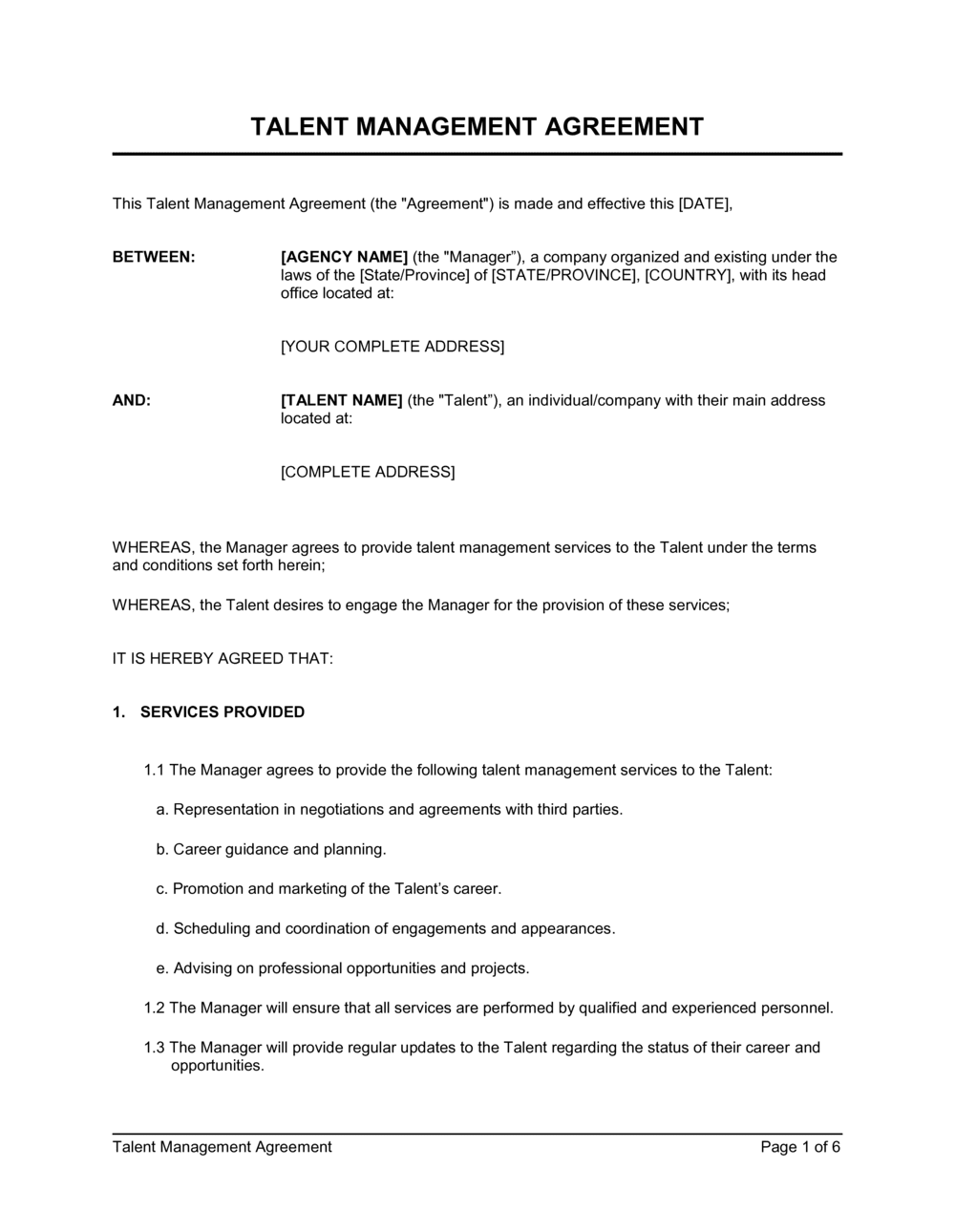
Talent Management Agreement Template

Free Word download β€’ Edit online β€’ Save & share with Drive β€’ Export to PDF

6 pagesβ€’25–35 min to fillβ€’Difficulty: Complexβ€’Signature requiredβ€’Legal review recommended
Learn more ↓
FreeTalent Management Agreement Template

At a glance

What it is
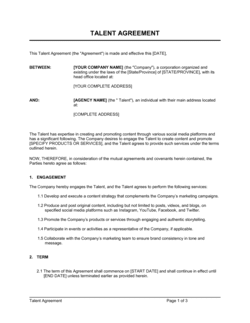
A Talent Management Agreement is a legally binding contract between a talent manager and a client β€” such as an artist, musician, actor, athlete, or influencer β€” that defines the scope of the manager's authority, compensation structure, and duration of the representation relationship. This free Word download gives you a professionally structured starting point you can edit online and export as PDF before signing.
When you need it
Use it when a manager is taking on responsibility for guiding a talent's career decisions, negotiating deals on their behalf, or coordinating bookings and opportunities across entertainment, sports, or media. It should be signed before any managerial services begin.
What's inside
Scope of representation, commission rate and calculation method, exclusivity terms, manager authority and approval rights, talent obligations, term and renewal conditions, post-termination commission (sunset clause), conflict of interest disclosures, and termination rights for both parties.

What is a Talent Management Agreement?

A Talent Management Agreement is a legally binding contract between a talent manager and a client β€” typically an artist, musician, actor, athlete, or digital content creator β€” that defines the manager's authority, compensation structure, and the scope and duration of the representation relationship. Unlike an informal handshake arrangement, a properly drafted management agreement establishes enforceable obligations on both sides: the manager's duty to advance the talent's career, and the talent's obligation to disclose income, cooperate with the manager's efforts, and pay agreed commissions. The agreement also delineates the critical legal boundary between a talent manager β€” who provides career guidance and strategic advice β€” and a licensed talent agent, who is authorized to actively solicit employment on the talent's behalf.

Why You Need This Document

Without a written talent management agreement, commission disputes are resolved by courts guessing at the parties' intentions, post-termination payment obligations exist in a legal vacuum, and a manager who has spent years developing a talent's career can be cut loose the day before a major deal closes with no contractual right to compensation. The cost of this ambiguity is concrete: talent managers have lost six-figure commission claims because no agreement specified the commission base; artists have been locked into inactive management relationships for years because no performance benchmark was agreed in writing. A signed talent management agreement, executed before the first management action is taken, closes these gaps and gives both parties a clear framework for the relationship β€” protecting the manager's commission rights and protecting the talent from unauthorized commitments made in their name.

Which variant fits your situation?

If your situation is…Use this template
Managing a recording artist or band seeking a record dealMusic Artist Management Agreement
Representing an athlete across endorsements and appearancesSports Management Agreement
Booking and coordinating live performances for a performerTalent Booking Agreement
Representing a digital creator for brand partnershipsInfluencer Management Agreement
Hiring an agent rather than a manager to solicit employmentTalent Agency Agreement
Formalizing a co-management arrangement between two managersCo-Management Agreement
Licensing talent's name and likeness for commercial useName and Likeness License Agreement

Common mistakes to avoid

❌ No sunset clause for post-termination commissions

Why it matters: A manager who developed a talent's career over two years may receive nothing from deals that close after termination, creating incentives for either party to time termination opportunistically.

Fix: Include a sunset clause specifying a reduced commission rate (typically 50–75% of the in-term rate) and a defined period of 12–24 months on deals procured or substantially developed during the term.

❌ Granting unlimited power of attorney

Why it matters: A manager with unconstrained authority can bind the talent to recording contracts, touring schedules, or sponsorship deals without the talent's direct review or approval.

Fix: Limit any power of attorney to specific, enumerated transaction types and include a dollar cap above which the talent's separate written consent is mandatory.

❌ Failing to carve out expenses from the commission base

Why it matters: Commissions calculated on gross revenue that includes production costs, equipment rental, and travel reimbursements significantly inflate the manager's earnings at the talent's expense.

Fix: Define 'gross income' explicitly to exclude reimbursed third-party expenses, union scale minimums, and pass-through costs before applying the commission percentage.

❌ No performance benchmark or activity-based termination right

Why it matters: Without a minimum activity clause, a talent is contractually locked in for the full term even if the manager books zero engagements β€” with no right to exit.

Fix: Include a performance clause: if the manager fails to secure a defined minimum number of paid engagements or a revenue threshold within any rolling 12-month period, the talent may terminate on 30 days' notice.

❌ Failing to disclose manager conflicts of interest

Why it matters: A manager who owns a stake in a label, venue, or production company and negotiates deals involving those entities without disclosure breaches their fiduciary duty and exposes the agreement to voiding.

Fix: Add a mandatory conflict-of-interest disclosure clause requiring written notice and talent consent before the manager may negotiate on behalf of any entity in which they hold a financial interest.

❌ Using a stage name instead of legal name in the parties block

Why it matters: Agreements referencing only a stage name create identity ambiguity β€” if the talent legally changes their name or disputes the contract, the binding party is unclear.

Fix: Always use the talent's full legal name in the parties clause, with the stage name noted as 'professionally known as' in a parenthetical immediately following.

The 10 key clauses, explained

Parties, Recitals, and Effective Date

In plain language: Identifies the manager (individual or company) and the talent by their full legal names, states the purpose of the agreement, and records the date it takes effect.

Sample language
This Talent Management Agreement ('Agreement') is entered into as of [DATE] ('Effective Date') between [MANAGER LEGAL NAME], a [STATE] [ENTITY TYPE] ('Manager'), and [TALENT FULL LEGAL NAME] ('Talent').

Common mistake: Using a stage name or trade name instead of the talent's legal name. If the talent's legal identity doesn't match their performing identity, enforcing commission rights or termination clauses against the right party becomes complicated.

Scope of Management Services

In plain language: Defines the specific categories of the talent's career the manager is authorized to advise on, coordinate, and negotiate β€” and equally important, what falls outside the manager's scope.

Sample language
Manager shall provide career guidance, negotiate contracts on Talent's behalf, coordinate publicity and public appearances, and advise on brand partnerships within the [MUSIC / FILM / SPORTS / DIGITAL MEDIA] industry. Manager shall not solicit employment on Talent's behalf in jurisdictions requiring an agent license without engaging a licensed co-agent.

Common mistake: Defining scope so broadly that the manager effectively acts as an unlicensed agent in states like California and New York β€” exposing the agreement to voiding under the Talent Agencies Act.

Term and Renewal

In plain language: Sets the initial duration of the agreement, defines the conditions under which it renews automatically or requires affirmative action, and identifies any performance-based exit rights.

Sample language
The initial term of this Agreement shall be [ONE / TWO / THREE] year(s) commencing on the Effective Date. This Agreement shall renew automatically for successive [ONE-YEAR] periods unless either party provides written notice of non-renewal at least [60] days before the end of the then-current term.

Common mistake: No auto-renewal language or failure to specify notice periods for non-renewal. If neither party acts, the relationship continues on unclear terms β€” making disputes about the agreement's existence inevitable.

Commission Rate and Calculation Basis

In plain language: States the percentage the manager earns, whether it applies to gross or net income, which income categories are included or excluded, and how co-management arrangements affect the rate.

Sample language
Manager shall be entitled to a commission of [15]% of Talent's gross income derived from all engagements, contracts, and deals procured or negotiated during the Term. 'Gross income' excludes reimbursed production expenses, union scale minimums, and third-party pass-through costs.

Common mistake: Defining the commission base as 'all income' without carving out expenses. A manager taking 15% of gross tour revenue that includes production costs will collect commission on money the talent never keeps β€” a source of frequent disputes.

Manager's Authority and Approval Rights

In plain language: Distinguishes what the manager may do independently versus what requires the talent's prior written approval β€” protecting the talent from unauthorized commitments.

Sample language
Manager is authorized to negotiate the terms of potential agreements on Talent's behalf. Manager shall not execute any agreement on behalf of Talent or commit Talent to any obligation without Talent's prior written approval, except as provided in any Power of Attorney attached hereto.

Common mistake: Granting the manager unlimited power of attorney without a defined scope or dollar threshold. Broad authority without guardrails allows the manager to bind the talent to deals they never reviewed.

Talent's Obligations

In plain language: Sets out the talent's responsibilities β€” maintaining professional conduct, timely disclosure of income, cooperation with the manager's efforts, and exclusivity compliance.

Sample language
Talent agrees to (a) conduct themselves professionally and maintain their public reputation, (b) promptly disclose all offers, engagements, and income to Manager, (c) execute agreements negotiated by Manager within [5] business days of presentation, and (d) not engage any other person to provide management services within the scope of this Agreement during the Term.

Common mistake: No income disclosure obligation. Managers paid on commission cannot verify or collect accurately if the talent receives income directly and fails to report it.

Accounting and Payment

In plain language: Requires the manager to maintain accurate records of income received, provide regular accountings to the talent, and remit talent income after commission deduction within a defined period.

Sample language
Manager shall provide Talent with a written accounting of all income received and commissions deducted on a [MONTHLY / QUARTERLY] basis within [15] days of the close of each accounting period. Manager shall remit all income due to Talent within [30] days of receipt, less Manager's commission.

Common mistake: No defined accounting period or payment deadline. Without these, managers holding client funds create commingling risks and the talent has no contractual basis to demand timely payment.

Post-Termination Commission (Sunset Clause)

In plain language: Entitles the manager to a reduced commission on income from deals that were negotiated, substantially developed, or in progress during the contract term β€” even after the agreement ends.

Sample language
Following termination, Manager shall be entitled to a commission of [X]% (reduced from [Y]%) on income received by Talent from contracts or engagements procured or substantially negotiated during the Term, for a period of [12 / 18 / 24] months after the Termination Date.

Common mistake: No sunset clause at all. Without one, a manager who spent years building a talent's career receives no compensation from deals that close the month after termination β€” a common and bitterly contested outcome.

Conflict of Interest and Fiduciary Duty

In plain language: Requires the manager to disclose any financial interest they hold in venues, labels, promoters, or other parties with whom they negotiate on the talent's behalf.

Sample language
Manager shall promptly disclose to Talent in writing any financial interest, ownership stake, or compensation arrangement Manager holds with any third party with whom Manager negotiates on Talent's behalf. Talent's written consent is required before Manager may represent conflicting interests.

Common mistake: No conflict disclosure obligation. Managers who own or co-own production companies, labels, or venues and fail to disclose those interests face breach-of-fiduciary-duty claims that can void the entire agreement.

Termination Rights and Cure Period

In plain language: Defines the grounds on which either party may terminate the agreement early β€” with and without cause β€” and the notice and cure periods that apply.

Sample language
Either party may terminate this Agreement for cause upon [30] days' written notice if the other party materially breaches this Agreement and fails to cure such breach within [15] days of receiving notice. Talent may terminate without cause upon [60] days' written notice if Manager fails to secure a minimum of [X] paid engagements within any consecutive [12]-month period.

Common mistake: No performance-based termination right for the talent. Without a minimum activity or results benchmark, a talent can be locked into an inactive management relationship for the full term with no exit.

How to fill it out

  1. 1

    Enter the parties' full legal names and entity details

    Use the manager's registered legal entity name (or full personal name if an individual) and the talent's legal name as it appears on government-issued ID. Include state of incorporation or residence.

    πŸ’‘ If the talent performs under a stage name, include a parenthetical β€” '[LEGAL NAME] p/k/a [STAGE NAME]' β€” so the contract references both identities clearly.

  2. 2

    Define the scope of management services precisely

    List the specific categories of the talent's career covered β€” music, film, endorsements, digital content, live performance β€” and explicitly exclude any activities that require a licensed agent in your jurisdiction.

    πŸ’‘ In California, soliciting employment on behalf of talent requires a Talent Agency Act license. Keep the scope focused on career guidance and negotiation support rather than direct job procurement.

  3. 3

    Set the term length and renewal conditions

    Choose an initial term of one to three years appropriate to the career stage. Add auto-renewal language with a 60-day non-renewal notice window and any performance-based exit triggers.

    πŸ’‘ First-time managers should negotiate a shorter initial term of one year β€” it protects both parties if the working relationship doesn't develop as expected.

  4. 4

    Specify the commission rate and income definition

    Enter the commission percentage and define exactly what income it applies to. Carve out reimbursed expenses, union minimums, and third-party pass-throughs from the gross income definition.

    πŸ’‘ Industry standard rates range from 10% to 20% for music and entertainment; sports management typically runs 3% to 10% depending on deal type. Rates above 25% are generally considered unconscionable in most jurisdictions.

  5. 5

    Establish the manager's authority limits

    Clarify what the manager may negotiate independently versus what requires the talent's written sign-off. Include a dollar threshold above which all commitments need explicit approval.

    πŸ’‘ A clear approval threshold β€” e.g., any commitment exceeding $5,000 requires written consent β€” protects the talent without slowing routine career decisions.

  6. 6

    Draft the accounting and payment terms

    Set the accounting period (monthly or quarterly), the number of days after the period close by which statements must be delivered, and the remittance deadline for income due to the talent.

    πŸ’‘ Require that client funds be held in a separate trust or client account, not commingled with the manager's operating funds β€” this is required by law in several jurisdictions.

  7. 7

    Negotiate the sunset clause duration and rate

    Agree on a post-termination commission rate (typically 50–75% of the in-term rate) and the period it applies β€” commonly 12 to 24 months depending on how long the in-term deal took to develop.

    πŸ’‘ Tie the sunset duration to deal type: a tour booked the month before termination may warrant a 6-month tail; a multi-year recording contract warrants the full 24 months.

  8. 8

    Sign before any management services begin

    Both parties should sign a fully negotiated agreement before the manager takes any action on the talent's behalf. Post-commencement signatures create consideration disputes and leave early commissions in a legal grey area.

    πŸ’‘ Use a witnessed or countersigned copy and store the executed original in a secure document system. eSign with a timestamped audit trail is accepted in most jurisdictions.

Frequently asked questions

What is a talent management agreement?

A talent management agreement is a legally binding contract between a talent manager and a client β€” typically an artist, musician, actor, athlete, or content creator β€” that defines the manager's authority, commission structure, scope of representation, and the duration of the relationship. It creates enforceable obligations on both sides and establishes how the manager will be compensated for developing the talent's career.

What is the difference between a talent manager and a talent agent?

A talent agent's primary function is procuring employment β€” actively soliciting and negotiating job opportunities on the talent's behalf. In California, New York, and several other states, this activity requires a license under talent agency legislation. A talent manager provides career guidance, business advice, and coordination services but is generally not licensed to solicit employment directly. The boundary matters legally: an unlicensed manager who acts as an agent in California can have the entire management agreement voided by the Labor Commissioner.

What commission rate is standard in a talent management agreement?

Standard rates vary by industry and career stage. Music management typically runs 15% to 20% of gross income. Film and television management commonly sits at 10% to 15%. Sports management commissions range from 3% to 10% depending on deal type β€” endorsement deals typically command higher rates than playing contracts. Rates above 25% are generally viewed as unconscionable and are difficult to enforce in most jurisdictions.

What is a sunset clause in a talent management agreement?

A sunset clause entitles the manager to a reduced commission on income from deals that were negotiated, booked, or substantially developed during the contract term β€” even after the agreement has been terminated. Sunset periods typically run 12 to 24 months, with the commission rate reduced to 50–75% of the in-term rate. Without a sunset clause, a manager who spent years developing a talent's career could receive nothing from deals that close shortly after termination.

Can a talent management agreement be terminated early?

Yes, if the agreement includes termination rights for cause and, ideally, a performance-based exit clause. Either party can terminate for material breach with written notice and a cure period β€” typically 15 to 30 days. Some agreements include a minimum-activity benchmark: if the manager fails to book a defined number of engagements within a rolling 12-month period, the talent may terminate on shortened notice. Without these provisions, a talent may be locked in for the full term regardless of the manager's performance.

Is a talent management agreement enforceable without a lawyer?

A well-drafted template is generally enforceable when properly completed and signed by both parties before services begin. However, talent management agreements intersect with jurisdiction-specific licensing laws, fiduciary duty standards, and entertainment-industry customs that vary significantly by state and country. Legal review is strongly recommended for any agreement covering a talent with meaningful income, equity in recordings or IP, or cross-border activity.

Does a talent management agreement need to be in writing?

In most jurisdictions, a written agreement is not technically required for a management relationship to exist β€” but without one, the commission rate, scope, term, and post-termination rights are all disputed territory. California's Labor Code requires written agreements for certain talent industry contracts. In all cases, a signed written agreement is essential to enforce commission rights, sunset provisions, and confidentiality obligations.

What should a talent management agreement say about exclusivity?

The exclusivity clause should specify which categories of the talent's career are covered exclusively by this manager, for what geographic territory, and whether any carve-outs apply β€” for instance, an existing relationship with a business manager or publicist. A blanket exclusivity clause covering all aspects of the talent's professional life can create problems when the talent legitimately needs separate representation in a specialized area.

Who owns the talent's IP and recordings under a management agreement?

A talent management agreement typically does not transfer any intellectual property rights from the talent to the manager β€” that would be the function of a recording contract, publishing agreement, or license. However, some management agreements include a producer or co-writer participation clause that gives the manager a share of royalties on specific works created during the term. Any such provision should be clearly delineated and independently reviewed by an entertainment lawyer.

How this compares to alternatives

vs Talent Agency Agreement

A talent agency agreement authorizes a licensed agent to actively solicit and negotiate employment on the talent's behalf β€” the core function regulated by state talent agency acts. A management agreement focuses on career strategy, business guidance, and coordination rather than direct job procurement. In California and New York, managers who cross into employment solicitation without a license risk having their agreements voided. Use an agency agreement when you need a licensed representative to book work; use a management agreement for long-term career development.

vs Independent Contractor Agreement

An independent contractor agreement engages a service provider for defined project-based work at a fixed fee or hourly rate. A talent management agreement creates an ongoing representation relationship compensated by commission on the talent's earnings β€” not a fixed payment for services. The management agreement also includes fiduciary obligations, exclusivity, and post-termination rights that a standard contractor agreement does not address.

vs Entertainment Services Agreement

An entertainment services agreement governs a specific performance, appearance, or content creation engagement β€” it is transactional and project-scoped. A talent management agreement is a long-term strategic relationship governing the talent's entire career or a defined segment of it. Both documents may exist simultaneously: the management agreement defines the ongoing relationship, while individual booking contracts govern each specific engagement.

vs Personal Services Agreement

A personal services agreement typically covers a defined set of personal services rendered by the talent directly to a client β€” such as an appearance, endorsement, or performance. A talent management agreement runs in the opposite direction: it governs what the manager does for the talent, not what the talent does for a third party. Personal services agreements define the talent's output obligations; management agreements define the manager's representation obligations.

Industry-specific considerations

Music and Recording

Commission applies across recording advances, touring income, sync licensing, merchandise, and publishing β€” each calculated differently, making a precise income definition essential.

Film, Television, and Theater

Manager-agent distinction is tightly regulated; the agreement must stay within career guidance and exclude direct employment solicitation to avoid licensing violations under state talent agency acts.

Professional Sports

Player contract commissions are capped or regulated by league collective bargaining agreements in the NFL, NBA, MLB, and NHL β€” the management agreement must acknowledge and defer to CBA limits.

Digital Media and Content Creation

Brand deal commissions, sponsored content rates, and platform monetization share are all relatively new income streams requiring explicit definition in the commission base to avoid disputes.

Jurisdictional notes

United States

California's Talent Agencies Act (Labor Code Β§1700 et seq.) prohibits unlicensed individuals from procuring employment for talent β€” managers who cross this line risk having their agreements voided by the Labor Commissioner. New York has similar licensing requirements under the Employment Agency Law. Commission rates and agreement terms are not directly regulated federally, but courts apply reasonableness standards. Several states also impose fiduciary duties on managers by statute.

Canada

Canada does not have a single national talent agency act equivalent β€” regulation falls to provinces. Ontario and British Columbia have employment agency legislation that may apply to managers who actively solicit work. Quebec civil law governs contracts differently from common-law provinces and may affect enforceability of certain standard clauses. Post-termination commission (sunset) provisions are generally enforceable if reasonable in duration and scope.

United Kingdom

The UK's Entertainment Industry regime does not impose licensing requirements on managers in the way California does, but talent managers owe fiduciary and contractual duties under common law. The Employment Agencies Act 1973 regulates employment agencies and businesses but generally excludes personal management relationships from its scope. Agreements should comply with the Unfair Contract Terms Act 1977 β€” clauses that unreasonably restrict the talent's rights may be struck down.

European Union

Talent management regulation across EU member states varies significantly β€” France, Germany, and Italy each have distinct entertainment industry regulations. GDPR applies to any personal data collected or processed about the talent, requiring appropriate data handling provisions in the agreement. Some EU jurisdictions impose mandatory cooling-off or withdrawal rights for personal services contracts. Legal advice from a local entertainment specialist is recommended for any EU-based management relationship.

Template vs lawyer β€” what fits your deal?

PathBest forCostTime
Use the templateEarly-career talent and emerging managers formalizing a new relationship in a single domestic marketFree30–60 minutes
Template + legal reviewTalent with existing income streams, cross-state or cross-border activity, or managers taking on multiple clients$500–$1,500 for an entertainment lawyer review3–7 days
Custom draftedEstablished talent with significant earnings, multi-territory representation, equity in recordings or IP, or complex co-management structures$2,000–$8,000+2–4 weeks

Glossary

Commission Rate
The percentage of the talent's gross or net income that the manager receives as compensation, typically ranging from 10% to 25% depending on industry and scope.
Exclusivity
A clause preventing the talent from engaging another manager for the same category of services during the contract term.
Sunset Clause
A post-termination provision entitling the manager to reduced commission on deals closed or substantially negotiated during the contract term, for a defined period after it ends.
Power of Attorney
An optional provision granting the manager legal authority to sign certain documents or negotiate on the talent's behalf without requiring the talent's direct signature each time.
Gross vs. Net Commission Base
The distinction between calculating commission on all income before deductions (gross) versus after specific expenses are subtracted (net) β€” a difference that significantly affects the manager's earnings.
Talent
The individual β€” artist, athlete, performer, or creator β€” whose career the manager represents and advances under the agreement.
Key Person Clause
A provision allowing the talent to terminate the agreement if a specific named individual at the management company leaves or is no longer involved in their career.
Term
The defined duration of the agreement β€” typically one to three years β€” with or without automatic renewal provisions.
Fiduciary Duty
The manager's legal obligation to act in the talent's best interest, avoid conflicts of interest, and prioritize the talent's career over personal gain.
Procurement of Employment
The act of actively soliciting or negotiating employment opportunities β€” a function typically reserved for licensed talent agents, not managers, in regulated US states.
Accounting Period
The regular interval β€” monthly or quarterly β€” at which the manager must provide financial statements showing income received and commissions deducted.

Part of your Business Operating System

This document is one of 3,000+ business & legal templates included in Business in a Box.

  • Fill-in-the-blanks β€” ready in minutes
  • 100% customizable Word document
  • Compatible with all office suites
  • Export to PDF and share electronically

Create your document in 3 simple steps.

From template to signed document β€” all inside one Business Operating System.
1
Download or open template

Access over 3,000+ business and legal templates for any business task, project or initiative.

2
Edit and fill in the blanks with AI

Customize your ready-made business document template and save it in the cloud.

3
Save, Share, Send, Sign

Share your files and folders with your team. Create a space of seamless collaboration.

Save time, save money, and create top-quality documents.

β˜…β˜…β˜…β˜…β˜…

"Fantastic value! I'm not sure how I'd do without it. It's worth its weight in gold and paid back for itself many times."

Managing Director Β· Mall Farm
Robert Whalley
Managing Director, Mall Farm Proprietary Limited
β˜…β˜…β˜…β˜…β˜…

"I have been using Business in a Box for years. It has been the most useful source of templates I have encountered. I recommend it to anyone."

Business Owner Β· 4+ years
Dr Michael John Freestone
Business Owner
β˜…β˜…β˜…β˜…β˜…

"It has been a life saver so many times I have lost count. Business in a Box has saved me so much time and as you know, time is money."

Owner Β· Upstate Web
David G. Moore Jr.
Owner, Upstate Web

Run your business with a system β€” not scattered tools

Stop downloading documents. Start operating with clarity. Business in a Box gives you the Business Operating System used by over 250,000 companies worldwide to structure, run, and grow their business.

Start freeΒ Β·Β No credit card required