Model Release and Permission to Use Photographs Template

Free Word download • Edit online • Save & share with Drive • Export to PDF

3 pages20–30 min to fillDifficulty: StandardSignature requiredLegal review recommended
Learn more ↓
FreeModel Release and Permission to Use Photographs Template

At a glance

What it is
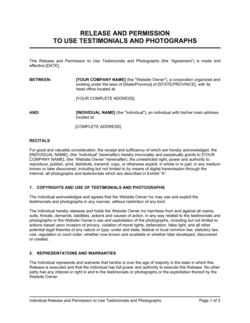
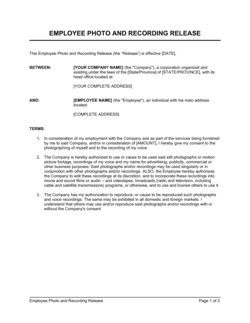
A Model Release and Permission to Use Photographs is a legally binding agreement in which a photographed subject grants a photographer, brand, or business the right to use, reproduce, and distribute their likeness for defined purposes. This free Word download is fully editable online and exportable as PDF — covering usage scope, compensation, territorial rights, and liability waiver in a single, enforceable document.
When you need it
Use it before or immediately after any photo or video session where the resulting images will be used commercially — advertising, social media campaigns, editorial content, product packaging, or stock licensing. It is also required when repurposing existing photographs for new commercial contexts not covered by the original arrangement.
What's inside
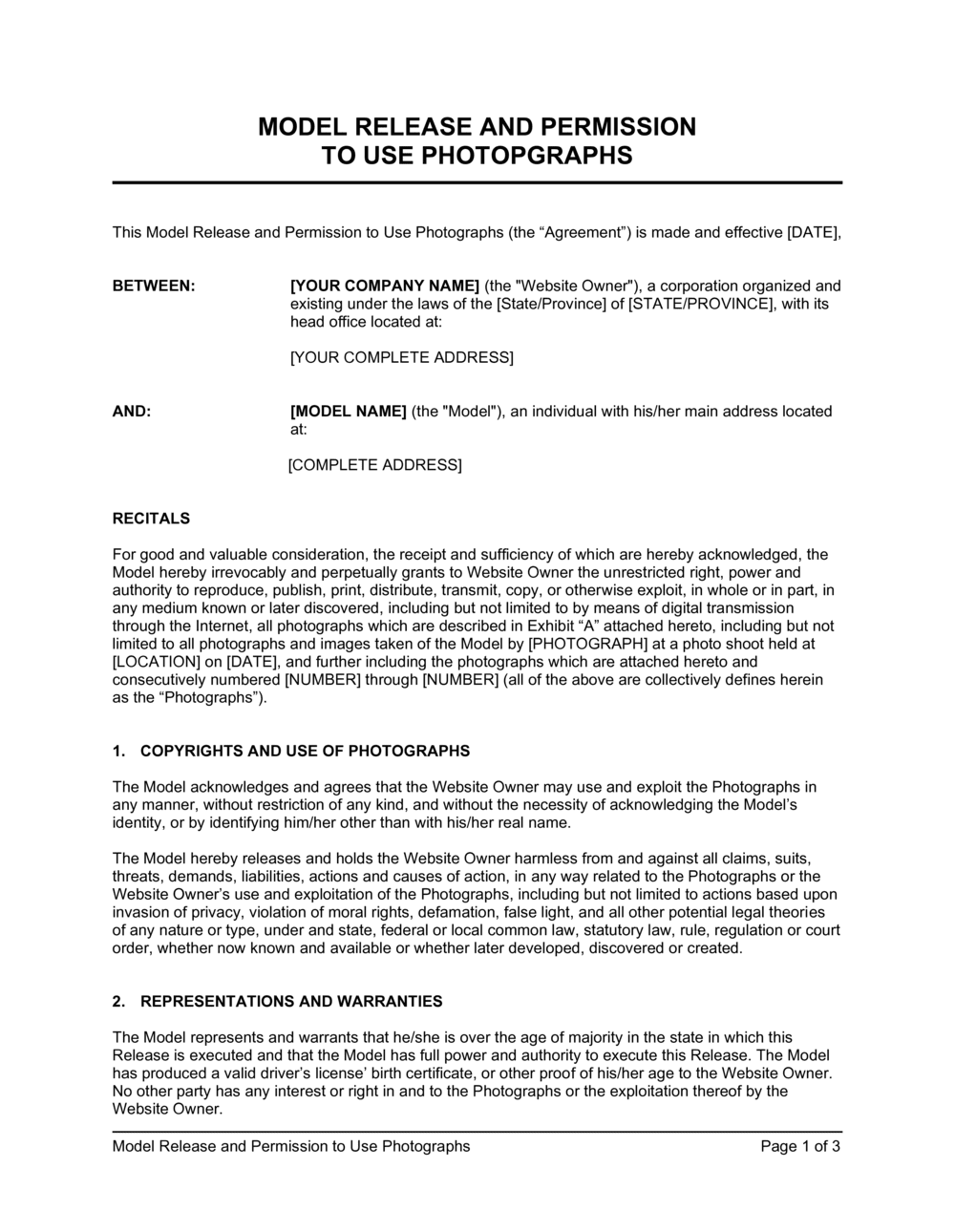
Parties and session details, grant of rights and permitted uses, territorial and duration scope, compensation and consideration, minor consent provisions, moral rights and right of publicity waiver, liability and indemnification, and governing law. A Schedule A captures specific image identifiers so the release is tied to exact photographs.

What is a Model Release and Permission to Use Photographs?

A Model Release and Permission to Use Photographs is a legally binding agreement in which an identifiable person — the model — grants a photographer, brand, or business the right to use, reproduce, and distribute photographs of their likeness for defined commercial purposes. The document specifies exactly which uses are permitted (advertising, social media, product packaging, stock licensing), the geographic territory, the duration, and the compensation exchanged. It also typically includes a waiver of right-of-publicity and privacy claims arising from those permitted uses. Without a signed release, using an identifiable person's image in any commercial context is generally an infringement of their right of publicity and, in many jurisdictions, a violation of data protection law as well.

Why You Need This Document

Using an identifiable person's photograph in advertising, on a product page, or across social media without a signed release exposes your business to right-of-publicity claims, privacy tort liability, and in GDPR-covered jurisdictions, regulatory enforcement. Right-of-publicity statutes in states like California and New York carry statutory damages per unauthorized use — even a small campaign can generate significant liability if the underlying releases are missing or incomplete. Beyond litigation risk, stock agencies and major advertising platforms require model releases before accepting or running image content. A verbal agreement, an email thread, or a handshake after the shoot provides none of the documented scope, consideration, and exclusions that make a release enforceable. This template gives you a professionally structured, jurisdiction-aware document you can execute on-site in under 15 minutes — and retrieve instantly when a rights question arises months later.

Which variant fits your situation?

If your situation is…Use this template
Adult model photographed for commercial advertising useModel Release and Permission to Use Photographs
Minor (under 18) appearing in photos or videoMinor Model Release Form
Property, building, or artwork appearing in imagesProperty Release Form
Video footage and on-camera appearanceVideo Release Form
Employee photographed for internal corporate use onlyEmployee Photo Consent Form
Broad assignment of all photography rights to the clientPhotography Services Agreement
One-time editorial use in a publication or news articleEditorial Image License Agreement

Common mistakes to avoid

❌ Obtaining no release before using images commercially

Why it matters: Using an identifiable person's likeness in advertising or marketing without consent is a violation of right-of-publicity laws in most US states and equivalent laws in Canada, the UK, and the EU. Statutory damages in some US states reach $750 per image.

Fix: Secure a signed release before the session ends. For existing images, contact the subject and obtain a written retroactive release with documented consideration before any commercial use.

❌ Using a verbal or email-only permission

Why it matters: Verbal consents are nearly impossible to prove and provide no clarity on scope, territory, or duration. A casual email saying 'sure, go ahead' does not establish the specific rights needed for a multi-platform campaign.

Fix: Always use a written, signed release that explicitly states permitted uses, territory, duration, and compensation — regardless of how informal the relationship with the model is.

❌ Applying one release to multiple unrelated sessions or clients

Why it matters: A release signed for a specific session cannot legally be extended to cover different photographs taken at a later date, or sublicensed to a different company without explicit authorization.

Fix: Issue a fresh release for each distinct session and ensure the release explicitly addresses sublicensing if images will be delivered to a third-party client or stock platform.

❌ Missing or incomplete minor consent

Why it matters: A release signed only by a minor is not enforceable in any major common-law or civil-law jurisdiction. Using images of an unconsented minor in commercial material exposes the company to both civil liability and, in some jurisdictions, criminal penalties.

Fix: Obtain a countersignature from the parent or legal guardian before every session involving a subject under 18, and keep the signed release on file indefinitely.

❌ No exclusions clause protecting the model from reputational harm

Why it matters: Without explicit exclusions, a broadly worded grant of rights technically permits use in contexts the model never anticipated — adult content, political ads, or defamatory juxtapositions — which can trigger right-of-publicity claims even after a signed release.

Fix: Include a specific exclusions clause listing at minimum: adult content, political advertising, defamatory uses, and implied product endorsements not listed in the release.

❌ Signing the release after images have already been published

Why it matters: Publication before a signed release exists means the infringement already occurred. A retroactive release limits future exposure but does not remedy the prior use — the model retains the right to sue for the period of unauthorized use.

Fix: Make execution of the release a prerequisite before any image is delivered to the client, posted online, or submitted to a stock platform. Build this step into every production workflow.

The 10 key clauses, explained

Parties and session identification

In plain language: Names and contact details of the model (the releasing party) and the photographer or company (the licensee), plus the date, location, and subject matter of the photo session.

Sample language
This Model Release is entered into as of [DATE] between [MODEL FULL NAME] ('Model') and [PHOTOGRAPHER / COMPANY LEGAL NAME] ('Licensee'), regarding photographs taken on [SESSION DATE] at [SESSION LOCATION] depicting [BRIEF DESCRIPTION OF CONTENT].

Common mistake: Using a trade name or social media handle instead of the legal entity name. If a rights dispute arises, enforcing the release against the correct legal entity becomes difficult without the registered name.

Grant of rights and permitted uses

In plain language: The core clause that gives the licensee permission to use, reproduce, distribute, and display the model's likeness, and lists the specific media and purposes covered.

Sample language
Model irrevocably grants to Licensee the right to use, reproduce, distribute, display, and create derivative works from the Photographs for the following purposes: [LIST — e.g., print advertising, social media, website, product packaging, trade shows]. All other uses require written consent.

Common mistake: Using 'any and all purposes' language without listing specific uses. Overly broad grants may be unenforceable in jurisdictions that require definite scope, and they expose the model to unanticipated uses they never intended to permit.

Territorial and duration scope

In plain language: Defines where in the world the images may be used and for how long — either a fixed term (e.g., two years from session date) or in perpetuity.

Sample language
The rights granted herein are: (a) Territory: [Worldwide / limited to COUNTRY/REGION]; (b) Term: [Perpetual / [X] years from the date of this Release, unless earlier terminated by written agreement].

Common mistake: Defaulting to perpetual worldwide rights for a one-off local campaign. Models may demand higher compensation — or rescind consent — if they later discover their image is still in active use years after the session.

Compensation and consideration

In plain language: States what the model receives in exchange for the release — cash, copies of images, or a nominal $1 — to satisfy the legal requirement of consideration that makes the contract enforceable.

Sample language
In consideration for signing this Release, Licensee shall provide Model with: [ONE OF: the sum of $[AMOUNT] / a digital copy of the approved Photographs / the sum of $1.00 (receipt of which Model acknowledges)]. Model agrees this consideration is full and adequate compensation for all rights granted.

Common mistake: Issuing a release with no stated consideration at all. A release signed for zero consideration is potentially voidable in common-law jurisdictions because no exchange of value exists to form a binding contract.

Exclusions and restrictions

In plain language: Carves out specific uses that are NOT permitted — adult content, political endorsements, defamatory contexts, or specific competitor brands — protecting the model's reputation.

Sample language
Notwithstanding the rights granted above, Licensee shall not use the Photographs in: (a) pornographic or sexually explicit material; (b) political advertising or endorsements; (c) any context that implies Model's endorsement of a product or service not identified in this Release; (d) materials that are defamatory or derogatory to Model.

Common mistake: Omitting exclusions entirely and relying on the permitted-use list as the only limit. If a permitted use is broadly stated, the absence of explicit exclusions can be interpreted as allowing harmful uses the model never anticipated.

Right of publicity and moral rights waiver

In plain language: The model expressly waives rights to control how their likeness is presented commercially and, where permitted by law, waives moral rights objections to alterations or edits.

Sample language
Model hereby waives any right of publicity or right of privacy claims arising from the permitted uses of the Photographs. To the extent permitted by applicable law, Model also waives any moral rights in the Photographs, including the right to object to modifications or edits made in the ordinary course of Licensee's use.

Common mistake: Asking a model to waive moral rights in a jurisdiction — such as France or Quebec — where moral rights are inalienable. The waiver will be void, and the licensee will have no protection against objections to image modifications.

Minor consent and parental authorization

In plain language: When the model is under the legal age of majority, a parent or legal guardian must sign on their behalf, and this clause confirms that authorization.

Sample language
If Model is under [18 / the applicable age of majority], the undersigned parent or legal guardian of Model hereby consents to the terms of this Release on Model's behalf and warrants that they have full authority to grant the rights described herein.

Common mistake: Having only the minor sign without a countersignature from the parent or guardian. A minor generally cannot enter a binding contract in any major jurisdiction — the release is unenforceable without adult authorization.

Representations and warranties

In plain language: Both parties confirm they have authority to enter the agreement, the model is not subject to conflicting exclusivity obligations, and the licensee will use the images only as permitted.

Sample language
Model represents and warrants that: (a) Model is at least [18] years of age or has parental consent as set out above; (b) Model has the full right and authority to grant the rights herein; (c) Model is not subject to any conflicting exclusivity agreement that would prevent the permitted uses.

Common mistake: No warranty that the model is free of conflicting exclusivity obligations. A model under contract with a competing brand could expose the licensee to a third-party infringement claim if the competing contract is not disclosed.

Indemnification and liability

In plain language: Allocates responsibility between the parties for claims arising from a breach of the release — typically, each party indemnifies the other for claims caused by their own breach.

Sample language
Each party agrees to indemnify, defend, and hold harmless the other from any claims, damages, or costs (including reasonable attorneys' fees) arising from a breach of that party's representations, warranties, or obligations under this Release.

Common mistake: One-sided indemnification that only protects the photographer or company. If the licensee misuses the images, an asymmetric clause may not hold up in court and leaves the model unprotected.

Governing law and entire agreement

In plain language: Specifies which jurisdiction's law governs the release and confirms this document supersedes all prior verbal or written understandings about image use.

Sample language
This Release is governed by the laws of [STATE / PROVINCE / COUNTRY]. This Release constitutes the entire agreement between the parties with respect to the subject matter hereof and supersedes all prior discussions, representations, or agreements.

Common mistake: Choosing a governing law based on the photographer's home state without considering where the model is located. Some states and countries apply local right-of-publicity law regardless of the governing-law clause.

How to fill it out

  1. 1

    Identify all parties with legal names

    Enter the model's full legal name and contact information, and the photographer's or company's registered legal name. If a talent agency is involved, note whether they are signing as the model's authorized representative.

    💡 Ask for government-issued ID at the session to verify the model's legal name and confirm they are of legal age before shooting.

  2. 2

    Describe the session and photographs

    Enter the session date, location, and a concise description of the content — e.g., 'fashion product photography for autumn apparel line.' Attach a Schedule A listing specific image file names or contact sheet references.

    💡 A Schedule A tied to specific image IDs prevents the release from being applied to unrelated photographs taken on the same day.

  3. 3

    Define permitted uses specifically

    List every medium and platform where the images will appear — print, digital, social media, out-of-home, product packaging, stock licensing. If in-scope uses may expand later, include a renegotiation clause rather than defaulting to 'all purposes.'

    💡 Match the permitted-use language exactly to the client's media plan. Vague language leads to disputes when a campaign is repurposed for a channel not explicitly listed.

  4. 4

    Set territory and duration

    Choose worldwide or limit to specific countries. Set a fixed term (e.g., two years from session date) or grant perpetual rights. For digital and social-media campaigns, worldwide perpetual is standard; for regional print campaigns, consider limiting scope.

    💡 Perpetual rights commands a higher fee for the model — if budget is limited, a two-year term with an option to extend is often a workable compromise.

  5. 5

    State the consideration clearly

    Enter the exact compensation amount, image copies, or nominal fee being exchanged. Have the model acknowledge receipt of consideration at signing to prevent later claims that no contract was formed.

    💡 Even if the model is a friend or colleague agreeing to shoot for free, state $1 as the consideration. A zero-consideration release is potentially voidable.

  6. 6

    Complete the minor consent section if applicable

    If the model is under 18, have the parent or legal guardian complete and sign the minor-consent block. Do not proceed with the session until this signature is obtained — retroactive consent from a guardian does not eliminate the enforceability risk.

    💡 Confirm the age of majority in your jurisdiction — it is 18 in most US states and Canadian provinces but varies internationally.

  7. 7

    Execute before the session ends

    Both the model and the authorized company representative must sign and date the release before the model leaves. Unsigned releases collected afterward are harder to enforce and may lack fresh consideration.

    💡 Use Business in a Box eSign to capture a timestamped digital signature on-site via mobile, eliminating the risk of a model becoming unreachable after the session.

  8. 8

    Store originals and distribute copies

    Provide the model with a signed copy immediately. File the executed release in a centralized system indexed by session date and image batch — you will need to retrieve it quickly if a licensing dispute arises months or years later.

    💡 Tag stored releases with the campaign name, client name, and image batch ID so you can locate the correct release in under two minutes during a rights challenge.

Frequently asked questions

What is a model release form?

A model release form is a binding legal agreement in which a photographed subject grants a photographer or company the right to use, reproduce, and distribute their likeness for specified purposes. It transfers the practical right to use the images commercially and provides the licensee with legal protection against right-of-publicity and privacy claims. Without a signed release, using an identifiable person's image in advertising or marketing is generally unlawful.

When is a model release required?

A model release is required any time an identifiable person's image will be used for commercial purposes — including advertising, social media marketing, product packaging, stock licensing, branding materials, and website content. Editorial uses (news, commentary, or educational content) typically do not require a release, but the line between editorial and commercial use is narrow and fact-specific. When in doubt, obtain a release.

Does a model release need to be notarized?

In most jurisdictions, notarization is not required for a model release to be enforceable. A signed, dated agreement with documented consideration is sufficient. Notarization adds evidentiary weight if authenticity is later disputed — for high-value campaigns or stock licensing arrangements, it may be worth the minor additional effort.

Can a model revoke a release after signing?

Generally, no. A signed release supported by valid consideration is a binding contract; revocation requires agreement from both parties unless the release was induced by fraud or misrepresentation. California provides a limited statutory right to rescind contracts for minors who have reached adulthood, and some EU member states recognize a right to withdraw consent under GDPR for certain digital uses. Consult a lawyer if a model demands revocation of an existing release.

What consideration is needed to make a model release enforceable?

Any measurable exchange of value satisfies the consideration requirement — a cash payment, a copy of the photographs, or even a nominal $1 fee. The amount is less important than the fact that something was exchanged. A release signed for no consideration at all is potentially voidable in common-law jurisdictions. Always state the consideration amount explicitly in the release and have the model acknowledge receipt at signing.

Does a model release cover video as well as photographs?

A standard photo model release does not automatically cover video footage. If the session involves both still photography and video, the release should explicitly list video, film, and moving-image content as permitted uses. For projects where video is the primary deliverable, use a dedicated video release form or add a video-specific rider to the photograph release.

What rights does a model retain after signing a release?

The model retains all rights not expressly granted. Specifically, the release does not transfer copyright in the photographs — that remains with the photographer. The model also retains rights against uses explicitly excluded in the release, and in some jurisdictions retains inalienable moral rights regardless of any waiver language. The release only grants the specific permissions listed; it is not a blanket transfer of all rights.

Is a model release required for photos used only on social media?

Yes. Social media is a commercial medium when used for brand promotion, sponsored content, or advertising. Right-of-publicity laws apply to Instagram, Facebook, TikTok, and other platforms in the same way they apply to print advertising. Platform terms of service do not substitute for a model release — the platform's right to distribute content under its own terms is separate from the brand's right to use a person's likeness commercially.

Do I need a separate release for each photo or just for the session?

One release per session is standard practice, with a Schedule A identifying the specific photographs covered. This approach is more efficient than per-image releases and provides clear documentation of exactly which images are cleared. If a second session occurs, even with the same model, a new release should be executed — the original release does not automatically extend to later photographs.

How this compares to alternatives

vs Photography Services Agreement

A photography services agreement governs the relationship between the photographer and the client — scope of work, deliverables, fees, and copyright ownership. A model release governs the relationship between the photographer (or client) and the subject being photographed. Both documents are needed for a commercial shoot; one does not substitute for the other.

vs Property Release Form

A property release grants permission to use images of privately owned property — buildings, artworks, pets — rather than a person's likeness. The underlying legal concern is different: property releases address trespass and trademark issues, while model releases address right-of-publicity and privacy. Commercial shoots often require both when a recognizable location and identifiable people appear in the same images.

vs Non-Disclosure Agreement

An NDA protects confidential information shared during a business relationship — it does not grant any permission to use a person's image or likeness. A model release grants usage rights; an NDA restricts disclosure of information. For a shoot involving unreleased product prototypes, both documents may be appropriate.

vs Talent Agreement

A talent agreement is a broader contract covering performance fees, exclusivity, scheduling obligations, credits, and usage rights for on-camera talent — typically used for named spokespeople or recurring brand ambassadors. A model release is a narrower, standalone document focused solely on image usage permissions and is appropriate for one-time or session-based engagements where no ongoing performance relationship exists.

Industry-specific considerations

Advertising and Marketing

Releases must cover every media channel in the media plan, including out-of-home, programmatic digital, and paid social — each adds scope that requires explicit authorization.

Fashion and Apparel

High volume of models per season requires a streamlined release workflow; releases must address sublicensing to wholesale and retail partners who display images in their own marketing.

Healthcare and Wellness

Patient or model releases must be carefully drafted to avoid implying medical endorsement; before-and-after images carry heightened regulatory risk under FTC guidelines.

E-commerce and Consumer Products

Product page images are used across multiple storefronts and partner sites, requiring worldwide rights and sublicensing authorization to be explicitly stated in the release.

Entertainment and Media

Background talent, extras, and featured performers each require separate releases; releases must address streaming platforms and international distribution rights.

Stock Photography Platforms

Platform submission standards require releases to grant broad sublicensing rights to an unlimited number of downstream licensees — standard single-use releases are insufficient.

Jurisdictional notes

United States

Right-of-publicity law is governed at the state level, with no single federal statute. California, New York, and Texas have the most developed statutes, with some providing post-mortem rights for up to 70 years. Statutory damages in California can reach $750 per unauthorized use under Civil Code §3344. Some states — including New York — require that the release specifically name the company or publication using the image for advertising purposes.

Canada

Privacy torts for misappropriation of personality exist under common law in most provinces and by statute in British Columbia, Manitoba, Saskatchewan, and Newfoundland. Quebec's Charter of Human Rights and Freedoms provides additional image rights. Moral rights under the Copyright Act are inalienable in Canada — a model can waive but not fully assign them, meaning the waiver clause must be carefully worded. French-language releases are required for sessions with Quebec residents under the Charter of the French Language.

United Kingdom

The UK has no standalone right-of-publicity statute; protection comes through passing off, malicious falsehood, and data protection law. The UK GDPR applies to images of identifiable individuals — a signed model release can serve as the lawful basis for processing under the 'legitimate interests' or 'consent' grounds, but the consent must be freely given and specific. Post-Brexit, the UK ICO applies its own data protection regime independently of the EU, though standards remain closely aligned.

European Union

EU GDPR treats photographs of identifiable individuals as personal data. Processing such data for commercial purposes typically requires explicit, informed consent — a well-drafted model release can constitute that consent, but it must state the specific purposes and platforms clearly. Several member states, including Germany and France, have strong personality rights (Persönlichkeitsrecht and droit à l'image) that exist independently of contract — French moral rights are inalienable and cannot be waived even by contract. The right to erasure under GDPR may allow subjects to request removal of digital images in limited circumstances.

Template vs lawyer — what fits your deal?

PathBest forCostTime
Use the templateStandard commercial photography sessions for social media, websites, and print advertising with straightforward usage scopeFree10–15 minutes per session
Template + legal reviewHigh-value campaigns, stock library builds, or sessions involving minor subjects or international distribution$200–$5001–2 days
Custom draftedCelebrity or named spokesperson engagements, broadcast advertising, or multi-jurisdiction licensing with complex sublicensing chains$1,000–$5,000+1–2 weeks

Glossary

Right of Publicity
A person's legal right to control commercial use of their name, image, likeness, and other identifiable personal attributes.
Likeness
Any visual representation of an identifiable person, including photographs, illustrations, digital composites, and video stills.
Consideration
The legally required exchange of value that makes a contract enforceable — in a model release, this is typically a payment, a copy of the images, or a stated nominal fee.
Moral Rights
Rights recognized in many jurisdictions allowing a creator or subject to object to uses of their image that are derogatory or distort their identity, separate from economic rights.
Perpetual License
A grant of rights with no expiration date, allowing the licensee to use the images indefinitely unless otherwise restricted.
Worldwide Rights
Authorization to use images in any country, without geographic restriction — standard for digital and internet usage.
Usage Scope
The specific media, platforms, and purposes for which the licensed images may be used, such as print advertising, social media, or product packaging.
Waiver
A voluntary relinquishment of a legal right — in a model release, typically the right to object to or seek additional compensation for the permitted uses.
Minor Consent
Written approval from a parent or legal guardian required when a photographed subject is under the age of majority in the applicable jurisdiction.
Indemnification
A contractual obligation by one party to compensate the other for losses or legal claims arising from a defined set of circumstances.
Editorial Use
Use of an image to illustrate a news story, commentary, or educational content — distinct from commercial use and subject to different legal standards.

Part of your Business Operating System

This document is one of 3,000+ business & legal templates included in Business in a Box.

  • Fill-in-the-blanks — ready in minutes
  • 100% customizable Word document
  • Compatible with all office suites
  • Export to PDF and share electronically

Create your document in 3 simple steps.

From template to signed document — all inside one Business Operating System.
1
Download or open template

Access over 3,000+ business and legal templates for any business task, project or initiative.

2
Edit and fill in the blanks with AI

Customize your ready-made business document template and save it in the cloud.

3
Save, Share, Send, Sign

Share your files and folders with your team. Create a space of seamless collaboration.

Save time, save money, and create top-quality documents.

★★★★★

"Fantastic value! I'm not sure how I'd do without it. It's worth its weight in gold and paid back for itself many times."

Managing Director · Mall Farm
Robert Whalley
Managing Director, Mall Farm Proprietary Limited
★★★★★

"I have been using Business in a Box for years. It has been the most useful source of templates I have encountered. I recommend it to anyone."

Business Owner · 4+ years
Dr Michael John Freestone
Business Owner
★★★★★

"It has been a life saver so many times I have lost count. Business in a Box has saved me so much time and as you know, time is money."

Owner · Upstate Web
David G. Moore Jr.
Owner, Upstate Web

Run your business with a system — not scattered tools

Stop downloading documents. Start operating with clarity. Business in a Box gives you the Business Operating System used by over 250,000 companies worldwide to structure, run, and grow their business.

Free Forever Plan · No credit card required