A Winning Formula For Developing Internal Talent Template

Free Word download • Edit online • Save & share with Drive • Export to PDF

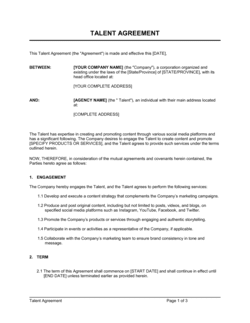
3 pages20–30 min to fillDifficulty: StandardSignature requiredLegal review recommended
Learn more ↓
FreeA Winning Formula For Developing Internal Talent Template

At a glance

What it is
A Winning Formula for Developing Internal Talent is a legally binding agreement between an employer and an employee that formalizes the terms under which the company invests in the employee's professional growth — covering training programs, certification funding, mentorship commitments, promotion pathways, and repayment obligations if the employee leaves before a defined tenure threshold. This free Word download is fully editable online and can be exported as PDF for signing before any sponsored development program begins.
When you need it
Use it whenever the company is funding a course, certification, degree program, leadership track, or structured mentorship that represents a material investment in a specific employee's skills. It is especially important when the training cost exceeds $500, the program spans more than 30 days, or the role targeted by the development carries specialized knowledge critical to business continuity.
What's inside
The agreement covers the scope and cost of the development program, the employee's service commitment and repayment schedule if they exit early, performance milestones and promotion criteria tied to the training, IP and confidentiality obligations arising from the program, and dispute resolution terms — all structured to be enforceable in the employee's work jurisdiction.

What is a Winning Formula for Developing Internal Talent?

A Winning Formula for Developing Internal Talent is a legally binding agreement between an employer and a specific employee that formalizes every material aspect of a structured internal development investment — including the program's scope, the employer's financial commitment, the employee's service obligation, pro-rata repayment terms if the employee exits early, measurable promotion milestones, and IP and confidentiality obligations arising from the training. Unlike a general tuition reimbursement policy, this document is a bilateral contract signed by a named individual before any program costs are incurred, creating enforceable obligations on both sides and a written record of the career development commitments the company is making in return.

Why You Need This Document

Without a signed talent development agreement, a company that funds a $15,000 certification program has no legal basis to recover that investment if the employee resigns the following month to join a competitor. Beyond cost recovery, the absence of documented promotion milestones and employer commitments means disputes about what was promised — and to whom — are resolved by whoever kept better emails. Employees who complete demanding development programs and receive no formal acknowledgment of the promised promotion pathway have a credible grievance; employers who make undocumented verbal commitments face breach-of-contract exposure with no written record to rely on. A properly executed development agreement closes both gaps simultaneously: it protects the company's financial investment through a proportionate, pro-rata repayment clause, and it protects the employee by recording the organization's specific career development obligations in a document that is enforceable in the employee's home jurisdiction.

Which variant fits your situation?

If your situation is…Use this template
Funding a university degree or part-time MBA for a high-potential employeeTuition Reimbursement Agreement
Sponsoring a short professional certification costing under $1,000Training Acknowledgment Letter
Formalizing a structured mentorship program with defined goals and check-insMentorship Agreement
Documenting a planned internal promotion with performance conditionsPromotion and Role Change Agreement
Creating a multi-year leadership development track with equity milestonesExecutive Development Agreement
Upskilling a fixed-term contractor with employer-funded trainingContractor Training and Development Agreement
Establishing a formal apprenticeship or trade-certification programApprenticeship Agreement

Common mistakes to avoid

❌ Flat 100% repayment with no pro-rata reduction

Why it matters: Courts in common-law jurisdictions assess whether a repayment clause is a genuine pre-estimate of loss or a penalty. A fixed 100% obligation that does not decrease over time is routinely struck down as punitive.

Fix: Structure repayment as a declining percentage — for example, 100% within 12 months, 75% within 24 months, 50% within 36 months — so the amount reflects the employer's diminishing unrealized benefit.

❌ Signing the agreement after the program has already started

Why it matters: In most common-law jurisdictions, an employee who is already enrolled in employer-funded training provided no new consideration when signing a post-enrollment repayment clause, potentially voiding it entirely.

Fix: Execute the agreement before the first training payment is made or the employee attends the first session. If timing slips, provide a documented additional benefit — a bonus, salary increase, or extra leave — as fresh consideration.

❌ Choosing governing law based on headquarters, not the employee's work location

Why it matters: Jurisdictions like California, Ontario, and EU member states apply local employment standards regardless of what the contract says. A training bond lawful under Texas law may be void under California law for the same employee.

Fix: Set the governing law to the jurisdiction where the employee physically performs their work. If employees work across multiple jurisdictions, prepare jurisdiction-specific addenda.

❌ No waiver clause for employer-initiated termination

Why it matters: Without a termination-without-cause carve-out, an employer who eliminates a role or constructively dismisses an employee after the program ends may still attempt to collect repayment — creating both legal exposure and reputational risk.

Fix: Add an explicit waiver stating that the repayment obligation is extinguished if the employee's departure results from termination without cause or constructive dismissal, and define both terms in the agreement.

The 10 key clauses, explained

Parties, Program Description, and Effective Date

In plain language: Identifies the employer and employee as legal entities, describes the specific training program or development initiative, and records the date the agreement takes effect.

Sample language
This Agreement is entered into as of [DATE] between [EMPLOYER LEGAL NAME], a [STATE/PROVINCE] [ENTITY TYPE] ('Company'), and [EMPLOYEE FULL NAME] ('Employee'). The Company agrees to sponsor Employee's participation in [PROGRAM NAME / CERTIFICATION / COURSE] ('Development Program'), commencing [START DATE] and estimated to conclude [END DATE].

Common mistake: Describing the program in vague terms like 'professional development training.' If the program changes scope mid-stream, a vague description makes the repayment clause ambiguous and harder to enforce.

Cost of the Development Program

In plain language: States the total employer investment — tuition, fees, materials, travel, and any salary continuation during training — so the repayment calculation has a fixed baseline.

Sample language
The total cost of the Development Program sponsored by the Company is estimated at $[AMOUNT], comprising tuition of $[X], examination fees of $[X], and materials of $[X] ('Sponsored Costs'). Actual costs exceeding this estimate by more than 10% require written approval from [TITLE].

Common mistake: Omitting a cost cap or approval threshold for overruns. Without one, the repayment amount becomes a moving target, and employees may dispute the figure owed.

Service Commitment and Repayment Schedule

In plain language: Sets the minimum post-program employment period the employee must complete before the repayment obligation expires, and defines the pro-rata reduction formula.

Sample language
In consideration of the Sponsored Costs, Employee agrees to remain employed by the Company for a minimum of [X] months following completion of the Development Program ('Service Period'). If Employee resigns or is terminated for Cause before the end of the Service Period, Employee shall repay the Company [100%] of Sponsored Costs if departure occurs within [12] months of completion, reducing by [25%] for each full [12]-month period thereafter.

Common mistake: Setting a repayment obligation at a flat 100% with no pro-rata reduction. Courts in many jurisdictions view a non-reducing repayment clause as a penalty — rather than a genuine pre-estimate of loss — and strike it down.

Performance Milestones and Promotion Criteria

In plain language: Links defined, measurable performance targets to the development program so that promotion, salary increases, or additional benefits are contingent on documented achievement.

Sample language
Employee's progression within the Development Program is conditional on achieving the following milestones: (a) [MILESTONE 1] by [DATE]; (b) [MILESTONE 2] by [DATE]; (c) satisfactory performance review rated [X] or above. Successful completion of all milestones makes Employee eligible for promotion to [TARGET ROLE] at a base salary of $[AMOUNT], subject to Company operational needs.

Common mistake: Tying promotion language to company 'sole discretion' with no defined criteria. Employees who complete all milestones but are denied promotion may claim the agreement was illusory, undermining the repayment clause in return.

Confidentiality of Program Content

In plain language: Prohibits the employee from sharing proprietary training materials, internal processes, or trade knowledge gained through the program with competitors or third parties.

Sample language
Employee acknowledges that the Development Program may include access to Confidential Information including [PROPRIETARY METHODOLOGIES / INTERNAL SYSTEMS / CLIENT DATA]. Employee shall not disclose or use such information outside the scope of employment during or after the Service Period, subject to the Company's standard confidentiality policy incorporated herein by reference.

Common mistake: Referencing a confidentiality policy that does not yet exist or has not been provided to the employee. If the incorporated document is unavailable at signing, the confidentiality clause may be unenforceable.

Intellectual Property Assignment

In plain language: Assigns to the employer any tools, methodologies, content, or improvements created by the employee as a direct result of the sponsored development program.

Sample language
Any work product, inventions, processes, or improvements developed by Employee as a direct result of the Development Program or using resources provided under this Agreement shall be the sole property of the Company and are hereby irrevocably assigned to the Company without additional compensation.

Common mistake: No IP assignment clause in a development agreement for technical roles. An employee who develops a new internal process or tool during a funded course may retain rights to it without explicit assignment language.

Employer Obligations

In plain language: Records what the company commits to provide — funding, time off for study, mentorship access, and the promotion pathway — so the agreement is bilateral and not solely employee-obligating.

Sample language
The Company shall: (a) pay Sponsored Costs directly to [INSTITUTION / PROVIDER] or reimburse Employee within [30] days of receipt of invoices; (b) grant Employee [X] hours per [week/month] of paid study leave; (c) assign [MENTOR NAME / TITLE] as a designated mentor for the duration of the Program; and (d) review Employee's eligibility for [TARGET ROLE] within [60] days of Program completion.

Common mistake: Drafting the agreement as entirely one-sided — only the employee has obligations. A court asked to enforce a repayment clause is more likely to do so when the employer's commitments are also documented and were honored.

Termination Without Cause and Waiver of Repayment

In plain language: Specifies that if the employer terminates the employee without cause or constructively dismisses them, the repayment obligation is waived in full.

Sample language
Notwithstanding any other provision of this Agreement, the repayment obligation under Section [X] shall not apply if Employee's employment is terminated by the Company without Cause, or if Employee resigns as a direct result of a constructive dismissal by the Company. 'Cause' is defined as [DEFINITION].

Common mistake: Omitting a constructive dismissal carve-out. If the employer changes the employee's role, location, or compensation materially after the development agreement is signed, the employee may be forced to resign — and without this clause, the employer may still attempt to collect repayment.

Dispute Resolution and Governing Law

In plain language: States which jurisdiction's law governs the agreement, and how disputes — including repayment disagreements — are resolved before litigation.

Sample language
This Agreement is governed by the laws of [STATE / PROVINCE / COUNTRY]. Any dispute arising under this Agreement shall first be submitted to good-faith mediation for [30] days before either party may initiate legal proceedings. Claims for injunctive relief may be brought immediately in a court of competent jurisdiction in [CITY / COUNTY].

Common mistake: Choosing a governing law based on the employer's headquarters when the employee works in a different jurisdiction. Several jurisdictions — including California and Ontario — apply local employment law regardless of what the contract states.

Entire Agreement and Amendment

In plain language: Confirms that the written agreement replaces all prior representations about the development program and can only be modified by a signed written amendment.

Sample language
This Agreement constitutes the entire agreement between the parties with respect to the Development Program and supersedes all prior representations, understandings, and communications, whether oral or written. Any amendment must be in writing and signed by both parties.

Common mistake: No entire agreement clause, leaving prior email exchanges — promising specific promotions or salary increases — admissible as contractual terms that override the written document.

How to fill it out

  1. 1

    Enter the employer's legal entity name and employee details

    Use the company's full registered legal name — not a trading name — and the employee's legal name matching their employment records. Confirm the effective date aligns with the program start, not the signing date.

    💡 Cross-check the employer entity name against payroll records to ensure the contracting party and the paying party are the same legal entity.

  2. 2

    Describe the development program with specificity

    Name the program, provider, certification body, and estimated duration. If the program has multiple phases, list each phase separately so milestones and cost allocations are unambiguous.

    💡 Attach the program syllabus or course outline as an exhibit — it anchors the repayment clause to a defined deliverable and reduces scope disputes.

  3. 3

    Set the total sponsored cost and approval threshold

    Enter the full estimated cost itemized by tuition, fees, materials, and travel. Add a 10–15% cost-overrun cap requiring written approval so the repayment baseline cannot grow without consent.

    💡 If the employer pays the provider directly, note that — it simplifies expense tracking and eliminates the need to collect and reimburse receipts.

  4. 4

    Define the service commitment period and pro-rata repayment formula

    Set the post-completion employment period required — typically 12–36 months depending on program cost — and specify how the repayment amount reduces for each completed period of service.

    💡 A four-year program with a 25%-per-year reduction is well within what courts consider a reasonable liquidated damages clause in most common-law jurisdictions.

  5. 5

    Document the performance milestones and promotion pathway

    Write at least two to three specific, measurable milestones the employee must achieve to progress. Tie the promotion eligibility clause to these milestones rather than to employer discretion alone.

    💡 Use SMART criteria — Specific, Measurable, Achievable, Relevant, Time-bound — for each milestone to make performance reviews objective and defensible.

  6. 6

    Add the employer obligations section

    Confirm and document what the company is committing to — paid study leave hours, mentor assignment, timeline for promotion review, and payment mechanics for the program costs.

    💡 A bilateral agreement is significantly more enforceable than a one-sided repayment clause — courts look for mutual consideration when evaluating training bonds.

  7. 7

    Include the waiver for termination without cause

    Add the constructive dismissal and termination-without-cause carve-out so the repayment obligation cannot be triggered by the employer's own decision to restructure or eliminate the role.

    💡 Define 'Cause' specifically — listing examples like gross misconduct, fraud, or willful non-performance — so there is no ambiguity when the clause is invoked.

  8. 8

    Execute before the program begins and store the signed copy

    Both parties must sign before the first payment is made or the program starts. Filing the executed agreement in your HRIS or document management system ensures it is retrievable if a repayment dispute arises.

    💡 Use a timestamped e-signature service to create an irrefutable execution record, especially for remote employees where wet signatures are impractical.

Frequently asked questions

What is an internal talent development agreement?

An internal talent development agreement is a binding contract between an employer and an employee that documents the terms under which the company invests in the employee's skills — covering the program details, cost, service commitment, repayment obligations, and promotion pathway. It protects both parties: the employer recovers training costs if the employee leaves early, and the employee has a written record of the employer's commitments regarding career progression.

Are training repayment clauses legally enforceable?

Training repayment clauses are generally enforceable in the US, Canada, and the UK when they represent a genuine pre-estimate of the employer's loss, not a penalty. Courts look for a pro-rata reduction over time, a reasonable service commitment period proportionate to the training cost, and mutual consideration — meaning the employer also made documented commitments. In California, very short service periods and excessive repayment amounts have been struck down. In Canada, a clause that leaves the employee unable to reasonably resign may be treated as an unlawful restraint of trade.

How long should the service commitment period be?

The appropriate length depends on the program cost and strategic importance of the role. As a general rule: 12 months for programs costing under $5,000, 24 months for $5,000–$15,000, and 36 months for programs above $15,000 or where the employee gains skills critical to the business. Periods beyond 36 months are more likely to face enforceability challenges and may deter candidates from accepting development opportunities in the first place.

What happens if the employer terminates the employee after a development program?

If the agreement includes a standard waiver clause — which it should — the repayment obligation is extinguished when the employer terminates without cause. Without this clause, the employer could technically pursue repayment even after initiating a layoff, which courts in most jurisdictions view unfavorably and which creates significant employee relations risk. Always include a clear carve-out for termination without cause and constructive dismissal.

Does a talent development agreement need to be signed before training begins?

Yes. In common-law jurisdictions — the US, Canada, UK, and Australia — a contract requires consideration from both sides at the time of signing. An employee who has already received training funding has given nothing new in exchange for a repayment clause signed afterward. Execute the agreement before the first training payment or attendance, and document the signing date clearly with a timestamped e-signature.

Can the agreement cover multiple development programs over several years?

Yes, and for structured internal talent pipelines this is common practice. Use a master agreement with program-specific schedules or exhibits — each schedule sets out the program details, cost, and service commitment for that phase, while the master agreement governs the shared terms like IP assignment, confidentiality, and dispute resolution. This avoids re-executing the full agreement for each training event.

What should performance milestones in the agreement look like?

Effective milestones are specific, measurable, and time-bound — for example, 'complete [CERTIFICATION NAME] with a minimum score of 80% by [DATE]' or 'lead a team of at least three direct reports within 18 months of program completion.' Vague milestones like 'demonstrate leadership ability' invite subjectivity and make performance disputes hard to resolve without litigation. Where possible, tie milestones to observable outputs rather than manager assessments alone.

Do I need a lawyer to draft this agreement?

For standard domestic agreements with a single employee in a well-defined jurisdiction, a high-quality template is usually sufficient. Engage a lawyer when the program cost exceeds $20,000, the employee works across multiple jurisdictions, the role involves significant IP exposure, or the repayment formula is complex. A one-hour employment lawyer review typically costs $250–$500 and provides meaningful protection for high-value development investments.

Is a talent development agreement the same as a training bond?

A training bond is a specific type of obligation — the employee's promise to repay costs if they leave early. A talent development agreement is the broader document containing the training bond alongside employer commitments, performance milestones, confidentiality, IP assignment, and promotion criteria. The bond is one clause within the full agreement; using only a standalone bond without the surrounding framework leaves both parties exposed to disputes about what the employer promised in return.

How this compares to alternatives

vs Tuition Reimbursement Policy

A tuition reimbursement policy is an HR policy document setting out general eligibility and reimbursement rules for all employees. A talent development agreement is a bilateral contract signed by a specific employee before a specific program, creating enforceable obligations on both sides. Policies alone are not contracts — only a signed agreement creates a legally binding repayment obligation.

vs Employment Contract

An employment contract governs the overall employment relationship — compensation, duties, IP, and termination. A talent development agreement is a supplementary document covering a specific training investment and the conditions attached to it. They work together: the employment contract provides the baseline relationship, and the development agreement adds program-specific rights and obligations.

vs Mentorship Agreement

A mentorship agreement documents an informal or structured guidance relationship between a mentor and mentee, typically without financial obligations. A talent development agreement involves a direct employer financial investment, triggering repayment and IP clauses that a mentorship agreement does not require. Use a mentorship agreement when no employer funds are being spent on an external program.

vs Independent Contractor Training Agreement

A contractor training agreement governs skills development for a self-employed individual engaged on a project basis, with no employment entitlements or long-term retention obligation. A talent development agreement applies to employees and relies on the employment relationship for its enforceability — particularly the repayment clause, which depends on the ongoing payroll relationship for practical collection.

Industry-specific considerations

Technology / SaaS

Covers employer-funded cloud certifications, security training, and specialized engineering bootcamps where skills are immediately transferable to competitors.

Healthcare

Addresses licensing prerequisites, continuing medical education requirements, and clinical specialization training funded by hospital or practice employers.

Financial Services

Governs CFA, CPA, and FINRA licensing program funding, with enhanced IP and confidentiality terms reflecting access to client and trading data during training.

Manufacturing

Documents apprenticeship and skilled-trades certification programs where employer-funded training directly increases the employee's external market value and poaching risk.

Professional Services

Formalizes MBA sponsorship, executive coaching, and leadership development tracks with non-solicitation provisions tied to client-facing roles.

Retail / Hospitality

Covers management training programs and multi-site leadership tracks where high turnover makes a documented repayment clause essential to cost recovery.

Jurisdictional notes

United States

Training repayment clauses are generally enforceable under US federal law when framed as liquidated damages rather than penalties. California courts apply heightened scrutiny — clauses must be proportionate, pro-rata, and not effectively trap the employee. The FLSA prohibits repayment arrangements that cause an employee's net earnings to fall below minimum wage in the repayment period. State laws vary significantly: review enforceability in the employee's specific state before execution.

Canada

Canadian courts enforce training repayment clauses when they represent a genuine pre-estimate of loss, include a pro-rata reduction, and do not constitute an unreasonable restraint on the employee's mobility. Ontario and British Columbia employment standards legislation must be reviewed to ensure the clause does not create an unlawful deduction from wages. Quebec employees must receive the agreement in French, and clauses that restrict mobility in a disproportionate way may be void under the Civil Code.

United Kingdom

Training cost recovery clauses are enforceable in England and Wales if they are a genuine pre-estimate of loss, are clearly documented in writing, and do not amount to an unlawful deduction from wages under the Employment Rights Act 1996. The employer must have the employee's written consent before any deduction is made from a final salary payment. Scottish contract law follows similar principles but may interpret proportionality differently. Review the ACAS Code of Practice on training agreements before execution.

European Union

The EU Transparent and Predictable Working Conditions Directive 2019/1152 limits employer restrictions on outside employment and imposes transparency requirements for training provided as a job requirement. Member states vary significantly: Germany requires training repayment clauses to specify the exact amount and reduction schedule to be enforceable; France caps the repayment obligation at the direct cost of training and prohibits collection if the employer terminates. GDPR considerations apply to storing employee development records containing personal data.

Template vs lawyer — what fits your deal?

PathBest forCostTime
Use the templateStandard domestic single-jurisdiction agreements for programs costing under $10,000 with straightforward pro-rata repaymentFree30–45 minutes
Template + legal reviewPrograms costing $10,000–$25,000, senior employees with equity or complex promotion terms, or employees working across two jurisdictions$250–$6001–3 days
Custom draftedExecutive sponsorships above $25,000, multi-jurisdiction workforces, heavily regulated industries, or agreements combined with non-compete and equity vesting terms$1,000–$3,5001–2 weeks

Glossary

Training Bond
A contractual obligation requiring an employee to repay some or all of the employer's training costs if they resign or are terminated for cause within a specified period.
Service Commitment Period
The minimum length of time an employee agrees to remain employed after completing a sponsored training program before the repayment obligation expires.
Clawback Provision
A clause allowing the employer to recover previously paid training costs, bonuses, or benefits if the employee fails to meet a defined tenure or performance condition.
Pro-rata Repayment
A repayment structure where the amount owed decreases proportionally over the service commitment period — for example, reducing by 25% for each completed year of four.
Succession Planning
A deliberate process of identifying and developing internal employees to fill critical leadership or specialist roles as they become vacant.
Development Milestone
A measurable, time-bound performance or skill target the employee must reach to progress within the talent development program and qualify for associated benefits.
IP Assignment
A clause transferring ownership of any work product, tools, or processes the employee creates during or as a result of the funded development program to the employer.
Tuition Reimbursement
Employer payment of some or all costs for an employee's external education, conditional on continued employment and minimum academic performance.
Constructive Dismissal
A situation in which an employer changes working conditions so significantly after a development agreement is signed that the employee is effectively forced to resign, potentially voiding repayment obligations.
Governing Law
The jurisdiction whose employment and contract law controls the interpretation and enforcement of the agreement — typically the state, province, or country where the employee performs their work.
Entire Agreement Clause
A provision stating that the written agreement replaces all prior oral or written representations about the development program, preventing side-letter disputes.

Part of your Business Operating System

This document is one of 3,000+ business & legal templates included in Business in a Box.

  • Fill-in-the-blanks — ready in minutes
  • 100% customizable Word document
  • Compatible with all office suites
  • Export to PDF and share electronically

Create your document in 3 simple steps.

From template to signed document — all inside one Business Operating System.
1
Download or open template

Access over 3,000+ business and legal templates for any business task, project or initiative.

2
Edit and fill in the blanks with AI

Customize your ready-made business document template and save it in the cloud.

3
Save, Share, Send, Sign

Share your files and folders with your team. Create a space of seamless collaboration.

Save time, save money, and create top-quality documents.

★★★★★

"Fantastic value! I'm not sure how I'd do without it. It's worth its weight in gold and paid back for itself many times."

Managing Director · Mall Farm
Robert Whalley
Managing Director, Mall Farm Proprietary Limited
★★★★★

"I have been using Business in a Box for years. It has been the most useful source of templates I have encountered. I recommend it to anyone."

Business Owner · 4+ years
Dr Michael John Freestone
Business Owner
★★★★★

"It has been a life saver so many times I have lost count. Business in a Box has saved me so much time and as you know, time is money."

Owner · Upstate Web
David G. Moore Jr.
Owner, Upstate Web

Run your business with a system — not scattered tools

Stop downloading documents. Start operating with clarity. Business in a Box gives you the Business Operating System used by over 250,000 companies worldwide to structure, run, and grow their business.

Start free · No credit card required