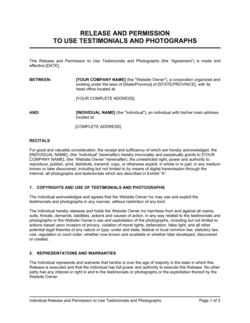
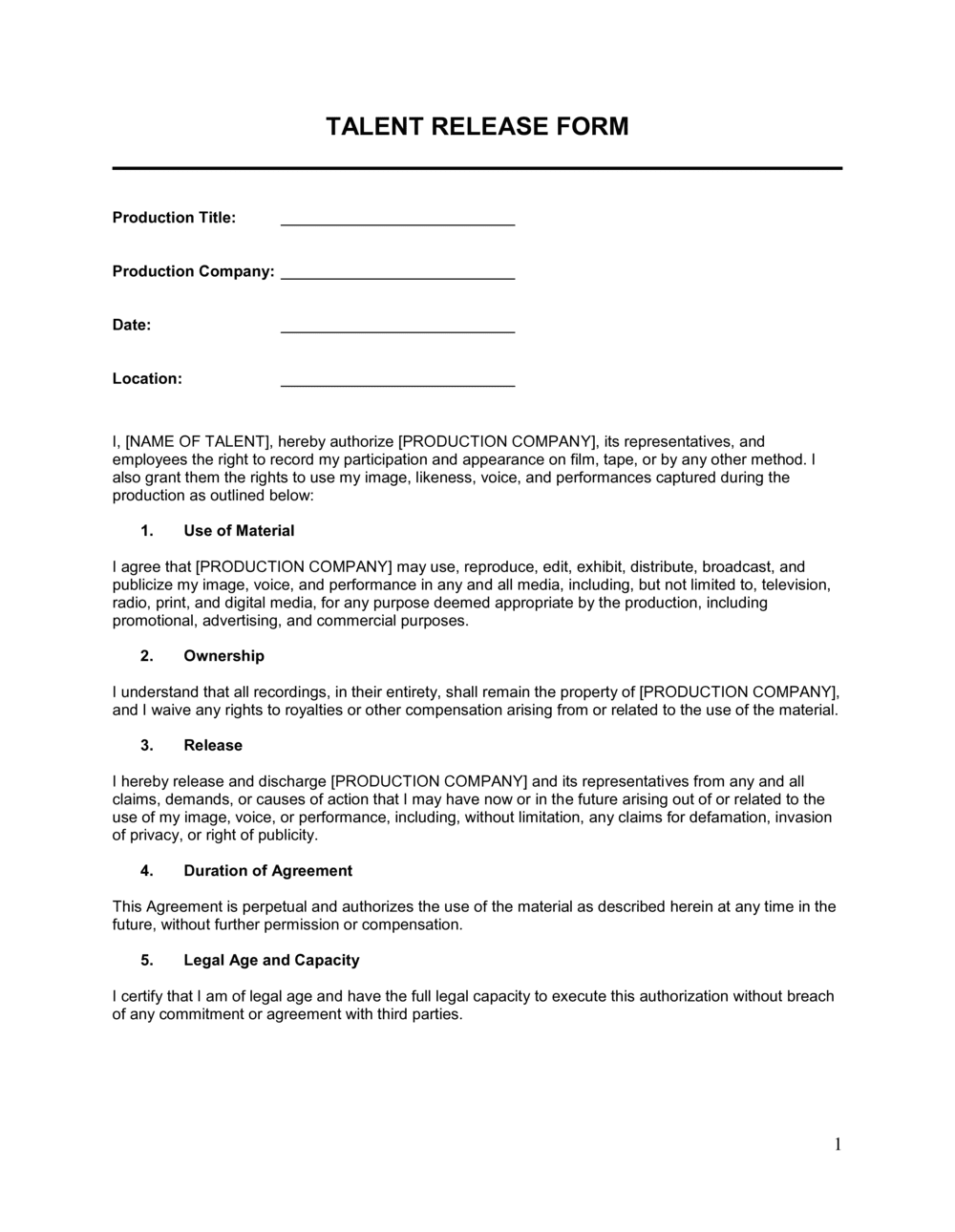
Talent Release Form Template

Free Word download β€’ Edit online β€’ Save & share with Drive β€’ Export to PDF

2 pagesβ€’20–25 min to fillβ€’Difficulty: Standard
Learn more ↓
FreeTalent Release Form Template

At a glance

What it is
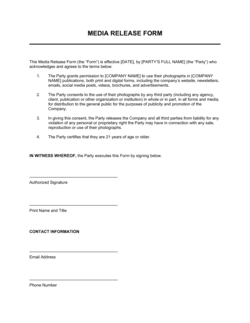
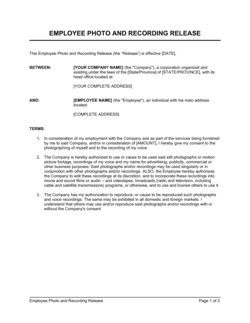
A Talent Release Form is a structured consent document that grants a producer, photographer, or company the right to record, reproduce, and distribute a person's image, voice, and likeness in photos, videos, or other media. This free Word download gives you a ready-to-use form you can edit online, print on set, and collect before any shoot or production begins.
When you need it
Use it before filming, photographing, or recording any individual who will appear in commercial, promotional, editorial, or social media content. It is equally essential for paid talent, unpaid volunteers, and interview subjects.
What's inside
Talent and producer identification, a description of the project and intended media, a grant of rights covering image, voice, and likeness, compensation terms, a warranty that the talent has authority to sign, and space for dated signatures from both parties.

What is a Talent Release Form?

A Talent Release Form is a written consent document that grants a producer, photographer, or company the right to record, reproduce, edit, and distribute a person's image, voice, and likeness in photographs, video, audio, or other media. It transfers the individual's right of publicity β€” their legal control over commercial use of their appearance β€” to the producer for the specified project and distribution channels. Without a signed release on file, any identifiable person appearing in published content is a potential source of a right-of-publicity or privacy claim, regardless of whether they were paid to participate.

Why You Need This Document

Publishing content that features an identifiable person without documented consent exposes your production to takedown demands, injunctions, and damages claims that can be filed long after the content goes live. Stock libraries, broadcasters, and digital advertising platforms routinely reject content that lacks a corresponding signed release β€” meaning unsigned forms can block distribution entirely, not just create legal risk. Collecting releases before the shoot also eliminates the leverage problem: talent who have already been recorded can demand payments or restrictions they would never have agreed to beforehand. This template gives you a complete, ready-to-sign form you can complete in minutes, collect on set or via eSign, and store with your project files so every production is cleared before content ever reaches an audience.

Which variant fits your situation?

If your situation is…Use this template
Professional model or actor appearing in a paid commercial campaignModel Release Form
Minor under 18 appearing in any media productionMinor Talent Release Form
Interview subject or expert quoted in editorial or documentary contentInterview Release Form
Employee filmed for internal training or company promotional materialEmployee Photo/Video Release Form
Event attendee photographed or filmed at a public or ticketed eventEvent Photography Release Form
Voiceover artist or narrator recorded for audio or multimedia contentVoiceover Talent Release Form
User-generated content creator licensing footage to a brandUGC Content License Agreement

Common mistakes to avoid

❌ Collecting releases after filming is complete

Why it matters: Talent who have already been recorded have more negotiating leverage and can demand payment or usage restrictions they would not have agreed to before the shoot.

Fix: Make signed releases a hard gate before any camera or microphone is activated. Build it into the call sheet as a required pre-shoot checklist item.

❌ Leaving the consideration field blank

Why it matters: A release with no stated consideration can be challenged as an unenforceable gift rather than a binding contract, especially if the talent later regrets signing.

Fix: Always record a specific dollar amount or describe the non-cash benefit. A nominal $1 payment with documented acknowledgment of receipt is legally sufficient.

❌ Not including a waiver of approval rights

Why it matters: Without this clause, talent may demand final approval of every edit, causing production delays and forcing costly re-shoots or content pulls after launch.

Fix: Include an explicit waiver of the right to inspect, approve, or object to editorial treatment, cropping, or combination with other content.

❌ Omitting the 'now known or hereafter developed' media qualifier

Why it matters: A release that lists only current platforms β€” TV, YouTube, Instagram β€” cannot legally extend to new platforms or content formats that emerge after signing.

Fix: Add 'in any media, whether now known or hereafter developed' to the grant of rights clause so future distribution channels are automatically covered.

The 9 key fields, explained

Talent identification

Producer / company identification

Project description

Grant of rights β€” image, voice, and likeness

Permitted media and usage channels

Compensation and consideration

Warranty and authority to sign

Waiver of approval and moral rights

Signature, date, and (if minor) guardian countersignature

How to fill it out

  1. 1

    Enter the producer's full legal entity name and contact details

    Fill in the company's registered legal name, address, and the name of the production contact. This identifies who is receiving the rights and who the talent can reach with questions.

    πŸ’‘ Save a pre-filled version with your company details as a master file so field crews only need to complete the talent-side fields on the day.

  2. 2

    Complete the talent's identifying information

    Enter the talent's full legal name, address, phone number, and email. For minors, also enter the parent or guardian's name and relationship to the talent.

    πŸ’‘ Ask talent to write their name and email in block capitals β€” illegible handwritten names on printed forms are a common source of filing errors.

  3. 3

    Describe the project specifically

    Enter the working title, production type (commercial, documentary, social media), the client or brand it is for, and a one-sentence description of the subject matter.

    πŸ’‘ Be specific enough that the talent knows exactly what they are consenting to, but avoid language that unintentionally limits future derivative uses of the same footage.

  4. 4

    Confirm the grant of rights language covers your intended use

    Review the image, voice, and likeness clause to ensure it is irrevocable, perpetual, and covers your distribution channels. Add 'now known or hereafter developed' to the media list.

    πŸ’‘ If the content will be used for AI training, product endorsement, or political advertising, add those uses explicitly β€” general grant language may not cover them.

  5. 5

    State the consideration clearly

    Enter the exact payment amount, or describe the non-cash consideration (e.g., product, credit, or copy of the finished video). Even a nominal $1 payment is sufficient to make the release binding.

    πŸ’‘ If talent is working for free, write '$1 and other valuable consideration, receipt of which is acknowledged' rather than leaving the field blank.

  6. 6

    Collect signatures before recording begins

    Have both the talent and a producer representative sign and date the form before any cameras or microphones are activated. For minors, obtain the parent or guardian's countersignature at the same time.

    πŸ’‘ Use Business in a Box eSign to collect digital signatures on location via a tablet β€” this timestamps consent and stores the executed form automatically.

  7. 7

    File the completed form linked to the project

    Store the signed release in a project folder alongside the production brief and shot list. Name the file with the talent's name and project title for easy retrieval.

    πŸ’‘ Retain releases for at least as long as you plan to use the content plus five years β€” some jurisdictions allow right-of-publicity claims years after initial publication.

Frequently asked questions

What is a talent release form?

A talent release form is a written consent document that grants a producer, photographer, or company the right to record, edit, reproduce, and distribute a person's image, voice, and likeness in specified media. It transfers the talent's right of publicity to the producer for the described project and usage channels, protecting the producer from future claims of unauthorized use.

Is a talent release form legally required?

No law universally mandates one, but using a person's image or likeness for commercial purposes without consent exposes the producer to right-of-publicity and privacy claims in most US states and many countries. Broadcasters, stock image libraries, and advertising networks typically require a signed release before accepting content featuring identifiable individuals.

What is the difference between a talent release form and a model release form?

The terms are often used interchangeably. In practice, a model release form is used for professional models in fashion, advertising, or commercial photography. A talent release form is broader β€” it covers any on-screen or on-mic participant, including interview subjects, event attendees, employees, and voiceover artists. The core grant of rights language in both is identical.

Do I need a separate release for minors?

Yes. A person under 18 cannot enter into a binding contract in most jurisdictions, so a parent or legal guardian must sign the release on their behalf. The minor should also sign where they are old enough to understand the document, but the guardian's signature is the legally operative one. Keep a copy of the guardian's ID with the executed form when possible.

Can a talent release form be signed digitally?

Yes. In the US, the ESIGN Act gives electronic signatures the same legal weight as wet-ink signatures, and equivalent laws exist in Canada, the UK, and the EU. A timestamped digital signature with an audit trail β€” showing who signed, when, and from which IP address β€” is often stronger evidence than a handwritten signature on a printed form.

What happens if I don't get a talent release form signed?

Publishing or distributing content featuring an identifiable person without consent can result in right-of-publicity claims, privacy violation lawsuits, injunctions requiring you to pull the content, and damages awards. Media buyers and platforms often require proof of release before accepting content, meaning unsigned releases can block distribution entirely.

Does a talent release form cover all future uses of the content?

Only if the grant of rights language is drafted broadly enough. A release that lists specific platforms or a fixed time period limits the producer to exactly those uses. To cover all future uses, include perpetual, irrevocable, worldwide rights across all media now known or hereafter developed. If the release is narrower, additional consent is required for any use outside its scope.

Should the producer also sign the talent release form?

Yes. While the talent's signature is the operative grant, a countersignature from a producer representative creates a mutual record of the agreement. It also demonstrates that the producer accepted the terms β€” which matters if the talent later claims they did not know who they were granting rights to.

How this compares to alternatives

vs Non-Disclosure Agreement

An NDA restricts a party from sharing confidential information they receive during a project. A talent release form grants rights to use recorded content. They operate in opposite directions β€” one restricts disclosure; the other permits it. Both are often used in the same production, but for entirely different purposes.

vs Video Production Agreement

A video production agreement governs the entire relationship between a producer and a client β€” scope, deliverables, payment schedule, and IP ownership. A talent release form is a single-purpose consent document collected from individuals who appear on camera. The production agreement does not substitute for individual talent releases.

vs Independent Contractor Agreement

An independent contractor agreement covers the full scope of a working relationship β€” services, payment, IP assignment, and termination. A talent release form is narrower: it captures only the consent to use recorded image, voice, and likeness. Paid talent typically need both β€” the contractor agreement governs the engagement; the release governs the footage.

vs Photography Services Agreement

A photography services agreement defines what the photographer will deliver and who owns the resulting images. A talent release form is signed by the subjects in those images, not the photographer. Both documents are needed for any commercial shoot β€” one covers the photographer-client relationship; the other covers the subject-producer relationship.

Industry-specific considerations

Media and Entertainment

Covers on-screen talent across broadcast, streaming, and theatrical productions where distribution rights are licensed to multiple parties worldwide.

Advertising and Marketing

Used for every identifiable individual in commercial campaigns, with media usage fields that must match the exact platforms and placements the brand has purchased.

Corporate Communications

Employees featured in training videos, culture content, or investor-facing materials must sign releases separate from their employment agreements to cover post-employment distribution.

Event Management

Collected at registration or on the day for speakers, performers, and attendees whose images will appear in event recap videos, press releases, or future promotional materials.

Template vs pro β€” what fits your needs?

PathBest forCostTime
Use the templatePhotographers, video producers, marketers, and event organizers collecting standard on-camera consentFree5 minutes per form
Template + professional reviewProductions involving minors, paid talent with union affiliations, or content intended for international distribution$150–$400 (entertainment lawyer review)1–2 days
Custom draftedMajor commercial campaigns, feature films, or any production where right-of-publicity claims pose significant financial exposure$500–$2,000+ (entertainment attorney)3–7 days

Glossary

Likeness
A person's visual appearance as captured in photographs, film, or video β€” including their face, body, and distinguishing features.
Grant of Rights
The section of the form where the talent formally gives the producer permission to use their image, voice, and likeness for specified purposes.
Perpetual License
A grant with no expiration date, allowing the producer to use the content indefinitely without returning for additional consent.
Consideration
Something of value exchanged to make a consent agreement binding β€” typically a payment amount, credit, or even a nominal fee of $1.
Media Usage
The specific channels and formats in which the recorded content may be distributed β€” such as broadcast, online, print, or social media.
Territorial Scope
The geographic boundaries within which the producer is permitted to distribute or publish the content β€” ranging from local to worldwide.
Right of Publicity
A person's legal right to control commercial use of their name, image, and likeness β€” the right a talent release form transfers to the producer.
Waiver of Moral Rights
A clause in which the talent agrees not to object to how the content is edited, cropped, or combined with other material.
Minor Release
A variant of the talent release form signed by a parent or legal guardian on behalf of a person under 18 years of age.
Work for Hire
An arrangement where any creative contribution by the talent is owned by the producer from the moment of creation, with no retained rights.

Part of your Business Operating System

This document is one of 3,000+ business & legal templates included in Business in a Box.

  • Fill-in-the-blanks β€” ready in minutes
  • 100% customizable Word document
  • Compatible with all office suites
  • Export to PDF and share electronically

Create your document in 3 simple steps.

From template to signed document β€” all inside one Business Operating System.
1
Download or open template

Access over 3,000+ business and legal templates for any business task, project or initiative.

2
Edit and fill in the blanks with AI

Customize your ready-made business document template and save it in the cloud.

3
Save, Share, Send, Sign

Share your files and folders with your team. Create a space of seamless collaboration.

Save time, save money, and create top-quality documents.

β˜…β˜…β˜…β˜…β˜…

"Fantastic value! I'm not sure how I'd do without it. It's worth its weight in gold and paid back for itself many times."

Managing Director Β· Mall Farm
Robert Whalley
Managing Director, Mall Farm Proprietary Limited
β˜…β˜…β˜…β˜…β˜…

"I have been using Business in a Box for years. It has been the most useful source of templates I have encountered. I recommend it to anyone."

Business Owner Β· 4+ years
Dr Michael John Freestone
Business Owner
β˜…β˜…β˜…β˜…β˜…

"It has been a life saver so many times I have lost count. Business in a Box has saved me so much time and as you know, time is money."

Owner Β· Upstate Web
David G. Moore Jr.
Owner, Upstate Web

Run your business with a system β€” not scattered tools

Stop downloading documents. Start operating with clarity. Business in a Box gives you the Business Operating System used by over 250,000 companies worldwide to structure, run, and grow their business.

Start freeΒ Β·Β No credit card required