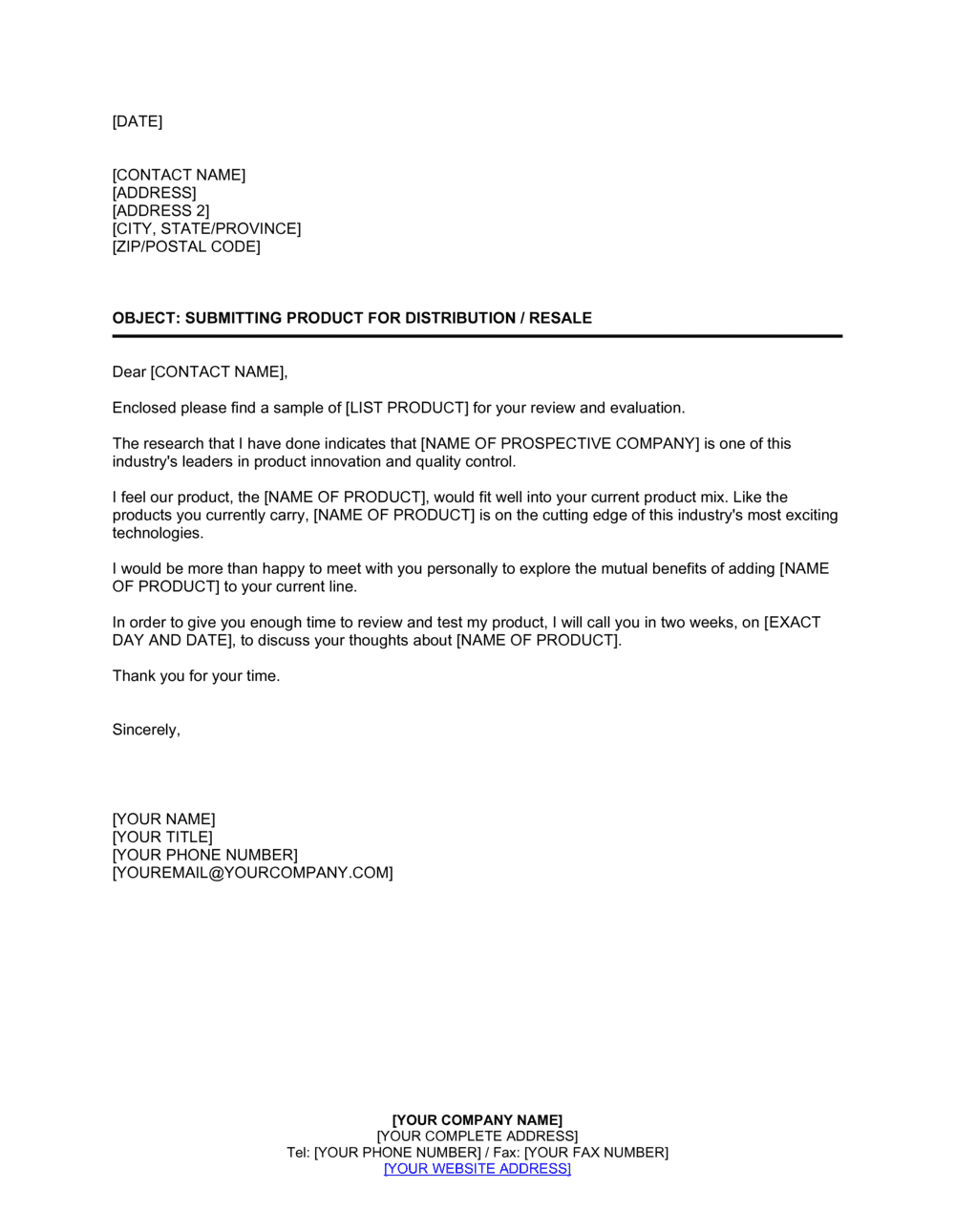
Submit Product for Distribution or Resale Template

Free Word download • Edit online • Save & share with Drive • Export to PDF

1 page20–30 min to fillDifficulty: StandardSignature requiredLegal review recommended
Learn more ↓
FreeSubmit Product for Distribution or Resale Template

At a glance

What it is
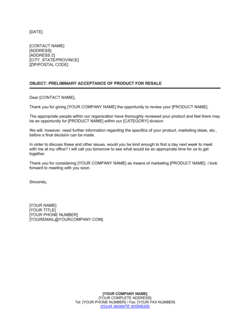
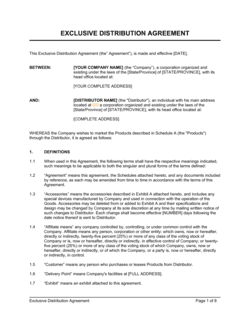
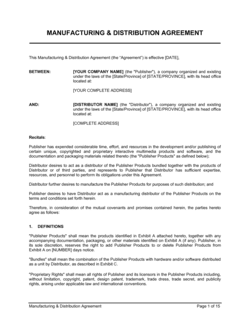
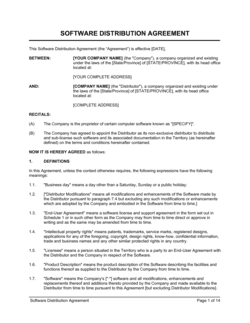
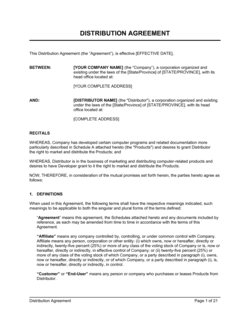
A Submit Product for Distribution or Resale agreement is a legally binding contract between a product manufacturer or supplier and a distributor or reseller that governs how the product may be marketed, sold, and distributed to end customers. This free Word download lets you define territory, pricing, exclusivity, IP usage, minimum purchase obligations, and termination terms in a single document you can edit online and export as PDF.
When you need it
Use it any time a manufacturer, brand owner, or supplier authorizes a third party — a wholesaler, retailer, or reseller — to carry and sell their product. It is equally necessary when a distributor formalizes the terms under which they will represent a new product line to downstream buyers.
What's inside
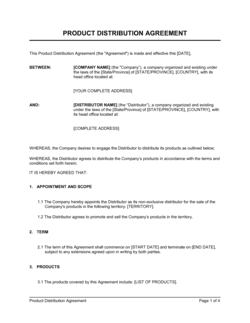
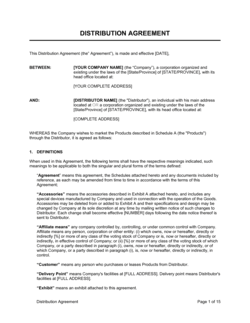
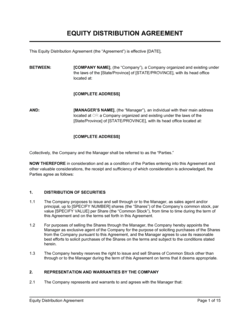
Parties and product description, territory and exclusivity, pricing and margin structure, minimum purchase commitments, IP and branding guidelines, warranties and liability, confidentiality, and termination conditions. The template includes placeholder schedules for product specifications and pricing.

What is a Submit Product for Distribution or Resale Agreement?

A Submit Product for Distribution or Resale agreement is a legally binding contract between a product manufacturer or supplier and a third-party distributor or reseller that governs the terms under which the distributor may purchase, market, and sell the supplier's products to end customers or downstream buyers. It establishes the authorized territory, exclusivity status, transfer pricing, minimum purchase commitments, permitted sales channels, intellectual property usage rights, product warranties, and the conditions under which either party may end the relationship. Unlike a simple purchase order, this agreement creates an ongoing commercial relationship with enforceable obligations on both sides — protecting the supplier's brand and pricing integrity while giving the distributor the certainty they need to invest in market development.

Why You Need This Document

Distributing a product through a third party without a written agreement exposes both sides to serious, concrete risks. Without defined territory and channel scope, a distributor can undercut your direct sales operation, flood discount marketplaces, and destroy the price integrity you have built across your entire distribution network. Without an IP license and termination clause, former distributors routinely continue using your trademarks and maintaining marketplace listings long after the relationship ends — trading on your brand without authorization. Without a minimum purchase commitment tied to exclusivity, a distributor can lock up an entire market while making no sales, blocking you from appointing anyone who will actually move product. On the distributor's side, no written agreement means no assurance that the supplier won't appoint a competing channel partner in the same territory next quarter. This template gives both parties a clear, enforceable foundation — territory rights, pricing rules, brand standards, and termination mechanics — in a single document you can complete in under an hour and enforce if the relationship breaks down.

Which variant fits your situation?

If your situation is…Use this template
Granting exclusive territory rights to a single regional distributorExclusive Distribution Agreement
Authorizing multiple resellers in the same market without exclusivityNon-Exclusive Reseller Agreement
Allowing a partner to resell software or SaaS productsSoftware Reseller Agreement
Engaging an agent to solicit orders on behalf of the supplierSales Agency Agreement
Selling finished goods to a retailer for resale under their own labelPrivate Label Agreement
Distributing goods internationally across multiple countriesInternational Distribution Agreement
Setting up a wholesale account with a retail chainWholesale Agreement

Common mistakes to avoid

❌ Granting exclusivity with no minimum purchase floor

Why it matters: A distributor with exclusive rights but no volume obligation can lock up a territory while making zero sales, preventing the supplier from appointing any other channel partner.

Fix: Always tie exclusivity to a quarterly or annual minimum purchase commitment with a defined cure period and an automatic conversion to non-exclusive if the floor is missed twice consecutively.

❌ Omitting channel and marketplace scope from the territory clause

Why it matters: A distributor who floods Amazon or discount marketplaces can undercut the supplier's direct channel and other authorized resellers, eroding price integrity and brand equity.

Fix: Name every online marketplace and retail format explicitly in the territory clause, and require written pre-approval for any channel not listed at signing.

❌ No MAP policy in a multi-reseller arrangement

Why it matters: Without a minimum advertised price, one reseller discounting aggressively forces all others to follow, collapsing margins across the entire distribution network.

Fix: Include a MAP provision in every reseller agreement and reserve the right to terminate authorization for persistent MAP violations after one written warning.

❌ Post-termination IP license with no removal deadline

Why it matters: Former distributors who continue using trademarks and product images after termination create consumer confusion and potentially infringe the supplier's IP without any ongoing authorization.

Fix: Add an explicit clause requiring the distributor to remove all branded materials, delist marketplace listings, and return or destroy brand assets within 30 days of termination.

❌ No liability cap on indirect or consequential damages

Why it matters: A product liability claim that flows through the distributor's sales channel can expose the supplier to consequential damages — lost profits, customer recalls, reputational harm — far exceeding the value of the distribution contract.

Fix: Include a mutual consequential-damages exclusion and a liability cap set at 12 months of fees paid, with carve-outs only for fraud, willful misconduct, and IP indemnification.

❌ Auto-renewal with no advance notice requirement

Why it matters: Without a defined notice window, the agreement rolls over automatically and the supplier cannot reappoint, restructure territory, or adjust pricing until the next full term expires.

Fix: Set a 60-day advance notice requirement for non-renewal, and calendar a reminder 90 days before each anniversary so you have time to evaluate the relationship before the window closes.

The 9 key clauses, explained

Parties, product description, and appointment

In plain language: Identifies the supplier and distributor as legal entities, describes the products covered by the agreement, and formally appoints the distributor to sell those products in the defined territory.

Sample language
[SUPPLIER LEGAL NAME] ('Supplier') hereby appoints [DISTRIBUTOR LEGAL NAME] ('Distributor') as an authorized [exclusive / non-exclusive] distributor of the Products listed in Schedule A within the Territory defined in Schedule B, for the Term of this Agreement.

Common mistake: Listing a brand name instead of the registered legal entity as the Supplier. When enforcement is needed, a mismatch between the contracting entity and the IP or invoicing entity creates standing disputes.

Territory and channel scope

In plain language: Defines exactly where and through which sales channels the distributor may sell — specifying countries, regions, states, and whether online marketplaces, retail, or wholesale channels are included or excluded.

Sample language
The Territory is limited to [COUNTRY / STATE / REGION]. Distributor may sell through [retail stores / e-commerce / both]. Distributor may not sell on [EXCLUDED MARKETPLACE, e.g., Amazon.com] without prior written consent of Supplier.

Common mistake: Omitting online and marketplace channels from the territory definition. Leaving channel scope silent allows the distributor to undercut other partners or the supplier's own direct channel without technically breaching the contract.

Exclusivity and minimum purchase commitments

In plain language: States whether the appointment is exclusive or non-exclusive and, if exclusive, ties that status to the distributor meeting minimum purchase volumes — with a defined cure period and consequences for falling short.

Sample language
Exclusivity is conditional on Distributor purchasing no less than [UNIT QUANTITY / DOLLAR AMOUNT] of Products per [calendar quarter / year] ('Minimum Commitment'). Failure to meet the Minimum Commitment for [TWO] consecutive periods shall, at Supplier's election, convert the appointment to non-exclusive upon [30] days' written notice.

Common mistake: Granting exclusivity with no minimum purchase floor. Without a volume trigger, the distributor can sit on exclusive rights without actively selling, blocking the supplier from appointing any other channel partner.

Pricing, transfer price, and MAP

In plain language: Sets the supplier's transfer price to the distributor, the recommended retail price, and the minimum advertised price — and specifies how and when the supplier may change pricing.

Sample language
Supplier shall sell Products to Distributor at the Transfer Prices set out in Schedule C. Supplier may adjust Transfer Prices on [60] days' written notice. Distributor shall not advertise Products below the MAP of $[AMOUNT] per unit without prior written approval.

Common mistake: No MAP provision in a reseller agreement. Without it, aggressive discounting by one channel partner can destroy price integrity across all other resellers and damage brand equity.

Intellectual property license and brand guidelines

In plain language: Grants the distributor a limited, non-transferable license to use the supplier's trademarks, logos, and product images solely to market the authorized products — and requires compliance with brand standards.

Sample language
Supplier grants Distributor a limited, non-exclusive, non-transferable, revocable license to use Supplier's trademarks and product images ('Marks') solely to market and sell the Products in the Territory during the Term. Distributor shall comply with Supplier's Brand Guidelines (Schedule D) and shall not modify the Marks in any way.

Common mistake: No provision requiring the distributor to stop using the supplier's marks after termination. Without an explicit obligation to remove listings, signage, and digital assets, former distributors continue trading on the supplier's brand after the relationship ends.

Orders, delivery, and acceptance

In plain language: Establishes how purchase orders are placed and accepted, lead times for fulfillment, risk of loss during shipping, and the process for rejecting non-conforming goods.

Sample language
Distributor shall submit purchase orders to Supplier in writing at least [X] business days in advance. Supplier shall confirm acceptance within [5] business days. Risk of loss transfers to Distributor upon delivery to [FOB ORIGIN / FOB DESTINATION]. Distributor must notify Supplier of any non-conforming goods within [10] business days of receipt.

Common mistake: No rejection window for non-conforming goods. Without a defined inspection period, the supplier can argue the distributor accepted defective goods by failing to object promptly.

Warranties, product liability, and indemnification

In plain language: States the supplier's product warranties, disclaims implied warranties beyond those expressly given, limits liability to a defined cap, and allocates indemnification between the parties for product defects and third-party claims.

Sample language
Supplier warrants that Products will conform to the specifications in Schedule A for [12] months from shipment. EXCEPT AS EXPRESSLY SET OUT HEREIN, SUPPLIER DISCLAIMS ALL IMPLIED WARRANTIES. Each party shall indemnify the other for losses arising from its own breach, negligence, or product defects attributable to it, subject to a liability cap of [12 months' fees paid].

Common mistake: No liability cap on the supplier's side. Without a cap, a product recall or injury claim can expose the supplier to unlimited consequential damages flowing through the distributor's sales channel.

Confidentiality and non-compete

In plain language: Requires both parties to protect each other's pricing, customer data, and business information as confidential, and restricts the distributor from representing competing products during the term.

Sample language
Each party shall hold the other's Confidential Information in strict confidence and not disclose it to any third party. During the Term, Distributor shall not distribute, represent, or promote any product that directly competes with the Products in the Territory without Supplier's prior written consent.

Common mistake: A non-compete that extends beyond the term of the agreement with no defined duration or geographic limit. Courts routinely void post-termination non-competes that are overbroad, leaving the supplier with no protection at all.

Term, termination, and effects of termination

In plain language: Sets the initial term, renewal mechanics, grounds for immediate termination for cause, the notice period for termination without cause, and what happens to outstanding inventory, orders, and licenses after termination.

Sample language
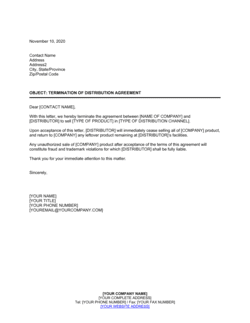
This Agreement commences on [DATE] and continues for [1 YEAR], renewing automatically for successive [1-YEAR] periods unless either party gives [60] days' written notice. Either party may terminate immediately for material breach unremedied within [30] days of written notice. On termination, Distributor shall cease using the Marks and may return unsold conforming inventory at Supplier's option within [60] days.

Common mistake: Auto-renewal with no notice requirement. Without a defined notice window, the agreement rolls over automatically and the supplier cannot reappoint without triggering the non-exclusive conversion or waiting out the next full term.

How to fill it out

  1. 1

    Identify the parties and the products precisely

    Enter the full registered legal name, jurisdiction of incorporation, and address for both the Supplier and the Distributor. Attach Schedule A listing each product by SKU, description, and unit of measure.

    💡 Cross-reference the Supplier's corporate registry name against invoicing and IP ownership records — mismatches between the contracting entity and the trademark owner are the leading cause of enforcement disputes.

  2. 2

    Define the territory and permitted channels

    Specify the geographic scope — country, state, or region — and name every sales channel the Distributor is authorized to use. Explicitly exclude any channel you want to reserve for direct sales or other partners.

    💡 List marketplace platforms (Amazon, Walmart Marketplace, eBay) by name in the channel definition. 'Online' without specifics has been interpreted to include every digital channel.

  3. 3

    Set exclusivity status and attach a minimum purchase schedule

    Choose exclusive or non-exclusive and, if exclusive, fill in the minimum purchase volume or dollar commitment per quarter or year. Include the cure period and the conversion clause that triggers if the Distributor misses the floor.

    💡 Set the minimum at 70–80% of the Distributor's projected sell-through, not your ideal revenue target. A reachable floor will be honored; an aspirational one will be missed and then disputed.

  4. 4

    Complete the pricing schedule and MAP policy

    Enter the Transfer Price for each SKU in Schedule C, the recommended retail price, and the MAP. State the notice period required before any pricing change takes effect.

    💡 A 60-day price-change notice is the market standard for consumer goods. Anything shorter destabilizes the Distributor's margin planning and invites early termination disputes.

  5. 5

    Tailor the IP license and brand guidelines schedule

    Specify which trademarks, logos, and product images the Distributor may use, attach the brand guidelines as Schedule D, and include an explicit obligation to remove all materials within 30 days of termination.

    💡 Require pre-approval for any co-branded or localized marketing materials — this prevents off-brand creative from appearing in market before you can review it.

  6. 6

    Fill in order, delivery, and inspection terms

    Set the minimum lead time for purchase orders, the supplier's acceptance window, the FOB point for risk transfer, and the distributor's window to notify of non-conforming goods.

    💡 A 10-business-day inspection window is the standard for physical goods. For perishables or regulated products, shorten it to 3–5 days to catch defects before distribution.

  7. 7

    Calibrate the liability cap and indemnification scope

    Set a mutual liability cap — typically 12 months of fees paid under the agreement — and confirm that each party indemnifies the other only for losses attributable to their own breach, negligence, or product defect.

    💡 Exclude IP infringement and fraud from the liability cap. Courts routinely uphold unlimited liability for willful misconduct even when a general cap is in place.

  8. 8

    Set the term, renewal, and termination notice periods

    Enter the initial term, the auto-renewal period, the notice period for termination without cause (typically 60–90 days), and the cure period for material breach (typically 30 days). Confirm what happens to inventory and outstanding orders on termination.

    💡 Include a sell-off period of 60–90 days post-termination during which the Distributor may liquidate existing inventory — this reduces termination disputes over stranded stock.

Frequently asked questions

What is a product distribution agreement?

A product distribution agreement is a legally binding contract between a supplier or manufacturer and a distributor or reseller that defines the terms under which the distributor may purchase, market, and sell the supplier's products. It typically covers territory, exclusivity, pricing, minimum purchase obligations, intellectual property use, warranties, and termination. Without one, the parties rely on informal understandings that are difficult to enforce and leave both sides exposed.

What is the difference between a distributor and a reseller?

A distributor typically buys product in bulk from the supplier, takes physical possession, and resells to retailers or sub-distributors, often providing logistics and warehousing. A reseller purchases product and sells directly to end customers, often without warehousing infrastructure. The legal agreement structure is similar for both, but a distributor agreement typically includes more detailed inventory, logistics, and sub-distribution provisions.

Do I need a lawyer to draft a product distribution agreement?

For straightforward domestic resale arrangements with a single SKU or product line, a well-structured template is generally sufficient as a starting point. Legal review is advisable when exclusivity is granted, when the distributor operates in a jurisdiction with specific commercial agency laws, when significant IP rights are involved, or when the contract value exceeds $100,000 annually. Cross-border arrangements almost always warrant legal review due to varying distribution and competition law requirements.

Is an exclusive distribution agreement enforceable?

Exclusive distribution agreements are generally enforceable in most jurisdictions when they include a defined territory, a fixed term, and mutual obligations. However, overly broad exclusivity — covering entire countries for unlimited terms without minimum purchase floors — can attract scrutiny under competition law in the EU, UK, and Canada. In the US, exclusive dealing arrangements are analyzed under a rule-of-reason standard. Consider consulting a lawyer when granting exclusivity that covers more than one country or a term longer than three years.

What should a minimum purchase commitment look like?

A minimum purchase commitment typically states a dollar value or unit quantity that the distributor must order within each calendar quarter or year. It should include a cure period — usually 30 to 60 days after the end of a period — during which the distributor can make up the shortfall. The most enforceable commitments tie non-performance directly to a specific consequence, such as conversion from exclusive to non-exclusive, rather than leaving the remedy to the supplier's discretion.

What happens to inventory when a distribution agreement is terminated?

Termination provisions should address this explicitly. Common approaches include a sell-off period of 60 to 90 days during which the distributor may liquidate authorized inventory at or above MAP, an option for the supplier to repurchase unsold conforming goods at the original transfer price, and a hard deadline after which the distributor must destroy or return any remaining stock. Without these provisions, stranded inventory is the most frequent source of post-termination disputes.

Can a reseller set their own retail prices?

In most jurisdictions, the supplier can set a minimum advertised price (MAP) but generally cannot dictate the actual resale price at the point of sale without running into resale price maintenance issues under competition law. In the US, vertical price-fixing is analyzed under the rule of reason, but explicit price-fixing agreements remain risky. In the EU, fixing minimum resale prices is a per-se infringement of Article 101 TFEU. MAP policies, combined with termination rights for repeated violations, are the standard enforcement mechanism.

What IP rights does a distributor need to sell a product?

A distributor needs a limited license to use the supplier's trademarks, logos, product images, and any registered designs solely for the purpose of marketing and selling the authorized products in the territory. This license should be non-exclusive, non-transferable, and expressly limited to the term of the agreement. It must include a clear obligation to cease all use and remove all branded materials — including online listings — within a specified period after termination.

How long should a distribution agreement last?

Initial terms of one to two years are common for new distribution relationships, giving both parties time to assess market performance before committing to longer terms. Exclusive arrangements often run two to three years with annual renewal options tied to minimum performance benchmarks. Longer fixed terms — five years or more — are appropriate only when the distributor is investing significantly in market development, infrastructure, or localization on the supplier's behalf.

How this compares to alternatives

vs Exclusive Distribution Agreement

An exclusive distribution agreement is a specialized form of this document that grants a single distributor sole rights in a defined territory, explicitly blocking the supplier from appointing competitors. The Submit Product for Distribution or Resale template covers both exclusive and non-exclusive arrangements. Use the exclusive form when the distributor is investing in market development and needs protected territory to justify that investment.

vs Sales Representative Agreement

A sales representative agreement engages an agent to solicit orders on the supplier's behalf without taking title to the goods — the supplier invoices the end customer directly and pays the agent a commission. A distribution agreement transfers title and risk to the distributor, who resells at their own margin. Misclassifying a distributor as an agent (or vice versa) triggers different tax, liability, and competition-law consequences.

vs Wholesale Agreement

A wholesale agreement governs a single buyer-seller relationship for the purchase of goods in bulk, typically without exclusivity or territory restrictions. A distribution agreement adds territory rights, exclusivity provisions, branding licenses, minimum purchase floors, and sell-through obligations. Use a wholesale agreement for straightforward bulk purchasing; use a distribution agreement when the buyer is representing your brand in a defined market.

vs International Distribution Agreement

An international distribution agreement adapts the core structure for cross-border arrangements, adding Incoterms, import and export compliance obligations, currency and payment risk provisions, and jurisdiction-specific competition law disclosures. The standard Submit Product for Distribution or Resale template is designed for domestic use. For any arrangement spanning multiple countries, the international variant is more appropriate.

Industry-specific considerations

Consumer Goods and FMCG

High SKU counts, short product cycles, and complex MAP enforcement across dozens of retail and online channels make a detailed pricing and channel-scope clause essential.

Food and Beverage

Short shelf-life goods require tight delivery lead times, inspection windows of 3–5 days, and explicit provisions covering lot traceability, recall procedures, and temperature-controlled logistics.

Technology and Electronics

Distributor agreements must address authorized service and warranty fulfillment, grey-market channel controls, and firmware or software bundling rights alongside hardware resale.

Pharmaceuticals and Medical Devices

Regulatory authorization, import licenses, and product liability indemnification are non-negotiable; distribution rights are typically tied to the distributor's regulatory standing in each market.

Wholesale and Retail

Retail chain buyers require vendor compliance programs, EDI integration, and chargeback provisions that must be explicitly addressed or excluded in the distribution agreement.

Manufacturing

OEM and private-label provisions, tooling ownership, and cross-border freight terms (Incoterms) are critical elements of any manufacturing supply chain distribution arrangement.

Jurisdictional notes

United States

US distribution arrangements are governed primarily by state commercial law (UCC Article 2 for goods). Exclusive dealing arrangements are reviewed under the Sherman Act rule-of-reason standard — they are generally enforceable when pro-competitive benefits outweigh foreclosure effects. California, New Jersey, and several other states have dealer protection statutes that restrict termination of established distribution relationships without good cause, even when the contract permits termination at will. Verify the governing state before drafting the termination clause.

Canada

Distribution agreements in Canada are governed by provincial sale of goods and contract law, with no single federal regime equivalent to the UCC. Quebec operates under civil law (Civil Code of Quebec), which may affect interpretation of exclusivity and termination provisions differently than common-law provinces. The Competition Act prohibits exclusive dealing arrangements that substantially lessen competition — relevant for dominant suppliers. Some provinces have specific legislation protecting franchisees and commercial agents that may apply to close distribution relationships.

United Kingdom

Post-Brexit, UK distribution agreements are governed by UK competition law (Chapter I of the Competition Act 1998) rather than EU block exemptions, though the UK Vertical Agreements Block Exemption Order 2022 closely mirrors the EU VBER. Commercial agents engaged to solicit orders on a supplier's behalf are protected under the Commercial Agents Regulations 1993, which grants mandatory compensation or indemnity on termination — misclassifying a distributor as an agent triggers these protections inadvertently. Minimum resale price maintenance remains a per-se infringement.

European Union

EU distribution agreements must comply with the Vertical Block Exemption Regulation (VBER) 2022/720, which permits exclusive and selective distribution arrangements when each party's market share is below 30%. Minimum resale price maintenance is a hard-core restriction prohibited under Article 4 VBER. The EU Commercial Agents Directive gives commercial agents a mandatory right to compensation or indemnity on termination that cannot be contractually waived. GDPR applies to any customer data shared between supplier and distributor as part of the arrangement.

Template vs lawyer — what fits your deal?

PathBest forCostTime
Use the templateSuppliers and domestic resellers entering straightforward non-exclusive product distribution arrangements with a single partnerFree30–60 minutes
Template + legal reviewExclusive territory grants, agreements with minimum purchase commitments exceeding $50,000/year, or distribution in a regulated product category$400–$9002–5 days
Custom draftedMulti-country distribution networks, pharmaceutical or medical device distribution, or arrangements involving significant IP licensing or co-development obligations$2,000–$8,000+2–4 weeks

Glossary

Distributor
A third party that purchases products from a supplier and resells them to retailers, end customers, or sub-distributors, typically taking title to the goods.
Reseller
An entity authorized to sell a supplier's products to end buyers, either purchasing the goods outright or earning a margin on sales made in the supplier's name.
Exclusive Territory
A defined geographic or channel-specific area in which the distributor is the only authorized seller of the supplier's product for the term of the agreement.
Minimum Purchase Commitment
A contractual obligation requiring the distributor to buy at least a specified quantity or dollar value of product within a defined period, often used to justify exclusivity.
Transfer Price
The price at which the supplier sells the product to the distributor — distinct from the recommended retail price at which the distributor sells to end customers.
MAP (Minimum Advertised Price)
The lowest price at which a reseller is permitted to advertise the product, used to protect brand positioning and prevent price erosion across channels.
Intellectual Property License
A limited, conditional grant allowing the distributor to use the supplier's trademarks, logos, and product descriptions solely for the purpose of marketing and selling the authorized products.
Sell-Through Obligation
A requirement that the distributor actively market and sell the product — not merely hold inventory — often tied to reporting and performance benchmarks.
Right of First Refusal
A contractual right giving the distributor the first opportunity to match any third-party offer before the supplier appoints a competing distributor in the territory.
Indemnification
A clause requiring one party to compensate the other for losses, claims, or damages arising from a specified cause — such as a product defect or an IP infringement claim.
Termination for Convenience
A right allowing either party to end the agreement without cause by providing advance written notice, typically 30 to 90 days, regardless of whether either party has breached.

Part of your Business Operating System

This document is one of 3,000+ business & legal templates included in Business in a Box.

  • Fill-in-the-blanks — ready in minutes
  • 100% customizable Word document
  • Compatible with all office suites
  • Export to PDF and share electronically

Create your document in 3 simple steps.

From template to signed document — all inside one Business Operating System.
1
Download or open template

Access over 3,000+ business and legal templates for any business task, project or initiative.

2
Edit and fill in the blanks with AI

Customize your ready-made business document template and save it in the cloud.

3
Save, Share, Send, Sign

Share your files and folders with your team. Create a space of seamless collaboration.

Save time, save money, and create top-quality documents.

★★★★★

"Fantastic value! I'm not sure how I'd do without it. It's worth its weight in gold and paid back for itself many times."

Managing Director · Mall Farm
Robert Whalley
Managing Director, Mall Farm Proprietary Limited
★★★★★

"I have been using Business in a Box for years. It has been the most useful source of templates I have encountered. I recommend it to anyone."

Business Owner · 4+ years
Dr Michael John Freestone
Business Owner
★★★★★

"It has been a life saver so many times I have lost count. Business in a Box has saved me so much time and as you know, time is money."

Owner · Upstate Web
David G. Moore Jr.
Owner, Upstate Web

Run your business with a system — not scattered tools

Stop downloading documents. Start operating with clarity. Business in a Box gives you the Business Operating System used by over 250,000 companies worldwide to structure, run, and grow their business.

Free Forever Plan · No credit card required