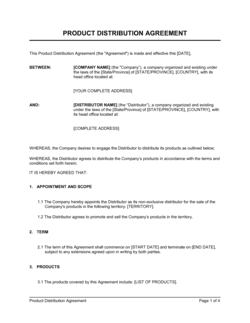
How To Write A Distribution Agreement

Free to read β€’ Save or share with one click

FreeHow To Write A Distribution Agreement Template

At a glance

What it is
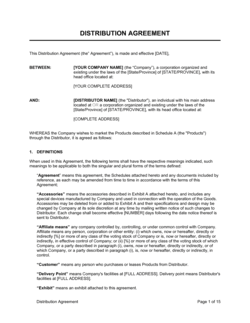
A Distribution Agreement guide is an operational document that walks you through every section of a distributor contract β€” territory, exclusivity, pricing, purchase obligations, marketing support, IP use, and termination β€” so you can draft or evaluate a binding agreement with confidence. This free Word download gives you a structured, section-by-section framework you can edit online and export as PDF to share with distributors, legal counsel, or your sales leadership team.
When you need it
Use it when appointing a new distributor in a region, renegotiating an existing distribution arrangement, or building a standard template your company can reuse across multiple markets and channel partners.
What's inside
Party identification and recitals, territory and exclusivity terms, product scope and pricing, purchase and sales obligations, marketing and promotional support, intellectual property and branding rules, reporting and audit rights, and termination and post-termination provisions.

What is a Distribution Agreement?

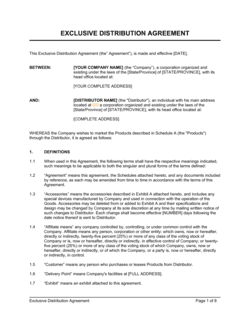
A Distribution Agreement is a commercial contract between a supplier β€” typically a manufacturer or brand owner β€” and a distributor that defines the terms under which the distributor will purchase, stock, market, and resell the supplier's products within a defined territory. It establishes whether the appointment is exclusive or non-exclusive, sets the prices and volumes at which products change hands, assigns marketing and reporting obligations to the distributor, and specifies what happens when the relationship ends. Unlike a one-off purchase order or wholesale invoice, a distribution agreement creates an ongoing structured channel relationship with enforceable performance standards on both sides.

Why You Need This Document

Operating a distribution channel without a written agreement exposes both supplier and distributor to four categories of risk that compound over time. Without a precise territory definition, a single successful sale in an adjacent market triggers a dispute that can unravel the entire relationship. Without minimum purchase obligations tied to a clear remedy, an exclusive distributor who stops selling can lock a supplier out of a market for years. Without documented post-termination procedures, end-of-contract inventory becomes a cost dispute that ends in litigation. And without audit rights, a supplier has no way to verify whether reported sales and MPO compliance reflect reality. This template gives you a section-by-section framework to close every one of those gaps in a single document β€” one you can complete in hours rather than commissioning from scratch.

Which variant fits your situation?

If your situation is…Use this template
Granting a distributor sole rights in a defined territoryExclusive Distribution Agreement
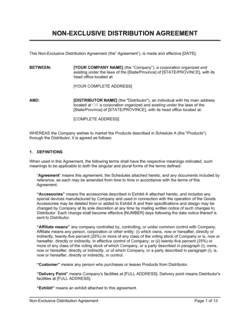
Working with multiple distributors in the same regionNon-Exclusive Distribution Agreement
Appointing a master distributor who will sub-appoint resellersMaster Distribution Agreement
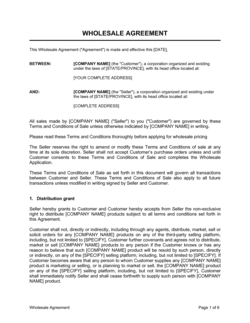
Selling finished goods directly to a buyer for resaleWholesale Agreement
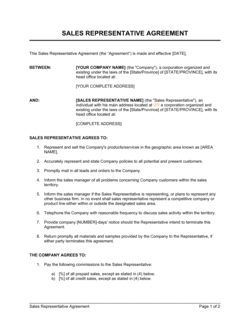
Authorizing a party to sell products on commission without holding inventorySales Agent Agreement
Distributing software or digital products through channel partnersSoftware Reseller Agreement
Engaging a third-party logistics provider to store and ship productsThird-Party Logistics Agreement

Common mistakes to avoid

❌ Vague territory definition

Why it matters: Without a precise list of countries or regions, both parties interpret the boundary differently β€” leading to disputes over whether a sale was inside or outside the grant and whether exclusivity was breached.

Fix: Attach a dedicated Schedule listing every jurisdiction covered, and add a clause confirming that online sales to customers outside the Territory are treated as out-of-territory solicitation.

❌ Exclusivity with no minimum purchase obligation

Why it matters: Granting exclusivity without an MPO locks the supplier out of the territory even if the distributor makes no meaningful sales effort β€” blocking direct sales and competing appointments alike.

Fix: Pair every exclusive appointment with a specific annual MPO in units or dollar value, and include a right to convert to non-exclusive if the MPO is missed.

❌ No price-change notice requirement

Why it matters: A supplier who can reprice products at will can eliminate the distributor's margin overnight on inventory already committed to customers β€” a common cause of relationship breakdown.

Fix: Require a minimum of 60 days' written notice for any transfer price increase, with purchases under open orders honored at the prior price.

❌ Automatic renewal without a tracked notice deadline

Why it matters: Contracts that renew automatically are routinely missed by both parties β€” leaving suppliers bound to underperforming distributors and distributors locked into terms they intended to renegotiate.

Fix: Set a 90-day non-renewal notice period and calendar the deadline immediately upon execution. Add a clause stating that failure to give timely notice does not waive the right to non-renew in the next period.

❌ No post-termination inventory process

Why it matters: When the agreement ends, undisposed inventory becomes a cost dispute β€” who stores it, who owns it, and who pays for returns or destruction are all contested without a written process.

Fix: Include a sell-off period of 30–90 days, a buy-back obligation or return process for remaining stock, and a hard date on which all IP licenses and use of trademarks expire.

❌ Omitting audit rights

Why it matters: Without the right to inspect distributor records, the supplier cannot verify reported sales figures, confirm MPO compliance, or detect grey-market diversion of products outside the territory.

Fix: Include an audit clause giving the supplier the right to inspect records on 10 business days' notice, and require the distributor to retain sales and inventory records for at least three years.

The 10 key sections, explained

Parties, recitals, and definitions

Appointment, territory, and exclusivity

Product scope and pricing

Minimum purchase and sales obligations

Marketing, promotion, and customer support

Intellectual property and branding

Reporting, records, and audit rights

Term and termination

Post-termination obligations

Limitation of liability, governing law, and dispute resolution

How to fill it out

  1. 1

    Identify both parties with registered legal names

    Enter the full registered name, entity type, and jurisdiction of incorporation for both supplier and distributor. Include principal address and any registration or tax ID number required in the territory.

    πŸ’‘ Check the distributor's company registry entry before signing β€” engaging a dissolved or incorrectly named entity voids the agreement's enforceability.

  2. 2

    Define the territory precisely

    List every country, state, province, or postal code covered. If channel restrictions apply β€” e.g., distributor may sell online but not to national retail chains β€” spell those out here rather than in a side letter.

    πŸ’‘ Attach a map or explicit list as Schedule 2. Ambiguous territory definitions are the single most litigated clause in distribution agreements.

  3. 3

    Decide on exclusivity and document the consequences

    Choose exclusive, non-exclusive, or sole distribution and specify what triggers a downgrade from exclusive to non-exclusive, including the minimum purchase threshold and the remedy mechanism.

    πŸ’‘ Exclusive appointments command higher distributor investment but require enforceable MPOs β€” without them, the supplier is locked out of the territory with no performance guarantee.

  4. 4

    Set transfer prices and the notice period for changes

    Enter the current transfer price for each product or reference a Schedule 3 price list. Set a minimum advance notice period β€” 60 days is standard β€” for any supplier-initiated price change.

    πŸ’‘ Index prices to a published benchmark (e.g., CPI or currency exchange rate) rather than leaving changes to supplier discretion β€” this reduces renegotiation friction.

  5. 5

    Draft the minimum purchase obligation with a clear remedy

    State the annual MPO in units or dollar value and write out exactly what happens if the distributor misses it: right to terminate, right to convert to non-exclusive, or right to appoint additional distributors.

    πŸ’‘ Set the MPO based on the distributor's realistic first-year sales forecast, not your optimistic projection β€” an MPO that is immediately missed undermines the whole relationship.

  6. 6

    Attach brand guidelines and IP license limits

    Reference the brand guidelines document as an exhibit and state that the distributor's license to use trademarks is conditioned on compliance. Include a process for the supplier to approve non-standard usage.

    πŸ’‘ Update the brand guidelines exhibit annually rather than amending the contract β€” this keeps branding rules current without requiring new signatures.

  7. 7

    Set reporting cadence and audit rights

    Specify the format, frequency, and submission deadline for sales and inventory reports. State the audit notice period, who bears the cost, and how discrepancies will be reconciled.

    πŸ’‘ Require reports in a machine-readable format (CSV or Excel) from day one β€” PDF summaries are difficult to compare across periods and complicate performance reviews.

  8. 8

    Finalize termination, sell-off, and post-termination terms

    Set the initial term, auto-renewal conditions, non-renewal notice period (90 days is standard), and cure period for breach. Define the sell-off window, stock return process, and the date on which all IP licenses expire.

    πŸ’‘ Add a calendar reminder for the non-renewal notice deadline the day you execute the agreement β€” missing it is the most avoidable contract trap in channel management.

Frequently asked questions

What is a distribution agreement?

A distribution agreement is a contract between a supplier (manufacturer or brand owner) and a distributor that defines the terms under which the distributor will purchase, market, and resell the supplier's products in a defined territory. It covers territorial rights, exclusivity, pricing, purchase obligations, branding rules, and termination conditions β€” giving both parties clear, enforceable obligations rather than relying on informal arrangements.

What is the difference between an exclusive and a non-exclusive distribution agreement?

An exclusive distribution agreement gives the distributor the sole right to sell the supplier's products within the territory β€” the supplier cannot appoint other distributors or sell directly in that region. A non-exclusive agreement allows the supplier to appoint multiple distributors or sell directly alongside the distributor. Exclusive arrangements typically require higher minimum purchase obligations to justify the territorial lock-out.

What should a distribution agreement include?

At minimum: parties and definitions, territory and exclusivity grant, product scope and transfer pricing, minimum purchase obligations and remedies, marketing and support obligations, IP and trademark license, reporting and audit rights, term and termination conditions, post-termination inventory process, and governing law. Omitting any of these creates gaps that are typically resolved in the distributor's favor under local law.

What is a minimum purchase obligation and why does it matter?

A minimum purchase obligation (MPO) is the floor volume or dollar value of products the distributor must buy from the supplier within a contract year. It matters because it gives the supplier a performance benchmark and a remedy β€” typically converting exclusivity to non-exclusive β€” if the distributor underperforms. Without an MPO, an exclusive arrangement can block the supplier from the territory indefinitely regardless of sales results.

Can a supplier control the prices at which a distributor resells products?

In most jurisdictions, suppliers cannot legally set minimum resale prices (resale price maintenance) β€” doing so violates competition law in the US, EU, UK, and Canada. Suppliers can suggest retail prices and, in some jurisdictions, set maximum resale prices. Including a mandatory minimum resale price clause in a distribution agreement creates serious antitrust exposure, so it is generally advisable to restrict the contract to transfer prices and recommended retail prices only.

How long should a distribution agreement last?

Initial terms of one to two years are common for new distributor relationships, with automatic annual renewal and a 90-day non-renewal notice period. Longer initial terms (3–5 years) are appropriate when the distributor is making a significant upfront investment β€” warehouse build-out, dedicated sales team, or regulatory approvals. The term should be matched to the distributor's realistic payback period on that investment.

What happens to unsold inventory when a distribution agreement ends?

The agreement should specify a sell-off period (typically 30–90 days) during which the distributor may continue selling existing stock at normal margins. After that window, remaining inventory should be returned to the supplier at cost or destroyed, with the process and cost allocation clearly stated. Without a written process, end-of-contract inventory becomes one of the most common sources of post-termination disputes.

Does a distribution agreement need to be reviewed by a lawyer?

For straightforward domestic appointments, a well-drafted template is usually sufficient with a light internal review. Legal review is advisable when the distributor is in a jurisdiction with mandatory distribution-law protections (EU, Middle East, Latin America), when exclusivity covers a major market, when the distributor investment is substantial, or when the agreement includes complex IP licensing or sub-distribution rights.

How is a distribution agreement different from a sales agent agreement?

A distributor buys products from the supplier, takes title and inventory risk, and resells at its own prices. A sales agent finds customers and earns a commission, but never takes title to the goods β€” the supplier contracts directly with the end customer. The distinction matters for tax treatment, competition law, and termination liability, which can be far higher for agents under commercial agency statutes in the EU and UK.

How this compares to alternatives

vs Sales Representative Agreement

A sales representative agreement engages an agent who solicits orders on the supplier's behalf without taking title to goods. A distribution agreement transfers ownership of inventory to the distributor, who resells at its own risk and pricing. The distinction determines tax liability, competition-law obligations, and termination compensation β€” agents in the EU and UK are entitled to statutory indemnity on termination that distributors are not.

vs Wholesale Agreement

A wholesale agreement governs a one-time or ongoing sale of goods to a buyer who resells them, typically without territorial restrictions or ongoing obligations. A distribution agreement is a longer-term relationship document with territorial rights, exclusivity, minimum purchase obligations, marketing duties, and detailed termination provisions. Use a wholesale agreement for transactional sales; use a distribution agreement when you want a structured channel partner relationship.

vs Franchise Agreement

A franchise agreement grants the franchisee the right to operate under the franchisor's brand and system, including business processes, training, and ongoing support. A distribution agreement covers product sales and marketing in a territory without granting rights to the supplier's broader business system or brand identity. Franchises involve far greater operational control, fees, and regulatory disclosure obligations than distribution arrangements.

vs Partnership Agreement

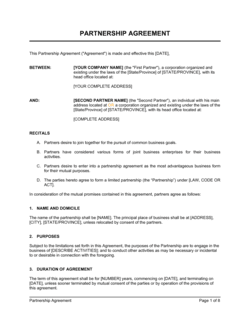
A partnership agreement creates a shared legal entity with joint liability and profit-sharing between the parties. A distribution agreement keeps the supplier and distributor as independent commercial parties β€” no shared liability, no profit-sharing, and no joint management. Confusing the two structures leads to unintended tax and liability consequences, particularly when the arrangement involves co-investment in marketing or infrastructure.

Industry-specific considerations

Consumer Goods

Retail channel restrictions, planogram and shelf-placement obligations, and seasonal MPO adjustments aligned to promotional calendars.

Manufacturing

Incoterms for bulk shipments, warranty pass-through to end customers, spare parts stocking requirements, and authorized service center obligations.

Technology / Hardware

Authorized reseller tiers, firmware and software bundling restrictions, grey-market anti-diversion clauses, and RMA (return merchandise authorization) procedures.

Food and Beverage

Shelf-life and cold-chain handling obligations, regulatory compliance in each territory, product recall procedures, and labeling and packaging localization requirements.

Template vs pro β€” what fits your needs?

PathBest forCostTime
Use the templateDomestic appointments with straightforward territory, standard pricing, and no complex IP or sub-distribution rightsFree1–3 hours
Template + professional reviewInternational appointments, exclusive arrangements covering major markets, or agreements with significant MPO and termination exposure$300–$800 for a contracts attorney review2–5 days
Custom draftedMulti-country distribution networks, regulated product categories (medical devices, food, pharma), or deals involving sub-distribution tiers and complex IP licensing$1,500–$5,000+1–3 weeks

Glossary

Territory
The defined geographic area β€” a country, region, or set of ZIP codes β€” within which the distributor is authorized to sell the supplier's products.
Exclusivity
A contractual grant giving the distributor the sole right to sell the supplier's products within the territory, preventing the supplier from appointing competing distributors there.
Minimum Purchase Obligation (MPO)
The minimum quantity or dollar value of products the distributor must buy from the supplier within a defined period, typically annually.
Transfer Price
The price at which the supplier sells products to the distributor, distinct from the distributor's resale price to end customers.
Resale Price Maintenance (RPM)
A practice β€” often legally restricted β€” where the supplier dictates the minimum or maximum price at which the distributor may resell products.
Sell-Through Obligation
A performance requirement specifying the volume or value of products the distributor must actually sell to end customers within a period.
Sub-distributor
A third party appointed by the distributor to sell in part of the territory, subject to the supplier's approval as stated in the agreement.
Audit Right
The supplier's contractual right to inspect the distributor's books and sales records to verify compliance with reporting and purchase obligations.
Incoterms
International Chamber of Commerce standardized trade terms (e.g., FOB, CIF, DDP) that define which party bears cost and risk during product shipment.
Post-Termination Sell-Off Period
A defined window after the agreement ends during which the distributor may continue selling existing inventory before returning or destroying remaining stock.
Non-Compete
A clause preventing the distributor from selling competing products β€” those of rival brands β€” during the term of the agreement, and sometimes for a period after termination.

Part of your Business Operating System

This document is one of 3,000+ business & legal templates included in Business in a Box.

  • Fill-in-the-blanks β€” ready in minutes
  • Compatible with all office suites
  • Export to PDF and share electronically

Create your document in 3 simple steps.

From template to signed document β€” all inside one Business Operating System.
1
Download or open template

Access over 3,000+ business and legal templates for any business task, project or initiative.

2
Edit and fill in the blanks with AI

Customize your ready-made business document template and save it in the cloud.

3
Save, Share, Send, Sign

Share your files and folders with your team. Create a space of seamless collaboration.

Save time, save money, and create top-quality documents.

β˜…β˜…β˜…β˜…β˜…

"Fantastic value! I'm not sure how I'd do without it. It's worth its weight in gold and paid back for itself many times."

Managing Director Β· Mall Farm
Robert Whalley
Managing Director, Mall Farm Proprietary Limited
β˜…β˜…β˜…β˜…β˜…

"I have been using Business in a Box for years. It has been the most useful source of templates I have encountered. I recommend it to anyone."

Business Owner Β· 4+ years
Dr Michael John Freestone
Business Owner
β˜…β˜…β˜…β˜…β˜…

"It has been a life saver so many times I have lost count. Business in a Box has saved me so much time and as you know, time is money."

Owner Β· Upstate Web
David G. Moore Jr.
Owner, Upstate Web

Run your business with a system β€” not scattered tools

Stop downloading documents. Start operating with clarity. Business in a Box gives you the Business Operating System used by over 250,000 companies worldwide to structure, run, and grow their business.

Free Forever PlanΒ Β·Β No credit card required