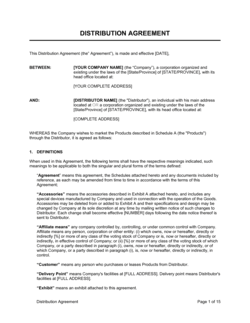
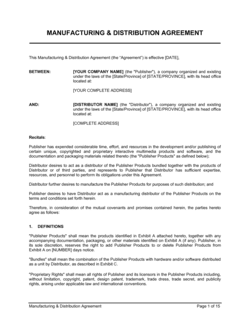
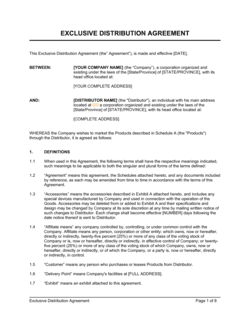
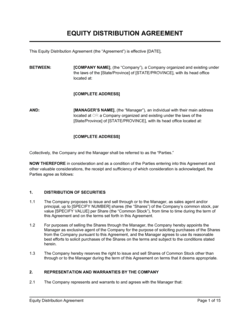
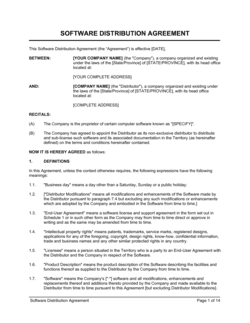
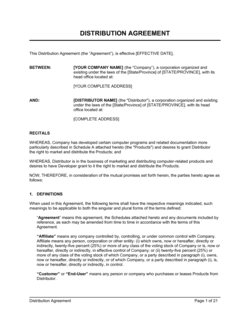
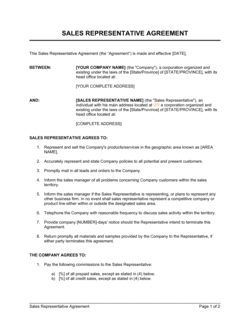
Product Distribution Agreement Template

Free Word download β€’ Edit online β€’ Save & share with Drive β€’ Export to PDF

4 pagesβ€’25–30 min to fillβ€’Difficulty: Complexβ€’Signature requiredβ€’Legal review recommended
Learn more ↓
FreeProduct Distribution Agreement Template

At a glance

What it is
A Product Distribution Agreement is a legally binding contract between a manufacturer or supplier and a distributor that governs how the distributor is authorized to market, sell, and deliver the supplier's products within a defined territory. This free Word download lets you set exclusivity terms, pricing, minimum purchase volumes, IP usage, and termination conditions in a single document you can edit online and export as PDF.
When you need it
Use it when appointing a new distributor for a defined region or channel, converting an informal reseller relationship into a formal arrangement, or replacing a handshake deal that has outgrown its original terms.
What's inside
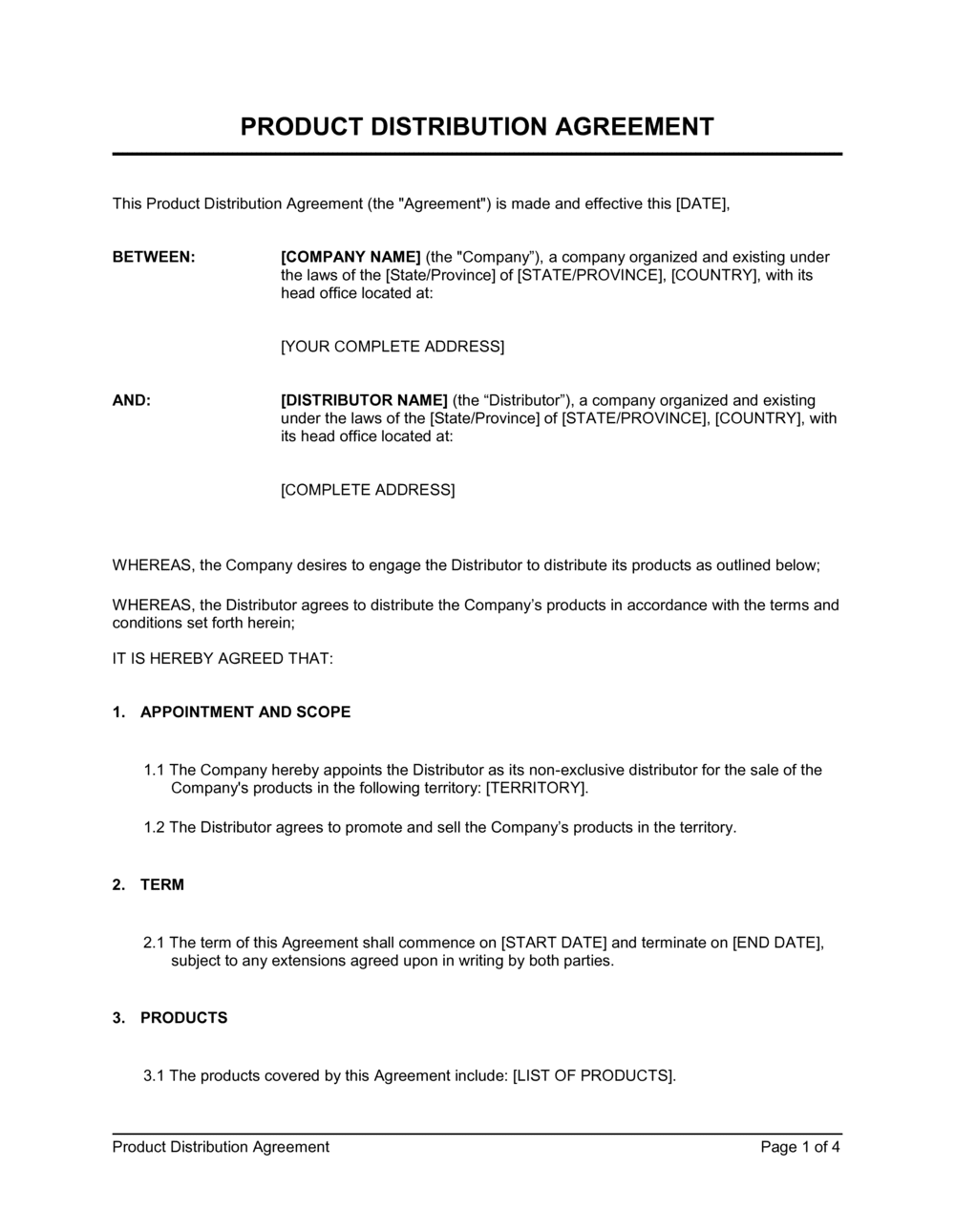
Appointment and territory clause, exclusivity terms, product and pricing schedule, minimum purchase requirements, IP and trademark license, confidentiality obligations, term and termination conditions, and governing law β€” structured across 10 core clauses in a ready-to-execute document.

What is a Product Distribution Agreement?

A Product Distribution Agreement is a legally binding contract between a manufacturer or supplier and a distributor that authorizes the distributor to market, sell, and deliver the supplier's products within a defined territory under agreed commercial terms. It establishes whether the appointment is exclusive or non-exclusive, sets the transfer price and minimum purchase volumes, licenses the supplier's trademarks for local marketing, and defines what happens when the relationship ends β€” covering inventory repurchase, IP cessation, and outstanding payment obligations. Unlike a casual purchase order relationship, a distribution agreement creates mutual, enforceable obligations that govern the entire commercial channel arrangement for its full term.

Why You Need This Document

Operating a distribution channel without a written agreement exposes both sides to serious commercial and legal risk. Without clearly defined territory and exclusivity terms, channel conflict erupts the moment the supplier signs a second partner in an adjacent region β€” or when the distributor opens an e-commerce site that reaches customers the supplier serves directly. Without a minimum purchase commitment, an exclusive distributor can sit on territorial rights indefinitely, blocking market entry while delivering no sales. Without an IP clause, distributors in some jurisdictions have registered suppliers' own trademarks locally and demanded compensation to relinquish them. And without a post-termination provision, a terminated distributor holding thousands of dollars of branded inventory has no legal basis to demand repurchase. A signed Product Distribution Agreement, executed before the first order ships, closes all of these gaps and gives both parties a clear framework for building β€” and, if necessary, ending β€” a productive commercial relationship.

Which variant fits your situation?

If your situation is…Use this template
Granting a single distributor the sole right to sell in a territoryExclusive Distribution Agreement
Appointing multiple distributors in the same regionNon-Exclusive Distribution Agreement
Distributing through an agent who earns commission rather than buying stockSales Agency Agreement
Reselling software or digital products under a vendor's brandSoftware Reseller Agreement
Selling to a retailer who takes ownership of goods at a fixed priceWholesale Agreement
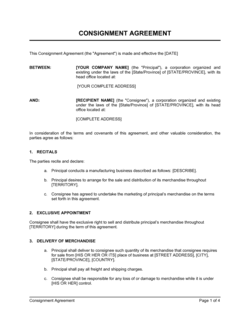
Supplier retaining ownership of goods until sold by the distributorConsignment Agreement
Appointing a master distributor who sub-appoints regional resellersMaster Distribution Agreement

Common mistakes to avoid

❌ Vague or missing territory definition

Why it matters: Without a clearly bounded territory, distributors claim rights over accounts the supplier intended to retain, leading to channel conflict and margin disputes that escalate quickly.

Fix: List every included country, state, or channel explicitly. Attach a map or account list as a Schedule if the territory is complex.

❌ No minimum purchase commitment

Why it matters: A distributor with an exclusive territory and no MPC can sit on the rights indefinitely, blocking the supplier from appointing anyone more active without triggering a breach claim.

Fix: Include an annual MPC with a ramp schedule for the first year and an explicit right to convert to non-exclusive or terminate on shortfall.

❌ No IP trademark protection clause

Why it matters: In some jurisdictions β€” particularly in Asia and Latin America β€” a distributor who registers the supplier's trademark locally can block the supplier from using its own brand in that country.

Fix: Include an explicit prohibition on local trademark registration by the distributor and an obligation to cooperate with the supplier's own registration efforts.

❌ Unrestricted change-of-control scenario

Why it matters: If the distributor is acquired by a competitor or a private equity firm with conflicting portfolio interests, the supplier may be locked into an exclusivity arrangement that actively harms its market position.

Fix: Add a change-of-control clause giving the supplier the right to terminate or renegotiate on [30–60] days' notice following any acquisition or material ownership change.

❌ No supplier inventory repurchase obligation on termination

Why it matters: Distributors required to hold safety stock as a contract obligation who are then terminated without a repurchase right are left holding unsellable branded inventory with no legal remedy.

Fix: Include a post-termination repurchase obligation at the distributor's original transfer price for all inventory purchased within the last [90] days of the agreement.

❌ Choosing governing law with no connection to either party's jurisdiction

Why it matters: Courts in the distributor's home country routinely apply local distribution-protection statutes regardless of a foreign governing-law clause β€” particularly in EU member states and in Latin American civil-law countries.

Fix: Choose the governing law of the supplier's or distributor's actual place of business, and have local counsel confirm that the chosen law will be recognized by courts in the distributor's jurisdiction.

The 10 key clauses, explained

Appointment and territory

In plain language: Identifies the distributor, defines the geographic territory or sales channel, states whether the appointment is exclusive or non-exclusive, and lists any supplier carve-outs for direct sales.

Sample language
[SUPPLIER NAME] hereby appoints [DISTRIBUTOR NAME] as its [exclusive / non-exclusive] distributor for the Products in [TERRITORY], commencing [START DATE]. Supplier reserves the right to sell directly to [CARVE-OUT ACCOUNTS] within the Territory.

Common mistake: Defining territory vaguely as 'North America' without specifying whether Canada and Mexico are included. Ambiguous territory boundaries trigger disputes the moment the distributor finds a large account near a border.

Products and pricing schedule

In plain language: Lists the authorized products by SKU or category, sets the transfer price or pricing formula, and establishes how price changes are communicated and when they take effect.

Sample language
The Products authorized under this Agreement are set out in Schedule A. Supplier shall sell Products to Distributor at the prices listed in Schedule B, subject to revision on [30 / 60] days' written notice. Distributor may set its own resale prices.

Common mistake: Omitting a notice period for price changes. Without one, suppliers can raise transfer prices effective immediately, wiping out distributor margins on already-committed orders.

Minimum purchase commitments

In plain language: Sets the volume or dollar value the distributor must purchase each year (or quarter) to retain its distribution rights, and states the consequence of failing to meet the commitment.

Sample language
Distributor shall purchase a minimum of [QUANTITY / $VALUE] of Products during each calendar year ('Annual Minimum'). Failure to meet the Annual Minimum entitles Supplier to convert the appointment to non-exclusive or terminate on [30] days' notice.

Common mistake: Setting the MPC at a level the distributor cannot realistically meet in the first year. An unachievable MPC functions as a disguised termination right, damaging the relationship before it starts.

Intellectual property license

In plain language: Grants the distributor a limited, non-transferable license to use the supplier's trademarks, logos, and product materials solely to market and sell the authorized products β€” and prohibits sub-licensing.

Sample language
Supplier grants Distributor a limited, non-exclusive, non-transferable license to use Supplier's Marks solely in connection with the distribution and marketing of the Products in the Territory. Distributor shall not modify, sublicense, or register any Mark without prior written consent.

Common mistake: No restriction on the distributor registering the supplier's trademark in the local territory. In some countries, a distributor can register a foreign brand locally and hold the supplier hostage on renewal.

Confidentiality

In plain language: Prohibits both parties from disclosing or using each other's confidential business information β€” pricing, customer lists, product roadmaps β€” for any purpose outside the agreement.

Sample language
Each party agrees to hold the other's Confidential Information in strict confidence and not to disclose or use it for any purpose outside this Agreement. This obligation survives termination for [3] years.

Common mistake: One-sided confidentiality that only binds the distributor. Suppliers share pricing models and strategic plans with distributors β€” an asymmetric clause leaves supplier information unprotected if the relationship sours.

Obligations of the distributor

In plain language: States what the distributor must actively do: maintain a sales team, hold inventory, meet reporting requirements, obtain local licenses, and not sell competing products (if a non-compete is included).

Sample language
Distributor shall: (a) employ a dedicated sales force of no fewer than [NUMBER] representatives; (b) maintain [MONTHS] of safety stock; (c) submit monthly sales reports by the [5th] of each month; and (d) not distribute Competing Products during the Term without Supplier's written consent.

Common mistake: No active promotion obligation. A passive distributor who holds exclusivity without selling is worse than no distributor β€” and without a diligent-efforts clause, the supplier has no contractual remedy.

Term and renewal

In plain language: Sets the initial contract period, states whether the agreement auto-renews, and defines the notice period required to prevent renewal or trigger renegotiation.

Sample language
This Agreement shall have an initial term of [2] years from the Effective Date and shall automatically renew for successive [1]-year terms unless either party provides [90] days' written notice of non-renewal before the end of the then-current term.

Common mistake: Short auto-renewal notice windows β€” 30 days or less. Distributors routinely miss short notice windows and find themselves locked in for another full year on unfavorable terms.

Termination for cause and convenience

In plain language: Lists the specific events that allow either party to terminate immediately for cause (material breach, insolvency, change of control) and states the notice period for termination without cause.

Sample language
Either party may terminate this Agreement immediately on written notice if the other party: (a) commits a material breach not cured within [30] days of notice; (b) becomes insolvent; or (c) undergoes a Change of Control. Either party may terminate without cause on [90] days' written notice.

Common mistake: No cure period for material breach. Immediate termination without a cure window is enforceable but destroys relationships over fixable problems β€” a 15–30 day cure period is standard and commercially sensible.

Post-termination obligations

In plain language: Covers the sell-off period for existing inventory, return of supplier materials, cessation of IP use, outstanding payment obligations, and survival of confidentiality and non-compete clauses.

Sample language
Following termination, Distributor shall have [90] days to sell existing inventory ('Sell-Off Period'). After the Sell-Off Period, Distributor shall cease using Supplier's Marks, return all Confidential Information, and pay all outstanding invoices within [30] days.

Common mistake: No inventory repurchase obligation on the supplier. Distributors ordered to hold safety stock and then terminated without a repurchase clause are left with unsellable branded goods and no recourse.

Governing law, dispute resolution, and indemnification

In plain language: Specifies which jurisdiction's law governs the contract, how disputes are resolved (arbitration, mediation, or litigation), and which party bears product liability and IP infringement claims.

Sample language
This Agreement is governed by the laws of [STATE / COUNTRY]. Disputes shall be resolved by [binding arbitration / litigation] in [CITY / VENUE]. Supplier shall indemnify Distributor against third-party claims arising from product defects. Distributor shall indemnify Supplier against claims arising from Distributor's marketing activities.

Common mistake: Choosing a governing law that has no connection to either party's place of business. Courts in the distributor's jurisdiction may override the chosen law anyway β€” especially in the EU and Latin America where distribution-specific statutes protect local distributors.

How to fill it out

  1. 1

    Identify both parties and the effective date

    Enter the supplier's and distributor's full legal entity names, registered addresses, and the date the agreement takes effect. Confirm entity types (LLC, corporation, partnership) match corporate registry records.

    πŸ’‘ Use the exact registered name β€” not a trade name β€” to ensure enforceability of the IP license and non-compete clauses against the correct legal entity.

  2. 2

    Define the territory precisely

    Name every country, state, province, or sales channel included. If the territory is a sales channel rather than a geography (e.g., e-commerce only), describe it by channel type and platform scope.

    πŸ’‘ If internet sales are not explicitly addressed, a territorial restriction may be unenforceable for online orders β€” add a specific e-commerce clause.

  3. 3

    Choose exclusivity and document any carve-outs

    Decide whether the appointment is exclusive, sole (exclusive to distributor but supplier may sell direct), or non-exclusive. List any specific accounts, channels, or customer categories the supplier reserves for direct sales.

    πŸ’‘ House accounts β€” major customers the supplier already manages directly β€” should be listed by name in a Schedule to avoid disputes on day one.

  4. 4

    Complete Schedule A (products) and Schedule B (pricing)

    List every authorized SKU or product category in Schedule A. Enter current transfer prices in Schedule B with the price-change notice period and any volume discount tiers.

    πŸ’‘ Tie Schedule A to a product code or SKU list rather than a description β€” product names change; codes don't.

  5. 5

    Set the minimum purchase commitment and consequences

    Enter the annual MPC in dollars or units and state clearly what happens on shortfall: conversion to non-exclusive, right to appoint additional distributors, or termination on notice.

    πŸ’‘ Set the first-year MPC at 60–70% of the distributor's own forecast to allow a ramp period β€” escalate in Years 2 and 3 as the relationship matures.

  6. 6

    Configure term, renewal, and termination provisions

    Set the initial term length, auto-renewal cadence, and the notice windows for non-renewal and termination without cause. Add specific cause-based termination triggers relevant to your industry.

    πŸ’‘ 90 days is the minimum commercially reasonable notice period for termination without cause where the distributor has invested in warehousing or staffing β€” 180 days is common for established arrangements.

  7. 7

    Address post-termination inventory and IP

    Specify the sell-off period length, whether the supplier is obligated to repurchase unsold stock and at what price, and the exact date by which the distributor must cease using all supplier IP.

    πŸ’‘ A supplier repurchase obligation at cost (not transfer price) is a fair standard β€” it protects the distributor while limiting the supplier's buyback liability.

  8. 8

    Sign before the distributor places its first order

    Both authorized signatories must execute the agreement β€” including all Schedules β€” before any product is shipped or payment is made. Unsigned agreements leave IP licenses and non-compete clauses legally unenforceable.

    πŸ’‘ Use a dated signature block with printed names and titles alongside signatures to prevent disputes about signing authority.

Frequently asked questions

What is a product distribution agreement?

A product distribution agreement is a legally binding contract between a supplier or manufacturer and a distributor that authorizes the distributor to market, sell, and deliver the supplier's products within a defined territory. It sets out exclusivity terms, pricing, minimum purchase volumes, IP usage rights, and what happens when the relationship ends. Without this agreement, distribution relationships rely on informal understandings that are difficult to enforce if a dispute arises.

What is the difference between an exclusive and non-exclusive distribution agreement?

In an exclusive distribution agreement, the supplier agrees not to appoint any other distributor β€” and typically not to sell directly β€” within the defined territory. In a non-exclusive agreement, the supplier retains the right to appoint additional distributors or sell directly in the same area. Exclusive arrangements typically carry higher minimum purchase commitments because the distributor is bearing the full market-development cost.

Does a distribution agreement need to be in writing?

In most jurisdictions, distribution arrangements can technically be formed orally, but a written agreement is essential for enforcing exclusivity, minimum purchase commitments, IP restrictions, non-compete clauses, and post-termination obligations. Oral arrangements also fail to meet the evidentiary requirements for arbitration or court proceedings. Executing a written agreement before the first order is best practice regardless of how well the parties know each other.

How long should a distribution agreement last?

Initial terms of one to three years are most common, with automatic annual renewal unless either party gives 90 days' notice. Shorter terms β€” six to twelve months β€” are appropriate for pilot arrangements in new markets. Longer initial terms of three to five years are reasonable when the distributor is required to make substantial upfront investment in warehousing, staffing, or brand development. The term length should be proportionate to the investment the distributor is expected to make.

Can a supplier set the resale prices a distributor charges?

No. Resale price maintenance β€” fixing the minimum or exact price at which a distributor sells to end customers β€” is illegal in most jurisdictions under competition and antitrust law, including in the US, Canada, the UK, and EU member states. Suppliers can set a recommended retail price (RRP) and communicate it as a suggestion, but contractual floors on resale prices expose both parties to regulatory fines and private damages claims.

What is a minimum purchase commitment and is it enforceable?

A minimum purchase commitment (MPC) is a contractual obligation for the distributor to buy a specified volume or dollar value of products in a given period. It is generally enforceable when clearly drafted with a specific consequence for shortfall β€” such as conversion to non-exclusive status or termination on notice. Courts in most common-law jurisdictions will uphold an MPC that is commercially reasonable and was freely negotiated. An MPC that is clearly unattainable from the outset may be treated as a penalty clause and struck down.

What happens to unsold inventory when a distribution agreement is terminated?

This depends entirely on the contract. Without a post-termination provision, the distributor typically owns the inventory it purchased and must sell it within any agreed sell-off period. Best practice is to include a supplier repurchase obligation β€” at the distributor's original transfer price β€” for stock purchased within a defined window before termination, and a specific end date after which the distributor must stop using all supplier IP, even on remaining stock.

Is a distribution agreement the same as a sales agency agreement?

No. A distributor buys products outright, takes on inventory risk, and resells in its own name at its own prices. A sales agent solicits orders on behalf of the supplier and earns a commission β€” the supplier remains the contracting party with the end customer and retains title to goods until delivery. The distinction matters significantly for VAT and tax treatment, product liability allocation, and the application of commercial agent protection statutes in the EU and UK.

Do I need a lawyer to draft a distribution agreement?

For straightforward domestic distribution relationships, a well-structured template reviewed by a commercial lawyer typically suffices. Legal counsel is strongly recommended when the arrangement involves international territories (where local distribution-protection laws may apply), when the distributor is required to make material upfront investments, when exclusivity covers a significant market, or when the products are regulated (food, pharmaceuticals, medical devices). A 2–4 hour template review typically costs $600–$1,200 and is a sound investment relative to the risk of a multi-year exclusive arrangement gone wrong.

How this compares to alternatives

vs Sales Agency Agreement

A sales agent solicits orders on the supplier's behalf and earns a commission β€” the supplier retains title to goods and contracts directly with end customers. A distributor purchases goods outright, bears inventory risk, and sells in its own name. The distinction determines who bears product liability, who is responsible for local VAT, and whether EU commercial agent protection statutes apply.

vs Franchise Agreement

A franchise agreement grants the franchisee the right to operate a full business model under the franchisor's brand β€” including systems, training, and ongoing support obligations β€” in exchange for royalties. A distribution agreement grants the right to resell specific products within a territory. Franchise relationships are far more operationally integrated and carry separate regulatory disclosure requirements in most jurisdictions.

vs Reseller Agreement

Reseller and distribution agreements are closely related but differ in depth. Reseller agreements are typically lighter and used for non-exclusive, lower-volume channel partnerships β€” often in software or digital products β€” with fewer obligations around minimum purchases, territory protection, or inventory. Distribution agreements carry more comprehensive exclusivity, MPC, and post-termination provisions suited to physical product channels.

vs Consignment Agreement

Under a consignment arrangement, the supplier retains ownership of goods until the distributor sells them to an end customer β€” the distributor never buys the inventory. A distribution agreement transfers title and inventory risk to the distributor on purchase. Consignment reduces the distributor's capital requirement but leaves the supplier exposed to inventory loss, damage, and the distributor's credit risk.

Industry-specific considerations

Consumer goods and FMCG

Shelf placement obligations, promotional co-op funding, retailer compliance requirements, and seasonal minimum order windows tied to product launches.

Manufacturing and industrial

Technical training obligations, spare parts stocking requirements, warranty service responsibilities, and authorized repair network provisions.

Technology hardware and electronics

Firmware update distribution protocols, authorized service center obligations, grey-market import restrictions, and product certification compliance by territory.

Food and beverage

Cold-chain handling standards, expiry date management, territory-specific import licensing, and regulatory compliance obligations for labeling and customs.

Healthcare and medical devices

Regulatory clearance as a condition precedent to sale, adverse event reporting obligations, product recall cooperation clauses, and strict IP and labeling compliance.

Professional services and B2B software

Reseller certification requirements, deal registration procedures to prevent channel conflict, margin protection on registered opportunities, and NFR (not-for-resale) license handling.

Jurisdictional notes

United States

Distribution agreements are primarily governed by state contract law and the UCC for goods. Antitrust rules under the Sherman Act prohibit resale price maintenance and certain territorial restrictions β€” exclusive dealing arrangements are reviewed under a rule-of-reason standard. Several states (including New Jersey, Wisconsin, and Arkansas) have dealer protection statutes requiring good cause for termination and a reasonable wind-down period, overriding at-will termination clauses.

Canada

Distribution agreements are governed by provincial contract and sale-of-goods law. Quebec's Civil Code imposes unique obligations, and French-language requirements apply to commercial agreements executed in Quebec. The Competition Act prohibits price maintenance and anticompetitive exclusive dealing. Some provinces have industry-specific distribution protection statutes β€” Ontario's Arthur Wishart Act covers franchise relationships but can capture certain intensive distribution arrangements.

United Kingdom

Post-Brexit, the UK's Competition and Markets Authority has issued its own Vertical Agreements Block Exemption (VABEO), diverging slightly from the EU regime. Exclusive territorial restrictions are permitted within limits. Commercial agent protection regulations (SI 1993/3053) apply when a distributor is structured functionally as an agent β€” the distinction matters for termination compensation rights. Governing-law clauses choosing English law are broadly respected in UK courts.

European Union

The EU Vertical Block Exemption Regulation (VBER 2022) permits exclusive distribution provided neither party holds more than 30% market share in the relevant market. Active sales restrictions into exclusive territories are permitted; passive sales restrictions to end consumers are generally prohibited. Several member states β€” including Germany, Belgium, and France β€” have mandatory local distribution protection laws requiring compensation on termination, which apply regardless of the chosen governing law.

Template vs lawyer β€” what fits your deal?

PathBest forCostTime
Use the templateDomestic distribution arrangements with a single, known partner in a non-regulated product categoryFree30–60 minutes
Template + legal reviewExclusive arrangements, cross-border distribution, or products subject to import licensing or safety regulations$600–$1,200 (2–4 hour commercial lawyer review)3–5 business days
Custom draftedMulti-territory exclusive networks, regulated industries (medical devices, food, pharmaceuticals), or arrangements involving material distributor investment$2,500–$8,000+2–4 weeks

Glossary

Exclusive Distribution
An arrangement in which the supplier agrees not to appoint any other distributor β€” or sell directly β€” within the defined territory for the contract term.
Territory
The specific geographic area or sales channel within which the distributor is authorized to market and sell the supplier's products.
Minimum Purchase Commitment (MPC)
A contractual floor on the value or volume of product the distributor must purchase in a given period, typically annually, to retain distribution rights.
Transfer Price
The price at which the supplier sells products to the distributor β€” distinct from the end-customer resale price, which the distributor typically sets independently.
Resale Price Maintenance (RPM)
A supplier's attempt to fix the price at which a distributor resells products β€” illegal in most jurisdictions and a significant antitrust risk.
Sell-Off Period
A defined window after termination during which the distributor is permitted to sell existing inventory purchased before the agreement ended.
Territorial Exclusivity Carve-Out
A specific customer, channel, or account category reserved for direct sale by the supplier even within an otherwise exclusive territory.
Intellectual Property License
The limited, revocable right granted to the distributor to use the supplier's trademarks, trade names, and product images solely for authorized distribution activities.
Indemnification
A clause requiring one party to compensate the other for losses, claims, or damages arising from a defined event β€” typically a product liability claim or IP infringement.
Change of Control
A provision allowing the supplier to terminate or renegotiate the agreement if the distributor is acquired, merged, or undergoes a material ownership change.
Force Majeure
A clause excusing either party from performance obligations caused by events outside their reasonable control, such as natural disasters, war, or government restrictions.

Part of your Business Operating System

This document is one of 3,000+ business & legal templates included in Business in a Box.

  • Fill-in-the-blanks β€” ready in minutes
  • 100% customizable Word document
  • Compatible with all office suites
  • Export to PDF and share electronically

Create your document in 3 simple steps.

From template to signed document β€” all inside one Business Operating System.
1
Download or open template

Access over 3,000+ business and legal templates for any business task, project or initiative.

2
Edit and fill in the blanks with AI

Customize your ready-made business document template and save it in the cloud.

3
Save, Share, Send, Sign

Share your files and folders with your team. Create a space of seamless collaboration.

Save time, save money, and create top-quality documents.

β˜…β˜…β˜…β˜…β˜…

"Fantastic value! I'm not sure how I'd do without it. It's worth its weight in gold and paid back for itself many times."

Managing Director Β· Mall Farm
Robert Whalley
Managing Director, Mall Farm Proprietary Limited
β˜…β˜…β˜…β˜…β˜…

"I have been using Business in a Box for years. It has been the most useful source of templates I have encountered. I recommend it to anyone."

Business Owner Β· 4+ years
Dr Michael John Freestone
Business Owner
β˜…β˜…β˜…β˜…β˜…

"It has been a life saver so many times I have lost count. Business in a Box has saved me so much time and as you know, time is money."

Owner Β· Upstate Web
David G. Moore Jr.
Owner, Upstate Web

Run your business with a system β€” not scattered tools

Stop downloading documents. Start operating with clarity. Business in a Box gives you the Business Operating System used by over 250,000 companies worldwide to structure, run, and grow their business.

Free Forever PlanΒ Β·Β No credit card required