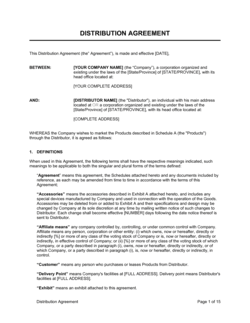
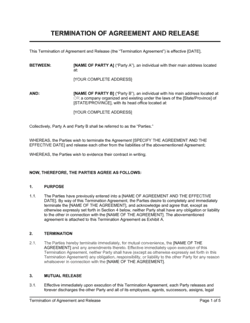
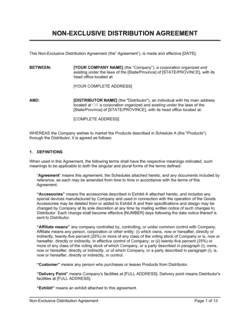
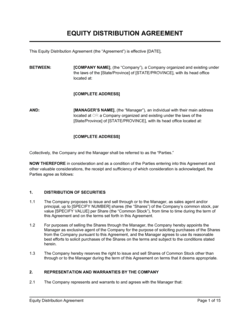
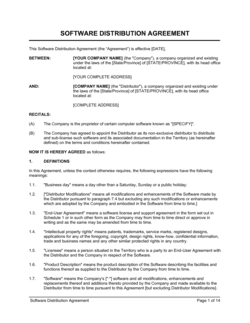
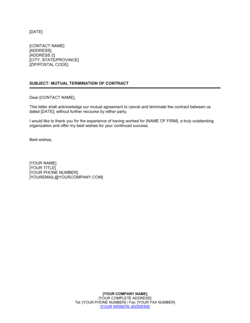
Termination of Distribution Agreement Template

Free Word download • Edit online • Save & share with Drive • Export to PDF

1 page20–30 min to fillDifficulty: StandardSignature requiredLegal review recommended
Learn more ↓
FreeTermination of Distribution Agreement Template

At a glance

What it is
A Termination of Distribution Agreement is a legally binding document that formally ends an existing distribution arrangement between a supplier and a distributor, specifying exactly how the relationship winds down. This free Word download covers inventory return or sell-off, customer account transition, post-termination restrictions, final payment reconciliation, and mutual releases — so both parties exit the relationship with clear obligations and no residual exposure.
When you need it
Use it when either party has decided to end an active distribution relationship — whether by mutual consent, expiry without renewal, or breach-triggered termination — and both sides need documented confirmation of how obligations are resolved and the relationship concluded.
What's inside
Termination date and grounds, inventory wind-down procedure, customer and account transition obligations, settlement of outstanding purchase orders and payments, post-termination non-compete and confidentiality restrictions, return of proprietary materials, and a mutual release of claims.

What is a Termination of Distribution Agreement?

A Termination of Distribution Agreement is a legally binding document that formally ends an existing distribution contract between a supplier and a distributor, replacing the original agreement's general termination clause with a precise, negotiated record of how every outstanding obligation is resolved. It covers the sell-off or return of unsold inventory, the transfer of customer accounts and data back to the supplier, reconciliation and payment of all outstanding invoices, rebates, and marketing funds, return or certified destruction of proprietary materials, and post-termination restrictions that prevent the distributor from immediately competing in the same territory. A properly executed termination agreement also includes a mutual release of claims, giving both parties legal certainty that the relationship is closed.

Why You Need This Document

Ending a distribution relationship on a handshake — or relying on an email exchange — leaves both parties exposed to claims that can surface months or years after the last product shipment. Without a written termination agreement, disputes over who owns residual inventory, what customer data must be transferred, and whether a rebate shortfall can still be recovered are resolved by litigation rather than contract. For the supplier, an undocumented termination risks a former distributor continuing to use your brand assets, sell to your customers, and retain confidential pricing — with no enforceable obligation to stop. For the distributor, it risks being held liable for post-termination obligations that were never formally extinguished. This template gives both parties a clear, signed record of the wind-down terms, a mutual release that closes outstanding claims, and post-termination restrictions calibrated to what courts in your jurisdiction will enforce — so the relationship ends cleanly and both sides can move forward.

Which variant fits your situation?

If your situation is…Use this template
Both parties agree to end the agreement without a disputeMutual Termination of Distribution Agreement
Supplier terminating for distributor's material breach or non-performanceTermination for Cause Letter (Distribution)
Ending an exclusive distribution arrangement in a specific territoryTermination of Exclusive Distribution Agreement
Winding down a sales agency rather than a product distributorTermination of Sales Agency Agreement
Terminating the broader commercial contract that contains distribution termsTermination of Business Contract
Ending a franchise distribution arrangementTermination of Franchise Agreement
Notifying the distributor of non-renewal before the agreement lapsesNotice of Non-Renewal of Contract

Common mistakes to avoid

❌ Signing the termination agreement after the termination date

Why it matters: A termination agreement signed after the stated termination date creates a gap during which neither the original agreement nor the termination agreement clearly governs obligations — leaving both parties exposed to claims for actions taken in that interval.

Fix: Execute the agreement on or before the termination date. If execution is delayed, amend the termination date to match the actual signature date.

❌ Granting a mutual release before finalizing the financial settlement

Why it matters: An unconditional release extinguishes the right to recover any underpayments, rebate shortfalls, or chargeback credits discovered during the final account reconciliation — even if the shortfall is discovered the day after signing.

Fix: Make the mutual release conditional on completion of the final account statement, or carve out financial claims explicitly from the scope of the release.

❌ No written confirmation of proprietary materials destruction

Why it matters: Without a written certificate, a supplier has no evidence if the distributor later uses confidential pricing, customer lists, or product specifications to support a competing product line.

Fix: Require a signed written certification of destruction or return for all proprietary materials within a specific deadline — 10 business days is standard.

❌ Omitting the customer data handover specification

Why it matters: Receiving an incomplete or incorrectly formatted customer list weeks after termination delays appointment of a replacement distributor, costs revenue, and often triggers customer attrition.

Fix: Specify the exact format, required data fields, and handover deadline in the agreement, and make payment of any final rebate conditional on timely delivery of the complete list.

The 10 key clauses, explained

Parties, recitals, and effective termination date

In plain language: Identifies the supplier and distributor as legal entities, references the original distribution agreement being terminated, and states the exact date the termination takes effect.

Sample language
This Termination Agreement is entered into as of [DATE] between [SUPPLIER LEGAL NAME], a [STATE/COUNTRY] [ENTITY TYPE] ('Supplier'), and [DISTRIBUTOR LEGAL NAME], a [STATE/COUNTRY] [ENTITY TYPE] ('Distributor'). The parties agree to terminate the Distribution Agreement dated [ORIGINAL AGREEMENT DATE] (the 'Agreement'), effective [TERMINATION DATE].

Common mistake: Referencing the original agreement by a colloquial name rather than its exact title and date — creating ambiguity about which agreement is being terminated if multiple agreements exist between the parties.

Wind-down and sell-off period

In plain language: Defines how long the distributor may continue selling existing inventory after the termination date, what sales are permitted, and any geographic or channel limits on those sales.

Sample language
Distributor shall have [30 / 60 / 90] days from the Termination Date (the 'Sell-Off Period') to sell existing inventory of the Products purchased prior to termination through [PERMITTED CHANNELS]. No new purchase orders shall be placed after the Termination Date.

Common mistake: Granting a sell-off period without specifying whether the distributor may discount the products — unrestricted discounting can undermine the supplier's pricing in the territory before a new distributor is appointed.

Inventory return and reconciliation

In plain language: Sets out what happens to unsold inventory at the end of the sell-off period — return to supplier, destruction, or transfer to a replacement distributor — and who bears the cost.

Sample language
At the end of the Sell-Off Period, Distributor shall return to Supplier all unsold Products in saleable condition, at Distributor's cost, to [RETURN ADDRESS]. Supplier shall credit Distributor [AMOUNT / PERCENTAGE] of the original invoice price for returned Products within [30] days of receipt and inspection.

Common mistake: Omitting the inspection and acceptance process for returned inventory — disputes about product condition routinely arise when there is no agreed standard or timeline for the supplier to reject damaged stock.

Settlement of outstanding payments

In plain language: Establishes the process for reconciling all money owed in both directions — unpaid invoices, rebates, marketing development funds, advances, and chargebacks — and sets a final settlement date.

Sample language
Within [30] days of the Termination Date, the parties shall prepare and exchange a final account statement. All undisputed amounts shall be paid within [15] days of agreement on the statement. Any disputed amounts shall be escalated pursuant to Section [X].

Common mistake: Failing to specify who prepares the final account statement and within what deadline — this creates a standoff where neither party acts and the settlement drags on for months.

Customer and account transition

In plain language: Requires the distributor to cooperate in transitioning end customers, transferring account records and contact information, and ceasing to represent the supplier to new prospects after the termination date.

Sample language
Distributor shall, within [14] days of the Termination Date, deliver to Supplier a complete and accurate list of all active customer accounts, including names, contact details, purchase history, and pending orders. Distributor shall not solicit those customers for competing products for [12] months following the Termination Date.

Common mistake: Not specifying the format and completeness standard for customer data handover — receiving a partial spreadsheet months after termination is the most common source of post-termination litigation between suppliers and distributors.

Return of proprietary materials

In plain language: Requires the distributor to return or certifiably destroy all supplier-owned materials — product literature, software, pricing schedules, trade secrets, and physical brand assets — and confirm compliance in writing.

Sample language
Within [10] business days of the Termination Date, Distributor shall return or destroy all Confidential Information, marketing materials, product samples, and any other Supplier-owned property in Distributor's possession, and provide written certification of destruction where return is not practicable.

Common mistake: Accepting an oral or informal confirmation of destruction. Without a written certificate, the supplier has no evidence for any later claim that the distributor used proprietary pricing or customer data after termination.

Post-termination non-compete and non-solicitation

In plain language: Restricts the distributor from selling competing products in the supplier's territory and from poaching the supplier's direct customers or employees for a defined post-termination period.

Sample language
For [12] months following the Termination Date, Distributor shall not (a) distribute, market, or sell any Competing Products within [TERRITORY], or (b) directly or indirectly solicit any customer introduced to Distributor by Supplier for the purpose of selling Competing Products.

Common mistake: Using a definition of 'Competing Products' that is too narrow — limited to identical SKUs rather than functionally substitutable goods — allowing the distributor to immediately begin selling near-identical alternatives.

Mutual release of claims

In plain language: Both parties release each other from all claims, liabilities, and obligations arising from the original distribution agreement, up to the termination date, other than obligations that survive termination.

Sample language
Each party hereby releases and forever discharges the other party from any and all claims, demands, and liabilities arising out of or relating to the Agreement prior to the Termination Date, except for obligations expressly stated to survive under this Termination Agreement.

Common mistake: Making the release unconditional before the final account statement is settled — releasing claims before payments are reconciled extinguishes the right to recover any shortfall discovered later.

Survival of obligations

In plain language: Identifies which provisions of the original distribution agreement and this termination agreement remain in force after the termination date — typically confidentiality, indemnification, governing law, and dispute resolution.

Sample language
The following provisions of the Agreement shall survive termination: Confidentiality (Section [X]), Indemnification (Section [X]), Limitation of Liability (Section [X]), and Governing Law (Section [X]). The non-compete and non-solicitation restrictions set forth in Section [X] of this Termination Agreement shall survive for the periods stated therein.

Common mistake: Failing to carry over the original indemnification clause — if the distributor made a misrepresentation to a customer before termination and a claim arises later, the supplier needs the contractual right to require the distributor to defend and indemnify.

Governing law, dispute resolution, and entire agreement

In plain language: States which jurisdiction's law governs the termination agreement, how disputes will be resolved, and confirms this document supersedes all prior negotiations about the termination.

Sample language
This Termination Agreement is governed by the laws of [STATE/PROVINCE/COUNTRY]. Any dispute shall be resolved by [binding arbitration / litigation] in [VENUE]. This Agreement constitutes the entire agreement of the parties with respect to the subject matter hereof and supersedes all prior discussions and correspondence.

Common mistake: Defaulting to the governing law of the original distribution agreement without checking whether that jurisdiction has changed its commercial arbitration or non-compete rules since the original agreement was signed.

How to fill it out

  1. 1

    Identify both parties and reference the original agreement precisely

    Enter each party's full registered legal name, entity type, and jurisdiction of incorporation. Cite the original distribution agreement by its exact title, date, and any amendment numbers so there is no ambiguity about which contract is being terminated.

    💡 Pull the legal name from the original agreement's signature block — not letterhead — to ensure an exact match.

  2. 2

    Set the termination date and notice period

    Specify the effective termination date as a calendar date. If the original agreement requires advance notice, confirm notice was properly given and reference the notice date in the recitals.

    💡 Check the original agreement's termination clause for minimum notice periods before setting the date — many distribution agreements require 90 to 180 days.

  3. 3

    Define the sell-off period and permitted sales

    Decide on a sell-off window — typically 30, 60, or 90 days from the termination date — and specify exactly which channels and geographies the distributor may use, whether discounting is permitted, and the maximum discount allowed.

    💡 Cap any sell-off discount at the distributor's standard trade terms to protect your pricing in the territory before a new distributor is in place.

  4. 4

    Agree on inventory return terms

    Specify who bears return freight costs, the condition standard for accepted returns (e.g., original sealed packaging), the credit percentage or formula for accepted stock, and the inspection timeline within which the supplier must notify the distributor of any rejection.

    💡 Conduct a physical inventory count together before finalizing the return clause — a joint count prevents disputes about quantity at the time of actual return.

  5. 5

    Prepare and attach the final account statement

    List every open invoice, rebate, marketing development fund balance, advance, and chargeback in both directions. Agree on the net balance and payment timeline before both parties sign. Attach the statement as a schedule to the agreement.

    💡 Settle undisputed amounts immediately and ring-fence disputed line items in a separate schedule — this unblocks the relationship wind-down while specific items are resolved.

  6. 6

    Specify customer data handover requirements

    Define the format (e.g., Excel, CRM export), fields required (name, address, contact, purchase history, pending orders), and the deadline for delivery. State what the distributor may and may not do with that data after handover.

    💡 Request the customer list in your CRM's import format specifically — reformatting thousands of records is time-consuming and introduces errors.

  7. 7

    Confirm post-termination restrictions and survival clauses

    Calibrate the non-compete duration and scope to match what is enforceable in the distributor's jurisdiction. List every clause from the original agreement that survives termination — particularly confidentiality, indemnification, and limitation of liability.

    💡 In EU member states, post-termination non-competes for commercial agents typically require additional compensation — check whether your distributor qualifies as a commercial agent under local law before inserting a non-compete.

  8. 8

    Execute and countersign before the termination date

    Both parties must sign the termination agreement before the effective termination date. Use dated signature blocks for each signatory and confirm each party has authority to bind the entity.

    💡 Send the final signed PDF to both parties' legal and finance teams on the same day — ensuring records match is far easier when distribution is simultaneous.

Frequently asked questions

What is a termination of distribution agreement?

A termination of distribution agreement is a legally binding document that formally ends an existing distribution contract between a supplier and a distributor. It defines how the parties wind down their obligations — including inventory disposal, customer account transition, final payment settlement, return of proprietary materials, and post-termination restrictions — so both sides exit cleanly without residual legal exposure.

Do I need a separate termination agreement if the original distribution contract has a termination clause?

Yes, in most cases. A termination clause in the original agreement typically sets out notice requirements and general consequences — it does not resolve the specific operational details of the wind-down: how much inventory exists, what the final account balance is, what customer data must be transferred, and what each party releases the other from. A separate termination agreement documents those specifics and provides a mutual release that closes out the relationship definitively.

Can a distribution agreement be terminated for cause?

Yes. Most distribution agreements allow termination for cause — typically defined as material breach, insolvency, failure to meet minimum purchase obligations, or unauthorized use of trademarks. Termination for cause generally requires written notice specifying the breach and a cure period (commonly 30 days). A termination agreement for-cause should reference the specific breach and confirm whether the mutual release applies or is excluded where the breach gives rise to damages claims.

What happens to unsold inventory when a distribution agreement is terminated?

The original distribution agreement typically sets out the baseline rule — return, sell-off, or destruction. A termination agreement formalizes the specific mechanics: the sell-off window (commonly 30 to 90 days), any discount limits during that period, the return credit percentage for unsold stock at the end of the window, and who bears freight and inspection costs. Without agreed terms, disputes over inventory value are among the most common post-termination claims.

How long should a sell-off period be after terminating a distribution agreement?

Thirty to ninety days is the standard range. The right length depends on the distributor's typical inventory levels, the product's shelf life or obsolescence risk, and how quickly the supplier needs to appoint a replacement distributor. Perishable or fast-moving goods typically warrant 30 days; complex capital equipment with long sales cycles may justify 90. Longer sell-off periods risk pricing disruption in the territory, especially if the distributor discounts aggressively.

What post-termination restrictions can a supplier include?

Suppliers commonly include a non-compete restricting the distributor from selling competing products in the territory for 6 to 12 months, a non-solicitation clause preventing the distributor from targeting supplier customers for competing offerings, and a continuing confidentiality obligation covering pricing, customer data, and trade secrets. Enforceability depends on jurisdiction — EU commercial agency law, California competition rules, and UK restraint-of-trade principles all impose different limits. Consider legal review before relying on these clauses in cross-border arrangements.

Is a mutual release required in a termination of distribution agreement?

A mutual release is not legally required but is strongly recommended when the termination is by mutual consent and there are no live disputes. It provides both parties with certainty that past claims under the distribution agreement are extinguished and prevents either side from reopening issues months or years later. Make the release conditional on completion of the financial settlement to avoid inadvertently waiving undiscovered payment shortfalls.

What customer data must the distributor hand over at termination?

At minimum: names and contact details for all active customers and prospects introduced by the supplier, purchase history for the preceding 24 months, details of any pending orders or warranty claims, and login credentials for any supplier-branded customer portals. The format should be agreed in the termination agreement — typically a structured data export compatible with the supplier's CRM — and the handover deadline should be 10 to 14 days after the termination date.

Do I need a lawyer to draft a termination of distribution agreement?

For straightforward domestic terminations by mutual consent, a high-quality template is typically sufficient. Legal review is advisable when the original agreement involves a significant territory, material inventory levels, or complex rebate and payment structures; when the termination is contested or for cause; or when the distributor operates in a jurisdiction with strong commercial-agency or distribution-law protections (EU member states, Quebec, and several Latin American countries). A one-to-two hour legal review typically costs $300 to $600 and is worthwhile for any termination with financial exposure above $50,000.

Which clauses from the original distribution agreement survive termination?

Typically: confidentiality and non-disclosure obligations, indemnification and product liability provisions, limitation of liability, intellectual property ownership, governing law and dispute resolution, and any post-termination non-compete or non-solicitation restrictions added by the termination agreement. The termination agreement should list each surviving clause by section number from the original agreement to avoid any ambiguity about what remains in force.

How this compares to alternatives

vs Termination of Business Contract Agreement

A general contract termination agreement ends any commercial contract between two parties and is not specific to distribution. A termination of distribution agreement adds provisions unique to distribution relationships — inventory sell-off, territory hand-back, customer transition, and post-termination restrictions on competing products. Use the distribution-specific template when product inventory, territorial exclusivity, or customer account ownership is involved.

vs Distribution Agreement

A distribution agreement establishes the relationship — territory, product line, pricing, and minimum purchase obligations. A termination agreement ends it. The two documents should be read together: the original agreement sets out the baseline termination notice requirements, and the termination agreement resolves the specific wind-down obligations that the original agreement leaves to the parties to negotiate at the time.

vs Mutual Termination Agreement

A mutual termination agreement is a generic document suitable for ending any contract by consent. It lacks the distribution-specific provisions covering inventory reconciliation, sell-off periods, territory transition, and customer data handover. Use the mutual termination template only when the distribution relationship has no residual inventory, customer accounts, or territory exclusivity to manage.

vs Cease and Desist Letter

A cease and desist letter demands that a party stop a specific activity — such as unauthorized use of a trademark or continued sales outside the permitted territory — without formally terminating the underlying agreement. A termination of distribution agreement is the appropriate document when the relationship is ending entirely, not merely when one provision is being enforced. A cease and desist may precede a termination if the distributor has breached the agreement and refuses to cure.

Industry-specific considerations

Consumer goods and FMCG

Short sell-off periods (30 days) are standard due to shelf-life constraints; inventory reconciliation must account for expiry-dated stock and retailer delistings.

Technology and electronics

Software licence deactivation and hardware return logistics require separate schedules; end-of-life firmware support obligations must be addressed in the survival clause.

Manufacturing and industrial equipment

Long sell-off windows (60 to 90 days) reflect complex capital sales cycles; spare parts inventory, warranty obligations, and service contract transfers require specific treatment.

Pharmaceutical and life sciences

Regulatory transfer requirements — including product registrations, import licences, and pharmacovigilance obligations — must be addressed before the termination date and often require regulator notification.

Food and beverage

Perishable inventory requires an accelerated reconciliation timeline; private-label packaging destruction must be certified to prevent unauthorized continued use of brand identity.

Professional services and licensing

IP licence revocation, return of branded collateral, and cessation of sub-licensing rights to downstream customers must each be tracked with specific deadlines and certification obligations.

Jurisdictional notes

United States

US distribution law is primarily state-governed. Several states — including New Jersey, Wisconsin, and California — have franchise or dealer protection statutes that impose mandatory notice periods and, in some cases, require good cause for termination regardless of what the contract says. Non-compete enforceability varies sharply by state; California bans most post-termination restrictions. Review the distributor's home state law before relying on non-compete or automatic termination provisions.

Canada

Canadian provinces do not have the same dealer-protection statutes as some US states, but common-law reasonable notice obligations apply. Ontario, Alberta, and BC courts have awarded damages for insufficient notice even where a contract permitted termination on shorter notice. Quebec's Civil Code applies different rules on abuse of rights that can impose additional obligations on suppliers terminating long-standing distribution relationships. French-language contract versions are required for provincially-regulated businesses in Quebec.

United Kingdom

The UK Commercial Agents Regulations 1993 provide significant statutory protections for commercial agents — including mandatory notice periods, a right to compensation or indemnity on termination, and restrictions on contracting out of these rights. Distributors who buy and resell on their own account are generally not covered by these regulations, but the line between distributor and agent is fact-specific. Post-Brexit, EU agency law no longer applies in Great Britain, but Northern Ireland retains alignment with EU commercial rules.

European Union

The EU Commercial Agents Directive (86/653/EEC) grants qualifying agents a right to compensation or goodwill indemnity on termination — even when the original agreement is silent. Some EU member states (Germany, France, Belgium, Spain) extend similar protections to distributors by statute or case law. Post-termination non-competes for commercial agents must be in writing, limited to two years, and confined to the geographic area and customer group covered by the agreement; many member states require additional financial compensation. Legal review by local counsel is strongly recommended before terminating any EU distribution arrangement.

Template vs lawyer — what fits your deal?

PathBest forCostTime
Use the templateMutual, uncontested terminations of domestic distribution agreements with limited inventory and straightforward payment reconciliationFree1–2 hours
Template + legal reviewTerminations involving significant inventory balances, large financial settlements, cross-border arrangements, or post-termination non-compete enforcement$300–$8002–5 days
Custom draftedContested terminations, for-cause terminations with damages claims, EU commercial agency law situations, or agreements with material liability exposure above $100,000$1,500–$5,000+1–3 weeks

Glossary

Termination Date
The specific calendar date on which the distribution agreement ceases to be operative and all active obligations wind down.
Wind-Down Period
A defined interval between the notice of termination and the termination date, during which the distributor fulfills existing orders and transitions accounts.
Sell-Off Period
A limited post-termination window — typically 30 to 90 days — during which the distributor may sell remaining inventory under the supplier's brand before returning unsold stock.
Mutual Release
A contractual clause in which both parties waive all known and unknown claims against each other arising from the original distribution agreement, effectively closing out the relationship.
Inventory Reconciliation
The process of auditing, valuing, and resolving all unsold product held by the distributor at termination — through return, sell-off, or write-down.
Non-Compete Restriction
A post-termination clause preventing the distributor from selling competing products within the supplier's territory for a defined period after the agreement ends.
Confidential Information
Proprietary data — including customer lists, pricing schedules, trade secrets, and product specifications — that the distributor must return or destroy and may not use after termination.
Outstanding Purchase Orders
Orders placed by the distributor before the termination date that have not yet been fulfilled or invoiced, which must be resolved as part of the wind-down.
Customer Transition
The process of notifying end customers, transferring account records, and reassigning service responsibilities from the distributor back to the supplier or a replacement distributor.
Clawback
A provision allowing the supplier to recover previously paid discounts, rebates, or marketing development funds if the distributor terminates or is terminated for cause before a specified milestone.
Indemnification Tail
A clause extending the distributor's obligation to indemnify the supplier — typically for product liability or misrepresentation — for a defined period after the agreement ends.

Part of your Business Operating System

This document is one of 3,000+ business & legal templates included in Business in a Box.

  • Fill-in-the-blanks — ready in minutes
  • 100% customizable Word document
  • Compatible with all office suites
  • Export to PDF and share electronically

Create your document in 3 simple steps.

From template to signed document — all inside one Business Operating System.
1
Download or open template

Access over 3,000+ business and legal templates for any business task, project or initiative.

2
Edit and fill in the blanks with AI

Customize your ready-made business document template and save it in the cloud.

3
Save, Share, Send, Sign

Share your files and folders with your team. Create a space of seamless collaboration.

Save time, save money, and create top-quality documents.

★★★★★

"Fantastic value! I'm not sure how I'd do without it. It's worth its weight in gold and paid back for itself many times."

Managing Director · Mall Farm
Robert Whalley
Managing Director, Mall Farm Proprietary Limited
★★★★★

"I have been using Business in a Box for years. It has been the most useful source of templates I have encountered. I recommend it to anyone."

Business Owner · 4+ years
Dr Michael John Freestone
Business Owner
★★★★★

"It has been a life saver so many times I have lost count. Business in a Box has saved me so much time and as you know, time is money."

Owner · Upstate Web
David G. Moore Jr.
Owner, Upstate Web

Run your business with a system — not scattered tools

Stop downloading documents. Start operating with clarity. Business in a Box gives you the Business Operating System used by over 250,000 companies worldwide to structure, run, and grow their business.

Start free · No credit card required