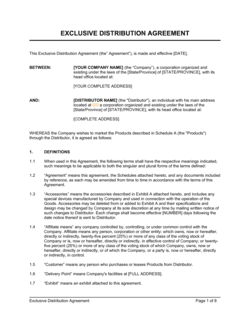
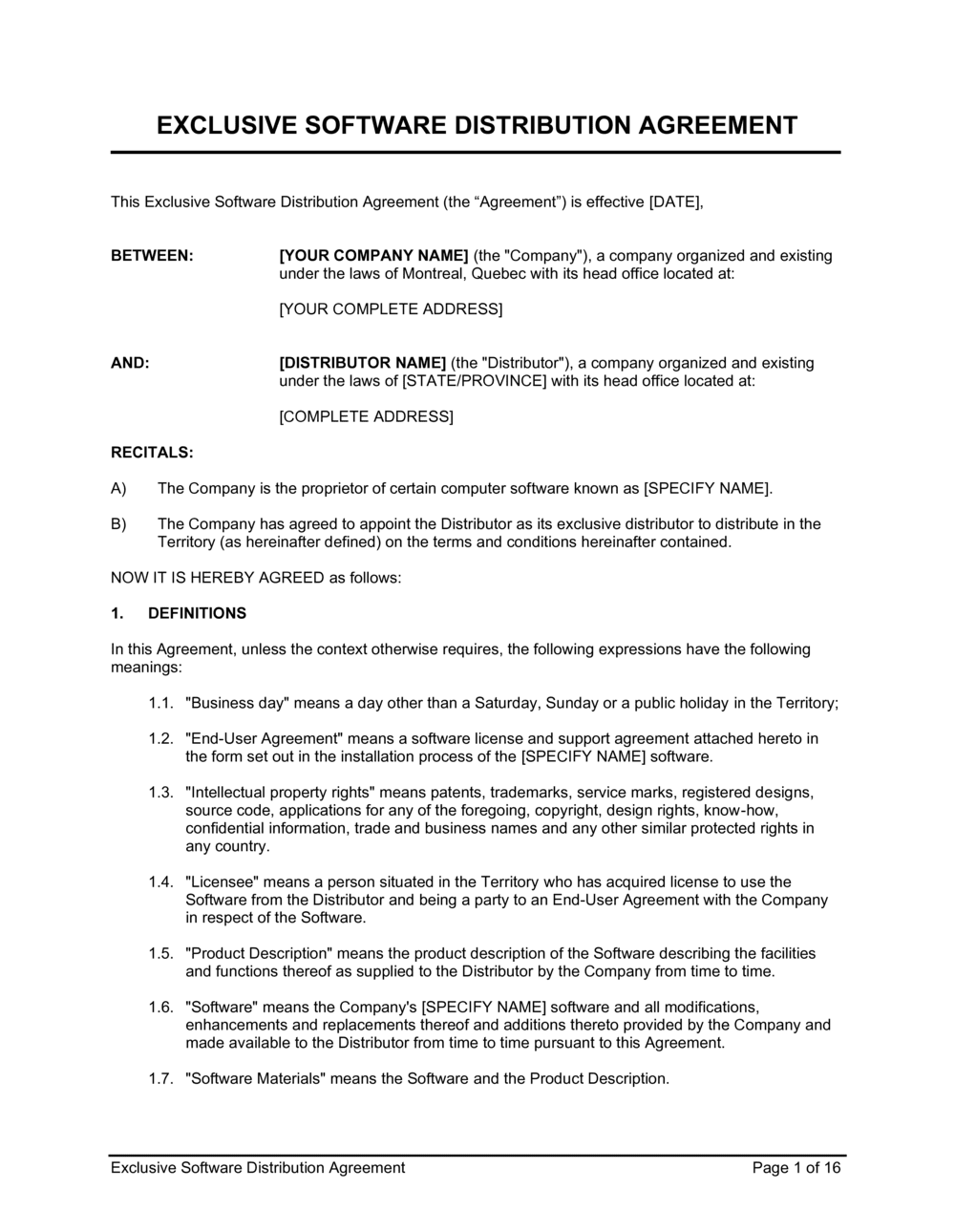
Exclusive Software Distribution Agreement Template

Free Word download • Edit online • Save & share with Drive • Export to PDF

16 pages35–45 min to fillDifficulty: ComplexSignature requiredLegal review recommended
Learn more ↓
FreeExclusive Software Distribution Agreement Template

At a glance

What it is
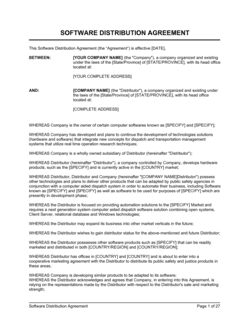
An Exclusive Software Distribution Agreement is a legally binding contract between a software developer or publisher and a distributor who is granted the sole right to market and resell the software within a defined territory or channel. This free Word download gives you a structured, attorney-reviewed starting point you can edit online and export as PDF — covering license scope, territory exclusivity, pricing, IP ownership, performance benchmarks, and termination rights in a single enforceable document.
When you need it
Use it when appointing a single regional or channel distributor to sell your software, or when a distributor is negotiating exclusive rights from a publisher before committing to a market-entry investment. It is also appropriate when converting a non-exclusive arrangement to exclusive status after a distributor has demonstrated performance.
What's inside
Grant of exclusivity and territory definition, license scope and sublicensing rights, pricing and margin structure, minimum sales performance requirements, intellectual property ownership and trademark usage rules, confidentiality obligations, warranties and liability limits, and termination rights with post-termination obligations.

What is an Exclusive Software Distribution Agreement?

An Exclusive Software Distribution Agreement is a legally binding contract between a software publisher and a distributor that grants the distributor the sole right to market, sell, and sublicense the software within a defined territory or channel for the duration of the agreement. Unlike a general reseller arrangement, exclusivity means no competing distributor — and typically not the publisher itself, unless explicitly reserved — may sell the same product in that territory. In exchange for this protected position, the distributor typically commits to minimum annual sales or purchase targets and invests in local marketing, support infrastructure, and customer acquisition. The agreement governs the full commercial relationship: pricing and margin structure, IP ownership, trademark usage, EULA pass-through obligations, confidentiality, warranties, and termination rights — all in a single enforceable document.

Why You Need This Document

Entering an exclusive distribution arrangement without a written agreement exposes both parties to significant and concrete risk. For the publisher, an undocumented exclusivity grant creates ambiguity about territory scope, prevents enforcement of minimum performance standards, and leaves IP ownership in localized or adapted versions legally uncertain. For the distributor, investing in market development without a signed contract means the publisher can appoint a competitor or begin selling directly — with no legal basis for a claim. Either party can face a dispute over whether the publisher reserved the right to sell to named accounts, what currency the margin applies in after a price increase, or who is responsible for transitioning end users when the relationship ends. A properly drafted Exclusive Software Distribution Agreement resolves all of these questions upfront, gives both sides a clear enforcement path when commitments are missed, and provides the structural framework that investors and acquirers expect to find during due diligence of any software business with channel operations.

Which variant fits your situation?

If your situation is…Use this template
Granting distribution rights in multiple territories with different exclusivity levelsNon-Exclusive Software Distribution Agreement
Licensing software directly to an end user rather than through a channelSoftware License Agreement
Engaging a reseller who also provides integration and support servicesValue-Added Reseller (VAR) Agreement
Distributing a SaaS product via a white-label arrangementWhite Label Software Agreement
Appointing a local agent who refers customers without taking title to licensesSoftware Referral and Affiliate Agreement
Distributing software bundled with hardware to OEM partnersOEM Software Agreement
Licensing software to a joint venture or co-development partnerJoint Venture Agreement

Common mistakes to avoid

❌ Failing to define the publisher's direct-sales carve-out

Why it matters: Without explicit language reserving the publisher's right to sell directly to named accounts or through its own website, a broad exclusivity clause may inadvertently prohibit the publisher from serving its own existing customers — creating a breach of its own contract.

Fix: Add a Schedule listing named accounts, direct-sales channels, and any OEM or government channels that remain with the publisher regardless of territory.

❌ No price-change notice requirement

Why it matters: A publisher who raises list prices without adequate notice forces the distributor to honor customer quotes at a loss, immediately damaging the relationship and triggering disputes over whether the contract has been materially breached.

Fix: Include a clause requiring at least 60 days' written notice before any list price change and confirm that existing written customer quotes are honored at the old price for 90 days.

❌ Minimum commitment targets defined as gross revenue without deductions

Why it matters: If returns, refunds, and license cancellations are not deducted from the MPC calculation, the distributor may appear to hit targets while the publisher has received no net economic benefit — and conversely, a distributor may fall short of targets due to factors outside their control.

Fix: Define MPC as net paid licenses after returns and cancellations, measured over a 12-month rolling period with a mid-year review checkpoint.

❌ Omitting a source code escrow requirement for business-critical software

Why it matters: If the publisher becomes insolvent, is acquired, or discontinues the product, the distributor and its end customers lose access to patches and updates — creating regulatory liability where customers depend on the software for compliance.

Fix: Include a source code escrow clause requiring the publisher to deposit current source code with a recognized escrow agent within 30 days of signing, with defined release triggers.

❌ No customer data and EULA pass-through obligations

Why it matters: When distributors sublicense software to end users without requiring acceptance of the publisher's EULA, the publisher's IP protections and usage restrictions become unenforceable against those end users — a particular risk in enterprise or government deployments.

Fix: Require the distributor to obtain each end user's written or click-through acceptance of the current EULA before delivering access, and to provide execution records on request.

❌ Confidentiality clause that survives indefinitely without a sunset

Why it matters: Perpetual confidentiality obligations can be unenforceable in some jurisdictions and create operational difficulty for distributors who change ownership or systems years after the agreement ends.

Fix: Set a defined post-termination confidentiality period — typically 3 to 5 years — except for trade secrets, which should be protected for as long as they remain secret under applicable law.

The 10 key clauses, explained

Grant of exclusive distribution rights

In plain language: Establishes who receives the exclusive right to distribute the software, in which territory or channel, and whether the exclusivity is absolute or conditional on performance.

Sample language
[PUBLISHER NAME] hereby grants to [DISTRIBUTOR NAME] the exclusive right to market, promote, and distribute [SOFTWARE NAME] within [TERRITORY] during the Term, subject to Distributor meeting the Minimum Purchase Commitments set out in Schedule A.

Common mistake: Failing to define whether 'exclusive' includes the publisher itself. Without explicit carve-outs, a publisher may inadvertently be prohibited from selling directly to enterprise customers in the same territory — causing a breach of its own contract.

Territory definition

In plain language: Precisely describes the geographic or channel boundaries of exclusivity, including any sub-regions, online channels, or industry verticals that are included or excluded.

Sample language
The Territory is defined as [COUNTRY / REGION], including all online sales channels targeting end users with a billing address in [TERRITORY], but excluding sales to [EXCLUDED CHANNEL / VERTICAL] which are reserved by Publisher.

Common mistake: Using country names without addressing cross-border digital sales. A distributor with exclusive rights in Germany but no carve-out for EU-wide online sales may face unauthorized parallel sales that undermine their territory.

License scope and sublicensing

In plain language: Defines exactly what the distributor is permitted to do with the software — sell, sublicense, modify, bundle — and prohibits everything not expressly listed.

Sample language
Distributor is authorized to sublicense [SOFTWARE NAME] to end users solely for [PERMITTED USE]. Distributor shall not modify, decompile, reverse-engineer, or create derivative works of the Software without Publisher's prior written consent.

Common mistake: Omitting a restriction on sublicensing to sub-distributors. Without it, the distributor may appoint their own subdistributors, diluting the publisher's control over the channel and creating enforcement gaps.

Pricing, margins, and payment terms

In plain language: Sets the distributor's purchase price or margin, invoicing currency, payment due dates, and consequences for late payment including interest.

Sample language
Publisher shall supply licenses to Distributor at [X]% below the then-current List Price set out in Schedule B. Payment is due Net [30] days from invoice date. Late payments accrue interest at [X]% per month.

Common mistake: Not specifying what happens when the publisher changes list prices. Without a minimum notice period — typically 30 to 90 days — the distributor may be committed to customer quotes that become unprofitable overnight.

Minimum purchase commitments and performance milestones

In plain language: Obligates the distributor to sell or purchase a minimum volume of licenses per period and specifies what happens — including termination of exclusivity — if the commitment is missed.

Sample language
Distributor shall purchase no fewer than [X] licenses (or $[Y] in aggregate license fees) in each Contract Year. Failure to meet the Minimum Purchase Commitment in any year shall, at Publisher's election, convert the exclusivity granted herein to a non-exclusive arrangement.

Common mistake: Setting minimum commitments as revenue targets without defining how 'revenue' is measured — gross, net, or billed. Disputes over whether deferred or returned licenses count toward the minimum are common and expensive to resolve.

Intellectual property ownership and trademark usage

In plain language: Confirms the publisher owns all IP in the software and grants the distributor a limited right to use the publisher's trademarks solely for marketing purposes in the territory.

Sample language
All intellectual property rights in and to the Software remain exclusively vested in Publisher. Distributor is granted a limited, non-exclusive, revocable license to use Publisher's trademarks in [TERRITORY] solely for marketing the Software, subject to Publisher's then-current brand guidelines.

Common mistake: Allowing distributor-created marketing materials to go unchecked. Without a review-and-approval clause for co-branded content, distributors may misrepresent the software's features, creating warranty and consumer-protection liability for the publisher.

Confidentiality obligations

In plain language: Prohibits both parties from disclosing the other's confidential information — pricing, roadmaps, customer data, and source code — to third parties during and after the agreement.

Sample language
Each party agrees to hold the other's Confidential Information in strict confidence and not to disclose it to any third party without prior written consent. This obligation survives termination of this Agreement for a period of [X] years.

Common mistake: Defining confidential information without carving out what is already public or independently developed. An overbroad definition can prevent the distributor from referencing publicly known product features in marketing, creating operational friction.

Warranties and limitation of liability

In plain language: States what the publisher warrants about the software — typically that it performs materially as described — and caps each party's financial exposure in the event of a claim.

Sample language
Publisher warrants that the Software will perform materially in accordance with the Documentation for [90] days from delivery. IN NO EVENT SHALL EITHER PARTY'S LIABILITY EXCEED THE FEES PAID BY DISTRIBUTOR IN THE [12] MONTHS PRECEDING THE CLAIM.

Common mistake: Including a warranty against all defects without a defined remedy. If the publisher is obligated to fix any defect but the fix timeline is unlimited, a distributor facing angry customers has no practical recourse.

Term, termination, and sell-off period

In plain language: Sets the initial contract term, renewal conditions, grounds for early termination by either party, notice requirements, and the window during which the distributor may sell remaining inventory after termination.

Sample language
This Agreement commences on [START DATE] and continues for [X] years, unless earlier terminated. Either party may terminate for material breach on [30] days' written notice if the breach is not cured within that period. Following termination, Distributor shall have [90] days to fulfill existing customer orders.

Common mistake: Omitting a cure period for termination for cause. Without a defined cure window — typically 30 days — a minor, correctable breach by the distributor can trigger immediate termination, exposing the publisher to a wrongful-termination claim.

Post-termination obligations

In plain language: Requires the distributor to cease distribution, return or destroy confidential materials, transition customers to the publisher or a new distributor, and pay any outstanding fees after the agreement ends.

Sample language
Upon termination or expiry, Distributor shall (a) immediately cease marketing the Software; (b) return or certify destruction of all Confidential Information; (c) cooperate with Publisher's transition of end-user accounts; and (d) pay all outstanding invoices within [30] days.

Common mistake: No customer transition assistance obligation. Without it, the publisher may lose active end-user relationships, support records, and renewal pipelines when a distributor relationship ends — particularly damaging if the split is acrimonious.

How to fill it out

  1. 1

    Identify the parties and their legal entities

    Enter the publisher's full registered corporate name and the distributor's legal entity name. Include each party's principal business address and jurisdiction of incorporation.

    💡 Confirm the exact registered name from each party's corporate registry filing — trade names and operating names create ambiguity when enforcing the agreement.

  2. 2

    Define the territory with precision

    Specify the exact geographic scope — countries, regions, or states — and explicitly address online and cross-border digital sales. Note any sub-regions or verticals the publisher reserves for direct sales.

    💡 For EU-based distributors, address whether exclusivity covers all EU member states or only named countries — EU single-market rules can affect how territorial restrictions are enforced.

  3. 3

    Set minimum purchase commitments and the exclusivity trigger

    Negotiate and enter the annual minimum license quantity or dollar value in Schedule A. Define clearly what happens when commitments are missed — automatic conversion to non-exclusive or a right to terminate.

    💡 Year 1 MPCs are typically set 20–30% below the distributor's own sales forecast to allow a realistic ramp; they escalate in Years 2–3.

  4. 4

    Specify the pricing structure and price-change notice period

    Enter the distributor's discount percentage or margin against List Price. Add a clause requiring the publisher to give at least 60 days' written notice before any list price increase takes effect.

    💡 Include a Most Favored Nation clause if the distributor is making significant upfront marketing investment — it protects against other distributors getting better pricing.

  5. 5

    Complete the IP, trademark, and localization terms

    Confirm that all IP remains with the publisher. If the distributor will localize the software, specify who owns the localized version and whether a separate fee applies. Add brand guideline requirements for co-branded marketing.

    💡 Require the distributor to submit translated or localized materials for approval before release — errors in localized versions create product liability and regulatory exposure for the publisher.

  6. 6

    Set the warranty scope and liability cap

    Define the warranty period — typically 90 days — and the remedy for breach (patch, replace, or refund). Cap each party's aggregate liability at the fees paid in the preceding 12 months, and list the categories of loss excluded entirely.

    💡 Exclude consequential and indirect damages explicitly — lost revenue from a missed sales opportunity is otherwise a potentially unlimited exposure for the publisher.

  7. 7

    Establish the term, renewal, and termination structure

    Set the initial term (typically 1–3 years), auto-renewal conditions, required notice to prevent renewal, termination-for-cause triggers, cure periods, and the post-termination sell-off window.

    💡 A 90-day non-renewal notice requirement is standard for distribution agreements. Shorter periods disadvantage the distributor who has committed marketing spend.

  8. 8

    Confirm governing law and dispute resolution

    Select the governing jurisdiction — typically the publisher's home state or country — and choose between arbitration and litigation. Include a carve-out allowing either party to seek injunctive relief in court for IP or confidentiality breaches.

    💡 For cross-border agreements, consider ICC or JAMS international arbitration rules rather than a single country's courts — enforcement of foreign court judgments is significantly harder than enforcing an arbitral award.

Frequently asked questions

What is an exclusive software distribution agreement?

An exclusive software distribution agreement is a contract between a software publisher and a distributor that grants the distributor the sole right to sell and sublicense the software within a defined territory or channel for a set period. Unlike a non-exclusive arrangement, no other distributor — and typically not the publisher itself, unless carved out — may sell the software in that territory during the exclusivity term. In exchange for exclusivity, the distributor usually commits to minimum purchase or sales targets.

What is the difference between an exclusive and a non-exclusive software distribution agreement?

An exclusive distribution agreement prohibits the publisher from appointing any other distributor — and often from selling directly — in the covered territory. A non-exclusive agreement permits the publisher to appoint multiple distributors and to sell directly at the same time. Exclusive arrangements command higher distributor investment in the market but carry greater risk for the publisher if the distributor underperforms. Most publishers start with non-exclusive terms and grant exclusivity only once a distributor has demonstrated sales traction.

What minimum purchase commitments should I include?

Minimum purchase commitments should reflect a realistic Year 1 sales target set 20–30% below the distributor's own forecast, escalating in subsequent years. Define whether the minimum is measured in unit licenses, dollar value of fees paid, or active customer subscriptions. Specify the measurement period (calendar year or rolling 12 months), what happens if the minimum is missed (conversion to non-exclusive status is common), and whether a shortfall payment option is available to preserve exclusivity.

Who owns the software if the distributor localizes it?

Under a properly drafted agreement, the publisher retains all IP in the original software and in any localized version. The agreement should explicitly state that the publisher owns all translations, adaptations, and derivative works created by or for the distributor, and that the distributor assigns any rights it might otherwise claim. Without this language, a distributor who commissions a localization may assert co-ownership of the adapted version — particularly in jurisdictions with strong moral rights protections for authors.

Can a publisher still sell directly in an exclusive territory?

Only if the agreement expressly reserves that right. A standard exclusivity grant without carve-outs will prevent the publisher from selling directly in the territory, including through its own website. Publishers should negotiate explicit exceptions for named accounts, government or enterprise contracts, existing customers, and direct online sales to individuals — all listed in a schedule attached to the agreement.

Is an exclusive software distribution agreement enforceable in the EU?

Exclusive territorial distribution agreements may be subject to EU competition law, specifically Article 101 of the Treaty on the Functioning of the European Union. Vertical agreements between non-competing parties are generally covered by the Vertical Block Exemption Regulation if neither party's market share exceeds 30%. Restrictions that amount to absolute territorial protection — preventing parallel imports between EU member states — are typically unenforceable regardless of what the contract says. Legal review by an EU competition specialist is advisable before signing.

What happens to end users if the distribution agreement is terminated?

The agreement should include a post-termination transition clause requiring the distributor to cooperate in transferring end-user accounts, support records, and license keys to the publisher or a replacement distributor. End users who have active licenses typically retain their usage rights under the EULA they accepted — the distribution channel changing does not invalidate their license. A sell-off period of 60 to 90 days allows the distributor to fulfill open orders before distribution rights fully revert.

What governing law should I choose for a cross-border distribution agreement?

Publishers typically choose their home jurisdiction as governing law — it gives them a familiar legal system and home-court advantage in disputes. For cross-border agreements between parties in different countries, international commercial arbitration (ICC, LCIA, or JAMS) is often preferable to litigation because arbitral awards are recognized in over 165 countries under the New York Convention. Whichever law is chosen, confirm it does not invalidate key clauses — California law, for example, voids certain non-compete provisions even in commercial contracts.

Do I need a lawyer to prepare an exclusive software distribution agreement?

For straightforward domestic arrangements involving lower-risk products, a high-quality template provides a solid starting point that covers the essential terms. Legal review is strongly advisable when the agreement involves cross-border parties, significant minimum purchase commitments, regulated software (healthcare, financial services), or substantial exclusivity periods over two years. An attorney familiar with technology licensing can typically review and adapt a template for $600–$2,000 — substantially less than the cost of resolving an ambiguous clause in litigation.

How this compares to alternatives

vs Non-Exclusive Software Distribution Agreement

A non-exclusive distribution agreement permits the publisher to appoint multiple distributors and sell directly in the same territory simultaneously. It carries no minimum commitment requirements and lower risk for the publisher, but gives the distributor no protected investment rationale. Use a non-exclusive structure when testing a new channel or market before committing to exclusivity.

vs Software License Agreement

A software license agreement runs directly between the publisher and the end user — it governs how an individual or organization may use the software. A distribution agreement is a commercial channel contract between the publisher and an intermediary who then sublicenses to end users. Distribution agreements require that end users also accept the publisher's EULA, making both documents necessary in a channel model.

vs Value-Added Reseller (VAR) Agreement

A VAR agreement covers a reseller who bundles the software with services, customization, or complementary products before selling to end users. It typically includes additional obligations around service delivery, support SLAs, and IP in customizations. An exclusive distribution agreement is narrower — it governs the resale of the software as-is without a significant services component.

vs White Label Software Agreement

A white label agreement permits the distributor to rebrand and resell the software under their own name, with the publisher's identity concealed from end users. An exclusive distribution agreement preserves the publisher's brand and trademarks — the distributor sells under the publisher's name. White label arrangements require additional IP provisions governing the distributor's brand ownership of the resold product.

Industry-specific considerations

Enterprise Software / SaaS

Subscription-based minimum commitments measured in annual recurring revenue rather than unit licenses; EULA pass-through obligations for each named end user; data processing addendum required where customer data transits the distributor.

Healthcare / MedTech

Distributor must hold applicable regulatory clearances (e.g., FDA registration for medical device software); HIPAA business associate obligations pass through to the distributor; software recalls and field safety actions require defined notification timelines.

Financial Services / Fintech

Distributor may need FCA, SEC, or equivalent regulatory authorization to distribute regulated financial software; audit rights clauses require the publisher to inspect distributor compliance with financial regulations; liability caps are typically negotiated higher given systemic risk.

Gaming and Consumer Software

Territory exclusivity is common at launch for physical and digital storefronts; return and refund policies must align with platform-specific rules (Steam, PlayStation Store); age-rating and content classification compliance obligations fall on the distributor in the target territory.

Jurisdictional notes

United States

US exclusive distribution agreements are generally enforceable under state commercial contract law. Antitrust exposure under the Sherman Act is low for vertical arrangements unless a party has significant market power. California courts will apply California law to IP and non-compete provisions regardless of governing-law clauses, potentially voiding certain restrictions. The Uniform Commercial Code may apply to software license transactions in some states, though the majority of software distribution is governed by common-law contract principles.

Canada

Exclusive distribution agreements in Canada are subject to the Competition Act, which prohibits arrangements that substantially lessen competition — a concern primarily for dominant software categories. Termination of a distribution agreement may trigger common-law good-faith obligations, meaning abrupt termination without cause can result in damages beyond the contract's notice period. Quebec distributors may require French-language contracts and documentation under the Charter of the French Language (Bill 96).

United Kingdom

Post-Brexit, the UK has its own vertical agreements block exemption (VABEO), effective until 2028, which largely mirrors the former EU regime and covers exclusive distribution arrangements between non-competing parties with under 30% market share. Absolute territorial protection preventing parallel imports from within the UK is prohibited. The UK's digital markets reforms under the Digital Markets, Competition and Consumers Act 2024 may impose additional obligations on software publishers with strategic market status.

European Union

The EU Vertical Block Exemption Regulation (VBER, 2022) permits exclusive distribution agreements where neither party exceeds 30% market share in the relevant market. Passive sales restrictions — preventing a distributor from fulfilling unsolicited orders from outside the territory — are generally prohibited. Active sales restrictions into other distributors' exclusive territories are permitted. GDPR obligations apply where the distributor handles personal data of EU end users, requiring a data processing agreement between publisher and distributor.

Template vs lawyer — what fits your deal?

PathBest forCostTime
Use the templateDomestic software publishers appointing a single distributor for a non-regulated product with straightforward pricing and a short initial termFree30–60 minutes
Template + legal reviewCross-border arrangements, SaaS subscription models, minimum commitments over $100K annually, or initial terms exceeding 2 years$600–$2,0003–7 days
Custom draftedRegulated industries (healthcare, fintech), exclusive arrangements involving significant upfront investment by the distributor, or multi-territory enterprise software deals$3,000–$10,000+2–6 weeks

Glossary

Exclusivity
A contractual right that prevents the software publisher from appointing any other distributor in the same territory or channel for the duration of the agreement.
Territory
The defined geographic region, country, or market segment within which the distributor has the right to market and sell the software.
Minimum Purchase Commitment (MPC)
A binding obligation requiring the distributor to purchase or sell a minimum quantity or dollar value of licenses within a specified period, typically annually.
Sublicense
A right granted by the distributor to an end customer allowing that customer to use the software under the terms of the original license — not to redistribute further.
Intellectual Property (IP) Ownership
The clause confirming that the software publisher retains all copyright, patents, and trade secrets in the software regardless of any distribution or customization activity.
Distributor Margin
The percentage discount from the publisher's list price at which the distributor acquires licenses, representing their gross profit on each sale.
End User License Agreement (EULA)
The agreement between the publisher and the end customer governing permitted use of the software — the distributor is typically required to ensure every end customer accepts it.
Escrow (Source Code Escrow)
An arrangement where the publisher deposits source code with a neutral third party, which releases it to the distributor if the publisher becomes insolvent or ceases support.
Termination for Cause
The right to end the agreement immediately, without notice or compensation, when a specific material breach — such as IP infringement or insolvency — occurs.
Sell-Off Period
A limited window after termination during which the distributor may continue to sell existing licensed inventory before all distribution rights revert to the publisher.
Localization
Adapting software for a specific market — translating the interface, currency, and documentation — with the agreement specifying who owns resulting localized versions.
Most Favored Nation (MFN) Clause
A provision requiring the publisher to offer the distributor pricing no worse than the best price it offers to any comparable distributor globally.

Part of your Business Operating System

This document is one of 3,000+ business & legal templates included in Business in a Box.

  • Fill-in-the-blanks — ready in minutes
  • 100% customizable Word document
  • Compatible with all office suites
  • Export to PDF and share electronically

Create your document in 3 simple steps.

From template to signed document — all inside one Business Operating System.
1
Download or open template

Access over 3,000+ business and legal templates for any business task, project or initiative.

2
Edit and fill in the blanks with AI

Customize your ready-made business document template and save it in the cloud.

3
Save, Share, Send, Sign

Share your files and folders with your team. Create a space of seamless collaboration.

Save time, save money, and create top-quality documents.

★★★★★

"Fantastic value! I'm not sure how I'd do without it. It's worth its weight in gold and paid back for itself many times."

Managing Director · Mall Farm
Robert Whalley
Managing Director, Mall Farm Proprietary Limited
★★★★★

"I have been using Business in a Box for years. It has been the most useful source of templates I have encountered. I recommend it to anyone."

Business Owner · 4+ years
Dr Michael John Freestone
Business Owner
★★★★★

"It has been a life saver so many times I have lost count. Business in a Box has saved me so much time and as you know, time is money."

Owner · Upstate Web
David G. Moore Jr.
Owner, Upstate Web

Run your business with a system — not scattered tools

Stop downloading documents. Start operating with clarity. Business in a Box gives you the Business Operating System used by over 250,000 companies worldwide to structure, run, and grow their business.

Start free · No credit card required