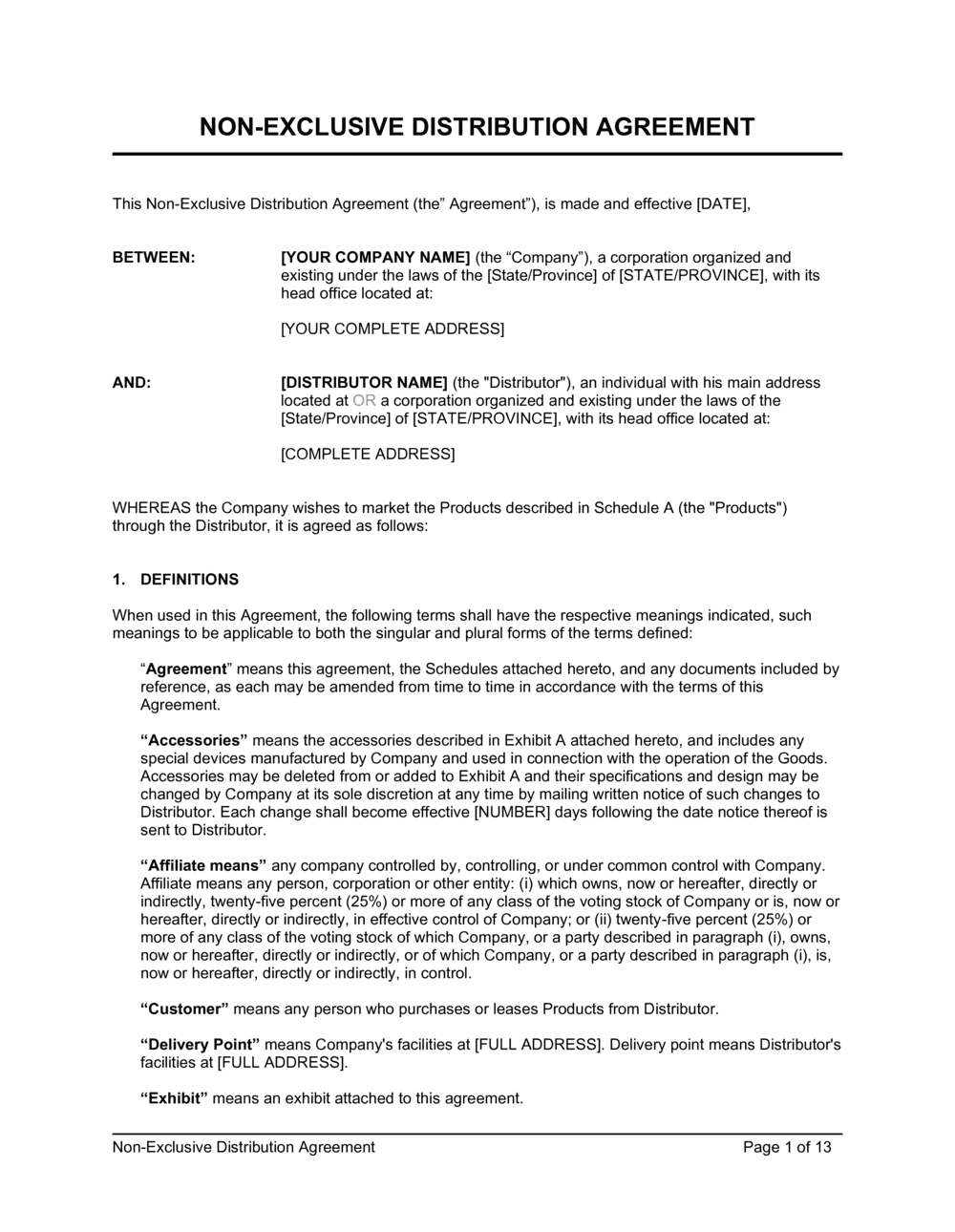
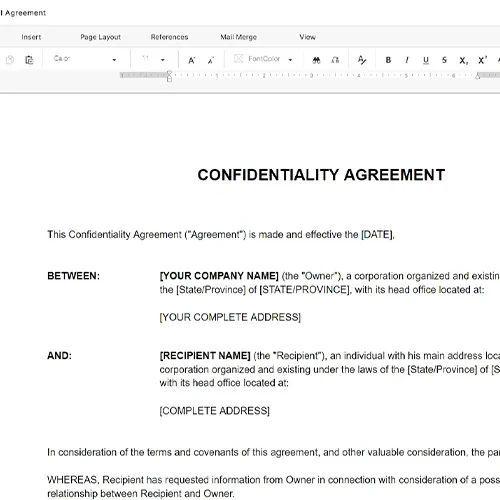
This non exclusive distribution agreement template has 13 pages and is a MS Word file type listed under our legal agreements documents.
Non exclusive distribution agreement template
NON-EXCLUSIVE DISTRIBUTION AGREEMENT This Non-Exclusive Distribution Agreement (the" Agreement"), is made and effective [DATE], BETWEEN: [YOUR COMPANY NAME] (the "Company"), a corporation organized and existing under the laws of the [State/Province] of [STATE/PROVINCE], with its head office located at: [YOUR COMPLETE ADDRESS] AND: [DISTRIBUTOR NAME] (the "Distributor"), an individual with his main address located at OR a corporation organized and existing under the laws of the [State/Province] of [STATE/PROVINCE], with its head office located at: [COMPLETE ADDRESS] WHEREAS the Company wishes to market the Products described in Schedule A (the "Products") through the Distributor, it is agreed as follows: DEFINITIONS When used in this Agreement, the following terms shall have the respective meanings indicated, such meanings to be applicable to both the singular and plural forms of the terms defined: "Agreement" means this agreement, the Schedules attached hereto, and any documents included by reference, as each may be amended from time to time in accordance with the terms of this Agreement. "Accessories" means the accessories described in Exhibit A attached hereto, and includes any special devices manufactured by Company and used in connection with the operation of the Goods. Accessories may be deleted from or added to Exhibit A and their specifications and design may be changed by Company at its sole discretion at any time by mailing written notice of such changes to Distributor. Each change shall become effective [NUMBER] days following the date notice thereof is sent to Distributor. "Affiliate means" any company controlled by, controlling, or under common control with Company. Affiliate means any person, corporation or other entity: (i) which owns, now or hereafter, directly or indirectly, twenty-five percent (25%) or more of any class of the voting stock of Company or is, now or hereafter, directly or indirectly, in effective control of Company; or (ii) twenty-five percent (25%) or more of any class of the voting stock of which Company, or a party described in paragraph (i), owns, now or hereafter, directly or indirectly, or of which Company, or a party described in paragraph (i), is, now or hereafter, directly or indirectly, in control. "Customer" means any person who purchases or leases Products from Distributor. "Delivery Point" means Company's facilities at [FULL ADDRESS]. Delivery point means Distributor's facilities at [FULL ADDRESS]. "Exhibit" means an exhibit attached to this agreement. "Goods" means those items described in Exhibit B. Goods may be deleted from or added to Exhibit B and their specifications and design may be changed by Company at its sole discretion at any time by mailing written notice of such changes to Distributor. Each change shall become effective [NUMBER] days following the date notice thereof is sent to Distributor. "Products" means Goods, Accessories, and Spare Parts. "Spare Parts means": (i) all parts and components of the Goods; (ii) any special devices used in connection with the maintenance or servicing of the Goods. Company warrants that a complete list of Spare Parts is set forth in Exhibit C. Spare parts may be deleted from or added to Exhibit C and their specifications and design may be changed by Company at its sole discretion at any time by mailing written notice of such changes to Distributor. Each change shall become effective [NUMBER] days following the date notice thereof is sent to Distributor. "Specifications" means those specifications set forth in Exhibit D. "Territory" means the following geographic area or areas: [SPECIFY]. During the term of this Agreement, Distributor shall have the first right of refusal at its option to expand the Territory to distribute the Products on a non-exclusive basis in [COUNTRIES]. Company shall give Distributor written notice and the terms under which it intends to permit distribution, or the terms of any offer or request from a third party for rights to distribute, any of the Products in any country not then included in the Territory. Distributor shall accept or reject such offer in writing within [NUMBER] days after receipt thereof, and, if Distributor accepts such offer, the Territory shall be appropriately expanded. "House Accounts" shall mean those Customers in the Territory who purchase Products directly from the Company. "Trademark" means any trademark, logo, service mark or other commercial designation, whether registered, used to represent or describe the Products of Company, as set forth in Exhibit E. APPOINTMENT OF DISTRIBUTOR Appointment Company hereby appoints Distributor as Company's non-exclusive distributor of Products in the Territory, and Distributor accepts that position. Appointment of Nonexclusive Distributor. Subject to the terms and conditions of this Agreement, the Company appoints the Distributor, and the Distributor hereby accepts such appointment, as the Company's non-exclusive authorized distributor for sale of the Products to the Customers (other than House Account) in the Territory (as these terms are defined in Section 1, above). Designation of House Account. In the event the Company notifies the Distributor that they have designated a Customer of the Distributor as a new House Account, such Customer will become a House Account effective Ninety (90) days following such notice. At the Company's sole discretion, they may compensate the Distributor for extraordinary sales and distribution efforts rendered prior to the designation of the new House Account. Referrals If Company or any Affiliate is contacted by any party inquiring about the purchase of Products in the Territory (other than Distributor or a party designated by Distributor), Company shall, or shall cause that Affiliate to, refer such party to Distributor for handling. Relationship of Parties Distributor is an independent contractor and is not the legal representative or agent of Company for any purpose and shall have no right or authority (except as expressly provided in this Agreement) to incur, assume or create in writing or otherwise, any warranty over any of Company's employees, all of whom are entirely under the control of Company, who shall be responsible for their acts and omissions. Distributor shall, at its own expense, during the term of this Agreement and any extension thereof, maintain full insurance under any Workmen's Compensation Laws effective in the state or other applicable jurisdiction covering all persons employed by and working for it in connection with the performance of this Agreement, and upon request shall furnish Company with satisfactory evidence of the maintenance of such insurance. Distributor accepts exclusive liability for all contributions and payroll taxes required under Federal Social Security Laws and State Unemployment Compensation Laws or other payments under any laws of similar character in any applicable jurisdiction as to all persons employed by and working for it. Nothing contained in this Agreement shall be deemed to create any partnership or joint venture relationship between the parties. Sale of Products by Distributor Distributor agrees to exercise its best efforts to develop the largest possible market for the Products in the Territory and shall continuously offer, advertise, demonstrate and otherwise promote the sale of Products in the Territory. The parties have consulted together and now agree that if Distributor's best efforts are used as provided in this Section, a minimum of [SPECIFY] Products ("Annual Market Potential") will be purchased and distributed in the Territory during the first year of this Agreement.
 Dashboard
 HR Management
 Links
Links Chat
Chat Connect
 Contacts
 Inbox
Inbox Business Al
 Project Management
 Notes
Notes Business Templates
 Cloud Drive
 Docs
Docs Sheets