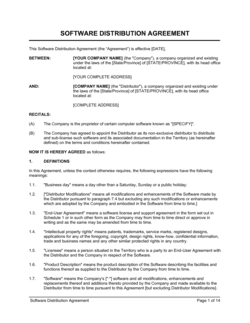
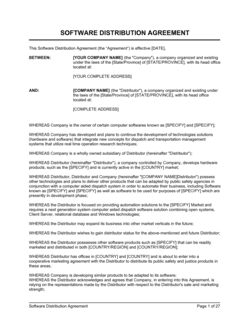
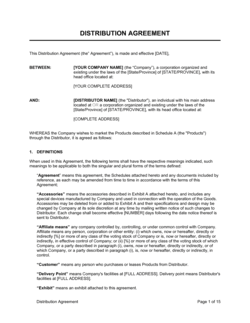
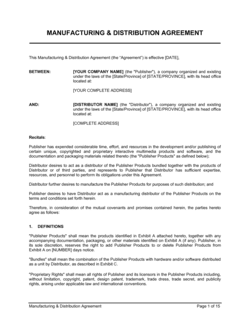
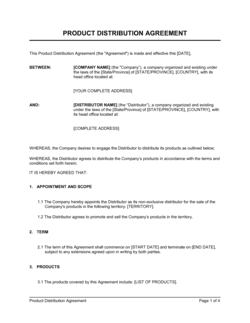
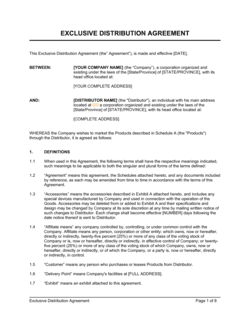
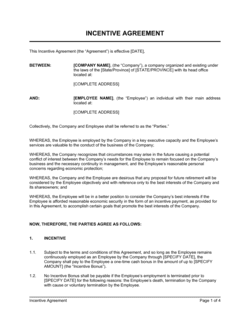
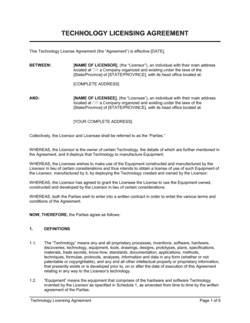
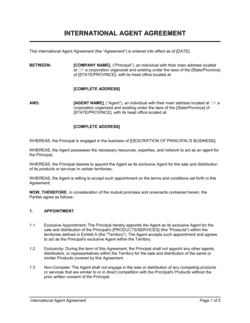
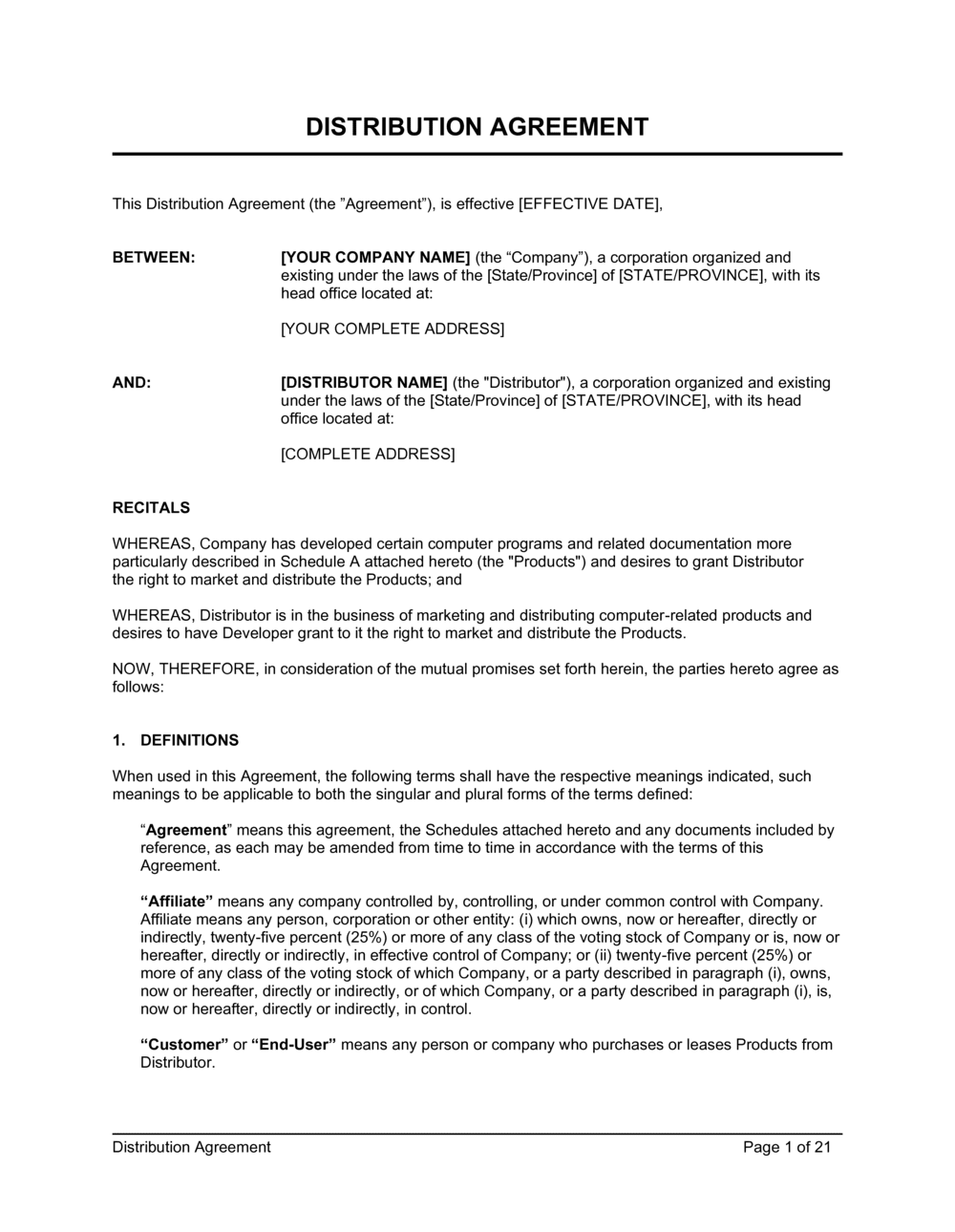
Distribution Agreement Software and Multimedia Template

Free Word download • Edit online • Save & share with Drive • Export to PDF

21 pages35–50 min to fillDifficulty: ComplexSignature requiredLegal review recommended
Learn more ↓
FreeDistribution Agreement Software and Multimedia Template

At a glance

What it is
A Distribution Agreement for Software and Multimedia is a legally binding contract between a software developer or multimedia rights holder (the licensor) and a third-party distributor that defines the terms under which the distributor may market, sell, or sublicense the product. This free Word download covers territory, license scope, royalties, IP ownership, confidentiality, and termination — and can be edited online and exported as PDF for execution.
When you need it
Use it when you are granting a reseller, VAR, OEM partner, or digital platform the right to distribute your software or multimedia content to end users. It is equally necessary when you are the distributor taking on a third-party product and need the rights and obligations documented before committing sales or marketing resources.
What's inside
Grant of distribution rights with exclusivity options, territory definition, license fee and royalty structure, IP ownership and trademark usage rules, confidentiality obligations, marketing and reporting requirements, representations and warranties, indemnification, and termination with post-termination obligations.

What is a Distribution Agreement for Software and Multimedia?

A Distribution Agreement for Software and Multimedia is a legally binding contract between a software developer or digital content owner (the licensor) and a third-party distributor that formally grants the distributor the right to market, sell, and sublicense the licensor's products to end users within a defined territory and channel. Unlike a simple reseller arrangement, this agreement addresses the full complexity of software and multimedia distribution: IP ownership confirmation, end-user sublicensing authority, royalty calculation methodology, territory exclusivity options, and the fate of active end-user licenses when the distribution relationship ends. It creates enforceable obligations on both sides and eliminates the ambiguity that courts otherwise fill with jurisdiction-specific defaults — often to the detriment of whichever party failed to document its position clearly.

Why You Need This Document

Without a signed distribution agreement, your software or multimedia content can be sold in markets you never authorized, at prices that undercut your other channels, with no mechanism to compel royalty payments or audit sales records. A distributor operating without a formal agreement has no binding territory restriction, no minimum performance obligation, and no confidentiality duty — meaning they can test your product, share your pricing and technical documentation with competitors, and walk away with no financial consequence. For the distributor, the absence of a written grant of rights creates its own risk: a licensor can revoke informal permissions at will, stranding any investment the distributor made in building a sales pipeline. This template establishes the rights, obligations, and commercial mechanics both parties need before a single license is sold — protecting the licensor's IP and revenue stream while giving the distributor the documented authority to invest confidently in the market.

Which variant fits your situation?

If your situation is…Use this template
Granting one exclusive distributor rights in a defined territoryExclusive Distribution Agreement
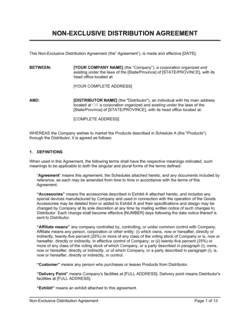
Appointing multiple non-exclusive distributors in the same marketNon-Exclusive Distribution Agreement
Allowing a partner to resell your SaaS product on a revenue-share basisReseller Agreement
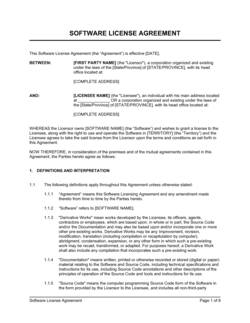
Licensing software directly to an end user without a distributorSoftware License Agreement
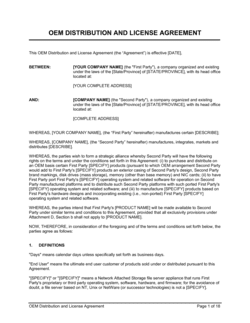
Engaging an OEM to bundle your software inside their hardware productOEM Agreement
Licensing multimedia content to a streaming or publishing platformContent Licensing Agreement
Appointing a foreign entity to distribute software internationallyInternational Distribution Agreement

Common mistakes to avoid

❌ Granting worldwide rights to a distributor with no geographic track record

Why it matters: A worldwide exclusive locks the licensor out of every market for the contract term, even regions the distributor never activates. Competitors or better-positioned partners in those markets cannot be engaged.

Fix: Limit the territory to regions where the distributor has demonstrated sales capability, with a right to reduce the territory if minimum performance thresholds are not met in a given country within 12 months.

❌ Leaving 'Net Revenue' undefined or over-deductible

Why it matters: Without a precise definition, distributors can deduct marketing costs, overhead, and currency-conversion losses, reducing the royalty base — and the licensor's actual income — to a fraction of gross sales.

Fix: Define Net Revenue as gross receipts less only refunds, chargebacks, and applicable sales taxes actually remitted. List every permitted deduction by name; disallow any not explicitly listed.

❌ No minimum performance commitment or enforcement mechanism

Why it matters: An exclusive distributor with no minimums can sit on the territory, generate zero sales, and block the licensor from appointing anyone else for the full contract term.

Fix: Set quarterly or annual minimums with automatic consequences — non-exclusive conversion or termination — for the first missed period, rather than a cure right that indefinitely delays enforcement.

❌ No provision for existing end-user sublicenses on termination

Why it matters: When the distribution agreement ends, end users who purchased valid sublicenses may find their software unsupported and their license legally uncertain, exposing both parties to complaints and potential liability.

Fix: Include a clause stating that valid end-user sublicenses granted before termination survive for their original term, and specify which party assumes ongoing support obligations for those users.

❌ Omitting audit rights over the distributor's royalty calculations

Why it matters: Without an audit clause, the licensor must accept the distributor's royalty reports at face value. Royalty underpayment disputes are common and extremely difficult to resolve without access to underlying sales records.

Fix: Include a right to audit the distributor's relevant books and records once per calendar year on 10 business days' notice, with costs borne by the distributor if an underpayment of more than 5% is discovered.

❌ No governing law or dispute resolution clause

Why it matters: Cross-border software distribution agreements without a governing law clause force the parties into expensive jurisdictional arguments before any substantive dispute can be addressed.

Fix: Choose a governing law that has a meaningful connection to at least one party's principal place of business, specify arbitration or litigation, and name a venue. For international agreements, ICC or LCIA arbitration provides a neutral forum.

The 10 key clauses, explained

Recitals and Definitions

In plain language: Identifies the parties, states the purpose of the agreement, and defines key terms used throughout — licensor, distributor, product, territory, and licensed materials.

Sample language
This Distribution Agreement ('Agreement') is entered into as of [DATE] between [LICENSOR LEGAL NAME], a [STATE/COUNTRY] [ENTITY TYPE] ('Licensor'), and [DISTRIBUTOR LEGAL NAME], a [STATE/COUNTRY] [ENTITY TYPE] ('Distributor'). 'Licensed Product' means [SOFTWARE/MULTIMEDIA TITLE] including all updates, upgrades, and documentation.

Common mistake: Defining 'Licensed Product' too narrowly so that future updates or new modules fall outside the agreement, requiring a contract amendment for each release.

Grant of Distribution Rights

In plain language: States whether the distribution rights are exclusive or non-exclusive, which channels are covered (retail, online, OEM, enterprise), and whether sublicensing to end users is permitted.

Sample language
Licensor hereby grants to Distributor a [exclusive / non-exclusive], non-transferable right to market, sell, and sublicense the Licensed Product to end users within the Territory through [PERMITTED CHANNELS], subject to the terms herein.

Common mistake: Granting 'worldwide' rights without any geographic carve-outs — leaving the licensor unable to appoint other partners in territories the distributor cannot realistically serve.

Territory

In plain language: Specifies the exact geographic scope of the distribution rights, any platform or channel restrictions, and whether online sales across borders are permitted or prohibited.

Sample language
The Territory is defined as [COUNTRY / REGION / PLATFORM]. Distributor shall not actively solicit sales, establish distribution channels, or fulfill orders from customers located outside the Territory without Licensor's prior written consent.

Common mistake: Omitting rules for online sales, which can inadvertently create cross-territory gray market sales that undermine other distributors or the licensor's direct channel.

License Fees, Royalties, and Payment Terms

In plain language: Sets out the fee structure — whether the distributor pays an upfront license fee, a per-unit royalty, a revenue-share percentage, or a combination — along with payment frequency, currency, and audit rights.

Sample language
Distributor shall pay Licensor a royalty of [X]% of Net Revenue from sales of the Licensed Product, payable within [30] days following the end of each calendar quarter. 'Net Revenue' means gross receipts less taxes, refunds, and chargebacks actually incurred.

Common mistake: Leaving 'Net Revenue' undefined or allowing excessive deductions that reduce the royalty base to near zero, a practice sometimes called royalty stripping.

Minimum Performance Commitments

In plain language: Requires the distributor to achieve a minimum level of sales or purchases within defined periods, with the consequence of losing exclusivity or triggering termination if the threshold is missed.

Sample language
Distributor shall achieve minimum Net Revenue of $[AMOUNT] during each [ANNUAL / QUARTERLY] period ('Minimum Commitment'). Failure to meet the Minimum Commitment in any period shall, at Licensor's option, convert this Agreement to a non-exclusive arrangement or entitle Licensor to terminate on [30] days' notice.

Common mistake: Setting minimums without specifying the consequence for missing them. A commitment with no enforcement mechanism is unenforceable in practice.

Intellectual Property Ownership and Trademark Use

In plain language: Confirms the licensor retains all IP rights in the product, restricts how the distributor may use the licensor's trademarks and branding, and requires the distributor to display copyright notices on all copies.

Sample language
All right, title, and interest in the Licensed Product, including all source code, object code, documentation, and associated IP, remain exclusively with Licensor. Distributor may use Licensor's trademarks solely to market the Licensed Product in the Territory and in accordance with Licensor's brand guidelines as updated from time to time.

Common mistake: Granting broad trademark use rights without requiring compliance with brand guidelines, leading to off-brand marketing that dilutes trademark value or creates consumer confusion.

Confidentiality

In plain language: Obligates both parties to keep each other's technical, commercial, and pricing information confidential during and for a defined period after the agreement term.

Sample language
Each party shall keep confidential all Confidential Information received from the other party and shall not disclose it to any third party without prior written consent. This obligation survives termination of this Agreement for a period of [3] years.

Common mistake: Failing to include a carve-out for information that becomes publicly available through no fault of the receiving party, making the clause overbroad and potentially unenforceable.

Representations, Warranties, and Indemnification

In plain language: Each party warrants it has authority to enter the agreement; the licensor warrants the product does not infringe third-party IP; and each party agrees to indemnify the other for losses arising from its own breach or misrepresentation.

Sample language
Licensor represents and warrants that it has full right and authority to grant the licenses herein and that, to Licensor's knowledge, the Licensed Product does not infringe any third-party intellectual property right. Each party ('Indemnifying Party') shall defend, indemnify, and hold harmless the other from any claims, damages, and costs arising from the Indemnifying Party's breach of this Agreement.

Common mistake: Including a blanket IP warranty with no knowledge qualifier. A warranty that the product 'does not infringe any IP worldwide' is commercially unreasonable and typically uninsurable.

Term, Termination, and Post-Termination Obligations

In plain language: Sets the initial term (typically 1–3 years), renewal conditions, notice periods for termination without cause, immediate termination triggers for cause, and what happens to inventory, sublicenses, and marketing materials after termination.

Sample language
This Agreement shall commence on [DATE] and continue for an initial term of [X] years, renewing automatically for successive [1]-year terms unless either party provides [90] days' written notice of non-renewal. Upon termination, Distributor shall cease all sales activities, return or destroy all Confidential Information, and provide Licensor with a final royalty report and payment within [30] days.

Common mistake: No explicit provision for the fate of existing end-user sublicenses on termination. Leaving active end-user licenses in limbo creates support obligations and potential liability for both parties.

Governing Law, Dispute Resolution, and Entire Agreement

In plain language: Specifies the governing jurisdiction, whether disputes go to arbitration or litigation, the venue, and an entire-agreement clause confirming this contract supersedes all prior negotiations.

Sample language
This Agreement shall be governed by the laws of [STATE / COUNTRY], without regard to its conflict-of-laws principles. Any dispute shall be resolved by binding arbitration under the rules of [AAA / ICC / LCIA] in [CITY], except that either party may seek injunctive relief in a court of competent jurisdiction. This Agreement constitutes the entire agreement of the parties regarding its subject matter.

Common mistake: Choosing a governing law that has no connection to either party's place of business, which courts in some jurisdictions may refuse to enforce if the choice appears designed to evade local mandatory protections.

How to fill it out

  1. 1

    Identify the parties and their legal entities

    Enter the full registered legal name, jurisdiction of incorporation, and principal address for both the licensor and the distributor. Confirm these match corporate registry records.

    💡 Request a certificate of good standing from the distributor before signing — a lapsed corporate registration can make the counterparty's obligations unenforceable.

  2. 2

    Define the licensed product precisely

    List every software title, version number, and associated multimedia content covered by the agreement. Decide whether future updates and new modules are automatically included or require a written addendum.

    💡 Include a Schedule A listing all covered products by name and version. This avoids disputes when a new release arrives during the contract term.

  3. 3

    Choose exclusivity and define the territory

    Decide whether the grant is exclusive or non-exclusive and document the territory with specificity — country, region, named platform, or sales channel. Add an active-sales restriction for territories not covered.

    💡 For digital products sold online, add explicit language restricting cross-territory fulfillment; without it, a distributor can inadvertently serve markets the licensor reserved for direct sales or another partner.

  4. 4

    Set the royalty structure and payment terms

    Choose between a per-unit royalty, a revenue-share percentage, or an upfront license fee with ongoing royalties. Define Net Revenue deductions precisely and set quarterly payment dates.

    💡 Cap allowable deductions from gross revenue at no more than 10–15% in total. Unlimited deduction baskets are routinely exploited to reduce royalty payments below any commercially meaningful level.

  5. 5

    Set minimum performance commitments

    Enter minimum annual or quarterly Net Revenue thresholds. Specify whether failure triggers automatic conversion to non-exclusive status, a right to terminate, or a cure period.

    💡 Negotiate minimums tied to the distributor's own sales forecast for Year 1 — using their number makes it harder to argue the threshold was unreasonable if performance misses.

  6. 6

    Complete the IP and trademark use provisions

    Confirm the licensor retains all IP. Attach brand guidelines or a trademark usage schedule as an exhibit, and require the distributor to display copyright notices on all copies and marketing materials.

    💡 Build in a right for the licensor to approve distributor marketing materials before first use — one review cycle prevents off-brand campaigns that are expensive to correct in the market.

  7. 7

    Finalize term, renewal, and termination mechanics

    Set the initial term (1–3 years is typical), auto-renewal conditions, notice periods for non-renewal (90 days is standard), and the list of for-cause termination triggers — unpaid royalties, IP infringement, insolvency.

    💡 Add a sell-off period of 30–60 days post-termination to allow the distributor to fulfill committed orders, but cap inventory the distributor may retain to prevent gray-market dumping.

  8. 8

    Execute before any distribution activity begins

    Both authorized signatories must sign before the distributor takes any action to market or sell the product. Post-commencement signatures raise enforceability issues for IP and confidentiality obligations.

    💡 Use a timestamped e-signature solution and store the fully executed copy on a document platform — both parties should receive a PDF of the countersigned agreement on the same day.

Frequently asked questions

What is a software and multimedia distribution agreement?

A software and multimedia distribution agreement is a legally binding contract between the owner of software or digital content (the licensor) and a third party (the distributor) authorized to sell, sublicense, or otherwise commercialize that product within a defined territory and channel. It governs the scope of distribution rights, royalty obligations, IP ownership, confidentiality, and what happens when the relationship ends. Without one, both parties rely on verbal understandings that courts in most jurisdictions will not enforce.

What is the difference between an exclusive and non-exclusive distribution agreement?

An exclusive agreement means the licensor will not appoint any other distributor — and typically will not sell directly — in the agreed territory during the contract term. A non-exclusive agreement allows the licensor to appoint multiple distributors or sell directly in the same market. Exclusivity commands a premium and should always be paired with minimum performance commitments; without them, an exclusive distributor faces no commercial pressure to actively sell the product.

Who owns the software IP under a distribution agreement?

The licensor retains full ownership of the software, source code, trademarks, and all associated intellectual property. A distribution agreement grants the distributor a limited right to sublicense the product to end users — it does not transfer any ownership interest. The agreement should state this explicitly to avoid any implied assignment argument, particularly if the distributor customizes or translates the product for a local market.

What royalty rate is typical for software distribution agreements?

Royalty rates for software distribution typically range from 15% to 40% of net revenue, depending on the distributor's role, the market, and the product's maturity. Distributors who bear significant sales, support, and localization costs generally receive higher rates. OEM arrangements and volume channel deals may use per-unit fees rather than percentage royalties. There is no universally standard rate — the right structure depends on each party's cost base and commercial leverage.

Do I need a distribution agreement if I already have a reseller agreement?

The two documents serve overlapping but distinct purposes. A reseller agreement typically covers the commercial terms of purchasing and reselling product, while a distribution agreement covers the broader rights to sublicense, market, and support the product within a territory. For software and multimedia, where end-user sublicensing and IP protection are central concerns, a distribution agreement provides more comprehensive protection than a standard reseller agreement. Review both documents together to ensure there are no conflicting terms.

What happens to end-user sublicenses when the distribution agreement is terminated?

If the agreement is silent, end-user sublicenses granted before termination exist in legal uncertainty — the distributor no longer has authority to support them, but the licensor has no direct relationship with those users. A well-drafted agreement will state that valid end-user sublicenses survive termination for their original term and will specify which party provides ongoing technical support, handles renewals, and collects any future fees from those users after the distribution relationship ends.

Is a distribution agreement for software enforceable across borders?

Generally yes, provided it specifies a governing law, a dispute resolution mechanism, and a venue. However, enforceability of specific clauses — particularly non-compete restrictions, automatic renewal terms, and consumer-facing warranty disclaimers — varies significantly by jurisdiction. In the EU, for example, certain consumer protections apply regardless of the chosen governing law. It is advisable to have the agreement reviewed by counsel in the distributor's home jurisdiction before execution.

Can a distribution agreement cover both software and multimedia content in a single contract?

Yes, and it is common to do so when the products are sold as a bundle or part of the same platform. The agreement should define each category of licensed material separately in Schedule A, with any different royalty rates or use restrictions called out explicitly for each type. Combining them without distinguishing the terms can lead to disputes about which royalty rate applies to bundled sales or which content is covered by a specific territorial restriction.

Do I need a lawyer to draft a software distribution agreement?

For straightforward domestic distribution arrangements with a known partner, a high-quality template reviewed by a business attorney typically provides adequate protection. Legal review becomes strongly advisable — and in complex situations essential — when the arrangement is exclusive, covers multiple jurisdictions, involves material upfront license fees, or includes custom indemnification terms. A 2–4 hour attorney review typically costs $600–$1,500 and is worthwhile for any agreement expected to generate significant revenue.

How this compares to alternatives

vs Software License Agreement

A software license agreement is a direct contract between the software owner and an end user, granting the user the right to install and use the software. A distribution agreement sits one level above — it grants a third-party distributor the right to sublicense the product to many end users. Use a license agreement for direct sales; use a distribution agreement when a partner handles the market.

vs Reseller Agreement

A reseller agreement covers the commercial terms of a partner purchasing and reselling product but typically does not address sublicensing rights, IP protection, or territory exclusivity in depth. A distribution agreement for software provides more comprehensive IP and territorial protections. For software products where the distributor grants end-user sublicenses, a distribution agreement is the more appropriate document.

vs Exclusive Distribution Agreement

An exclusive distribution agreement is a variant that grants one distributor sole rights in a territory. This template covers both exclusive and non-exclusive arrangements, making it the starting point; once exclusivity is confirmed, the exclusive distribution template provides more tailored terms around minimum commitments and exclusivity carve-outs.

vs Content Licensing Agreement

A content licensing agreement grants a licensee the right to use specific multimedia content — images, music, video — for defined purposes without distribution rights to third parties. A distribution agreement grants the distributor the right to sublicense that content to many end users. Use a content license for internal or single-party use; use a distribution agreement when a partner will commercialize the content to a market.

Industry-specific considerations

Software and SaaS

Channel partner and VAR programs for SaaS subscriptions require careful royalty-base definitions that account for monthly versus annual billing, upgrades, and churn-driven refunds.

Gaming and Interactive Media

Publisher and platform distribution deals require platform-specific revenue-share carve-outs, regional pricing controls, and DLC and in-app-purchase royalty treatment.

E-learning and EdTech

Content licensing to LMS platforms and corporate training distributors requires per-seat versus enterprise-site licensing options and SCORM compliance warranties.

Media and Entertainment

Film, music, and streaming distribution agreements must address synchronization rights, territory-by-territory content windows, and platform exclusivity holdback periods.

Cybersecurity and Enterprise Software

Government and enterprise reseller channels require export control compliance representations, security vulnerability disclosure obligations, and government contract flow-down clauses.

Healthcare IT

HIPAA Business Associate Agreement obligations must be addressed when distributed software processes protected health information, and distribution partners must meet minimum security standards.

Jurisdictional notes

United States

US software distribution agreements are primarily governed by contract law and the Uniform Commercial Code (UCC) Article 2 or UCITA in states that have adopted it. Export control laws (EAR, ITAR) apply to software distributed to foreign entities and must be addressed in the agreement. Non-compete restrictions on distributors vary in enforceability by state; California, in particular, limits post-termination territorial restrictions significantly.

Canada

Canadian distribution agreements are governed by provincial contract and sale-of-goods law, with Quebec requiring French-language contracts for consumer-facing software under the Charter of the French Language. PIPEDA and provincial privacy legislation impose obligations on parties handling personal data, which must be addressed if the distributed software collects user information. Non-exclusive distribution arrangements are generally straightforward; exclusive arrangements may attract scrutiny under the Competition Act if they foreclose market access.

United Kingdom

Post-Brexit, the UK operates under its own retained IP and competition law framework, separate from EU regulations. Commercial agents in the UK may be entitled to compensation on termination under the Commercial Agents Regulations 1993, which can apply to distribution arrangements depending on how the distributor's role is characterized. UK GDPR obligations apply when the distributed software processes personal data of UK residents, regardless of where the licensor is based.

European Union

EU distribution agreements must comply with the Vertical Block Exemption Regulation (VBER), which governs territorial restrictions, exclusive dealing, and resale price maintenance. Absolute territorial restrictions that prevent passive sales between EU member states are generally prohibited. GDPR applies when the software processes personal data of EU residents, requiring a data processing addendum. The EU Software Directive confirms that lawful end users retain certain rights that cannot be contractually overridden, including decompilation for interoperability.

Template vs lawyer — what fits your deal?

PathBest forCostTime
Use the templateDomestic non-exclusive distribution arrangements with established partners and standard royalty structuresFree30–60 minutes
Template + legal reviewExclusive agreements, cross-border distribution, material upfront fees, or custom indemnification terms$600–$1,5002–5 days
Custom draftedComplex multinational distribution programs, platform-level agreements, or high-value IP with significant royalty exposure$3,000–$10,000+2–4 weeks

Glossary

Licensor
The party that owns the software or multimedia content and grants distribution rights to the distributor under this agreement.
Distributor
The party authorized to market, sell, and sublicense the licensor's software or multimedia content to end users within a defined territory.
Exclusive Distribution
An arrangement where the licensor agrees not to appoint any other distributor — or sell directly — within the agreed territory during the contract term.
Territory
The geographic region, platform, or channel within which the distributor is authorized to sell or sublicense the product.
Royalty
A periodic payment made by the distributor to the licensor, calculated as a percentage of net revenue generated from sales of the licensed product.
Minimum Purchase Commitment
A contractual obligation requiring the distributor to purchase or generate a minimum dollar amount of sales within a specified period, often quarterly or annually.
Sublicense
A secondary license the distributor grants to an end user, authorizing that user to install and use the software under terms consistent with the master agreement.
End User License Agreement (EULA)
The agreement between the distributor (or licensor) and the end user that governs how the end user may install, use, and copy the software.
Intellectual Property (IP) Ownership
Confirmation in the agreement that the licensor retains full ownership of the software, source code, trademarks, and all associated IP regardless of distribution.
Termination for Cause
The right of either party to end the agreement immediately upon a material breach — such as unauthorized sublicensing, failure to pay royalties, or IP infringement — by the other party.
Gray Market
The unauthorized resale of legitimately purchased software or media outside the territory or channel for which it was licensed, often at discounted prices.

Part of your Business Operating System

This document is one of 3,000+ business & legal templates included in Business in a Box.

  • Fill-in-the-blanks — ready in minutes
  • 100% customizable Word document
  • Compatible with all office suites
  • Export to PDF and share electronically

Create your document in 3 simple steps.

From template to signed document — all inside one Business Operating System.
1
Download or open template

Access over 3,000+ business and legal templates for any business task, project or initiative.

2
Edit and fill in the blanks with AI

Customize your ready-made business document template and save it in the cloud.

3
Save, Share, Send, Sign

Share your files and folders with your team. Create a space of seamless collaboration.

Save time, save money, and create top-quality documents.

★★★★★

"Fantastic value! I'm not sure how I'd do without it. It's worth its weight in gold and paid back for itself many times."

Managing Director · Mall Farm
Robert Whalley
Managing Director, Mall Farm Proprietary Limited
★★★★★

"I have been using Business in a Box for years. It has been the most useful source of templates I have encountered. I recommend it to anyone."

Business Owner · 4+ years
Dr Michael John Freestone
Business Owner
★★★★★

"It has been a life saver so many times I have lost count. Business in a Box has saved me so much time and as you know, time is money."

Owner · Upstate Web
David G. Moore Jr.
Owner, Upstate Web

Run your business with a system — not scattered tools

Stop downloading documents. Start operating with clarity. Business in a Box gives you the Business Operating System used by over 250,000 companies worldwide to structure, run, and grow their business.

Start free · No credit card required