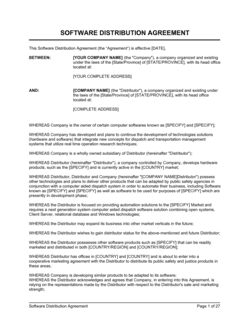
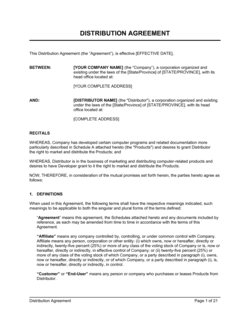
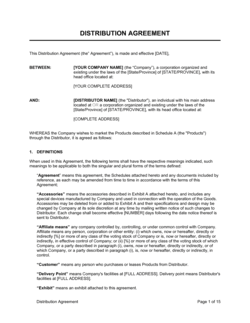
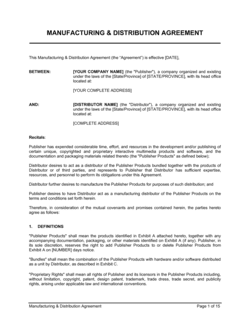
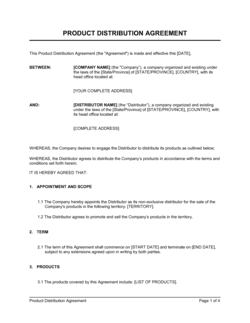
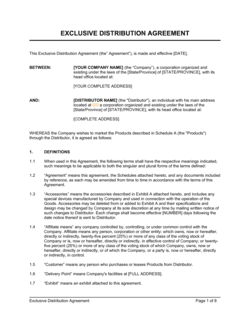
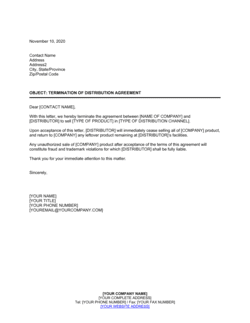
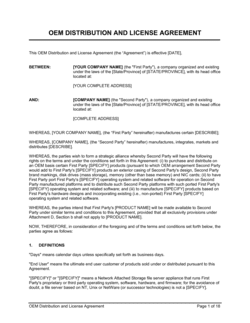
Software Distribution Agreement Template

Free Word download • Edit online • Save & share with Drive • Export to PDF

14 pages30–45 min to fillDifficulty: ComplexSignature requiredLegal review recommended
Learn more ↓
FreeSoftware Distribution Agreement Template

At a glance

What it is
A Software Distribution Agreement is a legally binding contract between a software developer or publisher (the vendor) and a third-party distributor that authorizes the distributor to market, sell, and deliver the vendor's software within a defined territory. This free Word download covers territory, license scope, pricing, IP ownership, support obligations, confidentiality, and termination in a single document you can edit online and export as PDF.
When you need it
Use it when you are a software vendor authorizing a reseller, VAR, systems integrator, or channel partner to distribute your product — or when you are a distributor formalizing the terms under which you will sell a vendor's software to end customers.
What's inside
Appointment and territory grant, license scope and restrictions, pricing and payment terms, intellectual property ownership and protection, distributor obligations and marketing commitments, end-user license pass-through, support and maintenance responsibilities, confidentiality, representations and warranties, and termination with post-termination obligations.

What is a Software Distribution Agreement?

A Software Distribution Agreement is a legally binding contract between a software vendor — the company that owns and develops the product — and a third-party distributor authorized to market, sell, and deliver that software to end customers within a defined territory. Rather than licensing the software directly to each end user, the vendor delegates the commercial relationship to the distributor, who acts as an intermediary. The agreement defines what the distributor may do with the software, on what terms end users receive it, how revenue flows between the parties, and what happens to IP, support, and active customer accounts if the relationship ends.

Unlike a simple reseller arrangement for physical goods, a software distribution agreement must address the IP-intensive nature of software: the vendor's copyright and trade secrets remain wholly owned regardless of how widely the software is distributed, and every end customer must accept the vendor's license terms — not just the distributor's commercial terms. This layered structure, with a distribution contract sitting above individual end-user licenses, is what makes software distribution agreements more complex than generic product reseller agreements.

Why You Need This Document

Operating without a signed distribution agreement exposes both parties to risks that materialize quickly once the distributor starts selling. A vendor with no written contract has no enforceable control over pricing, territorial boundaries, or how the distributor presents the software to customers — and no documented basis to terminate the relationship if performance is poor or the distributor begins misrepresenting the product. A distributor without a signed agreement has no documented authorization to sublicense, no committed transfer pricing, and no protection against the vendor pulling the product or appointing a competitor in the same territory without notice.

The consequences are concrete: disputed territories create channel conflict and customer confusion; absent EULA pass-through requirements mean end users may never formally accept the vendor's use restrictions; and missing termination wind-down provisions leave active customer accounts in limbo when the relationship ends. A signed software distribution agreement, executed before any marketing or sales activity begins, resolves all of these gaps — and this template gives vendors and distributors a complete, professionally structured starting point that can be adapted to exclusive or non-exclusive arrangements, domestic or cross-border markets, and perpetual or subscription-based software models.

Which variant fits your situation?

If your situation is…Use this template
Granting one distributor exclusive rights in a defined territoryExclusive Software Distribution Agreement
Appointing multiple resellers in the same market with no exclusivityNon-Exclusive Software Distribution Agreement
Authorizing a partner to resell SaaS subscriptions rather than perpetual licensesSaaS Reseller Agreement
Licensing software directly to an enterprise end user without a distributorSoftware License Agreement
Engaging a developer to build custom software for internal useSoftware Development Agreement
Granting a partner rights to bundle your software with their hardware productOEM Software Agreement
Formalizing a broad strategic channel partnership beyond software aloneChannel Partner Agreement

Common mistakes to avoid

❌ Granting exclusivity without a performance trigger

Why it matters: An exclusive distributor who underperforms locks the vendor out of the territory entirely, forfeiting revenue and market presence with no contractual remedy to reopen the market.

Fix: Include a clause converting exclusivity to non-exclusive — automatically or at the vendor's election — if the distributor misses its annual minimum commitment by more than a defined threshold.

❌ Allowing the distributor to use its own end-user terms

Why it matters: A distributor's standard terms may grant end users rights — such as sublicensing, modification, or access to source code — that directly contradict the vendor's IP ownership and intended use restrictions.

Fix: Require the distributor to present only the vendor's current EULA to end users, attach the EULA as an exhibit, and confirm it supersedes any distributor terms for software use.

❌ No IP infringement reporting obligation

Why it matters: A distributor encountering piracy or unauthorized copying in their territory faces no contractual incentive to report it. Infringement spreads unchecked while the vendor's IP is eroded.

Fix: Add a clause requiring the distributor to notify the vendor within 5 business days of any known or suspected infringement and to cooperate in enforcement actions at the vendor's cost.

❌ Omitting post-termination obligations for active end-user accounts

Why it matters: When the agreement ends, existing end customers may lose support, access to updates, or their license keys if neither party has a documented obligation to maintain service continuity.

Fix: Include a transition clause specifying who assumes support obligations for active end-user accounts, how long the distributor may continue renewals, and how the vendor will communicate the change to customers.

❌ No price-change notice period

Why it matters: A vendor that adjusts transfer prices immediately can make the distributor's existing customer quotes and pipeline commitments unprofitable, creating instant channel conflict.

Fix: Require a minimum of 60 days' written notice before any transfer price increase takes effect, with a carve-out protecting quotes already submitted to end customers.

❌ Missing or undefined support escalation path

Why it matters: Without documented severity levels, response times, and escalation contacts, critical end-user issues go unresolved as both parties assume the other is responsible — damaging the vendor's reputation through the distributor's customer base.

Fix: Attach a support schedule defining at least three severity levels, response and resolution targets for each, the vendor's escalation contact, and the distributor's first-line support obligations.

The 10 key clauses, explained

Appointment and territory grant

In plain language: Formally appoints the distributor and defines the geographic or market scope of their rights, and whether the appointment is exclusive or non-exclusive.

Sample language
Vendor hereby appoints [DISTRIBUTOR NAME] as a [non-exclusive / exclusive] distributor of the Software in the territory of [TERRITORY] ('Territory'), and [DISTRIBUTOR NAME] accepts such appointment, subject to the terms of this Agreement.

Common mistake: Leaving territory undefined or using vague language like 'the region.' Courts have split territories differently than the parties intended when the boundary is not specified by country code, state list, or a defined geographic description.

License scope and restrictions

In plain language: Sets out exactly what the distributor may do with the software — sublicense, demonstrate, bundle, modify — and what is expressly prohibited.

Sample language
Distributor is authorized to sublicense the Software to End Users solely for their internal use within the Territory. Distributor shall not: (a) modify, reverse engineer, or create derivative works of the Software; (b) sublicense outside the Territory; or (c) appoint sub-distributors without prior written consent.

Common mistake: Failing to prohibit sub-distribution in writing. Without an explicit restriction, a distributor can appoint its own resellers, fragmenting the vendor's channel and creating uncontrolled downstream use.

Pricing, transfer price, and payment terms

In plain language: Defines the price the distributor pays the vendor, any suggested or mandated end-user pricing, payment schedule, and currency.

Sample language
Distributor shall purchase licenses at the transfer price set out in Schedule A, payable within [30] days of invoice. Vendor reserves the right to update transfer prices on [60] days' written notice. End-user pricing is at Distributor's discretion unless a maximum resale price is specified in Schedule A.

Common mistake: Omitting a price-change notice period. A vendor that can change transfer prices immediately with no notice can make the distributor's existing customer commitments unprofitable overnight.

Minimum purchase commitments and sales targets

In plain language: Sets the minimum volume or revenue the distributor must achieve each period to maintain the appointment — and what happens if they miss the target.

Sample language
Distributor shall purchase a minimum of [X] licenses (or $[X] in transfer-price value) per contract year ('Minimum Commitment'). Failure to meet the Minimum Commitment in any year shall, at Vendor's election, convert this Agreement to non-exclusive or allow Vendor to terminate on [30] days' notice.

Common mistake: Setting a minimum commitment with no remedy clause. Without a stated consequence — exclusivity loss, right to terminate, or price adjustment — the minimum is effectively unenforceable.

Intellectual property ownership and protection

In plain language: Confirms the vendor retains all IP in the software, grants only a limited distribution right, and requires the distributor to protect and not challenge that IP.

Sample language
All right, title, and interest in and to the Software, including all related intellectual property rights, remain with Vendor. Distributor acquires no ownership rights by virtue of this Agreement. Distributor shall promptly notify Vendor of any known or suspected infringement of the Software within the Territory.

Common mistake: No requirement for the distributor to report IP infringement. A distributor encountering piracy or unauthorized copying in their territory may say nothing if they have no contractual obligation to report it.

End-user license agreement pass-through

In plain language: Requires the distributor to ensure every end customer accepts the vendor's EULA before receiving or accessing the software, and prohibits broader rights being granted to end users than the EULA permits.

Sample language
Distributor shall ensure that each End User accepts Vendor's then-current End User License Agreement ('EULA') prior to delivery or access. Distributor shall not grant End Users any rights in the Software greater than those set forth in the EULA. Vendor may update the EULA on [30] days' notice.

Common mistake: Allowing the distributor to use its own end-user terms instead of the vendor's EULA. Custom distributor terms may grant end users rights — such as sublicensing or modification — that the vendor never intended to allow.

Support, maintenance, and training

In plain language: Allocates first-line and second-line support responsibilities between the distributor and vendor, and sets out any training or certification obligations.

Sample language
Distributor shall provide first-line support to End Users. Vendor shall provide second-line support to Distributor for Errors not resolvable by Distributor, with a response time of [4] business hours for critical issues. Distributor shall complete Vendor's certification program within [90] days of execution.

Common mistake: No defined support escalation path or response times. When an end user faces a critical bug, both parties assume the other is handling it — the result is missed SLAs and damaged customer relationships.

Confidentiality

In plain language: Prevents both parties from disclosing each other's business-sensitive information — source code, pricing, customer lists, and roadmaps — during and after the agreement.

Sample language
Each party agrees to hold the other's Confidential Information in strict confidence and not to disclose it to any third party without prior written consent. 'Confidential Information' excludes information that is publicly known, independently developed, or received lawfully from a third party.

Common mistake: No post-termination survival period on confidentiality. Source code, pricing schedules, and customer data remain sensitive after the contract ends — the obligation should survive for at least 3–5 years.

Representations, warranties, and indemnification

In plain language: Each party warrants that they have authority to enter the agreement, the vendor warrants the software performs materially as documented, and the parties allocate liability for IP claims and third-party losses.

Sample language
Vendor warrants that the Software, when used as directed, will perform materially in accordance with the Documentation. Vendor shall indemnify Distributor against third-party claims that the Software infringes a third party's IP. Distributor shall indemnify Vendor against claims arising from Distributor's acts, omissions, or misrepresentations to End Users.

Common mistake: One-sided indemnification that only protects the vendor. Distributors who face IP infringement claims from end customers — based on vendor-supplied software — have no recourse if the indemnity only runs from distributor to vendor.

Termination and post-termination obligations

In plain language: Sets out grounds for termination (for cause, for convenience, or on expiry), notice periods, and what both parties must do after the agreement ends — including stock-sell-off periods and return of confidential materials.

Sample language
Either party may terminate this Agreement for convenience on [90] days' written notice. Either party may terminate immediately for material breach not cured within [30] days of written notice. Upon termination, Distributor shall cease all distribution activities, fulfill existing End User orders within [60] days, and return or destroy all Confidential Information.

Common mistake: No wind-down or sell-off period on termination. A distributor holding pre-purchased inventory or active customer commitments cannot simply stop overnight — omitting a reasonable sell-off period guarantees a dispute.

How to fill it out

  1. 1

    Identify the parties and define the software

    Enter both parties' full registered legal names and jurisdictions. Attach a Schedule or exhibit that precisely identifies the software by name, version, and format — perpetual license, SaaS subscription, or source code.

    💡 Use the exact legal entity name from corporate registry filings. A trade name or abbreviation can complicate enforcement against the right entity.

  2. 2

    Define the territory and exclusivity

    Specify the territory by country name, ISO country code, or a list of states or provinces. State clearly whether the appointment is exclusive, non-exclusive, or exclusive with carve-outs for the vendor's direct sales to named accounts.

    💡 If granting exclusivity, include a performance-based conversion clause — missed targets automatically convert the appointment to non-exclusive rather than triggering a termination dispute.

  3. 3

    Set transfer pricing and payment terms

    Complete Schedule A with the transfer price per license or per seat, volume discount tiers if applicable, currency, and payment terms. Include the notice period required before any price change takes effect.

    💡 State currency explicitly for cross-border arrangements. USD and EUR invoiced to the same distributor create reconciliation problems unless the agreement fixes an exchange-rate mechanism or billing currency.

  4. 4

    Specify minimum purchase commitments and consequences

    Set an annual minimum license purchase or revenue target and write the specific remedy for missing it — exclusivity loss, right to terminate, or right to appoint additional distributors in the territory.

    💡 Calibrate the minimum to what the distributor's first-year pipeline can realistically support. An unachievable minimum drives early termination and channel conflict.

  5. 5

    Define IP protections and EULA pass-through requirements

    Confirm the vendor's IP ownership clause, attach the current EULA as an exhibit, and require the distributor to obtain end-user acceptance before delivery. Note who bears responsibility for updating EULA terms as the product evolves.

    💡 If the vendor updates the EULA, give at least 30 days' notice — distributors with active proposals cannot reissue terms overnight without disrupting sales cycles.

  6. 6

    Allocate support responsibilities

    Assign first-line support to the distributor and second-line escalation to the vendor. Define severity levels, response times, and the escalation path for each level. Set any training or certification conditions.

    💡 Write SLA response times in business hours, not calendar hours, and specify the time zone to avoid ambiguity for cross-border arrangements.

  7. 7

    Tailor termination and wind-down provisions

    Set notice periods for convenience termination (typically 60–90 days for distribution agreements) and cure periods for material breach (typically 30 days). Include a sell-off or transition period of 60–90 days for the distributor to fulfill existing commitments.

    💡 Address what happens to active end-user subscriptions on termination — silent contracts leave end customers without support and the vendor facing chargebacks.

  8. 8

    Execute before any distribution activity begins

    Both authorized signatories must sign before the distributor markets, demos, or sells the software. Obtain a countersigned copy and store it in your document management system alongside all schedules.

    💡 In cross-border arrangements, confirm that each signatory has board or corporate authority to bind their entity — a signature from an unauthorized representative can void the agreement in some jurisdictions.

Frequently asked questions

What is a software distribution agreement?

A software distribution agreement is a legally binding contract between a software vendor and a third-party distributor that authorizes the distributor to market, sell, and deliver the vendor's software within a defined territory. It sets out the scope of the distribution right, pricing, IP protections, end-user license pass-through requirements, support obligations, and termination terms. Unlike a direct license, the vendor does not contract with end users directly — the distributor acts as the commercial intermediary.

What is the difference between a software distribution agreement and a software license agreement?

A software license agreement is a direct contract between the vendor and the end user governing how the software may be used. A distribution agreement is a commercial contract between the vendor and an intermediary authorizing that intermediary to sell or sublicense the software to end users. The two documents operate in tandem — the distributor must ensure every end user accepts the vendor's EULA, which is separate from and downstream of the distribution agreement.

Should a software distribution agreement be exclusive or non-exclusive?

Exclusivity depends on the distributor's market strength and the vendor's channel strategy. Exclusive agreements are appropriate when the distributor has dominant market presence in the territory and the vendor needs a committed partner. Non-exclusive arrangements work better when the vendor wants multiple resellers competing on price and coverage. Most vendors tie exclusivity to performance: if the distributor misses its annual minimum, exclusivity converts to non-exclusive automatically.

Who owns the intellectual property in a software distribution agreement?

The vendor retains all intellectual property rights in the software — copyright, patents, trademarks, and trade secrets — regardless of the distribution arrangement. The distribution agreement grants the distributor a limited commercial right to sell and sublicense, not an ownership interest. This distinction must be explicit in the IP ownership clause to prevent downstream claims based on the distributor's investment in marketing or customer development.

What happens to existing end users when a software distribution agreement is terminated?

Termination creates risk for end customers who purchased through the distributor if neither party has documented transition obligations. A well-drafted agreement includes a wind-down or sell-off period — typically 60–90 days — during which the distributor fulfills pending orders, and specifies who assumes support responsibility for active accounts. Without this clause, end users may face loss of support, license key issues, or service interruption, exposing the vendor to reputational damage and potential liability.

Is a software distribution agreement legally required?

No law mandates a formal written distribution agreement, but operating without one creates serious exposure. Without a written contract, the vendor has no enforceable restrictions on how the distributor uses, markets, or sublicenses the software — and no documented basis to terminate the relationship or reclaim the territory if performance is poor. In most jurisdictions, courts will imply commercially reasonable terms where none exist, which are rarely aligned with what the vendor intended.

What minimum purchase commitments should a software distribution agreement include?

Minimum commitments are typically expressed as an annual license count or transfer-price dollar value and should reflect a realistic assessment of the distributor's pipeline for the first 12 months. A common structure is a lower Year 1 threshold that steps up in Years 2 and 3 as the distributor ramps. The agreement should specify the exact consequence of missing the minimum — exclusivity loss, right to terminate, or the right to appoint additional distributors — rather than leaving the remedy unstated.

Does a software distribution agreement need to be reviewed by a lawyer?

For straightforward domestic reseller arrangements, a high-quality template is a strong starting point. Legal review is strongly recommended when the distribution right is exclusive, when the territory spans multiple countries with different IP or competition laws, when the software handles personal data subject to GDPR or similar regulations, or when the deal value is material. A template review by a technology lawyer typically costs $500–$1,500 and is worthwhile for any exclusive arrangement or cross-border deployment.

How should pricing and transfer prices be structured in the agreement?

Transfer prices — what the distributor pays the vendor per license or seat — are typically set in a schedule rather than the body of the agreement so they can be updated without a full contract amendment. The schedule should specify the base transfer price, any volume discount tiers, currency, payment terms (Net 30 is standard), and the minimum notice period before the vendor may increase prices. Suggested or maximum end-user pricing, if applicable, should also appear in the schedule.

How this compares to alternatives

vs Software License Agreement

A software license agreement is a direct contract between the vendor and an end user governing permitted use of the software. A distribution agreement is a commercial contract between the vendor and an intermediary authorizing resale or sublicensing. Use a license agreement when selling directly to end users; use a distribution agreement when appointing a reseller or channel partner to reach them.

vs Software Development Agreement

A software development agreement governs the creation of custom software by one party for another, including deliverables, milestones, IP ownership of the developed work, and acceptance testing. A distribution agreement presupposes the software already exists and governs only its commercial distribution. The two may be used together when a vendor also contracts the distributor to perform implementation services.

vs Reseller Agreement

A reseller agreement is a broader commercial document covering the resale of any product or service, not specific to software. A software distribution agreement is tailored to the IP-intensive nature of software — adding EULA pass-through, source code protections, IP indemnification, and sublicensing restrictions that a generic reseller agreement typically omits. For software specifically, use the software-specific form.

vs Channel Partner Agreement

A channel partner agreement typically governs a broader commercial relationship — co-marketing, co-selling, referral fees, and joint pipeline management — that may or may not include distribution rights. A software distribution agreement is narrower and more enforceable on IP and sublicensing terms. Where a partner has both referral and distribution rights, both documents are often used together.

Industry-specific considerations

SaaS / Technology

Subscription-based transfer pricing per seat, auto-renewal pass-through to end users, and data processing addenda required where the distributor handles personal data on the vendor's behalf.

Enterprise Software

Site license and enterprise agreement structures, volume discount schedules, mandatory certification programs, and named-account carve-outs from the distributor's exclusivity.

Healthcare / MedTech

FDA or CE mark compliance obligations passed through to distributors, HIPAA Business Associate Agreement requirements for US markets, and heightened confidentiality for patient data.

Financial Services

Regulatory licensing requirements for financial software distributors, audit rights and record-keeping obligations, and FCA or SEC compliance clauses depending on territory.

Manufacturing / Industrial

OEM bundling arrangements with hardware, export control compliance for dual-use software, and territory restrictions aligned to industrial distribution networks.

Professional Services / Consulting

Systems integrators bundling vendor software into client deployments, custom implementation services carved out of the distribution scope, and client-specific end-user license arrangements.

Jurisdictional notes

United States

US distribution agreements are governed by state contract law — choice of law and venue clauses should specify the state. California, New York, and Delaware are the most common choices. Export control laws (EAR, ITAR) apply to software distributed internationally from the US; certain encryption products require export licenses. Non-compete restrictions on distributors vary sharply by state and may be unenforceable in California.

Canada

Canadian distribution agreements should address both common-law provinces and Quebec, where civil law applies and contracts may need to meet additional formalities. PIPEDA and provincial privacy laws (notably Quebec's Law 25) impose data handling obligations if the distributor processes personal data. Minimum notice periods for terminating distribution relationships are implied by statute in some provinces, particularly for exclusive arrangements.

United Kingdom

Post-Brexit, UK and EU distribution arrangements require separate contractual consideration. UK GDPR applies when personal data is processed in connection with software distribution to UK customers. The Commercial Agents (Council Directive) Regulations 1993 do not typically apply to software distributors acting as principals (buying and reselling), but vendors should confirm the distributor's legal characterization before assuming this exemption.

European Union

GDPR requirements attach to any distribution arrangement involving personal data processing by EU-based distributors or end users; a Data Processing Agreement or addendum is typically required alongside the distribution agreement. EU competition law (Article 101 TFEU) restricts certain territorial exclusivity and resale price maintenance provisions — absolute territorial exclusivity preventing parallel imports within the EU is generally prohibited. The Vertical Block Exemption Regulation (VBER) updated in 2022 provides a safe harbor for compliant arrangements.

Template vs lawyer — what fits your deal?

PathBest forCostTime
Use the templateNon-exclusive domestic software resellers and VARs with standard pricing and no cross-border complexityFree30–60 minutes
Template + legal reviewExclusive appointments, SaaS subscription distribution, cross-border arrangements, or deals where the distributor handles personal data$500–$1,5003–5 business days
Custom draftedHigh-value exclusive territory grants, multi-jurisdiction distribution networks, regulated industries, or enterprise software with material IP and indemnification exposure$2,500–$8,000+2–4 weeks

Glossary

Vendor
The software developer or publisher that owns the product and grants distribution rights to the distributor under this agreement.
Distributor
The company or individual authorized to market, sell, and deliver the vendor's software to end users within a defined territory.
Territory
The specific geographic region, country, or set of countries within which the distributor is permitted to sell and support the software.
Exclusive Distribution
An arrangement where the vendor agrees not to appoint any other distributor — or sell directly — within the agreed territory for the duration of the agreement.
End-User License Agreement (EULA)
A separate contract between the vendor and the end customer that governs how the software may be used; the distributor must ensure each end user accepts it before receiving the software.
Resale Price
The price at which the distributor sells the software to end customers, which may be set by the vendor, suggested, or left to the distributor's discretion depending on the agreement.
Transfer Price
The price the distributor pays the vendor for each software license or subscription unit it procures for resale.
Minimum Purchase Commitment
A contractual floor requiring the distributor to purchase or sell a defined number of licenses or a minimum dollar value within a specified period — commonly annual.
Intellectual Property (IP)
All proprietary rights in the software — including copyright, patents, trademarks, and trade secrets — which remain owned by the vendor regardless of any distribution arrangement.
Sublicense
The distributor's act of granting end users the right to use the vendor's software; the distributor passes through the vendor's license terms rather than creating new rights.
Indemnification
A contractual obligation requiring one party to compensate the other for specified losses — typically, the vendor indemnifies the distributor against IP infringement claims, and the distributor indemnifies the vendor against its own acts or omissions.
Termination for Cause
The right to end the agreement immediately, without notice or payment, upon a defined material breach — such as unauthorized sublicensing, IP misuse, or insolvency.

Part of your Business Operating System

This document is one of 3,000+ business & legal templates included in Business in a Box.

  • Fill-in-the-blanks — ready in minutes
  • 100% customizable Word document
  • Compatible with all office suites
  • Export to PDF and share electronically

Create your document in 3 simple steps.

From template to signed document — all inside one Business Operating System.
1
Download or open template

Access over 3,000+ business and legal templates for any business task, project or initiative.

2
Edit and fill in the blanks with AI

Customize your ready-made business document template and save it in the cloud.

3
Save, Share, Send, Sign

Share your files and folders with your team. Create a space of seamless collaboration.

Save time, save money, and create top-quality documents.

★★★★★

"Fantastic value! I'm not sure how I'd do without it. It's worth its weight in gold and paid back for itself many times."

Managing Director · Mall Farm
Robert Whalley
Managing Director, Mall Farm Proprietary Limited
★★★★★

"I have been using Business in a Box for years. It has been the most useful source of templates I have encountered. I recommend it to anyone."

Business Owner · 4+ years
Dr Michael John Freestone
Business Owner
★★★★★

"It has been a life saver so many times I have lost count. Business in a Box has saved me so much time and as you know, time is money."

Owner · Upstate Web
David G. Moore Jr.
Owner, Upstate Web

Run your business with a system — not scattered tools

Stop downloading documents. Start operating with clarity. Business in a Box gives you the Business Operating System used by over 250,000 companies worldwide to structure, run, and grow their business.

Start free · No credit card required