Agreement of Transfer Template

Free Word download β€’ Edit online β€’ Save & share with Drive β€’ Export to PDF

2 pagesβ€’25–30 min to fillβ€’Difficulty: Standardβ€’Signature requiredβ€’Legal review recommended
Learn more ↓
FreeAgreement of Transfer Template

At a glance

What it is
An Agreement of Transfer is a legally binding document that formally conveys ownership of an asset, contract right, or intellectual property from one party (the transferor) to another (the transferee). This free Word download covers the description of the transferred property, consideration paid, representations and warranties, and the effective date β€” flexible enough for shares, IP, tangible assets, or contractual interests.
When you need it
Use it any time ownership of a defined asset or right changes hands and you need written proof of the transfer, a clear effective date, and enforceable warranties from the transferor about what they are conveying. Common triggers include business acquisitions, IP assignments, share sales between shareholders, and novation of contracts.
What's inside
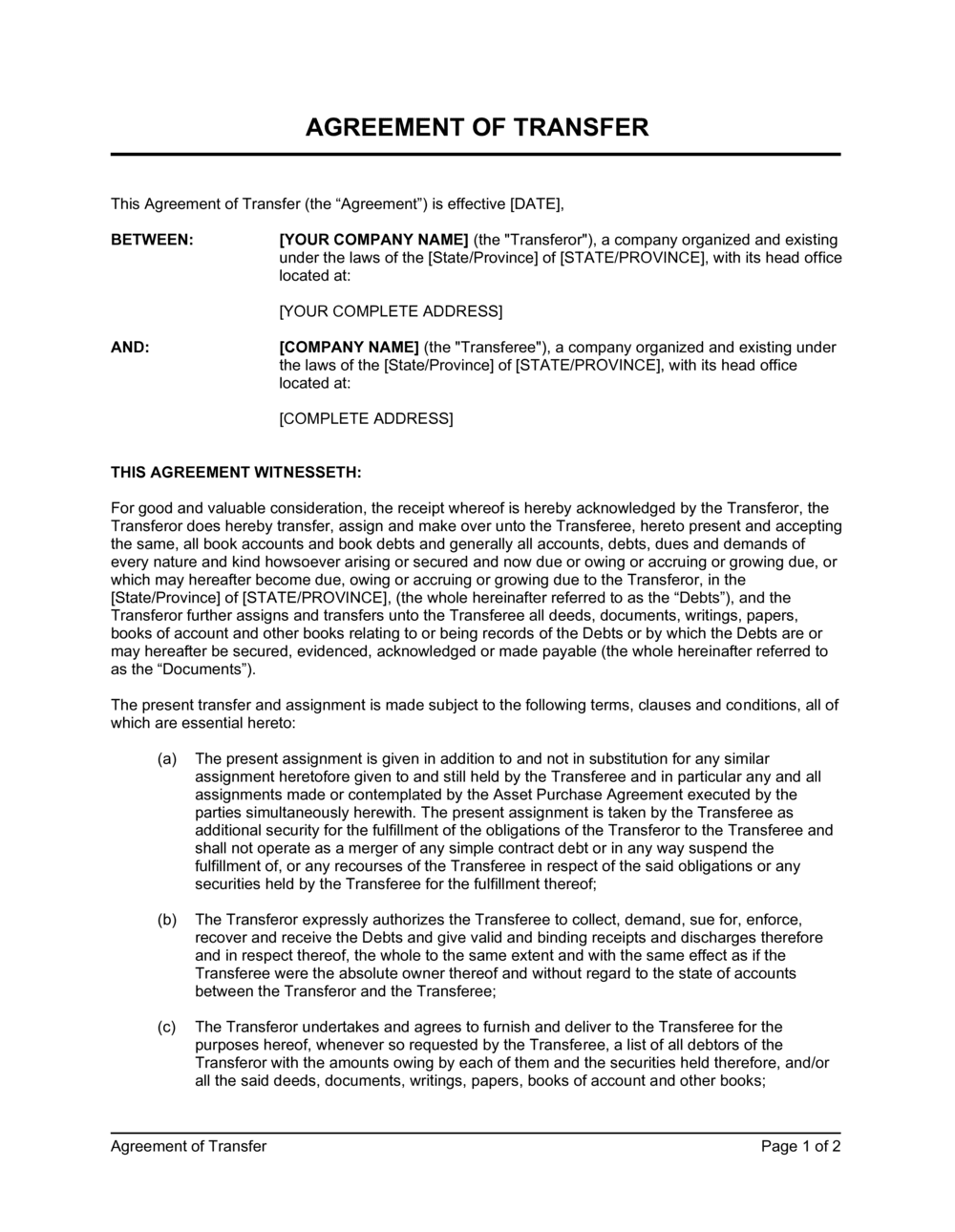
Identification of the parties and the asset being transferred, consideration and payment terms, representations and warranties from the transferor, conditions precedent to closing, indemnification, and governing law with dispute resolution. A schedule is included for a detailed description of the transferred asset.

What is an Agreement of Transfer?

An Agreement of Transfer is a legally binding document that formally conveys ownership of an asset, contract right, or intellectual property from one party β€” the transferor β€” to another β€” the transferee. It records a precise description of what is being transferred, the consideration paid, the representations and warranties the transferor makes about title and encumbrances, any conditions that must be satisfied before the transfer becomes effective, and the governing law. Unlike a simple bill of sale, a transfer agreement is flexible enough to cover a wide range of asset classes β€” shares, IP portfolios, tangible equipment, or contractual interests β€” and provides enforceable warranty and indemnification protections that survive closing.

Why You Need This Document

Transferring an asset without a written agreement leaves both parties exposed on multiple fronts at once. The transferee has no documented basis to claim good title if a prior encumbrance or competing claim surfaces after closing. The transferor has no evidence of what was β€” and was not β€” included in the transfer, making post-deal disputes about scope almost impossible to resolve cleanly. Without representations and warranties, a transferee who discovers a hidden lien or an undisclosed no-assignment clause in an underlying contract has no contractual remedy against the seller. And without a defined effective date and delivery checklist, the chain of title remains legally ambiguous β€” a problem that compounds over time whenever the asset is subsequently sold, licensed, or used as collateral. A properly drafted agreement of transfer closes all of these gaps: it establishes an unambiguous effective date, documents what changed hands, allocates liability for pre-closing defects, and creates enforceable warranties that protect the transferee if the asset turns out to be different from what was promised.

Which variant fits your situation?

If your situation is…Use this template
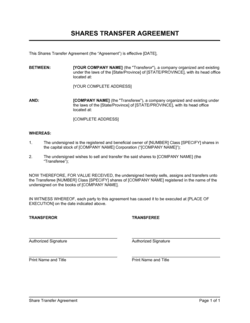
Transferring shares in a private company between shareholdersShare Transfer Agreement
Assigning intellectual property rights to an employer or acquirerIP Assignment Agreement
Transferring a contract so a new party steps into all rights and obligationsContract Novation Agreement
Selling a business as a going concern including all assetsBusiness Purchase Agreement
Transferring real property or landProperty Sale Agreement
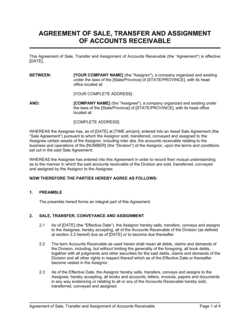
Assigning only the right to receive payments under an existing contractAssignment of Receivables Agreement
Gifting an asset without monetary considerationDeed of Gift

Common mistakes to avoid

❌ Vague asset description without a schedule

Why it matters: Courts cannot enforce a transfer of 'the business assets' or 'all intellectual property' β€” post-closing disputes about what was included are the most common source of transfer litigation.

Fix: Attach a numbered Schedule A listing each asset with identifying details β€” registration numbers, serial numbers, contract references β€” and have both parties initial it at signing.

❌ No disclosure of encumbrances or required consents

Why it matters: Undisclosed liens or no-assignment clauses in underlying contracts can invalidate the transfer entirely or expose the transferor to warranty breach claims for the full consideration received.

Fix: Conduct a lien search and review all underlying contracts before signing. Disclose everything in Schedule B and C β€” price adjustments are easier to negotiate than post-closing litigation.

❌ Omitting an indemnification cap

Why it matters: An unlimited indemnity can expose the transferor to liability far exceeding the consideration received, especially if the asset carries latent environmental, IP, or regulatory liabilities.

Fix: Cap indemnification at the purchase price, with carve-outs for fraud, willful misconduct, and breaches of fundamental warranties (title and authority to transfer).

❌ Signing after the stated effective date

Why it matters: Many jurisdictions do not give retroactive effect to transfer documents. A signature date after the effective date can create a gap in the chain of title and complicate tax and accounting treatment.

Fix: Execute the agreement on or before the effective date. If circumstances require a later signature, change the effective date to match the actual signing date and update any ancillary closing documents accordingly.

❌ Using a general transfer agreement for assets requiring a specialized instrument

Why it matters: Shares, real property, registered patents, and trademarks typically require jurisdiction-specific instruments β€” a stock transfer form, deed, or recorded assignment β€” in addition to or instead of a general agreement.

Fix: Confirm the form of transfer required for the specific asset class in the governing jurisdiction before relying solely on this agreement. Consult a lawyer for any registered asset transfer.

❌ No entire-agreement clause when a letter of intent was exchanged

Why it matters: Without an integration clause, pre-contract emails, term sheets, and letters of intent remain potentially enforceable, creating a patchwork of competing obligations that courts struggle to reconcile.

Fix: Include a standard entire-agreement clause and ensure all agreed schedules are attached and referenced before signing. Any surviving pre-contract commitments should be listed explicitly.

The 10 key clauses, explained

Parties and recitals

In plain language: Identifies the transferor and transferee by their full legal names and entity types, and provides background context explaining why the transfer is taking place.

Sample language
This Agreement of Transfer is entered into as of [EFFECTIVE DATE] between [TRANSFEROR LEGAL NAME], a [STATE/PROVINCE] [ENTITY TYPE] ('Transferor'), and [TRANSFEREE LEGAL NAME], a [STATE/PROVINCE] [ENTITY TYPE] ('Transferee').

Common mistake: Using a trade name or informal abbreviation instead of the registered legal entity name. If the transferor entity name is wrong, the transfer may not be binding on the actual owner of the asset.

Description of the transferred asset

In plain language: Precisely identifies the asset, right, or contract interest being transferred β€” referenced in a Schedule for complex or multi-item transfers.

Sample language
Transferor hereby transfers and assigns to Transferee all right, title, and interest in and to the asset(s) described in Schedule A attached hereto (the 'Transferred Asset'), free and clear of all encumbrances except as disclosed in Schedule B.

Common mistake: Using a vague description such as 'the business assets' without a detailed schedule. Ambiguity about what was transferred is the single most common source of post-closing disputes.

Consideration and payment terms

In plain language: States the price or other value the transferee provides in exchange for the asset and when and how payment is made.

Sample language
In consideration for the transfer of the Transferred Asset, Transferee shall pay to Transferor the sum of [PURCHASE PRICE] USD, payable as follows: [X]% on the Effective Date and the balance within [N] days of [CONDITION/DATE].

Common mistake: Stating consideration as 'one dollar and other good and valuable consideration' when a real price was agreed. Courts give this language reduced weight and it creates ambiguity in disputes about whether fair value was paid.

Representations and warranties of the transferor

In plain language: The transferor's factual promises about ownership, authority to transfer, absence of encumbrances, and the condition of the asset β€” forming the basis for indemnification claims if false.

Sample language
Transferor represents and warrants that: (a) Transferor has good and marketable title to the Transferred Asset; (b) the Transferred Asset is free and clear of all liens, claims, and encumbrances except as set out in Schedule B; (c) Transferor has full power and authority to execute this Agreement and effect the transfer; and (d) no consent, approval, or authorization of any third party is required, except as listed in Schedule C.

Common mistake: Limiting warranties to 'best of knowledge' without defining what knowledge means and whose knowledge counts. This loophole is routinely exploited by transferors who later claim ignorance of defects they reasonably should have known about.

Representations and warranties of the transferee

In plain language: The transferee's confirmations that they have the authority to enter the agreement and the financial capacity to complete the purchase.

Sample language
Transferee represents and warrants that: (a) Transferee has full power and authority to execute and perform this Agreement; (b) this Agreement constitutes a legal, valid, and binding obligation of Transferee; and (c) Transferee has the financial resources to pay the consideration as set out herein.

Common mistake: Omitting transferee warranties entirely. If the transferee is a shell entity without capacity or funding, the transferor has no contractual basis to recover if closing fails.

Conditions precedent to closing

In plain language: Events or approvals that must occur before the transfer becomes effective β€” such as third-party consents, regulatory filings, or payment receipt.

Sample language
The obligations of each party to complete the transfer are subject to the satisfaction of the following conditions on or before the Effective Date: (a) receipt of written consent from [THIRD PARTY]; (b) completion of [REGULATORY FILING]; and (c) delivery by Transferor of all documents listed in Schedule D.

Common mistake: Skipping conditions precedent when the asset requires third-party consent to transfer β€” such as a licensed IP portfolio or a contract with a no-assignment clause. Failing to obtain consent can void the transfer or expose both parties to breach claims.

Delivery and closing mechanics

In plain language: Specifies what documents and items the transferor must physically or electronically deliver at closing to complete the transfer β€” certificates, access credentials, executed assignments, and keys.

Sample language
On or before the Effective Date, Transferor shall deliver to Transferee: (a) a duly executed bill of sale or assignment instrument for the Transferred Asset; (b) all physical items constituting the Transferred Asset; and (c) any passwords, access credentials, or registration documents necessary for Transferee to exercise full ownership.

Common mistake: No delivery checklist in the agreement. Disputes about what was or was not handed over are far harder to resolve without a written delivery schedule signed by both parties at closing.

Indemnification

In plain language: Allocates liability for losses arising from breaches of representations, warranties, or pre-transfer obligations β€” defining who pays, for how long, and up to what cap.

Sample language
Transferor shall indemnify, defend, and hold harmless Transferee from and against any losses, damages, claims, or expenses arising from: (a) any breach of Transferor's representations or warranties; (b) any pre-closing liabilities relating to the Transferred Asset; or (c) any third-party claim arising from Transferor's ownership or use of the Transferred Asset prior to the Effective Date.

Common mistake: No cap on indemnification liability. An unlimited indemnity can expose the transferor to claims exceeding the consideration received β€” include a cap tied to the purchase price, with carve-outs for fraud and willful misconduct.

Governing law and dispute resolution

In plain language: Specifies which jurisdiction's law governs the agreement and the process for resolving disputes β€” arbitration, mediation, or litigation.

Sample language
This Agreement is governed by the laws of [STATE / PROVINCE / COUNTRY]. Any dispute arising under or in connection with this Agreement shall be resolved by [binding arbitration / mediation / the courts of [JURISDICTION]], and the parties irrevocably submit to the exclusive jurisdiction of such forum.

Common mistake: Choosing a governing law with no connection to either party or the asset's location. Courts in several jurisdictions will apply local law regardless of what the contract states if the choice of law is purely arbitrary.

Entire agreement and amendment

In plain language: Confirms that this document is the complete agreement between the parties and that no prior representations or side letters apply unless they are attached as schedules.

Sample language
This Agreement, together with its Schedules, constitutes the entire agreement between the parties with respect to the transfer of the Transferred Asset and supersedes all prior negotiations, representations, warranties, and understandings. No amendment shall be effective unless signed in writing by both parties.

Common mistake: No entire-agreement clause when prior letters of intent or term sheets were exchanged. Without it, the other party may argue that informal pre-contract commitments survive and override the signed document.

How to fill it out

  1. 1

    Identify both parties with full legal names

    Enter the transferor's and transferee's registered legal entity names β€” not trade names or abbreviations. Include entity type (LLC, corporation, individual) and jurisdiction of formation.

    πŸ’‘ Cross-check the transferor's name against the title document, share register, or IP registration record for the asset being transferred β€” a name mismatch creates a chain-of-title gap.

  2. 2

    Describe the transferred asset precisely in Schedule A

    Write a detailed description of every asset, right, or contract interest being transferred. For IP, include registration numbers. For equipment, include serial numbers. For contracts, include the counterparty name and date.

    πŸ’‘ If you are transferring multiple items, number them individually in the schedule β€” 'all assets of the business' is not specific enough to survive a dispute.

  3. 3

    Set the consideration amount and payment schedule

    Enter the agreed purchase price or other consideration in full. If payment is staged, specify each amount, trigger event, and deadline. State the currency explicitly.

    πŸ’‘ For non-cash consideration β€” equity, services, or debt forgiveness β€” describe it with the same precision you would use for a cash amount.

  4. 4

    Disclose encumbrances and required consents in Schedules B and C

    List any liens, charges, or third-party claims on the asset in Schedule B. In Schedule C, list every consent or approval needed to transfer β€” check the underlying contracts and IP registrations for no-assignment clauses.

    πŸ’‘ Failing to disclose a known encumbrance is a warranty breach from day one. Disclose everything and let the price negotiation account for it.

  5. 5

    Tailor the representations and warranties to the asset type

    Adjust the warranty list to match what you are transferring: IP transfers need warranties about inventorship and no prior licenses; share transfers need warranties about fully paid-up status and no pre-emptive rights; equipment transfers need warranties about condition and no regulatory holds.

    πŸ’‘ Add a materiality threshold (e.g., 'no encumbrances exceeding $[X]') to the warranty section to avoid triggering indemnification claims over minor issues.

  6. 6

    Define conditions precedent and a long-stop date

    List every event that must occur before closing and set a long-stop date β€” the date after which either party may terminate if conditions remain unsatisfied.

    πŸ’‘ A long-stop date prevents the deal from hanging open indefinitely if a required consent is delayed. Thirty to sixty days is typical for most asset transfers.

  7. 7

    Complete the delivery checklist in Schedule D

    List every document, physical item, and access credential the transferor must deliver at closing. Both parties should sign off on Schedule D at closing to confirm delivery.

    πŸ’‘ For digital assets β€” software, domain names, social accounts β€” include account transfer confirmations and password changes as explicit delivery items.

  8. 8

    Sign before the effective date and retain executed copies

    Both parties must sign before or on the effective date. Signatures after the stated effective date create a retroactivity problem β€” some jurisdictions do not recognize backdated transfers. Store signed copies with the asset's title records.

    πŸ’‘ For IP, shares, or real property, a signed agreement alone may not be sufficient β€” check whether a separate registered instrument (assignment deed, stock transfer form, or deed of transfer) is required in the governing jurisdiction.

Frequently asked questions

What is an agreement of transfer?

An agreement of transfer is a legally binding document that formally conveys ownership of an asset, right, or contractual interest from one party (the transferor) to another (the transferee). It records the description of the asset, the consideration paid, the effective date, and the transferor's representations about title and encumbrances. It is used for a wide range of assets including equipment, intellectual property, shares, and contract rights.

When do I need an agreement of transfer?

You need one any time ownership of a defined asset changes hands and you need written evidence of the transfer, an enforceable effective date, and warranties about what is being conveyed. Common situations include selling business equipment, assigning IP into a new entity, transferring shares between shareholders, and substituting a party to an ongoing contract.

What is the difference between an assignment and a transfer?

Assignment typically refers to conveying rights under a contract to a new party, while the original party may remain on the hook for obligations. A transfer is broader β€” it conveys full ownership of an asset or right, including both benefits and liabilities. Novation goes further still by replacing a party to a contract with the consent of all parties, fully releasing the original party. The terms are sometimes used interchangeably in practice, so the substance of what is being conveyed matters more than the label.

Does an agreement of transfer need to be notarized?

In most jurisdictions, a simple asset transfer agreement does not require notarization to be enforceable. However, transfers of real property, certain share transfers, and some registered IP assignments require notarization, witnessing, or registration with a government authority to have full legal effect. Check the specific requirements for your asset class and jurisdiction before relying solely on a signed agreement.

What warranties should a transferor give in an asset transfer?

At minimum, the transferor should warrant: good and marketable title to the asset, absence of undisclosed encumbrances or competing claims, authority to enter into and perform the agreement, and that no third-party consent is required other than those listed. For specific asset types, additional warranties apply β€” IP transfers typically require warranties about inventorship, no prior exclusive licenses, and no pending infringement claims.

What is the difference between a transfer agreement and a bill of sale?

A bill of sale is a simpler document used primarily for tangible personal property β€” equipment, vehicles, inventory β€” that records the sale and passes title. A transfer agreement is a more comprehensive contract that also covers representations and warranties, conditions precedent, indemnification, and dispute resolution. For high-value or complex transfers involving IP, shares, or contracts, a full transfer agreement provides significantly stronger protection than a bill of sale alone.

Can I use this template for transferring shares?

This general-purpose template is a starting point, but share transfers typically require a dedicated share transfer agreement that addresses pre-emptive rights, shareholder approval, share certificate delivery, and updates to the company's share register. In many jurisdictions, a specific stock transfer form prescribed by company law must also be completed. For share transfers, use the Business in a Box Share Transfer Agreement template and confirm local requirements with a lawyer.

How should I handle tax implications of an asset transfer?

Tax treatment varies significantly by asset type, jurisdiction, and the relationship between the parties. Share transfers may attract stamp duty or capital gains tax. IP transfers can have transfer pricing implications for related-party transactions. Equipment transfers may trigger sales tax or VAT. The transfer agreement itself does not resolve tax obligations β€” consult an accountant or tax advisor before finalizing the consideration structure and effective date.

How this compares to alternatives

vs Share Transfer Agreement

A share transfer agreement is specifically designed for conveying equity ownership in a company β€” covering pre-emptive rights, share register updates, and certificate delivery. A general agreement of transfer can reference shares but lacks the corporate-specific mechanics required in most jurisdictions. Use a dedicated share transfer agreement for any equity transaction.

vs Business Purchase Agreement

A business purchase agreement transfers an entire business as a going concern β€” including all assets, liabilities, employees, and contracts β€” under a single comprehensive instrument. An agreement of transfer is appropriate for transferring a specific, defined asset or right rather than a whole business. For acquisitions involving multiple asset classes, goodwill, and employee transfers, the business purchase agreement is the correct starting point.

vs Non-Disclosure Agreement

An NDA protects confidential information shared during due diligence before a transfer is agreed β€” it does not transfer any ownership. The two documents serve different stages of a transaction: the NDA governs pre-deal information sharing; the agreement of transfer closes the deal. Both are typically used together in any significant asset sale process.

vs Independent Contractor Agreement

An independent contractor agreement governs an ongoing service relationship and typically includes an IP assignment clause for work product created under the engagement. If you only need to transfer ownership of a specific, already-created asset from a contractor to your business, a standalone agreement of transfer is cleaner and more precise than amending a service agreement.

Industry-specific considerations

Technology / SaaS

Founders assign IP, domain names, and software code developed pre-incorporation into the company entity; acquirers transfer licensed software and customer contracts at exit.

Manufacturing

Transfer of production equipment, tooling, and supplier contracts when facilities change hands or a product line is divested.

Professional Services

Transfer of client contracts and goodwill when a practice or book of business is sold, requiring counterparty consent and client notification provisions.

Creative and Media

Copyright and trademark transfers from individual creators to studios, agencies, or corporate owners, with moral rights considerations in applicable jurisdictions.

Jurisdictional notes

United States

Asset transfers are generally governed by state law under the UCC for personal property. Real property requires a deed recorded with the county. IP assignments should be recorded with the USPTO or Copyright Office within three months to protect against subsequent purchasers. Some states impose transfer taxes on certain asset categories; confirm tax treatment before setting the effective date.

Canada

Personal property transfers are governed by provincial personal property security legislation, and security interests must be released or transferred accordingly. IP assignments should be recorded with CIPO for patents and trademarks to protect priority. Quebec civil law may require specific formalities for certain transfers. GST/HST may apply to commercial asset transfers; consult a tax advisor on structuring.

United Kingdom

Transfers of shares in UK companies require a stock transfer form and payment of 0.5% stamp duty on consideration above Β£1,000. IP assignments should be recorded at the UK Intellectual Property Office to take effect against third parties. Business asset transfers may trigger SDLT if real property is included. Post-Brexit, EU IP registrations and UK registrations are now separate and must be assigned independently.

European Union

IP assignment requirements vary by member state β€” EU trademark and design assignments must be recorded with EUIPO to have effect against third parties. Transfer of contracts involving personal data processing may require a data transfer impact assessment under GDPR. Some member states impose transfer taxes or notarial requirements for certain asset categories; France, Germany, and Spain each have distinct formalities for commercial asset sales.

Template vs lawyer β€” what fits your deal?

PathBest forCostTime
Use the templateStraightforward transfers of tangible assets or informal IP assignments between known parties with low dollar valuesFree30–60 minutes
Template + legal reviewIP transfers, contract assignments requiring third-party consent, or transfers above $25,000$400–$9002–5 days
Custom draftedComplex multi-asset transfers, cross-border transactions, regulated asset classes, or transfers as part of an M&A deal$2,000–$8,000+1–3 weeks

Glossary

Transferor
The party who currently owns the asset or right and is conveying it to another party under the agreement.
Transferee
The party who receives ownership of the asset or right as a result of the transfer.
Consideration
The price, payment, or other value exchanged by the transferee in return for receiving the asset β€” required in most jurisdictions for a transfer to be enforceable as a contract.
Effective Date
The specific date on which ownership legally passes from the transferor to the transferee, which may differ from the date the agreement is signed.
Representation
A factual statement made by the transferor about the asset β€” such as ownership status or absence of encumbrances β€” that the other party relies on in entering the agreement.
Warranty
A contractual promise that a stated fact is true, with the consequence that a breach entitles the other party to damages.
Encumbrance
Any lien, charge, mortgage, pledge, or third-party claim attached to an asset that could limit or burden the transferee's ownership.
Condition Precedent
An event or action that must occur before the transfer becomes legally effective β€” for example, obtaining a third-party consent or regulatory approval.
Indemnification
A contractual obligation by one party to compensate the other for losses arising from a breach of representations, warranties, or other specified events.
Novation
The substitution of a new party for an original party to a contract, with the consent of all parties, so the new party assumes all rights and obligations β€” distinct from a simple assignment.
Good Title
Ownership of an asset that is free and clear of undisclosed encumbrances, disputes, or competing claims, giving the transferor the unqualified right to transfer it.

Part of your Business Operating System

This document is one of 3,000+ business & legal templates included in Business in a Box.

  • Fill-in-the-blanks β€” ready in minutes
  • 100% customizable Word document
  • Compatible with all office suites
  • Export to PDF and share electronically

Create your document in 3 simple steps.

From template to signed document β€” all inside one Business Operating System.
1
Download or open template

Access over 3,000+ business and legal templates for any business task, project or initiative.

2
Edit and fill in the blanks with AI

Customize your ready-made business document template and save it in the cloud.

3
Save, Share, Send, Sign

Share your files and folders with your team. Create a space of seamless collaboration.

Save time, save money, and create top-quality documents.

β˜…β˜…β˜…β˜…β˜…

"Fantastic value! I'm not sure how I'd do without it. It's worth its weight in gold and paid back for itself many times."

Managing Director Β· Mall Farm
Robert Whalley
Managing Director, Mall Farm Proprietary Limited
β˜…β˜…β˜…β˜…β˜…

"I have been using Business in a Box for years. It has been the most useful source of templates I have encountered. I recommend it to anyone."

Business Owner Β· 4+ years
Dr Michael John Freestone
Business Owner
β˜…β˜…β˜…β˜…β˜…

"It has been a life saver so many times I have lost count. Business in a Box has saved me so much time and as you know, time is money."

Owner Β· Upstate Web
David G. Moore Jr.
Owner, Upstate Web

Run your business with a system β€” not scattered tools

Stop downloading documents. Start operating with clarity. Business in a Box gives you the Business Operating System used by over 250,000 companies worldwide to structure, run, and grow their business.

Start freeΒ Β·Β No credit card required