Stock Option Plan Template

Free Word download β€’ Edit online β€’ Save & share with Drive β€’ Export to PDF

9 pagesβ€’25–35 min to fillβ€’Difficulty: Complex
Learn more ↓
FreeStock Option Plan Template

At a glance

What it is
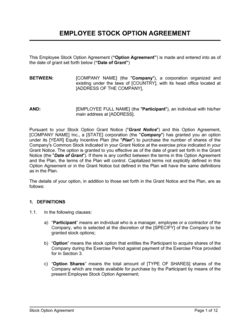
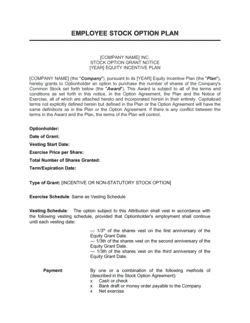
A Stock Option Plan is a formal company policy document that establishes the rules governing how stock options are granted to, vest with, and exercised by employees, directors, and consultants. This free Word download gives you a structured, board-ready starting point you can edit online and export as PDF to present for board approval and distribute to plan participants.
When you need it
Use it when you are ready to offer equity compensation to employees or key advisors β€” typically before or alongside your first formal employee hires, a seed or Series A financing round, or any situation where cash compensation alone cannot attract or retain the talent you need.
What's inside
Plan purpose and share reserve, eligibility criteria, grant and exercise procedures, vesting schedules and acceleration provisions, option types (ISO vs. NSO), exercise price methodology, termination and expiration rules, and plan administration responsibilities.

What is a Stock Option Plan?

A Stock Option Plan is a formal policy document adopted by a company's board of directors that establishes the complete framework for granting, vesting, and exercising options to purchase company stock. It defines the total share reserve, eligibility rules, option types available (ISO or NSO), standard vesting schedules, exercise price requirements, and procedures for what happens to options when a participant leaves the company or a change of control occurs. Every individual option agreement issued to an employee or advisor derives its authority from β€” and is governed by β€” this master plan document.

Why You Need This Document

Without a formal stock option plan in place, no option grant has a legal foundation. Companies that issue option agreements referencing a non-existent or unadopted plan expose every participant to tax risk and create cap table disputes that surface β€” at the worst possible time β€” during a financing round or acquisition due diligence. Investors and acquirers scrutinize equity plans closely: a missing or poorly drafted plan can delay a close, reduce your valuation, or require expensive legal remediation. A properly structured stock option plan, adopted by the board before the first grant is issued, ensures that every option you grant is defensible, tax-compliant, and enforceable from day one. This template gives you a board-ready starting point built around market-standard terms β€” 4-year vesting, 409A-compliant pricing, and double-trigger acceleration β€” so you can focus on hiring the people who will actually build the company.

Which variant fits your situation?

If your situation is…Use this template
Granting incentive stock options to US-based employees with tax benefitsIncentive Stock Option Agreement (ISO)
Granting options to non-employee advisors, consultants, or foreign workersNon-Qualified Stock Option Agreement (NSO)
Offering employees the right to purchase shares at a discount via payrollEmployee Stock Purchase Plan (ESPP)
Awarding restricted shares that vest over time without an exercise priceRestricted Stock Award Agreement
Providing cash-settled phantom equity to employees in a non-public companyPhantom Stock Plan
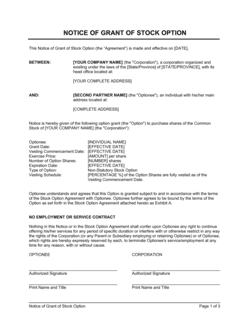
Documenting a specific option grant to an individual under an existing planStock Option Grant Notice and Agreement
Establishing equity incentives for a UK or Canadian subsidiaryShare Option Plan (International)

Common mistakes to avoid

❌ Granting options before board adoption

Why it matters: Options granted before the plan is formally adopted have no governing document β€” they are unenforceable as drafted and create tax compliance exposure for both the company and the recipient.

Fix: Obtain a signed board resolution adopting the plan before issuing any grant notices. Use the board adoption date as the earliest permissible grant date.

❌ Using a stale 409A valuation to set exercise prices

Why it matters: Granting options below fair market value triggers Section 409A penalties: the recipient owes ordinary income tax on the spread immediately β€” not at exercise β€” plus a 20% penalty tax.

Fix: Obtain a new 409A valuation before each grant cycle, or confirm your existing valuation is current (no material event has occurred and it is less than 12 months old).

❌ Designating ISOs for non-employee advisors or consultants

Why it matters: ISO status requires the recipient to be a bona fide employee at grant. Grants to non-employees automatically become NSOs regardless of the label β€” creating a mismatch between the grant notice and actual tax treatment.

Fix: Audit your participant list before each grant cycle. Advisors, board members who are not also employees, and independent contractors must receive NSOs only.

❌ No cashless or net exercise mechanism

Why it matters: Without an alternative to cash payment, employees who cannot fund the exercise price β€” particularly at private companies with no share liquidity β€” will let vested options expire unexercised.

Fix: Add both broker-assisted cashless exercise and net exercise (same-day sale of a portion of shares to cover the exercise price) as permitted payment methods in the plan and option agreement.

The 10 key sections, explained

Plan purpose and share reserve

Eligibility

Grant procedure and option agreement

Vesting schedule and cliff provisions

Exercise price and 409A compliance

Option types: ISO vs. NSO

Exercise procedure and payment methods

Termination, expiration, and forfeiture

Change of control and acceleration

Plan administration and amendment

How to fill it out

  1. 1

    Set the option pool size

    Determine the total share reserve as a percentage of fully diluted capitalization. Most early-stage companies set a pool of 10–20% of fully diluted shares. Enter the exact number of reserved shares and the percentage in the plan purpose section.

    πŸ’‘ Size the pool to cover 18–24 months of projected hiring. Investors will model dilution from the pool before setting your pre-money valuation β€” a pool increase at closing reduces founder ownership, not investor ownership.

  2. 2

    Define eligibility and option types

    Specify which participant classes β€” employees, directors, consultants β€” are eligible and which option type each may receive. Confirm that ISOs are limited to employees on payroll only.

    πŸ’‘ If you have non-US employees, designate their grants as NSOs from the outset. ISO rules are exclusively US federal tax provisions and have no benefit for non-US participants.

  3. 3

    Set the standard vesting schedule

    Enter the default vesting period (typically 48 months), cliff (12 months), and vesting frequency (monthly after cliff). Note that individual option agreements can deviate from this default.

    πŸ’‘ Monthly vesting after the cliff is the market standard for US tech companies. Quarterly vesting is common in other industries β€” check peer benchmarks before deviating.

  4. 4

    Establish the exercise price methodology

    Confirm that exercise prices will be set at FMV on the grant date per a current 409A valuation. Reference your most recent 409A report and note its effective date and expiration.

    πŸ’‘ A 409A valuation is typically valid for 12 months or until a material event. Build a calendar reminder to refresh it before the expiration date to avoid a lapse in defensibility.

  5. 5

    Define post-termination exercise periods

    Set the exercise window for each termination scenario: voluntary resignation (typically 90 days), involuntary without cause (90 days to 1 year), death (12–18 months), disability (12 months), and cause (immediate forfeiture).

    πŸ’‘ Consider extending the post-termination window to 1–5 years for private companies. Early employees cannot sell shares to fund an exercise β€” a 90-day window is effectively a forfeiture clause for many of them.

  6. 6

    Configure change-of-control and acceleration terms

    Decide between single-trigger and double-trigger acceleration for each participant class. Enter the relevant definitions of 'Change of Control' and the mechanics of option treatment in an acquisition.

    πŸ’‘ Double-trigger acceleration (change of control plus termination within 12 months) is the preferred structure for most participants β€” it aligns incentives with integration while still protecting employees against involuntary termination post-acquisition.

  7. 7

    Complete the administration and amendment section

    Identify the plan administrator by title (board of directors or compensation committee), enumerate their authorities, and specify which amendments require stockholder approval.

    πŸ’‘ Explicitly listing stockholder-approval triggers β€” pool increases, repricing, extension of option terms β€” signals governance maturity to institutional investors during due diligence.

  8. 8

    Have the board approve and adopt the plan

    Present the completed plan to the board for formal adoption by written consent or at a board meeting. Record the adoption date and attach the board resolution to the plan as an exhibit.

    πŸ’‘ The board adoption date is the plan's effective date β€” individual grant dates cannot precede it. Confirm the adoption date before issuing any grant notices.

Frequently asked questions

What is a stock option plan?

A stock option plan is a formal company policy document that establishes the rules governing how options to purchase company stock are granted, vest, and are exercised by employees, directors, and consultants. It creates the legal framework that all individual option agreements reference and is adopted by the board of directors before any grants are made.

What is the difference between an ISO and an NSO?

An Incentive Stock Option (ISO) is available only to employees and qualifies for favorable US tax treatment β€” no ordinary income tax is owed at exercise if holding period requirements are met. A Non-Qualified Stock Option (NSO) can be granted to employees, directors, and consultants, but the spread between exercise price and fair market value at exercise is taxed as ordinary income. Companies generally grant ISOs to employees and NSOs to everyone else.

What is a 4-year vesting schedule with a 1-year cliff?

It is the most common vesting structure for US tech companies. No options vest during the first 12 months of service (the cliff). On the first anniversary, 25% of the total grant vests at once. The remaining 75% vests monthly over the following 36 months β€” approximately 2.08% per month. An employee who leaves before the 12-month cliff forfeits all unvested options.

How large should the option pool be?

Most early-stage companies reserve 10–20% of fully diluted shares for their equity incentive plan. The right size depends on your hiring plan for the next 18–24 months. Investors will typically require a specific pool size before a financing round closes and will calculate dilution from it before setting your pre-money valuation β€” so a larger pool dilutes founders more than investors at closing.

What is a 409A valuation and why does it matter for a stock option plan?

A 409A valuation is an independent appraisal of a private company's common stock fair market value, required by US tax law to set defensible ISO exercise prices. Options granted at or above the 409A FMV are safe from Section 409A tax penalties. Options granted below FMV trigger immediate ordinary income tax plus a 20% penalty on the recipient, regardless of whether they have exercised or sold any shares.

What happens to unvested options when an employee leaves?

Unvested options are forfeited immediately upon termination of continuous service, unless the plan or individual option agreement contains an acceleration provision. Vested options may be exercised within the post-termination exercise window β€” typically 90 days for voluntary resignation β€” after which they expire. Options terminate immediately if the employee is dismissed for cause.

What is double-trigger acceleration?

Double-trigger acceleration requires two events to occur before unvested options accelerate: (1) a change of control of the company, and (2) the participant's involuntary termination or constructive dismissal within a defined period after the acquisition (typically 12 months). This is preferred over single-trigger acceleration because it preserves the acquirer's ability to retain key employees through integration.

Does a stock option plan need to be approved by shareholders?

Board approval is sufficient to adopt the plan and begin making grants in most cases. However, stockholder approval is typically required before the plan can qualify for ISO treatment under the IRS rules and before options can qualify as performance-based compensation under Section 162(m). Material amendments β€” such as increasing the share reserve or reducing exercise prices β€” also generally require stockholder approval.

Can a stock option plan be used by a non-US company?

Yes, but ISO treatment is a US federal tax provision with no equivalent in other countries. Non-US companies and subsidiaries should grant NSOs or jurisdiction-specific equity instruments β€” such as EMI options in the UK or stock option plans under Canadian securities rules β€” and should consult local tax and securities counsel before granting equity to non-US participants.

How this compares to alternatives

vs Stock Option Grant Notice and Agreement

A stock option plan is the master governing document that applies to all participants and all grants. A stock option grant notice and agreement is the individual document issued to a specific participant that references the plan and specifies their personal grant terms β€” number of shares, exercise price, and vesting commencement date. You need both: the plan first, then individual agreements for each grant.

vs Restricted Stock Award Agreement

A restricted stock award grants actual shares that vest over time, with no exercise price β€” the employee owns the stock from day one, subject to a repurchase right that lapses as they vest. A stock option grants the right to purchase shares in the future at a fixed price. Restricted stock is taxed differently and is typically used for founders or very early employees, while options are the standard for later hires.

vs Phantom Stock Plan

A phantom stock plan delivers a cash payment equal to the appreciation in share value without actually issuing shares. It achieves a similar retention effect as stock options but avoids dilution and cap table complexity. Phantom plans are common in private companies that are not planning a liquidity event or do not want to share ownership. Stock option plans create real equity ownership; phantom plans create a contractual cash obligation.

vs Employee Stock Purchase Plan (ESPP)

An ESPP allows employees to purchase shares at a discount β€” typically 5–15% below market β€” through payroll deductions over defined offering periods. It is a broad-based program designed to encourage general employee share ownership. A stock option plan is a selective, grant-based program targeting key contributors with a higher potential upside. Most public companies run both; private companies typically run only a stock option plan until a liquidity event.

Industry-specific considerations

SaaS / Technology

Equity compensation is often the primary retention tool for engineers and product managers; ISO grants, 4-year vesting, and double-trigger acceleration are market standard.

Biotech and Life Sciences

Long development timelines require extended vesting periods (4–6 years) and milestone-based acceleration tied to clinical or regulatory events.

Financial Services / Fintech

Regulatory constraints on equity compensation require coordination with compliance teams; deferred vesting and clawback provisions are common for regulated roles.

Professional Services

Options are used selectively for equity-partner track employees; smaller pools (5–10%) and longer vesting periods (5 years) are typical compared to technology companies.

Template vs pro β€” what fits your needs?

PathBest forCostTime
Use the templateEarly-stage startups establishing a basic equity incentive framework before the first formal hires or a pre-seed roundFree2–4 hours to complete and present for board approval
Template + professional reviewCompanies raising a seed or Series A round, or those making grants to employees in multiple US states or internationally$500–$2,000 for a startup attorney review3–5 business days
Custom draftedCompanies preparing for a Series B or later, anticipating an IPO, or requiring complex acceleration, clawback, or international sub-plan provisions$3,000–$10,000+2–4 weeks

Glossary

Option Pool
The total number of shares reserved by a company for issuance under its equity incentive plan, expressed as a percentage of fully diluted shares outstanding.
Incentive Stock Option (ISO)
A type of employee stock option that qualifies for favorable US tax treatment β€” no ordinary income tax at exercise β€” if specific IRS holding and eligibility requirements are met.
Non-Qualified Stock Option (NSO)
A stock option that does not qualify for ISO tax treatment; the spread at exercise is taxed as ordinary income for the recipient and is deductible by the company.
Vesting Schedule
The timeline and conditions under which an employee earns the right to exercise granted options, commonly structured as a 4-year schedule with a 1-year cliff.
Cliff Vesting
A vesting structure in which none of the options vest until the employee completes a defined initial period β€” typically 12 months β€” at which point a portion (often 25%) vests at once.
Exercise Price (Strike Price)
The price per share at which a plan participant may purchase stock when exercising an option, set at no less than fair market value on the grant date for ISOs.
Fair Market Value (FMV)
The price at which a share of company stock would change hands between a willing buyer and seller, determined by a 409A valuation for private companies.
409A Valuation
An independent appraisal of a private company's common stock fair market value required by US tax law to set defensible ISO exercise prices.
Acceleration
A plan provision that causes unvested options to vest early, triggered by events such as a change of control, termination without cause, or double-trigger conditions.
Post-Termination Exercise Period
The window after an employee leaves the company during which they may still exercise vested options, commonly 90 days for voluntary resignation and longer for death or disability.
Dilution
The reduction in existing shareholders' ownership percentage that occurs when new shares are issued β€” including shares issued on option exercise.

Part of your Business Operating System

This document is one of 3,000+ business & legal templates included in Business in a Box.

  • Fill-in-the-blanks β€” ready in minutes
  • 100% customizable Word document
  • Compatible with all office suites
  • Export to PDF and share electronically

Create your document in 3 simple steps.

From template to signed document β€” all inside one Business Operating System.
1
Download or open template

Access over 3,000+ business and legal templates for any business task, project or initiative.

2
Edit and fill in the blanks with AI

Customize your ready-made business document template and save it in the cloud.

3
Save, Share, Send, Sign

Share your files and folders with your team. Create a space of seamless collaboration.

Save time, save money, and create top-quality documents.

β˜…β˜…β˜…β˜…β˜…

"Fantastic value! I'm not sure how I'd do without it. It's worth its weight in gold and paid back for itself many times."

Managing Director Β· Mall Farm
Robert Whalley
Managing Director, Mall Farm Proprietary Limited
β˜…β˜…β˜…β˜…β˜…

"I have been using Business in a Box for years. It has been the most useful source of templates I have encountered. I recommend it to anyone."

Business Owner Β· 4+ years
Dr Michael John Freestone
Business Owner
β˜…β˜…β˜…β˜…β˜…

"It has been a life saver so many times I have lost count. Business in a Box has saved me so much time and as you know, time is money."

Owner Β· Upstate Web
David G. Moore Jr.
Owner, Upstate Web

Run your business with a system β€” not scattered tools

Stop downloading documents. Start operating with clarity. Business in a Box gives you the Business Operating System used by over 250,000 companies worldwide to structure, run, and grow their business.

Start freeΒ Β·Β No credit card required