Settlement of Disputed Amount_Buyer Template

Free Word download β€’ Edit online β€’ Save & share with Drive β€’ Export to PDF

1 pageβ€’20–30 min to fillβ€’Difficulty: Standardβ€’Signature requiredβ€’Legal review recommended
Learn more ↓
FreeSettlement of Disputed Amount_Buyer Template

At a glance

What it is
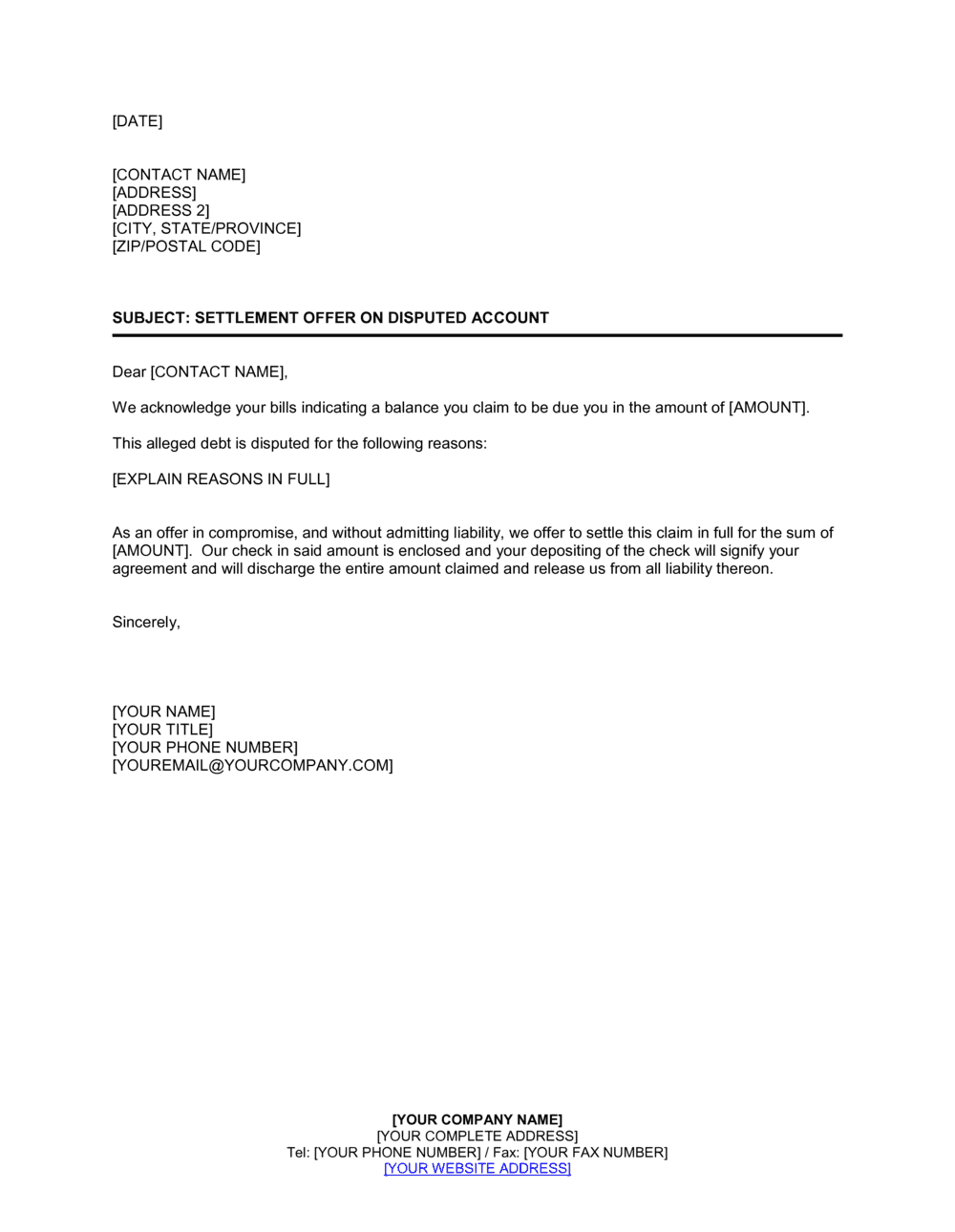
A Settlement of Disputed Amount (Buyer) is a binding legal agreement in which a buyer and seller resolve a disagreement over an invoice or outstanding balance by agreeing on a final, reduced, or modified payment amount that both parties accept as full and final satisfaction of the debt. This free Word download lets you document the agreed settlement terms, release all related claims, and close the dispute cleanly β€” edit online and export as PDF for execution.
When you need it
Use it when you have received an invoice you believe is incorrect, overstated, or partially unjustified, and you and the seller have verbally agreed to settle for a different amount. It is also appropriate when a billing dispute has been ongoing and both parties want to close the matter without litigation.
What's inside
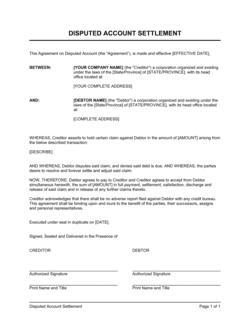
Identification of the parties and the original disputed invoice, a statement of the agreed settlement amount and payment terms, a mutual release of claims related to the dispute, representations and warranties from both sides, and governing law and signature blocks to make the resolution legally binding.

What is a Settlement of Disputed Amount (Buyer)?

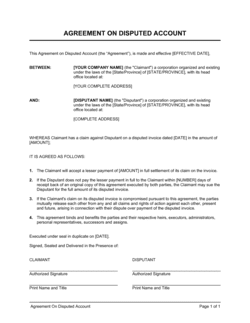
A Settlement of Disputed Amount (Buyer) is a binding legal agreement in which a buyer and a seller resolve a billing disagreement by documenting a final, mutually accepted payment β€” typically lower than the original invoiced amount β€” that completely discharges the underlying debt. It operates on the legal principle of accord and satisfaction: the seller knowingly accepts a different sum than originally claimed, and in exchange releases the buyer from any further obligation related to that invoice. The agreement records the nature of the dispute, the agreed settlement figure, the payment deadline, and a mutual release of claims β€” creating a clean legal record that neither party can later reopen.

The document is initiated by the buyer and is typically used after verbal settlement negotiations have already produced an informal agreement. Its purpose is to convert that informal understanding into an enforceable contract before any money changes hands.

Why You Need This Document

Without a signed settlement agreement, paying a reduced amount on a disputed invoice carries serious legal risk. In many jurisdictions, voluntary payment of any portion of a debt β€” even a disputed one β€” can be treated as acknowledgment of the full obligation, eliminating your basis for contesting the remainder. A properly executed settlement agreement prevents that outcome by documenting that both parties understood and agreed to the reduced amount as full satisfaction of the debt.

Beyond legal protection, the agreement serves three practical functions: it gives your accounts-payable team the documentation required to record a purchase discount without triggering an audit flag; it prevents the seller from sending the unpaid balance to collections weeks later; and it stops the seller's release of counterclaims from being challenged as a unilateral concession rather than a negotiated exchange. For any disputed invoice above a few thousand dollars, the 20 minutes required to complete and execute this template is the lowest-cost form of dispute insurance available.

Which variant fits your situation?

If your situation is…Use this template
Buyer initiating a settlement offer on a disputed invoiceSettlement of Disputed Amount (Buyer)
Seller offering to accept a reduced payment to close an overdue accountSettlement of Disputed Amount (Seller)
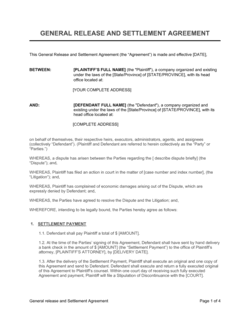
Both parties settling a broader commercial dispute beyond a single invoiceGeneral Settlement Agreement
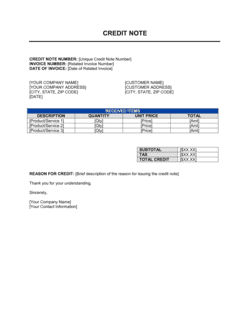
Buyer disputing goods quality and seeking a credit against future invoicesCredit Note
Parties agreeing to a payment plan rather than a lump-sum settlementPayment Agreement / Installment Plan
Dispute escalated to legal proceedings requiring formal resolutionMutual Release Agreement
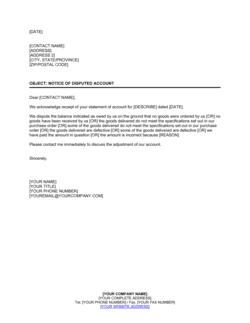
Buyer disputing a contractor invoice for incomplete or defective workNotice of Dispute Letter

Common mistakes to avoid

❌ Paying before getting a signed agreement

Why it matters: Payment without a signed settlement can be interpreted as voluntary satisfaction of the full debt, eliminating your legal basis for claiming a partial dispute and leaving you with no release of the remaining balance.

Fix: Obtain fully executed signatures from both parties before initiating any payment. Use eSign with timestamps so execution order is documented.

❌ Vague dispute description that implies admission

Why it matters: Language like 'Buyer agrees it owes a portion of the invoice' can be used against the buyer in a related dispute, tax audit, or regulatory inquiry as evidence of liability.

Fix: Draft the dispute description using contention language β€” 'Buyer disputes the invoiced amount on the grounds that...' β€” and include a no-admission-of-liability clause.

❌ Omitting the trigger for the seller's release

Why it matters: A release effective at signing, before payment clears, gives up the seller's only remaining leverage. If the buyer's payment bounces or is reversed, the seller has already extinguished the debt.

Fix: Make the seller's release expressly contingent on 'receipt and clearance of the Settlement Amount' rather than effective at signing.

❌ Failing to verify the invoice has not been assigned

Why it matters: If the seller has assigned the receivable to a factoring company or collections agency before signing the settlement, the seller lacks authority to release the debt β€” and the assignee can still pursue full payment.

Fix: Include a representation that the invoice has not been assigned, and independently verify with the seller's accounts-receivable team before signing.

❌ Using trade names instead of registered legal entity names

Why it matters: A settlement signed under a brand name ('Acme Supplies') rather than the registered entity ('Acme Supply Solutions LLC') may be unenforceable against the correct legal party, especially if they have multiple subsidiaries.

Fix: Look up both parties on the relevant state or provincial business registry and use the exact registered name in the agreement.

❌ No confidentiality clause on the settlement terms

Why it matters: If the reduced settlement amount becomes known to other creditors or vendors, they may demand equal treatment β€” or the seller may use the publicized precedent against you in future negotiations.

Fix: Add a mutual confidentiality clause restricting both parties from disclosing the settlement amount except to legal, financial, or tax advisors under a duty of confidentiality.

The 9 key clauses, explained

Parties and recitals

In plain language: Identifies the buyer and seller by full legal name and entity type, and summarizes the background β€” the original transaction, the invoice in question, and the nature of the dispute.

Sample language
This Settlement Agreement is entered into as of [DATE] between [BUYER LEGAL NAME], a [STATE] [ENTITY TYPE] ('Buyer'), and [SELLER LEGAL NAME], a [STATE] [ENTITY TYPE] ('Seller'). WHEREAS, a dispute has arisen regarding Invoice No. [INVOICE NUMBER] dated [DATE] in the original amount of $[AMOUNT] (the 'Disputed Invoice').

Common mistake: Using trade names instead of registered legal entity names. If the entity name doesn't match the original contract or invoice, enforcing the release against the right party becomes legally contested.

Description of the dispute

In plain language: States the buyer's specific grounds for disputing the original invoice amount β€” overcharge, delivery shortfall, quality defect, or billing error β€” without admitting liability.

Sample language
Buyer contends that the Disputed Invoice overstates the amount owed by $[AMOUNT] on the grounds that [SPECIFIC REASON β€” e.g., goods delivered were [X] units short of the [Y] units invoiced]. Seller disputes Buyer's contention. Both parties desire to resolve this matter without further dispute or litigation.

Common mistake: Admitting liability in the dispute description. The language should state the buyer's position as a contention, not a concession β€” use 'Buyer contends' or 'Buyer disputes' rather than 'Buyer acknowledges it owes.'

Settlement amount and payment terms

In plain language: Specifies the exact dollar amount the buyer agrees to pay, the payment method, and the deadline by which payment must be received.

Sample language
In full and final settlement of all claims arising from the Disputed Invoice, Buyer agrees to pay Seller the sum of $[SETTLEMENT AMOUNT] ('Settlement Amount') by [PAYMENT METHOD] on or before [DATE].

Common mistake: Stating a settlement amount without specifying the payment method or deadline. Vague payment terms allow the other party to dispute whether settlement was actually completed.

Seller's acceptance and release

In plain language: Confirms that the seller accepts the settlement amount as complete satisfaction of the invoiced debt and releases the buyer from any further obligation related to that invoice.

Sample language
Upon receipt of the Settlement Amount, Seller hereby releases and forever discharges Buyer from any and all claims, demands, or causes of action arising out of or relating to the Disputed Invoice, including any claim for the balance of $[REMAINING BALANCE].

Common mistake: Failing to specify the trigger for the release as 'upon receipt of payment.' A release that takes effect at signing β€” before payment clears β€” leaves the seller without recourse if the payment bounces.

Buyer's release of counterclaims

In plain language: The buyer releases any counterclaims against the seller arising from the same transaction β€” such as claims for damages caused by defective goods or late delivery β€” making the release mutual.

Sample language
Buyer hereby releases and forever discharges Seller from any and all claims arising out of or relating to the Disputed Invoice or the underlying transaction, including any claim for damages, penalties, or costs related to [SPECIFIC COUNTERCLAIM BASIS].

Common mistake: Omitting the buyer's release of counterclaims entirely. A one-sided release exposes the seller to residual claims and may be unenforceable as a full accord and satisfaction if consideration flows only one way.

No admission of liability

In plain language: States explicitly that the settlement does not constitute an acknowledgment of fault or legal liability by either party.

Sample language
This Agreement is entered into for the purpose of resolving a disputed claim and shall not be construed as an admission of liability or wrongdoing by either party.

Common mistake: Omitting this clause. Without it, a court or auditor reviewing the settlement may interpret the buyer's reduced payment as an implicit acknowledgment of partial liability, which can affect related disputes or tax treatment.

Representations and warranties

In plain language: Each party confirms they have authority to enter the agreement, that the debt is not subject to any third-party claim (e.g., an assignment), and that no other proceedings are pending relating to the same invoice.

Sample language
Each party represents and warrants that: (a) it has full authority to enter into this Agreement; (b) the Disputed Invoice has not been assigned or transferred to any third party; and (c) no action, suit, or proceeding is pending relating to the subject matter of this Agreement.

Common mistake: Skipping the representation that the invoice has not been assigned. If the seller has already assigned the receivable to a collections agency or factoring company, the release signed with the original seller is worthless.

Confidentiality of settlement terms

In plain language: Restricts both parties from disclosing the settlement amount or the terms of the agreement to third parties, except as required by law or for accounting and legal purposes.

Sample language
The parties agree to keep the terms of this Agreement, including the Settlement Amount, strictly confidential and shall not disclose them to any third party without prior written consent, except as required by applicable law or to their respective legal, financial, or tax advisors.

Common mistake: Omitting confidentiality language. Publicized settlement terms can set unfavorable precedents with other vendors or create liability if a third party claims the same treatment was owed to them.

Entire agreement and governing law

In plain language: Confirms this document is the complete agreement between the parties on the dispute, superseding all prior negotiations, and specifies which jurisdiction's laws govern it.

Sample language
This Agreement constitutes the entire agreement between the parties with respect to the Disputed Invoice and supersedes all prior negotiations, representations, and understandings. This Agreement shall be governed by the laws of [STATE / PROVINCE / COUNTRY].

Common mistake: Choosing a governing law with no connection to where either party operates or where the contract was performed. Courts in some jurisdictions will apply local law regardless, especially for consumer transactions.

How to fill it out

  1. 1

    Identify both parties with full legal names

    Enter the buyer's and seller's complete registered legal entity names, entity types (e.g., LLC, Inc.), and principal addresses. Cross-reference the original invoice to confirm the entity names match.

    πŸ’‘ If you are an individual rather than a business entity, use your full legal name as it appears on government-issued ID.

  2. 2

    Reference the disputed invoice precisely

    Enter the original invoice number, invoice date, and the originally invoiced amount. These details tether the settlement to the specific transaction and prevent ambiguity about what is being resolved.

    πŸ’‘ Attach a copy of the disputed invoice as Exhibit A β€” courts consistently give more weight to settlements that reference clearly identified underlying documents.

  3. 3

    Describe the dispute without admitting liability

    State the buyer's specific grounds for dispute β€” short delivery, defective goods, duplicate charge, or pricing discrepancy β€” using language like 'Buyer contends' rather than 'Buyer acknowledges.' Keep this factual and concise.

    πŸ’‘ Limit the dispute description to one paragraph. Lengthy recitations of grievances can be used against you in unrelated proceedings.

  4. 4

    State the settlement amount and payment deadline

    Enter the exact dollar figure both parties have verbally agreed to, the payment method (wire transfer, ACH, check), and a specific calendar deadline. Confirm the agreed currency if either party operates internationally.

    πŸ’‘ Choose a payment deadline no more than 10 business days out. Longer windows create risk that one party changes their mind before payment is made.

  5. 5

    Draft mutual release language for both sides

    Ensure the release covers the seller releasing the buyer from the remaining balance and the buyer releasing the seller from any counterclaims related to the same transaction. Make the release contingent on receipt of payment.

    πŸ’‘ If the buyer has a legitimate pending counterclaim unrelated to this invoice β€” for example, a separate delivery failure β€” carve it out explicitly rather than releasing it inadvertently.

  6. 6

    Include the no-admission-of-liability clause

    Confirm that settlement language stating neither party admits fault or legal liability is present in the body of the agreement before signing.

    πŸ’‘ This clause also protects against the settlement being cited as evidence of wrongdoing in any related regulatory or tax inquiry.

  7. 7

    Sign before making payment

    Both parties must execute the agreement before β€” or simultaneously with β€” the settlement payment. Paying first without a signed agreement can be treated as voluntary payment of the full amount in some jurisdictions.

    πŸ’‘ Use a timestamped eSign tool to capture execution date and IP address, then store the fully executed copy before initiating the wire or ACH.

  8. 8

    Retain a copy alongside the original invoice and payment confirmation

    File the signed settlement agreement, the disputed invoice, and the payment confirmation (wire receipt or cleared check image) together in your accounting records.

    πŸ’‘ For audit purposes, your accounting team should code the settlement payment against the original invoice and note the agreed reduction with a reference to the settlement agreement date and number.

Frequently asked questions

What is a settlement of disputed amount agreement?

A settlement of disputed amount agreement is a binding contract between a buyer and a seller that resolves a disagreement over an invoice or outstanding balance by establishing a final, agreed payment β€” often less than the original amount billed β€” that both parties accept as full satisfaction of the debt. Once executed and payment is made, neither party can pursue further claims related to that invoice.

Is a settlement of disputed amount legally binding?

Yes, when properly executed a settlement of disputed amount is generally enforceable as a contract. It typically qualifies as an accord and satisfaction under common law, meaning the creditor's acceptance of the settlement amount extinguishes the original debt. Enforceability depends on both parties having capacity to contract, genuine consideration being exchanged, and the agreement being signed by authorized representatives.

Does the buyer need a lawyer to use this template?

For straightforward invoice disputes involving a single, clearly identified invoice, a high-quality template is usually sufficient. Legal review is strongly recommended when the disputed amount exceeds $10,000, when the dispute involves potential counterclaims for damages, when the other party has legal counsel, or when the seller operates in a different jurisdiction with materially different contract law.

What is the difference between accord and satisfaction and a standard payment?

A standard payment satisfies the exact amount owed under an existing agreement. Accord and satisfaction occurs when the creditor agrees to accept a different amount β€” typically less β€” as full discharge of the original obligation. The key element is the creditor's knowing acceptance of the lesser sum with the understanding that it closes the debt entirely. Without a written settlement agreement, proving that acceptance occurred can be difficult.

Can the seller later sue for the remaining balance after signing?

No β€” once the seller has signed a settlement agreement with a valid release clause and received the agreed payment, they are generally barred from pursuing the remaining balance in most jurisdictions. That is the core purpose of the release of claims clause. However, if the buyer's payment fails to clear or is reversed, the original debt typically revives depending on the agreement's terms.

What should the buyer do if the seller refuses to sign?

If the seller refuses to sign a written settlement, the buyer should document all settlement negotiations in writing β€” emails, letters marked 'without prejudice' β€” to protect those communications from being used as admissions in litigation. The buyer should not pay any amount until a signed agreement is in place. If the dispute cannot be resolved directly, mediation or a demand letter from legal counsel is the typical next step before litigation.

Can this agreement cover multiple disputed invoices?

Yes β€” the template can be adapted to reference multiple invoices by listing each invoice number, date, and disputed amount in a schedule attached as an exhibit. The settlement amount and release should then clearly state that they cover all listed invoices collectively. Using a schedule keeps the agreement body clean while ensuring each invoice is specifically identified.

How does this agreement affect the buyer's accounting records?

The buyer's accounts-payable team should record the settlement payment against the original invoice and recognize the difference between the invoiced amount and the settlement amount as a purchase discount or vendor credit, depending on the reason for the dispute. The signed settlement agreement provides the documentation required to support that accounting treatment in an audit.

Does this agreement need to be notarized?

Notarization is not required for a settlement agreement between businesses to be enforceable in most jurisdictions. Both parties' authorized signatures are sufficient. However, if the settlement amount is large and you anticipate the other party might later challenge the authenticity of the signatures, notarization or witnessed execution adds a layer of evidentiary protection.

How this compares to alternatives

vs Settlement of Disputed Amount (Seller)

The seller variant is drafted from the creditor's perspective β€” it structures the seller's offer to accept less than owed and release the buyer. The buyer variant is drafted from the debtor's perspective, initiating the settlement and documenting the buyer's agreed payment. Both result in the same legal outcome but differ in framing, tone, and which party controls the drafting.

vs Mutual Release Agreement

A mutual release agreement resolves broader disputes between parties β€” not limited to a single invoice or debt β€” and typically does not involve a payment. A settlement of disputed amount specifically addresses a quantified billing disagreement and requires a payment as the consideration for the release. Use a mutual release when there is no remaining monetary exchange.

vs Credit Note

A credit note is a unilateral accounting document issued by the seller to reduce a previously issued invoice β€” it does not require the buyer's signature or constitute a binding legal agreement. A settlement agreement is bilateral, requires signatures from both parties, and provides a legally enforceable release. Use a credit note for straightforward billing corrections; use a settlement agreement when the dispute has been contentious or the amount is material.

vs Payment Agreement

A payment agreement structures installment payments on an undisputed debt β€” it does not resolve a disagreement about the amount owed. A settlement of disputed amount resolves the disagreement itself by fixing a final settlement figure. If a buyer disputes the amount owed and also needs time to pay the agreed settlement, the two documents can be used together.

Industry-specific considerations

Wholesale and Distribution

Short-shipment and pricing-discrepancy disputes are common; settlements often reference packing slips and purchase orders as supporting exhibits.

Construction

Change-order and materials-invoice disputes are frequent; settlements must address lien-waiver requirements to protect the buyer's property from mechanics' liens.

Professional Services

Disputes over hours billed versus deliverables received; settlement agreements typically include a mutual release of service quality claims alongside the billing adjustment.

Retail and E-commerce

Disputes over damaged goods, short-counts, or promotional allowances; settlement amounts often reflect a credit rather than a cash payment and interact with return-merchandise authorization processes.

Jurisdictional notes

United States

Accord and satisfaction is recognized in all US states under UCC Β§3-311 for instruments and common-law contract principles for other debts. Some states require the creditor to have received the payment with clear notice that it was offered as full settlement β€” marking a check 'payment in full' can trigger accord and satisfaction in many states even without a signed agreement. California requires additional consideration for modifications to existing contracts under Civil Code Β§1526.

Canada

Accord and satisfaction is recognized across Canadian common-law provinces; Quebec applies civil-law rules under the Civil Code of Quebec, which recognizes transaction agreements (Articles 2631–2637 CCQ) as binding settlements. Courts in Ontario and BC have enforced 'payment in full' cheque endorsements as accord and satisfaction when the creditor deposited the cheque with knowledge of the condition. Ensure the agreement identifies the governing provincial law.

United Kingdom

In England and Wales, accord and satisfaction requires genuine consideration β€” accepting less than the full amount owed is only enforceable if the debtor provides something additional, such as early payment or a lump sum in lieu of installments, unless the creditor's promise to accept less is made by deed. The rule in Foakes v Beer (1884) still applies, so settlement agreements should always include nominal additional consideration or be executed as a deed. Scotland follows similar principles under Scots contract law.

European Union

Settlement agreements (transaction contracts) are recognized across EU member states, though the specific requirements vary. France, Germany, and the Netherlands all enforce bilateral settlement of disputed debts when both parties have capacity and genuine consideration exists. The EU Late Payment Directive (2011/7/EU) may limit a seller's ability to waive statutory interest on commercial debts in B2B transactions, so settlement language should address whether statutory interest is included in the settlement amount.

Template vs lawyer β€” what fits your deal?

PathBest forCostTime
Use the templateBuyers resolving a single invoice dispute under $10,000 with a cooperative sellerFree20–30 minutes
Template + legal reviewDisputes over $10,000, situations involving potential counterclaims, or cross-border transactions$200–$500 for a 1-hour attorney review1–3 days
Custom draftedHigh-value disputes, ongoing supplier relationships with complex terms, or matters where litigation is a realistic outcome$800–$3,000+3–10 days

Glossary

Accord and Satisfaction
A legal doctrine where a creditor accepts a lesser or different payment than originally owed as full settlement of the debt, extinguishing the original obligation.
Disputed Amount
The portion of an invoice or debt that the paying party contests on grounds such as overcharge, non-delivery, defective goods, or billing error.
Settlement Amount
The specific dollar figure both parties agree to accept as complete and final payment in resolution of the disputed debt.
Release of Claims
A contractual clause in which one or both parties relinquish the right to pursue any further legal action related to the specific dispute being settled.
Mutual Release
A bilateral release where both the buyer and seller waive all claims against each other arising from the disputed transaction.
Consideration
The legal value exchanged to make a contract binding β€” in a settlement, the buyer's payment is consideration for the seller's release of the remaining balance.
Without Prejudice
A designation that prevents settlement negotiations or offers from being used as evidence of liability in subsequent legal proceedings.
Full and Final Settlement
Language confirming that the agreed payment discharges the entire obligation and that no further claims can be raised relating to the same invoice or transaction.
Representations and Warranties
Statements of fact each party makes in the agreement β€” for example, that they have authority to enter the settlement and that no third-party claim encumbers the debt.
Governing Law
The jurisdiction whose laws control the interpretation and enforcement of the settlement agreement if a dispute arises about the settlement itself.

Part of your Business Operating System

This document is one of 3,000+ business & legal templates included in Business in a Box.

  • Fill-in-the-blanks β€” ready in minutes
  • 100% customizable Word document
  • Compatible with all office suites
  • Export to PDF and share electronically

Create your document in 3 simple steps.

From template to signed document β€” all inside one Business Operating System.
1
Download or open template

Access over 3,000+ business and legal templates for any business task, project or initiative.

2
Edit and fill in the blanks with AI

Customize your ready-made business document template and save it in the cloud.

3
Save, Share, Send, Sign

Share your files and folders with your team. Create a space of seamless collaboration.

Save time, save money, and create top-quality documents.

β˜…β˜…β˜…β˜…β˜…

"Fantastic value! I'm not sure how I'd do without it. It's worth its weight in gold and paid back for itself many times."

Managing Director Β· Mall Farm
Robert Whalley
Managing Director, Mall Farm Proprietary Limited
β˜…β˜…β˜…β˜…β˜…

"I have been using Business in a Box for years. It has been the most useful source of templates I have encountered. I recommend it to anyone."

Business Owner Β· 4+ years
Dr Michael John Freestone
Business Owner
β˜…β˜…β˜…β˜…β˜…

"It has been a life saver so many times I have lost count. Business in a Box has saved me so much time and as you know, time is money."

Owner Β· Upstate Web
David G. Moore Jr.
Owner, Upstate Web

Run your business with a system β€” not scattered tools

Stop downloading documents. Start operating with clarity. Business in a Box gives you the Business Operating System used by over 250,000 companies worldwide to structure, run, and grow their business.

Start freeΒ Β·Β No credit card required