- Release
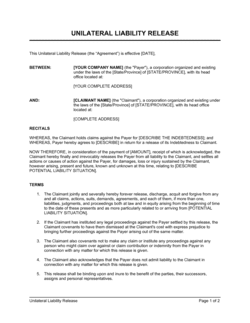
- A contractual surrender of a legal claim or right, preventing the releasing party from later asserting that claim in any court or proceeding.
- Mutual Release
- A release that flows in both directions simultaneously — each party gives up claims against the other in the same instrument.
- Consideration
- Something of value exchanged between parties to make a contract enforceable — in a mutual release, the exchange of reciprocal releases typically constitutes sufficient consideration.
- Claims
- Any past, present, or future demands, causes of action, suits, debts, or liabilities one party may assert against another.
- Unknown Claims
- Claims a party does not yet know about at the time of signing; a broad release expressly waives unknown claims, which may require specific statutory language in some jurisdictions.
- Recitals
- The background section of an agreement — introduced by 'Whereas' — that describes the factual context and the parties' intent, without creating binding obligations.
- Covenant Not to Sue
- A promise not to file a lawsuit over released claims — stronger than a simple release in some jurisdictions because it creates an independent contractual obligation.
- Non-Disparagement
- A clause prohibiting each party from making negative statements about the other to third parties, clients, or the public after the agreement is signed.
- Indemnification
- An obligation by one party to cover losses, damages, or legal costs the other party incurs as a result of specific events or third-party claims.
- Severability
- A clause specifying that if one provision of the agreement is found unenforceable, the rest of the agreement remains in full force.
- Integration Clause
- A provision stating that the written agreement is the complete and final expression of the parties' deal, superseding all prior negotiations and representations.