Sales Manager Job Description Template

Free Word download • Edit online • Save & share with Drive • Export to PDF

2 pages20–30 min to fillDifficulty: StandardSignature requiredLegal review recommended
Learn more ↓
FreeSales Manager Job Description Template

At a glance

What it is
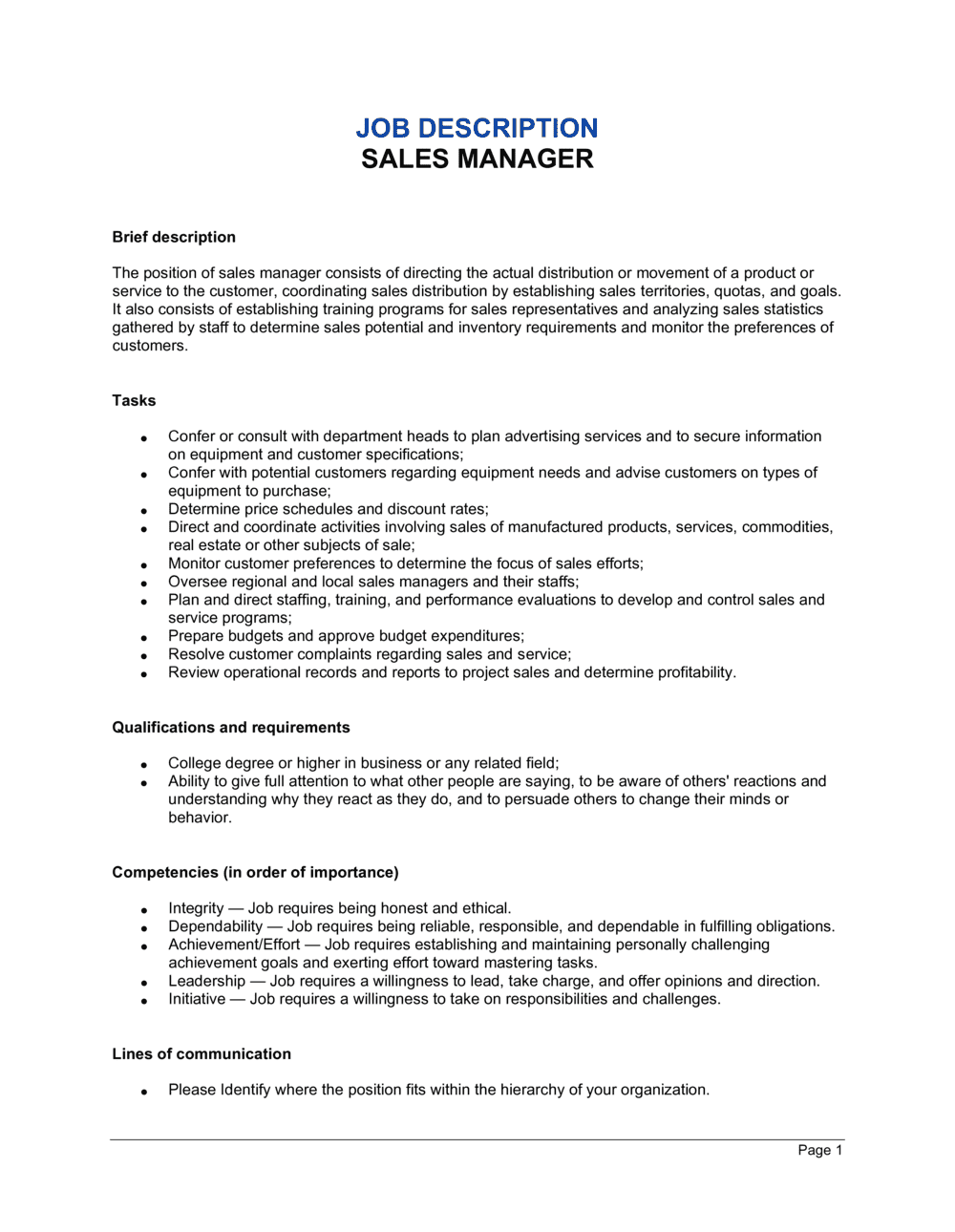
A Sales Manager Job Description is a formal document that defines the scope, responsibilities, qualifications, and reporting structure for a sales management role. This free Word download gives you a structured, legally grounded starting point you can edit online and export as PDF — ready to attach to an employment contract, post to job boards, or file as the authoritative role definition in your HR records.
When you need it
Use it when opening a new sales manager position, promoting an internal candidate into a management role, or standardizing inconsistent role definitions across a sales organization. It also serves as a Schedule A attachment to an employment contract signed before the hire's first day.
What's inside
Position title, department, and reporting line; a detailed list of core duties and performance expectations; required and preferred qualifications; compensation structure including base, commission, and bonus eligibility; working conditions and travel requirements; and an acknowledgment block for both employer and employee signatures.

What is a Sales Manager Job Description?

A Sales Manager Job Description is a formal document that defines the scope of authority, core duties, performance expectations, required qualifications, compensation structure, and reporting relationships for a sales management role. Unlike a casual role summary used only for recruiting, a properly drafted job description functions as the authoritative record of the employment relationship — incorporated by reference into the employment contract as Schedule A and signed by both the employer and the employee before the hire's first day. It establishes the documented standard against which performance is measured, KPIs are set, and — if necessary — termination for cause is defended.

Why You Need This Document

Operating without a signed, detailed sales manager job description creates four compounding risks. First, without documented KPIs and quota expectations, performance management actions — written warnings, performance-improvement plans, and terminations — lack an objective evidentiary foundation, making wrongful-dismissal claims far harder to defend. Second, an undefined role invites scope disputes: a sales manager who later claims their territory, travel obligations, or team size changed materially from what was agreed may have a constructive dismissal argument in Canada, the UK, and EU jurisdictions. Third, embedding commission rate specifics in verbal conversations rather than a written document turns every plan amendment into a potential wage claim. Fourth, qualification thresholds that are not documented and reviewed against anti-discrimination standards expose employers to EEOC and equivalent complaints before the first interview is even scheduled. This template gives you a structured, jurisdiction-aware starting point that closes all four gaps — ready to attach to your employment contract and sign on day one.

Which variant fits your situation?

If your situation is…Use this template
Hiring a senior-level sales leader managing multiple regional teamsDirector of Sales Job Description
Defining a quota-carrying individual contributor below manager levelSales Representative Job Description
Filling an account executive role focused on enterprise dealsAccount Executive Job Description
Attaching the role description formally to an employment agreementEmployment Contract
Hiring a sales manager on a fixed-term or project basisFixed-Term Employment Contract
Engaging a fractional or contract sales lead instead of a full-time hireIndependent Contractor Agreement
Posting the role externally and tracking candidate offersJob Offer Letter

Common mistakes to avoid

❌ Vague duties with no measurable output

Why it matters: Duties like 'drive revenue growth' or 'lead the sales team' provide no objective standard for performance management. When termination for cause is necessary, the absence of documented expectations creates wrongful-dismissal exposure.

Fix: Attach a number to every key responsibility — quota amount, team size, pipeline multiple, or reporting frequency — so each duty has an objectively verifiable standard.

❌ Omitting the travel and working-conditions clause

Why it matters: A sales manager later required to travel 40% of the time when no travel was mentioned in the job description may have grounds for a constructive dismissal claim, particularly in Canada and the UK.

Fix: State the expected travel percentage and work location (on-site, hybrid, remote) explicitly, and update the document if working conditions change materially.

❌ Embedding commission plan terms in the job description

Why it matters: Commission plans change annually. If the job description specifies a 5% commission rate that the company later revises downward, the older document can be cited as a contractual promise in a wage claim.

Fix: Reference the commission plan by name only — 'governed by the Company's Sales Compensation Plan as amended from time to time' — and maintain the plan as a separate, updatable document.

❌ Not obtaining a signed acknowledgment

Why it matters: Without a signed acknowledgment, the employee can claim they were unaware of specific duties or performance expectations — undermining disciplinary actions and performance-improvement plans.

Fix: Include an acknowledgment block and collect dual signatures (employer and employee) before or on the start date. Store the executed copy in the employee's permanent HR file.

❌ Setting qualification thresholds that create disparate-impact risk

Why it matters: Education or experience requirements that are not genuinely necessary to perform the job can disproportionately screen out protected classes, exposing the employer to EEOC complaints and civil liability.

Fix: Review each qualification requirement against the actual duties. Where a degree is not essential, add 'or equivalent experience.' Document the business necessity for any threshold that could be challenged.

❌ Using the same job description for roles in multiple jurisdictions

Why it matters: A job description drafted for a US at-will employee may contain clauses — including the working-conditions and termination language — that are unenforceable or non-compliant in Canada, the UK, or the EU.

Fix: Maintain jurisdiction-specific versions of the document, or use a modular approach with a core description plus jurisdiction-specific addenda reviewed by local counsel.

The 9 key clauses, explained

Position identification

In plain language: States the official job title, department, employment classification (full-time, exempt), and the document's effective date.

Sample language
Job Title: Sales Manager | Department: Sales | Reports To: [VP OF SALES / CRO / OWNER] | Classification: Full-Time, Exempt | Effective Date: [DATE]

Common mistake: Using a generic title like 'Manager' without specifying the function. An ambiguous title complicates FLSA exemption analysis and creates confusion when the employee is referenced in other HR documents.

Position summary

In plain language: A 2–4 sentence overview of the role's purpose, scope, and strategic importance within the organization.

Sample language
The Sales Manager is responsible for leading a team of [NUMBER] sales representatives to achieve the company's annual revenue target of $[AMOUNT]. This role owns the full sales cycle, from pipeline development through close, and reports directly to [TITLE].

Common mistake: Writing a position summary that describes the ideal candidate rather than the role itself. The summary should define what the job does, not who should apply.

Core duties and responsibilities

In plain language: An enumerated list of the essential functions the employee is expected to perform, covering team management, pipeline oversight, forecasting, and cross-functional collaboration.

Sample language
1. Manage and coach a team of [NUMBER] sales representatives, conducting weekly 1:1s and monthly performance reviews. 2. Own team quota of $[AMOUNT] per [QUARTER/YEAR]. 3. Maintain pipeline coverage of [X]× quota at all times. 4. Deliver weekly forecast to [TITLE] every [DAY] by [TIME].

Common mistake: Listing responsibilities so broadly that nothing is measurable — 'drive sales growth' without a quota or pipeline metric gives you no basis for performance management or termination for cause.

Qualifications — required

In plain language: Minimum education, years of experience, and skills the candidate must have to be considered for the role.

Sample language
Required: [X]+ years of B2B sales experience, including at least [X] years in a quota-carrying management role; demonstrated track record of achieving or exceeding $[AMOUNT] in annual team revenue; proficiency with [CRM PLATFORM].

Common mistake: Setting qualification thresholds that disproportionately screen out protected classes without a documented business necessity — education requirements in particular have drawn EEOC scrutiny.

Qualifications — preferred

In plain language: Additional credentials or experience that are desirable but not required, used to differentiate candidates without creating barriers to entry.

Sample language
Preferred: experience selling into the [INDUSTRY] vertical; familiarity with [SALES METHODOLOGY — e.g., MEDDIC, Challenger]; [DEGREE] in [FIELD]; proficiency in [TOOL].

Common mistake: Listing preferred qualifications that are indistinguishable from required ones. If you will not consider a candidate without a credential, it belongs in the required section.

Compensation and benefits

In plain language: Describes the base salary range, OTE, commission eligibility, and benefits — noting that specific plan terms are governed by a separate commission agreement.

Sample language
Base Salary: $[MIN]–$[MAX] per year, commensurate with experience. OTE: $[AMOUNT] at 100% quota attainment. Commission and bonus eligibility are governed by the Company's Sales Compensation Plan as amended from time to time. Benefits: [HEALTH / DENTAL / VISION / 401K / PTO].

Common mistake: Stating a specific commission percentage or accelerator in the job description. If the commission plan changes and the job description doesn't, the older document can be cited as a contractual promise.

Working conditions and travel requirements

In plain language: Specifies whether the role is on-site, hybrid, or remote; the expected travel percentage; and any physical or scheduling requirements relevant to ADA and accommodation analysis.

Sample language
This role is [ON-SITE / HYBRID — X days per week / REMOTE]. Travel: up to [X]% domestically, including overnight stays. Standard hours: [DAYS], [START TIME]–[END TIME], with flexibility required during peak sales periods.

Common mistake: Omitting travel expectations entirely. A sales manager later asked to travel 40% of the time when the job description stated no travel requirement may have a constructive dismissal claim in some jurisdictions.

Performance expectations and KPIs

In plain language: Documents the measurable standards against which the employee will be evaluated during reviews, including quota, pipeline coverage, team retention, and forecast accuracy.

Sample language
Performance will be evaluated on: (a) team quota attainment — target [X]% of $[AMOUNT] per [PERIOD]; (b) pipeline coverage — maintain [X]× quota in active pipeline; (c) forecast accuracy — within [±X]% of weekly commit; (d) team retention — voluntary attrition below [X]% annually.

Common mistake: Setting performance expectations only verbally during onboarding and not in the job description. Without a written standard, termination for underperformance is harder to defend and creates wrongful-dismissal exposure.

Acknowledgment and signature block

In plain language: A section where both the employer representative and the employee sign and date the document, confirming the employee has received and understood the job description.

Sample language
I acknowledge that I have received, read, and understood this Job Description and agree that it accurately reflects the duties and expectations of my role. Employee Signature: ___________ Date: ___________ | Employer Representative: ___________ Title: ___________ Date: ___________

Common mistake: Collecting only the employee's signature and omitting the employer representative's signature and title. An unsigned document on the employer side is harder to authenticate in a dispute.

How to fill it out

  1. 1

    Complete the position identification block

    Enter the exact job title, department, direct reporting line, FLSA classification, and effective date. Cross-reference your payroll and HRIS systems to ensure the title is consistent across all records.

    💡 Use the same title string in every HR document — offer letter, employment contract, and this job description — to prevent discrepancies that can complicate audits.

  2. 2

    Draft a concise position summary

    Write 2–4 sentences describing what the role does, the scale of responsibility (team size, revenue target), and who it reports to. Focus on the role's output, not the person.

    💡 Run the summary past the hiring manager and the new employee's future peer group before finalizing — misaligned expectations at day one are a leading cause of early attrition.

  3. 3

    List core duties with measurable specifics

    Enumerate 6–12 essential functions. Wherever possible, attach a number — team size, quota amount, pipeline multiple, or forecast frequency — so each duty is objectively measurable.

    💡 Distinguish between essential and marginal functions. The ADA requires employers to accommodate employees who can perform essential functions — a list that mixes the two creates legal ambiguity.

  4. 4

    Define required and preferred qualifications separately

    Set minimum thresholds for experience, education, and skills in the required block. Move nice-to-haves to the preferred block. Review both against EEOC guidance to ensure no unintentional disparate-impact screening.

    💡 If a degree requirement is not genuinely necessary to perform the job, consider replacing it with 'or equivalent experience' — this broadens your candidate pool and reduces disparate-impact risk.

  5. 5

    Enter compensation range and reference the commission plan

    State the base salary range and OTE. Reference the company's commission plan by name but do not reproduce its terms in this document. This keeps the job description current even when the commission plan is updated.

    💡 Several US states and cities (Colorado, New York City, California) now require salary ranges on job postings. Check your posting jurisdiction's law before publishing.

  6. 6

    Specify working conditions and travel expectations

    State on-site, hybrid, or remote status and the expected travel percentage. Include any physical requirements that are genuinely essential to the role — lifting thresholds, standing, or irregular hours.

    💡 Overstating travel requirements discourages qualified candidates; understating them creates a constructive dismissal exposure if you later require more. Use the actual expected percentage, not a ceiling.

  7. 7

    Document performance expectations and KPIs

    List the specific metrics against which the employee will be reviewed — quota attainment percentage, pipeline coverage ratio, forecast accuracy tolerance, and team retention rate.

    💡 Tie KPIs directly to the performance review cycle described in your employee handbook so the employee understands exactly how and when they will be evaluated.

  8. 8

    Obtain signatures before or on the start date

    Have both parties sign the document before or on the employee's first day. File the signed copy in the employee's HR record and provide the employee with their own copy.

    💡 In common-law jurisdictions, presenting a job description — or any restrictive employment document — after the start date without fresh consideration may render parts of it unenforceable.

Frequently asked questions

What is a sales manager job description?

A sales manager job description is a formal document that defines the duties, qualifications, performance expectations, compensation structure, and reporting relationships for a sales management role. It serves as the authoritative record of what the employer expects the employee to do and is typically attached as a Schedule A to the employment contract. A signed job description also provides the documented standard needed to support performance management, coaching, and — if necessary — termination for cause.

Is a job description legally binding?

A standalone job description is generally not a binding contract on its own, but it becomes legally significant in several contexts. When incorporated by reference into an employment agreement, it creates enforceable obligations. Courts and employment tribunals also rely on job descriptions to assess whether a termination was justified, whether a role change constituted constructive dismissal, and whether FLSA exemption classifications were correctly applied. A signed acknowledgment block strengthens the document's evidentiary value considerably.

What should a sales manager job description include?

At minimum: position title and FLSA classification, reporting structure, a position summary, an enumerated list of core duties with measurable expectations, required and preferred qualifications, compensation range and OTE, working conditions and travel requirements, performance KPIs, and a dual-signature acknowledgment block. Missing any of these creates gaps that can complicate performance management and expose the employer to discrimination or wrongful-dismissal claims.

Do I need to include a salary range in the job description?

In some US states and cities — including Colorado, California, New York City, and Washington — employers are legally required to include a salary range on any job posting. Even where not legally required, including a range reduces wasted interview cycles and demonstrates good-faith compliance with emerging pay-transparency expectations. Reference the commission plan by name rather than embedding specific rates, which can create contractual obligations when the plan changes.

How specific should the duties section be?

Specific enough that the duties are objectively measurable, but flexible enough that reasonable role evolution does not require a contract amendment. A good test: could a third party — an HR director, a judge, or an arbitrator — read the duties section and determine whether the employee performed them? Attaching quotas, pipeline multiples, and reporting frequencies achieves this without locking the employer into impractical specificity.

Can I use this job description as a Schedule A to an employment contract?

Yes — and in most cases you should. Incorporating the job description as Schedule A to the employment contract ensures that duties, qualifications, and performance expectations are part of the binding agreement. Have the employee initial Schedule A separately at signing to confirm they reviewed it. This prevents later claims that they were unaware of specific duties or performance standards.

How often should a sales manager job description be updated?

Review it annually at minimum, and update it whenever the role's scope, reporting structure, quota, or working conditions change materially. If a change is significant — for example, adding a new geographic territory, substantially increasing quota, or shifting from on-site to remote — document the change in writing and obtain fresh acknowledgment from the employee. In common-law jurisdictions, unilateral material changes to job duties without agreement can constitute constructive dismissal.

What is the difference between a job description and an offer letter?

An offer letter confirms the role, compensation, and start date to secure the candidate's acceptance — it is a summary document designed to close the hiring process. A job description is the comprehensive, operationally detailed record of the role's duties, qualifications, KPIs, and working conditions. The offer letter gets the candidate to say yes; the job description, attached to the employment contract, governs the working relationship from day one forward.

Does a job description protect the employer in a wrongful dismissal claim?

A well-drafted, signed job description significantly strengthens the employer's position in a wrongful dismissal dispute. It establishes the documented standard against which performance is measured, supports the chain of evidence from role definition to performance review to termination decision, and demonstrates that the employee was aware of expectations from the start. Without it, employers are left relying on verbal accounts that are difficult to corroborate in arbitration or court.

How this compares to alternatives

vs Employment Contract

An employment contract is the master legal agreement governing the working relationship — covering IP assignment, confidentiality, non-compete, termination, and severance. A job description defines the scope, duties, and performance expectations of the specific role. The two documents work together: the job description is typically attached as Schedule A to the employment contract and incorporated by reference.

vs Job Offer Letter

An offer letter confirms compensation, start date, and the role summary to close the hiring process. It is not a comprehensive operational document. A job description provides the full duty list, performance KPIs, qualification requirements, and working conditions that govern day-to-day employment. Relying on an offer letter alone leaves no documented standard for performance management.

vs Sales Representative Job Description

A sales representative job description covers an individual contributor role with no direct-report management obligations. A sales manager job description adds team management duties, coaching responsibilities, forecast accountability, and people-management KPIs such as team quota attainment and voluntary attrition. The two documents are not interchangeable and should be maintained as separate records.

vs Independent Contractor Agreement

A contractor agreement engages a self-employed individual without employment entitlements — no benefits, no FLSA protections, no tax withholding. A job description is inherently an employee document. Using a job description for what is structured as a contractor engagement is a misclassification signal; the level of behavioral control implied by a duty-specific job description is a primary test for employment status under the IRS common-law test and similar standards worldwide.

Industry-specific considerations

Technology / SaaS

Quota structure tied to ARR or MRR targets, CRM proficiency requirements, MEDDIC or Challenger sales methodology, and remote-first or hybrid working conditions are standard inclusions.

Financial Services

FINRA or FCA licensing conditions as prerequisites, compliance-aware language around customer solicitation, and commission plan references that satisfy regulatory disclosure requirements.

Retail and Consumer Goods

Territory management, in-store or field-based working conditions, seasonal quota variability, and management of hourly field sales staff require specific duty and scheduling language.

Manufacturing and Industrial

Technical product knowledge requirements, distributor and channel management duties, trade-show travel expectations, and FLSA outside-sales exemption considerations are commonly embedded.

Jurisdictional notes

United States

FLSA classification matters significantly — most sales managers qualify for the executive or administrative exemption from overtime, but the duties test must be met. Several states and cities (Colorado, California, New York City, Washington) require salary ranges on job postings. EEOC guidance restricts qualification requirements that have a disparate impact without demonstrated business necessity. California additionally limits the enforceability of non-compete and non-solicit language referenced in or attached to job descriptions.

Canada

Provincial Employment Standards Acts set minimum notice, termination pay, and constructive dismissal standards — a material change to a job description without employee consent can constitute constructive dismissal. Quebec employers must provide documents in French. Pay transparency legislation is expanding across provinces; British Columbia and Prince Edward Island already require salary ranges on postings. The job description should be incorporated into the employment contract to ensure it displaces common-law entitlements.

United Kingdom

Employers must provide a written statement of particulars on or before day one — a signed job description incorporated into that statement satisfies part of this requirement. Unilateral changes to job duties or working conditions without agreement can constitute constructive unfair dismissal under the Employment Rights Act 1996. The Equality Act 2010 requires that qualification thresholds be objectively justified to avoid indirect discrimination claims. Pay transparency requirements are under active legislative consideration as of 2025.

European Union

The EU Transparent and Predictable Working Conditions Directive requires written terms — including a description of duties — within 7 days of hire. The EU Pay Transparency Directive, which member states must implement by June 2026, will require salary range disclosure in job postings. GDPR applies to any personal data collected during the hiring process, including candidate assessments tied to the job description's qualification criteria. Consultation obligations with works councils may apply in Germany, France, and other member states before formalizing role definitions.

Template vs lawyer — what fits your deal?

PathBest forCostTime
Use the templateDomestic hires in a single US state or Canadian province where the role is straightforward and non-executiveFree30–60 minutes
Template + legal reviewMulti-state or cross-border hires, roles with complex commission structures, or industries with specific regulatory licensing requirements$200–$500 for an employment lawyer or HR consultant review2–5 business days
Custom draftedSenior sales leadership roles with equity, heavily regulated industries (financial services, healthcare), or jurisdictions with strict employment formality requirements$800–$2,500+1–2 weeks

Glossary

Job Description
A formal document that outlines the duties, qualifications, reporting relationships, and expectations for a specific role within an organization.
Reporting Structure
The chain of authority that defines who the employee reports to directly and, where applicable, which roles report to them.
OTE (On-Target Earnings)
Total expected compensation when the employee hits 100% of their quota — typically base salary plus full variable/commission payout.
Commission Plan
A compensation structure that ties a percentage of sales revenue or gross margin to the employee's pay, often detailed in a separate commission agreement.
KPI (Key Performance Indicator)
A measurable value used to evaluate whether an employee is meeting performance targets — for a sales manager, common KPIs include team quota attainment, pipeline coverage, and new-logo count.
Quota
A defined sales target — expressed in revenue, units, or gross margin — that an employee or team is expected to achieve within a set period.
At-Will Employment
An employment relationship in which either party may end the relationship at any time, for any lawful reason, without advance notice — recognized in most US states but not in Canada, the UK, or the EU.
Essential Functions
The core duties of a position that an employee must be able to perform, with or without reasonable accommodation — a concept with specific legal significance under the ADA in the US.
FLSA Exemption
A classification under the US Fair Labor Standards Act that determines whether a role qualifies as exempt from overtime pay requirements — most sales managers qualify as exempt under the executive or administrative exemption.
Acknowledgment Clause
A signed statement by the employee confirming they have received, read, and understood the job description — creating a documented record that supports later performance management.
Schedule A
An exhibit or addendum attached to an employment contract that specifies the employee's detailed duties — incorporating the job description into the binding agreement by reference.

Part of your Business Operating System

This document is one of 3,000+ business & legal templates included in Business in a Box.

  • Fill-in-the-blanks — ready in minutes
  • 100% customizable Word document
  • Compatible with all office suites
  • Export to PDF and share electronically

Create your document in 3 simple steps.

From template to signed document — all inside one Business Operating System.
1
Download or open template

Access over 3,000+ business and legal templates for any business task, project or initiative.

2
Edit and fill in the blanks with AI

Customize your ready-made business document template and save it in the cloud.

3
Save, Share, Send, Sign

Share your files and folders with your team. Create a space of seamless collaboration.

Save time, save money, and create top-quality documents.

★★★★★

"Fantastic value! I'm not sure how I'd do without it. It's worth its weight in gold and paid back for itself many times."

Managing Director · Mall Farm
Robert Whalley
Managing Director, Mall Farm Proprietary Limited
★★★★★

"I have been using Business in a Box for years. It has been the most useful source of templates I have encountered. I recommend it to anyone."

Business Owner · 4+ years
Dr Michael John Freestone
Business Owner
★★★★★

"It has been a life saver so many times I have lost count. Business in a Box has saved me so much time and as you know, time is money."

Owner · Upstate Web
David G. Moore Jr.
Owner, Upstate Web

Run your business with a system — not scattered tools

Stop downloading documents. Start operating with clarity. Business in a Box gives you the Business Operating System used by over 250,000 companies worldwide to structure, run, and grow their business.

Free Forever Plan · No credit card required