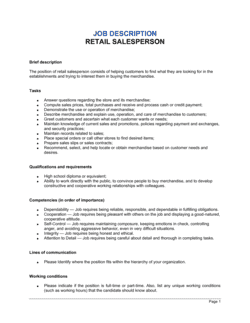
First-Line Supervisor or Manager of Retail Sales Workers Job Description Template

Free Word download • Edit online • Save & share with Drive • Export to PDF

2 pages20–30 min to fillDifficulty: StandardSignature requiredLegal review recommended
Learn more ↓
FreeFirst-Line Supervisor or Manager of Retail Sales Workers Job Description Template

At a glance

What it is
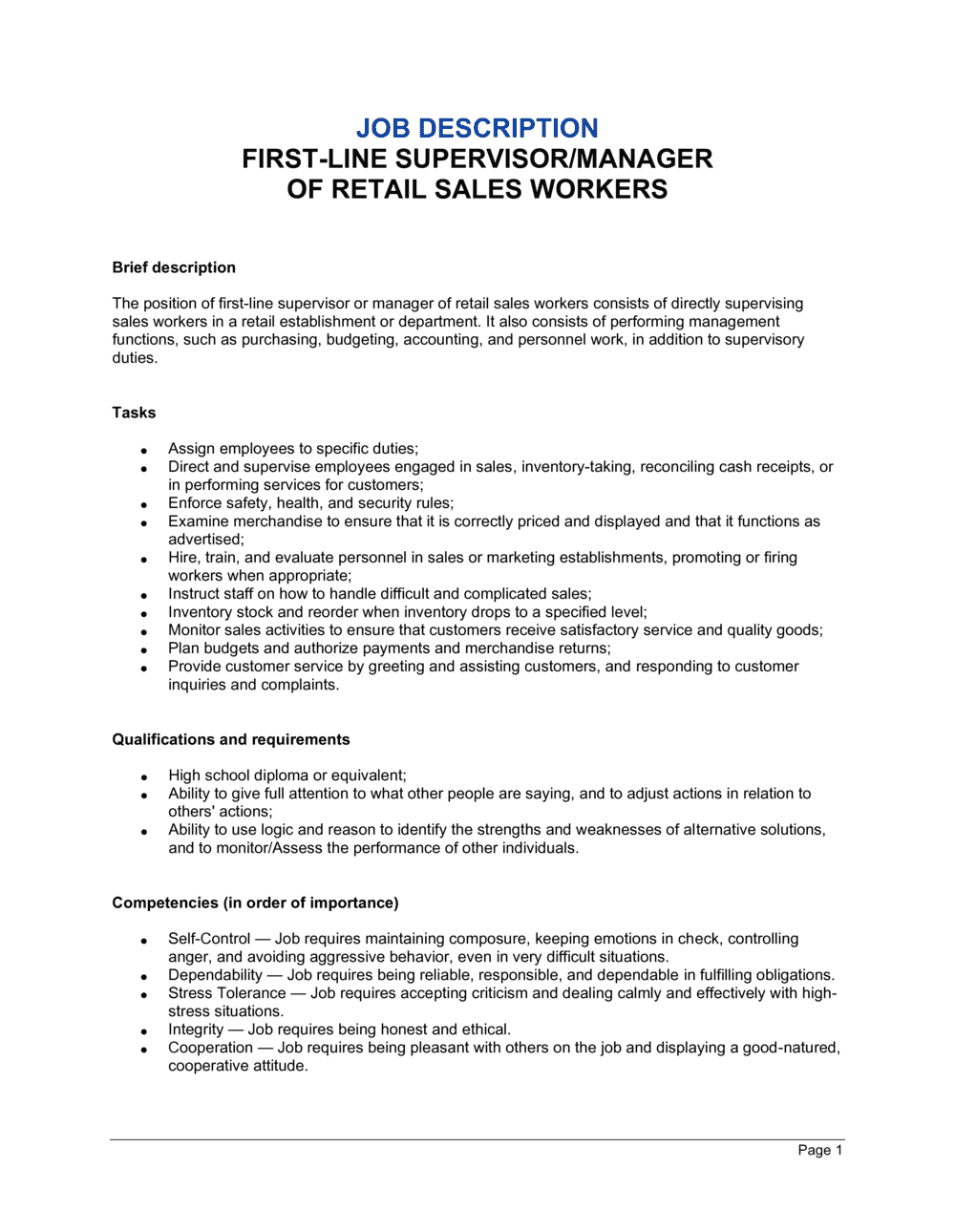
A First Line Supervisor or Manager of Retail Sales Workers Job Description is a formal employment document that defines the role, responsibilities, authority, and performance expectations for a front-line retail supervisory position. This free Word download provides a structured, editable template you can tailor to your store or chain and attach to an employment contract or offer letter as a binding Schedule of Duties.
When you need it
Use it when hiring or promoting a retail floor supervisor, team leader, or department manager who will oversee sales associates, manage shift operations, and be held accountable for sales targets and team performance. It is also used when restructuring an existing role to reflect new responsibilities or reporting lines.
What's inside
Job title, reporting structure, core duties and daily responsibilities, supervisory scope, performance metrics, scheduling and availability requirements, qualifications and certifications, compensation band, and acknowledgment signature block confirming the employee has reviewed and accepted the described role.

What is a First Line Supervisor or Manager of Retail Sales Workers Job Description?

A First Line Supervisor or Manager of Retail Sales Workers Job Description is a formal employment document that defines the duties, performance expectations, supervisory authority, scheduling requirements, and minimum qualifications for a front-line retail management role. It serves as the operational charter for the position — specifying exactly what the supervisor is expected to do, who they report to, how many associates they oversee, and what measurable targets they are held accountable for. When incorporated into an employment contract as a Schedule of Duties and signed by both parties, it becomes a binding component of the employment relationship, providing a documented baseline for performance management, disciplinary action, and, where necessary, termination for cause.

Why You Need This Document

Without a signed, role-specific job description, supervising and managing a retail floor supervisor becomes a credibility contest the moment performance or conduct is in dispute. Associates promoted into supervisory roles frequently claim they were never clearly told their responsibilities extended to disciplinary documentation, scheduling compliance, or shrink accountability — and without a signed document, that claim is difficult to disprove. From a compliance standpoint, an undocumented supervisory role that sits on the exempt/non-exempt classification boundary is a liability: misclassifying a retail supervisor as exempt when their primary duties are non-managerial exposes the employer to back-pay claims for every uncompensated overtime hour worked. This template closes both gaps — it establishes the documented duty baseline needed for defensible performance management and provides the classification evidence needed to defend your FLSA determination. For multi-location retailers and franchisors, it also creates the standardized role documentation that audits, wage-and-hour investigations, and workers' compensation proceedings routinely request.

Which variant fits your situation?

If your situation is…Use this template
Supervising a single department within a larger retail storeDepartment Supervisor Job Description
Managing an entire store location with full P&L accountabilityRetail Store Manager Job Description
Leading a small team of 2–5 associates with no direct reports hierarchyRetail Team Leader Job Description
Overseeing multiple store locations and their supervisorsDistrict Manager Job Description
Managing an e-commerce or omnichannel sales team remotelyE-Commerce Sales Supervisor Job Description
Supervising seasonal or temporary retail staff during peak periodsSeasonal Retail Supervisor Job Description
Engaging a contractor to manage sales staff on a project basisIndependent Contractor Agreement

Common mistakes to avoid

❌ Misclassifying the supervisor as FLSA-exempt

Why it matters: Retail supervisors who spend most of their time on non-managerial tasks — stocking, cashiering, cleaning — do not meet the executive exemption. Misclassification triggers back-pay for all uncompensated overtime, plus penalties.

Fix: Apply the duties test strictly: if the supervisor spends less than 50% of their time on genuine management activity, classify them as non-exempt and pay overtime accordingly.

❌ Using a generic job description not tied to a specific store or role scope

Why it matters: A description copied from the internet with no store-specific duties, KPIs, or reporting structure cannot support a performance improvement plan or a termination-for-cause decision.

Fix: Customize the duties, KPIs, reporting lines, and scheduling requirements for each specific location and team size before the employee signs.

❌ Omitting the employee's acknowledgment signature

Why it matters: Without a signed acknowledgment, the supervisor can claim they were never informed of specific duties or performance standards — undermining any disciplinary action that follows.

Fix: Require the employee to sign the acknowledgment block before their first shift. Store the original in the HR file and give the employee a copy.

❌ Setting KPIs in the job description that conflict with the employment contract

Why it matters: When the job description states a $15,000 weekly sales target and the offer letter states $12,000, the employee performs to the lower number and disputes any performance review based on the higher one.

Fix: Cross-reference all numeric performance targets across the job description, offer letter, and any performance review template before issuing any of them.

❌ Granting unlimited disciplinary authority without HR escalation requirements

Why it matters: A first-line supervisor who fires or suspends an employee without HR review can expose the company to wrongful termination, discrimination, or retaliation claims with no internal check to catch the error.

Fix: Define a clear escalation threshold in the supervisory authority clause: verbal warnings are at the supervisor's discretion; suspensions and terminations require manager and HR sign-off.

❌ Failing to update the job description when the role changes materially

Why it matters: An outdated job description that no longer reflects actual duties becomes useless as an enforcement tool and can be used against the employer in disputes about role scope or overtime classification.

Fix: Review and re-sign the job description any time the supervisor's team size, reporting line, or core duties change by more than 20%.

The 9 key clauses, explained

Job Title and Classification

In plain language: States the official position title, FLSA classification (exempt or non-exempt), employment type (full-time or part-time), and the department or business unit.

Sample language
Position Title: First Line Supervisor, Retail Sales | Department: [DEPARTMENT NAME] | Classification: [Exempt / Non-Exempt] | Employment Type: Full-Time

Common mistake: Misclassifying the role as exempt when the supervisor primarily performs the same tasks as the associates they manage — a common retail FLSA violation that triggers back-pay liability.

Reporting Structure

In plain language: Identifies the direct manager the supervisor reports to and the number and type of direct reports they oversee.

Sample language
Reports to: [STORE MANAGER / DISTRICT MANAGER NAME AND TITLE]. Directly supervises: [NUMBER] retail sales associates in the [DEPARTMENT / STORE LOCATION].

Common mistake: Leaving the direct-report count vague or omitting it entirely — this creates scope disputes when the supervisor is asked to manage additional staff without a compensation adjustment.

Core Duties and Responsibilities

In plain language: Lists the daily and recurring tasks the supervisor is expected to perform, from opening and closing procedures to coaching associates and managing inventory.

Sample language
Duties include: supervising [NUMBER] sales associates during assigned shifts; conducting daily floor walks to ensure merchandise presentation standards; processing returns, exchanges, and escalated customer complaints; and preparing shift performance reports for [STORE MANAGER].

Common mistake: Writing duties so broadly ('performs other tasks as assigned') that there is no meaningful baseline for performance management or termination for cause.

Supervisory Authority and Disciplinary Scope

In plain language: Defines what disciplinary actions the supervisor can initiate independently — verbal warnings, shift reassignments — versus what requires manager or HR approval.

Sample language
Supervisor is authorized to issue verbal and written warnings consistent with the Company's progressive discipline policy. Suspension, demotion, or termination recommendations must be escalated to [STORE MANAGER / HR DEPARTMENT] for approval prior to action.

Common mistake: Granting unlimited disciplinary authority in the job description without a corresponding HR approval step — exposing the employer to wrongful termination claims for unsupervised actions.

Sales Performance and KPI Accountability

In plain language: States the specific metrics the supervisor is held accountable for, including sales targets, conversion rates, average transaction value, and team productivity.

Sample language
Supervisor is responsible for achieving department sales targets of $[AMOUNT] per [PERIOD], maintaining a conversion rate of not less than [X]%, and reducing inventory shrink to no more than [X]% of department sales.

Common mistake: Setting KPIs in the job description that differ from those in the employment contract or offer letter — inconsistency between documents creates performance-management disputes.

Scheduling and Availability Requirements

In plain language: Describes shift expectations, weekend and holiday availability, and any on-call requirements that come with the supervisory role.

Sample language
Position requires availability for [DAYS/SHIFTS], including weekends, evenings, and statutory holidays as scheduled. Supervisor may be required to cover shifts on 24-hour notice in cases of associate absence.

Common mistake: Omitting scheduling expectations from the job description. When a supervisor disputes a holiday assignment, the absence of documented availability requirements makes enforcement impossible.

Minimum Qualifications and Certifications

In plain language: Lists the education level, years of experience, technical skills, and any required certifications (e.g., food-handler's permit, age-restricted sales license) the candidate must hold.

Sample language
Minimum [HIGH SCHOOL DIPLOMA / ASSOCIATE'S DEGREE] required. Minimum [X] years of retail sales experience, including [X] months in a supervisory or lead role. [CERTIFICATION NAME] required within [X] days of hire.

Common mistake: Requiring qualifications that screen out protected classes (e.g., a degree requirement for a role that objectively doesn't need one) — creating disparate-impact discrimination exposure.

Compensation Reference and Benefits Eligibility

In plain language: References the wage or salary band, overtime eligibility, and benefits the role qualifies for — without locking specific figures that should live in the employment contract.

Sample language
Compensation: hourly rate of $[MIN]–$[MAX] per hour [or annual salary of $[MIN]–$[MAX]], commensurate with experience. Non-exempt employees are eligible for overtime pay at 1.5× the regular rate for hours exceeding 40 per workweek. Benefits eligibility as per Company policy.

Common mistake: Omitting compensation entirely on the assumption it belongs only in the offer letter — leaving a gap that allows disputes about whether supervisory duties justify market-rate pay.

Acknowledgment and Signature Block

In plain language: A signed statement by the employee confirming they have received, read, and understood the job description, and that it accurately reflects the duties they are expected to perform.

Sample language
I, [EMPLOYEE FULL NAME], acknowledge receipt of this job description dated [DATE] and confirm that I understand and accept the duties, requirements, and expectations described herein. Signature: ___________ Date: ___________

Common mistake: Collecting only the manager's signature and not the employee's — an unsigned job description cannot be used to enforce performance standards or support a termination-for-cause decision.

How to fill it out

  1. 1

    Enter the position title and FLSA classification

    Confirm the exact job title, department, and whether the role is exempt or non-exempt under the FLSA. Use the duties test — not just the salary level — to determine classification.

    💡 The 'executive exemption' under the FLSA requires that the supervisor's primary duty is management and that they have genuine authority to hire or fire. A supervisor who mainly stocks shelves likely does not qualify as exempt.

  2. 2

    Define the reporting structure with specific names and headcounts

    Name the direct manager this supervisor reports to and state the number of direct reports. Avoid 'TBD' — if the team size isn't fixed, state a range and the condition that triggers a review.

    💡 Documenting span of control protects you when a supervisor claims a role-expansion warrants a pay increase — the baseline is in writing.

  3. 3

    List duties with enough specificity to support performance management

    Write 8–12 duties that reflect actual day-to-day activity. Include both operational tasks (opening procedures, cash handling) and people-management tasks (coaching, disciplinary documentation).

    💡 Each duty should be specific enough that you could evaluate whether the employee is or isn't doing it on any given week.

  4. 4

    Specify supervisory authority and escalation thresholds

    Define which actions the supervisor can take independently and which require HR or manager approval. Reference the company's progressive discipline policy by name.

    💡 Ambiguity here is the single biggest source of wrongful-termination claims at the first-line supervisor level. Make the line clear.

  5. 5

    Insert measurable KPIs for sales and operational performance

    Enter specific numeric targets — weekly sales goal, conversion rate floor, shrink cap — that match what appears in the employment contract or annual performance review template.

    💡 Ensure these numbers are consistent with what your employment contract or offer letter states. Conflicts between documents are litigated at the employer's expense.

  6. 6

    Document scheduling expectations and availability requirements

    State shift availability requirements explicitly: required days, on-call expectations, and holiday coverage obligations. Reference the company's scheduling policy if one exists.

    💡 Retail supervisors are frequently scheduled on holidays and weekends without documented consent — this clause prevents 'I didn't know' disputes.

  7. 7

    Confirm qualification requirements are legally defensible

    Review education and experience minimums to confirm they are genuinely required for the role's duties. Remove any requirements that are not job-related or that could screen out protected groups.

    💡 A blanket four-year-degree requirement for a retail floor supervisor role will not survive a disparate-impact challenge in most jurisdictions.

  8. 8

    Execute signatures before the employee's first shift

    Both the hiring manager and the employee must sign and date the acknowledgment block before day one. File the signed copy in the employee's HR file and provide the employee with a copy.

    💡 In common-law jurisdictions, a job description signed after employment begins may lack the fresh consideration needed to make its terms enforceable.

Frequently asked questions

What does a first line supervisor of retail sales workers do?

A first line supervisor of retail sales workers directly manages a team of sales associates on the store floor — assigning tasks, monitoring performance, coaching staff, handling escalated customer issues, and ensuring merchandise presentation and inventory standards are met. They typically report to a store or department manager and are the primary point of contact for front-line staff on issues like scheduling, returns, and real-time performance feedback.

Is a job description a legally binding document?

A job description becomes legally binding when it is incorporated into an employment contract by reference — typically as a Schedule A or attachment — and signed by both parties. A standalone job description that is not attached to a contract or acknowledged by the employee carries limited legal weight. However, even an unsigned description can be introduced as evidence of role expectations in employment disputes, so accuracy matters regardless of whether it is formally executed.

Should a retail supervisor be classified as exempt or non-exempt under the FLSA?

Classification depends on the duties test, not the job title. A retail supervisor qualifies as exempt under the FLSA executive exemption only if their primary duty is genuine management — directing two or more employees, having input into hiring and firing decisions, and spending at least 50% of their time on managerial tasks. A supervisor who primarily stocks shelves, runs the register, or performs associate-level work is typically non-exempt and entitled to overtime pay regardless of how their title reads.

What should a retail supervisor job description include?

At minimum: job title and FLSA classification, reporting structure, core duties and daily responsibilities, supervisory authority and disciplinary scope, measurable KPIs, scheduling and availability requirements, minimum qualifications and any required certifications, a compensation reference, and a signed acknowledgment block. Missing any of these creates gaps that appear in performance disputes, overtime claims, and termination proceedings.

Do I need a lawyer to draft a retail supervisor job description?

For a straightforward store-level hire, a well-structured template is typically sufficient. Engage an employment lawyer when the role sits on the exempt/non-exempt classification boundary, when the supervisor will have hire/fire authority with no HR review layer, when the business operates in a jurisdiction with strict written-duties requirements (such as California or the UK), or when the description will be incorporated into a complex executive employment agreement.

Can I use the same job description for all store locations?

You can use a consistent template structure across locations, but each copy should be customized with the specific store location, direct manager's name, team size, location-specific KPIs, and any jurisdiction-specific scheduling or certification requirements. A generic description that doesn't reflect actual duties for that location is difficult to enforce and may not satisfy job-posting transparency laws in states like Colorado, New York, or Washington.

What happens if a supervisor's duties change after the job description is signed?

If the role changes materially — new direct reports, a different reporting line, significantly different KPIs, or a reclassification between exempt and non-exempt — the job description should be updated and re-executed with a new signature from the employee. In Canada and the UK, a material unilateral change to duties can constitute constructive dismissal if the employee did not agree to the change. Re-executing the document with proper notice protects both parties.

What is the difference between a job description and an offer letter?

An offer letter confirms the role, compensation, and start date to secure acceptance. A job description defines the duties, performance expectations, supervisory authority, and qualifications that govern day-to-day employment. The offer letter gets the employee to accept; the job description governs how they are managed. Both should be consistent with each other and with the employment contract.

Are there salary transparency laws that affect how I write the compensation section?

Yes. Colorado, California, New York, Washington, and several other states now require employers to include a pay range in any job posting or description used for recruitment. If your job description doubles as a posting, include the compensation band. Even for internal documents, including a pay range reduces disputes and helps supervisors understand their earning potential and classification basis.

How this compares to alternatives

vs Retail Store Manager Job Description

A store manager job description covers full P&L accountability, hiring authority, vendor relationships, and strategic planning for the entire location. A first line supervisor description is scoped to direct floor oversight, shift management, and associate performance. Use the store manager template when the role includes budget authority and overall location accountability; use this template for department or shift-level supervisory positions.

vs Employment Contract

An employment contract defines the legal terms of the employment relationship — compensation, IP, non-compete, termination, and severance. A job description defines the operational scope of the role. The job description is typically incorporated into the employment contract as a Schedule A. You need both documents; one does not substitute for the other.

vs Independent Contractor Agreement

An independent contractor agreement engages a self-employed individual with no employment entitlements — no benefits, no overtime, no FLSA protection. A job description is an employment document; using it with a contractor creates misclassification risk. If the person supervising your retail staff has set hours, uses your equipment, and works exclusively for you, they are almost certainly an employee, not a contractor.

vs Job Offer Letter

A job offer letter confirms the role, compensation, and start date to trigger acceptance. It does not contain the detailed duties, performance standards, scheduling requirements, or supervisory authority scope that a job description provides. For a supervisory hire, both documents should be issued together — the offer letter references the job description, and the employee signs both.

Industry-specific considerations

Specialty Retail

Product knowledge requirements and brand-standard enforcement make precise duty documentation critical for coaching and disciplinary consistency across locations.

Grocery and Food Retail

Food-handler certifications, age-restricted product sale compliance, and union-agreement interactions require jurisdiction-specific qualification and authority clauses.

Franchise Retail

Franchisors typically mandate standardized job descriptions for all supervisory roles; the template must align with the franchise operations manual to satisfy compliance audits.

E-commerce and Omnichannel Retail

Supervisors overseeing both in-store and online fulfillment teams require dual-channel KPIs and remote-supervision authority clauses not present in traditional store-only descriptions.

Luxury and Department Stores

Client relationship management, high-value transaction authorization limits, and clienteling performance metrics require more detailed supervisory authority and KPI language.

Home Improvement and Hardware Retail

Safety certification requirements, hazardous-materials handling protocols, and contractor-customer liaison duties add specialized qualification and duty clauses to the standard template.

Jurisdictional notes

United States

The FLSA executive exemption requires the supervisor's primary duty to be management and that they direct at least two employees — a title alone is insufficient. Several states (Colorado, New York, Washington, California) require pay ranges in any job description used for posting. California also mandates seat-time breaks and specific scheduling disclosures that should be referenced in the duties and availability clauses.

Canada

Each province sets minimum wages and overtime thresholds that apply to retail supervisors. Ontario's Employment Standards Act requires employers to post schedules at least 24 hours in advance and restricts on-call requirements for certain workers — scheduling clauses must reflect these limits. Quebec requires that all employment documents be available in French for employees working in Quebec. Constructive dismissal risk rises sharply when duties change materially without documented employee consent.

United Kingdom

UK employers must provide a written statement of employment particulars on or before day one, and the job description is typically incorporated into that statement. The National Living Wage applies to all workers aged 21 and over; supervisory roles must clearly document any premium above base-rate entitlement. Working Time Regulations cap the working week at 48 hours on average unless the employee has signed an opt-out. Sunday working rights for retail employees provide an additional layer of scheduling protection that the availability clause must acknowledge.

European Union

The EU Transparent and Predictable Working Conditions Directive requires written employment terms within seven days of hire, covering duties, working hours, and compensation — a compliant job description satisfies part of this requirement. Member states vary significantly on overtime thresholds, Sunday trading restrictions, and works council consultation rights for new supervisory roles. GDPR applies to any employee data collected through onboarding and acknowledgment processes. France and Germany impose particularly detailed working-time and scheduling rules that affect the availability clause.

Template vs lawyer — what fits your deal?

PathBest forCostTime
Use the templateSingle-location retail owners hiring their first supervisor with a straightforward non-exempt hourly roleFree20–30 minutes
Template + legal reviewMulti-location retailers, roles on the exempt/non-exempt boundary, or jurisdictions with strict employment documentation requirements$200–$500 for an employment lawyer or HR consultant review1–3 days
Custom draftedEnterprise retail chains, unionized environments, or supervisory roles with hire/fire authority and significant overtime or classification exposure$500–$2,000+1–2 weeks

Glossary

First Line Supervisor
The lowest level of management with direct, day-to-day authority over non-supervisory employees — the person who assigns tasks, monitors output, and resolves immediate floor issues.
Scope of Supervision
The number and categories of employees a supervisor is directly responsible for managing, including scheduling, performance monitoring, and disciplinary authority.
Key Performance Indicators (KPIs)
Measurable targets assigned to a role — such as units per transaction, conversion rate, or shrink percentage — used to evaluate whether the supervisor is meeting expectations.
At-Will Employment
An employment relationship in most US states that either party may end at any time for any lawful reason, without advance notice — unless a contract specifies otherwise.
Exempt vs. Non-Exempt Classification
Under the US FLSA, exempt employees are not entitled to overtime pay; non-exempt employees must receive 1.5× their regular rate for hours over 40 per week. Retail supervisors often sit at this boundary.
Acknowledgment Signature
A signed statement by the employee confirming they have read, understood, and accepted the job description as an accurate representation of their role.
Reporting Structure
The documented chain of authority showing who the supervisor reports to and who reports to them — essential for performance management and dispute resolution.
Progressive Discipline
A structured corrective process — verbal warning, written warning, suspension, termination — that supervisors are typically authorized to initiate for direct reports.
Shrink
Retail industry term for inventory loss attributable to theft, administrative error, or vendor fraud — a metric frequently tied to a supervisor's performance accountability.
Schedule A (Attachment)
A separately signed appendix to an employment contract that incorporates the job description by reference, making its terms part of the binding agreement.

Part of your Business Operating System

This document is one of 3,000+ business & legal templates included in Business in a Box.

  • Fill-in-the-blanks — ready in minutes
  • 100% customizable Word document
  • Compatible with all office suites
  • Export to PDF and share electronically

Create your document in 3 simple steps.

From template to signed document — all inside one Business Operating System.
1
Download or open template

Access over 3,000+ business and legal templates for any business task, project or initiative.

2
Edit and fill in the blanks with AI

Customize your ready-made business document template and save it in the cloud.

3
Save, Share, Send, Sign

Share your files and folders with your team. Create a space of seamless collaboration.

Save time, save money, and create top-quality documents.

★★★★★

"Fantastic value! I'm not sure how I'd do without it. It's worth its weight in gold and paid back for itself many times."

Managing Director · Mall Farm
Robert Whalley
Managing Director, Mall Farm Proprietary Limited
★★★★★

"I have been using Business in a Box for years. It has been the most useful source of templates I have encountered. I recommend it to anyone."

Business Owner · 4+ years
Dr Michael John Freestone
Business Owner
★★★★★

"It has been a life saver so many times I have lost count. Business in a Box has saved me so much time and as you know, time is money."

Owner · Upstate Web
David G. Moore Jr.
Owner, Upstate Web

Run your business with a system — not scattered tools

Stop downloading documents. Start operating with clarity. Business in a Box gives you the Business Operating System used by over 250,000 companies worldwide to structure, run, and grow their business.

Start free · No credit card required