1
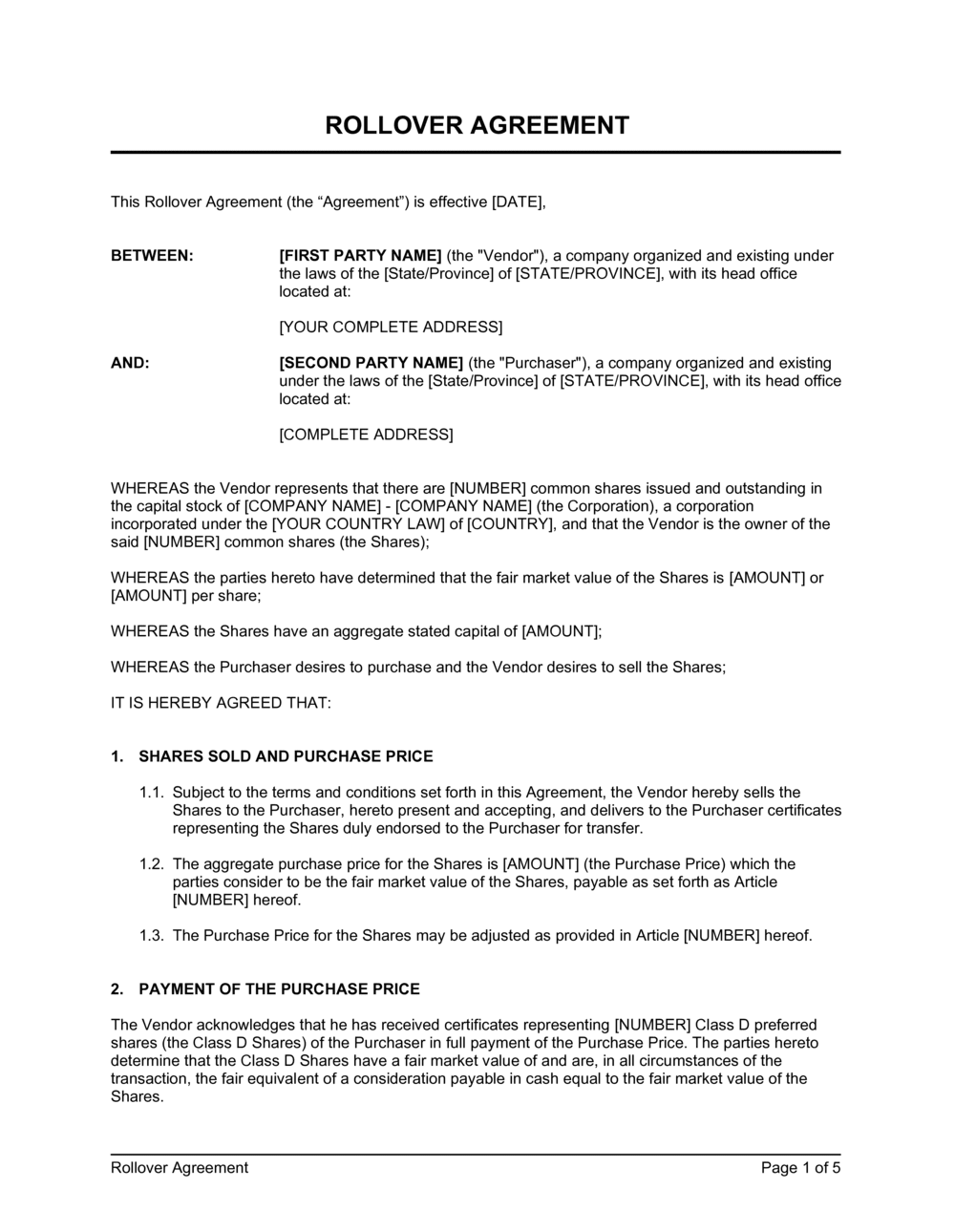
Identify all parties and cross-reference the purchase agreement
Enter the full legal name of the buyer, newco, and each rolling shareholder. Confirm that all defined terms in this agreement align with the master Purchase Agreement — particularly 'Enterprise Value,' 'Closing Date,' and 'Transaction Expenses.'
💡 Run a side-by-side comparison of defined terms between this agreement and the Purchase Agreement before circulating the first draft. Definition mismatches are the single most common source of post-close disputes.
2
Set the per-share valuation and rollover amount
Enter the agreed per-share value, the total equity value attributable to the rolling shareholder, and the rollover amount expressed both as a dollar figure and as a percentage of total proceeds. Include a hard dollar floor and cap.
💡 Anchor the per-share value to the same implied enterprise value used in the Purchase Agreement to prevent double-adjustment arguments at true-up.
3
Define the adjustment metrics and calculation methodology
Specify which financial metrics trigger a post-closing adjustment (working capital, net debt, transaction expenses, or cash), the reference targets for each, and the formula for converting the adjustment amount into a share count change or cash true-up.
💡 Attach the adjustment calculation methodology as a numbered Schedule rather than embedding it in the body — this makes it easier to amend independently if accounting treatment changes between signing and closing.
4
Draft the dispute resolution timeline
Set specific day-count deadlines for the Closing Statement delivery, the Notice of Disagreement window, the negotiation period, and the independent accountant referral. Name the accounting firm (or a selection mechanism) in the agreement itself.
💡 Avoid naming a firm with a pre-existing relationship to either party as the independent accountant. Perceived conflicts routinely cause the process to restart, adding weeks to resolution.
5
Complete the representations and investor status confirmations
Confirm the rolling shareholder's accredited investor status, title to shares, authority to contract, and acknowledgment of illiquidity. If the rolling shareholder is an entity rather than an individual, add entity authorization representations.
💡 For non-US rolling shareholders, replace the Regulation D accredited investor standard with the equivalent exemption under the applicable local securities law — the US standard does not apply extraterritorially.
6
Set lock-up duration and permitted transfer exceptions
Enter the lock-up period (typically 12–36 months for management rollovers in private equity deals), list permitted transfer carve-outs, and require any permitted transferee to execute a joinder agreement as a condition of the transfer.
💡 A 24-month lock-up aligned to the sponsor's expected hold period is standard. If the hold period is uncertain, consider a milestone-based release (e.g., upon an IPO or qualified sale) rather than a fixed date.
7
Address tax elections and required filings
State explicitly whether the exchange is intended to be tax-deferred and under which Code section. List all required tax filings (Form 8023, Form 8594, or equivalent) and allocate responsibility for preparation and timely filing.
💡 Have a tax advisor confirm the intended treatment before the agreement is signed — changing the tax election after closing requires amended returns and can trigger penalties.
8
Execute before or simultaneously with the purchase agreement closing
This agreement must be signed at or before the closing of the underlying acquisition. Post-close execution raises consideration issues and may leave the rollover equity issuance without an effective governing document during the gap period.
💡 Use a closing checklist to confirm simultaneous execution of this agreement, the Purchase Agreement, and any newco shareholder or operating agreement — all three must be consistent and signed at the same time.