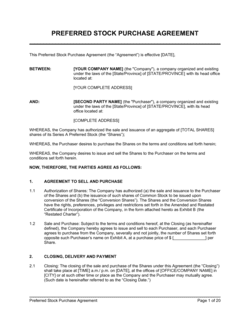
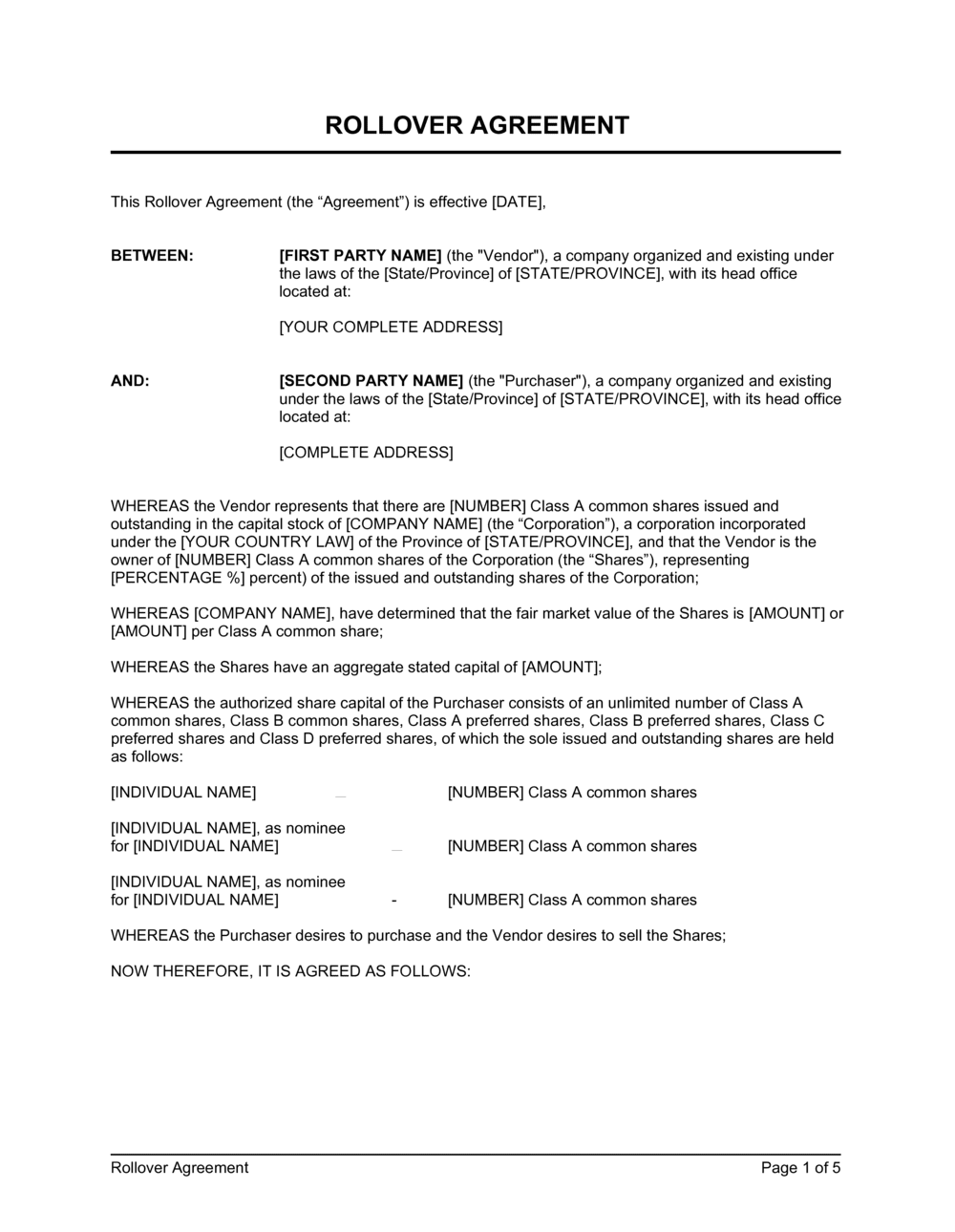
Rollover Agreement Values Shares with Election Clause Template

Free Word download • Edit online • Save & share with Drive • Export to PDF

5 pages25–35 min to fillDifficulty: ComplexSignature requiredLegal review recommended
Learn more ↓
FreeRollover Agreement Values Shares with Election Clause Template

At a glance

What it is
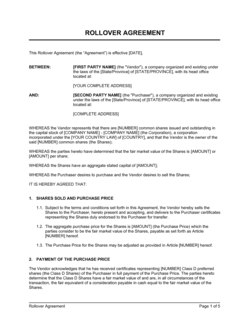
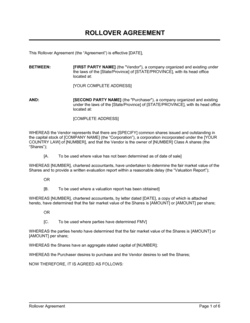
A Rollover Agreement Values Shares With Election Clause is a legally binding contract used in mergers and acquisitions that governs how a selling shareholder exchanges a portion of their existing equity for equity in the acquiring or surviving entity, rather than receiving the full consideration in cash. The share valuation provisions set the price at which rolled shares are credited against total deal consideration, while the election clause gives each qualifying shareholder a formal mechanism to elect whether — and in what amount — to participate in the rollover. This free Word download is structured for immediate editing and export as PDF.
When you need it
Use it when closing a private-equity-backed acquisition, management buyout, or recapitalization where selling shareholders are offered the option to retain equity in the go-forward business. It is particularly critical when the parties need a documented, IRS-compliant or CRA-compliant basis for deferring capital gains on the rolled portion of consideration.
What's inside
Share valuation methodology and agreed per-share price, election mechanics and deadline, rollover percentage caps, representations and warranties of the rolling shareholder, tax treatment provisions, restrictive covenants, governance rights in the acquiring entity, and conditions to closing.

What is a Rollover Agreement Values Shares With Election Clause?

A Rollover Agreement Values Shares With Election Clause is a legally binding contract used in mergers, acquisitions, and recapitalizations to govern the process by which a selling shareholder exchanges a portion of their existing equity — rather than receiving that portion as cash — for an equity interest in the acquiring or surviving entity. The share valuation provisions establish the agreed per-share price at which rolled equity is credited against the total purchase consideration, ensuring the rolling shareholder neither gains nor loses value relative to a full cash sale. The election clause provides each eligible shareholder with a formal, irrevocable mechanism — subject to a fixed deadline — to specify exactly how much of their consideration they wish to roll, creating a documented record that is essential for tax-deferral compliance and securities law purposes. Together, these provisions give both the acquirer and the rolling shareholder certainty on the go-forward capital structure, the tax treatment of the transaction, and the governance rights the rolling shareholder holds in the new entity.

Why You Need This Document

Proceeding with an equity rollover without a properly executed rollover agreement — or relying solely on a few paragraphs buried in the main purchase agreement — exposes every party to serious risk simultaneously. Without documented share valuation mechanics, per-share rollover value disputes arise at closing when deal math shifts due to working capital adjustments or option pool changes. Without a formal election clause with a fixed deadline, tax authorities may characterize the rollover as an involuntary exchange rather than a voluntary contribution, eliminating the capital gains deferral that rolling shareholders expect under IRC Section 721, IRC Section 351, ITA Section 85, or their international equivalents. Without a rollover cap and pro rata reduction mechanism, an over-subscribed election round forces last-minute renegotiation that delays closing and erodes deal confidence. This template gives acquirers, selling shareholders, and their counsel a structured, professionally drafted starting point that covers valuation methodology, election mechanics, tax covenants, governance rights, and restrictive covenants — reducing drafting time and ensuring nothing critical is left to informal side agreements.

Which variant fits your situation?

If your situation is…Use this template
Management team rolling equity in a private equity buyoutRollover Agreement Values Shares With Election Clause
Straightforward equity contribution with no cash election componentEquity Contribution Agreement
Shareholder exchanging shares in a statutory merger or amalgamationShare Exchange Agreement
Seller reinvesting proceeds through a subscription rather than a rolloverSubscription Agreement
Co-investor entering the acquiring entity alongside the sponsorCo-Investment Agreement
Rolled shares subject to continued vesting and forfeiture termsRestricted Stock Agreement
Full sale of shares with no rollover componentShare Purchase Agreement

Common mistakes to avoid

❌ Mismatching the share valuation basis with the purchase agreement

Why it matters: If the rollover agreement uses a basic share count while the purchase agreement uses fully diluted shares, the per-share rollover value will be higher than the effective deal price — creating unintended economic advantages for rolling shareholders and potential disputes at closing.

Fix: Cross-reference the exact share count definition from the purchase agreement in the valuation schedule and have both counsel confirm the numbers match before execution.

❌ Setting the election deadline after the closing date

Why it matters: An election made after cash consideration has already transferred creates a deemed taxable sale followed by a reinvestment — eliminating the tax deferral the entire structure was designed to achieve.

Fix: Set the election deadline at least 5 business days before the anticipated closing date and make all elections irrevocable after that point.

❌ Using the wrong IRC code section for the entity type

Why it matters: Applying Section 351 corporation language to a partnership rollover — or Section 721 partnership language to a corporate acquisition vehicle — invalidates the non-recognition treatment, triggering an immediate capital gains tax on the rolled amount.

Fix: Confirm the tax code section with a qualified M&A tax advisor before finalizing the agreement, and include a mutual covenant requiring both parties to file consistent returns.

❌ Omitting the rollover cap and pro rata reduction formula

Why it matters: Without a cap, the acquirer may be forced to issue more rollover equity than the capital structure supports, diluting the sponsor's ownership below modeled levels. Without a pro rata formula, over-subscribed elections require case-by-case renegotiation.

Fix: State a hard dollar cap and include an automatic pro rata reduction formula that applies without further consent of any party when elections exceed the cap.

❌ Granting governance rights that conflict with the new entity's charter

Why it matters: A rollover agreement promising tag-along rights or board observer access that the new entity's shareholders agreement or charter does not accommodate creates unenforceable obligations and post-close litigation risk.

Fix: Review the new entity's governing documents before finalizing the rollover agreement and ensure all governance rights are explicitly reflected in both documents.

❌ Not tying the rollover agreement's effectiveness to the main deal closing

Why it matters: An unconditionally effective rollover agreement creates binding equity obligations even if the main transaction falls through, leaving rolling shareholders holding equity in an entity that never completed its acquisition.

Fix: Include an explicit condition precedent that the rollover takes effect simultaneously with — and only upon — the closing of the main purchase agreement.

The 10 key clauses, explained

Recitals and defined terms

In plain language: Sets out the background of the transaction — acquirer, target, purchase agreement reference — and defines the specific terms used throughout the rollover agreement.

Sample language
WHEREAS, [ACQUIRER NAME] ('Buyer') is acquiring all outstanding equity interests of [TARGET COMPANY NAME] ('Company') pursuant to that certain Purchase Agreement dated [DATE]; and WHEREAS, the Rolling Shareholder desires to contribute [NUMBER] shares ('Rollover Shares') in exchange for equity in [NEWCO NAME].

Common mistake: Failing to cross-reference the defined terms in the main purchase agreement, creating inconsistent definitions that can invalidate the rollover mechanics on a technicality.

Share valuation and per-share rollover price

In plain language: Establishes the methodology used to calculate the value of each existing share being rolled — typically derived from the total enterprise value minus net debt, divided by fully diluted share count.

Sample language
The per-share value of each Rollover Share shall be [$ AMOUNT PER SHARE], calculated as ([TOTAL EQUITY VALUE] divided by [FULLY DILUTED SHARE COUNT]) as of [VALUATION DATE], as set forth in Schedule A.

Common mistake: Using a different share count basis (basic vs. fully diluted) in the rollover agreement than in the purchase agreement — this creates a per-share price discrepancy that can trigger renegotiation or disputes at closing.

Election clause and election deadline

In plain language: Gives each eligible shareholder a formal window in which to submit an election form specifying how much of their consideration to roll, with a fixed deadline after which no election may be made or changed.

Sample language
Each Eligible Shareholder may elect to roll up to [X]% of their Total Consideration by completing and delivering the Election Form attached as Exhibit A no later than [DATE] at [TIME] [TIME ZONE] ('Election Deadline'). Elections are irrevocable after the Election Deadline.

Common mistake: Setting the election deadline after the anticipated closing date. A post-close election creates tax and title complications because the transfer of consideration may have already occurred.

Rollover cap and minimum threshold

In plain language: States the maximum aggregate rollover amount the acquirer will accept from all rolling shareholders combined, and any minimum amount required for the rollover structure to proceed.

Sample language
The aggregate Rollover Consideration shall not exceed $[MAXIMUM AMOUNT] ('Rollover Cap'). If valid elections result in aggregate rollover elections exceeding the Rollover Cap, each electing shareholder's rollover amount shall be reduced pro rata.

Common mistake: Omitting a pro rata reduction mechanism when the cap is exceeded — without one, the acquirer must either accept over-subscription or unwind elections after the deadline.

Representations and warranties of the rolling shareholder

In plain language: The rolling shareholder confirms they own the rollover shares free and clear of liens, have authority to enter the agreement, and are an accredited investor or its equivalent under applicable securities law.

Sample language
Rolling Shareholder represents and warrants that: (a) Rolling Shareholder has good and marketable title to the Rollover Shares, free and clear of all liens; (b) Rolling Shareholder has full legal capacity and authority to execute this Agreement; (c) Rolling Shareholder qualifies as an 'accredited investor' as defined under Rule 501 of Regulation D.

Common mistake: Omitting the accredited investor representation. Issuing new equity in a private company to non-accredited investors triggers federal and state securities law filing requirements that can delay or prevent closing.

Tax treatment and election mechanics

In plain language: Specifies the intended tax treatment of the rollover — whether as a Section 721 contribution, a Section 351 exchange, or another structure — and the parties' obligations to file consistent tax returns and make any required elections.

Sample language
The parties intend that the contribution of Rollover Shares in exchange for [PARTNERSHIP INTERESTS / NEWCO SHARES] shall qualify as a non-recognition transaction under Section [721 / 351] of the Internal Revenue Code. Each party agrees to file all tax returns consistent with this treatment and not to take any position inconsistent herewith without prior written consent.

Common mistake: Using Section 721 partnership contribution language when the new entity is actually a corporation — the wrong code section voids the intended tax deferral and creates an immediate taxable event.

Governance rights in the acquiring entity

In plain language: Describes the rights the rolling shareholder receives in the new entity — board observer rights, voting rights, information rights, and tag-along or drag-along provisions.

Sample language
In consideration of the Rollover Contribution, Rolling Shareholder shall receive [CLASS / TYPE] equity interests in [NEWCO NAME] representing [X]% of the fully diluted capitalization, subject to the terms of the Shareholders Agreement dated [DATE], including tag-along rights as set forth in Section [X] thereof.

Common mistake: Granting governance rights in the rollover agreement without ensuring they are consistent with the new entity's governing documents — conflicting provisions in the shareholders agreement override or nullify rollover agreement promises.

Restrictive covenants

In plain language: Post-closing obligations on the rolling shareholder — typically non-compete, non-solicit, and lock-up restrictions on the new equity — that run for defined periods to protect the acquirer's investment.

Sample language
For a period of [X] years following the Closing Date, Rolling Shareholder shall not, directly or indirectly, engage in any Competing Business within [GEOGRAPHIC AREA]. Rolling Shareholder agrees not to transfer, sell, or encumber the Rollover Equity for a period of [X] months following Closing ('Lock-Up Period').

Common mistake: Including a non-compete with no geographic or industry limit. Courts in most jurisdictions will either strike down the entire clause or blue-pencil it in a way that is less favorable to the acquirer than a narrowly drafted restriction.

Conditions to effectiveness

In plain language: Lists the conditions that must be satisfied before the rollover is legally effective — primarily that the main transaction closes, minimum elections are received, and all regulatory approvals are obtained.

Sample language
This Agreement shall become effective and binding only upon: (a) the simultaneous closing of the transactions contemplated by the Purchase Agreement; (b) receipt of valid elections representing no less than $[MINIMUM AMOUNT] in aggregate rollover consideration; and (c) receipt of all required regulatory approvals.

Common mistake: Failing to link the rollover agreement's effectiveness to the closing of the main purchase agreement. If the main deal falls through, an unconditionally effective rollover agreement can leave parties with residual obligations and disputed equity positions.

Governing law and dispute resolution

In plain language: Specifies which jurisdiction's law governs the agreement and the mechanism for resolving disputes — typically arbitration for confidentiality or Delaware courts for US private equity transactions.

Sample language
This Agreement shall be governed by and construed in accordance with the laws of the State of [DELAWARE / OTHER], without regard to conflict of laws principles. Any dispute shall be resolved by binding arbitration in [CITY] under the rules of [AAA / JAMS], except that either party may seek injunctive relief in a court of competent jurisdiction.

Common mistake: Selecting a governing law state that is inconsistent with the governing law of the main purchase agreement. Inconsistent governing law creates conflicting interpretation risk, particularly on cross-referenced defined terms.

How to fill it out

  1. 1

    Identify all parties and link to the main purchase agreement

    Enter the full legal names of the acquirer, the target company, and each rolling shareholder. Include a direct cross-reference to the purchase agreement by date and title in the recitals.

    💡 If there are multiple rolling shareholders, consider attaching a Schedule of Rolling Shareholders rather than naming each in the body — this simplifies execution logistics.

  2. 2

    Calculate and document the per-share rollover value

    Derive the per-share value from the agreed enterprise value minus net debt, divided by the fully diluted share count as defined in the purchase agreement. Attach the calculation as Schedule A.

    💡 Confirm that the share count basis (basic, treasury-method, or fully diluted) matches exactly what is used in the purchase agreement purchase price calculation to avoid a per-share discrepancy.

  3. 3

    Set the election deadline and prepare the election form

    Choose an election deadline that is at least 5 business days before the anticipated closing date and attach a completed election form as Exhibit A. Make the election irrevocable after the deadline.

    💡 Send the election form with a clear cover letter explaining the tax implications of electing versus not electing — shareholders who do not understand the choice often miss the deadline.

  4. 4

    Define the rollover cap and pro rata reduction mechanics

    State the maximum aggregate rollover amount in dollars and include a pro rata reduction formula in case total elections exceed the cap. Specify who performs the calculation and by what date.

    💡 Set the cap at the amount your tax counsel has confirmed is consistent with the intended non-recognition structure — exceeding it may push the transaction outside safe-harbor thresholds.

  5. 5

    Confirm the tax code section and file consistent elections

    Work with tax counsel to confirm whether the rollover qualifies under IRC Section 721 (partnership), Section 351 (corporation), or an equivalent non-US provision. Enter the correct code section and include a mutual covenant to file consistent tax returns.

    💡 If the new entity is a partnership, confirm whether the contribution triggers the disguised sale rules under IRC Section 707(a)(2)(B) — this is a common oversight that converts the deferral into immediate income.

  6. 6

    Define the governance rights and attach the shareholders agreement

    Specify the class and percentage of new equity the rolling shareholder receives, then ensure those rights are mirrored in the new entity's shareholders or operating agreement. Attach that agreement or a form of it as an exhibit.

    💡 Do not grant board seats or observer rights in the rollover agreement without confirming the new entity's charter documents accommodate them — a conflicting charter provision will control.

  7. 7

    Draft the restrictive covenants with appropriate scope

    Set the non-compete duration and geography proportionate to the shareholder's role and the business's actual competitive footprint. Include a separate lock-up period for the new equity.

    💡 California-based rolling shareholders are subject to California's near-total ban on non-compete clauses — include a jurisdiction-specific carve-out to avoid voiding the entire covenant.

  8. 8

    Execute before or simultaneously with the main transaction closing

    Arrange for all parties to sign the rollover agreement at or immediately before the main purchase agreement closing. Stagger execution so the rollover takes effect simultaneously with the transfer of consideration.

    💡 Use a single closing checklist that tracks both the main purchase agreement and the rollover agreement signature pages — missed signatures on the rollover are a common last-minute closing delay.

Frequently asked questions

What is a rollover agreement in an M&A transaction?

A rollover agreement is a contract used in mergers and acquisitions that allows a selling shareholder to exchange a portion of their existing equity for equity in the acquiring or surviving entity instead of receiving the full sale price in cash. The share valuation provisions determine the value credited to the rolled shares, and the election clause gives each eligible shareholder a formal, time-bound process to choose how much to roll. Rollover agreements are most commonly used in private equity buyouts to retain management alignment with the go-forward business.

Why is the election clause important in a rollover agreement?

The election clause creates a documented, auditable record of each shareholder's voluntary decision to exchange deal consideration for new equity. Without a formal election process, the tax authorities may characterize the rollover as a mandatory exchange rather than a voluntary contribution, potentially eliminating the intended tax deferral. The clause also sets a hard deadline that prevents late elections from disrupting the closing timeline and gives the acquirer certainty on the final capital structure before close.

How are rolled shares valued in a rollover agreement?

Rolled shares are typically valued at the same per-share price implied by the main transaction — calculated as the total equity value divided by the fully diluted share count as of the valuation date. This number is documented in a valuation schedule attached to the rollover agreement so there is no ambiguity about what consideration a rolling shareholder foregoes. It is critical that this calculation uses the same share count basis as the purchase price calculation in the main purchase agreement.

What tax rules apply to equity rollovers in the United States?

The primary US tax rules are IRC Section 721, which generally allows tax-free contributions of property to a partnership in exchange for partnership interests, and IRC Section 351, which allows tax-free transfers to a corporation where the contributors control at least 80% of the new entity. The correct provision depends entirely on the legal form of the acquiring entity. Rolling shareholders typically defer capital gains on the rolled portion until a subsequent taxable sale of the new entity. Tax counsel review is strongly recommended before execution, as disguised sale rules and other anti-avoidance provisions can convert deferred gains into current income.

Do I need a lawyer to prepare a rollover agreement?

Yes, in most cases. Rollover agreements involve tax-deferral mechanics, securities law representations, and governance provisions that interact with the main purchase agreement, the new entity's charter, and applicable tax code sections. Errors in any of these areas can produce immediate tax liability, unenforceable equity rights, or securities law violations. A high-quality template provides the structural foundation and reduces drafting time significantly, but qualified M&A counsel and a tax advisor should review the final document before execution.

What is a rollover cap and why does it matter?

A rollover cap is the maximum aggregate dollar amount or percentage of total deal consideration that the acquirer will accept as rolled equity. It matters because the capital structure of the acquiring entity is modeled around a specific split between rolled equity and cash — too much rollover dilutes the sponsor's ownership or violates debt covenants that limit seller equity participation. A pro rata reduction mechanism in the rollover agreement automatically scales back elections when the cap is exceeded, avoiding renegotiation after the election deadline passes.

Can a rollover agreement include a non-compete clause?

Yes, and it commonly does. Because rolling shareholders are typically key management members who will continue in the business, the acquirer often includes non-compete, non-solicit, and equity lock-up provisions directly in the rollover agreement. Enforceability depends on jurisdiction and scope — restrictions must be reasonable in duration, geography, and breadth. California and certain other jurisdictions restrict or ban post-employment non-competes, so jurisdiction-specific carve-outs are necessary for rolling shareholders located in those states or provinces.

What happens to the rollover agreement if the main transaction does not close?

If the rollover agreement contains a condition precedent linking its effectiveness to the closing of the main purchase agreement, it automatically terminates without creating ongoing obligations. Without that condition, the parties may be bound by an agreement to exchange equity in a transaction that never occurred, creating disputes over whether any consideration is owed. Always include an explicit simultaneous-closing condition to avoid this outcome.

How is a rollover agreement different from a share purchase agreement?

A share purchase agreement governs the sale of all shares for cash consideration — the seller exits entirely. A rollover agreement governs the partial retention of equity by the seller in exchange for reduced cash consideration at closing. The two documents typically run in parallel in the same transaction: the share purchase agreement covers the cash portion of the deal, while the rollover agreement covers the equity reinvestment portion and the tax mechanics that apply to it.

How this compares to alternatives

vs Share Purchase Agreement

A share purchase agreement governs the outright sale of all shares for cash — the seller exits fully at closing. A rollover agreement governs the portion of equity the seller retains in the new entity instead of receiving cash. In most private equity buyouts, both documents are executed simultaneously: the SPA handles the cash sale, and the rollover agreement handles the equity reinvestment and associated tax deferral mechanics.

vs Subscription Agreement

A subscription agreement covers a new cash investment in a company in exchange for newly issued shares. A rollover agreement covers the exchange of existing shares in a target entity for equity in an acquiring entity — no new cash changes hands for the rolled portion. The tax treatment differs significantly: a subscription is generally a taxable event, while a qualifying rollover may defer capital gains under applicable non-recognition provisions.

vs Shareholders Agreement

A shareholders agreement governs the ongoing relationship among equity holders in the new entity after the rollover — voting rights, transfer restrictions, information rights, and exit mechanics. The rollover agreement governs the transaction by which the rolling shareholder acquires their position. Both documents are needed: the rollover agreement creates the equity; the shareholders agreement governs it going forward.

vs Equity Incentive Plan

An equity incentive plan grants new equity to employees as compensation, typically subject to vesting schedules and performance conditions. A rollover agreement converts existing sale consideration into equity — the shareholder already earned the underlying value through ownership. Rollover equity typically comes with fewer forfeiture conditions than incentive equity, though lock-up and non-compete restrictions are common in both.

Industry-specific considerations

Private Equity and Investment

Management rollover is a standard feature of LBO structures, aligning seller-managers with the sponsor's return profile and reducing the cash required at close.

Technology / SaaS

Founder rollovers preserve equity incentives through earn-out periods and support second-bite-of-the-apple participation in a subsequent sponsor exit at a higher valuation.

Professional Services

Partner equity rollovers in professional services acquisitions retain client relationships and human capital, with lock-up periods typically tied to client retention milestones.

Manufacturing

Operational management teams in manufacturing buyouts roll equity to maintain decision-making continuity, with non-compete terms scoped to specific product categories and geographies.

Jurisdictional notes

United States

The primary non-recognition provisions are IRC Sections 721 and 351, depending on whether the acquiring entity is a partnership or corporation. Rolling shareholders must also consider the disguised sale rules under IRC Section 707(a)(2)(B) if they receive any cash boot alongside the rolled equity. State-level non-compete enforceability varies sharply — California, Minnesota, and North Dakota impose significant restrictions on post-closing covenants. Securities law representations (accredited investor status under Regulation D) are required for private placements of new equity.

Canada

Canadian rollovers typically rely on the Section 85 rollover election under the Income Tax Act, which allows a tax-deferred transfer of eligible property to a Canadian corporation at an elected amount. Provinces impose their own securities rules on private equity issuances. Quebec's Civil Code imposes distinct requirements on non-compete clauses, including a 5-year maximum duration. CRA scrutinizes the elected amount closely — it must fall within the range of the property's adjusted cost base to fair market value.

United Kingdom

UK rollover relief is primarily available under TCGA 1992 Sections 135 and 136 for share-for-share exchanges, where HMRC treats the exchange as a reorganization rather than a disposal for capital gains purposes. HMRC clearance under Section 138 is available and strongly advisable for material transactions. Enterprise Investment Scheme and Entrepreneurs Relief considerations may apply to qualifying sellers. Post-Brexit, EU state aid rules no longer limit relief structuring for UK-only transactions.

European Union

EU rollover transactions are governed by the EC Merger Directive and each member state's implementation of share exchange relief. French, German, and Dutch tax law each provide rollover mechanisms, but the conditions, elected value ranges, and reporting requirements differ materially by jurisdiction. GDPR considerations apply when transferring shareholder personal data across borders as part of the closing process. Non-compete clauses require financial compensation to the departing shareholder in several member states, including France and Germany, to be enforceable.

Template vs lawyer — what fits your deal?

PathBest forCostTime
Use the templateStraightforward management rollovers in domestic transactions where the parties have experienced M&A counsel overseeing the broader dealFree2–4 hours to complete the template
Template + legal reviewMid-market buyouts under $50M where the rollover amount is below $5M and the entity structure is a standard Delaware LLC or corporation$1,500–$4,000 for M&A counsel review3–7 business days
Custom draftedLarge or complex transactions, multi-jurisdiction rollovers, rollovers involving partnership disguised-sale risk, or transactions with multiple rolling shareholders across different share classes$5,000–$25,000+2–6 weeks

Glossary

Rollover Equity
The portion of a selling shareholder's deal consideration that is exchanged for equity in the acquiring or surviving entity instead of being paid out in cash.
Election Clause
A contractual provision that gives each eligible shareholder a formal, time-bound process to indicate their choice of how much — if any — of their consideration to roll into the new entity.
Per-Share Rollover Value
The agreed price per share used to calculate how many new equity units a rolling shareholder receives in exchange for their existing shares.
Implied Enterprise Value
The total value attributed to the target company in the transaction, used as the anchor for calculating per-share rollover value.
Tax Deferral
The postponement of a capital gains tax liability on the rolled portion of equity to a future taxable event, such as a subsequent sale of the new entity.
IRC Section 721
The US Internal Revenue Code provision that generally allows a tax-free contribution of property — including equity — to a partnership in exchange for a partnership interest.
IRC Section 351
The US Internal Revenue Code provision that permits a tax-free transfer of property to a corporation in exchange for stock, subject to an 80% control requirement.
Rollover Cap
The maximum percentage or dollar amount of deal consideration that any shareholder — or all shareholders in aggregate — may elect to roll rather than receive in cash.
Representations and Warranties
Factual statements made by the rolling shareholder about ownership, title, absence of liens, and authority to enter the agreement, on which the acquirer relies at closing.
Conditions to Closing
Specific prerequisites — such as receipt of regulatory approvals or satisfaction of a minimum cash election threshold — that must be met before the rollover becomes effective.
Tag-Along Right
A governance right allowing a minority rolling shareholder to sell their new equity on the same terms as the majority sponsor in any future exit transaction.

Part of your Business Operating System

This document is one of 3,000+ business & legal templates included in Business in a Box.

  • Fill-in-the-blanks — ready in minutes
  • 100% customizable Word document
  • Compatible with all office suites
  • Export to PDF and share electronically

Create your document in 3 simple steps.

From template to signed document — all inside one Business Operating System.
1
Download or open template

Access over 3,000+ business and legal templates for any business task, project or initiative.

2
Edit and fill in the blanks with AI

Customize your ready-made business document template and save it in the cloud.

3
Save, Share, Send, Sign

Share your files and folders with your team. Create a space of seamless collaboration.

Save time, save money, and create top-quality documents.

★★★★★

"Fantastic value! I'm not sure how I'd do without it. It's worth its weight in gold and paid back for itself many times."

Managing Director · Mall Farm
Robert Whalley
Managing Director, Mall Farm Proprietary Limited
★★★★★

"I have been using Business in a Box for years. It has been the most useful source of templates I have encountered. I recommend it to anyone."

Business Owner · 4+ years
Dr Michael John Freestone
Business Owner
★★★★★

"It has been a life saver so many times I have lost count. Business in a Box has saved me so much time and as you know, time is money."

Owner · Upstate Web
David G. Moore Jr.
Owner, Upstate Web

Run your business with a system — not scattered tools

Stop downloading documents. Start operating with clarity. Business in a Box gives you the Business Operating System used by over 250,000 companies worldwide to structure, run, and grow their business.

Start free · No credit card required