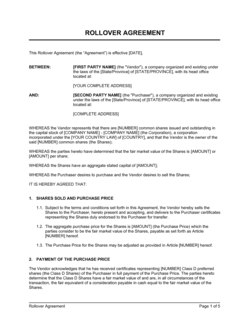
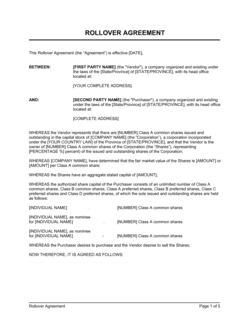
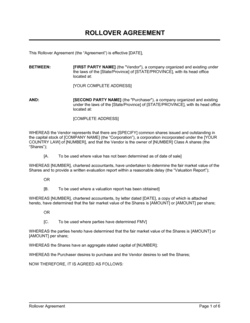
Rollover Agreement Values Assets with Surplus Account Template

Free Word download • Edit online • Save & share with Drive • Export to PDF

5 pages25–35 min to fillDifficulty: ComplexSignature requiredLegal review recommended
Learn more ↓
FreeRollover Agreement Values Assets with Surplus Account Template

At a glance

What it is
A Rollover Agreement Values Assets With Surplus Account is a binding legal contract used when one party transfers identified assets into a new or existing entity, with the agreed value of those assets formally recorded and any excess value above a stated threshold credited to a surplus account. This free Word download provides a structured, professionally formatted starting point you can edit online and export as PDF for execution by all parties.
When you need it
Use it when restructuring a business, contributing assets to a partnership or corporation in exchange for equity or units, or transferring property where the fair market value exceeds the consideration paid and the surplus must be formally tracked. It is particularly relevant in corporate reorganizations, mergers, and estate-planning rollover transactions.
What's inside
The agreement covers party identification, a detailed asset schedule with agreed valuations, the mechanics of the surplus account, transfer conditions and closing procedures, representations and warranties on asset title and value, indemnification, governing law, and execution blocks for all parties.

What is a Rollover Agreement Values Assets With Surplus Account?

A Rollover Agreement Values Assets With Surplus Account is a legally binding contract under which a transferor contributes identified assets to a corporation or other entity at agreed fair market values, receives shares or equity units as consideration, and the excess of the aggregate asset values over the stated capital attributed to those shares is formally recorded as a credit to the entity's contributed surplus account. The agreement documents every material dimension of the transaction: the asset schedule with supported valuations, the share issuance mechanics, any applicable tax election, closing deliveries, and the representations and warranties each party makes about title, authority, and value. It functions simultaneously as a corporate restructuring instrument, a tax-planning document, and a property transfer record — and in jurisdictions such as Canada, it provides the contractual foundation for a joint statutory election that allows the transferor to defer accrued gains on transferred property.

Why You Need This Document

Without a formal rollover agreement, a business restructuring or incorporation can unravel on multiple fronts at once. Tax authorities in Canada, the United States, and the United Kingdom require specific documentation — and in Canada, a joint election — to recognize the deferral; absent that paperwork, the full accrued gain on transferred assets becomes taxable in the year of transfer. Corporate law requires a board resolution and updated share register to validate the share issuance; without them, the transferor's equity interest may be challenged by future investors, lenders, or litigation counterparties. The surplus account entry, if omitted or misclassified, corrupts the company's equity records and creates errors that compound across every future distribution, redemption, and tax filing. A properly executed rollover agreement with a complete asset schedule, calculated surplus, and filed tax election resolves all of these risks in a single instrument — and this template gives you the structure to get there without starting from a blank page.

Which variant fits your situation?

If your situation is…Use this template
Rolling assets into a newly incorporated company in exchange for sharesRollover Agreement Values Assets With Surplus Account
Transferring property to a partnership in exchange for partnership unitsPartnership Contribution Agreement
Selling assets between related entities at agreed transfer pricesAsset Purchase Agreement
Reorganizing a corporation where shares, not assets, are the rollover subjectShare Exchange Agreement
Contributing a single piece of real property with surplus treatmentProperty Transfer Agreement
Merging two entities with a full asset schedule and valuation reportMerger Agreement
Transferring intellectual property as part of a business rolloverIP Assignment Agreement

Common mistakes to avoid

❌ Missing the tax election filing deadline

Why it matters: A late or unfiled joint election means the rollover deferral is lost, and the full accrued gain on transferred assets is recognized in the year of transfer — potentially triggering a large, unexpected tax bill.

Fix: Calendar the election deadline immediately upon signing and assign a named responsible party — typically the tax advisor — to confirm submission with proof of receipt.

❌ Using book value instead of fair market value on the asset schedule

Why it matters: Tax authorities can challenge agreed values that materially diverge from supportable fair market value, reassessing the gain and imposing penalties for misrepresentation.

Fix: Obtain independent appraisals for material assets — real property, goodwill, and IP — and attach the appraisal reports as exhibits to the agreement.

❌ Including unplanned boot that triggers partial gain recognition

Why it matters: Any non-share consideration paid to the transferor equal to or exceeding the elected amount crystallizes a taxable gain on that portion, defeating the deferral structure.

Fix: Before finalizing the consideration clause, model the boot against the transferor's ACB for each asset. Structure debt assumptions as the transferee's obligation, not as consideration paid to the transferor, where possible.

❌ Failing to distinguish contributed surplus from retained earnings in the company's books

Why it matters: Misclassification means future dividends may inadvertently access the wrong equity account, exposing shareholders to capital-dividend account errors and incorrect tax reporting.

Fix: Instruct the company's accountant to post the surplus account credit as a separate contributed-surplus line item on the balance sheet at closing, supported by the agreement's calculation exhibit.

❌ Omitting individual asset transfer instruments at closing

Why it matters: The rollover agreement itself does not transfer title to real property, registered vehicles, or IP — each requires a separate jurisdiction-specific instrument, and missing one leaves title legally in the transferor's hands.

Fix: Attach a closing deliveries checklist as a schedule, listing every required instrument by asset type, and confirm execution and registration of each before releasing share certificates.

❌ No indemnification cap on the transferor's liability

Why it matters: Unlimited indemnity exposure can make the transaction commercially unacceptable for a transferor rolling over the bulk of their life's work — and it leaves the deal vulnerable to renegotiation after signing.

Fix: Negotiate a liability cap expressed as a percentage of the aggregate agreed value (typically 10–25%) with a de minimis basket below which claims cannot be brought.

The 10 key clauses, explained

Parties and Recitals

In plain language: Identifies the transferor, the transferee entity, and any guarantors or acknowledgment parties, and sets out the background facts that explain why the rollover is being undertaken.

Sample language
This Rollover Agreement is entered into as of [DATE] between [TRANSFEROR FULL LEGAL NAME] ('Transferor') and [TRANSFEREE CORPORATION / ENTITY NAME], a [JURISDICTION] [ENTITY TYPE] ('Company'). WHEREAS, Transferor wishes to transfer the Assets described herein to the Company in exchange for [SHARES / UNITS / CONSIDERATION] on the terms set out below.

Common mistake: Naming a trade name rather than the registered legal entity as the transferee. If the receiving entity's name does not match its corporate registry records, share issuance and title transfers may be legally defective.

Asset Schedule and Agreed Values

In plain language: Lists every asset being transferred — real property, equipment, receivables, IP, or business goodwill — with the agreed fair market value assigned to each, totaling the aggregate rollover consideration.

Sample language
Schedule A sets out each Asset, its description, and the Agreed Value attributed to it. The aggregate Agreed Value of all Assets is $[TOTAL AMOUNT]. The parties agree that the Agreed Values reflect fair market value as of [VALUATION DATE].

Common mistake: Using book value instead of fair market value on the schedule. Regulators, tax authorities, and future auditors will challenge a rollover where the elected or agreed values are not supportable — particularly for goodwill and IP.

Surplus Account Mechanics

In plain language: Defines how the surplus account is established, calculated, and recorded — specifically the amount by which aggregate asset values exceed the paid-up capital or stated capital assigned to the shares or units issued in return.

Sample language
The Company shall credit to its Contributed Surplus Account an amount equal to the excess of (a) the aggregate Agreed Value of the Assets over (b) the stated capital attributed to the [CLASS] Shares issued as consideration, being $[SURPLUS AMOUNT] as of the Closing Date.

Common mistake: Failing to distinguish contributed surplus from retained earnings in the company's books. Conflating these accounts creates dividend-designation problems and can expose shareholders to unintended tax consequences on distributions.

Consideration and Share Issuance

In plain language: States the exact number and class of shares or units the transferee issues to the transferor as consideration, the stated capital amount per share, and any non-share consideration (boot) paid.

Sample language
In consideration for the transfer of the Assets, the Company shall issue to Transferor [NUMBER] [CLASS] Shares at a stated capital of $[AMOUNT PER SHARE], for aggregate stated capital of $[TOTAL STATED CAPITAL]. No other consideration shall be payable unless set out in Schedule B.

Common mistake: Including unintended boot — such as assumption of a shareholder loan — without accounting for the gain it triggers. Any non-share consideration equal to or greater than the elected amount forces full gain recognition on that portion.

Tax Election

In plain language: Documents the parties' agreement to jointly file a tax election (such as a Section 85 election in Canada or equivalent statutory provision) specifying the elected amount for each transferred asset, and their obligation to file the election by the required deadline.

Sample language
The Transferor and the Company agree to jointly execute and file the Election on Form T2057 (or equivalent) with the Canada Revenue Agency within the time prescribed by subsection 85(6) of the Income Tax Act, electing the amounts set out in Schedule C for each eligible property.

Common mistake: Missing the filing deadline for the joint tax election. In Canada, a late T2057 election requires the CRA's acceptance and may attract a late-filing penalty — and in the worst case, the deferral is lost entirely, crystallizing the full gain.

Representations and Warranties of the Transferor

In plain language: The transferor confirms that it owns the assets free and clear of undisclosed encumbrances, has authority to transfer them, and that the agreed values are not materially misleading.

Sample language
Transferor represents and warrants that: (a) it has good and marketable title to each Asset, free and clear of all liens and encumbrances except as disclosed in Schedule D; (b) it has full power and authority to enter into this Agreement; and (c) to Transferor's knowledge, the Agreed Values do not materially misstate the fair market value of any Asset.

Common mistake: Using a blanket warranty of 'no encumbrances' without attaching a disclosure schedule. Undisclosed liens on transferred assets may result in the transferee acquiring impaired title, triggering indemnification claims after closing.

Representations and Warranties of the Transferee

In plain language: The receiving entity confirms it is duly incorporated, authorized to issue shares, and that the share issuance is valid under its constating documents and applicable corporate law.

Sample language
The Company represents and warrants that: (a) it is duly incorporated and in good standing under the laws of [JURISDICTION]; (b) the issuance of the Shares has been duly authorized by its board of directors; and (c) the Shares will be validly issued, fully paid, and non-assessable upon delivery.

Common mistake: Skipping the transferee's representations entirely. If the receiving entity has no authority to issue the class of shares specified, the transferor may receive defective securities — invalidating the rollover structure.

Closing Conditions and Deliveries

In plain language: Lists the specific documents and actions each party must complete at closing — share certificates, board resolutions, asset transfer instruments, and updated corporate records — before the transfer becomes effective.

Sample language
At Closing, the Company shall deliver to Transferor: (i) share certificate(s) for the Shares; (ii) a certified copy of the board resolution authorizing the issuance; and (iii) an updated shareholders' register. Transferor shall deliver to the Company: (i) executed transfer instruments for each Asset; and (ii) all keys, access credentials, and physical possession of tangible Assets.

Common mistake: Treating closing as a single signature event without tracking individual asset transfers. Real property, vehicles, and registered IP each require jurisdiction-specific transfer instruments — omitting any one can leave the title transfer legally incomplete.

Indemnification

In plain language: Sets out each party's obligation to compensate the other for losses arising from a breach of its representations, warranties, or covenants, including the scope of covered losses and any limitation on liability.

Sample language
Each party ('Indemnitor') shall indemnify and hold harmless the other party ('Indemnitee') from and against any and all losses, damages, costs, and expenses (including reasonable legal fees) arising from any breach of the Indemnitor's representations, warranties, or covenants in this Agreement, provided that the Indemnitor's aggregate liability shall not exceed $[CAP AMOUNT].

Common mistake: No indemnification cap. Unlimited indemnity exposure for a transferor who rolls over a business built over many years creates an asymmetric risk that can make the transaction commercially unacceptable.

Governing Law and Dispute Resolution

In plain language: Specifies the jurisdiction whose laws govern the agreement and the mechanism for resolving disputes — arbitration, mediation, or court — along with the venue.

Sample language
This Agreement shall be governed by and construed in accordance with the laws of [PROVINCE / STATE / COUNTRY], without regard to its conflict-of-laws rules. Any dispute arising under this Agreement shall be resolved by binding arbitration in [CITY] under the rules of [ARBITRATION BODY], except that either party may seek injunctive relief from any court of competent jurisdiction.

Common mistake: Selecting a governing law jurisdiction that has no connection to where either the assets are located or the entities are incorporated. Courts may decline to apply foreign law to domestic asset transfers, creating enforceability uncertainty.

How to fill it out

  1. 1

    Identify and describe all parties using registered legal names

    Enter the full registered legal name, jurisdiction of incorporation, and registered address for both the transferor and the transferee. If the transferor is an individual, include their full legal name and government-issued ID reference.

    💡 Run a corporate registry search the day you fill in this section — entity names change, and a mismatch between the agreement and the registry record can create title transfer problems.

  2. 2

    Prepare a complete asset schedule with supported valuations

    List every asset being transferred in Schedule A with a description, identification number (serial, title reference, or registration number), and the agreed fair market value. Obtain third-party appraisals for real property, goodwill, and IP where values exceed $100,000.

    💡 If any asset carries an encumbrance — mortgage, lien, or security interest — disclose it on a separate Schedule D and confirm whether it transfers with the asset or is discharged at closing.

  3. 3

    Calculate the surplus account amount

    Subtract the total stated capital to be attributed to issued shares from the aggregate agreed value of all assets. Enter this difference as the opening credit to the contributed surplus account and document the calculation in an exhibit.

    💡 Have your accountant confirm the surplus calculation before execution — an error here affects the company's paid-up capital records and can compound into tax problems on future share redemptions.

  4. 4

    Define the consideration: shares, stated capital, and any boot

    Specify the number, class, and stated capital of shares to be issued. If any non-share consideration is included (cash, debt assumption, or notes payable), enter it in Schedule B and calculate whether it triggers partial gain recognition.

    💡 Keep boot below the transferor's adjusted cost base in the transferred assets to preserve full tax deferral in jurisdictions that permit elected-amount rollover treatment.

  5. 5

    Complete the tax election schedule

    If a statutory tax election applies (e.g., Section 85 in Canada), complete Schedule C with the elected amount for each eligible property. Confirm that each elected amount falls within the required range — between ACB and fair market value.

    💡 Engage a tax advisor before setting elected amounts. An amount set too low for depreciable property can trigger recaptured depreciation; too high can waste the deferral.

  6. 6

    Draft and attach closing deliveries checklists

    List the specific instruments needed to transfer each category of asset: land transfer forms for real property, bill of sale for equipment, assignment agreements for contracts and IP, and updated vehicle registrations.

    💡 Assign each closing delivery to a named responsible party with a deadline. An unstructured closing is the single most common cause of incomplete asset transfers in rollover transactions.

  7. 7

    Execute the agreement before the closing date

    Both parties — and any guarantors — must sign the agreement and all schedules. If the transferee is a corporation, attach a board resolution authorizing the transaction and the share issuance.

    💡 Use dated counterpart signature pages so that each party's execution is timestamped — this matters for proving the transaction preceded any triggering tax event.

  8. 8

    File the tax election within the required deadline

    Submit the joint tax election to the applicable tax authority by the statutory deadline — in Canada, the earlier of the transferee's tax return filing deadline for the year of transfer. Retain proof of filing.

    💡 Calendar the deadline the day you sign the agreement. Late elections are not automatically accepted and the late-filing penalty can approach the cost of the tax you were trying to defer.

Frequently asked questions

What is a rollover agreement with asset valuation and surplus account?

A rollover agreement with asset valuation and surplus account is a legal contract under which a transferor contributes identified assets to a corporation or other entity at agreed fair market values, receives shares or units as consideration, and the excess of asset values over stated capital is credited to a surplus account on the entity's balance sheet. It is commonly used in corporate reorganizations, business incorporations, and estate-planning transactions where tax deferral on the transfer is a key objective.

When should a business use a rollover agreement?

Use a rollover agreement when transferring assets into a corporation or partnership in exchange for equity, when the fair market value of those assets exceeds the stated capital to be attributed to the shares issued, and when the parties want to formally document the surplus and any applicable tax election. Common triggers include incorporating a sole proprietorship, contributing a business to a holding company, and restructuring before a sale.

What is the surplus account in a rollover agreement?

The surplus account — formally called the contributed surplus account — records the portion of transferred asset value that exceeds the stated or paid-up capital assigned to the shares issued in exchange. It is a separate equity account on the company's balance sheet and has implications for how future distributions are characterized for tax purposes. Getting the opening balance right at the time of the rollover is important for accurate ongoing equity tracking.

What is a Section 85 election and does this agreement cover it?

A Section 85 election is a provision of the Canadian Income Tax Act that allows a taxpayer to transfer eligible property to a Canadian corporation on a tax-deferred basis by jointly electing a transfer price (the elected amount) within a prescribed range. This rollover agreement template includes a tax election clause and schedule designed for use with a Section 85 filing, though the specific form (T2057) must be completed separately and filed with the CRA within the statutory deadline.

Does a rollover agreement need to be reviewed by a lawyer?

Yes, in most situations. A rollover agreement triggers tax, corporate law, and property law consequences simultaneously. The elected amount, surplus account mechanics, and closing instruments all require careful structuring to achieve the intended tax deferral and avoid inadvertent gain recognition. For straightforward single-asset rollovers at lower values, a template with accountant review may suffice; for multi-asset business rollovers, legal and tax counsel is typically essential.

What assets can be transferred under a rollover agreement?

Eligible assets typically include capital property (real estate, equipment, vehicles), eligible depreciable property, inventory in certain circumstances, and intangible assets such as IP and goodwill. Each jurisdiction's tax rules define which properties qualify for deferred rollover treatment. Assets subject to liens or third-party consents require additional steps — lender consent for mortgaged property and contractual consent for assigned agreements — before they can be effectively transferred.

What happens if the agreed value on the asset schedule is wrong?

If the agreed value materially understates or overstates fair market value, the tax authority can reassess the transferor's gain, deny the deferral, and impose penalties for misrepresentation. The transferee may also have claims under the agreement's representations and warranties if the misstatement was material. Supporting valuations with independent appraisals for significant assets is the most effective protection against reassessment.

Can boot be included in a rollover transaction?

Yes, but with significant tax consequences. Boot — non-share consideration such as cash, assumed debt, or promissory notes — paid to the transferor triggers recognition of gain to the extent the boot equals or exceeds the elected amount. In jurisdictions that allow an elected-amount rollover, the transferor can control the gain recognized by setting the elected amount thoughtfully, but any boot above that amount results in taxable income. Structuring debt assumptions carefully is critical to minimizing boot exposure.

What is the difference between a rollover agreement and an asset purchase agreement?

An asset purchase agreement transfers assets at full fair market value for cash or notes, triggering immediate recognition of any gain by the seller. A rollover agreement transfers assets in exchange for equity at an elected or agreed amount, deferring gain recognition to when the shares are eventually sold. The rollover is used for reorganizations and incorporations where the transferor wants to continue their economic interest inside the new entity; an asset purchase is used for arm's-length sales to third-party buyers.

How this compares to alternatives

vs Asset Purchase Agreement

An asset purchase agreement transfers assets at full fair market value for cash or notes, with the seller recognizing any accrued gain immediately. A rollover agreement transfers assets in exchange for equity at an elected or agreed amount, deferring the gain to when the shares are ultimately sold. Use a rollover when the transferor wants continued equity participation; use an asset purchase for arm's-length third-party sales.

vs Share Purchase Agreement

A share purchase agreement transfers the shares of an existing company rather than its underlying assets. The buyer acquires all assets and liabilities through the share transfer. A rollover agreement transfers specific identified assets into a new or existing entity. Rollovers are used to build or restructure entities; share purchases are used to acquire existing ones.

vs Partnership Contribution Agreement

A partnership contribution agreement governs contributions of assets or cash to a partnership in exchange for partnership units. A rollover agreement with surplus account is specifically designed for corporate-share transactions where the surplus account is a defined corporate equity concept. The two instruments overlap in reorganization contexts but the accounting treatment, tax rules, and legal formalities differ.

vs Business Transfer Agreement

A business transfer agreement covers the sale of an entire operating business as a going concern — including goodwill, contracts, employees, and liabilities — typically at a negotiated purchase price. A rollover agreement is a restructuring instrument used to move assets into an entity in exchange for equity, not to sell a business to a third party. The rollover is typically between related parties; the business transfer is typically at arm's length.

Industry-specific considerations

Professional Services

Accounting, legal, and consulting firms use rollover agreements to incorporate sole practices into professional corporations, transferring client relationships, work-in-progress, and equipment at agreed values with surplus credited to professional corp equity.

Real Estate

Property investors roll rental portfolios into holding corporations or partnerships, requiring careful valuation of each property and land transfer forms at closing; mortgage assumptions must be structured to avoid triggering recourse obligations.

Technology / SaaS

Founders transferring IP, software code, and domain assets into a newly incorporated company must support IP valuations independently; misvalued IP in a tech rollover is the most common trigger for CRA or IRS scrutiny.

Manufacturing

Equipment-heavy businesses require serial-number-level asset schedules, depreciation recapture analysis for each piece of depreciable property, and physical delivery confirmations at closing to ensure complete title transfer.

Healthcare

Medical practice incorporations often involve goodwill, patient records (subject to privacy law transfer restrictions), and licensing conditions that must be satisfied before the rollover closes; regulatory consents add lead time.

Retail and Franchise

Franchise operators rolling locations into holding structures must obtain franchisor consent for entity changes; inventory valuation must reflect current cost — not retail — to avoid surplus account overstatement.

Jurisdictional notes

United States

IRC Section 351 governs tax-free transfers of property to a controlled corporation in exchange for stock, provided the transferors collectively hold at least 80% control immediately after the transfer. No formal joint election is required, but the transaction must be reported on Form 8594 for asset acquisitions and disclosed on the transferor's tax return. State law governs the corporate mechanics of share issuance and asset transfer, with real property requiring a deed filed in the county where the property is located.

Canada

Section 85 of the Income Tax Act is the primary mechanism for tax-deferred asset rollovers to Canadian corporations, requiring a joint election on CRA Form T2057 filed by the earlier of the transferee's filing deadline or the prescribed deadline. The elected amount for each eligible property must fall between the property's ACB (or UCC for depreciable property) and its fair market value. Contributed surplus and paid-up capital calculations are closely scrutinized by the CRA, and Quebec civil law imposes additional formality requirements for property transfers in that province.

United Kingdom

TCGA 1992 Section 165 and TCGA 1992 Section 162 provide holdover and incorporation relief for qualifying asset transfers to close companies and partnerships. Stamp Duty Land Tax (SDLT) applies to transfers of UK real property at market value, with relief available in limited group-reorganization scenarios. Companies House filings must reflect the updated share register, and a board resolution authorizing the share issuance is required under the Companies Act 2006. HMRC clearance is advisable for material reorganization rollovers.

European Union

The EU Merger Directive (2009/133/EC) provides a framework for tax-neutral cross-border asset transfers between EU member-state entities, but implementation varies by member state. VAT implications on asset transfers depend on whether the transfer qualifies as a transfer of a going concern (TOGC), which is VAT-exempt in most member states. GDPR obligations apply if personal data forms part of the transferred asset base. Surplus account treatment follows member-state-specific accounting standards, which may differ from IFRS or local GAAP.

Template vs lawyer — what fits your deal?

PathBest forCostTime
Use the templateSingle-asset rollovers at values below $50,000 with a straightforward equity exchange and no tax election requiredFree1–3 hours
Template + legal reviewMulti-asset business rollovers with a Section 85 or equivalent election, surplus account mechanics, and closing deliveries across multiple asset types$1,500–$4,000 (lawyer plus accountant review)1–2 weeks
Custom draftedComplex reorganizations involving real property, IP portfolios, third-party consents, multiple transferors, or cross-border asset transfers$5,000–$20,000+3–8 weeks

Glossary

Rollover Transaction
A transfer of assets or shares from one entity to another, structured to defer or minimize immediate tax liability under applicable law.
Surplus Account
A balance-sheet account that records the amount by which the fair market value of contributed assets exceeds the stated or paid-up capital attributed to those assets.
Agreed Value
The fair market value of a transferred asset as determined and accepted by all parties to the agreement, used as the basis for share issuance or consideration calculations.
Paid-Up Capital (PUC)
The amount recognized as legal capital for a corporation's shares for tax purposes — distinct from fair market value and critical in determining the tax cost of a rollover.
Adjusted Cost Base (ACB)
The tax cost of a property for capital gains purposes, which the transferor carries over to shares received in a tax-deferred rollover.
Boot
Non-share consideration received in a rollover transaction — such as cash, debt assumption, or notes — which may trigger partial recognition of a gain.
Elected Amount
In a statutory rollover, the value at which the transferor and transferee jointly elect to transfer the asset, allowing the transferor to control the amount of gain or loss recognized.
Section 85 Election (Canada)
A Canadian Income Tax Act provision allowing a taxpayer to transfer eligible property to a corporation on a tax-deferred basis at an elected amount agreed by both parties.
Contributed Surplus
The portion of equity capital arising from asset contributions in excess of par or stated value, recorded separately from retained earnings.
Representations and Warranties
Contractual statements of fact made by each party about the assets, their title, encumbrances, and the authority to transfer them, upon which the other party relies in closing.
Indemnification
A contractual obligation by one party to compensate the other for losses, costs, or liabilities arising from a breach of the agreement or from undisclosed encumbrances on transferred assets.
Closing Conditions
The specific actions, deliveries, and confirmations that must be completed before the asset transfer and surplus account entries become legally effective.

Part of your Business Operating System

This document is one of 3,000+ business & legal templates included in Business in a Box.

  • Fill-in-the-blanks — ready in minutes
  • 100% customizable Word document
  • Compatible with all office suites
  • Export to PDF and share electronically

Create your document in 3 simple steps.

From template to signed document — all inside one Business Operating System.
1
Download or open template

Access over 3,000+ business and legal templates for any business task, project or initiative.

2
Edit and fill in the blanks with AI

Customize your ready-made business document template and save it in the cloud.

3
Save, Share, Send, Sign

Share your files and folders with your team. Create a space of seamless collaboration.

Save time, save money, and create top-quality documents.

★★★★★

"Fantastic value! I'm not sure how I'd do without it. It's worth its weight in gold and paid back for itself many times."

Managing Director · Mall Farm
Robert Whalley
Managing Director, Mall Farm Proprietary Limited
★★★★★

"I have been using Business in a Box for years. It has been the most useful source of templates I have encountered. I recommend it to anyone."

Business Owner · 4+ years
Dr Michael John Freestone
Business Owner
★★★★★

"It has been a life saver so many times I have lost count. Business in a Box has saved me so much time and as you know, time is money."

Owner · Upstate Web
David G. Moore Jr.
Owner, Upstate Web

Run your business with a system — not scattered tools

Stop downloading documents. Start operating with clarity. Business in a Box gives you the Business Operating System used by over 250,000 companies worldwide to structure, run, and grow their business.

Free Forever Plan · No credit card required