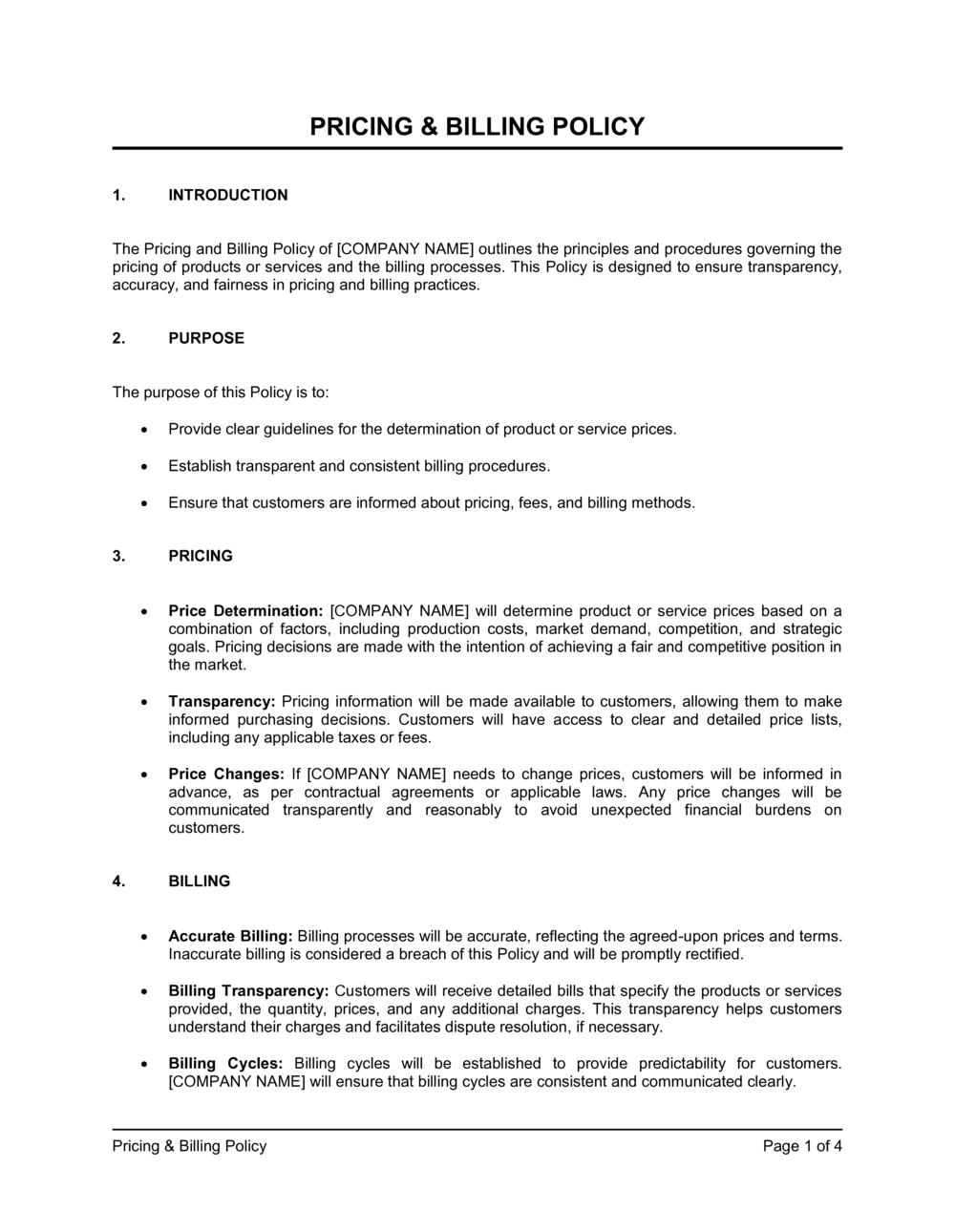
Pricing and Billing Policy Template

Free Word download β€’ Edit online β€’ Save & share with Drive β€’ Export to PDF

4 pagesβ€’20–30 min to fillβ€’Difficulty: Standard
Learn more ↓
FreePricing and Billing Policy Template

At a glance

What it is
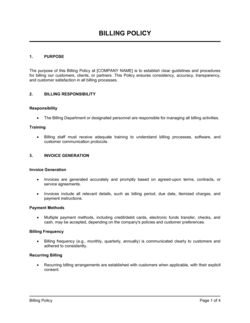
A Pricing and Billing Policy is an internal and client-facing document that defines how a business sets prices, issues invoices, applies payment terms, charges late fees, and handles refunds or disputes. This free Word download gives you a structured, editable template you can tailor to your business model and share with customers, staff, and finance teams.
When you need it
Use it when onboarding new clients, standardizing your accounts-receivable process, or resolving recurring disputes about payment terms, overdue balances, or refund eligibility. It is especially important when scaling a team that handles billing independently.
What's inside
Policy scope and purpose, pricing structure and rate schedules, invoicing procedures and frequency, accepted payment methods, payment terms and due dates, late fees and collections process, refund and credit policy, and dispute resolution procedures.

What is a Pricing and Billing Policy?

A Pricing and Billing Policy is an operational document that establishes a company's standard procedures for setting prices, issuing invoices, collecting payment, applying late fees, and resolving billing disputes. It functions as both an internal reference for finance and operations staff and an external-facing document that sets clear payment expectations with clients before work begins. Rather than leaving billing decisions to individual judgment calls, the policy creates a consistent, repeatable process that applies equally to every client and every transaction.

Why You Need This Document

Without a written billing policy, every overdue invoice becomes a negotiation and every refund request becomes a precedent. Staff handling accounts receivable have no documented standard to reference, leading to inconsistent enforcement of payment terms and late fees β€” which clients quickly learn to exploit. A formal billing policy closes this gap by giving you an enforceable framework: a defined dispute window prevents clients from contesting invoices months after delivery, a clear collections escalation path moves overdue accounts through reminders to suspension to referral without requiring management intervention at each step, and a documented refund rule eliminates the goodwill-draining ad-hoc decisions that erode margins over time. This template gives you a complete, editable starting point in Word format β€” ready to attach to your service agreements and distribute to clients from day one.

Which variant fits your situation?

If your situation is…Use this template
Service-based business billing clients hourly or by projectPricing and Billing Policy (Services)
SaaS or subscription product with recurring monthly billingSubscription Billing Policy
Retail or e-commerce store with product returns and exchangesRefund and Return Policy
Professional services firm billing for time and disbursementsFee Schedule and Billing Policy
Healthcare provider billing patients and insurersPatient Billing Policy
Business needing a standalone late payment and collections policyCollections Policy
Business setting terms for a single client engagementService Agreement

Common mistakes to avoid

❌ Embedding specific rates in the policy body

Why it matters: Every rate change requires a formal policy amendment and client notification, creating administrative burden and version-control problems.

Fix: Reference a separate, dated fee schedule as an exhibit. Update the exhibit independently without triggering a full policy revision cycle.

❌ Using 'due upon receipt' as a payment term

Why it matters: AP departments interpret this inconsistently β€” some pay in 30 days, others in 60. It provides no enforceable baseline for calculating late fees.

Fix: Replace it with a specific number of days: 'Net 15 from invoice date' or 'Net 30 from invoice date.' A specific date eliminates all ambiguity.

❌ No dispute window defined

Why it matters: Without a stated window, clients can raise disputes on invoices months after delivery β€” tying up revenue and making investigation nearly impossible.

Fix: State a 30-day dispute window explicitly and require disputes to be submitted in writing to a specific email address.

❌ Blanket no-refund clause for all fees

Why it matters: Courts in several jurisdictions treat overbroad no-refund clauses as unconscionable, particularly for unused prepaid services β€” voiding the clause entirely.

Fix: Distinguish between earned fees for completed work (non-refundable) and unearned prepaid amounts or retainer balances (refundable on a pro-rated basis).

The 10 key sections, explained

Purpose and scope

Pricing structure and rate schedule

Invoicing procedures and frequency

Accepted payment methods

Payment terms and due dates

Late fees and interest

Collections and service suspension

Refunds and credits

Dispute resolution

Policy amendments and acknowledgment

How to fill it out

  1. 1

    Define the scope and effective date

    Enter your company's legal name, the effective date of the policy, and the client and service types it covers. Confirm whether the policy applies to new clients only or also to existing accounts.

    πŸ’‘ State explicitly that the policy is incorporated by reference into all service agreements β€” this binds existing clients without requiring individual amendments.

  2. 2

    Document your pricing models

    Describe each pricing model you use β€” hourly, flat-project, monthly retainer, or subscription. Reference a separate fee schedule (Exhibit A) for specific rates rather than embedding dollar amounts in the policy body.

    πŸ’‘ Keeping rates in a separate exhibit means you can update pricing without issuing a policy amendment to every client.

  3. 3

    Set invoicing frequency and delivery method

    Specify when invoices are generated (weekly, monthly, upon milestone completion) and how they are sent (email PDF, client portal, or postal mail). Name the billing contact or department responsible.

    πŸ’‘ Require clients to confirm their preferred billing contact and AP email at contract signing β€” this alone cuts payment delays by reducing invoice misrouting.

  4. 4

    Choose and document payment terms

    Select a standard payment window (Net 15 or Net 30 are most common for B2B services) and enter it consistently. Add an early-payment discount if you offer one, and specify any deposit requirements for new clients or large projects.

    πŸ’‘ Net 15 meaningfully improves cash flow for service businesses compared to Net 30 β€” negotiate this upfront rather than accepting a client's default terms.

  5. 5

    Set the late fee rate and escalation triggers

    Enter the monthly late fee percentage and the number of days after the due date before it begins accruing. Add the service suspension threshold (commonly 60 days) and the collections referral threshold (commonly 90 days).

    πŸ’‘ Check your state or province's maximum allowable interest rate for commercial accounts before finalizing the late fee β€” exceeding it voids the clause.

  6. 6

    Write the refund and credit policy

    Specify which fees are refundable (e.g., unused retainer balance) and which are not (e.g., completed project fees, non-refundable deposits). State the request window in days and the processing timeline.

    πŸ’‘ A 'pro-rated unused retainer' refund policy is more enforceable and client-friendly than a blanket no-refund clause for ongoing engagements.

  7. 7

    Define the dispute window and process

    Enter the number of days clients have to contest an invoice in writing, the email address or portal where disputes are submitted, and the company's response timeline. Clarify that undisputed line items remain due on the original date.

    πŸ’‘ A 30-day dispute window is standard β€” shorter windows can be challenged as unreasonable for corporate clients with multi-level AP approval processes.

  8. 8

    Add the amendment clause and distribute

    Include language stating how much notice you will give before changes take effect (30 days is standard) and that continued service constitutes acceptance. Distribute the final policy to all active clients and attach it to new service agreements going forward.

    πŸ’‘ Store a signed acknowledgment or email confirmation from each client in your CRM β€” this is your evidence if the policy is later disputed.

Frequently asked questions

What is a pricing and billing policy?

A pricing and billing policy is an operational document that defines how a business prices its services, issues invoices, collects payment, applies late fees, and handles refunds or billing disputes. It creates a consistent, documented standard for all billing activity β€” reducing disputes, improving cash flow, and giving staff clear procedures to follow without escalating every edge case to management.

Why do businesses need a formal billing policy?

Without a written billing policy, payment disputes are resolved by whoever argues most convincingly in the moment. A documented policy gives you an enforceable baseline for late fees, a defined dispute window, and a collections escalation path. It also signals professionalism to clients and is frequently required by corporate procurement teams before they will add a vendor to their approved supplier list.

What payment terms should I use in my billing policy?

Net 30 is the most widely accepted standard for B2B service businesses. Net 15 is common for smaller engagements or clients with simpler AP processes, and it meaningfully improves cash flow. Avoid 'due upon receipt' β€” it is interpreted inconsistently and provides no enforceable basis for late fees. Always pair payment terms with a specific due date on the invoice itself.

How much can I charge as a late fee?

In the United States, late fee rates are governed by state usury laws and vary by jurisdiction β€” most states cap commercial late fees between 1% and 2% per month. In Canada, provincial legislation sets similar limits. A rate of 1.5% per month (18% per annum) is common and enforceable in most North American jurisdictions, but you should verify the cap in your state or province before publishing the policy.

Should a billing policy be shared with clients?

Yes. A billing policy that is never shared provides no legal or operational protection. Distribute it at contract signing, attach it to service agreements as an exhibit, and include a summary of key terms on your invoices. For the policy to be enforceable β€” particularly late fees and the dispute window β€” the client must have received it before the first invoice was issued.

What is the difference between a billing policy and payment terms in a contract?

Payment terms in a contract are client-specific and govern a single engagement. A billing policy is a company-wide document that applies to all clients and covers the full billing lifecycle β€” pricing, invoicing, late fees, refunds, and disputes. The contract's payment terms should reference and incorporate the billing policy by name so the two documents work together rather than creating conflicting standards.

What should a billing dispute clause include?

A dispute clause should specify the number of days a client has to raise a dispute in writing (typically 30 days from invoice date), the email address or portal where disputes are submitted, the company's investigation and response timeline (10 business days is standard), and a statement that undisputed portions of the invoice remain due on the original due date. Missing any of these elements leaves the process undefined and favors the non-paying party.

How often should a pricing and billing policy be updated?

Review the policy annually, at minimum, and update it whenever your pricing model changes, you add a new service line, or you change your payment platform. Always notify active clients at least 30 days before changes take effect and document their acknowledgment. Keep prior versions on file with their effective dates so you can reference the policy version that applied at the time of any given invoice.

Can a billing policy replace payment terms in a service agreement?

No. A billing policy sets company-wide defaults, but a service agreement should still contain client-specific payment terms β€” project fee, deposit amount, billing frequency, and any negotiated exceptions to the standard policy. The agreement should incorporate the billing policy by reference so that the policy governs anything not specifically addressed in the contract.

How this compares to alternatives

vs Service agreement

A service agreement governs the terms of a specific client engagement β€” scope, deliverables, IP, and liability. A billing policy sets company-wide payment and invoicing standards that apply across all engagements. The service agreement should incorporate the billing policy by reference so both documents work together. Neither replaces the other.

vs Invoice template

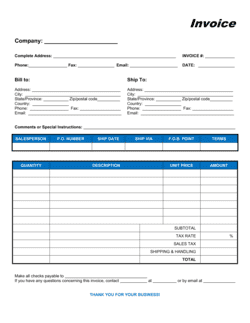
An invoice is the transactional document that requests payment for a specific delivery. A billing policy is the governing document that defines how invoices are issued, what terms they carry, and what happens when they go unpaid. The policy is written once and referenced on every invoice; the invoice is generated for every transaction.

vs Credit policy

A credit policy governs whether and how much credit you extend to customers before payment β€” credit limits, credit checks, and credit application procedures. A billing policy governs how you invoice and collect after credit is extended. Businesses with significant trade credit exposure typically need both documents.

vs Refund policy

A refund policy focuses specifically on the conditions and process for returning money to clients. A billing policy is broader, covering pricing, invoicing, payment terms, late fees, collections, and disputes β€” with refunds as one component. For service businesses, a standalone refund policy is usually unnecessary if the billing policy addresses refunds adequately.

Industry-specific considerations

Professional services

Hourly rate schedules, disbursement pass-throughs, retainer billing cycles, and trust account handling for legal or accounting firms.

SaaS and technology

Subscription upgrade and downgrade proration, annual vs. monthly billing cycles, failed payment retry logic, and automatic renewal terms.

Creative and marketing agencies

Milestone-based project billing, third-party vendor expense pass-throughs, monthly retainer invoicing, and rush-fee provisions for expedited work.

Healthcare

Insurance co-pay and deductible billing, patient payment plans, HIPAA-compliant invoice delivery, and charity care or hardship policies.

Template vs pro β€” what fits your needs?

PathBest forCostTime
Use the templateSmall businesses, freelancers, and agencies standardizing billing practices for the first timeFree1–2 hours
Template + professional reviewBusinesses adding late fees, non-refundable deposit clauses, or operating across multiple states or provinces$150–$400 for an accountant or business advisor review1–3 days
Custom draftedHealthcare providers, regulated financial services, or businesses with complex multi-currency or subscription billing models$500–$2,000 for a lawyer or specialized consultant1–2 weeks

Glossary

Payment Terms
The agreed conditions under which a buyer must pay a seller, including the due date, acceptable payment methods, and any early-payment discounts.
Net 30 / Net 15
Payment terms requiring the full invoice amount to be paid within 30 or 15 days of the invoice date.
Late Fee
An additional charge assessed on outstanding balances that remain unpaid past the due date, typically expressed as a monthly percentage.
Retainer
An upfront fee paid by a client to reserve a provider's services or time for a defined period, typically billed monthly.
Disbursement
A third-party cost β€” such as postage, filing fees, or travel expenses β€” that a service provider incurs on a client's behalf and passes through on an invoice.
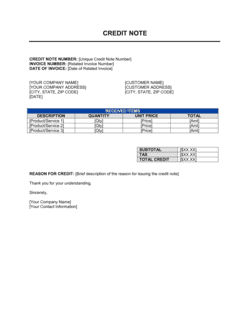
Credit Note
A document issued to reduce or cancel a previously issued invoice, used when a refund, billing error, or service adjustment is required.
Collections
The process of pursuing payment on overdue invoices, which may include reminder notices, suspension of services, or referral to a collections agency.
Dispute Window
The number of days after invoice delivery within which a client may formally contest a charge β€” typically 7 to 30 days.
Scope Creep
The gradual expansion of deliverables or work beyond what was originally agreed, which must be captured in a change order to trigger additional billing.
Change Order
A written amendment to a service agreement that documents additional work, adjusts the project scope, and specifies the associated additional fee.

Part of your Business Operating System

This document is one of 3,000+ business & legal templates included in Business in a Box.

  • Fill-in-the-blanks β€” ready in minutes
  • 100% customizable Word document
  • Compatible with all office suites
  • Export to PDF and share electronically

Create your document in 3 simple steps.

From template to signed document β€” all inside one Business Operating System.
1
Download or open template

Access over 3,000+ business and legal templates for any business task, project or initiative.

2
Edit and fill in the blanks with AI

Customize your ready-made business document template and save it in the cloud.

3
Save, Share, Send, Sign

Share your files and folders with your team. Create a space of seamless collaboration.

Save time, save money, and create top-quality documents.

β˜…β˜…β˜…β˜…β˜…

"Fantastic value! I'm not sure how I'd do without it. It's worth its weight in gold and paid back for itself many times."

Managing Director Β· Mall Farm
Robert Whalley
Managing Director, Mall Farm Proprietary Limited
β˜…β˜…β˜…β˜…β˜…

"I have been using Business in a Box for years. It has been the most useful source of templates I have encountered. I recommend it to anyone."

Business Owner Β· 4+ years
Dr Michael John Freestone
Business Owner
β˜…β˜…β˜…β˜…β˜…

"It has been a life saver so many times I have lost count. Business in a Box has saved me so much time and as you know, time is money."

Owner Β· Upstate Web
David G. Moore Jr.
Owner, Upstate Web

Run your business with a system β€” not scattered tools

Stop downloading documents. Start operating with clarity. Business in a Box gives you the Business Operating System used by over 250,000 companies worldwide to structure, run, and grow their business.

Start freeΒ Β·Β No credit card required