Rejected Goods Return Instructions Template

Free Word download • Edit online • Save & share with Drive • Export to PDF

1 page20–30 min to fillDifficulty: StandardSignature requiredLegal review recommended
Learn more ↓
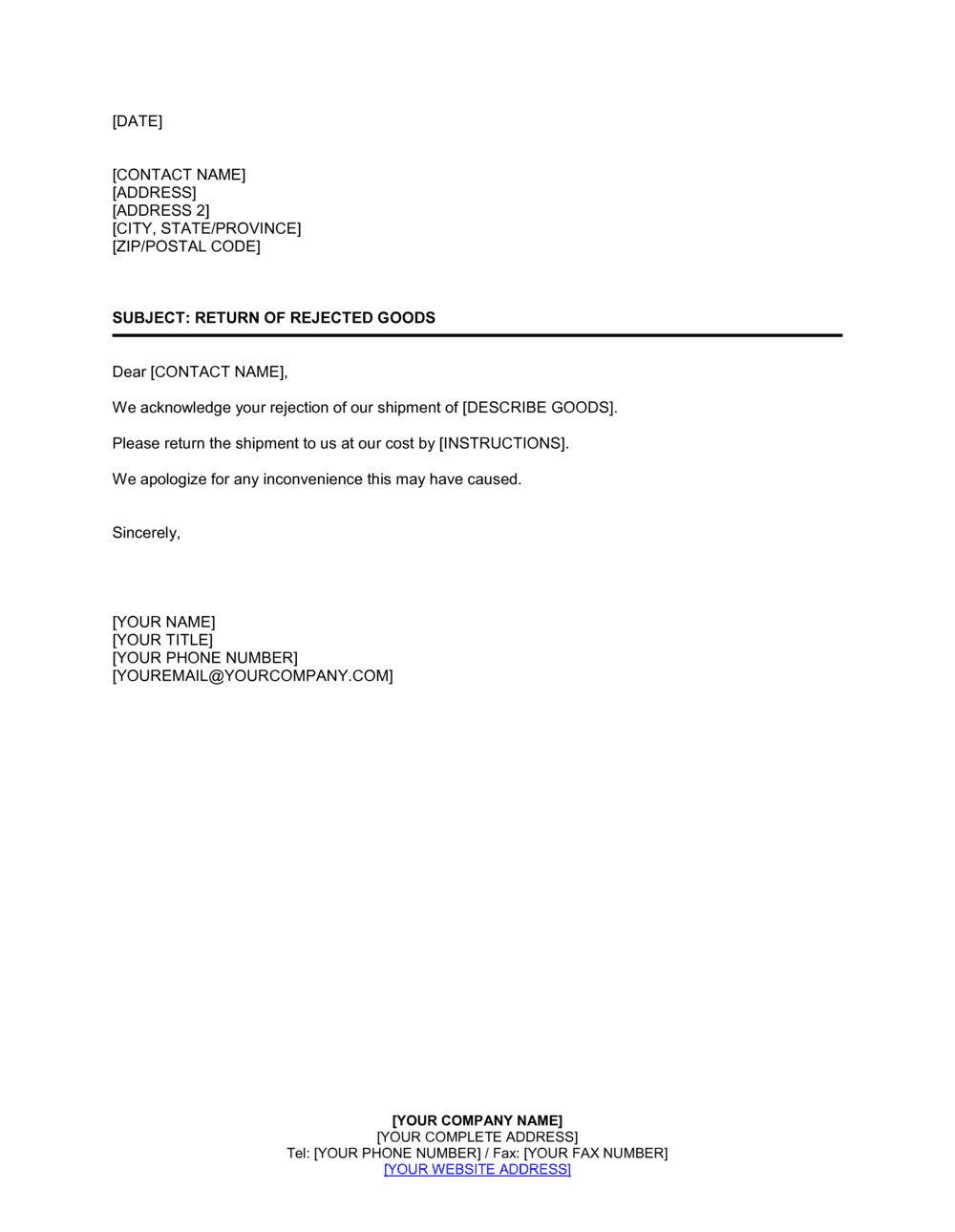
FreeRejected Goods Return Instructions Template

At a glance

What it is
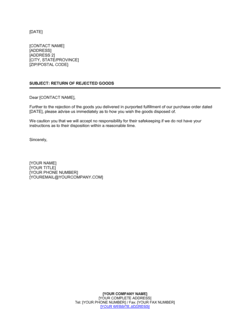
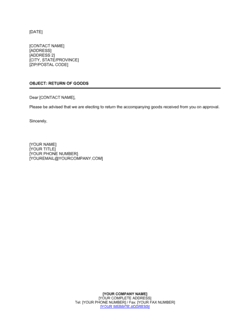
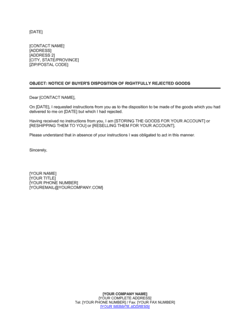
Rejected Goods Return Instructions is a formal written notice a buyer issues to a supplier when delivered goods fail to meet the agreed contractual specifications — documenting the grounds for rejection, directing the supplier on how and where to collect or accept the return, and preserving the buyer's legal remedies. This free Word download gives you a structured, legally grounded template you can edit online and export as PDF to send to suppliers within the rejection window required by your purchase agreement or applicable law.
When you need it
Issue it immediately upon discovering that delivered goods are defective, non-conforming, short-shipped, or otherwise in breach of the purchase order or supply agreement — and before you use, process, or incorporate the goods in a way that could be treated as acceptance under applicable commercial law.
What's inside
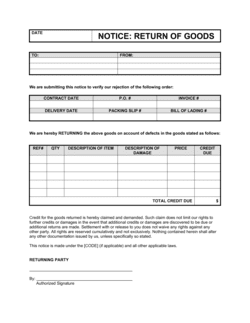
Identification of the rejected shipment and purchase order, detailed grounds for rejection with reference to the applicable specification or contract clause, instructions for return logistics and cost allocation, a statement of the buyer's elected remedy (replacement, credit, or refund), and a deadline for the supplier's response and collection.

What is a Rejected Goods Return Instructions document?

A Rejected Goods Return Instructions document is a formal written notice a buyer issues to a supplier when a delivered shipment fails to meet the contractual specifications set out in a purchase order or supply agreement. It serves a dual function: it formally invokes the buyer's legal right to reject the goods under applicable commercial law — such as Article 2 of the UCC in the United States or the Sale of Goods Act in the UK — and it directs the supplier on the precise logistics for collecting or receiving the returned shipment. The document identifies the specific shipment being rejected, states the grounds for rejection with reference to the breached contractual term or quality specification, allocates return freight and storage costs, elects the buyer's chosen remedy (replacement, refund, or credit), and preserves all remaining legal rights against the supplier. Issuing this notice promptly and in writing is what transforms an informal complaint into an enforceable legal position.

Why You Need This Document

Failing to issue a proper, timely written rejection notice is one of the most costly procedural mistakes a buyer can make. Under the UCC and its international equivalents, using, processing, or simply retaining goods beyond a reasonable inspection period constitutes legal acceptance — permanently extinguishing the right to reject, regardless of how serious the defect is. Without a written record specifying the grounds for rejection, suppliers routinely dispute that any valid rejection occurred, leaving buyers unable to withhold payment or recover the purchase price through their bank, insurer, or in court. The consequences extend beyond the immediate shipment: undocumented rejections cannot support a pattern-of-breach argument if you later need to terminate the supply relationship or claim consequential losses such as production downtime or lost customer contracts. This template gives you the structured, legally grounded notice you need to protect your payment rights, trigger the supplier's collection obligations, and create an auditable record — all within the 20 to 30 minutes required to complete and send it before your rejection window closes.

Which variant fits your situation?

If your situation is…Use this template
Rejecting goods immediately at the point of delivery before accepting them into warehouseRejected Goods Return Instructions
Formally notifying a supplier of a defect discovered after initial acceptanceProduct Defect Notice Letter
Requesting a replacement or credit for a partial shipment that is non-conformingSupplier Corrective Action Request
Terminating a supply agreement due to repeated delivery failuresContract Termination Letter
Sending goods back under a vendor's standard return merchandise authorization processReturn Merchandise Authorization Form
Claiming damages from a carrier for goods damaged in transitFreight Claim Letter
Disputing an invoice where goods were rejected but already invoicedInvoice Dispute Letter

Common mistakes to avoid

❌ Waiting too long to issue the rejection notice

Why it matters: Using, processing, or retaining goods beyond a reasonable inspection period constitutes acceptance under the UCC and equivalent statutes, extinguishing the right to reject. Even a well-documented defect becomes unactionable if the notice is issued weeks after delivery.

Fix: Issue the rejection notice on the day of inspection — or within 1 to 2 business days at the latest. Store goods untouched in a quarantine area while the notice is being prepared.

❌ Vague grounds for rejection without contractual references

Why it matters: A rejection notice that says 'goods are not satisfactory' gives the supplier no basis to investigate, and courts have held that insufficiently particularized rejection notices fail to trigger the seller's obligation to cure or accept the return.

Fix: Reference the exact contract clause, purchase order specification, or quality standard breached, and quantify the non-conformity wherever possible.

❌ Discarding rejected goods before the supplier collects

Why it matters: Destroying non-conforming goods — even those that are clearly worthless — before the supplier has inspected and collected them can eliminate the buyer's remedy entirely and expose the buyer to a conversion or damages claim.

Fix: Hold all rejected goods at the stated storage location until the supplier collects or provides written authorization to dispose of them. Document the condition of goods at the time of disposal if destruction is unavoidable.

❌ Omitting the reservation of rights clause

Why it matters: Accepting a replacement shipment or credit note without a reservation of rights can be construed as a full and final settlement of the rejection event, barring any subsequent claim for consequential losses such as production downtime or lost customer contracts.

Fix: Include the standard reservation of rights language in every rejection notice, even when you expect the matter to resolve quickly and amicably.

❌ Failing to attach documentary evidence with the initial notice

Why it matters: Evidence submitted weeks after the rejection notice is routinely challenged as fabricated or unrepresentative of the condition of goods at delivery. A supplier's insurer or legal team will scrutinize the timing of all supporting documentation.

Fix: Compile photographs, inspection reports, and test data before sending the notice and attach them as a labeled exhibit in the same communication.

❌ Using a governing law clause that conflicts with the supply agreement

Why it matters: A rejection notice specifying a different governing jurisdiction than the master supply contract creates a genuine legal ambiguity about which terms govern the remedies — and the supplier will exploit that ambiguity to delay resolution.

Fix: Mirror the governing law and dispute resolution clause from the operative supply agreement in every rejection notice issued under that agreement.

The 10 key clauses, explained

Shipment and Purchase Order Identification

In plain language: Identifies the specific delivery being rejected by referencing the purchase order number, invoice number, delivery date, carrier, and tracking or bill of lading number.

Sample language
This notice concerns the shipment received on [DATE] under Purchase Order No. [PO NUMBER], Invoice No. [INVOICE NUMBER], delivered by [CARRIER NAME] under Bill of Lading No. [BOL NUMBER].

Common mistake: Referencing only the invoice number without the PO number. If the supplier's records use a different document reference, the rejection can be disputed as misdirected and your rejection window may be lost.

Grounds for Rejection

In plain language: States the precise reason or reasons the goods are rejected, referencing the specific contractual specification, quality standard, or purchase order term that the goods failed to meet.

Sample language
The goods are hereby rejected on the following grounds: (a) [DESCRIPTION OF DEFECT OR NON-CONFORMITY], which fails to meet the specification set out in Schedule [X] of the Purchase Order; (b) [SECOND GROUND, IF ANY].

Common mistake: Using vague language such as 'goods not as expected' without citing the specific contractual requirement breached. Courts and arbitrators require the buyer to identify the non-conformity with sufficient particularity to allow the seller to investigate.

Inspection Evidence

In plain language: Documents that the buyer conducted a timely inspection and records the evidence supporting the rejection — photographs, test results, measurement data, or third-party inspection reports.

Sample language
Buyer conducted an inspection of the shipment on [DATE]. Supporting documentation — including photographic evidence, measurement records, and [INSPECTION REPORT / LAB TEST RESULT] — is attached as Exhibit A.

Common mistake: Sending the rejection notice without attaching supporting evidence. Unsupported rejection notices are routinely challenged by suppliers, and evidence gathered weeks later carries less evidentiary weight.

Preservation and Storage Obligations

In plain language: Confirms that the buyer is holding the rejected goods safely pending the supplier's collection and states any storage conditions required to preserve their condition.

Sample language
Buyer is holding the rejected goods at [ADDRESS / WAREHOUSE LOCATION] in a secure, climate-controlled environment consistent with the goods' specifications. Buyer will exercise reasonable care to preserve the goods pending collection by Seller.

Common mistake: Discarding or destroying rejected goods before the supplier has had an opportunity to inspect and collect them. Doing so can extinguish the buyer's remedy and expose the buyer to a damages counterclaim.

Return Logistics Instructions

In plain language: Directs the supplier on how, when, and where to collect or receive the rejected goods — including the collection deadline, agreed carrier, and packaging requirements for the return shipment.

Sample language
Seller shall arrange collection of the rejected goods from [ADDRESS] no later than [DATE — e.g., 10 business days from this notice]. Collection shall be coordinated with [BUYER CONTACT NAME] at [EMAIL / PHONE]. Seller is responsible for all return freight costs unless otherwise agreed in writing.

Common mistake: Omitting a collection deadline. Without a deadline, rejected goods can remain in the buyer's warehouse indefinitely, creating ongoing storage costs and potential deemed-acceptance arguments.

Cost Allocation

In plain language: Allocates the costs of return freight, storage, re-inspection, and restocking between the buyer and the supplier, consistent with the supply contract or applicable law.

Sample language
All costs of return freight, re-packaging, storage from [DATE OF REJECTION], and re-inspection shall be borne by Seller. Buyer reserves the right to deduct documented storage costs of $[RATE] per day from any outstanding or future invoices if collection is not made by the deadline above.

Common mistake: Accepting responsibility for return freight costs by default without checking the supply agreement. Most supply contracts place return costs on the supplier for a wrongful delivery — assuming the buyer will pay undermines leverage.

Elected Remedy

In plain language: States the buyer's chosen remedy for the non-conforming delivery — replacement with conforming goods, a credit note, a full refund, or a price reduction — and the deadline by which the supplier must respond.

Sample language
Buyer hereby elects the following remedy: [select one: (a) replacement with conforming goods delivered no later than [DATE]; (b) full refund of the invoice price of $[AMOUNT] within [X] business days; (c) credit note in the amount of $[AMOUNT] to be applied to the next invoice].

Common mistake: Not specifying a remedy, leaving the supplier to choose. Under many commercial law frameworks, the seller retains the right to cure if the buyer has not elected a remedy — potentially extending the dispute timeline by weeks.

Reservation of Rights

In plain language: Preserves all of the buyer's legal and contractual rights, including the right to claim damages for costs arising from the defective delivery — even while the immediate remedy is being processed.

Sample language
This notice is without prejudice to all other rights and remedies of Buyer under the Purchase Order, the Supply Agreement dated [DATE], and applicable law, including the right to claim damages for consequential losses arising from the non-conforming delivery.

Common mistake: Omitting a reservation of rights clause and stating only the immediate remedy. Without it, the supplier may argue that accepting a replacement constitutes a full settlement, barring future damage claims.

Response Deadline and Escalation

In plain language: Sets the deadline by which the supplier must acknowledge the rejection notice and confirm its intended course of action, and states what happens if the deadline is not met.

Sample language
Seller must acknowledge receipt of this notice and confirm its intended remedy within [5] business days. Failure to respond by [DATE] will result in Buyer procuring replacement goods from an alternative supplier at Seller's cost pursuant to the cover rights available under applicable law.

Common mistake: Setting an unrealistically short response window. A 24-hour deadline for a cross-border supplier invites a dispute about commercial reasonableness — 5 to 10 business days is standard for most supply relationships.

Governing Law and Dispute Resolution

In plain language: Specifies which jurisdiction's law governs the rejection notice and how any arising dispute will be resolved — referencing the supply contract's governing law clause where it exists.

Sample language
This notice is governed by the laws of [STATE / PROVINCE / COUNTRY]. Any dispute arising from this rejection shall be resolved in accordance with the dispute resolution clause of the Supply Agreement dated [DATE], or, in the absence of such clause, by [ARBITRATION / LITIGATION] in [VENUE].

Common mistake: Choosing a governing law that differs from the supply agreement without reason. Conflicting governing law provisions in ancillary documents create ambiguity about which terms prevail — always mirror the governing law in the master supply contract.

How to fill it out

  1. 1

    Identify the shipment with precision

    Enter the purchase order number, invoice number, delivery date, carrier name, and bill of lading or tracking number in the shipment identification clause. Pull these directly from the delivery documentation — not from memory.

    💡 Keep a copy of the signed delivery note showing the date of receipt. This document establishes the start of your inspection and rejection window under most commercial law frameworks.

  2. 2

    Document the specific grounds for rejection

    List each reason for rejection and tie it explicitly to the contractual specification, quality standard, or purchase order term that was breached. Use Schedule references if the PO contains a specification schedule.

    💡 Where possible, express the non-conformity in measurable terms — '14 of 200 units tested below the minimum tensile strength of 50 MPa per Schedule B' is far stronger than 'goods are defective.'

  3. 3

    Gather and attach supporting evidence

    Compile photographs, inspection reports, measurement data, or third-party lab test results as Exhibit A before sending the notice. Attach them in the same communication as the notice itself.

    💡 Date-stamp all photographs at capture and note the inspector's name. Evidence created after the notice is issued carries significantly less weight in a dispute.

  4. 4

    State your preservation and storage arrangements

    Confirm where the rejected goods are being held and describe the storage conditions. If the goods are perishable or require special handling, note this explicitly and set a shorter collection deadline.

    💡 If you genuinely cannot store the goods safely — for example, frozen or hazardous materials — notify the supplier immediately and document the situation before taking any disposal steps.

  5. 5

    Set collection logistics and a firm deadline

    Specify the collection address, the contact person the supplier should coordinate with, and a collection deadline in business days. Confirm that all return freight costs are the supplier's responsibility per the supply agreement.

    💡 5 to 10 business days is a commercially reasonable collection window for domestic suppliers; 10 to 15 business days is more appropriate for international arrangements.

  6. 6

    Elect your remedy clearly

    Choose one remedy — replacement, refund, or credit — and enter the specific dollar amount and deadline. Do not leave the remedy blank or open-ended.

    💡 If replacement is your preferred remedy and the goods are time-sensitive, state a delivery deadline for the replacement shipment. Missing this date triggers a second rejection cycle.

  7. 7

    Include a reservation of rights and response deadline

    Add the reservation of rights clause verbatim and set a response deadline of 5 business days for domestic suppliers. Reference the supply agreement's dispute resolution clause in the governing law section.

    💡 Send the completed notice by email with read receipt and also by recorded mail or courier to create an irrefutable delivery record — especially for high-value rejections.

  8. 8

    Sign and send before the inspection window closes

    Have the authorized buyer representative sign the notice and dispatch it within the inspection and rejection period specified in your supply contract or by applicable law. Late rejection notices risk being treated as acceptance.

    💡 Set a calendar reminder the day goods are received to track the rejection deadline. In UCC jurisdictions, 'reasonable time' for rejection is interpreted strictly — often as few as 2 to 5 days for goods with an obvious defect.

Frequently asked questions

What are rejected goods return instructions?

Rejected goods return instructions are a formal written notice issued by a buyer to a supplier when delivered goods do not conform to the agreed contract, purchase order, or specification. The document identifies the non-conforming shipment, states the specific grounds for rejection, directs the supplier on how and where to collect or receive the return, allocates return costs, elects the buyer's remedy, and preserves all remaining legal rights. Issuing this notice in writing is essential to triggering the supplier's obligations and protecting the buyer's position under commercial law.

When should I issue a rejected goods return notice?

Issue the notice as soon as possible after completing your inspection of the delivered goods — ideally on the day of inspection and no later than 2 to 5 business days after delivery for straightforward defects. Most commercial law frameworks, including the UCC in the US and the Sale of Goods Act in the UK, require rejection to occur within a reasonable time. Using, processing, or incorporating goods into production before issuing the notice typically constitutes legal acceptance and extinguishes your right to reject entirely.

Does a rejection notice need to be in writing?

In most jurisdictions and under most supply contracts, a written rejection notice is either legally required or strongly advisable. Under the UCC, a buyer must give the seller timely notice of rejection; oral notice is technically sufficient but creates significant evidentiary risk. A written notice with supporting documentation establishes a clear, time-stamped record that the rejection was proper, timely, and based on documented grounds — protecting you if the dispute escalates to arbitration or litigation.

Who pays for returning rejected goods?

Under most supply agreements and applicable commercial law, the seller bears the cost of return freight when the rejection is valid — because the non-conforming delivery was the seller's breach. However, this can be modified by contract: some supply agreements place return logistics costs on the buyer regardless of fault. Always check your supply agreement before allocating return costs in the rejection notice. If the agreement is silent, default to assigning costs to the seller and include appropriate language in the notice.

What remedies can a buyer elect when rejecting goods?

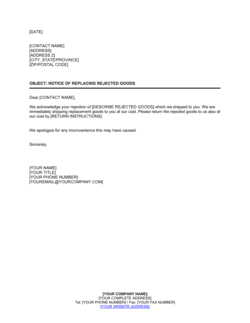
The most common remedies available to a buyer upon valid rejection are: replacement with conforming goods within a specified timeframe, a full refund of the invoice price, a credit note to be applied against future invoices, or a negotiated price reduction reflecting the reduced value of the non-conforming goods. The buyer may also have the right to cover — purchasing equivalent goods from an alternative supplier — and recover the price difference from the breaching seller. The available remedies depend on the supply contract terms and the applicable jurisdiction's commercial law.

What happens if the supplier does not respond to the rejection notice?

If the supplier fails to respond within the deadline set in the rejection notice, the buyer typically has the right to proceed with its elected remedy without further authorization — for example, purchasing replacement goods from a third party at the seller's cost. The buyer should document the non-response in writing, send a follow-up notice confirming the deadline has passed, and then take the elected remedy action. Retaining all correspondence is essential if the matter proceeds to formal dispute resolution.

Can I reject only part of a shipment?

Yes. Most commercial law frameworks, including the UCC, allow a buyer to make a partial rejection — accepting conforming units and rejecting non-conforming ones in the same shipment. The rejection notice should clearly identify the specific units, lot numbers, or quantities being rejected, and the accepted portion should be clearly segregated in the warehouse to avoid any deemed-acceptance argument. Payment obligations typically apply only to the accepted portion of the shipment.

Does signing a delivery note prevent me from rejecting goods?

Signing a delivery note generally acknowledges receipt of the shipment, not acceptance of its conformity with the contract. In most jurisdictions, you retain the right to reject goods after signing for delivery, provided you do so within the inspection period and before using or processing the goods. To protect your position, annotate the delivery note with any visible defects, damages, or discrepancies at the time of receipt, even if you have not yet conducted a full inspection.

What is the difference between rejected goods return instructions and a corrective action request?

Rejected goods return instructions address a specific non-conforming delivery — they trigger the physical return of goods and the buyer's immediate remedy. A corrective action request (CAR) is directed at the supplier's underlying process failure and asks the supplier to investigate the root cause and implement systemic fixes to prevent recurrence. The two documents serve different purposes: the return instructions resolve the immediate delivery dispute; the CAR addresses the long-term supplier performance issue. For significant or repeated quality failures, both documents should be issued.

Do I need a lawyer to issue rejected goods return instructions?

For routine rejections of modest value under a clear supply agreement, a well-drafted template is generally sufficient. Consider engaging a lawyer when the rejected shipment has high monetary value, when the supplier is disputing the rejection grounds, when consequential losses — such as production downtime or lost customer contracts — may give rise to a damages claim, or when the rejection involves cross-border commercial law complications. A legal review of a high-value rejection notice typically costs $300–$800 and can prevent a much more expensive dispute later.

How this compares to alternatives

vs Supplier Corrective Action Request

A corrective action request addresses the supplier's underlying process failure and demands root-cause analysis and systemic remediation. Rejected goods return instructions address only the immediate non-conforming shipment and trigger the physical return and buyer's remedy. For significant quality failures, both documents should be issued: the return instructions resolve the delivery dispute; the corrective action request prevents recurrence.

vs Contract Termination Letter

A contract termination letter ends the entire supply relationship, typically for material or repeated breach. Rejected goods return instructions address a single non-conforming delivery while leaving the supply agreement intact. Issue the termination letter when a pattern of rejections — or a single catastrophic breach — justifies ending the supplier relationship entirely.

vs Invoice Dispute Letter

An invoice dispute letter challenges the payment obligation on a specific invoice — it may reference a rejection, but its primary purpose is to contest or withhold payment. Rejected goods return instructions focus on the physical return of goods and the supplier's obligations. Both documents are often issued together when a supplier has invoiced for goods that have been rejected.

vs Purchase Order

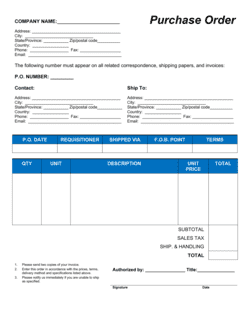
A purchase order creates the initial contractual obligation between buyer and seller, specifying quantity, description, price, and delivery terms. Rejected goods return instructions are issued after delivery when the goods fail to meet the purchase order's requirements. The rejection notice must reference the purchase order by number to establish the contractual baseline against which the non-conformity is measured.

Industry-specific considerations

Manufacturing

Raw material and component rejections tied to precise dimensional or material specification standards, with production downtime costs as consequential damages in dispute calculations.

Retail and E-commerce

Bulk merchandise rejections for incorrect labeling, wrong SKUs, or below-minimum quality — often handled under a vendor compliance program with pre-agreed return logistics and chargeback rights.

Food and Beverage

Perishable goods require same-day or next-day rejection notices with immediate collection deadlines; food safety and regulatory compliance grounds (out-of-spec temperature, contamination) add complexity to the grounds clause.

Construction and Engineering

Rejection of materials that fail structural testing, do not match approved submittals, or arrive outside tolerances — often governed by project specifications rather than a generic supply contract.

Pharmaceuticals and Medical Devices

GMP non-conformance and regulatory documentation failures are common rejection grounds; rejected goods must be quarantined, and FDA or EMA notification obligations may apply before return or disposal.

Technology and Electronics

Component-level defects, firmware version mismatches, and ESD handling failures during shipping are typical rejection grounds; RMA processes are standard and must be cross-referenced in the return instructions.

Jurisdictional notes

United States

Article 2 of the Uniform Commercial Code governs the sale and rejection of goods in all US states. The Perfect Tender Rule (UCC § 2-601) gives buyers the right to reject goods for any non-conformity, but rejection must occur within a reasonable time and the seller must be promptly notified (UCC § 2-602). Sellers have a limited right to cure before the contract deadline under UCC § 2-508. Some states have enacted variations — confirm your state's version of Article 2 for high-value transactions.

Canada

Rejection of goods in Canada is primarily governed by provincial Sale of Goods Acts modeled on the UK's original 1893 statute. Buyers must reject within a reasonable time after delivery; what is 'reasonable' depends on the nature of the goods and the inspection opportunity. Quebec is governed by the Civil Code of Quebec, which contains distinct rules on non-conforming deliveries and seller's obligations. For international supply contracts, the CISG may apply by default unless expressly excluded.

United Kingdom

The Sale of Goods Act 1979 (as amended by the Sale and Supply of Goods Act 1994) governs rejection rights for commercial buyers. Business buyers have a right to reject goods that are not of satisfactory quality, not fit for purpose, or not as described — but this right may be lost if goods are accepted, including by acting inconsistently with the seller's ownership. The Consumer Rights Act 2015 provides separate, stronger protections for consumer purchases. Post-Brexit, CISG does not apply to UK contracts by default.

European Union

The UN Convention on Contracts for the International Sale of Goods (CISG) applies by default to commercial cross-border sales between EU member state businesses and foreign parties unless expressly excluded. The CISG requires buyers to inspect goods promptly and give notice of non-conformity within a reasonable time — typically interpreted as days to a few weeks depending on the goods. The EU's harmonized consumer sales directives apply to B2C transactions, while B2B rejection rights vary by member state domestic law for purely domestic contracts.

Template vs lawyer — what fits your deal?

PathBest forCostTime
Use the templateBuyers rejecting routine shipments of modest value under a clear supply agreement with an established supplierFree20–30 minutes per rejection notice
Template + legal reviewRejections involving high-value shipments, complex defects, or anticipated supplier pushback$300–$8001–2 days
Custom draftedCross-border rejections with multi-jurisdictional law questions, consequential damage claims, or rejections that may lead to supplier termination or litigation$1,000–$3,500+3–7 days

Glossary

Rejection
A buyer's formal refusal to accept delivered goods on the grounds that they do not conform to the contract, purchase order, or applicable specification.
Non-Conforming Goods
Goods that fail to meet one or more of the agreed requirements — including quantity, quality, description, packaging, or delivery date — as set out in the purchase order or supply contract.
Acceptance
The point at which a buyer is legally treated as having agreed that goods meet the contract, typically by using, processing, or retaining them beyond a reasonable inspection period.
Perfect Tender Rule
A principle in US commercial law under the UCC that gives a buyer the right to reject goods for any non-conformity, no matter how minor, provided rejection occurs within the allowed inspection period.
Inspection Period
The window of time after delivery during which the buyer has the right to examine goods and notify the seller of rejection — the length varies by contract terms and jurisdiction.
Return Merchandise Authorization (RMA)
A supplier-issued reference number or approval that authorizes a buyer to return goods and tracks the return within the supplier's logistics system.
Remedy
The legal or contractual relief available to the buyer after a valid rejection — typically replacement of conforming goods, a price reduction, a credit note, or a full refund.
Mitigation
The buyer's obligation to take reasonable steps to limit losses arising from a supplier's breach, such as storing rejected goods safely pending collection rather than discarding them.
Risk of Loss
The allocation of financial responsibility if goods are damaged or destroyed — on rejection, risk typically reverts to the seller once the buyer has given proper notice.
Cover
A buyer's right, after a supplier's breach, to purchase equivalent goods from an alternative source and recover the price difference from the breaching supplier.
Salvage Value
The residual value of rejected goods if they cannot be returned — relevant when the buyer disposes of perishable or otherwise unsalvageable non-conforming goods.

Part of your Business Operating System

This document is one of 3,000+ business & legal templates included in Business in a Box.

  • Fill-in-the-blanks — ready in minutes
  • 100% customizable Word document
  • Compatible with all office suites
  • Export to PDF and share electronically

Create your document in 3 simple steps.

From template to signed document — all inside one Business Operating System.
1
Download or open template

Access over 3,000+ business and legal templates for any business task, project or initiative.

2
Edit and fill in the blanks with AI

Customize your ready-made business document template and save it in the cloud.

3
Save, Share, Send, Sign

Share your files and folders with your team. Create a space of seamless collaboration.

Save time, save money, and create top-quality documents.

★★★★★

"Fantastic value! I'm not sure how I'd do without it. It's worth its weight in gold and paid back for itself many times."

Managing Director · Mall Farm
Robert Whalley
Managing Director, Mall Farm Proprietary Limited
★★★★★

"I have been using Business in a Box for years. It has been the most useful source of templates I have encountered. I recommend it to anyone."

Business Owner · 4+ years
Dr Michael John Freestone
Business Owner
★★★★★

"It has been a life saver so many times I have lost count. Business in a Box has saved me so much time and as you know, time is money."

Owner · Upstate Web
David G. Moore Jr.
Owner, Upstate Web

Run your business with a system — not scattered tools

Stop downloading documents. Start operating with clarity. Business in a Box gives you the Business Operating System used by over 250,000 companies worldwide to structure, run, and grow their business.

Free Forever Plan · No credit card required