Collection Instructions to Lawyers Template

Free Word download β€’ Edit online β€’ Save & share with Drive β€’ Export to PDF

1 pageβ€’20–30 min to fillβ€’Difficulty: Standardβ€’Signature requiredβ€’Legal review recommended
Learn more ↓
FreeCollection Instructions to Lawyers Template

At a glance

What it is
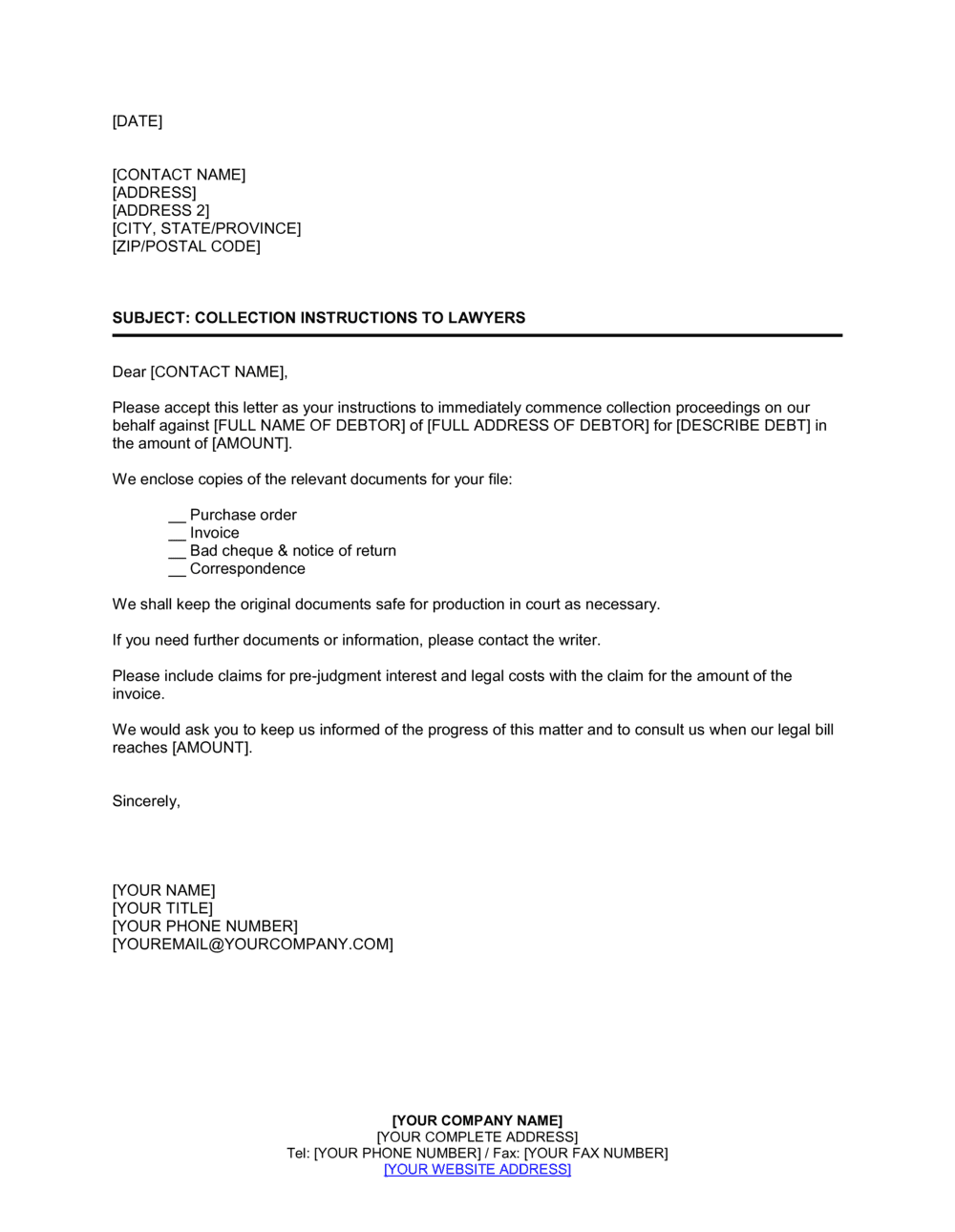
Collection Instructions to Lawyers is a formal written authorization a creditor sends to outside counsel directing the attorney or law firm to pursue recovery of an outstanding debt on the creditor's behalf. This free Word download gives you a professionally structured starting point you can edit online β€” specifying the debtor, the amount owed, supporting documentation, and the scope of authority granted β€” then export as PDF and deliver to your legal representative.
When you need it
Use it when internal collection efforts, demand letters, and payment plans have failed, and you are ready to escalate recovery to a licensed attorney or law firm. It is also appropriate when the debt amount justifies legal costs, when the debtor is disputing the amount owed, or when cross-border enforcement is required.
What's inside
Creditor and debtor identification, a full account of the debt history and amount outstanding, the scope of authority granted to the attorney, documentation and evidence schedule, fee and cost arrangements, reporting requirements, settlement authority limits, and instructions on escalation to litigation if necessary.

What is a Collection Instructions to Lawyers?

Collection Instructions to Lawyers is a formal written document a creditor uses to authorize and brief an attorney or law firm to pursue recovery of an outstanding debt on the creditor's behalf. It functions simultaneously as a retainer letter and an operational brief β€” identifying the debtor, documenting the exact amount owed with supporting evidence, defining the scope of the lawyer's authority at each stage of the collection process, establishing the fee arrangement, and setting reporting expectations. Unlike a demand letter addressed to the debtor, this document is an internal instrument that governs the relationship between the creditor and their legal representative throughout the recovery process.

Why You Need This Document

Without a formal written instruction, the lawyer you engage has no clear mandate: they do not know whether to demand, negotiate, settle, or litigate, and they have no documented threshold below which a settlement requires your approval. That ambiguity is costly β€” it produces unauthorized settlements, unexpected legal bills, and gaps in communication at precisely the moments when fast commercial decisions matter most. A properly executed collection instruction also protects you legally: it establishes the retainer, documents the agreed fee arrangement, and creates an auditable record of what authority you granted if a dispute arises between you and your lawyer. This template gives you a complete, professionally structured starting point that covers every material term β€” from the precise balance claimed to the litigation escalation trigger β€” so your lawyer can act immediately and you retain control of the outcome at every step.

Which variant fits your situation?

If your situation is…Use this template
Pursuing a single overdue invoice from a domestic commercial debtorCollection Instructions to Lawyers
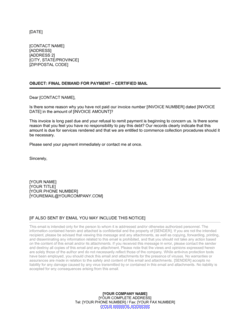
Sending a final demand before instructing a lawyerFinal Demand Letter
Recovering a debt without legal escalation using a standard demandDebt Collection Letter
Pursuing a consumer debtor under a regulated consumer credit agreementConsumer Debt Collection Letter
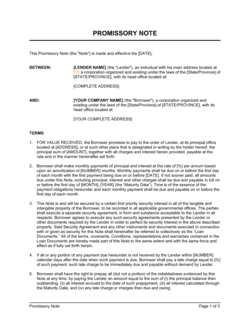
Documenting the underlying obligation before instructing counselPromissory Note
Handling cross-border or multi-jurisdiction debt recoveryInternational Debt Collection Instructions
Recovering a debt secured by a personal guaranteePersonal Guarantee Demand Letter

Common mistakes to avoid

❌ Providing an approximate rather than exact outstanding balance

Why it matters: A demand letter based on a rounded or estimated figure gives the debtor an easy basis to dispute the claim on quantum, delaying payment and forcing the lawyer to reconcile the account on billable time.

Fix: Run a precise aged receivables report at the date of instruction, apply the contractual or statutory interest rate from the due date, and provide the exact figure with a supporting account statement.

❌ Granting unlimited settlement authority with no approval threshold

Why it matters: Without a threshold, the lawyer may accept a settlement that recovers only a fraction of the debt β€” or conversely, reject a commercially sensible offer β€” without consulting you.

Fix: Set an explicit dollar threshold in the scope-of-authority clause: any settlement below that figure requires your written approval before the lawyer can accept.

❌ No cost cap on the legal engagement

Why it matters: On small to mid-sized debts, legal fees can accumulate to a point where the net recovery is negligible or negative, turning a collection matter into an unbudgeted expense.

Fix: Include a cost cap proportionate to the debt value β€” typically 15–25% of the outstanding balance β€” and require written approval for any expenditure above that cap.

❌ Sending incomplete or unorganized documentation to the lawyer

Why it matters: A disorganized evidence package forces the lawyer to spend billable time identifying gaps and requesting missing documents, and those gaps may only surface at a critical procedural stage.

Fix: Use the supporting documentation schedule clause as a checklist before signing: contract, invoices, delivery evidence, prior correspondence, and any earlier demand letters must all be accounted for.

❌ Omitting a reporting and communication requirement

Why it matters: Without a defined reporting cadence, creditors can remain uninformed for weeks while the debtor disputes the claim, enters insolvency, or dissipates assets β€” each of which requires an immediate commercial decision.

Fix: Specify a minimum reporting frequency (every 14 days) and a list of trigger events that require immediate notification, regardless of the scheduled update cycle.

❌ Instructing a lawyer who is not licensed in the debtor's jurisdiction

Why it matters: A lawyer without standing in the debtor's jurisdiction cannot issue proceedings or enforce a judgment there, effectively making the instruction unenforceable at the point it matters most.

Fix: Confirm the instructed lawyer is licensed in the jurisdiction where the debtor is located and where enforcement will occur, or that they have a confirmed referral arrangement with local counsel.

The 10 key clauses, explained

Parties and authorization

In plain language: Identifies the creditor instructing the lawyer, the law firm or attorney being engaged, and the formal grant of authority to act on the creditor's behalf.

Sample language
[CREDITOR LEGAL NAME] ('Client') hereby instructs [LAW FIRM NAME] ('Solicitors') to take all necessary steps to recover the debt described herein from [DEBTOR LEGAL NAME] ('Debtor') on Client's behalf.

Common mistake: Using a trade name rather than the registered legal entity for the creditor. If the entity name doesn't match the invoices or contracts being enforced, the lawyer cannot establish standing without additional documentation.

Debt particulars and account history

In plain language: Sets out the exact amount owed, the nature of the underlying obligation, the original due date, the date of default, and any payments already received.

Sample language
The Debtor owes the sum of $[AMOUNT] arising from [DESCRIPTION OF SERVICES / GOODS], per Invoice(s) [INVOICE NUMBERS] dated [DATE(S)], due on [DUE DATE(S)]. The Debtor has paid $[AMOUNT TO DATE], leaving a balance of $[OUTSTANDING BALANCE] as at [DATE].

Common mistake: Stating a rounded or approximate outstanding balance. The lawyer must work with the precise figure β€” including accrued interest and any contractual late fees β€” or the demand letter will be disputed on quantum.

Supporting documentation schedule

In plain language: Lists all documents the creditor is providing to support the claim β€” invoices, contracts, delivery records, correspondence, and any prior demand letters.

Sample language
Client provides the following documents in support of this instruction: (a) signed contract dated [DATE]; (b) Invoice Nos. [LIST]; (c) delivery receipts dated [DATE(S)]; (d) correspondence with Debtor dated [DATE(S)]; (e) prior demand letter dated [DATE].

Common mistake: Forwarding documents without an organized schedule. A disorganized evidence package forces the lawyer to spend billable time cataloguing your file, and gaps in the documentation may only surface at the worst moment β€” during a court hearing.

Scope of authority and instructions

In plain language: Defines precisely what the lawyer is authorized to do β€” send a demand, negotiate a payment plan, issue proceedings, or all of the above β€” and any actions that require prior approval.

Sample language
Solicitors are authorized to: (a) issue a formal letter of demand; (b) negotiate a payment arrangement on terms no less favorable than [MINIMUM TERMS]; (c) commence proceedings if payment or a satisfactory arrangement is not received within [X] days. Any settlement below $[THRESHOLD] requires Client's prior written approval.

Common mistake: Granting unlimited authority without a settlement threshold. Without one, the lawyer may accept a settlement far below the recoverable amount β€” or decline a commercially reasonable offer β€” without consulting you.

Interest and costs

In plain language: States whether the creditor is claiming contractual or statutory interest on the debt, how costs of collection are to be treated, and whether the lawyer should seek a cost order against the debtor.

Sample language
Client is entitled to claim interest at [X]% per annum from [DATE] pursuant to [CONTRACT CLAUSE / APPLICABLE STATUTE]. Solicitors shall seek recovery of legal costs from the Debtor where available under applicable law. Client shall be responsible for disbursements incurred regardless of outcome.

Common mistake: Omitting the interest rate and start date. If the underlying contract or statute entitles the creditor to interest, failing to claim it from the correct date permanently forfeits that amount.

Fee arrangement

In plain language: Sets out how the instructed lawyer will be compensated β€” hourly rate, fixed fee, contingency percentage, or a hybrid β€” and any cost caps or budget approvals required.

Sample language
Solicitors' fees shall be [hourly rate of $[X] per hour / a contingency fee of [X]% of amounts recovered / a fixed fee of $[X]]. Client approves expenditure up to $[CAP] without further authorization. Expenditure exceeding $[CAP] requires prior written approval.

Common mistake: Agreeing to an open-ended hourly engagement with no cost cap for a small debt. Legal fees can quickly exceed the debt value if no budget is set, turning a collection matter into a net loss.

Reporting and communication

In plain language: Requires the lawyer to provide progress updates at defined intervals and to seek the creditor's instructions before taking any significant step.

Sample language
Solicitors shall provide a written status report every [X] days and shall promptly notify Client of: (a) any response or payment received from the Debtor; (b) any dispute raised by the Debtor; (c) any material development affecting the prospects of recovery.

Common mistake: No reporting requirement at all. Without one, creditors can go weeks without knowing whether the demand was sent, a dispute was raised, or the debtor became insolvent β€” each of which requires an immediate commercial decision.

Litigation authority and escalation

In plain language: Provides conditional authority to issue court proceedings if the debtor does not respond to the demand or engage in good-faith negotiation, subject to the creditor's cost approval.

Sample language
If the Debtor fails to pay or enter a satisfactory arrangement within [X] days of the letter of demand, Solicitors are authorized to issue proceedings in [COURT / TRIBUNAL NAME] without further instruction, subject to Client's approval of the estimated litigation budget of approximately $[X].

Common mistake: Authorizing litigation with no budget approval step. Filing costs, counsel fees, and hearing preparation can multiply rapidly β€” a creditor who did not sanction the spend may receive an unexpected bill larger than the debt itself.

Confidentiality and data handling

In plain language: Requires the lawyer to keep the creditor's commercial information and account data confidential and to handle personal data in compliance with applicable privacy law.

Sample language
Solicitors shall maintain the confidentiality of all information provided by Client and shall handle any personal data of the Debtor in accordance with [APPLICABLE PRIVACY LEGISLATION], using it solely for the purpose of these collection instructions.

Common mistake: Omitting data-handling requirements when the debtor is an individual consumer. In jurisdictions with strict consumer privacy laws, sharing personal data with third-party collectors without proper authorization can expose the creditor to regulatory fines.

Governing law and termination

In plain language: Specifies which jurisdiction's law governs the instruction, and how either party may end the engagement β€” including what happens to funds already collected if instructions are withdrawn.

Sample language
These instructions are governed by the laws of [JURISDICTION]. Client may withdraw these instructions at any time on [X] days' written notice. Any funds received by Solicitors prior to withdrawal shall be remitted to Client within [X] business days, less agreed fees and disbursements.

Common mistake: No termination clause. If the creditor decides to settle directly with the debtor, a lawyer without clear withdrawal terms may argue entitlement to fees as if the matter were fully concluded.

How to fill it out

  1. 1

    Identify the creditor and law firm with full legal names

    Enter the creditor's registered legal entity name β€” not a brand or trading name β€” and the full name of the instructed law firm or attorney. Cross-reference company registry records to ensure the entity name matches the invoices and contracts being enforced.

    πŸ’‘ If the debt was originally owed to a subsidiary or related entity, confirm which legal entity holds the right to sue before instructing counsel.

  2. 2

    Set out the debt particulars precisely

    State the exact outstanding balance as at a specific date, listing each invoice number, its original due date, and any payments received to date. Calculate accrued interest from the contractual or statutory start date and include it in the total claimed.

    πŸ’‘ Attach a debtor account statement or aged receivables report as a schedule β€” it gives the lawyer an auditable record of the balance that is harder for the debtor to dispute.

  3. 3

    Compile and schedule all supporting documentation

    Gather the signed contract, all unpaid invoices, delivery receipts, correspondence with the debtor, and any prior demand letters. List each document in the supporting documentation schedule clause with its date and a brief description.

    πŸ’‘ Number each document (Exhibit A, B, C) and include that reference in the schedule β€” it makes the lawyer's evidence file immediately court-ready.

  4. 4

    Define the scope of authority with a settlement threshold

    Specify exactly what the lawyer is authorized to do at each stage β€” demand, negotiate, settle, litigate β€” and set a clear dollar threshold below which any settlement offer must be referred back to you for approval before acceptance.

    πŸ’‘ A settlement threshold set at 80–85% of the outstanding balance is typical for commercial debts; adjust based on the debtor's financial position and the strength of your documentation.

  5. 5

    Agree the fee arrangement and set a cost cap

    Choose between hourly, fixed, or contingency billing and document it in the fee arrangement clause. Set a cost cap β€” the maximum the lawyer can spend without returning for approval β€” proportionate to the debt value.

    πŸ’‘ For debts under $20,000, a fixed-fee or contingency arrangement keeps costs predictable. Hourly billing on small debts can quickly erode the recovery.

  6. 6

    Set the reporting frequency and escalation triggers

    Specify how often the lawyer must report to you (every 14 days is standard for active collection matters) and list the specific events β€” a dispute, an insolvency filing, a partial payment β€” that require immediate notification rather than waiting for the scheduled update.

    πŸ’‘ Ask the lawyer to send a brief written update within 24 hours of any debtor response, even if just to confirm a call took place.

  7. 7

    Review governing law and data-handling requirements

    Confirm the jurisdiction whose law governs the instruction matches where the debtor is located and where enforcement will take place. Add specific privacy law references if the debtor is an individual consumer.

    πŸ’‘ If the debtor operates in a different province, state, or country from the creditor, confirm with the lawyer that they are licensed or have a referral arrangement in the debtor's jurisdiction before signing.

  8. 8

    Sign and deliver with a complete evidence package

    Both the authorized signatory for the creditor and the accepting lawyer should sign the instructions. Deliver the signed instructions together with every document listed in the supporting documentation schedule.

    πŸ’‘ Retain a countersigned copy in your accounts receivable file. If the matter proceeds to litigation, the signed instruction letter may be relevant to establishing the retainer relationship and fee agreement.

Frequently asked questions

What are collection instructions to lawyers?

Collection instructions to lawyers is a formal written document a creditor uses to authorize an attorney or law firm to pursue recovery of an unpaid debt on the creditor's behalf. It specifies the debtor, the amount owed, the supporting evidence, the scope of authority granted to the lawyer, the fee arrangement, and reporting requirements. It functions as both a retainer letter and an operational brief for the collection matter.

When should I instruct a lawyer to collect a debt?

Instructing a lawyer is appropriate when internal collection efforts and written demand letters have failed to produce payment or a credible payment plan, when the debtor is disputing the amount owed, when the debt is large enough to justify legal costs, when the statute of limitations deadline is approaching, or when the debtor is in a different jurisdiction requiring local legal representation. As a general guide, legal escalation becomes cost-effective for commercial debts above $5,000–$10,000 depending on the jurisdiction.

What documents should I provide with collection instructions?

At minimum: the signed contract or agreement creating the debt, all unpaid invoices with their due dates, proof of delivery or service completion, all correspondence with the debtor (including email chains), any payment plan agreements that were not honored, and copies of prior demand letters. The more complete and organized the file, the faster the lawyer can act and the lower the billable time for preparation.

What is a settlement authority threshold and why does it matter?

A settlement authority threshold is the minimum amount the lawyer is authorized to accept from the debtor without first returning to you for approval. Setting this threshold in writing protects you from an unexpected settlement that recovers far less than the recoverable amount. Typical commercial practice sets the threshold at 80–90% of the outstanding balance for straightforward debts, lower where the debtor's financial position is poor or enforcement would be difficult.

What fee arrangements are available for debt collection lawyers?

The three most common structures are: hourly billing, where you pay for time spent regardless of outcome; a fixed fee for defined steps such as a letter of demand or a court filing; and a contingency fee, where the lawyer receives a percentage β€” typically 15–33% β€” of amounts actually recovered. For smaller or straightforward debts, contingency or fixed-fee arrangements align the lawyer's incentives with yours. Always include a cost cap in the instruction letter for hourly engagements.

What happens if the debtor disputes the amount owed?

A dispute raised by the debtor in response to a lawyer's demand is a material development that the lawyer should report to you immediately, per the reporting clause. Depending on the nature of the dispute β€” whether it is a genuine contractual disagreement or a stalling tactic β€” you and your lawyer will decide whether to negotiate, refer the dispute to mediation, or proceed directly to litigation. Your collection instructions should specify that any dispute requires your prior approval before any concession is made.

Can I withdraw collection instructions once they have been sent?

Yes β€” in most jurisdictions you can terminate the retainer at any time with reasonable notice, though you will typically remain liable for fees and disbursements incurred up to the date of withdrawal. The termination clause in your instruction letter should specify the notice period and require the lawyer to remit any funds already collected, less agreed fees, within a defined number of business days. If you settle directly with the debtor after instructing a lawyer, notify your lawyer immediately to avoid duplicate demand actions.

Is a collection instruction to a lawyer different from a letter of demand?

Yes. A letter of demand is sent by the creditor β€” or by the lawyer on the creditor's behalf β€” directly to the debtor, requiring payment within a set period. Collection instructions are the internal document the creditor sends to the lawyer to authorize and brief the engagement. The collection instruction drives the letter of demand: it tells the lawyer exactly how much to claim, what documents support the claim, and how far they are authorized to proceed.

Do collection instructions need to be signed?

Yes. Signed instructions create a clear record of the retainer relationship, the scope of authority granted, and the agreed fee terms β€” all of which become relevant if there is a later dispute between the creditor and the lawyer about what was authorized. Both the creditor's authorized signatory and the accepting lawyer should sign and retain a countersigned copy.

How this compares to alternatives

vs Demand for payment letter

A demand for payment letter is sent directly to the debtor β€” it is the final internal escalation step before legal action. Collection instructions to lawyers are the document you send to your attorney to authorize and brief the legal recovery process. The demand letter precedes the instruction; the instruction triggers the lawyer's formal involvement. If the demand letter is ignored, the collection instruction is the next step.

vs Debt collection agreement

A debt collection agreement is a commercial contract between a creditor and a third-party collection agency β€” not a law firm β€” setting out the agency's authority, fees, and obligations. Collection instructions to lawyers are addressed to a licensed attorney and carry the weight of a legal retainer, enabling court proceedings and enforcement actions that a collection agency cannot initiate.

vs Promissory note

A promissory note is the underlying instrument that creates and evidences the debt obligation β€” it is what the debtor signed to agree to repay. Collection instructions to lawyers reference the promissory note as evidence but are a separate operational document authorizing enforcement. You need the note to establish the debt; you need the instruction letter to direct your lawyer to collect it.

vs Final demand letter

A final demand letter is the last written warning sent to the debtor before legal proceedings, typically giving 7–14 days to pay. Collection instructions to lawyers are sent to your attorney, not the debtor, and authorize the lawyer to issue that final demand β€” and to proceed further if it is ignored. The two documents work together: the instruction authorizes the lawyer to send the demand and escalate if necessary.

Industry-specific considerations

Financial services and lending

Loan default recovery with reference to security interests, guarantee enforcement, and jurisdiction-specific consumer credit regulations that govern the collection process.

Construction and contracting

Progress claim and final payment disputes where statutory adjudication or lien rights run in parallel with the collection instruction, requiring the lawyer to coordinate both tracks.

Professional services

Fee recovery from non-paying clients where the underlying engagement letter and time records are the primary evidence, and the professional relationship may influence settlement strategy.

Commercial real estate and property

Unpaid rent, service charge arrears, and lease-related debts where distress, forfeiture, or possession proceedings may run alongside the collection instruction.

Jurisdictional notes

United States

Federal debt collection is governed by the Fair Debt Collection Practices Act (FDCPA), which applies primarily to consumer debts. Commercial debt collection is regulated at the state level; bar rules in each state govern attorney conduct in collection matters. Some states β€” including California, New York, and Illinois β€” have additional consumer protection statutes that impose stricter requirements on collection communications. Confirm whether the debt is commercial or consumer before instructing counsel, as the applicable rules differ materially.

Canada

Debt collection is regulated provincially; Ontario, Alberta, British Columbia, and Quebec each have their own Collection and Debt Settlement Services Acts imposing licensing, disclosure, and conduct requirements on collectors. Quebec instructions must account for the Civil Code rather than common-law contract principles. Lawyers instructed to collect debts in multiple provinces may need local referral arrangements. Statutory interest rates on judgment debts vary by province.

United Kingdom

Solicitors in England and Wales must comply with SRA conduct rules when instructed to collect debts. The Late Payment of Commercial Debts (Interest) Act 1998 entitles commercial creditors to statutory interest at 8% above the Bank of England base rate on overdue invoices β€” claim this in the instruction if no higher contractual rate applies. Consumer debt collection is regulated by the Financial Conduct Authority. Scotland has a separate legal system; Scottish enforcement mechanisms including diligence differ from those in England and Wales.

European Union

The EU Late Payment Directive entitles commercial creditors to statutory interest and a minimum flat-rate recovery fee on overdue invoices β€” member states implement this at national level with varying rates. GDPR applies to any personal data shared with the instructed lawyer about individual debtors; a brief data-processing note in the instruction is advisable. Cross-border enforcement within the EU is facilitated by the European Payment Order procedure, which your lawyer can invoke for uncontested claims across member states.

Template vs lawyer β€” what fits your deal?

PathBest forCostTime
Use the templateCreditors with straightforward undisputed commercial debts who need a professional, complete brief for outside counselFree30–60 minutes to complete and deliver
Template + legal reviewLarger debts, partially disputed balances, or matters involving consumer debtors under regulated credit frameworks$300–$800 for a lawyer to review and refine the instructions and fee arrangement1–3 business days
Custom draftedCross-border enforcement, secured lending defaults, insolvency-adjacent recoveries, or debts above $100,000 with complex evidentiary issues$1,000–$3,000+ depending on complexity and jurisdiction3–7 business days

Glossary

Creditor
The party owed money β€” the business or individual giving the collection instructions to the lawyer.
Debtor
The party that owes money and against whom collection action is being directed.
Scope of Authority
The defined limits of what the instructed lawyer is authorized to do β€” negotiate, litigate, settle, or simply demand payment.
Letter of Demand
A formal written notice from a creditor or their lawyer requiring the debtor to pay the outstanding amount within a specified period.
Judgment Debt
A debt confirmed by a court order, enabling the creditor to use enforcement mechanisms such as garnishment, asset seizure, or charging orders.
Statute of Limitations
The legally prescribed time window within which a creditor must commence legal action to recover a debt before the claim is time-barred.
Contingency Fee
A fee arrangement where the lawyer is paid a percentage of the amount recovered rather than charging a fixed or hourly rate.
Settlement Authority
The threshold below which the instructed lawyer is authorized to accept a settlement offer without returning to the creditor for approval.
Enforcement
Post-judgment mechanisms used to collect money owed under a court order, including wage garnishment, bank levies, and property liens.
Subrogation
The right of a third party β€” typically an insurer β€” that has paid a debt on behalf of a creditor to step into the creditor's shoes and pursue recovery.
Default
The failure of a debtor to meet a payment obligation by the agreed date, triggering collection rights under the underlying agreement.

Part of your Business Operating System

This document is one of 3,000+ business & legal templates included in Business in a Box.

  • Fill-in-the-blanks β€” ready in minutes
  • 100% customizable Word document
  • Compatible with all office suites
  • Export to PDF and share electronically

Create your document in 3 simple steps.

From template to signed document β€” all inside one Business Operating System.
1
Download or open template

Access over 3,000+ business and legal templates for any business task, project or initiative.

2
Edit and fill in the blanks with AI

Customize your ready-made business document template and save it in the cloud.

3
Save, Share, Send, Sign

Share your files and folders with your team. Create a space of seamless collaboration.

Save time, save money, and create top-quality documents.

β˜…β˜…β˜…β˜…β˜…

"Fantastic value! I'm not sure how I'd do without it. It's worth its weight in gold and paid back for itself many times."

Managing Director Β· Mall Farm
Robert Whalley
Managing Director, Mall Farm Proprietary Limited
β˜…β˜…β˜…β˜…β˜…

"I have been using Business in a Box for years. It has been the most useful source of templates I have encountered. I recommend it to anyone."

Business Owner Β· 4+ years
Dr Michael John Freestone
Business Owner
β˜…β˜…β˜…β˜…β˜…

"It has been a life saver so many times I have lost count. Business in a Box has saved me so much time and as you know, time is money."

Owner Β· Upstate Web
David G. Moore Jr.
Owner, Upstate Web

Run your business with a system β€” not scattered tools

Stop downloading documents. Start operating with clarity. Business in a Box gives you the Business Operating System used by over 250,000 companies worldwide to structure, run, and grow their business.

Start freeΒ Β·Β No credit card required