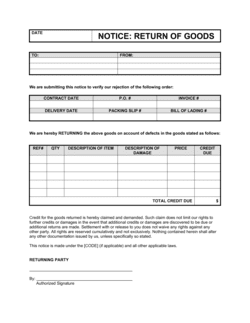
Return of Goods on Approval Template

Free Word download • Edit online • Save & share with Drive • Export to PDF

1 page20–30 min to fillDifficulty: StandardSignature requiredLegal review recommended
Learn more ↓
FreeReturn of Goods on Approval Template

At a glance

What it is
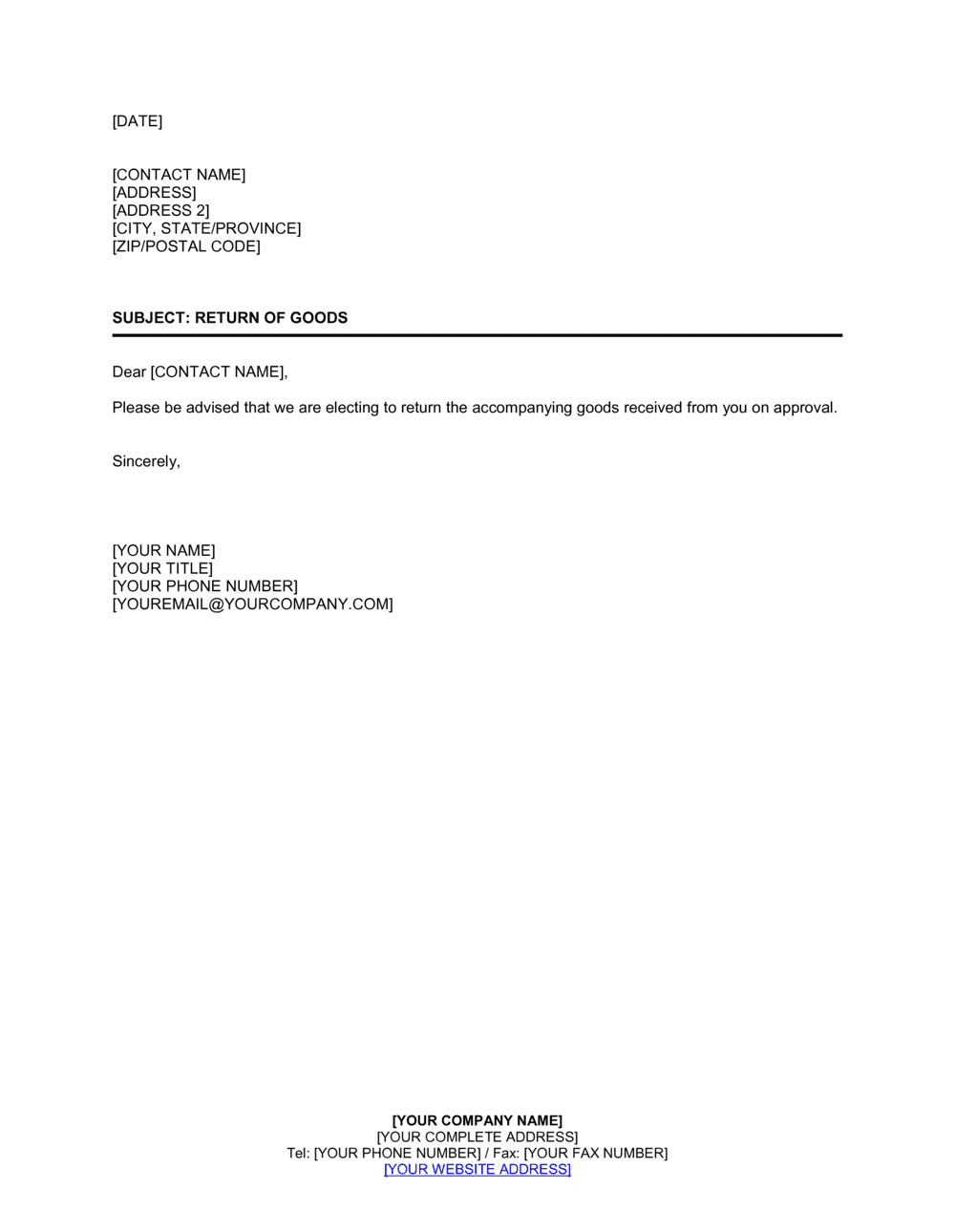
A Return of Goods on Approval is a legally binding document used when a buyer who received goods on a trial or approval basis decides not to purchase them and wishes to return them to the seller. This free Word download formalizes the return process, confirms the goods' condition at return, and releases both parties from further obligation — protecting the seller's right to inspect returned goods and the buyer's right to a credit or refund.
When you need it
Use it whenever goods were originally sent under a sale-on-approval or goods-on-trial arrangement and the buyer elects to return rather than purchase. It is especially important when the goods are high-value, when the approval period is expiring, or when the condition of the goods at return could be disputed.
What's inside
Party identification, original approval agreement reference, description and quantity of returned goods, condition statement and inspection rights, title and risk transfer terms, credit or refund terms, liability release, and governing law. Together these clauses create a clean, documented record that closes out the approval transaction.

What is a Return of Goods on Approval?

A Return of Goods on Approval is a legally binding document that formally records the return of goods originally sent to a buyer on a trial or approval basis, where the buyer has decided not to purchase. In a sale-on-approval arrangement, title to the goods never passes to the buyer — the seller retains ownership throughout the trial period, and the buyer's only obligation is to return the goods in their original condition if they choose not to proceed. This document closes out that arrangement by confirming the identity and condition of goods being returned, allocating transit risk, specifying the credit or refund the buyer will receive, and releasing both parties from further claims once the return is accepted. It functions as both a formal closing record and a condition-at-return certificate that protects either party if a dispute arises after the goods change hands.

Why You Need This Document

Without a formal return document, a routine goods-on-approval transaction can unravel into a protracted dispute. A buyer who returns goods without a written record has no protection against a seller who later claims the goods arrived damaged, were returned outside the approval period, or were not the items originally sent. Conversely, a seller who accepts goods back without a condition statement has no documented basis to charge the buyer if damage is discovered during inspection. The accounting implications are also real: both parties need a written record to reverse any provisional entries, process a credit note, and satisfy auditors that no sale occurred. For high-value goods — machinery, artwork, technology hardware — the cost of an unresolved condition dispute can easily exceed the value of the goods themselves. This template gives both parties a clean, signed record that the return was timely, the condition was agreed, and the transaction is closed.

Which variant fits your situation?

If your situation is…Use this template
Goods were sent on trial and buyer is returning within the approval periodReturn of Goods on Approval
Goods were sent on consignment and the consignee is returning unsold stockConsignment Agreement
Buyer is returning defective goods under a warranty claimProduct Warranty and Return Policy
Goods were purchased outright and buyer wishes to return for a refundSales Return Authorization
Seller wants to formalize the original goods-on-approval arrangementSale on Approval Agreement
Dispute over condition of returned goods requires a formal inspection recordGoods Inspection Report

Common mistakes to avoid

❌ Omitting an itemized goods description

Why it matters: A return document that refers only to 'the goods' cannot be matched to specific inventory, allowing either party to dispute quantities or substitute inferior items during return transit.

Fix: List every returned item by name, SKU or serial number, quantity, and unit value. Attach a separate schedule if the list is long.

❌ No documented condition statement at time of return

Why it matters: Without a written condition record, a seller who discovers damage after receipt has no evidence of when the damage occurred — making it nearly impossible to charge the buyer for it.

Fix: Require the buyer to complete a condition statement before shipment and attach photographs. Include a Schedule A for any known deviations from original condition.

❌ No inspection deadline for the seller

Why it matters: An open-ended inspection right lets the seller delay acceptance indefinitely, leaving the buyer unable to obtain their credit or close the transaction in their accounts.

Fix: Set a specific inspection window — typically 5 to 10 business days from receipt — and state that failure to object within that period constitutes acceptance of the return.

❌ Failing to allocate transit risk during return shipping

Why it matters: If goods are damaged in transit and the return document is silent on risk of loss, both parties will claim the other bears responsibility, turning a routine return into a costly dispute.

Fix: Explicitly state which party bears risk from the moment goods leave the buyer's premises until the seller physically receives them. Require adequate carrier insurance for the full declared value.

❌ Using a blanket liability release with no carve-outs

Why it matters: An overbroad release that waives all claims — including fraud or intentional misconduct — can be set aside by courts in many jurisdictions, potentially voiding the entire release clause.

Fix: Draft the release to cover claims arising from the normal approval transaction, with explicit carve-outs for fraud, willful misconduct, and any condition dispute noted in Schedule A.

❌ Signing after goods have already been returned

Why it matters: A return document signed after goods have shipped cannot document the condition at time of return, and its liability release may lack consideration in some common-law jurisdictions.

Fix: Execute the return document before the goods leave the buyer's premises. If the return has already occurred, obtain a separate written acknowledgment of condition from the buyer contemporaneous with the shipment.

The 9 key clauses, explained

Parties and original agreement reference

In plain language: Identifies the seller and buyer by legal name and references the original sale-on-approval agreement or delivery note under which the goods were dispatched.

Sample language
This Return of Goods on Approval is entered into on [DATE] between [SELLER LEGAL NAME] ('Seller') and [BUYER LEGAL NAME] ('Buyer'), in connection with the Sale on Approval Agreement dated [ORIGINAL DATE] (Reference No. [APPROVAL REF]).

Common mistake: Omitting the reference to the original approval agreement. Without it, the return document stands alone and cannot be matched to the underlying transaction, complicating accounting reconciliation and any future dispute.

Description and quantity of returned goods

In plain language: Provides a precise itemized list of the goods being returned — including product name, SKU or serial number, quantity, and unit value — so both parties agree on exactly what is coming back.

Sample language
The following goods are being returned under this Agreement: [PRODUCT NAME], SKU [NUMBER], Qty [X], unit value $[AMOUNT]; [PRODUCT NAME], SKU [NUMBER], Qty [X], unit value $[AMOUNT]. Total value of returned goods: $[TOTAL].

Common mistake: Using generic descriptions like 'the goods' without itemizing. Vague descriptions make it impossible to verify that what was returned matches what was sent, enabling disputes over shortages or substitutions.

Condition of goods at return

In plain language: States the condition in which the goods are being returned — unused, in original packaging, or with documented wear — and confirms the buyer's representation that no damage occurred during the approval period.

Sample language
Buyer represents that the Goods are returned in [ORIGINAL / DESCRIBED] condition: [CONDITION DESCRIPTION]. Buyer confirms the Goods have not been materially altered, damaged, or used beyond reasonable inspection. Any known defects or deviations from original condition are noted in Schedule A.

Common mistake: Not including a Schedule A for known condition deviations. If the goods come back with minor damage and there is no mechanism to document it, the seller has no contractual basis to charge the buyer for it.

Inspection rights

In plain language: Reserves the seller's right to inspect the returned goods within a defined period after receipt before confirming the return is accepted and issuing a credit or refund.

Sample language
Seller shall have [X] business days from receipt of the Goods to inspect them and confirm whether the return is accepted. Seller shall notify Buyer in writing of any objection to the condition of the Goods within this period. Failure to notify within the inspection window constitutes acceptance of the return.

Common mistake: Setting no inspection deadline. Without a time limit, the seller can delay indefinitely, leaving the buyer uncertain about their credit and unable to close the transaction in their own accounts.

Title and risk of loss on return

In plain language: Confirms when title and risk of loss transfer back to the seller — typically on physical receipt of the goods, or on the seller's written confirmation of acceptance of the return.

Sample language
Risk of loss for the Goods during return transit shall remain with [BUYER / SELLER] until the Goods are received at Seller's facility at [ADDRESS]. Title shall revert to Seller upon Seller's written acceptance of the return.

Common mistake: Leaving transit risk unallocated. If goods are damaged in return shipping and the document is silent on risk, a court must determine liability — a costly and unpredictable outcome for both parties.

Return shipping and costs

In plain language: States which party is responsible for the cost of return shipping, insurance during transit, and any packaging requirements.

Sample language
Buyer shall bear all costs of packaging, insurance, and freight for return shipment unless otherwise agreed in writing. Goods must be packed in original packaging or equivalent protective materials. Seller's return authorization number [RA-XXXX] must appear on the outer packaging.

Common mistake: Omitting the return authorization number requirement. Goods arriving without an RA number are frequently delayed or refused at the seller's warehouse, creating an unnecessary dispute over whether the return was timely.

Credit, refund, or offset terms

In plain language: Sets out what the buyer receives in exchange for the return — a credit note, a refund, or an offset against an outstanding balance — and the timeline for the seller to issue it after accepting the return.

Sample language
Upon Seller's acceptance of the return, Seller shall issue a credit note to Buyer for $[AMOUNT] within [X] business days, applicable against future invoices. Alternatively, if no future orders are anticipated, Seller shall remit a cash refund of $[AMOUNT] within [X] business days.

Common mistake: Not specifying the timeline for issuing the credit or refund. A vague 'within a reasonable time' obligation routinely results in the buyer following up for weeks and the seller deprioritizing the credit issuance.

Liability release and mutual discharge

In plain language: Releases both parties from further claims arising out of the original approval arrangement once the return is accepted — subject to any documented exceptions for condition disputes.

Sample language
Upon Seller's acceptance of the returned Goods and issuance of the credit or refund described herein, each party releases the other from any further liability, claim, or obligation arising from the Sale on Approval Agreement referenced above, except as to claims arising from fraud or willful misconduct.

Common mistake: A blanket release with no carve-out for fraud or undisclosed damage. Courts have set aside overbroad releases in consumer and commercial contexts — a narrow, well-drafted carve-out preserves the clause's enforceability.

Governing law and jurisdiction

In plain language: Specifies which jurisdiction's law governs the return agreement and which courts or arbitral bodies will resolve any dispute.

Sample language
This Agreement shall be governed by the laws of [STATE / PROVINCE / COUNTRY], without regard to its conflict-of-law provisions. Any dispute shall be resolved exclusively in the courts of [CITY / JURISDICTION], and both parties consent to such jurisdiction.

Common mistake: Choosing a governing law that has no connection to either party or the location of the goods. Courts in some jurisdictions will disregard a governing-law clause that appears designed solely to disadvantage the weaker party.

How to fill it out

  1. 1

    Identify both parties using legal entity names

    Enter the full registered legal names of both the seller and the buyer. For companies, use the name on the corporate registry, not a trade name or brand name.

    💡 Cross-reference the party names against the original sale-on-approval agreement to confirm they match exactly — a name discrepancy can complicate enforceability.

  2. 2

    Reference the original approval agreement

    Enter the date and reference number of the original sale-on-approval or delivery note. This links the return document to the underlying transaction and simplifies accounting reconciliation.

    💡 If no formal approval agreement exists, reference the original delivery note or purchase order number instead and note the trial terms that were communicated.

  3. 3

    Itemize the returned goods precisely

    List every item being returned with its product name, SKU or serial number, quantity, and per-unit value. Confirm the total value of goods being returned.

    💡 Match the itemization exactly to the original delivery record — any discrepancy between what was sent and what is listed as returned should be flagged in Schedule A.

  4. 4

    Document the condition of the goods

    State the condition of each returned item. If goods are in original, unopened condition, say so explicitly. If there is any wear, damage, or deviation from original condition, describe it in Schedule A and attach photographs if possible.

    💡 Photographs taken at the time of packaging for return shipping are the single most useful piece of evidence in any condition dispute.

  5. 5

    Set the inspection window and acceptance process

    Enter the number of business days the seller has to inspect the goods after receipt. Include what constitutes a valid objection and the consequence of missing the deadline.

    💡 Five business days is a practical standard for most goods; extend to ten for complex machinery or high-value equipment requiring specialist inspection.

  6. 6

    Allocate transit risk and specify shipping instructions

    Decide whether buyer or seller bears the risk of loss during return transit and enter the seller's return address and return authorization number format.

    💡 For high-value goods, require the buyer to obtain carrier insurance covering the full declared value of the shipment and name the seller as an additional insured.

  7. 7

    Specify the credit or refund amount and timeline

    Enter the exact dollar amount of the credit or refund and the number of business days after return acceptance within which the seller must issue it.

    💡 If the credit will be applied to a future order rather than paid out, specify the expiry date of the credit note to prevent it from sitting unresolved on both parties' books indefinitely.

  8. 8

    Sign before the goods are shipped back

    Both parties should sign the return document before the goods leave the buyer's premises. This ensures the agreed condition record and release terms are in place before any transit damage dispute arises.

    💡 Use a timestamped eSign solution so the execution date is independently verifiable — particularly important if the approval period expiry date is in dispute.

Frequently asked questions

What is a return of goods on approval?

A return of goods on approval is a formal document used when a buyer who received goods on a trial or approval basis decides not to keep them and returns them to the seller. It records the identity of the parties, the goods being returned, their condition at return, how transit risk is allocated, and what credit or refund the buyer will receive. It closes out the original sale-on-approval arrangement and releases both parties from further obligation once the return is accepted.

How does a sale-on-approval arrangement work?

In a sale-on-approval arrangement, the seller sends goods to the buyer for a defined trial period. The buyer may use or inspect the goods during that period. If the buyer accepts — either expressly or by keeping the goods past the approval period — title and the obligation to pay transfer to the buyer. If the buyer rejects the goods within the approval period, they must return them and owe no payment. The return-of-goods-on-approval document formalizes this second outcome.

Who bears the risk of loss during return transit?

This depends entirely on what the parties agree in the return document. In many jurisdictions, the default rule under commercial law is that risk remains with the buyer until the seller receives the goods back. However, this default can be varied by contract. The return document should specify clearly which party bears transit risk and require adequate insurance to cover the full declared value of the shipment.

Does the buyer owe payment if goods are returned on approval?

No — provided the buyer returns the goods within the approval period in their original condition. The return document should confirm that no payment obligation arises and direct the seller to issue a credit note or refund as applicable. If the goods are returned damaged or after the approval period has expired, the seller may have a claim for the purchase price or for compensation for damage, depending on the terms agreed.

Is a return of goods on approval document legally binding?

Yes, when properly signed by both parties it is generally enforceable as a binding contract in most jurisdictions. It documents mutual agreement on the terms of the return — condition, risk, credit — and the liability release is supported by the consideration of each party giving up their right to further claims. As with any contract, specific enforceability depends on applicable local law and the circumstances of the transaction.

What happens if the goods arrive back damaged?

The seller should document the damage during the inspection window and notify the buyer in writing before that window closes. If the damage occurred in transit, the claim typically lies against the carrier, which is why carrier insurance is important. If the damage was caused by the buyer during the approval period, the seller may have a breach-of-contract claim against the buyer for the diminution in value. The return document's Schedule A and condition statement are the primary evidence in either case.

How does this document differ from a standard purchase return?

A standard purchase return relates to goods that were bought outright and are being returned under a return policy or warranty. A return of goods on approval relates to goods where title never passed to the buyer — they were on trial. The legal and accounting treatment differs significantly: no sale was ever recognized, so no revenue reversal is needed on the seller's side, and no accounts-payable obligation was incurred by the buyer.

Do I need a lawyer to complete this document?

For routine commercial returns of modest-value goods, a well-completed template is typically sufficient. Consider engaging a lawyer when the goods are high-value or irreplaceable, when the buyer and seller are in different jurisdictions with differing commercial law, when the condition of the goods is already disputed, or when the original approval agreement contains unusual terms that affect how the return should be documented.

What is the difference between goods on approval and consignment?

In a sale-on-approval arrangement, the goods are sent to a specific buyer who may accept or reject them for their own use. In a consignment arrangement, goods are placed with a third party — typically a retailer — to sell to end customers, with the consignee remitting proceeds minus a commission. Both arrangements involve deferred title transfer, but consignment involves an ongoing sales relationship rather than a single trial-and-accept decision.

How this compares to alternatives

vs Sale on Approval Agreement

A sale on approval agreement establishes the original terms under which goods are sent for trial — approval period, acceptance triggers, pricing, and risk allocation. A return of goods on approval is the downstream document that formally closes out the transaction when the buyer elects not to purchase. You need the original agreement first; this return document references and terminates it.

vs Consignment Agreement

A consignment agreement governs an ongoing arrangement where a consignee holds goods to sell on behalf of the owner. A return of goods on approval is a one-time document closing out a single buyer's trial of specific goods. Consignment returns are typically addressed within the consignment agreement itself rather than in a separate return document.

vs Purchase Return Authorization

A purchase return authorization governs the return of goods that were sold outright — title has already passed, and the return reverses the sale. A return of goods on approval covers goods where title never passed. The accounting treatment, tax implications, and legal framework differ substantially between the two.

vs Product Warranty Claim Form

A warranty claim form is used when goods that were purchased are returned because they are defective or fail to meet specifications. A return of goods on approval is used when the buyer simply elects not to purchase — the goods need not be defective. Mixing the two documents creates incorrect expectations about the buyer's remedies and the seller's obligations.

Industry-specific considerations

Wholesale and Distribution

Distributors frequently send trial stock to retailers on approval; a formal return document prevents disputes over which SKUs were returned and in what condition.

Art and Luxury Goods

High-value unique items — artwork, jewelry, bespoke furnishings — sent on approval require precise condition documentation at return to protect against claims of damage or substitution.

Industrial Equipment and Machinery

Equipment pilots and trials involve complex return logistics, specialist inspection requirements, and significant freight costs that must be clearly allocated in the return document.

Technology Hardware

Device pilots and proof-of-concept deployments require serial-number-level itemization in the return document and a clear process for wiping proprietary data before goods leave the buyer's premises.

Jurisdictional notes

United States

Sale-on-approval arrangements in the US are governed primarily by Article 2 of the Uniform Commercial Code, which provides that risk of loss for goods on approval remains with the seller until the buyer accepts. UCC §2-327 specifies that return of goods on approval is at the seller's expense and risk. State-level variations are minor, but California and New York courts have developed nuanced case law on what constitutes implied acceptance.

Canada

Canada's provincial Sale of Goods Acts — modeled on the UK's original statute — govern sale-on-approval transactions. The buyer's right to return goods within the approval period is generally well-protected. In Quebec, the civil law tradition applies, and the Civil Code of Quebec governs conditional sales differently from common-law provinces. Return shipping costs and risk allocation should be explicitly stated because provincial default rules vary.

United Kingdom

The Sale of Goods Act 1979 (as amended) and the Consumer Rights Act 2015 govern goods-on-approval arrangements in the UK. Section 18 Rule 4 of the Sale of Goods Act provides that property passes when the buyer signifies approval or retains the goods beyond the agreed return period. For B2B transactions, the parties have broad freedom to vary these defaults by contract, making clear documentation of the return terms especially important.

European Union

No single EU-level instrument specifically governs sale-on-approval arrangements, so member state commercial codes apply. The EU Sale of Goods Directive (2019/771) addresses conformity and remedies for consumer sales but does not directly regulate approval-basis trials. GDPR considerations arise if the return process involves personal data collected during the trial period. Cross-border returns within the EU should specify the governing law explicitly, as member state rules on risk transfer and inspection rights differ materially.

Template vs lawyer — what fits your deal?

PathBest forCostTime
Use the templateRoutine commercial returns of standard goods where the approval terms were clear and the condition of goods is uncontestedFree15–30 minutes
Template + legal reviewHigh-value goods, cross-border returns, or situations where the approval period expiry or condition is already disputed$200–$5001–2 days
Custom draftedBespoke or irreplaceable goods, complex multi-party approval arrangements, or returns involving significant disputed liability$800–$2,500+3–7 days

Glossary

Sale on Approval
A transaction in which the buyer receives goods for trial and title does not pass until the buyer explicitly accepts them or the approval period expires.
Approval Period
The defined window of time within which a buyer may use, inspect, or trial goods before deciding to purchase or return them.
Title Transfer
The point at which legal ownership of goods moves from seller to buyer — under a sale on approval, title remains with the seller until acceptance.
Risk of Loss
The legal responsibility for goods that are damaged, destroyed, or stolen; in sale-on-approval arrangements, risk allocation must be explicitly stated.
Acceptance
The buyer's express or implied agreement to purchase the goods, which triggers the passage of title and the obligation to pay.
Inspection Right
The seller's right to examine returned goods to confirm they are in the same condition as when dispatched, before issuing a credit or refund.
Credit Note
A document issued by the seller acknowledging the return and reducing or eliminating the buyer's payment obligation for the returned goods.
Liability Release
A clause by which one or both parties waive future claims arising from the approval transaction once the return is completed and accepted.
Consignment
A related arrangement where goods are placed with a third party for sale, but title and risk remain with the original owner until the goods are sold.
Return Authorization Number
A unique reference code issued by the seller to approve and track a return, used to match the returned goods to the original approval transaction.

Part of your Business Operating System

This document is one of 3,000+ business & legal templates included in Business in a Box.

  • Fill-in-the-blanks — ready in minutes
  • 100% customizable Word document
  • Compatible with all office suites
  • Export to PDF and share electronically

Create your document in 3 simple steps.

From template to signed document — all inside one Business Operating System.
1
Download or open template

Access over 3,000+ business and legal templates for any business task, project or initiative.

2
Edit and fill in the blanks with AI

Customize your ready-made business document template and save it in the cloud.

3
Save, Share, Send, Sign

Share your files and folders with your team. Create a space of seamless collaboration.

Save time, save money, and create top-quality documents.

★★★★★

"Fantastic value! I'm not sure how I'd do without it. It's worth its weight in gold and paid back for itself many times."

Managing Director · Mall Farm
Robert Whalley
Managing Director, Mall Farm Proprietary Limited
★★★★★

"I have been using Business in a Box for years. It has been the most useful source of templates I have encountered. I recommend it to anyone."

Business Owner · 4+ years
Dr Michael John Freestone
Business Owner
★★★★★

"It has been a life saver so many times I have lost count. Business in a Box has saved me so much time and as you know, time is money."

Owner · Upstate Web
David G. Moore Jr.
Owner, Upstate Web

Run your business with a system — not scattered tools

Stop downloading documents. Start operating with clarity. Business in a Box gives you the Business Operating System used by over 250,000 companies worldwide to structure, run, and grow their business.

Start free · No credit card required