Congratulations on Promotion Template

Free Word download β€’ Edit online β€’ Save & share with Drive β€’ Export to PDF

1 pageβ€’20–30 min to fillβ€’Difficulty: Standardβ€’Signature requiredβ€’Legal review recommended
Learn more ↓
FreeCongratulations on Promotion Template

At a glance

What it is
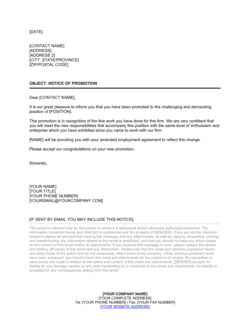
A Congratulations on Promotion letter is a formal written notice from an employer to an employee that simultaneously celebrates the achievement and documents the material changes to the employment relationship β€” new title, revised compensation, updated reporting structure, and effective date. This free Word download gives HR managers and business owners a ready-to-edit template they can export as PDF and deliver to the promoted employee before their first day in the new role.
When you need it
Issue this letter any time an employee moves to a higher-level position, whether through an annual review cycle, a fast-track recognition, or a structural reorganization. It is especially important when the promotion changes compensation, title, or reporting lines that need to be reflected in payroll, benefits, and personnel files.
What's inside
The letter covers the congratulatory opening, new job title and department, effective date of the promotion, revised salary or hourly rate, updated benefits eligibility, new reporting structure, and any revised duties or scope of responsibility. A signature block confirms both parties have received and acknowledged the updated terms.

What is a Congratulations on Promotion Letter?

A Congratulations on Promotion letter is a formal written notice an employer issues to an employee that serves two purposes simultaneously: it recognizes the employee's achievement and documents the binding changes to their employment terms β€” new job title, revised salary, updated reporting structure, and the exact date those changes take effect. Unlike a casual verbal acknowledgement or an informal email, a signed promotion letter creates an authoritative record that is filed in the employee's personnel file, processed by payroll, and referenced in any future dispute about what was agreed at the time of the promotion. It functions as a targeted amendment to the underlying employment agreement, updating specific terms while leaving all other provisions β€” including confidentiality, IP assignment, and termination arrangements β€” intact.

Why You Need This Document

Without a written, signed promotion letter, the terms of a promotion exist only in the memories of the manager and employee β€” and those memories diverge quickly. Payroll departments require a documented effective date and new salary figure to process changes accurately; missing one creates retroactive pay disputes that consume HR time and damage trust. Employees who are promoted without receiving a formal letter have no authoritative record of their new title or authority, which creates friction on background checks, client introductions, and internal budget approvals. In Canada, the UK, and the EU, employment law requires written notification of changed terms within a defined window β€” an undocumented promotion can constitute a statutory violation independent of any dispute. For first-time managers, the absence of a written probationary clause makes reversing a poor fit promotion legally and organizationally complicated. This template gives HR teams and business owners a consistent, legally grounded document they can issue in minutes β€” protecting both the employer's interests and the employee's right to clear, confirmed terms.

Which variant fits your situation?

If your situation is…Use this template
Promoting an employee to a first-time people-management roleCongratulations On Promotion (Manager)
Elevating a senior individual contributor to a director-level titleCongratulations On Promotion (Director)
Announcing an internal promotion to the wider teamInternal Promotion Announcement
Confirming a lateral transfer with a title change but no salary changeEmployee Transfer Letter
Promoting an executive to a C-suite role with equity changesExecutive Employment Agreement
Issuing a pay raise without a title changeSalary Increase Letter
Documenting a temporary acting or interim role upgradeActing Role Appointment Letter

Common mistakes to avoid

❌ Using an informal job title in the letter

Why it matters: If the letter says 'Senior Dev Lead' but the HRIS records say 'Senior Software Engineer II,' the employee's background check, LinkedIn, and payroll records will conflict β€” creating confusion with future employers and auditors.

Fix: Confirm the exact official job title with the HR information system administrator before drafting the letter and use that title verbatim.

❌ Omitting the effective date

Why it matters: Without a specific date, payroll cannot process the compensation change, and the employee has no authoritative record of when their new title and salary began β€” leading to retroactive pay disputes.

Fix: Always include a specific calendar date aligned to the start of a pay period, and repeat it wherever the letter references when new terms begin.

❌ No signed acknowledgement on file

Why it matters: An unsigned promotion letter cannot demonstrate the employee accepted the new terms. In a dispute about compensation, duties, or termination, the employer has no documentary evidence the employee was informed.

Fix: Request a signed return copy with a stated deadline and withhold formal HRIS updates until the executed copy is filed in the personnel record.

❌ Preserving at-will language for employees in non-at-will jurisdictions

Why it matters: In Canada, the UK, and the EU, at-will clauses have no legal effect and signal that the employer has not adapted their templates to local law β€” undermining overall contract credibility.

Fix: Maintain jurisdiction-specific variants of the template. For non-US employees, replace at-will language with a notice-period preservation clause referencing the original employment contract.

❌ Including specific benefits plan details rather than categories

Why it matters: If the letter states the employee is entitled to 'Plan B family dental coverage with a $2,500 annual maximum' and the plan is updated the following year, the employer may be in breach of the letter's terms.

Fix: Reference benefit changes by category only ('your health plan tier will be upgraded to the senior employee plan as of the effective date') and direct the employee to the current plan summary for specifics.

❌ Skipping the probationary period clause for new managers

Why it matters: When an individual contributor is promoted to a management role for the first time, the risk of a poor fit is higher. Without a documented evaluation period and defined remedy, reversing the promotion is legally and operationally messy.

Fix: Include a 60-to-90-day performance review clause for all first-time management promotions, and specify in writing that unsatisfactory performance may result in a return to a comparable individual-contributor role.

The 10 key clauses, explained

Congratulatory opening and context

In plain language: Opens the letter warmly, names the employee, and briefly recognizes the performance or qualities that led to the promotion decision.

Sample language
Dear [EMPLOYEE FULL NAME], On behalf of [COMPANY NAME], I am pleased to inform you that you have been promoted to the position of [NEW JOB TITLE], effective [EFFECTIVE DATE]. This decision reflects your outstanding contributions to [DEPARTMENT / PROJECT] and our confidence in your continued growth.

Common mistake: Skipping the personal recognition entirely and moving straight to the administrative terms β€” this leaves the employee feeling processed rather than valued, which undermines retention.

New job title and department

In plain language: States the employee's new official title and the department or business unit they belong to in the new role.

Sample language
Your new title is [NEW JOB TITLE], reporting to [SUPERVISOR TITLE / NAME] within the [DEPARTMENT NAME] department.

Common mistake: Using an informal or abbreviated title that differs from the title entered in the HR system β€” the discrepancy causes confusion on background checks, org charts, and payroll records.

Effective date

In plain language: Sets the precise date the promotion takes effect, which governs when payroll changes, new duties, and updated authority begin.

Sample language
This promotion is effective as of [DATE β€” e.g., June 1, 2026]. All changes to title, compensation, and responsibilities described in this letter take effect on that date.

Common mistake: Omitting the effective date or using a vague phrase like 'immediately' β€” payroll departments need a specific date to process the compensation change, and ambiguity creates retroactive pay disputes.

Revised compensation

In plain language: States the new base salary or hourly rate, payment frequency, and any change to bonus target or incentive plan.

Sample language
Your annual base salary will increase from [$CURRENT SALARY] to [$NEW SALARY], paid [bi-weekly / semi-monthly]. You will also be eligible for an annual discretionary bonus of up to [X]% of your base salary under the [PLAN NAME] program.

Common mistake: Listing only the new salary without stating the previous salary β€” omitting the comparison figure creates disputes later if the employee believes a different increase was promised.

Updated reporting structure

In plain language: Identifies who the employee now reports to and, where relevant, which team members or direct reports now fall under their authority.

Sample language
In your new role, you will report directly to [MANAGER NAME], [MANAGER TITLE]. The following team members will report to you: [DIRECT REPORT NAMES / TITLES, or 'as communicated separately'].

Common mistake: Failing to document new direct reports in the letter β€” if the management relationship is later disputed, no written record exists to confirm the scope of authority the employee was granted.

Revised duties and scope

In plain language: Summarizes the key responsibilities and decision-making authority of the new role, noting how they differ materially from the previous position.

Sample language
In your new capacity as [NEW TITLE], your primary responsibilities will include [KEY DUTY 1], [KEY DUTY 2], and [KEY DUTY 3]. A full job description is attached as Schedule A and forms part of this letter.

Common mistake: Reproducing the old job description word-for-word with the new title substituted β€” employees reasonably rely on the letter to understand what has actually changed in their role.

Benefits and leave entitlements

In plain language: Confirms any changes to benefits eligibility, vacation accrual, or other entitlements triggered by the promotion to a new grade or classification.

Sample language
As a result of your promotion to [GRADE / BAND], your annual vacation entitlement increases to [X] days per year effective [DATE]. Your eligibility for [BENEFIT β€” e.g., company car allowance / additional health coverage] also begins on [DATE].

Common mistake: Referencing the benefits plan by its specific current terms rather than by category β€” plan details change annually, and contractual references to specific coverage levels create amendment obligations every year.

At-will or notice-period preservation clause

In plain language: Clarifies that the promotion does not alter the fundamental nature of the employment relationship β€” at-will in the US, or notice-based elsewhere β€” and that prior agreements remain in effect.

Sample language
This letter does not alter the at-will nature of your employment with [COMPANY NAME]. Your employment may be terminated by either party at any time, for any lawful reason, with or without notice, except as otherwise required by applicable law. All other terms of your existing employment agreement dated [DATE] remain in full force.

Common mistake: Omitting this clause entirely, which can allow an employee to argue that the promotion letter itself created an implied fixed-term or for-cause-only termination arrangement.

Probationary period in new role (optional)

In plain language: If applicable, sets a defined evaluation window β€” typically 60 to 90 days β€” during which the employer assesses the employee's performance in the new role before the promotion is fully confirmed.

Sample language
This promotion is subject to a [90]-day performance review period beginning [START DATE]. Should performance in the new role not meet the expectations described in Schedule A, the Company reserves the right to return you to your previous role or to a comparable position.

Common mistake: Including a probationary period without specifying what happens if the employee does not meet expectations β€” leaving the remedy undefined makes the clause unenforceable and the conversation uncomfortable.

Acknowledgement and signature block

In plain language: Provides signature lines for both the employer representative and the employee, with the employee's signature confirming receipt and acceptance of the promotion terms.

Sample language
Please sign and return one copy of this letter by [RETURN DATE] to confirm your acceptance of these terms. Your signature indicates that you have read, understood, and agreed to the conditions of this promotion. [EMPLOYER SIGNATURE / DATE] [EMPLOYEE SIGNATURE / DATE]

Common mistake: Sending the letter via email without requesting a signed acknowledgement β€” without a signed copy on file, the employer cannot demonstrate the employee was informed of and agreed to the new terms.

How to fill it out

  1. 1

    Enter the employee's and company's identifying details

    Fill in the employee's full legal name, current title, new title, and the company's registered name. Ensure the new title matches exactly what will be entered in the HR information system and payroll.

    πŸ’‘ Cross-check the new title against your internal job architecture or salary-band framework before printing β€” a mismatch between the letter and HRIS creates downstream confusion.

  2. 2

    Set a specific effective date

    Choose a concrete calendar date β€” typically the first day of a pay period β€” and enter it in the effective date clause and anywhere else the letter references the start of new terms.

    πŸ’‘ Aligning the effective date to the start of a pay period eliminates the need to prorate compensation mid-cycle, which reduces payroll processing errors.

  3. 3

    Complete the compensation block with both old and new figures

    State the current salary or rate and the new salary or rate side by side. Include payment frequency, the new bonus target percentage if applicable, and the name of any incentive plan the employee is joining or upgrading within.

    πŸ’‘ If the employee is moving to a new salary band with a different bonus structure, attach the plan summary document and reference it in the letter rather than reproducing full plan terms.

  4. 4

    Confirm the updated reporting structure

    Name the employee's new direct supervisor by title and name. If the promotion creates a new management relationship, list the direct reports or note that the reporting chart will be communicated separately.

    πŸ’‘ Notify the new direct reports before the letter is issued so they do not learn about their new manager from a forwarded email rather than a direct conversation.

  5. 5

    Summarize the revised duties and attach a schedule

    Write two to four sentences describing how the new role differs materially from the previous one β€” scope of decisions, team size, budget authority, or client-facing responsibility. Attach a formal job description as Schedule A.

    πŸ’‘ Keep the duty summary in the letter body brief and direct; the full job description in Schedule A is the authoritative scope document.

  6. 6

    Update benefits and leave entitlements

    Check whether the promotion triggers a change in vacation accrual, health-plan tier, retirement contribution, or any other benefit. Note the category of change and the date it takes effect, without referencing specific plan dollar amounts.

    πŸ’‘ Confirm with your benefits broker or plan administrator whether a grade change triggers a qualifying life event under the health plan before issuing the letter.

  7. 7

    Add the at-will or notice preservation clause

    Confirm that the promotion does not modify the fundamental employment arrangement by including the at-will or notice-based termination clause appropriate to the employee's jurisdiction.

    πŸ’‘ For employees in Canada, the UK, or the EU, replace the at-will language with a clause that explicitly preserves the notice period from the original employment contract.

  8. 8

    Obtain signatures before the effective date

    Send the letter to the employee at least three to five business days before the effective date and request a signed copy back by a stated return date. File the executed copy in the employee's personnel file immediately.

    πŸ’‘ Use a digital signature tool to timestamp execution and store the completed document automatically β€” this eliminates the risk of a signed copy going missing before it reaches the file.

Frequently asked questions

What is a congratulations on promotion letter?

A congratulations on promotion letter is a formal written document an employer issues to an employee to notify them of a promotion, recognize their achievement, and document the material changes to their employment terms β€” new title, salary, reporting structure, and effective date. It serves both as a motivational communication and as a binding record that updates the employment relationship.

Does a promotion letter need to be signed?

Yes. While a promotion letter is not always a standalone contract, an employee's signature confirming receipt and acceptance is strongly recommended in most jurisdictions. Without a signed acknowledgement, the employer cannot demonstrate that the employee was formally informed of and agreed to the revised title, salary, and duties. A signed copy should be placed in the employee's personnel file immediately.

What should a promotion letter include?

At minimum: the employee's new job title and department, the effective date, the revised compensation (current and new figures), the updated reporting structure, a summary of revised duties, any changes to benefits or leave entitlements, preservation of at-will or notice-based termination terms, and a signature block for both parties. Optionally include a probationary period clause for first-time management promotions.

Is a promotion letter legally binding?

A signed promotion letter is generally considered an amendment to the underlying employment agreement and is enforceable as a statement of revised employment terms. Courts and employment tribunals in the US, Canada, the UK, and the EU have treated promotion letters as binding documents when they are signed and specific. Vague letters without a signature are harder to enforce but still create an evidentiary record.

Can a promotion letter change an employee's at-will status?

It can, inadvertently, if poorly drafted. Language implying that the employee will remain in the new role as long as performance is satisfactory, or that termination is only available for cause, may be interpreted as modifying at-will status in some US states. The template includes a clause that explicitly preserves at-will status to prevent this ambiguity.

When should a promotion letter be issued?

Issue the letter at least three to five business days before the effective date so the employee has time to review, sign, and return it before their first day in the new role. This also gives payroll and HR systems enough lead time to process the compensation and title changes accurately. Never backdate a promotion letter β€” use the actual issuance date and the actual effective date.

What is the difference between a promotion letter and a salary increase letter?

A promotion letter confirms a change in job title, responsibilities, and usually compensation β€” it updates multiple dimensions of the employment relationship simultaneously. A salary increase letter changes only the compensation without altering the title or duties. An employee can receive a salary increase letter without a promotion, or a promotion without an immediate salary change, though the latter is unusual.

Do I need to issue a new employment contract when I promote an employee?

In many cases, a well-drafted promotion letter that references and supplements the original employment agreement is sufficient. A full new employment contract is advisable when the promotion involves equity grants, a significantly different non-compete scope, new IP assignment obligations, or when the original contract is outdated and contains provisions that no longer reflect the employment relationship. Consult an employment lawyer if you are unsure which approach applies to your jurisdiction.

How should a promotion letter address a first-time management promotion?

A first-time management promotion should include a probationary period clause β€” typically 60 to 90 days β€” that evaluates the employee's performance in the new role and specifies what happens if the fit is poor. Without this clause, reversing the promotion is both legally and operationally difficult. The letter should also name the direct reports or indicate that the team structure will be communicated separately before the effective date.

How this compares to alternatives

vs Salary Increase Letter

A salary increase letter changes only the employee's compensation without altering their title, duties, or reporting structure. A promotion letter updates all material employment terms simultaneously and typically includes a revised job description as a schedule. Use a salary increase letter for merit raises or cost-of-living adjustments when no title change is involved.

vs Employment Contract

An employment contract establishes the full original terms of the working relationship β€” duties, compensation, IP assignment, non-compete, and termination. A promotion letter amends specific terms within that existing contract rather than replacing it. A new employment contract is warranted only when the promotion substantially changes restrictive covenants, equity arrangements, or the nature of the role.

vs Offer Letter

An offer letter is issued to external candidates before their first day to confirm the terms of new employment. A promotion letter is issued to existing employees whose terms are changing. Offer letters address onboarding logistics and background-check conditions; promotion letters address continuity of employment terms and preservation of existing agreements.

vs Employee Transfer Letter

An employee transfer letter documents a lateral move to a different department, location, or role without a change in grade or compensation. A promotion letter documents an upward move with a title change and typically a compensation increase. A transfer involving a simultaneous upgrade should use the promotion letter format with a note confirming the transfer.

Industry-specific considerations

Technology / SaaS

Promotions frequently involve changes to on-call responsibilities, access to production systems, and participation in equity refresh grants β€” all of which should be referenced or attached as supplemental documents.

Professional Services

Title changes from associate to manager or manager to director affect client billing rates, profit-sharing eligibility, and business development expectations that must be reflected in the updated duties section.

Financial Services

Promotions in regulated roles may require updated FCA, FINRA, or provincial securities registration β€” the letter should note any licensing condition precedent to the employee exercising full authority in the new role.

Healthcare

Clinical promotions often carry changes to credentialing requirements, supervised-practice restrictions, and HIPAA access levels that must be explicitly noted and coordinated with compliance teams before the effective date.

Jurisdictional notes

United States

At-will employment remains the default in 49 states and should be explicitly preserved in the promotion letter. A promotion does not independently create for-cause termination protection, but careless language implying permanent employment in the new role has been used successfully by employees in wrongful-termination claims. Compensation changes must comply with federal FLSA overtime classifications β€” a promotion that reclassifies an employee from non-exempt to exempt must be documented carefully.

Canada

At-will employment has no legal standing in Canada. The promotion letter must preserve the existing notice-period terms from the original employment contract, or set new ones that meet or exceed provincial Employment Standards Act minimums. In Ontario, courts have found that a significant promotion β€” particularly one that introduces new restrictive covenants β€” may require fresh consideration beyond the promotion itself to be enforceable. Quebec employers must issue the letter in French for provincially regulated roles.

United Kingdom

A promotion that changes a statutory written statement of particulars β€” title, salary, location, or hours β€” requires the employer to provide an updated written statement within one month of the change under the Employment Rights Act 1996. The promotion letter can serve this function if it covers all required statutory particulars. Employers should also confirm whether the promotion affects the employee's IR35 status if they were previously engaged through a personal service company.

European Union

The EU Transparent and Predictable Working Conditions Directive requires employers to notify employees of changes to employment particulars within the first day of the change taking effect. A signed promotion letter satisfies this requirement. Member states impose additional requirements β€” in Germany, works councils (Betriebsrat) may need to be informed or consulted before a promotion affects represented employees; in France, salary changes must be reflected in the pay stub for the relevant period without exception.

Template vs lawyer β€” what fits your deal?

PathBest forCostTime
Use the templateStandard internal promotions for non-executive employees in a single jurisdictionFree15–20 minutes per letter
Template + legal reviewFirst-time management promotions, cross-border employees, or roles with new IP or non-compete obligations$150–$400 for an employment lawyer review1–2 business days
Custom draftedExecutive promotions involving equity restructuring, regulatory licensing changes, or materially revised restrictive covenants$600–$2,000+3–7 business days

Glossary

Effective Date
The specific calendar date on which the new title, salary, and responsibilities take legal and operational effect.
Job Title
The official designation of the employee's position within the organization, which governs how their role is described internally and on employment records.
Compensation Adjustment
A change to base salary, hourly rate, or bonus target that accompanies the promotion and must be reflected in payroll from the effective date.
Reporting Structure
The chain of authority that defines who the promoted employee reports to and, if applicable, who now reports to them.
Acknowledgement Signature
The employee's signature confirming they have received, read, and accepted the terms set out in the promotion letter.
At-Will Status
In US jurisdictions, a clause confirming that the promotion does not change the underlying at-will nature of the employment relationship.
Benefits Eligibility
The specific health, retirement, vacation, or other benefit entitlements that change as a result of moving to a new job grade or classification.
Probationary Period
An optional defined period β€” typically 30 to 90 days β€” during which the employee is evaluated in the new role before the promotion is considered fully confirmed.
Personnel File
The employer's official record of an employee's employment history, into which signed promotion letters must be placed to document title and compensation changes.
Grade or Band
An internal salary classification level that determines compensation range, bonus eligibility, and benefit tier β€” often updated automatically when a promotion is issued.

Part of your Business Operating System

This document is one of 3,000+ business & legal templates included in Business in a Box.

  • Fill-in-the-blanks β€” ready in minutes
  • 100% customizable Word document
  • Compatible with all office suites
  • Export to PDF and share electronically

Create your document in 3 simple steps.

From template to signed document β€” all inside one Business Operating System.
1
Download or open template

Access over 3,000+ business and legal templates for any business task, project or initiative.

2
Edit and fill in the blanks with AI

Customize your ready-made business document template and save it in the cloud.

3
Save, Share, Send, Sign

Share your files and folders with your team. Create a space of seamless collaboration.

Save time, save money, and create top-quality documents.

β˜…β˜…β˜…β˜…β˜…

"Fantastic value! I'm not sure how I'd do without it. It's worth its weight in gold and paid back for itself many times."

Managing Director Β· Mall Farm
Robert Whalley
Managing Director, Mall Farm Proprietary Limited
β˜…β˜…β˜…β˜…β˜…

"I have been using Business in a Box for years. It has been the most useful source of templates I have encountered. I recommend it to anyone."

Business Owner Β· 4+ years
Dr Michael John Freestone
Business Owner
β˜…β˜…β˜…β˜…β˜…

"It has been a life saver so many times I have lost count. Business in a Box has saved me so much time and as you know, time is money."

Owner Β· Upstate Web
David G. Moore Jr.
Owner, Upstate Web

Run your business with a system β€” not scattered tools

Stop downloading documents. Start operating with clarity. Business in a Box gives you the Business Operating System used by over 250,000 companies worldwide to structure, run, and grow their business.

Free Forever PlanΒ Β·Β No credit card required