Promotion Policy Template

Free Word download β€’ Edit online β€’ Save & share with Drive β€’ Export to PDF

3 pagesβ€’20–25 min to fillβ€’Difficulty: Standard
Learn more ↓
FreePromotion Policy Template

At a glance

What it is
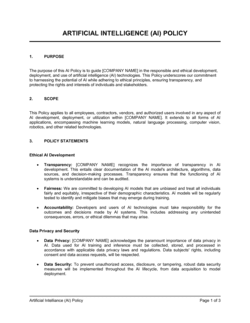
A Promotion Policy is a formal internal document that defines the criteria, process, and decision-making authority used when advancing employees to higher-level roles. This free Word download gives HR teams and managers a structured, editable template they can tailor to their organization and export as PDF for distribution in the employee handbook or intranet.
When you need it
Use it when your organization is scaling past 15–20 employees and promotion decisions are no longer handled informally, when employees are raising fairness concerns about how advancement works, or when preparing for an HR audit or compliance review.
What's inside
Eligibility criteria, performance and competency standards, the nomination and evaluation process, decision-making authority and approval chain, timelines, compensation adjustment guidelines, and communication requirements for both successful and unsuccessful candidates.

What is a Promotion Policy?

A Promotion Policy is a formal internal document that defines the criteria, process, and approval chain an organization follows when advancing employees to higher-level roles. It establishes eligibility requirements β€” such as minimum tenure and performance rating β€” describes the competency standards a candidate must demonstrate, sets out how nominations are submitted and evaluated, and specifies how compensation adjustments are calculated. Rather than leaving advancement decisions to individual managers, a promotion policy creates a consistent, organization-wide standard that applies equally across departments and teams.

Why You Need This Document

Without a written promotion policy, advancement decisions are made informally β€” by whoever has the most influence in a given moment β€” and employees quickly notice the inconsistency. The consequences are concrete: high performers leave when they cannot see a clear path forward, managers make commitments they are not authorized to keep, and a single contested promotion decision becomes difficult to defend without documented criteria. A promotion policy closes all three gaps. It gives employees a transparent picture of what advancement requires, gives managers a process they are empowered to follow, and gives HR the documentation needed to respond confidently if a decision is challenged. This template gives you a structured, editable starting point that covers every stage from eligibility to communication β€” ready to adapt to your organization's structure and distribute in minutes.

Which variant fits your situation?

If your situation is…Use this template
Formalizing promotion criteria for a single department or job familyPromotion Policy
Mapping all roles, levels, and salary bands across the organizationJob Grading and Salary Scale
Documenting how performance is evaluated to support promotion decisionsPerformance Review Template
Outlining how new roles are posted internally before external recruitingJob Posting Policy
Setting annual salary increase guidelines linked to performance ratingsCompensation Policy
Guiding employees through a structured career development conversationCareer Development Plan
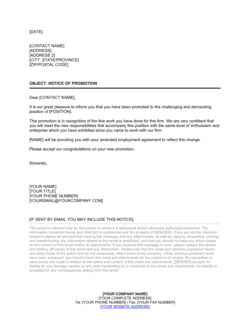
Communicating a promotion decision formally to the affected employeePromotion Letter

Common mistakes to avoid

❌ Using subjective promotion criteria

Why it matters: Terms like 'demonstrates leadership' or 'shows potential' cannot be evaluated consistently, leaving the company exposed to discrimination claims when different managers apply different mental models.

Fix: Replace every subjective criterion with a behavioral definition tied to a specific, observable output β€” for example, 'led at least one project with a budget exceeding $[X] and two or more direct reports.'

❌ Skipping the calibration step

Why it matters: Without cross-manager calibration, promotion rates vary widely by department, and the same performance level produces different outcomes depending on who the employee's manager is.

Fix: Schedule a mandatory calibration session with all nominating managers and HR before any decisions are finalized, and document the outcome of each candidate discussion.

❌ Announcing promotions before approvals are complete

Why it matters: Managers who communicate a promotion verbally before HR and finance have approved the compensation change create legal and morale problems when the offer has to be revised or withdrawn.

Fix: Add an explicit step in the process requiring all sign-offs in the HRIS before the manager is authorized to notify the employee.

❌ Never updating the policy after the first publication

Why it matters: A policy that no longer reflects actual practice is worse than having no policy at all β€” it creates a paper trail of broken commitments that employees can cite in grievances or litigation.

Fix: Assign a named policy owner, schedule an annual review on the calendar, and version-stamp every update with an effective date.

The 9 key sections, explained

Purpose and scope

Eligibility requirements

Promotion criteria and competency standards

Nomination and submission process

Evaluation and calibration process

Decision-making authority and approval chain

Compensation adjustment guidelines

Communication and notification requirements

Policy review and updates

How to fill it out

  1. 1

    Define the policy's scope and exclusions

    Specify which employee groups are covered β€” full-time, part-time, fixed-term β€” and explicitly carve out any populations governed by a separate agreement, such as executives or union members.

    πŸ’‘ If your organization operates in multiple jurisdictions, note whether local employment law affects any eligibility or process requirements in those locations.

  2. 2

    Set concrete eligibility thresholds

    Enter the minimum tenure requirement (e.g., 12 months in current role) and the minimum performance rating from the most recent review cycle. Add any mandatory training or certification prerequisites in Schedule A.

    πŸ’‘ Align the tenure threshold with your performance review cycle so that every eligible nominee has at least one completed review on file.

  3. 3

    Map promotion criteria to your competency framework

    For each level or grade in scope, list the specific competencies the candidate must demonstrate and the performance evidence required to support each claim.

    πŸ’‘ Use observable, behavioral language β€” 'independently managed a cross-functional project with three or more stakeholders' β€” rather than trait-based language like 'shows initiative.'

  4. 4

    Specify the nomination form and submission window

    Name the exact form, system, or document managers must use to submit a nomination, and set the promotion cycle dates β€” typically twice per year aligned to review cycles.

    πŸ’‘ Linking the promotion cycle to performance review dates (e.g., Q1 and Q3) reduces the administrative overhead of gathering supporting evidence that already exists.

  5. 5

    Define the calibration panel and scoring method

    Name the roles (not individuals) that must participate in the calibration session and describe how candidates will be assessed β€” a rating rubric, ranking stack, or narrative review.

    πŸ’‘ A rubric with defined behavioral anchors at each rating point (1–5) is far more defensible than a panel vote, especially for contested decisions.

  6. 6

    Set approval authority by level

    List each promotion level and the corresponding approvers β€” department head, HR, VP, CEO. Confirm all approvals must be recorded in your HRIS or tracking system before any communication.

    πŸ’‘ Adding a 48-hour hold between final approval and manager communication prevents premature announcements while compensation processing catches up.

  7. 7

    Complete the compensation adjustment table

    Enter the salary increase range (e.g., 8–15%) and the band minimum/midpoint constraints for each grade. Note who must approve exceptions that push compensation above the midpoint.

    πŸ’‘ Express the adjustment as a range rather than a fixed percentage to give managers flexibility while keeping total comp within band.

  8. 8

    Assign an owner and set the review date

    Name the HR role responsible for maintaining the policy and set an annual review date. Record the effective date and version number in the document header.

    πŸ’‘ Store the policy in your HRIS or intranet alongside the competency framework and salary bands it references so employees can access all three in one place.

Frequently asked questions

What is a promotion policy?

A promotion policy is a formal internal document that defines how an organization decides to advance employees to higher-level roles. It specifies eligibility requirements, the criteria used to evaluate candidates, who nominates and approves decisions, how compensation changes are determined, and how both successful and unsuccessful candidates are notified. A written policy replaces ad hoc promotion decisions with a consistent, defensible process.

Why does a company need a formal promotion policy?

Without a written policy, promotion decisions are made informally and inconsistently, which creates real retention and legal risks. Employees who perceive promotions as arbitrary are more likely to disengage or leave. If an employee alleges that a promotion decision was discriminatory, the absence of documented criteria makes the company's position much harder to defend. A formal policy also helps managers have productive development conversations by giving employees a clear picture of what advancement requires.

What criteria should a promotion policy include?

A complete policy covers minimum tenure in the current role, a required performance rating from the most recent review cycle, demonstrated competencies at the target level, and any mandatory training or certification prerequisites. Criteria should be observable and measurable β€” tied to specific behaviors or outputs rather than traits like "shows leadership potential." The policy should also specify how evidence of meeting each criterion is documented and submitted.

How often should promotions be reviewed?

Most organizations run promotion cycles twice per year, typically aligned with performance review cycles in Q1 and Q3. Annual cycles work for smaller organizations but create long waits for high performers who meet criteria mid-year. Some companies allow off-cycle promotions for exceptional cases, but these should require additional approval steps to prevent the policy from being bypassed routinely.

Who should be involved in the promotion decision?

At minimum, the nominating manager, their manager (second level), and an HR business partner should be involved. For senior-level promotions, a VP or C-suite approver is typically added. A calibration session involving all managers with nominees in the same cycle is best practice β€” it ensures that candidates are evaluated against the same standard regardless of which team they sit in.

What should happen when an employee is not promoted?

Unsuccessful candidates should receive timely verbal feedback from their manager and a written development summary within the timeframe specified in the policy. The summary should identify the specific gaps between the candidate's current performance and the promotion criteria, and outline concrete development actions. Transparency in this feedback is one of the most important factors in retaining employees who were not promoted.

How does a promotion policy differ from a performance review policy?

A performance review policy governs how employee performance is evaluated on a regular cadence β€” what is assessed, by whom, and how ratings are calibrated. A promotion policy governs a separate decision: whether an employee's demonstrated performance and competencies qualify them for advancement to a higher level. The two policies are closely linked β€” the promotion policy typically requires a minimum performance rating as an eligibility condition β€” but they cover different processes and outputs.

Should employees be allowed to self-nominate for promotion?

Some organizations allow self-nomination as a way to surface candidates whose managers may be overlooking them, which can support equity goals. However, self-nominations should still require manager endorsement before entering the formal evaluation process. Without that gate, the calibration panel receives a high volume of unsupported nominations and the process becomes unwieldy. A better alternative is a transparent process where employees can formally request a development conversation with their manager to discuss readiness.

How should compensation changes be handled in a promotion policy?

The policy should specify a salary adjustment range (typically 8–15% for a one-grade promotion) and state that the new salary must fall within the target grade's band. Exceptions above the band midpoint should require additional approval. Compensation changes should not be communicated to the employee until all approvals β€” including HR and finance β€” are confirmed, to avoid committing to a number that cannot be supported.

How this compares to alternatives

vs Performance Review Policy

A performance review policy sets the cadence and method for evaluating employee performance on an ongoing basis. A promotion policy uses those review outcomes as inputs to a separate advancement decision. The review tells you how someone is doing; the promotion policy determines whether that performance level qualifies them for a higher-level role.

vs Compensation Policy

A compensation policy governs how salaries are set, adjusted, and benchmarked across the organization, including annual merit increases. A promotion policy covers the specific salary adjustment triggered by a role change to a higher grade. The two policies must be aligned β€” the promotion policy's adjustment ranges must sit within the salary bands defined in the compensation policy.

vs Promotion Letter

A promotion letter is the individual communication sent to an employee confirming their advancement β€” new title, effective date, and updated compensation. A promotion policy is the organizational rulebook that governs how that decision was made. The policy comes first; the letter is one of its required outputs.

vs Career Development Plan

A career development plan is an individualized roadmap an employee and manager build together to close skill gaps and prepare for future roles. A promotion policy is an organization-wide rulebook that defines what readiness looks like and how the formal decision is made. Development plans are the preparation; the promotion policy governs the outcome.

Industry-specific considerations

Technology / SaaS

Engineering and product ladder levels (L3–L7) require precise competency anchors at each grade to prevent title inflation and salary compression.

Professional Services

Advancement from associate to manager to director is heavily client-facing; the policy typically includes billable utilization thresholds and client feedback requirements as promotion criteria.

Retail / Hospitality

High turnover makes a visible, fair promotion process a key retention tool; eligibility criteria often include scheduling reliability and customer satisfaction scores alongside performance.

Healthcare

Clinical roles require licensure and credentialing milestones as prerequisites; promotion criteria must align with scope-of-practice regulations and professional standards bodies.

Template vs pro β€” what fits your needs?

PathBest forCostTime
Use the templateHR managers and business owners formalizing promotion processes for teams of 15–150 employeesFree2–4 hours
Template + professional reviewOrganizations with multi-level job grades, union exposure, or cross-jurisdiction teams where local employment law affects eligibility rules$300–$800 for an HR consultant review3–5 business days
Custom draftedEnterprise HR teams building a fully integrated talent framework with competency models, salary bands, and succession planning$2,000–$8,000 for a full HR policy suite4–8 weeks

Glossary

Promotion
An advancement to a role with greater responsibility, seniority, or compensation than the employee's current position.
Eligibility Criteria
The minimum requirements an employee must meet before being considered for promotion, such as tenure, performance rating, or skill certification.
Nomination
A formal recommendation submitted by a manager or HR to initiate the promotion evaluation process for a specific employee.
Calibration Session
A structured meeting where managers review promotion candidates together to ensure evaluation standards are applied consistently across teams.
Competency Framework
A defined set of skills, behaviors, and knowledge levels required at each role or grade within the organization.
Job Grade
A classification level that groups roles of similar responsibility and market value, typically tied to a salary band.
Succession Planning
The process of identifying and preparing internal candidates to fill critical roles when they become vacant.
Merit-Based Promotion
An advancement decision driven by documented performance results and demonstrated competencies, not tenure or personal relationships.
Promotion Freeze
A temporary suspension of all or some promotion decisions, typically during financial restructuring or a hiring moratorium.
Compensation Adjustment
A salary change made in connection with a promotion, typically expressed as a percentage increase or a move to the next salary band's midpoint.

Part of your Business Operating System

This document is one of 3,000+ business & legal templates included in Business in a Box.

  • Fill-in-the-blanks β€” ready in minutes
  • 100% customizable Word document
  • Compatible with all office suites
  • Export to PDF and share electronically

Create your document in 3 simple steps.

From template to signed document β€” all inside one Business Operating System.
1
Download or open template

Access over 3,000+ business and legal templates for any business task, project or initiative.

2
Edit and fill in the blanks with AI

Customize your ready-made business document template and save it in the cloud.

3
Save, Share, Send, Sign

Share your files and folders with your team. Create a space of seamless collaboration.

Save time, save money, and create top-quality documents.

β˜…β˜…β˜…β˜…β˜…

"Fantastic value! I'm not sure how I'd do without it. It's worth its weight in gold and paid back for itself many times."

Managing Director Β· Mall Farm
Robert Whalley
Managing Director, Mall Farm Proprietary Limited
β˜…β˜…β˜…β˜…β˜…

"I have been using Business in a Box for years. It has been the most useful source of templates I have encountered. I recommend it to anyone."

Business Owner Β· 4+ years
Dr Michael John Freestone
Business Owner
β˜…β˜…β˜…β˜…β˜…

"It has been a life saver so many times I have lost count. Business in a Box has saved me so much time and as you know, time is money."

Owner Β· Upstate Web
David G. Moore Jr.
Owner, Upstate Web

Run your business with a system β€” not scattered tools

Stop downloading documents. Start operating with clarity. Business in a Box gives you the Business Operating System used by over 250,000 companies worldwide to structure, run, and grow their business.

Free Forever PlanΒ Β·Β No credit card required