Private Placement_due Diligence Requisition List Template

Free download • Use as a template • Print or share

14 pages40–50 min to useDifficulty: ExpertSignature requiredLegal review recommended
Learn more ↓
FreePrivate Placement_due Diligence Requisition List Template

At a glance

What it is
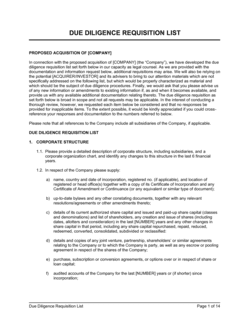
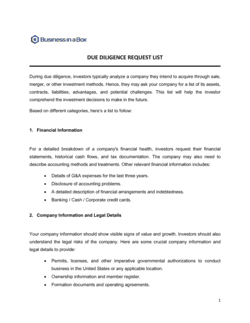
A Private Placement Due Diligence Requisition List is a formal document request submitted by an investor or their counsel to a company conducting a private securities offering. It catalogs every category of corporate, financial, legal, and operational record the investor needs to review before committing capital. This free Word download gives you a structured, attorney-informed starting point you can edit online and export as PDF for immediate use in a live transaction.
When you need it
Use it when an investor, fund, or their counsel needs to systematically request documents from a target company prior to closing a private placement, including Regulation D offerings, convertible note rounds, SAFE agreements, and private equity transactions. It is typically issued after an NDA is signed and a term sheet is under negotiation.
What's inside
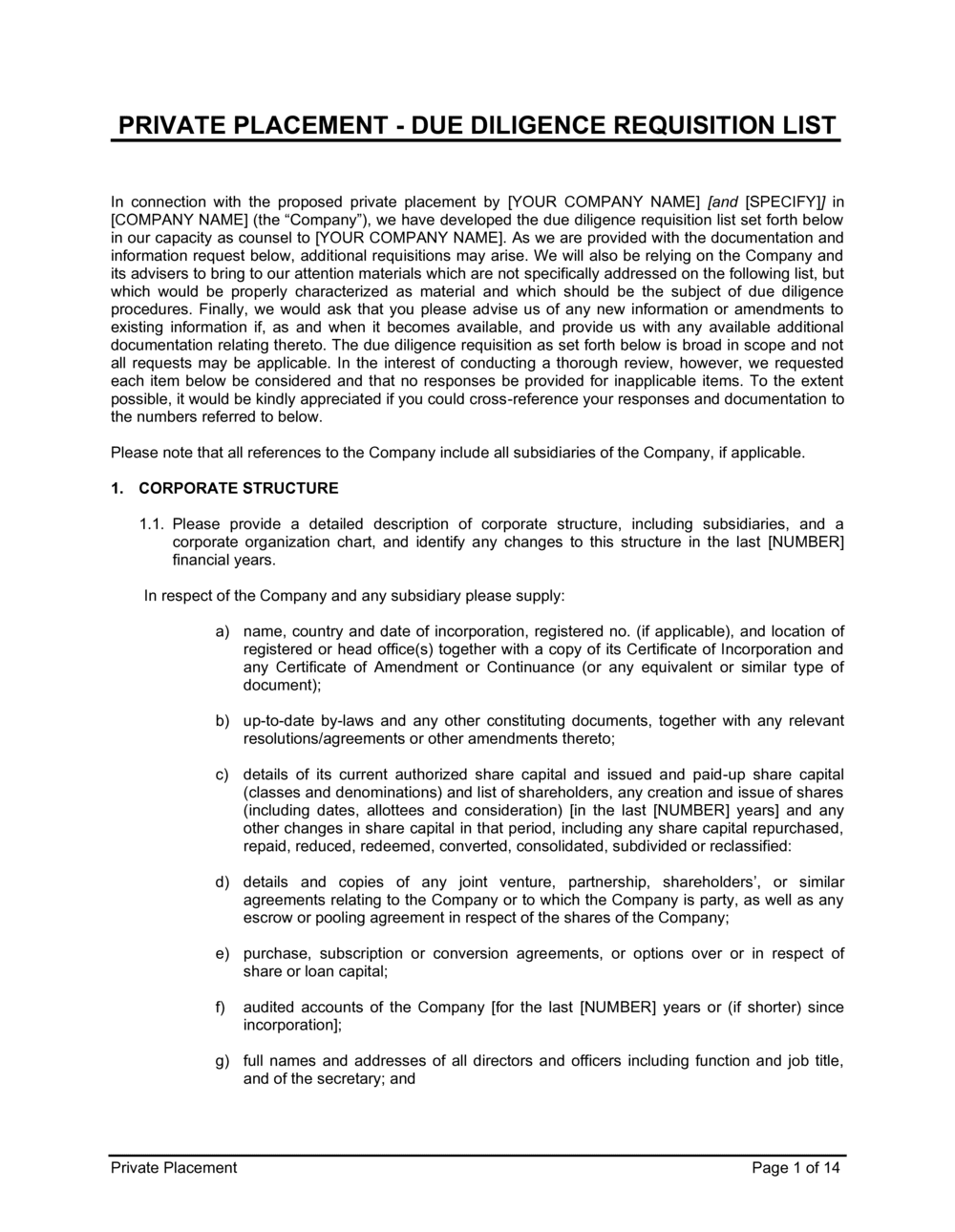
The list covers corporate formation and governance records, capitalization tables and equity documents, audited and unaudited financial statements, material contracts, intellectual property registrations, litigation and regulatory history, employee and compensation records, and environmental and compliance matters — organized into numbered sections for systematic document production and tracking.

What is a Private Placement Due Diligence Requisition List?

A Private Placement Due Diligence Requisition List is a formal, numbered document request issued by an investor — or their legal counsel — to a company conducting a private securities offering. It identifies every category of corporate, financial, legal, intellectual property, and operational record the investor requires to independently verify the company's condition before committing capital. Unlike the company-authored private placement memorandum, the requisition list is entirely investor-driven: it defines the scope of independent verification rather than relying on the company's own disclosures. The executed list, combined with the governing NDA, creates the contractual framework that governs document production, officer certification, and the completeness representations that flow into the final transaction documents at closing.

Why You Need This Document

Proceeding with a private placement investment without a structured requisition list leaves the investor exposed on every front that matters: unassigned intellectual property discovered after closing, undisclosed litigation that surfaces during integration, cap table defects that dilute the new investor's position, and prior offering compliance failures that create rescission liability for the entire shareholder base. Each of these outcomes is common, expensive, and preventable. A properly issued requisition list — tailored to the company's stage and industry, issued with a firm production deadline, and tracked against a numbered log — converts an informal information exchange into a documented, accountable process with an officer certification behind it. This template gives investors, founders preparing data rooms, and deal counsel a professionally structured starting point that covers every standard diligence category and can be tailored to any transaction in under two hours.

Which variant fits your situation?

If your situation is…Use this template
Seed or pre-seed investment with minimal corporate historyStartup Due Diligence Checklist
Mergers and acquisitions transaction with full asset or share purchaseM&A Due Diligence Checklist
Real estate private placement or syndicationReal Estate Due Diligence Checklist
Debt financing or convertible note roundConvertible Note Agreement
Investor seeking a summary-level overview rather than full document productionPrivate Placement Memorandum
Structuring the legal terms governing the offering itselfSubscription Agreement
Pre-diligence confidentiality protection before documents are sharedNon-Disclosure Agreement (NDA)

Common mistakes to avoid

❌ Issuing the requisition list before an NDA is in place

Why it matters: Without an executed NDA, the company has no contractual obligation to keep the diligence process confidential, and the investor has no legal basis to restrict how the company uses information about the investor's interest or valuation expectations.

Fix: Execute a mutual NDA before issuing the requisition list. Reference the NDA in the list's recitals so document production is clearly governed by its confidentiality obligations.

❌ Using a generic checklist without tailoring it to the company's stage

Why it matters: A 150-item institutional checklist sent to a seed-stage company with 8 employees produces incomplete, disorganized responses and signals to management that the investor doesn't understand the business.

Fix: Remove inapplicable sections and add industry-specific categories before sending. A focused 50-item list produces faster, more complete responses than an exhaustive template.

❌ Failing to request IP assignment agreements from all contributors

Why it matters: Unassigned IP from a co-founder, early contractor, or academic institution is one of the most common material defects found in early-stage due diligence and frequently requires expensive remediation or delays closing.

Fix: Explicitly request executed IP assignment agreements from every individual who contributed to the product, including pre-incorporation work — and confirm assignments cover all jurisdictions where the company operates.

❌ Accepting a summary cap table without underlying grant documents

Why it matters: Cap table summaries routinely omit anti-dilution provisions, most-favored-nation rights, side letters, and acceleration terms — all of which directly affect the economic position of the incoming investor.

Fix: Request all underlying equity issuance documents — stock purchase agreements, option grant notices, SAFE agreements, and convertible notes — and reconcile them against the cap table line by line.

❌ Setting no deadline for document production

Why it matters: Without a production deadline, companies treat the requisition list as lower priority than revenue-generating work, and diligence drags for months — burning goodwill and increasing deal risk.

Fix: State a specific production deadline in the requisition letter — 10 to 15 business days is standard — and confirm it with the company's counsel before sending.

❌ Not requesting prior offering documents and Form D filings

Why it matters: If a prior fundraising round was conducted without proper securities law exemption compliance, the company may face rescission liability that becomes the new investor's problem post-close.

Fix: Request all prior offering documents, subscription agreements, accredited investor certifications, and exemption filings — and have securities counsel review them for compliance gaps before closing.

The 10 key clauses, explained

Corporate organization and governance records

In plain language: Requests the company's foundational legal documents — certificate of incorporation, bylaws, board and shareholder meeting minutes, and all amendments — to confirm the entity is validly formed and governed.

Sample language
Please provide: (a) Certificate of Incorporation and all amendments; (b) Bylaws and all amendments; (c) Minutes of all Board and shareholder meetings for the past [3] years; (d) Organizational chart showing all subsidiaries and affiliates.

Common mistake: Requesting only the current certificate of incorporation without all amendments. A company that changed its authorized share structure without proper amendment creates undisclosed capitalization defects.

Capitalization and equity documents

In plain language: Requests the fully diluted cap table, all equity issuance documents, outstanding options, warrants, convertible notes, and SAFEs to verify ownership structure and identify pre-existing dilution.

Sample language
Please provide: (a) Fully diluted cap table as of [DATE]; (b) All stock purchase agreements, option grants, and warrant certificates; (c) All convertible instruments (SAFEs, convertible notes) with principal, interest, and conversion terms; (d) Option plan documents and all grant schedules.

Common mistake: Accepting a cap table summary without the underlying grant documents. Summary tables frequently omit acceleration provisions, side letters, or anti-dilution rights that materially affect an incoming investor's position.

Financial statements and projections

In plain language: Requests audited or reviewed financial statements for the past three years, the most recent management accounts, and forward-looking financial projections with supporting assumptions.

Sample language
Please provide: (a) Audited financial statements for fiscal years [YEAR-2] through [YEAR]; (b) Unaudited management accounts for the most recent [3] months; (c) 3-year financial projections with key assumptions; (d) Most recent budget and any board-approved operating plan.

Common mistake: Accepting projections without the supporting assumption model. A revenue forecast disconnected from unit economics, headcount, and capital deployment cannot be independently validated.

Material contracts

In plain language: Requests all significant commercial agreements — customer contracts, supplier agreements, distribution agreements, licensing deals, and debt instruments — that could affect the company's revenue, obligations, or restrictions post-investment.

Sample language
Please provide copies of: (a) All customer contracts representing more than [5]% of annual revenue; (b) All supplier or vendor agreements with annual value exceeding $[THRESHOLD]; (c) All loan agreements, lines of credit, and debt instruments; (d) All partnership, distribution, and reseller agreements.

Common mistake: Setting a contract threshold that is too high, excluding mid-tier contracts that contain change-of-control provisions or exclusivity clauses that could block the investment or trigger defaults.

Intellectual property records

In plain language: Requests all patent applications and grants, trademark and copyright registrations, trade secret policies, IP assignment agreements from founders and employees, and any IP licenses granted to or by the company.

Sample language
Please provide: (a) Schedule of all patents, trademarks, and copyrights, including application numbers and registration dates; (b) Executed IP assignment agreements from all founders, employees, and contractors; (c) All in-bound and out-bound IP license agreements; (d) Description of trade secret protection policies and procedures.

Common mistake: Omitting IP assignment agreements from early contractors and co-founders. Unassigned IP from a pre-incorporation contractor is one of the most common — and most expensive — diligence defects in early-stage deals.

Litigation, disputes, and regulatory matters

In plain language: Requests disclosure of all pending, threatened, or settled litigation, regulatory investigations, government inquiries, and any consent orders or injunctions affecting the company or its principals.

Sample language
Please provide: (a) A schedule of all pending or threatened claims, litigation, arbitration, or government investigations; (b) Copies of all demand letters received in the past [3] years; (c) Any consent decrees, settlement agreements, or regulatory orders; (d) Any correspondence with securities regulators relating to the company's prior offerings.

Common mistake: Limiting the request to currently pending litigation and omitting settled matters and demand letters. Prior settlements often reveal patterns of customer or employee disputes that signal operational or product risk.

Employee and compensation matters

In plain language: Requests the employee roster, compensation schedules, employment agreements for key personnel, equity grant details, benefit plans, and any severance or change-of-control obligations that would increase costs post-investment.

Sample language
Please provide: (a) Employee roster with titles, start dates, and compensation as of [DATE]; (b) Executed employment agreements and offer letters for all officers and key employees; (c) Description of all bonus, commission, and equity incentive plans; (d) Any severance agreements or change-of-control payment obligations.

Common mistake: Failing to request change-of-control payment schedules. A financing round or acquisition trigger hidden severance obligations or option acceleration that materially affects post-close cash flow.

Regulatory and compliance records

In plain language: Requests all material permits, licenses, and government authorizations required to operate, along with evidence of compliance with applicable industry regulations, data privacy laws, and environmental requirements.

Sample language
Please provide: (a) Copies of all material operating licenses and permits; (b) Any notices of violation or non-compliance from regulatory authorities in the past [3] years; (c) A description of the company's data privacy and cybersecurity policies and any breach history; (d) Environmental permits and any known environmental liabilities.

Common mistake: Treating regulatory compliance as boilerplate when the target operates in a licensed industry. Missing a required license — in fintech, healthcare, cannabis, or financial services — can invalidate the company's revenue model.

Prior financing and securities issuance history

In plain language: Requests documentation of all prior capital raises, including offering documents, subscription agreements, investor side letters, and evidence of exemption compliance with applicable securities laws.

Sample language
Please provide: (a) All prior private placement memoranda, offering circulars, or offering summaries; (b) Executed subscription agreements from all prior investors; (c) Form D filings (US) or equivalent exemption filings; (d) All investor side letters, most-favored-nation agreements, or information rights agreements.

Common mistake: Accepting Form D filings as sufficient evidence of exemption compliance without reviewing the underlying subscription agreements. Improper accredited investor verification in a prior round can expose the company — and the new investor — to rescission liability.

Insurance coverage

In plain language: Requests certificates of insurance for all material policies — D&O, E&O, general liability, cyber, and key-person life insurance — to confirm the company is adequately covered against foreseeable risks.

Sample language
Please provide: (a) Certificates of insurance for all current policies; (b) Directors and Officers (D&O) liability policy with limits and coverage summary; (c) Errors and Omissions (E&O) or professional liability policy; (d) Cyber liability and data breach coverage; (e) Key-person life insurance policies, if any.

Common mistake: Overlooking cyber liability coverage for SaaS or data-driven businesses. A company storing material customer data with no cyber insurance represents an unquantified contingent liability that can exceed the investment amount.

How to fill it out

  1. 1

    Identify the parties and transaction context

    Enter the investor entity's legal name, the target company's legal name, and the date of the requisition. Include a brief description of the offering type (e.g., Regulation D, Series A equity round, convertible note) so the company understands the scope of the request.

    💡 Reference the specific NDA and term sheet by date in the recitals — this confirms the request is made under confidentiality protection and within the agreed diligence period.

  2. 2

    Customize document categories to the transaction

    Remove or mark as not applicable any sections irrelevant to the company's stage or industry — a two-year-old SaaS startup does not have environmental permits. Add industry-specific sections (e.g., FDA clearances for medical devices, money transmission licenses for fintech).

    💡 A requisition list tailored to the company's actual profile gets faster, more complete responses than a generic 100-item checklist that includes dozens of inapplicable items.

  3. 3

    Set a response deadline and document format

    Specify a production deadline — typically 10–15 business days from issue — and the preferred format: organized PDF uploads to a named virtual data room, or physical production. Number each item to facilitate tracking and follow-up.

    💡 Use a shared data room index that mirrors the requisition list numbering so you can track production status in real time without email chains.

  4. 4

    Define the certification requirement

    Include a certification block requiring an authorized officer of the company to confirm the documents produced are complete, accurate, and represent all responsive records. This creates a contractual basis for representations and warranties.

    💡 Request that the certification be executed by the CEO or CFO — not outside counsel — so the company itself bears responsibility for completeness.

  5. 5

    Circulate to co-investors and counsel for alignment

    If the round involves multiple investors or syndicate members, align on a single consolidated requisition list before sending. Competing lists from multiple investors overwhelm the company's management team and slow the diligence process.

    💡 Designate a lead investor or lead counsel to own the master requisition list and consolidate supplemental requests from other investors into a single addendum.

  6. 6

    Track responses against the numbered list

    Maintain a running log showing each numbered item, whether documents have been received, whether the response is complete, and any follow-up items outstanding. Share the status log with the company to drive timely production.

    💡 Color-code the tracker — green for complete, yellow for partially produced, red for outstanding — and share a weekly update so both sides stay aligned without daily calls.

  7. 7

    Issue follow-up requests for deficient responses

    Where responses are incomplete or documents reference additional agreements not yet produced, issue a numbered follow-up request citing the original item number. Keep all supplemental requests in writing.

    💡 Document every oral representation made during management calls about diligence items — send a written confirmation email immediately after each call summarizing what was represented and what is still outstanding.

  8. 8

    Execute the document before the diligence period opens

    Both parties — or their authorized representatives — should sign the requisition list before the company begins producing documents. The executed list, combined with the NDA, establishes the contractual framework governing document production and confidentiality.

    💡 If the investor is a fund, confirm the signatory has authority under the fund's governing documents — a signature from an analyst rather than a general partner can create closing ambiguity.

Frequently asked questions

What is a private placement due diligence requisition list?

A private placement due diligence requisition list is a formal, numbered document request submitted by an investor — or their legal counsel — to a company conducting a private securities offering. It catalogs every category of corporate, financial, legal, and operational record the investor needs to review before committing capital. It is the primary tool for organizing and tracking the diligence process in a private placement transaction.

When should a due diligence requisition list be issued?

It is typically issued after a mutual NDA is executed and a term sheet is under negotiation — when both parties have signaled serious intent to proceed but before binding transaction documents are signed. Issuing it too early wastes management bandwidth; issuing it too late compresses the diligence window and increases closing risk. A production deadline of 10–15 business days from issue is standard practice.

Who prepares the due diligence requisition list?

The investor or their outside legal counsel typically prepares and issues the list. In institutional transactions, the lead investor's counsel owns the master list and coordinates supplemental requests from other investors to avoid overwhelming the company with competing checklists. For angel investments or smaller rounds, the investor may complete the list directly using a standard template adapted to the company's stage.

What documents are typically requested in a private placement due diligence?

Core categories include corporate formation and governance records, the fully diluted cap table with all underlying equity documents, audited and management financial statements, all material commercial contracts, IP registrations and assignment agreements, litigation and regulatory history, employment and compensation records, prior offering documents and securities law exemption filings, and insurance certificates. The specific items vary by company stage, industry, and transaction size.

Is a due diligence requisition list legally binding?

The executed requisition list, combined with the governing NDA and term sheet, generally creates a contractual framework governing document production, confidentiality, and the scope of representations. The company's officer certification — confirming completeness and accuracy of production — becomes the basis for representations and warranties in the final transaction documents. In most jurisdictions, material omissions from a certified due diligence production can support claims of misrepresentation or breach of warranty.

How does a requisition list differ from a private placement memorandum?

A private placement memorandum (PPM) is a disclosure document the company prepares and delivers to investors describing the offering terms, risk factors, and business overview. A due diligence requisition list is an investor-initiated document request asking the company to produce underlying records for independent verification. The PPM is what the company says about itself; the requisition list drives collection of the documents that allow the investor to verify those statements independently.

What is a virtual data room and how does it relate to this document?

A virtual data room (VDR) is a secure online platform — such as Intralinks, Datasite, or Box — where the company uploads due diligence documents for investor review. The requisition list defines what goes into the data room; the VDR is how it is securely organized and shared. Organizing the data room using the same numbered structure as the requisition list makes tracking production status straightforward for both parties.

Does due diligence vary by jurisdiction?

Yes. Securities law exemption requirements, data privacy obligations, employment record disclosures, and environmental compliance items all vary significantly by jurisdiction. A US Regulation D offering requires Form D filings and accredited investor verification; a UK offering under the Financial Services and Markets Act requires different exemption documentation; EU offerings must address GDPR data processing records. Investors operating across borders should adapt the requisition list with jurisdiction-specific sections and have local counsel review regulatory compliance items.

How long does the due diligence process typically take?

For a seed or Series A round with a well-prepared company and a focused requisition list, diligence typically runs 3–6 weeks. For larger private equity transactions or complex regulated-industry deals, 6–12 weeks is common. The most significant variable is how quickly the company can produce organized documents — companies that maintain a standing data room with current records routinely close 2–4 weeks faster than those assembling documents from scratch.

How this compares to alternatives

vs Private Placement Memorandum

A private placement memorandum (PPM) is a disclosure document the company prepares to describe the offering, its terms, and its risk factors — it is what the company says about itself. A due diligence requisition list is the investor's tool for independently verifying those statements by reviewing underlying records. Both are used in the same transaction but serve opposite roles: the PPM discloses; the requisition list verifies.

vs Subscription Agreement

A subscription agreement is the binding contract through which an investor formally commits to purchase securities at agreed terms. It is executed at closing, after due diligence is complete and satisfactory. The requisition list is a pre-closing diligence tool — the two documents are sequential, not interchangeable, with the requisition list process being a closing condition that must be satisfied before the subscription agreement is signed.

vs Non-Disclosure Agreement

An NDA governs confidentiality of all information exchanged during a transaction and must be executed before the requisition list is issued. The NDA does not specify what documents are requested or required — it protects the information once produced. The requisition list is a substantive document request that operates within the confidentiality framework the NDA establishes.

vs Letter of Intent

A letter of intent (or term sheet) records the preliminary agreed terms of the investment and typically triggers the formal due diligence process. It is not a comprehensive document request — it describes the deal structure, not the records needed to validate it. The requisition list is issued after the LOI is signed and drives the investigative work that confirms the representations embedded in the term sheet.

Industry-specific considerations

Technology / SaaS

Source code ownership verification, SaaS customer contract assignment rights, data privacy compliance, and open-source license audits are critical categories alongside standard corporate and financial diligence.

Healthcare / Life Sciences

FDA clearances and clinical trial records, HIPAA compliance documentation, reimbursement code registrations, and healthcare fraud and abuse compliance policies require dedicated requisition sections.

Financial Services / Fintech

Money transmission licenses, broker-dealer registrations, AML and KYC program documentation, banking partnership agreements, and regulatory examination history require specialized diligence categories.

Real Estate

Title records, zoning and land use approvals, environmental phase reports, tenant lease abstracts, and property-level financial statements dominate the requisition list for real estate private placements.

Manufacturing

Environmental permits and contamination history, supply chain contract assignments, product liability claims history, and quality certification records are material categories beyond standard corporate diligence.

Professional Services

Client concentration analysis, professional liability claims history, non-solicitation agreement enforceability, and key-person dependency documentation are distinctive diligence priorities for services businesses.

Jurisdictional notes

United States

US private placements typically rely on Regulation D exemptions (Rules 504, 506(b), or 506(c)) under the Securities Act of 1933. Diligence should confirm Form D filings with the SEC and applicable state blue sky filings. Rule 506(c) offerings require documented accredited investor verification for each prior and current investor. State securities regulators may impose additional requirements — California, New York, and Texas apply active oversight of exempt offerings.

Canada

Canadian private placements are governed provincially — each province and territory has its own Securities Act and requires separate exemption analysis. The accredited investor and offering memorandum exemptions under National Instrument 45-106 are most commonly used. Quebec requires French-language disclosure for Quebec-resident investors. Diligence should confirm that all prior offering documents comply with the applicable provincial exemptions and that any required offering memoranda were properly delivered.

United Kingdom

UK private placements fall under the Financial Services and Markets Act 2000 and the Financial Promotion Order. Common exemptions include the high net worth individual and sophisticated investor exemptions. Post-Brexit, EU prospectus exemptions no longer apply in the UK. Diligence should confirm FCA authorization status of any placement agent, proper financial promotion compliance, and whether the company holds or requires FCA authorization for any regulated activities — particularly relevant for fintech and financial services targets.

European Union

EU private placements must navigate the Prospectus Regulation (EU) 2017/1129 exemptions — commonly the qualified investor exemption or the offer to fewer than 150 persons per member state. GDPR compliance is a mandatory diligence category for any EU-based target or any company processing EU resident data, requiring review of data processing agreements, privacy policies, and breach history. Member state securities regulators retain jurisdiction over local exemption filings, and requirements vary materially between Germany, France, the Netherlands, and other member states.

Template vs lawyer — what fits your deal?

PathBest forCostTime
Use the templateAngel investors, early-stage rounds under $500K, or founders building a data room proactively before an investor meetingFree1–2 hours to tailor and issue
Template + legal reviewSeries A or B rounds, deals involving regulated industries, or investors without dedicated legal counsel on the transaction$500–$1,500 for counsel review and customization2–3 days
Custom draftedPrivate equity buyouts, cross-border placements, complex capital structures, or transactions exceeding $5M where material legal risk is present$3,000–$10,000+ for full legal diligence management1–2 weeks

Glossary

Private Placement
A securities offering sold directly to a select group of accredited investors without a public registration filing with a securities regulator.
Due Diligence
The systematic investigation of a company's legal, financial, and operational condition that an investor conducts before committing capital.
Requisition List
A formal, numbered list of documents and information categories that one party formally requests the other party to produce in a transaction.
Data Room
A secure virtual or physical repository where the company organizes and shares due diligence documents with prospective investors under an NDA.
Regulation D
A US SEC safe harbor exemption from public registration that allows companies to raise capital from accredited investors through private placements.
Cap Table
A spreadsheet recording all equity holders, their ownership percentages, option pools, warrants, and the dilution impact of new investment rounds.
Material Contracts
Agreements that are significant enough to the company's business that a reasonable investor would want to review them before investing — typically revenue contracts, supplier agreements, and debt instruments.
Representations and Warranties
Factual statements made by the company about its legal, financial, and operational condition that the investor relies on as a condition of closing.
Accredited Investor
A person or entity meeting minimum income, net worth, or professional credentials set by securities regulators — the class of investor eligible to participate in most private placements.
Closing Conditions
Specific requirements — including satisfactory completion of due diligence — that must be met before a private placement transaction can legally close.
SAFE Agreement
A Simple Agreement for Future Equity — a convertible instrument used in early-stage financings that converts to equity at a future priced round.
Subscription Agreement
The binding contract through which an investor formally agrees to purchase securities in a private placement at agreed terms.

Part of your Business Operating System

This document is one of 3,000+ business & legal templates included in Business in a Box.

  • Fill-in-the-blanks — ready in minutes
  • 100% customizable Word document
  • Compatible with all office suites
  • Export to PDF and share electronically

Create your document in 3 simple steps.

From template to signed document — all inside one Business Operating System.
1
Download or open template

Access over 3,000+ business and legal templates for any business task, project or initiative.

2
Edit and fill in the blanks with AI

Customize your ready-made business document template and save it in the cloud.

3
Save, Share, Send, Sign

Share your files and folders with your team. Create a space of seamless collaboration.

Save time, save money, and create top-quality documents.

★★★★★

"Fantastic value! I'm not sure how I'd do without it. It's worth its weight in gold and paid back for itself many times."

Managing Director · Mall Farm
Robert Whalley
Managing Director, Mall Farm Proprietary Limited
★★★★★

"I have been using Business in a Box for years. It has been the most useful source of templates I have encountered. I recommend it to anyone."

Business Owner · 4+ years
Dr Michael John Freestone
Business Owner
★★★★★

"It has been a life saver so many times I have lost count. Business in a Box has saved me so much time and as you know, time is money."

Owner · Upstate Web
David G. Moore Jr.
Owner, Upstate Web

Run your business with a system — not scattered tools

Stop downloading documents. Start operating with clarity. Business in a Box gives you the Business Operating System used by over 250,000 companies worldwide to structure, run, and grow their business.

Free Forever Plan · No credit card required