How To Conduct A Merger Or Acquisition

Free to read β€’ Save or share with one click

FreeHow To Conduct A Merger Or Acquisition Template

At a glance

What it is
A How To Conduct A Merger Or Acquisition guide is a structured operational document that walks a leadership team through every phase of an M&A transaction β€” from target identification and valuation through due diligence, deal structuring, regulatory clearance, and post-close integration. This free Word download gives acquirers and sellers a reusable process framework they can edit online and share with advisors, board members, and integration teams as a PDF.
When you need it
Use it when your company is actively evaluating an acquisition target, preparing to sell, or managing a merger between two entities of comparable size. It is equally useful for first-time acquirers who need a process map and serial acquirers who want a repeatable operational standard.
What's inside
Strategic rationale, target screening criteria, valuation methodology, letter of intent guidance, due diligence checklist, deal structure options, regulatory and compliance considerations, negotiation framework, closing procedure, and a post-merger integration roadmap.

What is a How To Conduct A Merger Or Acquisition guide?

A How To Conduct A Merger Or Acquisition guide is a structured operational document that maps every phase of an M&A transaction β€” from defining acquisition criteria and identifying targets through valuation, due diligence, deal structuring, regulatory clearance, closing, and post-merger integration. It functions as both a process playbook for deal teams and a governance framework for boards approving transaction milestones. Unlike a legal agreement or a single-phase checklist, this document covers the full transaction lifecycle, giving acquirers and sellers a repeatable methodology they can apply to every deal regardless of size.

Why You Need This Document

M&A transactions fail at a rate of 50–70% by most measures, and the most common cause is not bad strategy β€” it is undisciplined process execution. Teams that skip formal target screening overpay for the wrong companies. Teams that treat due diligence as a checklist rather than a valuation hypothesis miss the liabilities that surface in year two post-close. Companies that begin integration planning after close consistently miss their synergy timelines by six to twelve months and lose the talent the acquisition was designed to retain. A structured process guide eliminates these failure modes by establishing decision gates, assigning accountability, and connecting each phase to the next before the deal team is too emotionally committed to change course. This template gives you the framework in a format you can tailor to your transaction, share with advisors, and reuse as your acquisition capability matures.

Which variant fits your situation?

If your situation is…Use this template
Acquiring a smaller company to add capabilities or market shareHow To Conduct A Merger Or Acquisition
Selling the business to a strategic or financial buyerBusiness Sale Agreement
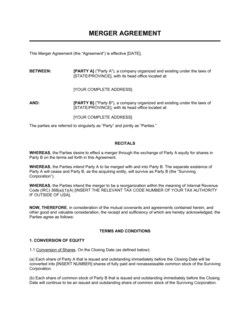
Merging two companies of comparable sizeMerger Agreement
Screening and tracking multiple acquisition targetsM&A Target Screening Scorecard
Conducting structured financial and legal due diligenceDue Diligence Checklist
Integrating two teams, systems, and cultures post-closePost-Merger Integration Plan
Securing exclusivity before entering full due diligenceLetter of Intent (M&A)

Common mistakes to avoid

❌ Starting due diligence without a defined walk-away price

Why it matters: Deal teams that enter due diligence without a pre-set ceiling consistently justify upward price revisions as new information surfaces, ultimately overpaying. The sunk cost of diligence fees makes it psychologically harder to walk away.

Fix: Document the walk-away enterprise value before signing the LOI and require board sign-off to exceed it. Treat it as a governance checkpoint, not a negotiating position.

❌ Choosing deal structure based on speed rather than liability exposure

Why it matters: A share purchase closes faster but transfers all hidden liabilities β€” undisclosed tax obligations, pending litigation, and environmental issues β€” to the buyer with no automatic remedy.

Fix: Evaluate asset vs. share purchase based on the due diligence findings, not the closing timeline. Budget for R&W insurance on material transactions to cap exposure without extending negotiations.

❌ Delaying integration planning until after close

Why it matters: Companies that start integration planning post-close typically miss their first-year synergy targets by 40–60% and experience disproportionate talent attrition in the first 90 days.

Fix: Assign an integration manager and begin drafting the Day 1 plan in parallel with due diligence. The integration plan should be board-approved before the purchase agreement is signed.

❌ Failing to communicate with employees and customers on closing day

Why it matters: A communication vacuum on Day 1 generates uncertainty that drives key talent and long-tenured customers to explore alternatives before integration has a chance to demonstrate value.

Fix: Prepare employee, customer, and supplier communications in advance and execute them within hours of close. The message should be specific, not generic β€” name the integration lead, the timeline, and the expected impact on day-to-day operations.

❌ Using a single valuation method to set the purchase price

Why it matters: Relying solely on an EBITDA multiple without cross-checking against a DCF or comparable transactions can result in overpayment in seller's markets or a missed deal in buyer's markets.

Fix: Require at least two independent valuation methods in the preliminary valuation section and document the rationale for the weight assigned to each when arriving at the final bid range.

❌ Underestimating regulatory review timelines

Why it matters: An HSR second request, CFIUS review, or sector-specific regulatory approval can add 3–9 months to close, during which the target business may deteriorate and key personnel may depart.

Fix: Map all regulatory requirements in the acquisition criteria phase β€” not after LOI β€” and build a realistic regulatory timeline into the LOI, purchase agreement, and board approval schedule.

The 10 key sections, explained

Strategic rationale and acquisition criteria

Target identification and long-list screening

Preliminary valuation and price range

Approach, NDA, and letter of intent

Due diligence process

Deal structure and financing

Negotiation and purchase agreement

Regulatory and compliance clearance

Closing procedure

Post-merger integration roadmap

How to fill it out

  1. 1

    Define your acquisition strategy and target criteria

    Start by articulating the specific strategic gap the acquisition is meant to fill β€” capability, geography, customer segment, or technology. Translate that into measurable screening criteria: revenue range, EBITDA minimum, industry code, and geographic footprint.

    πŸ’‘ Limit your criteria to five to seven factors and weight them. More than seven turns screening into a paralysis exercise rather than a decision tool.

  2. 2

    Build and score the target long list

    Source candidates from investment banks, brokers, industry databases, and your own network. Score each against your weighted criteria and reduce to a short list of three to six targets worth approaching.

    πŸ’‘ Track even rejected targets β€” a company that doesn't fit today may be the right acquisition in 18 months after a strategic pivot or ownership change.

  3. 3

    Run preliminary valuation on short-listed targets

    Use publicly available financials or industry benchmarks to build an indicative EBITDA multiple range and a rough DCF. Establish a walk-away price before any conversation begins.

    πŸ’‘ Set your walk-away price in writing before you meet management. Anchoring effects are real β€” face-to-face enthusiasm reliably pushes acquirers 15–20% above their pre-meeting ceiling.

  4. 4

    Execute the NDA and conduct a management meeting

    Once a target agrees to explore a transaction, execute a mutual NDA and arrange a management meeting to validate your thesis, assess cultural fit, and request preliminary financials.

    πŸ’‘ Bring your integration lead to the first management meeting β€” cultural and operational red flags are easier to spot before you are emotionally committed to the deal.

  5. 5

    Submit the letter of intent with defined terms

    Draft an LOI specifying the indicative purchase price range, deal structure, exclusivity period, key conditions, and a timeline. Keep the LOI short β€” it is a framework, not a contract.

    πŸ’‘ Include a specific exclusivity expiry date rather than an open-ended period. A 45-day hard stop creates urgency and prevents the seller from using your LOI to shop a better offer.

  6. 6

    Conduct structured due diligence by workstream

    Assign workstream leads for financial, legal, commercial, HR, and IT diligence. Use a shared data room and a centralized findings log. Hold a weekly diligence call to surface red flags and assess whether each finding changes the valuation.

    πŸ’‘ Create a 'deal-breaker list' at the start of diligence β€” three to five findings that would cause you to walk away β€” and review it explicitly at the halfway point.

  7. 7

    Negotiate the purchase agreement and closing conditions

    Work with outside counsel to negotiate the definitive purchase agreement, focusing on indemnification caps, survival periods, working capital adjustments, and closing conditions. Ensure all regulatory filings are submitted in parallel.

    πŸ’‘ Consider representations and warranties (R&W) insurance on deals above $10M β€” it allows cleaner negotiations and protects against seller insolvency post-close.

  8. 8

    Execute closing and launch the integration plan

    Confirm all closing conditions are satisfied, execute the wire and transfer documents, and immediately activate the Day 1 integration plan. Communicate with employees, customers, and suppliers on the day of close.

    πŸ’‘ Assign a single integration owner who reports directly to the CEO for the first 90 days β€” split accountability is the single most common cause of integration delay.

Frequently asked questions

What is the typical process for conducting a merger or acquisition?

A standard M&A process runs through six phases: strategy and target identification, preliminary valuation and approach, letter of intent and exclusivity, due diligence, purchase agreement negotiation and regulatory clearance, and closing followed by post-merger integration. Each phase has defined deliverables and decision gates. First-time acquirers often underestimate the time from LOI to close β€” six to twelve months is typical for transactions above $10M.

What is due diligence in an M&A transaction?

Due diligence is the structured investigation of a target company across five workstreams β€” financial, legal, commercial, operational, and HR/IT β€” conducted after an LOI is signed and before the purchase agreement is executed. Its purpose is to verify the seller's representations, identify undisclosed liabilities, validate the valuation thesis, and surface integration risks. Due diligence findings should feed directly into price adjustments, indemnification terms, and the post-close integration plan.

What is the difference between an asset purchase and a share purchase?

In an asset purchase, the buyer selects specific assets and liabilities to acquire, leaving unwanted items β€” and most pre-closing liabilities β€” with the seller's legal entity. In a share purchase, the buyer acquires the entire legal entity, inheriting all assets, contracts, and liabilities, including any that were not disclosed. Asset purchases offer cleaner liability protection; share purchases transfer customer contracts and licenses more easily and tend to close faster. Tax treatment differs significantly between the two structures.

What should a letter of intent include in an M&A deal?

An M&A letter of intent should specify the indicative purchase price range, proposed deal structure (asset vs. share), consideration mix (cash, stock, earnout), exclusivity period with a hard expiry date, list of closing conditions, and an estimated timeline to definitive agreement. It should state clearly which provisions are binding β€” typically exclusivity, confidentiality, and governing law β€” and which are non-binding. Keep the LOI to two to four pages; longer LOIs create negotiating anchors that slow down the definitive agreement.

How is a company valued in an acquisition?

Acquirers typically use three methods in combination: an EBITDA multiple benchmarked against comparable transactions in the same industry, a discounted cash flow (DCF) analysis projecting free cash flows at a risk-adjusted discount rate, and a comparable company analysis using public-market trading multiples. The final bid range reflects a weighted combination of all three. EBITDA multiples vary widely by industry β€” from 3–5Γ— for distribution businesses to 10–15Γ— for SaaS companies with high recurring revenue.

What is an earnout and when should I use one?

An earnout defers a portion of the purchase price β€” typically 10–30% β€” contingent on the target meeting agreed revenue or EBITDA milestones in the one to three years after closing. Use an earnout when there is a significant gap between buyer and seller price expectations, when the business is highly dependent on the seller's ongoing involvement, or when future performance is genuinely uncertain. Earnouts frequently generate post-close disputes; define the metric, measurement methodology, and dispute resolution process in the purchase agreement with precision.

How long does a typical M&A process take?

From initial target approach to close, most transactions between $5M and $100M take six to twelve months. The phases roughly break down as follows: target identification and preliminary valuation (4–8 weeks), LOI negotiation (2–4 weeks), due diligence (6–10 weeks), purchase agreement negotiation (4–8 weeks), and regulatory clearance and closing (4–12 weeks depending on jurisdiction and deal complexity). Serial acquirers with a standardized process and standing outside counsel typically close 20–30% faster than first-time buyers.

What is post-merger integration and why does it matter?

Post-merger integration is the process of combining two companies' people, systems, processes, and cultures after close to realize the synergies that justified the acquisition price. Studies consistently show that 50–70% of acquisitions fail to meet their financial objectives, and the primary cause is poor integration execution β€” delayed decisions, unclear ownership, and cultural conflict. Integration planning should begin during due diligence, not after close, and the 90-day plan should be board-approved before the purchase agreement is signed.

Do I need an investment banker or M&A advisor for this process?

For transactions below $5M, a business broker or experienced M&A attorney is often sufficient. For transactions between $5M and $50M, an M&A advisor adds value in target sourcing, process management, and competitive tension in the sale process β€” typically charging a success fee of 3–7% of deal value. For transactions above $50M, a full investment bank mandate is standard. This guide template is designed to help management teams run a disciplined internal process regardless of whether an external advisor is engaged.

How this compares to alternatives

vs Due Diligence Checklist

A due diligence checklist is a single-phase document focused exclusively on the information-gathering workstream of an M&A transaction. This M&A process guide covers all phases from strategy through integration. Use the checklist as a workstream tool nested inside this broader process document.

vs Letter of Intent

A letter of intent is the document that formalizes agreement on headline terms and initiates the exclusivity period. This process guide covers when, how, and with what terms to use an LOI as one milestone in a multi-phase transaction process. The LOI template is a companion document, not a substitute for a process framework.

vs Business Sale Agreement

A business sale agreement is the definitive legal contract executed at close that governs the actual transfer of assets or shares. This process guide is the operational playbook that leads up to and informs the sale agreement. Both documents are needed; one without the other leaves significant process or legal gaps.

vs Strategic Plan

A strategic plan defines where the business is going over a 3–5 year horizon across all growth levers. An M&A process guide focuses specifically on executing inorganic growth through acquisition. The two should be connected β€” M&A activity should be explicitly authorized and prioritized within the broader strategic plan.

Industry-specific considerations

Technology / SaaS

IP ownership verification, recurring revenue quality assessment, customer churn analysis, and technology stack consolidation are the dominant due diligence and integration workstreams.

Professional Services

Client concentration risk and key-person dependency are the primary valuation risks; non-solicitation agreements and retention packages for senior professionals are standard closing conditions.

Manufacturing

Environmental liability assessment, equipment appraisal, union contract review, and supply chain integration complexity drive both due diligence scope and post-close integration timelines.

Healthcare / MedTech

Regulatory approvals (FDA clearances, state licensure), HIPAA compliance history, payer contract transferability, and provider credentialing are critical pre-close conditions that add months to deal timelines.

Template vs pro β€” what fits your needs?

PathBest forCostTime
Use the templateFirst-time acquirers, small business buyers under $5M, and internal teams building a repeatable M&A process frameworkFree4–8 hours to customize for a specific transaction
Template + professional reviewTransactions between $2M and $20M where management is running the process with outside legal counsel$5,000–$25,000 (M&A attorney or advisor engagement for process oversight)1–2 weeks to tailor process and engage advisors
Custom draftedTransactions above $20M, cross-border deals, regulated industries, or competitive auction processes requiring full investment bank support$50,000–$500,000+ (investment bank success fee plus legal and advisory costs)6–12 months end-to-end

Glossary

Letter of Intent (LOI)
A non-binding document signed before due diligence that outlines the proposed deal terms, purchase price range, and exclusivity period.
Due Diligence
The formal investigation of a target company's financial, legal, operational, and commercial health before finalizing a transaction.
Enterprise Value (EV)
The total value of a business β€” equity plus net debt β€” used as the basis for acquisition pricing regardless of capital structure.
EBITDA Multiple
A valuation shorthand expressing acquisition price as a multiple of Earnings Before Interest, Taxes, Depreciation, and Amortization.
Asset Purchase vs. Share Purchase
Two deal structures: an asset purchase acquires specific assets and liabilities by name; a share purchase acquires the entire legal entity including all hidden liabilities.
Exclusivity Period
A defined window β€” typically 30 to 60 days β€” during which the seller agrees not to negotiate with other buyers while due diligence proceeds.
Representations and Warranties
Contractual statements by the seller confirming facts about the business β€” financials, contracts, IP ownership, litigation β€” that survive closing and can trigger indemnification.
Earnout
A deferred payment mechanism that ties part of the purchase price to the target's post-closing performance against agreed revenue or EBITDA milestones.
Synergy
The incremental value created by combining two companies β€” typically from revenue uplift, cost elimination, or capability transfer β€” that neither could achieve independently.
Integration Management Office (IMO)
A dedicated cross-functional team created post-close to coordinate systems, culture, process, and people integration across both organizations.
Purchase Price Adjustment
A post-closing true-up mechanism that adjusts the final price based on working capital, cash, or debt levels at the exact closing date.

Part of your Business Operating System

This document is one of 3,000+ business & legal templates included in Business in a Box.

  • Fill-in-the-blanks β€” ready in minutes
  • Compatible with all office suites
  • Export to PDF and share electronically

Create your document in 3 simple steps.

From template to signed document β€” all inside one Business Operating System.
1
Download or open template

Access over 3,000+ business and legal templates for any business task, project or initiative.

2
Edit and fill in the blanks with AI

Customize your ready-made business document template and save it in the cloud.

3
Save, Share, Send, Sign

Share your files and folders with your team. Create a space of seamless collaboration.

Save time, save money, and create top-quality documents.

β˜…β˜…β˜…β˜…β˜…

"Fantastic value! I'm not sure how I'd do without it. It's worth its weight in gold and paid back for itself many times."

Managing Director Β· Mall Farm
Robert Whalley
Managing Director, Mall Farm Proprietary Limited
β˜…β˜…β˜…β˜…β˜…

"I have been using Business in a Box for years. It has been the most useful source of templates I have encountered. I recommend it to anyone."

Business Owner Β· 4+ years
Dr Michael John Freestone
Business Owner
β˜…β˜…β˜…β˜…β˜…

"It has been a life saver so many times I have lost count. Business in a Box has saved me so much time and as you know, time is money."

Owner Β· Upstate Web
David G. Moore Jr.
Owner, Upstate Web

Run your business with a system β€” not scattered tools

Stop downloading documents. Start operating with clarity. Business in a Box gives you the Business Operating System used by over 250,000 companies worldwide to structure, run, and grow their business.

Start freeΒ Β·Β No credit card required