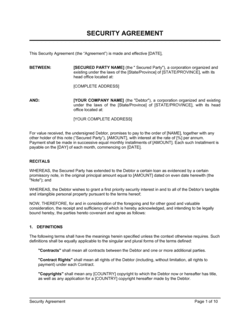
Subordination Agreement Private Companies Template

Free Word download • Edit online • Save & share with Drive • Export to PDF

3 pages25–35 min to fillDifficulty: ComplexSignature requiredLegal review recommended
Learn more ↓
FreeSubordination Agreement Private Companies Template

At a glance

What it is
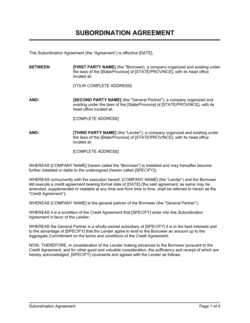
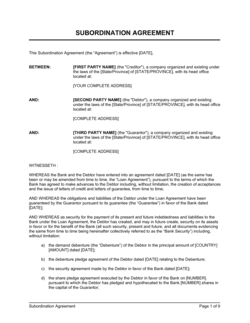
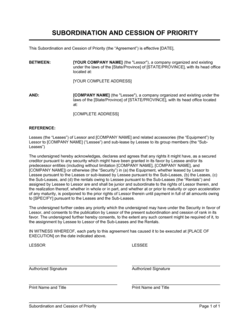
A Subordination Agreement for Private Companies is a legally binding contract in which one creditor (the subordinated or junior lender) agrees to rank its debt claim behind another creditor (the senior lender) in the event of the borrower's default, insolvency, or liquidation. This free Word download lets you establish a clear priority waterfall between competing creditors, satisfying bank and institutional lender requirements before funding is released.
When you need it
Use it when a private company takes on new senior financing — bank loans, SBA loans, or asset-backed credit facilities — and an existing creditor (such as a founder, related party, or mezzanine lender) must formally step back in repayment priority. It is also required when refinancing existing debt where a subordinated obligation carries over.
What's inside
Identification of all parties and their respective debt instruments, the subordination and standstill provisions governing repayment order, payment blockage and enforcement restrictions, representations and warranties, default cross-reference to the senior credit agreement, and governing law and signature blocks for all parties including the borrower.

What is a Subordination Agreement for Private Companies?

A Subordination Agreement for Private Companies is a legally binding contract in which a junior (subordinated) creditor formally agrees that its right to repayment from a borrower ranks behind the claims of a senior creditor in the event of default, insolvency, or liquidation. The document creates a contractually enforceable priority waterfall: the senior lender is paid in full before the junior creditor receives a single dollar of principal, interest, or fees. It also typically includes a standstill provision — preventing the junior creditor from taking enforcement action for a defined period — and a payment blockage right that allows the senior lender to suspend junior debt payments on the occurrence of a default. All three parties (senior lender, junior lender, and borrower) must sign for the agreement to be fully effective.

Why You Need This Document

Without a signed subordination agreement in place, a bank or institutional lender will typically decline to disburse funds — or will accelerate an existing facility — if it discovers that competing creditor claims are not formally ranked behind it. The practical consequences are severe: a pending acquisition stalls at closing, a growth credit line is withdrawn, or an SBA loan application is rejected on the final compliance checklist. Beyond satisfying lender requirements, a properly drafted subordination agreement protects the senior lender's recovery position in a default scenario by eliminating the race-to-assets dynamic that arises when multiple creditors can enforce simultaneously. For private company founders who have made shareholder loans to their own businesses, it also preserves the loan as a legitimate debt instrument rather than forcing repayment or equity conversion — a material structural benefit during a fundraise or refinancing.

Which variant fits your situation?

If your situation is…Use this template
Subordinating a founder or shareholder loan to a bank credit facilitySubordination Agreement (Shareholder Loan)
Multi-lender transaction requiring full intercreditor termsIntercreditor Agreement
Real estate mortgage lien priority between two lendersSubordination Agreement (Real Estate)
SBA loan requiring subordination of all other debtSubordination Agreement (SBA Compliant)
Seller note subordinated to acquisition financingSeller Note Subordination Agreement
General corporate debt subordination with payment blockage onlySubordination Agreement Private Companies
Subordinating equipment financing to a revolving credit facilitySubordination and Standstill Agreement

Common mistakes to avoid

❌ Subordinating only principal and excluding interest and fees

Why it matters: In an insolvency, accrued interest and default interest can exceed the original principal. A subordination limited to principal allows the junior creditor to collect ahead of the senior lender on all other amounts — defeating the purpose of the agreement.

Fix: Draft the subordination clause to cover 'all amounts now or hereafter owing' on the junior debt, expressly including interest, default interest, fees, costs, and indemnity claims.

❌ No standstill period or an indefinite one

Why it matters: Without a standstill, the junior creditor can immediately accelerate and enforce on default, triggering a race to assets that damages both lenders. An indefinite standstill with no expiry strips the junior creditor of all meaningful rights and may be unenforceable.

Fix: Set a defined standstill period of 90–180 days with clear provisions on what happens when it expires and how many times it may be reset.

❌ Omitting the borrower as a full signatory

Why it matters: If the borrower does not sign and covenant against making prohibited payments, there is no direct contractual bar on the borrower paying the junior creditor — the senior lender's only remedy would be against the junior creditor after the fact.

Fix: Include the borrower as a full signatory with an express covenant not to make any payment on the junior debt in violation of the agreement.

❌ Using a governing law different from the senior credit agreement

Why it matters: Conflicting governing law between the subordination agreement and the senior credit agreement means different courts may interpret the same default event differently, creating a gap in the senior lender's enforcement chain.

Fix: Align the governing law clause with the governing law of the senior credit agreement — confirm this with the senior lender's counsel before signing.

❌ No cap on the senior debt amount covered by the subordination

Why it matters: Without a cap, the senior lender can increase the facility or add new tranches post-signing, and the entire enlarged amount ranks ahead of the junior creditor — diluting the junior position without limit.

Fix: Negotiate a defined maximum principal cap (typically 110–120% of the original facility) above which new senior advances are not automatically covered by the subordination.

❌ Failing to update the agreement when the senior debt is amended

Why it matters: If the senior credit agreement is materially amended — extended maturity, new covenants, increased rate — and the subordination agreement is not updated, the enforceability of the subordination over the amended debt is uncertain in several jurisdictions.

Fix: Include a clause granting the senior lender amendment rights and obligating the parties to execute an updated subordination if the senior debt is refinanced into a materially different instrument.

The 10 key clauses, explained

Recitals and party identification

In plain language: Names all three parties — the senior lender, the subordinated lender, and the borrower — and describes the debt instruments each creditor holds, including principal amounts and loan dates.

Sample language
This Subordination Agreement ('Agreement') is entered into as of [DATE] by and among [SENIOR LENDER NAME] ('Senior Lender'), [JUNIOR LENDER NAME] ('Junior Lender'), and [BORROWER LEGAL NAME] ('Borrower'). Senior Lender holds a term loan in the principal amount of $[AMOUNT] dated [DATE]; Junior Lender holds a promissory note in the principal amount of $[AMOUNT] dated [DATE].

Common mistake: Describing the debt instruments without referencing the underlying loan agreement by date and title — if the senior debt is later amended, ambiguity arises about whether the subordination still applies.

Subordination of junior debt

In plain language: The core operative clause: the junior creditor formally agrees that its entire claim — principal, interest, fees, and any other amounts — is subordinated to and ranks behind the senior debt in all respects.

Sample language
Junior Lender hereby subordinates all of its right, title, and interest in and to the Junior Debt, including all principal, interest, fees, and other amounts payable thereunder, to the prior payment in full of all Senior Debt, in cash, in whatever form and whenever arising.

Common mistake: Limiting subordination to 'principal only' and inadvertently allowing the junior creditor to collect interest ahead of the senior creditor in an insolvency — courts have divided on this in the absence of explicit language.

Payment blockage and permitted payments

In plain language: Defines the circumstances in which all junior debt payments must stop, and carves out any scheduled payments the senior lender expressly permits to continue before a blockage event occurs.

Sample language
Upon the occurrence and continuance of a Senior Default, Junior Lender shall not accept or receive any payment on account of the Junior Debt without the prior written consent of Senior Lender. Notwithstanding the foregoing, Borrower may make scheduled interest payments on the Junior Debt in amounts not exceeding $[AMOUNT] per [period] provided no Senior Default has occurred.

Common mistake: Omitting a cap or time limit on the payment blockage period. An indefinite blockage with no cure or expiry gives the senior lender disproportionate leverage and may be challenged as unconscionable in some jurisdictions.

Standstill and enforcement restrictions

In plain language: Prevents the junior creditor from accelerating repayment, initiating litigation, filing for insolvency against the borrower, or taking any enforcement step for a defined standstill period after a default.

Sample language
Junior Lender shall not, without the prior written consent of Senior Lender, accelerate the Junior Debt, commence or join any insolvency proceeding against Borrower, or take any enforcement action with respect to any collateral securing the Junior Debt for a period of [180] days following written notice of a default under the Junior Debt.

Common mistake: Setting a standstill period without specifying what happens when it expires — an open-ended standstill effectively strips the junior creditor of all enforcement rights and may be unenforceable.

Turnover and trust obligation

In plain language: Requires the junior creditor to hold in trust and immediately pay over to the senior lender any payment it receives in violation of the agreement — including distributions received in an insolvency proceeding.

Sample language
If Junior Lender receives any payment on the Junior Debt in violation of this Agreement, Junior Lender shall hold such payment in trust for the benefit of Senior Lender and promptly pay it over to Senior Lender in the same form received, with any necessary endorsements.

Common mistake: Failing to include the trust obligation. Without it, a junior creditor who receives a payment by mistake has no clear obligation to return it, and the senior lender's recourse is limited to a restitution claim.

Senior lender's right to amend senior debt

In plain language: Allows the senior lender to modify, increase, or restructure the senior debt without the junior creditor's consent, and confirms that the subordination continues to apply to the amended debt.

Sample language
Junior Lender consents to any increase, extension, renewal, modification, or amendment of the Senior Debt without further notice to or consent of Junior Lender, and the subordination obligations of Junior Lender shall apply to the Senior Debt as so modified.

Common mistake: No cap on the senior debt amount to which the subordination applies — allowing the senior lender to increase the senior facility by any amount post-signing, diluting the junior lender's position without limit.

Representations and warranties

In plain language: Each party confirms that it has authority to enter the agreement, the debt described is accurately characterized, no other agreements conflict with the subordination, and no default currently exists.

Sample language
Each party represents and warrants that: (a) it has full power and authority to execute this Agreement; (b) the debt instruments described herein are in full force and effect; (c) this Agreement does not conflict with any other agreement to which it is a party; and (d) no event of default currently exists under either the Senior Debt or the Junior Debt.

Common mistake: Omitting a representation that no undisclosed liens or competing subordination agreements exist — a borrower with multiple creditor arrangements can inadvertently create conflicting priority claims.

Borrower acknowledgment and consent

In plain language: The borrower formally acknowledges the priority arrangement, agrees not to make prohibited payments to the junior lender, and confirms its obligations under the senior debt remain unchanged.

Sample language
Borrower acknowledges and agrees to the terms of this Agreement, shall not make any payment on the Junior Debt in violation hereof, and confirms that nothing herein modifies or waives any obligation of Borrower under the Senior Credit Agreement.

Common mistake: Treating the borrower as a passive acknowledgment party rather than a full signatory with binding obligations — without the borrower's covenant, there is no contractual bar on the borrower making prohibited payments.

Term and termination

In plain language: States that the agreement remains in effect until the senior debt is paid in full, and specifies whether any residual obligations (such as the turnover obligation) survive after termination.

Sample language
This Agreement shall remain in full force and effect until the Senior Debt has been paid in full in cash and all commitments of the Senior Lender have been terminated. The turnover obligations in Section [X] shall survive termination of this Agreement.

Common mistake: No survival clause for the turnover obligation — a junior creditor who receives a payment after the agreement 'terminates' but before the senior debt is fully discharged could argue no obligation to turn it over.

Governing law and dispute resolution

In plain language: Specifies which jurisdiction's law governs the agreement and how disputes are resolved — typically the governing law of the senior credit agreement.

Sample language
This Agreement shall be governed by and construed in accordance with the laws of the State of [STATE], without regard to its conflict-of-laws principles. Any dispute arising hereunder shall be resolved exclusively in the state or federal courts located in [CITY, STATE].

Common mistake: Choosing a governing law different from the senior credit agreement's governing law — conflicting jurisdictional interpretations of the same default event can paralyze enforcement.

How to fill it out

  1. 1

    Identify and name all three parties correctly

    Enter the full registered legal name of the senior lender, the junior lender, and the borrower. Confirm each party's entity type and jurisdiction of formation. All three must be signatories.

    💡 Pull entity names directly from the relevant loan agreements rather than letterhead — trade names and legal names often differ and the mismatch can create enforceability gaps.

  2. 2

    Describe each debt instrument precisely

    For both the senior debt and the junior debt, include the instrument name, principal amount, date of execution, and a short-form reference to the governing loan agreement. This anchors the subordination to specific obligations.

    💡 If the senior facility is a revolving credit line, state the maximum commitment amount rather than the drawn balance — the subordination should cover the full available credit, not just what has been drawn at signing.

  3. 3

    Define the scope of subordinated obligations

    Confirm that the subordination covers all amounts owed on the junior debt — principal, interest, default interest, fees, costs, and any indemnity claims — not just the face amount of the note.

    💡 Expressly include 'all amounts now or hereafter owing' to prevent disputes if the junior debt is later amended or additional advances are made.

  4. 4

    Draft the payment blockage and permitted payments provisions

    List the trigger events that activate the payment blockage, the cap or time limit on the blockage period, and any permitted payments (such as scheduled interest) that the senior lender agrees may continue before a blockage event.

    💡 Cap the blockage period at 180 days — this is the market standard in US and Canadian senior lending and reduces the risk of the clause being challenged as unduly oppressive.

  5. 5

    Set the standstill period and post-standstill rights

    Enter the standstill duration (typically 90–180 days) and describe exactly what enforcement rights the junior creditor retains after the standstill expires, including whether those rights are subject to any additional conditions.

    💡 Include a statement that the standstill period resets only once per calendar year — without this, a senior lender can repeatedly extend the standstill by declaring new defaults.

  6. 6

    Include the turnover and trust obligation

    Draft the clause requiring the junior creditor to hold prohibited payments in trust and deliver them to the senior lender immediately upon receipt, in the same form received.

    💡 Reference the specific account or wire instructions to which turnover payments should be delivered — ambiguity here can slow enforcement by days during a liquidity crisis.

  7. 7

    Confirm the senior lender's amendment rights and any cap on the senior debt

    Grant the senior lender the right to amend, increase, or extend the senior debt without re-consent from the junior lender, but negotiate and insert a cap on the maximum principal amount covered by the subordination.

    💡 A senior debt cap of 110–120% of the current facility is market standard — it protects the junior creditor from unlimited dilution while giving the senior lender reasonable flexibility.

  8. 8

    Execute with all three parties before any funds are released

    Obtain wet or electronic signatures from authorized representatives of the senior lender, junior lender, and borrower. The agreement must be fully executed before the senior lender disburses funds.

    💡 Confirm each signatory's authority — a corporate borrower requires a board resolution or officer certificate authorizing the signing, and many senior lenders require this as a closing deliverable.

Frequently asked questions

What is a subordination agreement for private companies?

A subordination agreement for private companies is a legally binding contract in which a junior creditor agrees that its debt claim against a borrower ranks behind the senior creditor's claim in all repayment priority. In practice, this means the senior lender is repaid in full before the junior creditor receives anything in a default, insolvency, or liquidation scenario. Banks and institutional lenders typically require one as a condition of extending credit when the borrower already has existing debt obligations.

Who are the parties to a subordination agreement?

A subordination agreement typically involves three parties: the senior lender (whose claim has first priority), the junior or subordinated lender (whose claim ranks behind), and the borrower (who owes obligations to both). All three must sign the agreement. Without the borrower's signature and covenant against prohibited payments, the senior lender cannot directly prevent the borrower from repaying the junior creditor in violation of the agreement.

Why does a bank require a subordination agreement?

Banks require subordination agreements to protect their security interest and repayment priority against other creditors the borrower may owe money to — including founders, shareholders, related-party lenders, or mezzanine debt providers. Without it, a bank's ability to recover in an insolvency is diminished if junior creditors can compete for the same assets. Most SBA loan programs and conventional commercial lending packages require all existing debt to be formally subordinated before funds are disbursed.

What is the difference between a subordination agreement and an intercreditor agreement?

A subordination agreement is a focused document establishing the priority and payment restrictions between two creditors and a single borrower. An intercreditor agreement is broader — it typically governs the rights, remedies, enforcement procedures, and priorities among multiple creditors in a complex capital structure, often addressing collateral sharing, voting on restructurings, and waterfall distributions in detail. Subordination agreements are common in small and mid-market private company transactions; intercreditor agreements are standard in leveraged buyouts and syndicated lending.

Does a subordination agreement affect the junior creditor's security interest?

Subordination agreements govern payment priority but do not automatically release or extinguish the junior creditor's security interest. The junior creditor typically retains its lien but agrees not to enforce it during the standstill period and to step back in the insolvency waterfall. If the senior lender requires the junior creditor to release its security interest entirely, a separate release or postponement of security instrument is needed in addition to the subordination agreement.

What is a standstill provision and why does it matter?

A standstill provision prohibits the junior creditor from taking any enforcement action — accelerating the loan, filing suit, or seizing collateral — for a defined period after a default occurs, typically 90 to 180 days. It matters because without a standstill, a junior creditor can race to enforce and deplete assets before the senior lender can act, leaving the senior creditor with less collateral to recover against. The standstill period gives the senior lender time to manage the default without a competing enforcement action.

Is a subordination agreement enforceable in insolvency proceedings?

In most jurisdictions — including the US, Canada, the UK, and the EU — contractual subordination agreements are generally enforceable in insolvency proceedings, provided they are properly executed and cover the relevant debt with sufficient specificity. US courts have consistently upheld subordination agreements in bankruptcy under Section 510(a) of the Bankruptcy Code. However, the precise enforceability depends on how the agreement is drafted, whether all parties had proper authority at signing, and jurisdiction-specific insolvency rules. Legal review is strongly recommended for any high-value transaction.

Can a shareholder loan be subordinated to a bank loan?

Yes — shareholder loan subordination is one of the most common uses of this agreement type in private company finance. Banks routinely require founder and shareholder loans to be subordinated before extending a credit facility, because shareholder loans that rank alongside bank debt reduce the bank's effective recovery rate in a default. A subordination agreement converts the shareholder loan from a competing claim to a fully subordinated obligation, satisfying the bank's structural requirements without requiring the shareholder to repay the loan.

Do I need a lawyer to draft a subordination agreement?

For straightforward subordinations — a single shareholder loan behind a standard bank facility — a high-quality template with careful customization is typically adequate for many small business transactions. Engage a lawyer when the subordinated amount is material (generally above $250,000), the transaction involves multiple creditors or complex security interests, the borrower is in financial distress, or the governing jurisdiction has specific insolvency rules that affect enforceability. A 1–2 hour lawyer review for a standard subordination typically costs $400–$800 and is worthwhile for any transaction where the senior lender's own counsel is involved.

How this compares to alternatives

vs Intercreditor Agreement

An intercreditor agreement is a comprehensive multi-party document governing the full relationship between two or more creditors — covering collateral sharing, enforcement coordination, voting rights on restructurings, and waterfall distributions. A subordination agreement is narrower, focusing on payment priority and enforcement restrictions. Use a subordination agreement for two-creditor private company transactions; use an intercreditor agreement when three or more creditors hold different tranches of a complex capital structure.

vs Postponement of Claim Agreement

A postponement of claim agreement is used predominantly in Canadian lending and achieves a similar outcome to a subordination agreement — the junior creditor postpones its right to repayment until the senior debt is paid. The key difference is that a postponement is often broader in scope and is the instrument most Canadian banks require by name. The US equivalent term is subordination agreement; both documents serve the same structural purpose.

vs Loan Agreement

A loan agreement establishes the terms of a single debt obligation between a lender and borrower — amount, interest rate, repayment schedule, and covenants. A subordination agreement does not create a new debt; it governs the priority relationship between two existing debts. Both are needed in a multi-creditor transaction: the loan agreement creates the obligation, and the subordination agreement orders its repayment priority.

vs Personal Guarantee

A personal guarantee makes an individual personally liable for a company's debt if the company defaults. A subordination agreement governs the order in which creditors are repaid from the company's own assets — it does not introduce personal liability. In many private company financings, a senior lender requires both: a personal guarantee from the principals and a subordination agreement from any junior creditors.

Industry-specific considerations

Technology / SaaS

Founder and early investor shareholder loans are routinely subordinated to venture debt or bank growth facilities as a condition of the credit approval.

Manufacturing

Equipment financing lenders frequently require subordination of existing working capital or related-party debt before approving asset-backed term loans.

Retail and Franchising

Franchise acquisition financing commonly involves a seller note that must be subordinated to the senior acquisition lender as a condition of closing.

Construction

Construction lenders require subordination of all mezzanine, equity bridge, and related-party advances before disbursing draws on a project facility.

Professional Services

Management buyouts in professional services firms often involve seller financing that must be formally subordinated to the bank or private credit facility funding the acquisition.

Healthcare

Healthcare practice acquisitions financed with a mix of SBA loans and seller notes require subordination of the seller note to satisfy SBA program requirements.

Jurisdictional notes

United States

Contractual subordination agreements are expressly enforceable in US bankruptcy proceedings under Section 510(a) of the Bankruptcy Code. SBA Standard Operating Procedures require all existing debt to be subordinated before an SBA loan is approved. State law governs formation and general contract enforcement; most senior lenders specify New York or Delaware law as the governing jurisdiction. Non-compete analogies aside, courts apply a four-corners analysis to the subordination scope — vague or incomplete coverage of the junior debt has been held insufficient in several circuit court decisions.

Canada

Canadian banks typically use a document called a Postponement and Subordination of Claim Agreement rather than a US-style subordination agreement — the two instruments are functionally equivalent but differ in terminology and prescribed form. Provincial insolvency law (the Companies' Creditors Arrangement Act and the Bankruptcy and Insolvency Act) generally respects contractual subordination arrangements. Quebec-based transactions must be documented in French or bilingual form for provincially-regulated parties, and Quebec civil law may interpret enforcement provisions differently from common-law provinces.

United Kingdom

Subordination agreements are enforceable under English law and are commonly used in UK leveraged finance and mid-market lending. The Insolvency Act 1986 and the Companies Act 2006 both recognize contractual priority arrangements. English courts apply a strict interpretation of the subordination scope — the agreement must clearly cover all claims, including contingent and future claims, to be effective in administration or liquidation. Financial Conduct Authority regulated lenders may have additional requirements for documentation form and execution.

European Union

Subordination is recognized across EU member states, but enforceability in insolvency proceedings varies significantly by country. Germany, France, and the Netherlands each have distinct insolvency regimes with specific rules on how contractual subordination interacts with statutory creditor rankings. The EU Restructuring Directive (2019/1023) introduced harmonized restructuring frameworks, but implementation at member-state level is uneven as of 2026. GDPR considerations apply if the agreement requires cross-border sharing of personal data of individual guarantors or signatories.

Template vs lawyer — what fits your deal?

PathBest forCostTime
Use the templateStandard two-creditor subordinations — e.g., a shareholder loan subordinated to a single bank facility — where the subordinated amount is under $250,000Free30–60 minutes
Template + legal reviewSubordinations above $250,000, SBA-required subordinations, or transactions where the senior lender's own counsel is involved$400–$8001–3 days
Custom draftedComplex multi-creditor structures, leveraged acquisitions, distressed borrowers, or cross-border transactions with conflicting insolvency laws$2,000–$8,000+1–3 weeks

Glossary

Senior Creditor
The lender whose debt claim has first priority of repayment in a default or insolvency scenario.
Junior (Subordinated) Creditor
The lender or debt holder whose repayment claim ranks behind the senior creditor under the terms of the subordination agreement.
Subordination
A contractual arrangement in which one creditor agrees that its right to repayment is junior to — and paid only after — another creditor's claim.
Standstill Provision
A clause preventing the junior creditor from taking enforcement action (such as demanding repayment or seizing collateral) for a defined period while the senior debt is outstanding.
Payment Blockage
A right granted to the senior creditor to suspend all payments on the subordinated debt upon the occurrence of a defined default event.
Priority Waterfall
The contractually or legally defined order in which creditors are repaid from a borrower's assets — senior secured, then senior unsecured, then subordinated, then equity.
Intercreditor Agreement
A broader multi-party agreement that governs the rights, remedies, and ranking of multiple creditors — subordination agreements are often a component within one.
Insolvency
The state in which a company cannot meet its debt obligations as they fall due or its liabilities exceed its assets, triggering priority rules for creditor repayment.
Cross-Default
A clause stating that a default under one debt agreement automatically constitutes a default under another, activating the priority provisions of the subordination agreement.
Permitted Payments
Specific categories of payment on the junior debt that the senior creditor expressly allows to continue — such as scheduled interest — even while the subordination is in effect.
Enforcement Action
Any step by a creditor to recover a debt — including demand letters, litigation, acceleration of the loan, or seizure of collateral.

Part of your Business Operating System

This document is one of 3,000+ business & legal templates included in Business in a Box.

  • Fill-in-the-blanks — ready in minutes
  • 100% customizable Word document
  • Compatible with all office suites
  • Export to PDF and share electronically

Create your document in 3 simple steps.

From template to signed document — all inside one Business Operating System.
1
Download or open template

Access over 3,000+ business and legal templates for any business task, project or initiative.

2
Edit and fill in the blanks with AI

Customize your ready-made business document template and save it in the cloud.

3
Save, Share, Send, Sign

Share your files and folders with your team. Create a space of seamless collaboration.

Save time, save money, and create top-quality documents.

★★★★★

"Fantastic value! I'm not sure how I'd do without it. It's worth its weight in gold and paid back for itself many times."

Managing Director · Mall Farm
Robert Whalley
Managing Director, Mall Farm Proprietary Limited
★★★★★

"I have been using Business in a Box for years. It has been the most useful source of templates I have encountered. I recommend it to anyone."

Business Owner · 4+ years
Dr Michael John Freestone
Business Owner
★★★★★

"It has been a life saver so many times I have lost count. Business in a Box has saved me so much time and as you know, time is money."

Owner · Upstate Web
David G. Moore Jr.
Owner, Upstate Web

Run your business with a system — not scattered tools

Stop downloading documents. Start operating with clarity. Business in a Box gives you the Business Operating System used by over 250,000 companies worldwide to structure, run, and grow their business.

Free Forever Plan · No credit card required