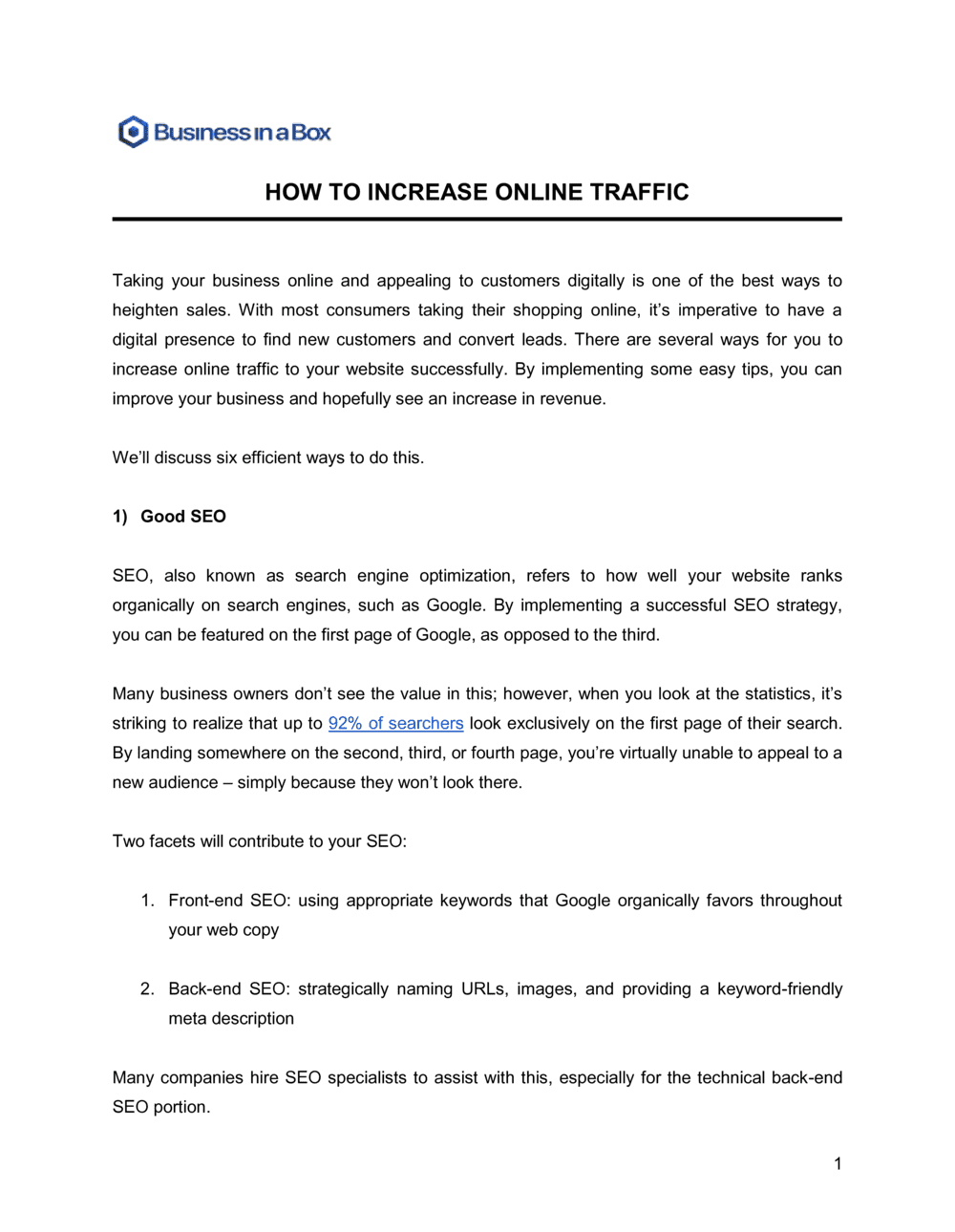
How To Increase Online Traffic

Free Word download β€’ Edit online β€’ Save & share with Drive β€’ Export to PDF

5 pagesβ€’20–30 min to fillβ€’Difficulty: Standard
Learn more ↓
FreeHow To Increase Online Traffic Template

At a glance

What it is
A How To Increase Online Traffic plan is a structured operational document that outlines specific tactics, channels, targets, and timelines for growing website visitors and digital audience reach. This free Word download gives you a ready-to-edit framework covering SEO, content marketing, paid acquisition, social media, email, and analytics β€” exportable as PDF to share with your team, clients, or stakeholders.
When you need it
Use it when launching a new website, recovering from a traffic decline, planning a digital marketing campaign, or building a quarterly growth roadmap for online visibility. It is also the right document when onboarding a marketing hire or agency and you need a shared, written plan to align everyone.
What's inside
A situation audit, defined traffic goals and KPIs, SEO strategy, content plan, paid channel budget allocation, social media tactics, email marketing approach, link-building strategy, and an analytics and reporting framework with a monthly review cadence.

What is a How To Increase Online Traffic plan?

A How To Increase Online Traffic plan is a structured operational document that maps the specific tactics, channels, budgets, and timelines a business will use to grow the number of visitors arriving at its website. It coordinates organic search, paid acquisition, content marketing, social media, email, and link-building into a single written framework with defined KPIs and a monthly review process. Rather than a list of tips, it is an executable plan that assigns ownership, sets measurable targets, and establishes the criteria for deciding when a tactic is working and when it is not.

Why You Need This Document

Without a written traffic plan, digital marketing activity becomes reactive β€” teams publish content without keyword targets, run paid campaigns without pause rules, and report on vanity metrics that do not connect to revenue. The cost is real: budgets are spent on channels that cannot be measured, ranking opportunities are missed because no one owns the SEO workstream, and leadership has no basis for evaluating whether the investment is working. A structured traffic plan forces the discipline of setting a specific baseline, a specific goal, and a specific timeline before any tactic begins β€” so every channel decision is made in service of the same number. This template gives you that structure in a format you can complete in a single working session and share with your team, agency, or stakeholders the same day.

Which variant fits your situation?

If your situation is…Use this template
Building a 90-day traffic push around a product launchProduct Launch Plan
Focusing exclusively on search engine optimization tacticsSEO Strategy Plan
Planning a content calendar to support organic traffic growthContent Marketing Plan
Allocating budget across paid digital channelsDigital Marketing Budget Plan
Creating a full inbound marketing strategy beyond trafficMarketing Plan
Presenting traffic and channel performance to leadershipMarketing Report
Planning social media activity to drive referral trafficSocial Media Marketing Plan

Common mistakes to avoid

❌ Targeting high-difficulty keywords too early

Why it matters: New or low-authority sites that target competitive head terms see no rankings for six months or more, producing zero traffic while time and budget are spent.

Fix: Start with long-tail keywords (difficulty score below 40 in your tool of choice) and build domain authority through consistent content and link acquisition before pursuing head terms.
❌ Publishing content with no keyword target

Why it matters: Unoptimized articles rarely rank on page one and contribute nothing measurable to organic traffic, making the content effort impossible to justify.

Fix: Assign a primary keyword and a secondary keyword to every piece of content before writing begins, and confirm the on-page optimization before publishing.

❌ Running paid traffic to the homepage

Why it matters: Homepage bounce rates for paid traffic average 65–80% because visitors cannot immediately find the specific offer that prompted their click, wasting the entire ad spend.

Fix: Build a dedicated landing page for each paid campaign with a single CTA that matches the ad's offer and messaging exactly.

❌ Ignoring technical SEO issues in the site audit

Why it matters: Crawl errors, slow Core Web Vitals, and duplicate content prevent even well-optimized pages from ranking, making all content and link-building work less effective.

Fix: Run a full technical audit using Screaming Frog or Google Search Console's Coverage report before investing in new content, and prioritize fixing crawl-blocking errors first.

❌ Treating traffic volume as the only success metric

Why it matters: A plan that doubles sessions but doesn't improve leads or revenue has not achieved a business objective β€” and will struggle to justify budget at renewal.

Fix: Define a conversion KPI alongside the sessions target from the start: form submissions, demo requests, or purchases per 1,000 sessions, not raw visitor count alone.

❌ Abandoning tactics before the measurement window closes

Why it matters: SEO, content, and link-building typically take three to six months to show meaningful ranking movement β€” stopping at week six and declaring failure wastes all prior investment.

Fix: Commit to a minimum 90-day measurement window for organic tactics before evaluating effectiveness, and use paid channels for faster feedback in the interim.

The 9 key sections, explained

Situation audit

Traffic goals and KPIs

SEO strategy

Content plan

Paid acquisition strategy

Social media and community tactics

Email marketing and owned-channel traffic

Link-building strategy

Analytics and reporting framework

How to fill it out

  1. 1

    Complete the situation audit before anything else

    Pull the last 90 days of data from Google Analytics 4 and Google Search Console. Record sessions by channel, top-performing pages, average position, and CTR for your existing keyword set.

    πŸ’‘ Export the data as a CSV and paste the summary numbers directly into the audit section β€” use actual figures, not estimates.

  2. 2

    Set one primary traffic goal with a specific number and date

    Write a single headline goal β€” e.g., 'Reach 15,000 monthly organic sessions by December 31' β€” then list three to five supporting KPIs that are directly measurable in your analytics platform.

    πŸ’‘ Make the goal ambitious but achievable: a 20–30% increase over six months is credible to stakeholders; 10x in three months rarely is.

  3. 3

    Identify your top three keyword opportunities

    Use a tool like Ahrefs, Semrush, or Google Search Console to find keywords where you currently rank on page 2 (positions 11–20). These are the fastest wins for organic traffic improvement.

    πŸ’‘ Sort by current impressions descending β€” high-impression, page-2 keywords are the lowest-effort ranking opportunities available to you right now.

  4. 4

    Build the content calendar from keyword clusters

    Group your target keywords into topic clusters. Assign one cornerstone piece per cluster, plus two to four supporting posts. Enter each piece in the content plan section with a target publish date and assigned owner.

    πŸ’‘ Plan at least eight weeks of content before you publish the first piece β€” consistency matters more than any individual article's quality.

  5. 5

    Set paid channel budgets with explicit pause rules

    Enter the monthly budget for each paid channel. For each campaign, define the CPC or ROAS threshold that triggers a pause or bid adjustment, and specify how many days of data you need before making that call.

    πŸ’‘ Never evaluate paid campaign performance before it has accumulated at least 100 clicks β€” smaller samples produce misleading CTR and conversion data.

  6. 6

    Define the email and social media link-back cadence

    Schedule email sends and social posts that link directly to your priority content. Tie each social post and email CTA to a specific URL so you can attribute traffic in GA4 using UTM parameters.

    πŸ’‘ Use a consistent UTM naming convention from day one β€” source, medium, and campaign β€” so channel-level attribution is clean when you build your monthly report.

  7. 7

    Set up the monthly analytics scorecard

    Create a Looker Studio or spreadsheet dashboard that pulls sessions by channel, keyword ranking changes, and conversion rate side-by-side with the prior month. Schedule a standing 60-minute review each month.

    πŸ’‘ Include a 'next actions' column in the scorecard where the team agrees on three to five tactical changes based on the data before the meeting ends.

Frequently asked questions

What is an online traffic growth plan?

An online traffic growth plan is a structured operational document that defines specific tactics, channels, targets, and timelines for increasing the number of visitors to a website. It covers organic search, paid advertising, content marketing, social media, email, and link-building in a single coordinated framework, with defined KPIs and a monthly review cadence to track progress against goals.

How long does it take to increase website traffic?

Paid channels can produce additional traffic within 24–72 hours of launching a campaign. Organic SEO and content marketing typically require three to six months before significant ranking and traffic improvement appears, because search engines need time to crawl, index, and evaluate new content. A balanced plan combines paid channels for short-term volume with organic investment for sustainable, compounding returns.

What is the fastest way to increase website traffic?

Paid search (Google Ads) and paid social (Meta, LinkedIn) deliver immediate traffic as soon as a campaign goes live. For zero-cost tactics, publishing to an existing email list and sharing content on social media are the fastest organic levers. Long-tail SEO targeting page-2 keywords is the fastest search tactic, often producing ranking improvements within four to eight weeks rather than the six-plus months required for competitive head terms.

What metrics should I track to measure traffic growth?

The core metrics are: total sessions by channel (organic, paid, referral, social, email, direct), keyword ranking positions for your target terms, organic click-through rate from Search Console, bounce rate and pages per session as engagement proxies, and goal completions or conversion rate by traffic source. Track these monthly against the baseline established in your situation audit, not daily.

How much content should I publish to grow organic traffic?

For most small to mid-size sites, two to four keyword-targeted pieces per month consistently outperforms sporadic publishing of higher volumes. Quality and keyword relevance matter more than cadence. A single well-optimized, comprehensive guide targeting a long-tail keyword cluster typically drives more traffic over twelve months than four thin, unoptimized posts published in the same period.

Does social media actually drive website traffic?

Social media is a referral traffic channel, not a search channel. Its contribution varies significantly by industry and platform β€” B2C brands often see meaningful traffic from Instagram and Pinterest; B2B companies generate more from LinkedIn. The key is including an explicit link or CTA in every post and using UTM parameters to accurately attribute social sessions in Google Analytics 4.

What is the difference between this plan and a full marketing plan?

A traffic growth plan focuses specifically on increasing website visitor volume across digital channels, with tactics and KPIs tied directly to sessions and rankings. A full marketing plan covers a broader scope including branding, positioning, offline channels, pricing strategy, product marketing, and customer retention. Use this document when the specific problem to solve is getting more people to the website.

Do I need a separate SEO agency or can I execute this plan in-house?

For businesses with a marketing generalist or small team, this template provides enough structure to execute a solid organic and paid strategy in-house. Consider engaging an SEO specialist or agency when the site has more than 500 pages, the industry is highly competitive, or the business needs to recover from a Google algorithm penalty, all of which require technical expertise beyond typical in-house capacity.

How this compares to alternatives

vs Marketing Plan

A marketing plan covers the full scope of marketing activity β€” branding, positioning, product marketing, pricing, and multi-channel campaigns. An online traffic plan focuses narrowly on increasing website sessions through digital channels. Use this document when the specific business problem is visitor volume; use the marketing plan when the problem is broader brand or commercial strategy.

vs Content Marketing Plan

A content marketing plan focuses on the creation, distribution, and editorial calendar for owned content. An online traffic plan treats content as one of several acquisition channels alongside SEO, paid, social, and email. If content is your primary traffic driver, both documents work together β€” the content plan provides editorial detail that feeds into the traffic plan's content section.

vs Social Media Marketing Plan

A social media marketing plan covers platform strategy, community management, engagement metrics, and brand voice across social channels. An online traffic plan treats social media specifically as a referral traffic source, with tactics subordinated to a sessions-growth goal. Use the social media plan when social presence and engagement are the objective; use this plan when the objective is routing social audiences back to the website.

vs Marketing Report

A marketing report documents what happened β€” channel performance, campaign results, and KPI actuals for a completed period. An online traffic plan documents what will happen β€” tactics, timelines, budgets, and targets for a future period. The report is retrospective; the traffic plan is prospective. In practice, the report's findings should feed directly into the next period's traffic plan.

Industry-specific considerations

E-commerce / Retail

Product-page SEO, Google Shopping campaigns, and cart-abandonment email flows are the primary traffic and recovery levers.

SaaS / Technology

Bottom-of-funnel keyword targeting (e.g., 'best [CATEGORY] software'), comparison content, and developer-community link-building drive high-intent organic traffic.

Professional Services

Local SEO, Google Business Profile optimization, and thought-leadership content targeting client pain-point keywords dominate traffic strategy.

Media and Publishing

High-frequency content publishing, news SEO (structured data, Google Discover), and newsletter-to-site referral loops are the core traffic engines.

Template vs pro β€” what fits your needs?

PathBest forCostTime
Use the templateSmall business owners, in-house marketers, and freelancers building a structured traffic plan without external supportFree3–6 hours to complete, ongoing monthly review
Template + professional reviewGrowing businesses that want an SEO specialist or digital marketing consultant to validate the keyword strategy and channel mix$300–$1,500 for a strategy review session1–2 weeks
Custom draftedCompetitive industries, enterprise sites with 500+ pages, or businesses recovering from a Google penalty requiring expert technical SEO$2,000–$10,000+ for a full agency engagement3–6 weeks

Glossary

Organic Traffic
Visitors who arrive at a website through unpaid search engine results, as opposed to paid ads or direct navigation.
Bounce Rate
The percentage of sessions in which a visitor leaves after viewing only one page, without taking any further action.
Keyword Difficulty
A score estimating how competitive a search term is to rank for, based on the strength of pages currently ranking on the first page.
Backlink
A hyperlink from an external website pointing to your site, which search engines treat as a vote of authority and relevance.
Domain Authority (DA)
A third-party score (0–100) estimating how likely a website is to rank in search results, based on the quantity and quality of its backlinks.
Click-Through Rate (CTR)
The percentage of people who click a link after seeing it, calculated as clicks divided by impressions.
Cost Per Click (CPC)
The amount paid each time a user clicks a paid advertisement in a search or display campaign.
Impression Share
The percentage of eligible auction impressions your paid ads received versus the total available for your targeting criteria.
Session
A single continuous visit to a website by one user, typically ending after 30 minutes of inactivity.
Long-Tail Keyword
A search phrase of three or more words with lower search volume but higher purchase intent and typically lower keyword difficulty.
Referral Traffic
Visitors who arrive at a website by clicking a link on another website, rather than through search or direct navigation.

Part of your Business Operating System

This document is one of 3,000+ business & legal templates included in Business in a Box.

  • Fill-in-the-blanks β€” ready in minutes
  • 100% customizable Word document
  • Compatible with all office suites
  • Export to PDF and share electronically

Create your document in 3 simple steps.

From template to signed document β€” all inside one Business Operating System.
1
Download or open template

Access over 3,000+ business and legal templates for any business task, project or initiative.

2
Edit and fill in the blanks with AI

Customize your ready-made business document template and save it in the cloud.

3
Save, Share, Send, Sign

Share your files and folders with your team. Create a space of seamless collaboration.

Save time, save money, and create top-quality documents.

β˜…β˜…β˜…β˜…β˜…

"Fantastic value! I'm not sure how I'd do without it. It's worth its weight in gold and paid back for itself many times."

Managing Director Β· Mall Farm
Robert Whalley
Managing Director, Mall Farm Proprietary Limited
β˜…β˜…β˜…β˜…β˜…

"I have been using Business in a Box for years. It has been the most useful source of templates I have encountered. I recommend it to anyone."

Business Owner Β· 4+ years
Dr Michael John Freestone
Business Owner
β˜…β˜…β˜…β˜…β˜…

"It has been a life saver so many times I have lost count. Business in a Box has saved me so much time and as you know, time is money."

Owner Β· Upstate Web
David G. Moore Jr.
Owner, Upstate Web

Run your business with a system β€” not scattered tools

Stop downloading documents. Start operating with clarity. Business in a Box gives you the Business Operating System used by over 250,000 companies worldwide to structure, run, and grow their business.

Start freeΒ Β·Β No credit card required