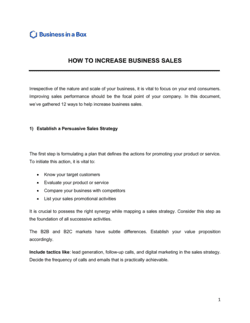
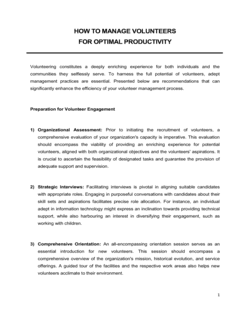
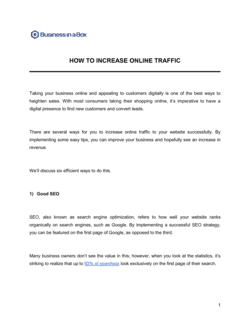
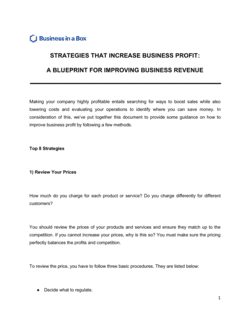
How To Increase Business Productivity

Free to read β€’ Save or share with one click

FreeHow To Increase Business Productivity Template

At a glance

What it is
A How To Increase Business Productivity document is a structured operational guide that identifies where time, effort, and resources are lost in a business and outlines concrete steps to recover them. This free Word download gives you a ready-made framework covering workflow analysis, goal-setting, process optimization, technology adoption, and performance measurement β€” editable online and exportable as PDF for sharing with leadership or teams.
When you need it
Use it when output per employee is declining, deadlines are consistently missed, costs are rising without a corresponding increase in revenue, or leadership needs a documented plan to present to owners, investors, or a board. It is also a natural output of any operational review or annual planning cycle.
What's inside
Current-state productivity assessment, productivity goals and KPIs, workflow and process audit findings, technology and tooling recommendations, communication and meeting efficiency guidelines, employee engagement and accountability measures, and a 90-day implementation roadmap with owners and milestones.

What is a How To Increase Business Productivity document?

A How To Increase Business Productivity document is a structured operational plan that identifies where time, effort, and resources are being lost across a team or organization and sets out a concrete, sequenced roadmap for recovering them. It combines a current-state productivity assessment with specific goals, a workflow and process audit, tooling recommendations, communication guidelines, and a 90-day implementation plan β€” giving leadership a single source of truth for driving measurable efficiency improvements. Unlike a generic report, it assigns named owners to every action and ties each recommendation to a tracked KPI, making accountability built-in rather than assumed.

Why You Need This Document

Without a written productivity improvement plan, efficiency efforts dissolve into one-off initiatives that lose momentum by Week 6 and leave no measurable record of what changed or why. Teams continue absorbing the same bottlenecks β€” redundant meetings, tool sprawl, unclear role ownership β€” because no one has formally mapped them, prioritized them, or assigned accountability for fixing them. The cost compounds quickly: industry benchmarks consistently show that knowledge workers lose 20–30% of their available hours to low-value activities that a structured audit would surface and eliminate. A documented plan forces the diagnostic work before the solutions, sequences changes to prevent change fatigue, and creates the 30- and 90-day review checkpoints that keep improvements on track long after the initial rollout energy fades. This template gives you the framework to run that process in hours rather than weeks.

Which variant fits your situation?

If your situation is…Use this template
Conducting a full organizational efficiency reviewOperational Efficiency Plan
Tracking individual employee output and goalsEmployee Performance Improvement Plan
Standardizing a repeatable task or processStandard Operating Procedure (SOP)
Setting company-wide goals tied to measurable resultsOKR Planning Template
Identifying and eliminating process waste in a manufacturing or service contextProcess Improvement Plan
Onboarding a new team or department with productivity expectationsEmployee Onboarding Checklist
Presenting operational improvements to the board or investorsOperations Report

Common mistakes to avoid

❌ Recommending solutions before completing the assessment

Why it matters: Teams resist changes that are not connected to evidence they recognize. Leaders lose credibility when recommendations cannot be traced to measured problems.

Fix: Publish the assessment findings to the team before presenting recommendations β€” let the data create the case for change before the solutions are proposed.

❌ Setting too many simultaneous improvement goals

Why it matters: More than four active priorities in a 90-day cycle divides focus to the point where none of the changes receive sustained effort, and most stall by Week 4.

Fix: Rank all identified improvements by impact-to-effort ratio and limit the active plan to the top three or four initiatives. Defer the rest to the next 90-day cycle.

❌ Adding new tools without consolidating existing ones

Why it matters: Each additional platform increases context-switching time and requires cognitive overhead that directly reduces the focused work the tool is meant to enable.

Fix: Conduct a tool audit as the first step of any productivity initiative. Remove or consolidate before evaluating any new software purchase.

❌ Publishing the plan without named owners for each action

Why it matters: Action items without a single named owner default to being everyone's responsibility β€” and everyone's responsibility becomes no one's priority within two weeks.

Fix: Every action in the 90-day roadmap must have exactly one named owner and one due date. Shared ownership is not ownership.

❌ Skipping the 30-day review checkpoint

Why it matters: Without an early checkpoint, problems in implementation compound for 60–90 days before anyone acknowledges them β€” by which point the plan has lost momentum and credibility.

Fix: Schedule the 30-day review before the plan is distributed and treat it as a required milestone, not an optional check-in.

❌ Treating the plan as a one-time document rather than a living tool

Why it matters: A productivity plan filed after publication provides no ongoing accountability. Teams revert to prior habits within 60 days without active tracking against the defined KPIs.

Fix: Assign someone to update the KPI dashboard weekly and present results at the 30- and 90-day reviews. Visibility sustains momentum.

The 9 key sections, explained

Current-state productivity assessment

Productivity goals and KPIs

Workflow and process audit

Technology and tooling recommendations

Meeting and communication efficiency guidelines

Employee engagement and accountability

Delegation and role clarity

Training and skill development plan

90-day implementation roadmap

How to fill it out

  1. 1

    Complete the current-state assessment before writing recommendations

    Gather output data from your project management system, time-tracking tool, or manager surveys. Document the three to five metrics that best represent current productivity for your team or business.

    πŸ’‘ Use a 10-question pulse survey to identify perceived bottlenecks from the people doing the work β€” frontline input surfaces issues that dashboards miss.

  2. 2

    Set two to four specific, measurable productivity goals

    Convert each pain point from the assessment into a target expressed as a number β€” cycle time, on-time delivery rate, revenue per employee, or utilization rate. Assign a target date and an owner to each.

    πŸ’‘ Limit goals to four maximum for a 90-day cycle. More than four competing priorities means none of them get the focused effort they need.

  3. 3

    Map and audit your two or three highest-impact processes

    Choose the processes that consume the most time or have the most reported friction. Walk through each step, measure the average time at each stage, and identify which steps could be eliminated, combined, or automated.

    πŸ’‘ Record a screen-share of someone performing the process end to end β€” watching the actual workflow reveals waste that no verbal description captures.

  4. 4

    Audit existing tools before recommending new ones

    List every software tool currently in use across the team. Identify which are duplicated in function, which are used by fewer than 50% of the team, and which have features already purchased but not activated.

    πŸ’‘ Tool consolidation alone commonly saves 30–60 minutes per employee per week β€” audit before adding.

  5. 5

    Draft meeting and communication rules with specific defaults

    Write out the specific rules β€” maximum meeting length, required agenda lead time, async-default scenarios, and meeting-free windows β€” and get explicit sign-off from leadership before publishing.

    πŸ’‘ Pilot the rules with one team for 30 days and measure calendar hours freed before rolling out company-wide.

  6. 6

    Build the 90-day roadmap with sequenced, not simultaneous, changes

    Organize changes across three 30-day phases. Process changes go in Phase 1, tooling changes in Phase 2, and structural or role changes in Phase 3. Assign a single named owner to each action.

    πŸ’‘ Each phase should end with a measurable milestone review β€” not just a check-in β€” so the team can confirm what is working before layering in the next phase.

  7. 7

    Schedule a 30-day and 90-day review before you publish the plan

    Put the review dates on the calendar at the time the plan is distributed. Plans without scheduled reviews are treated as one-time documents rather than active management tools.

    πŸ’‘ At the 30-day review, look only at leading indicators β€” tasks completed, tools adopted, meeting hours reduced. Lagging metrics like revenue per employee take 60–90 days to reflect process changes.

Frequently asked questions

What is a business productivity improvement plan?

A business productivity improvement plan is a structured document that diagnoses where time, effort, or resources are being lost in an organization and outlines specific, measurable steps to recover them. It typically covers a current-state assessment, productivity KPIs, process audit findings, tool and communication recommendations, and a sequenced 90-day implementation roadmap with named owners and milestones.

How do you measure business productivity?

The most common productivity metrics are revenue per employee, on-time delivery rate, task cycle time, utilization rate (billable hours as a percentage of available hours), and units produced per labor hour. The right metric depends on your business model β€” a professional services firm tracks billable utilization; a manufacturer tracks units per shift. Define your two or three primary KPIs before building the improvement plan.

What are the most common causes of low business productivity?

The five most frequently documented causes are excessive or poorly run meetings, tool sprawl and context-switching, unclear role ownership and decision authority, processes that have never been audited or updated, and the absence of measurable goals that connect daily work to business outcomes. Most productivity losses can be traced to one or more of these structural issues rather than individual effort problems.

How long does a productivity improvement plan typically take to show results?

Leading indicators β€” meeting hours reduced, tool adoption rates, tasks completed on schedule β€” are typically visible within 30 days. Lagging indicators like revenue per employee, gross margin, or customer throughput take 60–90 days to reflect process changes. Plan for a 90-day cycle with a formal review at day 30 and day 90.

Should a productivity improvement plan cover the whole company or one department?

Start with one department or function β€” preferably the one with the most measurable productivity gap. A scoped plan is faster to implement, easier to measure, and builds credibility before a company-wide rollout. Once the first department demonstrates measurable results, the same framework adapts to additional teams with fewer obstacles.

What is the difference between a productivity plan and a performance improvement plan?

A productivity improvement plan is an organizational or team-level operational document focused on process, tools, and structure. A performance improvement plan (PIP) is an HR document focused on an individual employee's output, behavior, or skill gaps β€” typically initiated when performance falls below a defined threshold. The two can be complementary but serve different audiences and purposes.

How do I get employee buy-in for a productivity improvement plan?

Share the assessment findings with the team before presenting solutions β€” people support changes they helped diagnose. Involve frontline employees in the workflow audit phase; they identify waste that managers cannot see from dashboards alone. Tie productivity goals to team outcomes that employees care about, such as reduced overtime, fewer escalations, or faster project closures rather than abstract efficiency percentages.

What tools support a productivity improvement plan?

Project management platforms (Asana, Monday.com, ClickUp), time-tracking tools (Toggl, Harvest, Clockify), async communication tools (Loom, Notion, Confluence), and meeting analytics tools (Clockwise, Reclaim) all support execution. The right stack depends on team size and current tooling β€” the priority is consolidating existing platforms before adding new ones.

How often should a business productivity plan be updated?

Review and update the active plan at 30 days and 90 days. After the initial 90-day cycle, conduct a full quarterly review to close completed initiatives, measure KPI progress against targets, and initiate the next cycle of improvements. Annual productivity planning should be aligned to the fiscal year budget cycle so that tooling and staffing investments can be included.

How this compares to alternatives

vs Standard Operating Procedure (SOP)

An SOP documents how a specific task or process should be performed β€” step by step, role by role. A productivity improvement plan diagnoses which processes need to change and sets a strategic roadmap for making those changes. SOPs are the outputs of a productivity plan, not a substitute for one.

vs Employee Performance Improvement Plan

A performance improvement plan targets an individual employee's specific shortfalls in output, behavior, or skills and is typically an HR-owned document with legal implications. A business productivity plan is an operational document targeting team and process-level inefficiency. The two serve different purposes and different audiences.

vs Operations Report

An operations report records what happened β€” output metrics, capacity utilization, incidents, and variances against targets for a past period. A productivity improvement plan is forward-looking β€” it uses current-state data to plan and implement specific changes. Reports feed the assessment phase of the plan; they do not replace it.

vs Strategic Plan

A strategic plan sets a company's 3–5 year direction, competitive positioning, and resource allocation. A productivity improvement plan is a 90-day operational execution tool focused on removing friction from current workflows. The two complement each other β€” a strategic plan defines where the business is going; a productivity plan ensures the organization can execute at the pace required to get there.

Industry-specific considerations

Professional services

Billable utilization rate is the primary KPI β€” productivity plans in this sector focus on reducing non-billable administrative time and improving matter or project scoping accuracy.

SaaS and technology

Engineering and product teams measure productivity by sprint velocity, deployment frequency, and cycle time from commit to production β€” improvement plans focus on reducing context-switching and meeting load for individual contributors.

Manufacturing

Output per labor hour and machine utilization rate drive productivity analysis β€” plans address shift scheduling, preventive maintenance cadence, and materials flow to reduce downtime and rework.

Retail and e-commerce

Order fulfillment cycle time, return processing rate, and revenue per labor hour are the key metrics β€” productivity plans target pick-pack workflows, system integrations, and seasonal staffing models.

Healthcare

Patient throughput, documentation time per encounter, and appointment no-show rates define productivity β€” improvement plans address EHR workflow efficiency and administrative task delegation.

Financial services

Cases processed per analyst, client onboarding cycle time, and compliance review throughput are primary measures β€” plans focus on workflow automation for repetitive data handling and approval routing.

Template vs pro β€” what fits your needs?

PathBest forCostTime
Use the templateOperations managers, department heads, and small business owners running a focused 90-day improvement cycleFree4–8 hours to complete, 90 days to execute
Template + professional reviewLeaders conducting a cross-departmental productivity overhaul or preparing findings for a board presentation$500–$2,000 for a facilitator or operations consultant review1–2 weeks including stakeholder interviews
Custom draftedEnterprise-wide transformation programs, post-merger integration, or regulated industries requiring documented process compliance$5,000–$25,000+ for a management consulting engagement4–12 weeks

Glossary

Productivity KPI
A quantifiable metric used to measure output relative to input β€” such as revenue per employee, tasks completed per sprint, or units produced per labor hour.
Workflow Audit
A structured review of how work moves through a team or organization, identifying steps that are redundant, delayed, or performed by the wrong people.
Bottleneck
A point in a process where the flow of work slows or stops because capacity at that step is insufficient to handle incoming volume.
Deep Work
Uninterrupted, focused work on cognitively demanding tasks β€” as opposed to reactive work like email and meetings β€” that produces the highest-value output per hour.
Time-Boxing
A scheduling method that assigns a fixed, maximum time block to a specific task or meeting, preventing scope creep and enforcing prioritization.
Utilization Rate
The percentage of available working hours spent on productive or billable activities, as opposed to administrative overhead or idle time.
Delegation Matrix
A visual tool that maps tasks against the appropriate owner based on skill level, authority, and strategic value β€” clarifying who should do what.
Async Communication
Work communication that does not require all participants to be present simultaneously β€” such as recorded video updates, shared documents, or threaded comments.
90-Day Sprint
A focused improvement cycle of approximately three months with defined goals, owners, and check-in points β€” short enough to maintain urgency, long enough to show results.
Change Fatigue
The exhaustion and disengagement employees experience when exposed to too many simultaneous or poorly sequenced organizational changes.

Part of your Business Operating System

This document is one of 3,000+ business & legal templates included in Business in a Box.

  • Fill-in-the-blanks β€” ready in minutes
  • Compatible with all office suites
  • Export to PDF and share electronically

Create your document in 3 simple steps.

From template to signed document β€” all inside one Business Operating System.
1
Download or open template

Access over 3,000+ business and legal templates for any business task, project or initiative.

2
Edit and fill in the blanks with AI

Customize your ready-made business document template and save it in the cloud.

3
Save, Share, Send, Sign

Share your files and folders with your team. Create a space of seamless collaboration.

Save time, save money, and create top-quality documents.

β˜…β˜…β˜…β˜…β˜…

"Fantastic value! I'm not sure how I'd do without it. It's worth its weight in gold and paid back for itself many times."

Managing Director Β· Mall Farm
Robert Whalley
Managing Director, Mall Farm Proprietary Limited
β˜…β˜…β˜…β˜…β˜…

"I have been using Business in a Box for years. It has been the most useful source of templates I have encountered. I recommend it to anyone."

Business Owner Β· 4+ years
Dr Michael John Freestone
Business Owner
β˜…β˜…β˜…β˜…β˜…

"It has been a life saver so many times I have lost count. Business in a Box has saved me so much time and as you know, time is money."

Owner Β· Upstate Web
David G. Moore Jr.
Owner, Upstate Web

Run your business with a system β€” not scattered tools

Stop downloading documents. Start operating with clarity. Business in a Box gives you the Business Operating System used by over 250,000 companies worldwide to structure, run, and grow their business.

Start freeΒ Β·Β No credit card required