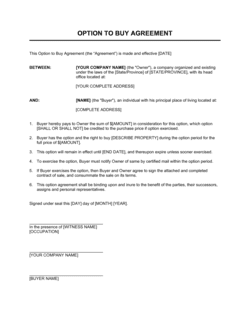
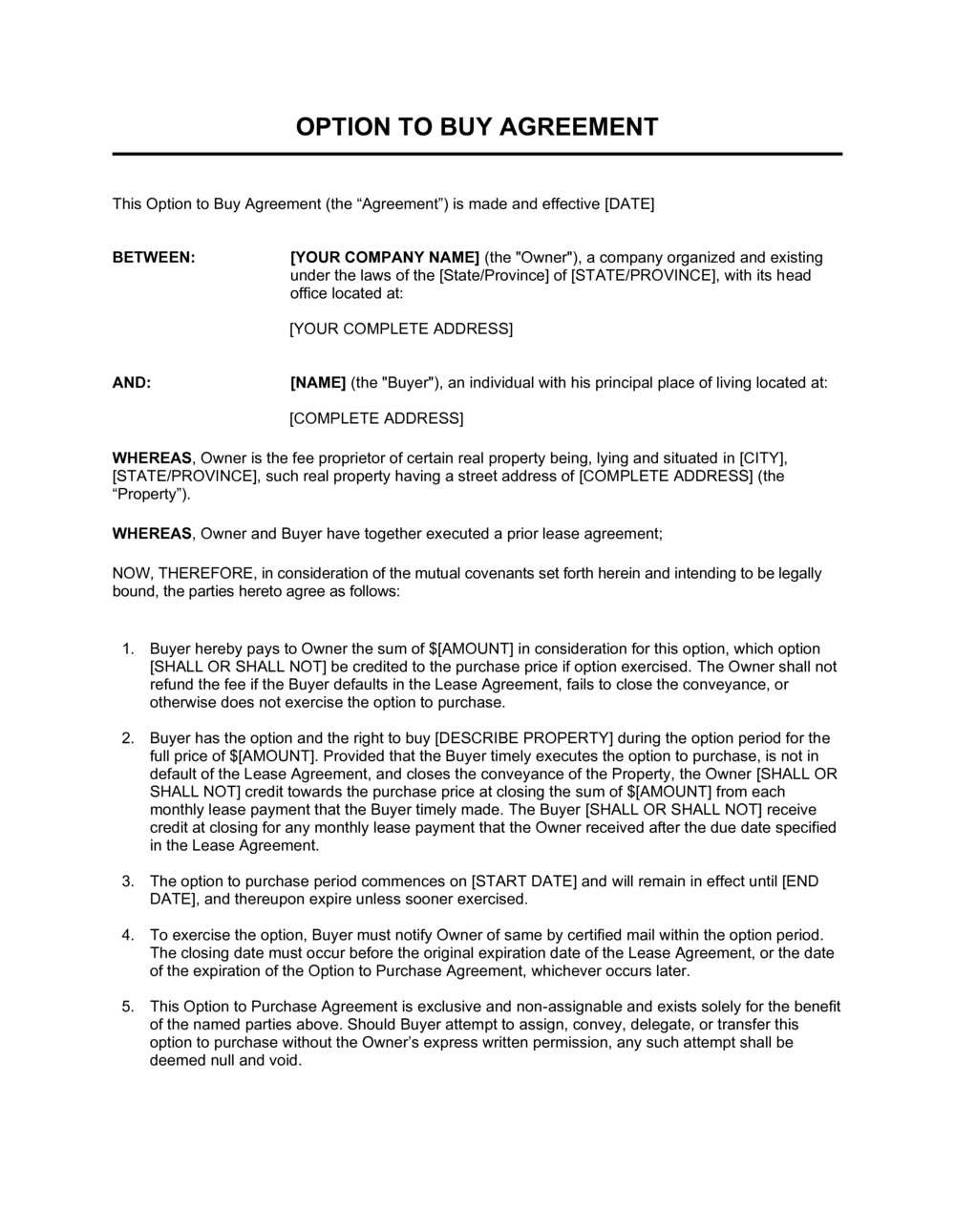
Option to Buy Agreement Long Template

Free Word download • Edit online • Save & share with Drive • Export to PDF

3 pages25–30 min to fillDifficulty: ComplexSignature requiredLegal review recommended
Learn more ↓
FreeOption to Buy Agreement Long Template

At a glance

What it is
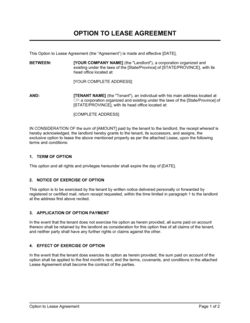
An Option to Buy Agreement is a binding legal contract in which a seller grants a buyer the exclusive right — but not the obligation — to purchase a specific property or business asset at a pre-agreed price within a defined time window. This free Word download covers the full long-form version, including option fee, exercise procedure, conditions precedent, default remedies, and closing mechanics.
When you need it
Use it when a buyer needs time to secure financing, conduct due diligence, or satisfy regulatory conditions before committing to a purchase, and the seller agrees to hold the asset off the market for that period in exchange for a non-refundable option fee.
What's inside
Parties and property description, option fee and consideration, option period and exercise procedure, purchase price and payment terms, conditions precedent, representations and warranties, default and remedies, and governing law and closing mechanics.

What is an Option to Buy Agreement?

An Option to Buy Agreement is a binding legal contract in which a seller (the optionor) grants a buyer (the optionee) the exclusive right — but not the obligation — to purchase a specific property or business asset at a pre-agreed price within a defined time window. In exchange for that right, the buyer pays a non-refundable option fee, which is typically credited toward the purchase price if the option is exercised. Unlike a purchase and sale agreement, which immediately obligates both parties, an option is unilateral: only the seller is bound during the option period, while the buyer retains the freedom to walk away by allowing the option to lapse. This long-form version covers the full range of commercial terms including conditions precedent, representations and warranties, default remedies, assignment rights, and recording mechanics — making it suitable for real estate transactions, business acquisitions, development projects, and joint venture buyouts.

Why You Need This Document

Without a written option agreement, a buyer conducting due diligence or arranging financing has no legal protection against the seller accepting a competing offer in the interim. A seller who agrees verbally to hold a property faces no enforceable obligation — and the buyer loses both the deal and the time invested. A properly executed and recorded option to buy agreement locks the purchase price, prevents the seller from transacting with third parties, and gives the buyer a court-enforceable right to complete the acquisition if the option is exercised. The remedies clause preserves the right to seek specific performance — critical because real property and unique business assets cannot simply be replaced with a damages award. For sellers, the agreement ensures that only a serious buyer with committed option capital can occupy the holding period. This template provides the structural foundation for both sides to negotiate from, reducing the likelihood of a disputed lapse, a forfeited fee, or a title defect that derails closing.

Which variant fits your situation?

If your situation is…Use this template
Simple option on residential property with a short exercise windowOption to Buy Agreement (Short)
Tenant exercising a right to buy leased commercial premisesLease with Option to Purchase
Optioning a privately held business rather than real propertyBusiness Purchase Agreement
Granting a right of first refusal rather than an exclusive optionRight of First Refusal Agreement
Land option for a development project subject to planning approvalLand Option Agreement
Option combined with a full purchase and sale agreementPurchase and Sale Agreement
Buyout option clause embedded in a shareholders agreementShareholders Agreement

Common mistakes to avoid

❌ Using a street address instead of the legal property description

Why it matters: Addresses are administrative identifiers, not legal descriptions. An option recorded with only an address may be unenforceable against a subsequent purchaser who claims the property was not identifiable.

Fix: Attach the full legal description from the title report as Schedule A, reference it throughout the agreement, and use the parcel identification number as a secondary identifier.

❌ Leaving option fee refundability ambiguous

Why it matters: When conditions precedent fail or due diligence uncovers problems, buyers assume the fee is refundable and sellers assume it is not — creating immediate litigation exposure.

Fix: State explicitly for each scenario — seller default, buyer voluntary termination, failed conditions, and expiry — whether the option fee is retained, refunded, or credited.

❌ No exercise notice formality requirements

Why it matters: Sellers have successfully argued that an informal email or phone call did not constitute valid exercise, leaving a buyer who believed they had exercised the option without a binding purchase agreement.

Fix: Require exercise by written notice delivered via a specified method — certified mail, overnight courier, or email with confirmed read receipt — to a named recipient by the deadline.

❌ Failing to record the option or a memorandum of option

Why it matters: An unrecorded option on real property is generally not binding on a subsequent bona fide purchaser who buys the property without notice of the option, effectively destroying the buyer's right.

Fix: Record the agreement or a short-form memorandum of option in the land records of the county or jurisdiction where the property is located as soon as possible after signing.

❌ No specific performance remedy preserved for buyer

Why it matters: If the seller refuses to close after the buyer exercises the option, a buyer limited to a damages remedy may recover far less than the value of the deal — particularly in rising markets where the property's value has appreciated.

Fix: Explicitly preserve the buyer's right to seek specific performance in equity, in addition to damages, in the default and remedies clause.

❌ Conditions precedent drafted too broadly

Why it matters: Vague conditions — such as 'financing satisfactory to buyer' with no further definition — allow the buyer to walk away for almost any reason, making the option period a free due diligence window with no real seller protection.

Fix: Define each condition with an objective standard: loan amount, interest rate ceiling, lender type, or approval authority. Add a good-faith-efforts obligation for the buyer to pursue each condition diligently.

The 10 key clauses, explained

Parties and asset description

In plain language: Identifies the seller (optionor) and buyer (optionee) by their full legal names and describes the asset being optioned with enough specificity to be unambiguous — legal property description, parcel number, or business registration details.

Sample language
This Option to Buy Agreement is entered into as of [DATE] between [SELLER FULL LEGAL NAME] ('Optionor') and [BUYER FULL LEGAL NAME] ('Optionee'). The subject property is described as: [LEGAL DESCRIPTION / ADDRESS / PARCEL ID] ('Property').

Common mistake: Using a street address alone without the legal property description. Addresses can be ambiguous or change; an unambiguous legal description or parcel number is required to record the option and enforce it against third parties.

Option fee and consideration

In plain language: States the amount the buyer pays for the option right, whether it is refundable, and how it is credited — or forfeited — at closing or upon lapse.

Sample language
In consideration of the sum of $[OPTION FEE AMOUNT], paid by Optionee to Optionor upon execution ('Option Fee'), Optionor hereby grants Optionee the exclusive option to purchase the Property. The Option Fee is non-refundable but shall be credited against the Purchase Price if the option is exercised.

Common mistake: Failing to state whether the option fee is refundable if conditions precedent are not met. Ambiguity on this point is a frequent source of disputes — specify refundability for each scenario explicitly.

Option period and extension

In plain language: Defines the start and expiry dates of the option window and, if applicable, the buyer's right to extend for an additional fee.

Sample language
The option shall commence on [START DATE] and expire at 5:00 p.m. [TIMEZONE] on [EXPIRY DATE] ('Option Period'), unless sooner terminated. Optionee may extend the Option Period by [X] days upon payment of an additional $[EXTENSION FEE] no later than [X] business days before expiry.

Common mistake: Not specifying a time of day for expiry. Without a time, the option technically runs until midnight — creating a gap in which a seller may attempt to accept another offer or take other action during the expiry day.

Exercise procedure

In plain language: Prescribes the exact method by which the buyer exercises the option — written notice, delivery method, recipient, and what happens immediately after exercise.

Sample language
Optionee may exercise the option by delivering written notice to Optionor at [ADDRESS / EMAIL] via [certified mail / overnight courier / email with read receipt] no later than the expiry of the Option Period ('Exercise Notice'). Upon delivery of the Exercise Notice, this Agreement shall constitute a binding Purchase and Sale Agreement on the terms set out herein.

Common mistake: Allowing any form of informal notice — including a text message or verbal notice — to constitute valid exercise. Courts have split on this; specify a delivery method and confirm receipt as required to avoid a seller claiming they never received timely notice.

Purchase price and payment terms

In plain language: States the total purchase price locked in at signing, the deposit due upon exercise, and the balance due at closing.

Sample language
The total Purchase Price for the Property shall be $[PURCHASE PRICE] ('Purchase Price'). Upon exercise, Optionee shall pay a deposit of $[DEPOSIT AMOUNT] within [X] business days. The balance of $[BALANCE] shall be paid in immediately available funds at Closing.

Common mistake: Fixing a purchase price without an adjustment mechanism for a multi-year option period. In long-horizon options (12+ months), the lack of an indexing or renegotiation clause can render the agreement commercially impractical or invite challenge.

Conditions precedent to closing

In plain language: Lists the events or approvals that must be satisfied before the buyer is obligated to close — such as clean title, financing, environmental clearance, or zoning approval — and the consequence if they are not met.

Sample language
The obligation of Optionee to close is subject to satisfaction of the following conditions by [CONDITION DEADLINE]: (a) clear and marketable title to the Property, free of liens other than [PERMITTED ENCUMBRANCES]; (b) financing approval for $[AMOUNT] on terms acceptable to Optionee; (c) [ANY ADDITIONAL CONDITIONS]. If any condition is not satisfied, Optionee may terminate this Agreement by written notice, in which case [SPECIFY OPTION FEE TREATMENT].

Common mistake: Writing conditions precedent so broadly that the buyer can exit for almost any reason. Sellers should require that conditions be specific, objective, and time-bound so the option period does not become a free diligence window with no real commitment.

Representations and warranties

In plain language: Statements by both parties confirming their authority to enter the agreement and the seller's representations about title, condition, and absence of undisclosed encumbrances.

Sample language
Optionor represents and warrants that: (a) Optionor has full legal authority to grant this option and sell the Property; (b) the Property is free of undisclosed liens, encumbrances, or claims; (c) there are no pending or threatened legal proceedings affecting the Property; and (d) Optionor has not granted any other option, right of first refusal, or purchase right over the Property.

Common mistake: Omitting a warranty that no competing option or right of first refusal exists. If a prior right holder surfaces after signing, the buyer's option may be unenforceable or the seller may be in simultaneous default under two agreements.

Default and remedies

In plain language: Defines what constitutes default by either party, the notice and cure period, and the available remedies — including specific performance, forfeiture of the option fee, or damages.

Sample language
In the event of Optionor's default, Optionee may: (a) seek specific performance compelling Optionor to complete the sale; or (b) terminate this Agreement and recover all amounts paid hereunder plus [LIQUIDATED DAMAGES / ACTUAL DAMAGES]. In the event of Optionee's default after exercise, Optionor may retain the Option Fee as liquidated damages, which the parties agree represents a reasonable estimate of Optionor's loss.

Common mistake: Providing only a damages remedy for seller default without preserving the right to seek specific performance. Because real property is legally unique, specific performance is generally available — and failing to preserve it in the contract weakens the buyer's negotiating position in a dispute.

Assignment

In plain language: States whether the buyer may transfer the option right to a third party — such as an affiliate, an LLC formed for the acquisition, or another investor — and whether seller consent is required.

Sample language
Optionee may not assign this Agreement or any rights hereunder without the prior written consent of Optionor, which consent shall not be unreasonably withheld. Notwithstanding the foregoing, Optionee may assign to a wholly-owned affiliate upon [X] days' written notice to Optionor.

Common mistake: Leaving assignment silent. Without an express clause, assignment rights default to jurisdiction-specific rules — in some states, option rights are freely assignable by default, which may not be what the seller intended.

Governing law and dispute resolution

In plain language: Specifies the jurisdiction whose law governs the agreement and the process for resolving disputes — litigation, mediation, or arbitration.

Sample language
This Agreement is governed by the laws of [STATE / PROVINCE / COUNTRY]. Any dispute arising hereunder shall be resolved by binding arbitration administered by [AAA / JAMS / applicable body] in [CITY], except that either party may seek injunctive relief or specific performance in any court of competent jurisdiction.

Common mistake: Choosing a governing law that has no connection to the property's location. Real property disputes are typically subject to the law of the jurisdiction where the property is situated, and a conflicting choice-of-law clause may be disregarded by a court.

How to fill it out

  1. 1

    Identify the parties using their full legal names

    Enter the seller's and buyer's full legal names — individual or registered entity — exactly as they appear on title or corporate registry documents. Mismatched names create title defects at closing.

    💡 If the buyer intends to close through an entity not yet formed (e.g., a project LLC), include an assignment clause allowing transfer to a wholly-owned affiliate without seller consent.

  2. 2

    Describe the asset precisely

    For real property, use the full legal description from the deed or title report, not just the street address. For a business, include the registered name, registration number, and a description of the assets included.

    💡 Attach the legal description as Schedule A and reference it in the body of the agreement — this prevents transcription errors in the main text.

  3. 3

    Set the option fee, refundability, and credit terms

    State the option fee amount, confirm it is non-refundable (or specify the refund conditions), and clarify whether it is credited toward the purchase price at closing.

    💡 A non-refundable option fee of 1–3% of the purchase price is market-standard for real estate; adjust upward for longer option periods or highly competitive assets.

  4. 4

    Define the option period with a precise expiry time

    Enter the start date, expiry date, and time of day (with time zone). If you are including an extension right, specify the extension fee and the deadline for exercising it.

    💡 Build in enough time to complete all due diligence — environmental, title, and financing — before the option period ends. Compressed timelines are the leading cause of buyers losing option fees.

  5. 5

    Specify the exercise procedure and required notice method

    Define exactly how the buyer must deliver the exercise notice — certified mail, email with read receipt, or hand delivery — and to whom. Confirm that exercise converts the option into a binding purchase obligation automatically.

    💡 Require the buyer to send the exercise notice to both the seller and the seller's attorney simultaneously to prevent disputes about notice receipt.

  6. 6

    List all conditions precedent with specific deadlines

    Enumerate each condition — financing, clear title, zoning approval — with a measurable standard and a deadline. State whether the option fee is refunded if a condition fails.

    💡 Tie each condition to a specific deadline that falls before the option expiry, not on it — this gives time for the parties to negotiate if a condition is close to being met.

  7. 7

    Complete the representations and warranties

    Have the seller confirm authority to sell, clear title, no competing options, and no undisclosed encumbrances. The buyer should confirm authority to enter the agreement.

    💡 Request a current title report or abstract before finalizing the representations — it is faster to negotiate accurate warranties at signing than to resolve title issues after exercise.

  8. 8

    Sign before the option period begins and consider recording

    Both parties must sign before the option period starts. In most jurisdictions, an option on real property can be recorded against the title to put third parties on notice and protect the buyer's priority.

    💡 Recording the option (or a memorandum of option) is strongly advisable for any option exceeding 60 days — it prevents the seller from granting a competing interest to a bona fide third-party purchaser.

Frequently asked questions

What is an option to buy agreement?

An option to buy agreement is a binding contract in which a seller grants a buyer the exclusive right — but not the obligation — to purchase a specific property or business asset at a fixed price within a defined time period. The buyer pays a non-refundable option fee for this right. If the buyer exercises the option before it expires, the seller is legally obligated to complete the sale on the agreed terms. If the buyer does not exercise, the option lapses and the seller keeps the option fee.

What is the difference between an option to buy and a purchase agreement?

A purchase agreement creates an immediate mutual obligation — both parties are bound to complete the transaction. An option to buy creates a one-sided right: the buyer may choose to purchase, but the seller cannot sell to anyone else during the option period. The buyer's obligation only arises when they deliver the exercise notice. This distinction is critical for buyers who need time to arrange financing or complete due diligence before committing.

Is an option to buy agreement legally binding?

Yes, an option to buy agreement is generally legally binding when it includes valid consideration (the option fee), clearly identifies the parties and the asset, and specifies the purchase price and option period. The seller's obligation to keep the offer open and not sell to a third party is fully enforceable. Once the buyer exercises the option, both parties are bound to complete the sale on the agreed terms, and either party may seek specific performance or damages for default.

Can the option fee be credited toward the purchase price?

Yes, and this is the most common arrangement. The option fee is typically non-refundable if the buyer does not exercise, but is credited in full against the purchase price if the buyer exercises the option and the deal closes. Some agreements split this — crediting a portion and retaining the rest as compensation for the seller's holding period. The treatment should be stated explicitly in the agreement to avoid disputes at closing.

What happens if the seller sells the property to someone else during the option period?

If the option is properly recorded in the land records, a subsequent purchaser takes the property subject to the option — meaning the buyer retains the right to purchase even after the sale to the third party. If the option is unrecorded, a bona fide purchaser for value without notice may take free of the option, leaving the original buyer with only a damages claim against the seller. Recording promptly after signing is the primary protection against this risk.

How long can an option to buy period last?

There is no universal legal maximum for option periods, but practical and jurisdictional considerations apply. Residential real estate options typically run 30–180 days. Commercial and development options commonly extend 6–24 months to allow time for planning approvals, environmental assessments, or financing arrangements. Some jurisdictions require options on real property to specify an end date to be enforceable. Longer periods generally command higher option fees to compensate the seller for the extended holding period.

Is an option to buy the same as a right of first refusal?

No. An option to buy is an exclusive right to purchase at a fixed price within a set period — the seller cannot sell to anyone else regardless of whether a third-party offer emerges. A right of first refusal only activates when the seller receives a bona fide third-party offer; the rights holder then has the opportunity to match that offer and purchase on the same terms. An option provides stronger and more predictable protection for the buyer.

Does an option to buy agreement need to be notarized?

Notarization is not required for the agreement itself to be binding between the parties in most US states and Canadian provinces. However, if you intend to record the option (or a memorandum of option) in the land registry or county recorder's office — which is strongly advisable for any option on real property — the document will typically need to be notarized or witnessed to meet recording requirements. Requirements vary by jurisdiction; confirm with a local real estate attorney before signing.

Do I need a lawyer to draft or review an option to buy agreement?

For standard real estate or business acquisition options, a high-quality template provides a solid foundation. Legal review is strongly recommended for any option involving a purchase price above $100,000, a multi-year option period, complex conditions precedent, or cross-border transactions. A real estate or M&A attorney can review a completed template in 1–3 hours at a cost of $300–$800, confirm recording requirements, and tailor the remedies clause to your jurisdiction's enforcement landscape.

How this compares to alternatives

vs Purchase and Sale Agreement

A purchase and sale agreement creates an immediate bilateral obligation — both buyer and seller are committed to completing the transaction on agreed terms. An option to buy is unilateral: only the seller is bound during the option period, and the buyer may walk away by letting the option lapse. Use a purchase and sale agreement when both parties are ready to transact; use an option when the buyer needs a controlled period before committing.

vs Lease with Option to Purchase

A lease with option to purchase combines an occupancy agreement with an embedded purchase right, typically with rent credits accumulating toward the purchase price. A standalone option to buy agreement has no occupancy component and is used by investors, developers, or acquirers who are not occupying the property during the option period. The lease-option structure is common in residential and small commercial transactions; the standalone option is more typical in investment and development contexts.

vs Right of First Refusal Agreement

A right of first refusal only activates when the seller receives a qualifying third-party offer — the rights holder then has a limited window to match it. An option to buy provides an unconditional exclusive right to purchase at a pre-fixed price regardless of whether any third-party offer exists. Options provide the buyer with far more certainty and market protection; rights of first refusal are weaker but easier for sellers to accept because they do not prevent a market process.

vs Business Purchase Agreement

A business purchase agreement governs the immediate transfer of a going-concern business, covering assets or shares, representations, indemnities, and closing mechanics. An option to buy agreement on a business grants the buyer the right to purchase at a future date after completing due diligence, regulatory approvals, or financing — without immediately binding either party to close. The option precedes and, upon exercise, converts into the full purchase agreement.

Industry-specific considerations

Real estate investment

Investors use options to control properties during due diligence and financing, preserving capital by committing only the option fee until conditions are confirmed.

Construction and development

Developers option land parcels while pursuing rezoning, environmental clearance, or planning approval, avoiding full purchase commitment before entitlements are secured.

Mergers and acquisitions

Acquirers option private businesses during due diligence and regulatory review, preventing the target from being sold to a competing bidder while the deal is structured.

Retail and commercial leasing

Commercial tenants negotiate lease-with-option-to-purchase arrangements, building equity-like rights into long-term occupancy agreements without immediate acquisition commitment.

Jurisdictional notes

United States

Option agreements on real property are governed by the law of the state where the property is located, regardless of any choice-of-law clause. Recording requirements vary by state but generally require notarization to record a memorandum of option in the county recorder's office. California, Texas, and New York each have specific statutory frameworks affecting enforceability of options, particularly regarding the rule against perpetuities for long-duration options. Non-compete and assignability defaults also vary significantly by state.

Canada

Options on real property in Canada are governed provincially. In Ontario, a memorandum of option should be registered on title under the Land Titles Act to protect the buyer against subsequent purchasers and encumbrancers. Quebec's civil law system (rather than common law) governs option agreements in that province — called 'promesse de vente' — and requires specific formalities for enforceability. British Columbia and Alberta have their own Land Title Act registration procedures. Legal review is recommended to confirm provincial recording and formality requirements.

United Kingdom

In England and Wales, an option to purchase land must be in writing and signed by both parties to satisfy the Law of Property (Miscellaneous Provisions) Act 1989. Options should be registered as an option notice at HM Land Registry to bind third parties; an unregistered option is a minor interest that may be overreached. Stamp Duty Land Tax may be triggered on the grant of the option and again on exercise. Scotland operates under a separate legal system with distinct land registration requirements under the Land Registration etc. (Scotland) Act 2012.

European Union

Option agreement requirements vary substantially across EU member states — France, Germany, Spain, and the Netherlands each have distinct rules on form, registration, and tax treatment. In France, a 'promesse unilatérale de vente' must generally be registered with tax authorities within 10 days of signing to be enforceable against third parties. Germany requires notarial form for options on real property under the BGB. GDPR considerations apply where the agreement involves processing personal data of individuals. Cross-border options should be reviewed by local counsel in each relevant jurisdiction.

Template vs lawyer — what fits your deal?

PathBest forCostTime
Use the templateStraightforward options on residential or small commercial property with a purchase price under $100,000 and a standard option period of 90 days or lessFree30–60 minutes
Template + legal reviewOptions on commercial property, business acquisitions, multi-year terms, or transactions with complex conditions precedent or recording requirements$300–$800 (1–3 hours of attorney review)2–5 days
Custom draftedHigh-value development land options, cross-border transactions, options with equity participation or profit-sharing, or regulated-industry acquisitions$1,500–$5,000+1–3 weeks

Glossary

Option Fee
A payment made by the buyer to the seller in exchange for the exclusive right to purchase; typically non-refundable but credited toward the purchase price on exercise.
Option Period
The defined window of time during which the buyer may exercise the option; the right lapses automatically if not exercised before expiry.
Exercise Notice
The formal written notice the buyer delivers to the seller to trigger the option and convert it into a binding purchase obligation.
Purchase Price
The pre-agreed amount the buyer will pay for the asset if the option is exercised, fixed at signing regardless of market changes during the option period.
Conditions Precedent
Specified events or approvals that must occur before the buyer is obligated to close — such as financing approval, clean title, or regulatory consent.
Right of First Refusal
A related but distinct right that entitles the holder to match any third-party offer before the owner can sell to that third party — not an exclusive option at a fixed price.
Closing
The final step in completing the transaction, at which the purchase price is paid and ownership of the asset is transferred to the buyer.
Consideration
The legal value exchanged to make a contract binding; in an option agreement, the option fee serves as the consideration for the seller's commitment to hold the asset.
Default
A party's failure to perform a material obligation under the agreement — such as the seller refusing to transfer title after the buyer exercises the option.
Representations and Warranties
Factual statements made by each party at signing about the condition, title, and authority to sell the asset, which create liability if found to be false.
Specific Performance
A court remedy requiring the defaulting party to fulfill the contract as written, rather than paying damages — commonly sought when land or unique assets are involved.
Time of the Essence
A clause stating that all deadlines in the agreement are strict, meaning a party that misses a deadline is in immediate default without any grace period.

Part of your Business Operating System

This document is one of 3,000+ business & legal templates included in Business in a Box.

  • Fill-in-the-blanks — ready in minutes
  • 100% customizable Word document
  • Compatible with all office suites
  • Export to PDF and share electronically

Create your document in 3 simple steps.

From template to signed document — all inside one Business Operating System.
1
Download or open template

Access over 3,000+ business and legal templates for any business task, project or initiative.

2
Edit and fill in the blanks with AI

Customize your ready-made business document template and save it in the cloud.

3
Save, Share, Send, Sign

Share your files and folders with your team. Create a space of seamless collaboration.

Save time, save money, and create top-quality documents.

★★★★★

"Fantastic value! I'm not sure how I'd do without it. It's worth its weight in gold and paid back for itself many times."

Managing Director · Mall Farm
Robert Whalley
Managing Director, Mall Farm Proprietary Limited
★★★★★

"I have been using Business in a Box for years. It has been the most useful source of templates I have encountered. I recommend it to anyone."

Business Owner · 4+ years
Dr Michael John Freestone
Business Owner
★★★★★

"It has been a life saver so many times I have lost count. Business in a Box has saved me so much time and as you know, time is money."

Owner · Upstate Web
David G. Moore Jr.
Owner, Upstate Web

Run your business with a system — not scattered tools

Stop downloading documents. Start operating with clarity. Business in a Box gives you the Business Operating System used by over 250,000 companies worldwide to structure, run, and grow their business.

Start free · No credit card required