1
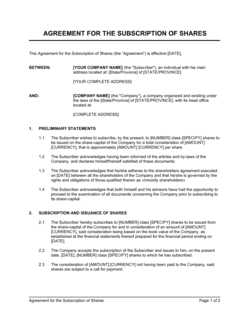
Enter both parties' full legal details
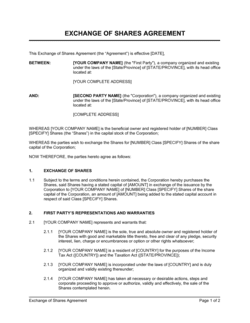
Record each party's registered legal name, entity type, jurisdiction of incorporation, and registration number in the header fields.
💡 Cross-check the exact entity name against the relevant company registry before filling — a single word difference can create an enforceability problem.
2
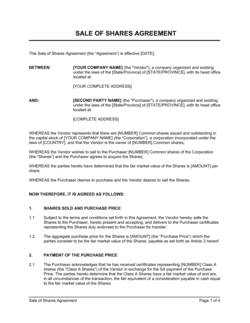
Describe the shares being exchanged
For each party, enter the share class, exact number of shares, nominal value per share, and the name of the company in which the shares are held.
💡 Attach a copy of the current share register for each company as a schedule to the agreement — it eliminates disputes about what was owned at the time of signing.
3
Set the exchange ratio and valuation basis
Enter the agreed exchange ratio and include a brief note on the valuation methodology used — such as a mutual independent valuation or a negotiated net asset value.
💡 Even a one-sentence reference to how the ratio was determined protects both parties if the exchange is later challenged as undervalue.
4
Complete the representations and warranties for each party
Work through the warranty fields for Party A and Party B separately, adapting each reference to the correct company name, share class, and financial statement date.
💡 Include a disclosure letter as a schedule where either party needs to qualify a warranty — blanket disclaimers inside the warranty text itself are harder to enforce.
5
Define conditions precedent and add a longstop date
List every approval or consent required before closing and set a longstop date by which all conditions must be satisfied, after which either party may terminate without penalty.
💡 Keep the conditions list short and specific — vague conditions like 'satisfactory due diligence' without defined criteria stall deals indefinitely.
6
Set the closing date and mechanics
Enter the closing date, list each closing action in sequence, and identify who is responsible for each step — executing transfer forms, delivering certificates, and updating registers.
💡 Nominate a single point of contact at each company responsible for confirming completion of each closing action on the day.
7
Complete indemnity limits and lock-up terms
Enter the indemnity cap (typically the value of the exchanged shares) and the lock-up period duration if applicable.
💡 A 12-month lock-up is standard for strategic exchanges; for purely financial swaps with no ongoing relationship, a shorter period or none may be appropriate.
8
Select governing law and save the completed form
Enter the governing jurisdiction, confirm the dispute resolution mechanism, and save the completed document as both an editable Word file and a PDF.
💡 Choose the jurisdiction where the majority of the commercial activity occurs — or where both parties are incorporated — to avoid conflict-of-laws complications.