1
Identify the parties and their legal entities
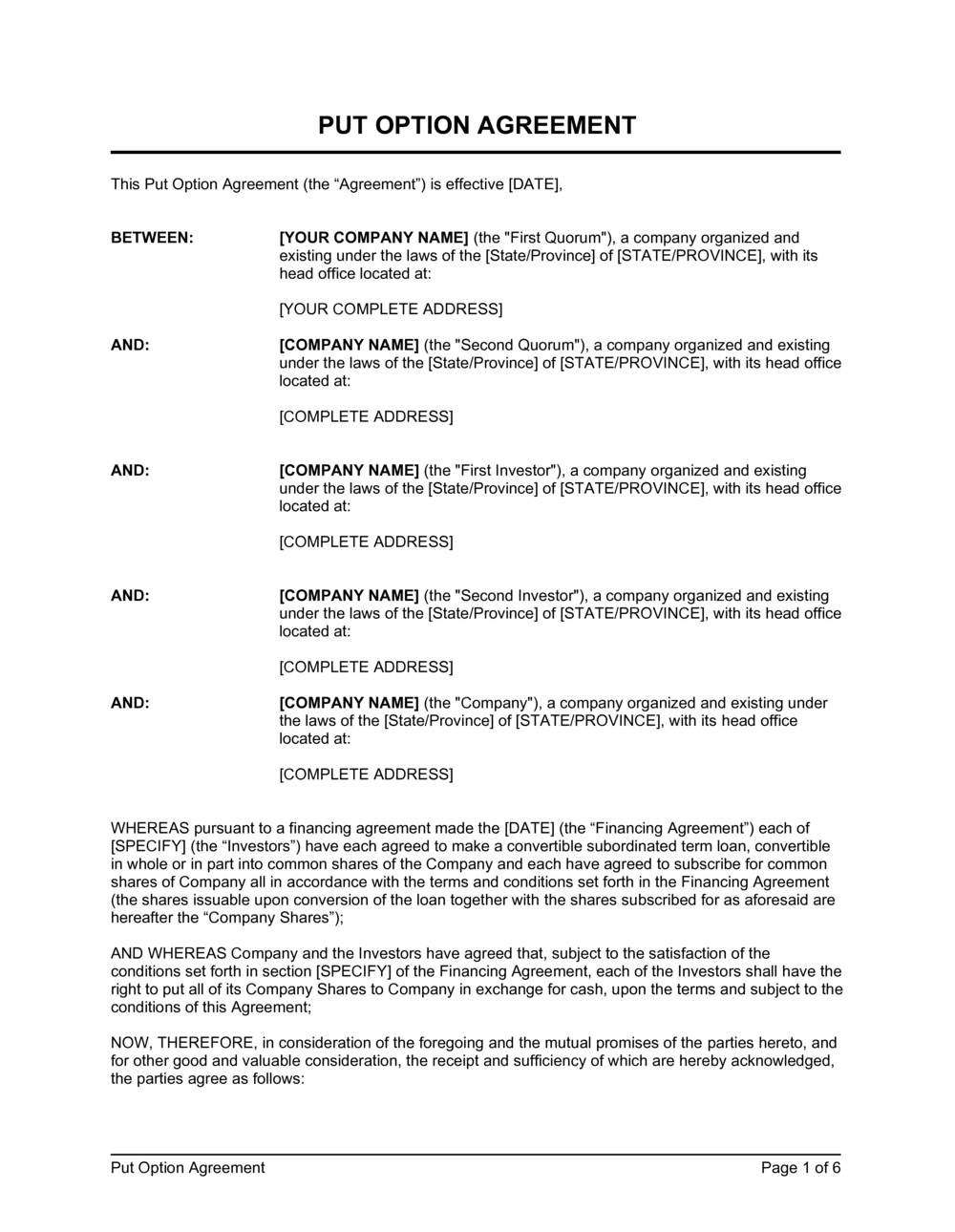
Enter the full registered legal name, jurisdiction of incorporation, and registered address for both the option holder and the grantor. Confirm that each party has authority to enter the agreement through its constitutional documents.
💡 Run a company registry search before signing to confirm the grantor's legal name and good standing — an entity that has been dissolved cannot be bound by the agreement.
2
Define the option asset precisely
Specify the exact shares or asset subject to the put by class, number, and certificate number. If the asset is a shareholding, confirm the percentage it represents and whether that percentage is dilution-protected.
💡 Include an anti-dilution adjustment formula if new share issuances are likely before the option period ends — otherwise a dilutive fundraise will reduce the value of the put without a price adjustment.
3
Set the exercise price or valuation formula
Choose between a fixed exercise price (simpler, more certain) and a formula-based price tied to EBITDA, revenue, or net asset value. If using a formula, define every input term and appoint a tiebreaker mechanism for valuation disputes.
💡 A fixed price provides certainty for both parties; a formula-based price is fairer if the option period is long — but always include a floor and a cap to bound the range.
4
Define the option period with specific calendar dates
Enter exact start and end dates for the option window. Avoid 'trigger event' start dates without also specifying a long-stop date — open-ended option periods create valuation uncertainty and can be difficult to enforce.
💡 Option periods of 12–36 months are typical for private equity and joint venture arrangements. Options running longer than 5 years may face enforceability challenges in some jurisdictions.
5
Draft conditions precedent carefully
List every condition that must be met before exercise or completion. If regulatory approval is required, specify the authority and the deadline for obtaining it. Avoid conditions the grantor controls unilaterally.
💡 Add a 'deemed satisfaction' provision stating that conditions are deemed met if the grantor fails to use reasonable endeavors to satisfy them within a specified period.
6
Specify completion mechanics and payment security
Set a specific completion date (typically 10–20 business days after exercise notice), the payment method, and whether funds will be held in escrow pending transfer of title. Include simultaneous exchange obligations so neither party is exposed.
💡 If the grantor's ability to fund the exercise price is uncertain, negotiate a payment guarantee, a letter of credit, or an escrow funded at signing rather than at exercise.
7
Include specific performance as an express remedy
Confirm that the option holder's right to seek specific performance — forcing the grantor to complete the purchase — is expressly preserved alongside damages claims.
💡 In many jurisdictions, specific performance is discretionary unless the contract expressly records that the parties intend it to be available — include that language explicitly.
8
Execute the agreement before any triggering event
Both parties must sign the agreement before the events or circumstances that will make the put right valuable — signing after a dispute arises is too late. Date the agreement accurately and retain executed originals.
💡 Use Business in a Box eSign to timestamp execution and create an auditable record of when signatures were applied relative to any triggering events.