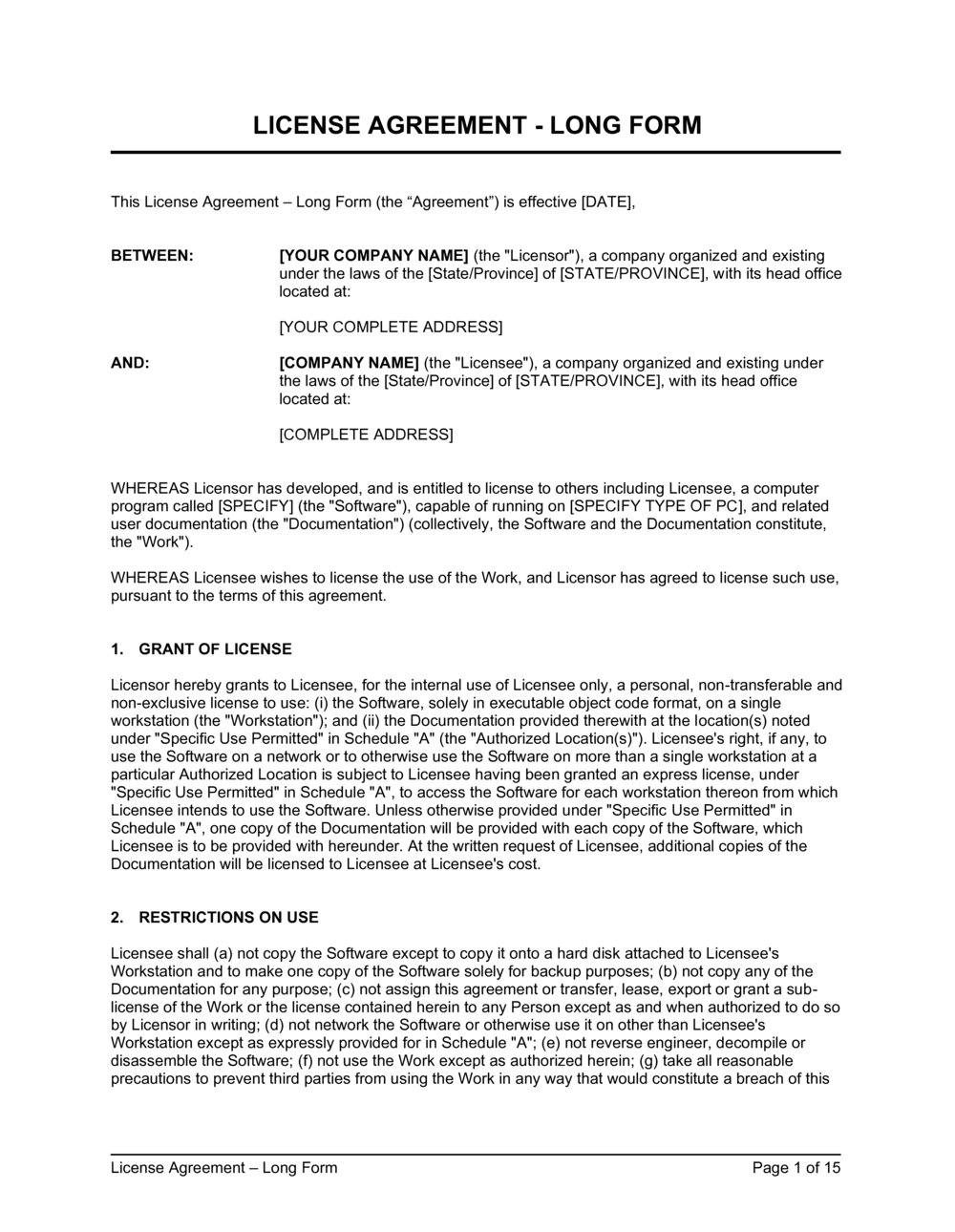
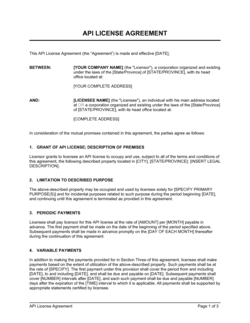
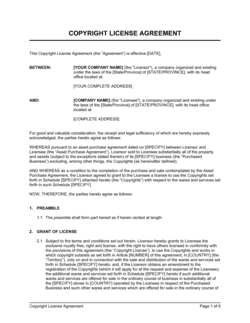
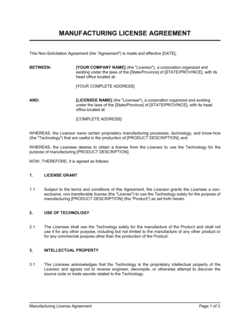
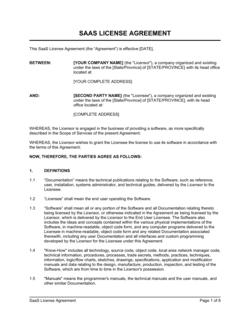
License Agreement Long Form Template

Free Word download β€’ Edit online β€’ Save & share with Drive β€’ Export to PDF

15 pagesβ€’30–40 min to fillβ€’Difficulty: Complex
Learn more ↓
FreeLicense Agreement Long Form Template

At a glance

What it is
A License Agreement Long Form is a structured document that records the terms under which an owner (licensor) grants another party (licensee) the right to use, distribute, or sublicense intellectual property β€” software, patents, trademarks, content, or proprietary processes. This free Word download covers all material fields in a single form you can edit online and export as PDF in minutes.
When you need it
Use it when you are granting or receiving rights to IP and need a comprehensive written record that defines scope, territory, royalties, and termination conditions before commercial use begins.
What's inside
Party details, grant of license, permitted use and restrictions, territory and exclusivity, royalty and payment terms, IP ownership and warranties, sublicensing rules, term and termination, and governing law.

What is a License Agreement Long Form?

A License Agreement Long Form is a structured document that records the complete terms under which an intellectual property owner (the licensor) grants a defined set of rights to another party (the licensee) β€” covering scope, territory, exclusivity, royalties, sublicensing, IP ownership, and termination in a single comprehensive form. Unlike a short-form license, this document captures every material field needed for commercial IP arrangements involving meaningful financial value or operational complexity. It applies to software, patents, trademarks, branded content, proprietary methodologies, and any other licensable IP asset.

Why You Need This Document

Operating without a complete license agreement exposes both parties to disputes that are expensive and slow to resolve. A licensor without clear scope and territory language may find a licensee exploiting rights in markets or fields never intended. A licensee without defined royalty calculation terms pays whatever the licensor demands at audit time. Without an explicit sublicensing clause, the licensor loses control over who ultimately accesses the IP. And without a precise termination and cure mechanism, either party can end a valuable commercial relationship over a minor administrative lapse. This template captures every critical field in a single, consistent form β€” so both parties know exactly what was agreed, from day one through the last renewal cycle.

Which variant fits your situation?

If your situation is…Use this template
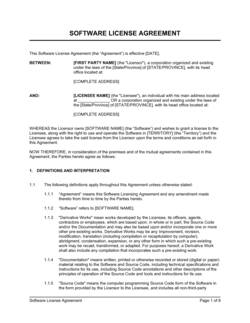
Granting rights to use a software product under defined conditionsSoftware License Agreement
Licensing a trademark for use on physical productsTrademark License Agreement
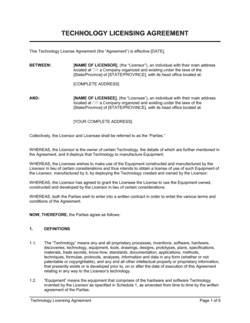
Allowing a third party to use proprietary technology or a patentTechnology License Agreement
Short, simple license with minimal negotiation expectedLicense Agreement Short Form
Granting rights to reproduce or distribute creative or media contentContent License Agreement
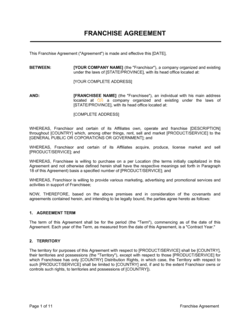
Franchising a business model including brand and operating systemFranchise Agreement
Licensing music, video, or artwork for commercial useIntellectual Property License Agreement

Common mistakes to avoid

❌ Vague description of licensed property

Why it matters: Without a precise definition, the licensee may claim the license covers related IP the licensor never intended to include, leading to infringement disputes.

Fix: Reference specific registration numbers, version numbers, or attach a detailed Exhibit A listing every asset covered by the grant.

❌ Omitting the territory field

Why it matters: A missing territory clause defaults to a worldwide license in most jurisdictions, stripping the licensor of the ability to grant the same IP to others in different markets.

Fix: Always state the geographic scope explicitly β€” even if the intent is worldwide, write 'worldwide' to confirm it was deliberate.

❌ Leaving sublicensing rights undefined

Why it matters: If the agreement is silent on sublicensing, some jurisdictions allow it by default, enabling the licensee to extend rights to undisclosed third parties.

Fix: Include a clear sublicensing clause β€” either prohibiting it outright or requiring written consent β€” so the licensor retains control over who accesses the IP.

❌ No definition of 'Net Sales' for royalty calculation

Why it matters: Without a defined base, licensees apply generous deductions for returns, discounts, and freight, reducing the royalty-bearing amount by 20–40%.

Fix: Define 'Net Sales' in the definitions section with a specific, exhaustive list of permitted deductions and a percentage cap on each category.

❌ Auto-renewal with only a 30-day notice window

Why it matters: A short notice window causes both parties to miss the deadline and remain locked into terms they planned to renegotiate or terminate.

Fix: Set the non-renewal notice period at 60–90 days and calendar the deadline at least two weeks before it falls due.

❌ No cure period for breach-based termination

Why it matters: Immediate termination for any breach β€” including minor administrative lapses β€” creates disproportionate consequences and may be unenforceable in some jurisdictions.

Fix: Include a 30-day written notice and cure period for material breaches, with immediate termination reserved for insolvency, fraud, or IP ownership challenges.

The 10 key fields, explained

Parties and Recitals

Definition of Licensed Property

Grant of License and Scope

Territory

Royalties and Payment Terms

IP Ownership and No-Contest

Sublicensing and Assignment

Term and Renewal

Termination and Effect of Termination

Governing Law and Dispute Resolution

How to fill it out

  1. 1

    Enter both parties' legal entity names and addresses

    Use the full registered name of each party β€” not a trade name or abbreviation. Include the entity type (LLC, Inc., Ltd.) and the principal business address for each.

    πŸ’‘ Check each party's corporate registry filing to confirm the exact legal name before completing this field.

  2. 2

    Define the licensed property precisely

    Describe the IP being licensed with enough specificity that a third party could identify it without further information. Reference patent numbers, trademark registrations, software version numbers, or attach Exhibit A with a detailed description.

    πŸ’‘ Attach a separate exhibit for complex IP portfolios rather than cramming all detail into the body β€” it keeps the main form readable and easier to amend.

  3. 3

    Choose exclusivity and permitted use

    Decide whether the license is exclusive or non-exclusive, and specify the field of use. Exclusive licenses command higher royalties and restrict the licensor from granting competing rights in the same territory.

    πŸ’‘ If exclusivity is limited to a specific field or channel (e.g., retail only), state it explicitly β€” silence creates disputes over adjacent use cases.

  4. 4

    Set the territory

    Enter the geographic scope β€” a single country, a list of countries, a region, or worldwide. If the licensor retains rights in certain markets, list those exclusions explicitly.

    πŸ’‘ For digital products, consider whether 'worldwide' is truly intended β€” some jurisdictions have mandatory IP provisions that affect enforceability.

  5. 5

    Complete the royalty and payment section

    Enter the royalty rate or flat fee, define the calculation base (Net Sales, Gross Revenue, or per-unit fee), set the payment frequency, and specify the reporting format the licensee must use.

    πŸ’‘ Define 'Net Sales' with a specific list of permitted deductions and a cap (e.g., returns not to exceed 5% of gross) to prevent royalty base erosion.

  6. 6

    Set the term, renewal, and termination fields

    Enter the initial term length, the auto-renewal interval if applicable, the notice period required to prevent auto-renewal, and the cure period for breach-based termination.

    πŸ’‘ Set the non-renewal notice window at 60–90 days β€” 30 days is too short for either party to evaluate and act on renewal decisions.

  7. 7

    Select governing law and dispute resolution

    Choose the jurisdiction whose law applies and the dispute resolution mechanism β€” arbitration is generally faster and more private than court litigation for IP disputes.

    πŸ’‘ If both parties are in different countries, a neutral arbitration seat (e.g., New York or London) often avoids jurisdictional disputes.

  8. 8

    Attach exhibits and review before sharing

    Complete any exhibits (IP description, royalty report format, approved sublicensees) before sending the form to the other party. Review all cross-references between the body and exhibits for consistency.

    πŸ’‘ A single inconsistency between the body and an exhibit β€” different royalty rates, for example β€” creates an ambiguity that typically resolves in the other party's favor.

Frequently asked questions

What is a license agreement?

A license agreement is a contract in which the owner of intellectual property (the licensor) grants another party (the licensee) specific rights to use, reproduce, distribute, or sublicense that IP under defined conditions. It does not transfer ownership β€” the licensor retains title to the IP throughout. The agreement sets the scope, territory, duration, royalties, and restrictions on use.

What is the difference between an exclusive and a non-exclusive license?

An exclusive license means only the named licensee may use the IP in the specified territory or field β€” even the licensor is excluded from that use. A non-exclusive license allows the licensor to grant the same rights to multiple parties simultaneously. Exclusive licenses typically command higher royalties because they restrict the licensor's ability to generate competing revenue from the same IP.

When do I need a long-form license agreement rather than a short form?

Use the long form when the deal involves complex royalty structures, multiple IP assets, sublicensing rights, field-of-use restrictions, or significant commercial value on either side. A short-form agreement suits simple, low-risk grants with straightforward flat fees. If there is any ambiguity about scope, territory, or payment, the long form's additional clauses provide protection for both parties.

Does a license agreement need to be signed to be enforceable?

In most jurisdictions, a written license agreement is enforceable when signed by both parties. Some license types β€” particularly for software β€” are also enforced through click-wrap or shrink-wrap acceptance, but for commercial B2B licensing, a countersigned written agreement is the standard. Courts in several countries require written form for exclusive IP licenses to be valid.

What royalty rate is standard in a license agreement?

Royalty rates vary significantly by industry and IP type. Software licenses often use flat fees or per-seat pricing. Patent licenses in technology commonly run 2–5% of Net Sales. Consumer product trademark licenses typically fall between 5–15% of Net Sales. Content and music licenses vary widely. The appropriate rate depends on the IP's commercial value, exclusivity, and field of use β€” comparable deal databases can provide benchmarks for a specific industry.

Can a licensee sublicense the IP to a third party?

Only if the license agreement explicitly permits it. Without a sublicensing clause, some jurisdictions allow sublicensing by default while others prohibit it. To retain control, licensors should include a clause that either prohibits sublicensing outright or requires prior written consent for each sublicense, along with approval rights over the sublicensee's identity and terms.

What happens to the license if the licensor sells the underlying IP?

Typically, a license agreement binds successor owners β€” the buyer of the IP takes it subject to existing licenses. However, this depends on jurisdiction and whether the license was recorded with the relevant IP registry. Licensees should include a clause confirming the agreement survives a change of ownership and binds any successor or assign of the licensor.

How do I calculate royalties owed under a license agreement?

Royalties are calculated by multiplying the agreed rate by the royalty base defined in the agreement β€” typically Net Sales or gross revenue for a specified period. For example, a 5% royalty on $200,000 in Net Sales for the quarter equals $10,000 due within 30 days of quarter-end. The licensee submits a sales report with each payment so the licensor can verify the calculation.

What is a field-of-use restriction in a license agreement?

A field-of-use restriction limits the licensee's rights to a specific application, industry, or distribution channel β€” for example, consumer retail only, not industrial. This allows the licensor to grant separate licenses in other fields to different parties, maximizing the value of the IP portfolio. Violating a field-of-use restriction is typically treated as a material breach.

How this compares to alternatives

vs License Agreement Short Form

The short form covers the basic grant, term, royalty, and termination in a condensed format suited to low-risk or simple arrangements. The long form adds detailed fields for sublicensing, field-of-use, IP ownership, no-contest, and reporting β€” necessary when commercial stakes or IP complexity are significant.

vs Software License Agreement

A software license agreement is purpose-built for software products β€” it covers usage restrictions, seat counts, source-code handling, and SaaS-specific terms like uptime and data handling. The long-form license agreement is broader and applies to any IP type, including patents, trademarks, and content.

vs Technology Licensing Agreement

A technology licensing agreement focuses on proprietary processes, know-how, or patents in a technical field, often with R&D collaboration and improvement-sharing clauses. The long-form license agreement is a general-purpose document adaptable to any IP category, without technology-specific provisions.

vs Franchise Agreement

A franchise agreement bundles a license with an entire operating system β€” brand standards, training, territory, and ongoing support obligations. A license agreement grants IP rights only, without the operational framework. Use the franchise agreement when the licensor is also providing a business model and support infrastructure.

Industry-specific considerations

Software and Technology

Version-specific grants, seat-based or usage-based royalties, source-code escrow references, and update and support obligations.

Manufacturing and Consumer Products

Trademark and patent licenses tied to product SKUs, minimum royalty guarantees, quality control approval rights, and territory exclusivity by distribution channel.

Media and Entertainment

Content reproduction rights, platform-specific grants (streaming, broadcast, print), synchronization licenses for music, and term limits tied to distribution windows.

Professional Services and Consulting

Methodology and framework licenses for consulting firms, per-engagement or annual flat-fee royalties, and confidentiality obligations covering proprietary tools.

Template vs pro β€” what fits your needs?

PathBest forCostTime
Use the templateStraightforward IP licensing deals with defined scope, territory, and royalty structureFree15–30 minutes
Template + professional reviewExclusive licenses, deals with royalties above $50,000 per year, or sublicensing rights$300–$800 for an IP attorney review1–3 days
Custom draftedComplex patent portfolios, cross-border licensing with multiple IP registrations, or high-value commercial deals$2,000–$8,000+1–4 weeks

Glossary

Licensor
The party that owns the intellectual property and grants rights to use it under the agreement.
Licensee
The party receiving permission to use the licensed IP under the terms set out in the agreement.
Grant of License
The specific clause conferring rights β€” defining what the licensee may do with the IP and on what conditions.
Exclusive License
A grant where only the named licensee may use the IP in a specified territory or field, excluding even the licensor.
Non-Exclusive License
A grant where the licensor may simultaneously license the same IP to multiple parties.
Royalty
A periodic payment made by the licensee to the licensor, typically calculated as a percentage of revenue or a flat fee per unit sold.
Territory
The geographic area within which the licensee is permitted to exercise the licensed rights.
Sublicense
A secondary license granted by the licensee to a third party, permitted only if the main agreement explicitly allows it.
Field of Use
A restriction limiting the licensee's rights to a specific application, industry, or purpose β€” for example, consumer products only.
Term
The duration of the license β€” the period during which the licensee's rights are active, after which they expire or must be renewed.
Termination for Cause
The licensor's right to end the agreement immediately upon a specific breach, such as non-payment of royalties or unauthorized sublicensing.

Part of your Business Operating System

This document is one of 3,000+ business & legal templates included in Business in a Box.

  • Fill-in-the-blanks β€” ready in minutes
  • 100% customizable Word document
  • Compatible with all office suites
  • Export to PDF and share electronically

Create your document in 3 simple steps.

From template to signed document β€” all inside one Business Operating System.
1
Download or open template

Access over 3,000+ business and legal templates for any business task, project or initiative.

2
Edit and fill in the blanks with AI

Customize your ready-made business document template and save it in the cloud.

3
Save, Share, Send, Sign

Share your files and folders with your team. Create a space of seamless collaboration.

Save time, save money, and create top-quality documents.

β˜…β˜…β˜…β˜…β˜…

"Fantastic value! I'm not sure how I'd do without it. It's worth its weight in gold and paid back for itself many times."

Managing Director Β· Mall Farm
Robert Whalley
Managing Director, Mall Farm Proprietary Limited
β˜…β˜…β˜…β˜…β˜…

"I have been using Business in a Box for years. It has been the most useful source of templates I have encountered. I recommend it to anyone."

Business Owner Β· 4+ years
Dr Michael John Freestone
Business Owner
β˜…β˜…β˜…β˜…β˜…

"It has been a life saver so many times I have lost count. Business in a Box has saved me so much time and as you know, time is money."

Owner Β· Upstate Web
David G. Moore Jr.
Owner, Upstate Web

Run your business with a system β€” not scattered tools

Stop downloading documents. Start operating with clarity. Business in a Box gives you the Business Operating System used by over 250,000 companies worldwide to structure, run, and grow their business.

Start freeΒ Β·Β No credit card required