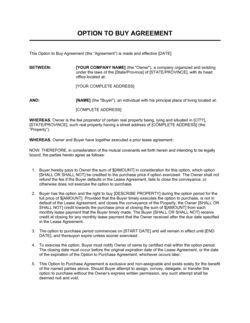
Option to Buy Agreement Template

Free Word download • Edit online • Save & share with Drive • Export to PDF

1 page20–30 min to fillDifficulty: StandardSignature requiredLegal review recommended
Learn more ↓
FreeOption to Buy Agreement Template

At a glance

What it is
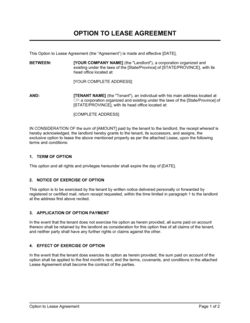
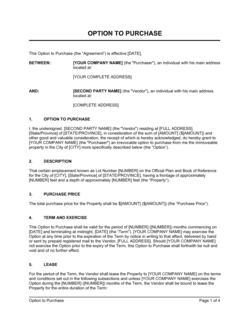
An Option To Buy Agreement is a legally binding contract that grants one party the exclusive right — but not the obligation — to purchase a specific asset at a predetermined price within a defined period. This free Word download covers option consideration, exercise price, exercise period, and the terms that govern the eventual purchase, and can be exported as PDF and executed immediately.
When you need it
Use it when a buyer needs time to arrange financing, conduct due diligence, or obtain approvals before committing to a purchase, while the seller agrees to hold the asset off the market for a fee. Common triggers include real estate acquisitions, business buyouts, and equipment or intellectual property purchases.
What's inside
Option consideration and grant, exercise price and payment terms, exercise period and procedure, representations and warranties, conditions to closing, default and termination provisions, confidentiality, and governing law.

What is an Option To Buy Agreement?

An Option To Buy Agreement is a legally binding contract that grants one party — the buyer, or optionee — the exclusive right, but not the obligation, to purchase a specific asset from the seller, or optionor, at a fixed price within a defined period. In exchange for this right, the buyer pays the seller a negotiated option fee, which is typically non-refundable but credited toward the purchase price if the option is exercised. The seller is bound to honor the sale on the agreed terms during the option period; the buyer retains the freedom to walk away, losing only the option consideration. Option to buy agreements are used across real estate, mergers and acquisitions, equipment purchases, and intellectual property transactions wherever one party needs time to arrange financing, conduct due diligence, or obtain regulatory approval before committing to a full purchase.

Why You Need This Document

Without a written option agreement, a seller faces no obligation to hold an asset off the market while you conduct due diligence or arrange financing — they can accept a competing offer at any moment, leaving you with no recourse and no compensation for the time and money you invested. Equally, without a fixed exercise price in writing, any verbal understanding about the purchase price is unenforceable in virtually every jurisdiction, meaning the seller can raise the price the moment the asset becomes more valuable. A properly drafted option agreement locks in the price, holds the asset exclusively for you during the exercise period, and gives you a court-enforceable right to complete the purchase by specific performance if the seller refuses. For real property, recording the option against the title protects you against a subsequent buyer or lender who might otherwise take priority. This template gives you a legally structured starting point that covers every critical clause — from option consideration and exercise notice mechanics to seller conduct restrictions and default remedies — so you can move quickly without the risk of a handshake deal collapsing at the worst possible moment.

Which variant fits your situation?

If your situation is…Use this template
Securing the right to purchase residential or commercial real estateReal Estate Option Agreement
Combining a lease with the right to purchase at lease endLease With Option To Purchase Agreement
Granting an employee or investor the right to buy company sharesStock Option Agreement
Acquiring an entire business rather than a single assetBusiness Purchase Agreement
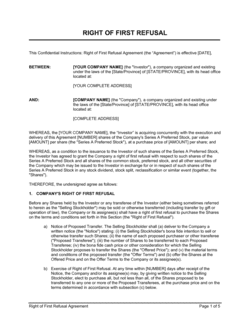
First right to match any third-party offer before the seller acceptsRight of First Refusal Agreement
Purchasing specific business assets rather than the whole entityAsset Purchase Agreement
Documenting the final binding purchase after the option is exercisedPurchase and Sale Agreement

Common mistakes to avoid

❌ Ambiguous option consideration credit language

Why it matters: If the agreement does not clearly state whether the option fee is credited toward the purchase price, both parties will have conflicting expectations at closing — and the dispute will surface at the worst possible moment.

Fix: State explicitly: 'The Option Consideration of [AMOUNT] is non-refundable and shall be credited in full toward the Exercise Price at closing. If the option lapses unexercised, Optionor retains the Option Consideration absolutely.'

❌ Leaving the exercise price open to market adjustment

Why it matters: An exercise price tied to 'fair market value at time of exercise' defeats the purpose of an option and may render it unenforceable as an agreement to agree — courts in most jurisdictions will not enforce it.

Fix: Fix the exercise price as a specific dollar amount at signing. If price protection over time is needed, use a clearly defined CPI adjustment formula rather than a future appraisal.

❌ No restrictions on the seller's conduct during the option period

Why it matters: Without express restrictions, the seller can legally encumber the asset with new mortgages, alter it materially, or enter contracts that will survive the sale — all reducing value before the buyer exercises.

Fix: Include a covenant prohibiting the seller from granting new encumbrances, making material alterations, or entering into contracts affecting the asset without the buyer's written consent during the option period.

❌ Failing to record the option against real property

Why it matters: An unrecorded real estate option is not binding on a subsequent purchaser or mortgagee who takes the property without actual notice of the option — the buyer can lose their right entirely.

Fix: Record a notice of option or a memorandum of option agreement with the county recorder as soon as the agreement is signed to put subsequent parties on constructive notice.

❌ Vague or oral exercise notice procedures

Why it matters: A disputed delivery — for example, an email that the seller claims was never received — can result in a declared lapse of the option and the loss of the entire deal and option consideration paid.

Fix: Specify in writing that the exercise notice must be delivered by registered mail, overnight courier, or email with read-receipt confirmation, and set the effective time as actual receipt rather than sending.

❌ Governing law inconsistent with the asset's location

Why it matters: Courts applying their own jurisdiction's law to a real property option will typically override a contractual choice of law that has no connection to the property's location, creating expensive jurisdictional confusion.

Fix: Always designate the law of the jurisdiction where the asset is located as the governing law for option agreements involving real property or locally-regulated assets.

The 10 key clauses, explained

Parties and Recitals

In plain language: Identifies the seller (optionor) and buyer (optionee) by their full legal names and entity types, and briefly describes the asset and the purpose of the agreement.

Sample language
This Option To Buy Agreement ('Agreement') is entered into as of [DATE] between [SELLER LEGAL NAME], a [STATE] [ENTITY TYPE] ('Optionor'), and [BUYER LEGAL NAME], a [STATE] [ENTITY TYPE] ('Optionee'). Optionor owns the property described in Schedule A ('Property') and desires to grant Optionee an exclusive option to purchase the Property on the terms set out herein.

Common mistake: Using trade names instead of registered legal entity names. A mismatch between the agreement and title records or corporate registries can cloud title and delay or void closing.

Grant of Option and Consideration

In plain language: States that the seller irrevocably grants the buyer the exclusive option to purchase the asset in exchange for a defined option fee, and whether that fee is credited toward the purchase price.

Sample language
In consideration of [OPTION CONSIDERATION AMOUNT] paid by Optionee to Optionor (receipt of which is acknowledged), Optionor hereby grants to Optionee an exclusive, irrevocable option to purchase the Property for the Exercise Price set out in Section 3, on the terms of this Agreement. The Option Consideration is non-refundable but shall be credited toward the Exercise Price upon closing.

Common mistake: Failing to state whether the option consideration is refundable or credited to the purchase price. Ambiguity on this point is one of the most common sources of post-exercise disputes.

Exercise Price and Payment Terms

In plain language: Sets the fixed purchase price the buyer will pay if the option is exercised, the currency, and the payment mechanics at closing — deposit, balance, and method.

Sample language
The exercise price for the Property is [EXERCISE PRICE] ([WRITTEN AMOUNT]) USD ('Exercise Price'), payable as follows: (a) a deposit of [DEPOSIT AMOUNT] within [X] business days of delivery of the Exercise Notice, and (b) the balance of [BALANCE AMOUNT] at closing by wire transfer to Optionor's designated account.

Common mistake: Leaving the exercise price subject to renegotiation or market adjustment. A fixed price is the core commercial benefit of an option — any price-adjustment mechanism undermines the buyer's certainty and may make the option unenforceable as an illusory promise.

Exercise Period and Exercise Notice

In plain language: Defines the window during which the buyer can exercise the option and specifies the exact form, delivery method, and content of the written notice required to trigger the purchase.

Sample language
Optionee may exercise the option at any time during the period commencing on [START DATE] and expiring at 5:00 p.m. [TIMEZONE] on [EXPIRY DATE] ('Exercise Period') by delivering written notice to Optionor at the address in Section 12 ('Exercise Notice'). The Exercise Notice shall specify the proposed closing date, which shall be no fewer than [X] business days after delivery.

Common mistake: Not specifying the exact delivery method (email, registered mail, courier) or time zone for the exercise deadline. An ambiguous delivery mechanism can lead to a disputed lapse if the notice arrives close to the expiry time.

Conditions to Closing

In plain language: Lists the events or approvals that must be satisfied before the buyer is obligated to complete the purchase after exercising the option — financing, due diligence, regulatory approvals, or title clearance.

Sample language
The obligation of Optionee to close is subject to satisfaction of the following conditions by the closing date: (a) Optionee obtaining financing on terms acceptable to Optionee in its sole discretion; (b) title to the Property being free and clear of all encumbrances other than Permitted Encumbrances listed in Schedule B; and (c) [ADDITIONAL CONDITION].

Common mistake: Drafting conditions entirely in the buyer's sole discretion without a good-faith or reasonableness standard. Courts in some jurisdictions will void financing conditions drafted with unlimited subjectivity as illusory, rendering the option unenforceable.

Representations and Warranties

In plain language: Each party makes factual statements about their legal authority to sign and the condition or ownership of the asset. The seller typically warrants clear title, no undisclosed encumbrances, and compliance with applicable laws.

Sample language
Optionor represents and warrants that: (a) Optionor has full legal authority to grant this option and convey the Property; (b) the Property is free from all liens and encumbrances except as disclosed in Schedule B; (c) no litigation, proceeding, or governmental investigation affecting the Property is pending or, to Optionor's knowledge, threatened; and (d) all information provided to Optionee regarding the Property is accurate and complete in all material respects.

Common mistake: Limiting representations to 'to the seller's knowledge' on all items, including those within the seller's direct control such as undisclosed mortgages. Courts have found this overreaches and, where fraud is present, the limitation will not protect the seller.

Seller's Obligations During the Option Period

In plain language: Restricts the seller from selling, encumbering, or materially altering the asset during the option period, and may require the seller to maintain it in its current condition.

Sample language
During the Option Period, Optionor shall not: (a) sell, transfer, assign, or otherwise dispose of the Property or any interest therein; (b) grant any lien, mortgage, or encumbrance on the Property without Optionee's prior written consent; or (c) take any action that would materially diminish the value or condition of the Property.

Common mistake: Omitting restrictions on the seller's conduct during the option period entirely. Without them, the seller can encumber the asset with new debt or alter it materially, reducing its value before the buyer exercises.

Default and Remedies

In plain language: Defines what constitutes a breach by either party, the notice and cure period required before declaring a default, and the remedies available — including forfeiture of the option consideration or specific performance.

Sample language
If Optionor defaults in any material obligation under this Agreement and fails to cure within [X] days after written notice from Optionee, Optionee may, at its election: (a) terminate this Agreement and recover the Option Consideration; or (b) seek specific performance of this Agreement. If Optionee exercises the option and fails to close without cause, Optionor may retain the Option Consideration as liquidated damages and not as a penalty.

Common mistake: Failing to specify whether the option consideration forfeiture is the seller's sole remedy or one of several remedies. Without clarity, sellers may pursue both retention of the fee and additional damages, leading to costly litigation.

Confidentiality

In plain language: Prohibits both parties from disclosing the existence of the agreement, the exercise price, or due diligence materials to third parties — with exceptions for advisors and required regulatory disclosures.

Sample language
Each party agrees to keep the existence of this Agreement and all due diligence materials exchanged hereunder strictly confidential and shall not disclose them to any third party without the other party's prior written consent, except to legal counsel, accountants, and lenders who are bound by equivalent confidentiality obligations or as required by applicable law.

Common mistake: No confidentiality clause at all when the exercise price or deal structure is competitively sensitive. A leaked option price sets a floor for competing offers and can materially increase the cost of the eventual purchase.

Governing Law, Dispute Resolution, and Notices

In plain language: Specifies which jurisdiction's law governs the agreement, how disputes are resolved (court, arbitration, or mediation), and the official addresses and methods for delivering legal notices.

Sample language
This Agreement is governed by the laws of [STATE / PROVINCE / COUNTRY]. Any dispute arising hereunder shall be resolved by binding arbitration administered by [AAA / JAMS / ADRIC] in [CITY], except that either party may seek injunctive or equitable relief in any court of competent jurisdiction. Notices shall be delivered by registered mail or courier to the addresses in Schedule C, effective upon receipt.

Common mistake: Specifying a governing law with no connection to where the asset is located. For real property, courts almost universally apply the law of the jurisdiction where the property sits, regardless of what the contract states.

How to fill it out

  1. 1

    Identify the parties with full legal names

    Enter each party's registered legal name, entity type, state or province of formation, and principal address. For individuals, use the name on government-issued ID.

    💡 Run a quick corporate registry search before signing to confirm the seller's entity is in good standing — a dissolved entity cannot grant a valid option.

  2. 2

    Describe the asset precisely

    Attach a Schedule A with the full legal description of the property (for real estate) or a detailed itemized list (for business assets or IP). Vague descriptions are the most common source of post-exercise disputes.

    💡 For real property, copy the legal description verbatim from the most recent deed on file with the county recorder — do not rely on a marketing listing.

  3. 3

    Set the option consideration amount and credit terms

    Enter the option fee, state that it is non-refundable, and specify whether it is credited toward the exercise price at closing. Confirm the payment method and due date.

    💡 Option consideration between 1–3% of the exercise price is typical for real estate; commercial asset options often use a flat fee. Too low a fee signals low commitment and may weaken enforceability in some jurisdictions.

  4. 4

    Fix the exercise price with no adjustment mechanism

    Enter a specific dollar amount as the exercise price. Avoid language like 'fair market value at time of exercise' — this eliminates the commercial certainty that makes an option valuable.

    💡 If inflation risk over a long option period is a concern, use a fixed price with a clearly defined index-based adjustment formula rather than an open-ended appraisal mechanism.

  5. 5

    Define the exercise period with an exact expiry date and time

    Set a specific calendar date and time (including time zone) for the option to expire. Specify the exact form, content, and delivery method of the exercise notice.

    💡 Option periods of 30–180 days are standard for most transactions. Periods longer than one year raise enforceability concerns in some jurisdictions and should be reviewed by local counsel.

  6. 6

    List the conditions to closing clearly

    Identify every condition the buyer must satisfy after exercising the option — financing, due diligence sign-off, regulatory approvals. Each condition should have a defined deadline and a good-faith or reasonable efforts standard.

    💡 Limit conditions to items genuinely outside the buyer's immediate control. A long list of subjective buyer conditions gives the seller grounds to argue the option is illusory and unenforceable.

  7. 7

    Complete the representations and warranties

    Review each representation carefully with the actual facts of the asset. Cross-check the title report, any existing liens, and any pending litigation before the seller signs.

    💡 Attach a disclosure schedule identifying any exceptions to the representations — undisclosed exceptions discovered post-closing are far more expensive to resolve than ones addressed up front.

  8. 8

    Execute before the option period begins and record if required

    Both parties must sign the agreement before the option period starts. For real estate options, check whether recording the option with the county recorder is required or advisable to put third parties on notice.

    💡 Recording a real estate option prevents the seller from granting a conflicting interest to a third-party purchaser who claims they had no notice of your option.

Frequently asked questions

What is an option to buy agreement?

An option to buy agreement is a contract that grants one party the exclusive right — but not the obligation — to purchase a specific asset at a fixed price within a defined time period. The buyer pays a fee (option consideration) to the seller for this right. If the buyer exercises the option, the seller is legally obligated to sell on the agreed terms; if the buyer does not exercise, the option lapses and the seller retains the fee.

What is the difference between an option to buy and a purchase agreement?

An option to buy agreement gives the buyer the right to purchase but does not obligate them to do so — only the seller is bound during the option period. A purchase agreement obligates both parties to complete the transaction. The option is used when the buyer needs time to arrange financing or conduct due diligence before committing; the purchase agreement is signed when both parties are ready to close.

Is an option to buy agreement legally binding?

Yes, an option to buy agreement is generally enforceable as a binding contract when it is supported by consideration (the option fee), signed by both parties, and meets the formal requirements of the applicable jurisdiction. For real property, most jurisdictions also require the agreement to be in writing to satisfy the Statute of Frauds. A properly drafted and executed option is typically enforceable by specific performance if the seller refuses to complete the sale after the buyer exercises.

Can an option to buy agreement be used for real estate?

Yes, real estate is one of the most common uses for option agreements. Buyers use them to control a property while arranging financing, zoning approvals, or development permits. Sellers receive an option fee for taking the property off the market. For real estate options, it is advisable to record the agreement with the relevant land registry or county recorder to protect the buyer's interest against third parties.

What happens if the option period expires without the buyer exercising?

If the buyer does not deliver a valid exercise notice before the expiry of the option period, the option lapses automatically. The seller retains the option consideration (which is typically non-refundable) and is free to sell the asset to any third party. No further obligation exists between the parties with respect to the purchase, though any surviving provisions such as confidentiality will remain in force.

How much should option consideration be?

Option consideration typically ranges from 1% to 5% of the exercise price for real estate transactions and from a flat fee to 2% of asset value for business or equipment options. The amount is negotiated between the parties — a higher fee signals stronger buyer commitment and generally supports enforceability. In most agreements, the option fee is credited toward the purchase price if the option is exercised, reducing the net cost to the buyer.

Can an option to buy agreement be assigned to a third party?

Whether an option can be assigned depends on the agreement's terms. Most commercial option agreements restrict or prohibit assignment without the seller's written consent. Real estate investors sometimes structure options specifically to allow assignment, enabling them to sell the option right to another buyer before the exercise date. Any assignment provision should clearly state whether the original buyer remains liable after assignment.

What is the difference between an option to buy and a right of first refusal?

An option to buy grants the buyer a unilateral right to purchase at a fixed price regardless of whether the seller wants to sell. A right of first refusal only activates when the seller decides to sell — the holder gets the right to match any third-party offer before the seller accepts it. An option provides stronger price and timing certainty; a right of first refusal is less restrictive on the seller and is typically easier to negotiate.

Does an option to buy agreement need to be notarized?

Notarization is generally not required for an option to buy agreement to be enforceable as a contract in most US states, Canadian provinces, or UK jurisdictions. However, if the option is to be recorded against real property — which is advisable to protect the buyer's interest against third parties — notarization of the signatures may be required by the recording office. Check local recording requirements before execution.

How this compares to alternatives

vs Purchase and Sale Agreement

A purchase and sale agreement obligates both parties to complete the transaction on agreed terms — neither party can walk away without breaching. An option to buy binds only the seller during the option period; the buyer retains the right to walk away and forfeit only the option consideration. Use an option when the buyer needs time to arrange financing or conduct due diligence before committing.

vs Lease With Option To Purchase Agreement

A lease with option to purchase combines a rental arrangement with a future purchase right — the buyer occupies the property as a tenant while holding the option. A standalone option to buy does not include any tenancy or occupancy rights and is used purely as a purchase-control mechanism. Use the lease-option structure when the buyer wants to use the asset during the option period.

vs Right of First Refusal Agreement

A right of first refusal only grants the holder a right to match a third-party offer if and when the seller decides to sell — the seller retains full control over timing and price. An option to buy grants the holder a unilateral right to purchase at a fixed price regardless of whether the seller wants to sell. Options provide stronger commercial certainty; rights of first refusal are less burdensome on the seller and easier to negotiate.

vs Asset Purchase Agreement

An asset purchase agreement documents the completed acquisition of specific business assets and is executed at or near closing. An option to buy agreement is executed before the decision to purchase is final, reserving the right to complete the acquisition later. The option to buy often leads to an asset purchase agreement once the buyer exercises — both documents are typically needed for a complete asset acquisition.

Industry-specific considerations

Real Estate

Options are used to control development sites, commercial acquisitions, and lease-to-own arrangements while financing or planning approvals are secured — recording is critical to protect the buyer's interest.

Mergers and Acquisitions

M&A advisors use options to hold a target business or its assets off the market during due diligence, with the exercise price fixed before the diligence process reveals value-inflating information.

Technology and SaaS

Options are used to acquire patent portfolios, software licenses, or competing products at a fixed price — particularly where the asset's future value is uncertain and the buyer needs time to evaluate integration fit.

Manufacturing and Equipment

Manufacturers use options to lock in equipment or facility purchases at current prices during capital-approval processes, protecting against price increases while board or lender sign-off is obtained.

Retail and Franchising

Franchisors and franchisees use options to secure retail locations or territory rights before lease terms are finalized, and to grant existing franchisees the first right to expand into adjacent territories.

Agriculture and Natural Resources

Options on farmland, mineral rights, or timber permits allow buyers to evaluate resource potential or secure regulatory permits before committing to a full purchase — option periods of 12–36 months are common.

Jurisdictional notes

United States

Options involving real property must satisfy the Statute of Frauds — a written, signed agreement is required in all 50 states. Recording a memorandum of option with the county recorder is strongly advisable to protect against intervening purchasers or lenders. Non-compete and option period enforceability standards vary by state; California courts apply heightened scrutiny to options with exercise periods exceeding one year. The FTC's rules on option contracts in consumer contexts may also apply depending on the asset type.

Canada

Real property options must be in writing under provincial Statute of Frauds equivalents in all common-law provinces. In Ontario, an option to purchase land is registrable on title under the Land Registration Reform Act, and registration is standard practice to protect the buyer's priority. In Quebec, option agreements are governed by the Civil Code of Quebec and differ structurally from common-law options — a notarized promise to sell (promesse de vente) is the equivalent instrument. Option consideration treatment for tax purposes should be confirmed with a Canadian tax advisor.

United Kingdom

Options over land in England and Wales must comply with the Law of Property (Miscellaneous Provisions) Act 1989, which requires a written contract signed by both parties. Options should be registered as an estate contract at HM Land Registry to bind successors in title — failure to register can result in the option being void against a third-party buyer. SDLT (Stamp Duty Land Tax) may be triggered at the point the option is granted, not just at exercise, so UK tax advice should be obtained before signing. Scottish property law differs materially and requires separate Scottish solicitor review.

European Union

Option agreement formality requirements vary significantly by member state — France, Germany, Spain, and Italy each have distinct rules governing promesses de vente, Optionsverträge, and comparable instruments, including varying notarization and registration requirements for real property. GDPR applies to any personal data exchanged during due diligence. Cross-border EU options involving real property should always be reviewed by local counsel in the jurisdiction where the asset is situated, as EU member states retain sovereignty over real property law.

Template vs lawyer — what fits your deal?

PathBest forCostTime
Use the templateStraightforward single-asset options between known parties where the exercise price is under $250,000 and both parties understand the basic termsFree30–60 minutes
Template + legal reviewReal estate options, business asset options over $100,000, or options involving conditions precedent such as financing or regulatory approval$400–$1,0002–5 days
Custom draftedComplex multi-asset acquisitions, options with equity or IP components, cross-border transactions, or exercise prices above $500,000$2,000–$8,000+1–3 weeks

Glossary

Option Consideration
The fee the buyer pays the seller to obtain the option right — typically non-refundable and often credited toward the purchase price if the option is exercised.
Exercise Price
The agreed purchase price at which the buyer may acquire the asset if the option is exercised, fixed at the time the option is granted.
Exercise Period
The window of time during which the buyer may exercise the option — after this period expires unexercised, the option lapses and the seller is free to sell elsewhere.
Exercise Notice
The formal written notice the buyer must deliver to the seller to trigger the purchase obligation, typically specifying a closing date.
Option Lapse
Automatic termination of the option right when the buyer fails to exercise within the exercise period or breaches a condition of the agreement.
Conditions Precedent
Specific events or approvals that must occur before the buyer is obligated to complete the purchase, such as financing approval or zoning clearance.
Representations and Warranties
Factual statements made by each party about the asset and their authority to contract, which survive closing and can form the basis of a damages claim if false.
Specific Performance
A court-ordered remedy requiring a party to fulfill their contractual obligations — particularly relevant when money damages are inadequate to compensate for a unique asset.
Right of First Refusal
A separate but related right that requires the seller to offer the asset to the holder before selling to a third party — distinct from an option, which grants a unilateral right to buy.
Option Assignment
The transfer of the buyer's option right to a third party — typically restricted or prohibited without the seller's written consent.
Earnest Money
A deposit paid at the time the option is exercised as evidence of good faith, typically applied toward the purchase price at closing.

Part of your Business Operating System

This document is one of 3,000+ business & legal templates included in Business in a Box.

  • Fill-in-the-blanks — ready in minutes
  • 100% customizable Word document
  • Compatible with all office suites
  • Export to PDF and share electronically

Create your document in 3 simple steps.

From template to signed document — all inside one Business Operating System.
1
Download or open template

Access over 3,000+ business and legal templates for any business task, project or initiative.

2
Edit and fill in the blanks with AI

Customize your ready-made business document template and save it in the cloud.

3
Save, Share, Send, Sign

Share your files and folders with your team. Create a space of seamless collaboration.

Save time, save money, and create top-quality documents.

★★★★★

"Fantastic value! I'm not sure how I'd do without it. It's worth its weight in gold and paid back for itself many times."

Managing Director · Mall Farm
Robert Whalley
Managing Director, Mall Farm Proprietary Limited
★★★★★

"I have been using Business in a Box for years. It has been the most useful source of templates I have encountered. I recommend it to anyone."

Business Owner · 4+ years
Dr Michael John Freestone
Business Owner
★★★★★

"It has been a life saver so many times I have lost count. Business in a Box has saved me so much time and as you know, time is money."

Owner · Upstate Web
David G. Moore Jr.
Owner, Upstate Web

Run your business with a system — not scattered tools

Stop downloading documents. Start operating with clarity. Business in a Box gives you the Business Operating System used by over 250,000 companies worldwide to structure, run, and grow their business.

Start free · No credit card required